
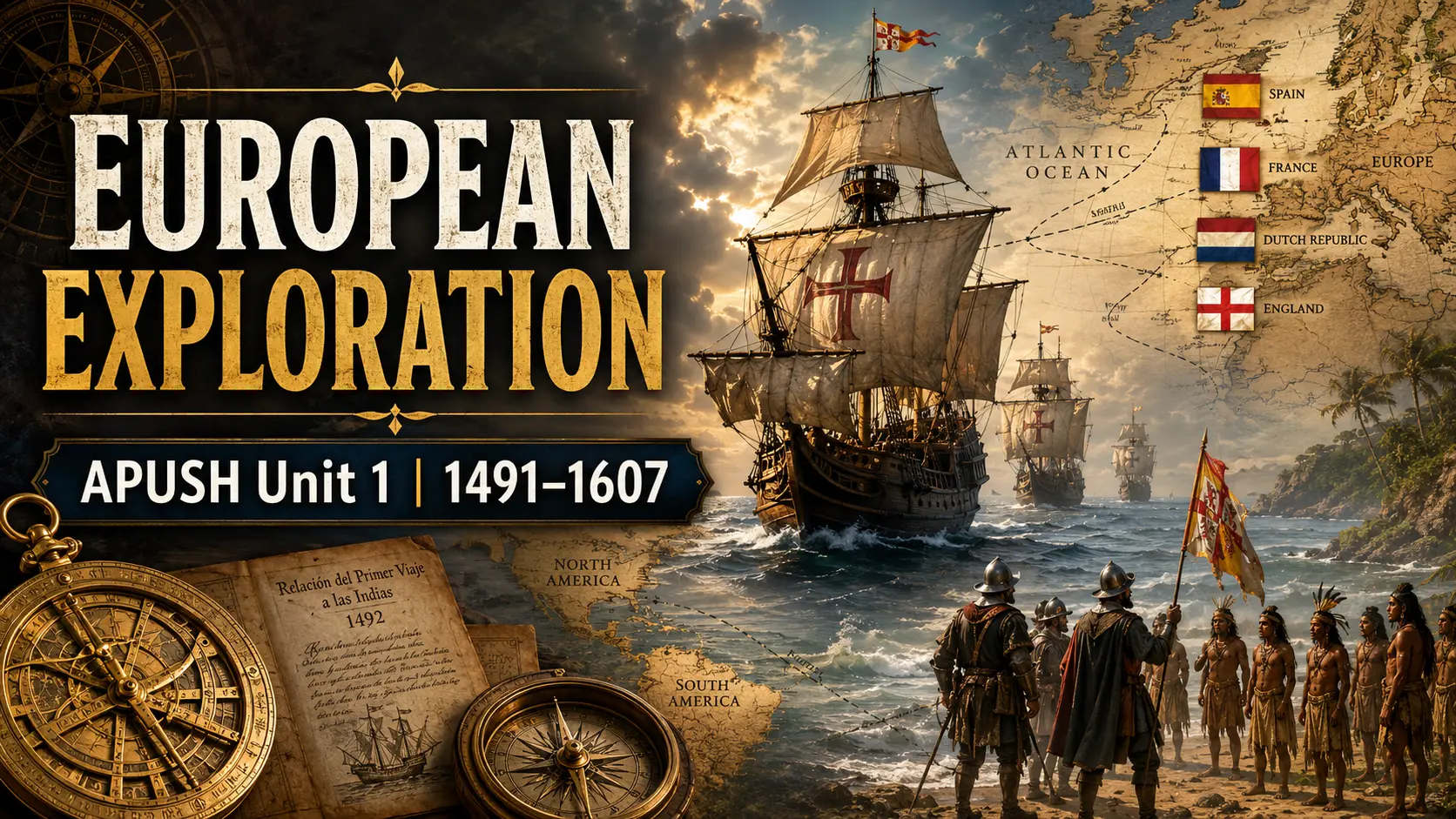
1.3 European Exploration in the Americas (1491-1607) | Unit 1: Period 1 - 1491-1607 | APUSH
European exploration in the Americas was driven by a mix of economic ambition, imperial rivalry and religious goals. For APUSH Topic 1.3, the key is causation: explain why European states crossed the Atlantic and how those motives shaped early contact with the Americas.
APUSH thesis in one sentence: European exploration of the Americas was caused by the search for wealth and trade routes, competition among European states and empires, the desire to spread Christianity and the growing ability of Europeans to sail and claim territory across the Atlantic.
Watch the video, then use the cause-and-effect chart below to turn the lesson into APUSH evidence.
What APUSH Topic 1.3 Expects
Topic 1.3 asks students to explain the causes of European exploration and conquest in the Americas. This is a causation topic. You do not need to memorize every voyage, but you should be able to connect European motives to the broader world of the 1400s and 1500s: Atlantic trade, competition among monarchies, Christian missionary goals and the search for new sources of wealth.
The College Board places this topic under the theme America in the World. That theme focuses on diplomatic, economic, cultural and military interactions among peoples and empires. In Topic 1.3, the Americas become part of expanding Atlantic and global systems, but they were not empty spaces. Europeans encountered Native societies with their own economies, diplomacy, conflicts and land-use systems.
A strong APUSH answer should avoid saying that Europeans explored simply because they were "curious." Curiosity existed, but the exam expects structural causes: money, power, religion and competition. These motives shaped Spanish, Portuguese, French and English actions in different ways.
Big Ideas to Remember
1. Wealth Was a Major Cause
European rulers, merchants and investors wanted gold, silver, new trade routes and access to valuable goods. Exploration promised profit and helped connect the Americas to emerging Atlantic trade networks.
2. Rivalry Pushed Expansion
Spain, Portugal, France and England competed for territory, trade routes and military advantage. If one state gained wealth overseas, rivals feared falling behind.
3. Christianity Shaped Conquest
Many European leaders and missionaries justified exploration as a way to spread Christianity. Religious goals often worked alongside economic and imperial motives.
Main Causes of European Exploration
The simplest APUSH frame is sometimes called "gold, glory and God," but that phrase is only useful if you explain it historically. In Topic 1.3, "gold" means wealth and trade, "glory" means imperial and military competition, and "God" means the desire to spread Christianity. These causes overlapped rather than operating separately.
| Cause | What It Meant | APUSH Evidence | How to Explain It |
|---|---|---|---|
| Search for wealth | Europeans sought gold, silver, trade routes, land and commercial advantage. | Spanish search for mineral wealth; Columbus seeking westward access to Asian trade; later extraction of silver and gold. | Economic motives encouraged states and investors to sponsor voyages and claim territory. |
| Imperial competition | European kingdoms competed for land, military power and status. | Spanish-Portuguese rivalry, Treaty of Tordesillas, French and English challenges to Spanish power. | Exploration became a tool of state-building and rivalry among expanding empires. |
| Spread of Christianity | European monarchs and missionaries aimed to convert Indigenous peoples. | Spanish Catholic missions; religious justifications for conquest and colonization. | Religion provided a moral language for expansion, even when economic and military goals were also present. |
| Maritime knowledge and technology | Navigation, ship design and mapping improved long-distance Atlantic travel. | Caravels, compasses, astrolabes, better maps and experience from Atlantic island voyages. | Technology did not cause exploration by itself, but it made European ambitions more practical. |
Spain and Portugal: Early Atlantic Expansion
Spain and Portugal were the first major European powers to build Atlantic empires. Portugal developed maritime routes around Africa and across the Atlantic, while Spain sponsored Christopher Columbus's 1492 voyage westward. Columbus did not reach Asia, but his voyage linked Europe, Africa and the Americas in new ways and encouraged further Spanish claims in the Caribbean and mainland Americas.
Spain's early advantage came from conquest, settlement and extraction. Spanish explorers and conquistadors sought wealth, especially precious metals, while the Spanish crown claimed sovereignty over lands and peoples. Portugal, meanwhile, focused heavily on Atlantic and Indian Ocean trade networks and claimed Brazil after 1500.
The Treaty of Tordesillas in 1494 is useful APUSH evidence because it shows how Spain and Portugal treated Atlantic expansion as a diplomatic and imperial competition. It divided claims between the two Iberian powers, even though Indigenous peoples were not consulted and already occupied the lands being claimed.
France and England: Challenging Spain
France and England entered Atlantic exploration later than Spain and Portugal, but their motives followed the same broad APUSH pattern: wealth, competition and religion. They wanted access to trade, fishing grounds, furs and land, and they did not want Spain to dominate the Americas uncontested.
French activity in North America often centered on fishing, exploration of the St. Lawrence region and the fur trade. French explorers and traders depended heavily on Native alliances, which became important in later APUSH periods. France's pattern of colonization differed from Spain's: fewer settlers, more emphasis on trade networks and diplomatic relationships with Native peoples.
English promoters increasingly argued that colonization would bring wealth, weaken Spain, spread Protestantism and provide new opportunities for trade and settlement. Richard Hakluyt's writings are especially useful evidence because they show how English advocates linked colonization to economic, religious and geopolitical goals before Jamestown.
Native Peoples Were Central Historical Actors
European exploration was not a one-sided story of Europeans "discovering" empty land. The Americas were already home to diverse Native societies. Europeans arrived in places with established trade networks, political systems, religious practices, agricultural economies and territorial claims.
Native peoples responded to Europeans in different ways depending on local circumstances. Some traded, negotiated or formed alliances. Others resisted, adapted or tried to use European rivalries for their own purposes. This matters because APUSH increasingly asks students to understand contact as interaction among historical actors, not just European expansion.
Topic 1.3 focuses on European causes of exploration, but it prepares you for Topic 1.4 and Topic 1.6, where the consequences of contact become central: disease, the Columbian Exchange, conquest, cultural change, conflict and new Atlantic systems of labor and trade.
Key Explorers and Evidence
| Person or Source | European Power | Why It Matters | Use It For |
|---|---|---|---|
| Christopher Columbus | Spain | His 1492 voyage connected Spain to the Caribbean and helped trigger sustained European exploration of the Americas. | Wealth, trade routes, Spanish claims, early contact. |
| Hernan Cortes | Spain | Conquest of the Aztec Empire showed how exploration could lead to conquest and access to wealth. | Spanish conquest, mineral wealth, imperial expansion. |
| Francisco Pizarro | Spain | Conquest of the Inca Empire expanded Spanish power in South America. | Spanish empire, conquest, wealth extraction. |
| Jacques Cartier | France | Explored the St. Lawrence region and helped establish French interest in northern North America. | French exploration, trade, rivalry with Spain. |
| John Cabot | England | His voyage supported later English claims in North America. | English exploration, Atlantic competition. |
| Richard Hakluyt | England | His pro-colonization arguments connected English expansion to trade, religion and anti-Spanish rivalry. | Motives for colonization, evidence for causation. |
Mini Timeline: 1491-1607
| Date | Event | Why It Matters for APUSH |
|---|---|---|
| 1492 | Columbus reaches the Caribbean under Spanish sponsorship. | Marks the beginning of sustained European contact with the Americas. |
| 1494 | Treaty of Tordesillas divides Spanish and Portuguese claims. | Shows imperial rivalry and European assumptions about claiming territory. |
| 1497 | John Cabot sails under English sponsorship. | Supports later English claims and shows competition beyond Spain and Portugal. |
| 1519-1521 | Cortes and allies defeat the Aztec Empire. | Demonstrates the link between exploration, conquest, wealth and empire. |
| 1530s | Cartier explores the St. Lawrence region for France. | Shows French interest in northern North America and trade possibilities. |
| 1580s | English colonization efforts at Roanoke. | Shows English attempts to challenge Spain and establish a foothold before Jamestown. |
| 1607 | Jamestown founded by the Virginia Company. | Marks the transition from exploration toward lasting English colonization in APUSH Period 2. |
Key Terms for APUSH 1.3
Mercantilism
An economic idea that colonies and trade should increase a nation's wealth and power. It becomes especially important in later colonial history, but its roots help explain exploration.
Treaty of Tordesillas
A 1494 agreement between Spain and Portugal dividing claims in the Atlantic world. It is strong evidence for imperial competition.
Conquistadors
Spanish conquerors who pursued wealth, status and territory in the Americas. They are central to Spanish exploration and conquest.
Missionary Work
Religious efforts to convert Indigenous peoples to Christianity. Missionary goals often accompanied conquest and colonization.
Atlantic World
The network of interactions linking Europe, Africa and the Americas through trade, migration, conquest, disease and cultural exchange.
Joint-Stock Company
A business organization in which investors pooled capital and shared risk. It becomes important for English colonization, including the Virginia Company at Jamestown.
How to Write About Topic 1.3 on the AP Exam
Because Topic 1.3 is a causation topic, your answer should show relationships between causes and actions. Do not only list explorers. Explain why states sponsored voyages and why those voyages mattered.
Strong SAQ sentence pattern
One major cause of European exploration was the search for wealth, because Spanish and Portuguese rulers hoped Atlantic voyages would open access to precious metals, land and trade routes that could strengthen their states.
Strong comparison sentence pattern
Spain emphasized conquest and mineral extraction in much of its American empire, while France relied more heavily on trade and Native alliances in northern North America, showing that European powers pursued different strategies within the same Atlantic competition.
Strong LEQ thesis pattern
European exploration in the Americas from 1491 to 1607 was caused primarily by economic ambition and imperial competition, though religious goals and maritime technology also mattered; together these motives pushed Spain, Portugal, France and England to sponsor voyages, claim territory and begin transforming the Atlantic world.
Common Mistakes to Avoid
- Only listing explorers: APUSH wants causation, not a trivia list. Explain motives and consequences.
- Ignoring Native peoples: Europeans entered inhabited lands with existing societies, diplomacy and economies.
- Using "God, gold and glory" without detail: Always translate the phrase into specific historical causes.
- Confusing exploration with later colonization: Topic 1.3 is about causes of exploration; Jamestown in 1607 begins the shift toward Period 2.
- Treating all European powers as identical: Spain, Portugal, France and England had overlapping motives but different strategies.
APUSH Practice Questions
Short-Answer Practice
- Identify one economic cause of European exploration in the Americas.
- Explain one way imperial rivalry encouraged European exploration.
- Explain one difference between Spanish and French approaches to the Americas.
Model SAQ Response
One economic cause of European exploration was the search for new sources of wealth. Spain sponsored voyages and conquest partly because precious metals, land and trade could strengthen the monarchy and give it an advantage over rival European states. This economic motive overlapped with imperial competition, since France and England later sought their own footholds in North America to challenge Spanish power.
LEQ-Style Prompt
Evaluate the relative importance of economic, religious and political causes of European exploration in the Americas during the period 1491-1607.
Planning tip: Use one paragraph for wealth and trade, one for imperial rivalry and one for Christianity. In the conclusion, explain which cause was most important and why.
Fast Review
- Topic 1.3 is about causes of European exploration and conquest.
- The major causes were wealth, imperial competition and the spread of Christianity.
- Maritime technology and navigation made long-distance voyages more practical.
- Spain and Portugal led early Atlantic expansion, while France and England later challenged Iberian dominance.
- Native peoples were not passive background figures; they shaped trade, diplomacy, resistance and adaptation.
- Topic 1.3 sets up Topic 1.4 by explaining why Europeans entered the Americas before the Columbian Exchange and conquest transformed both hemispheres.
FAQ
What were the three biggest motives for European exploration?
The three biggest motives were wealth, imperial competition and Christianity. Students often remember these as "gold, glory and God," but APUSH answers should explain the specific economic, political and religious causes behind that phrase.
Why did Spain explore the Americas?
Spain explored and conquered parts of the Americas to gain wealth, claim territory, compete with other European powers and spread Catholic Christianity.
How did France's approach differ from Spain's?
Spain emphasized conquest, settlement and mineral extraction in much of its American empire. France placed more emphasis on fishing, fur trade and alliances with Native peoples in northern North America.
Why is Richard Hakluyt useful for APUSH 1.3?
Hakluyt is useful because his writing shows English arguments for colonization before Jamestown, including trade, competition with Spain, religion and strategic power.
How does European exploration connect to the Columbian Exchange?
Exploration created sustained contact between Europe, Africa and the Americas. That contact led to the Columbian Exchange: the movement of crops, animals, diseases, people, wealth and ideas across the Atlantic world.


