
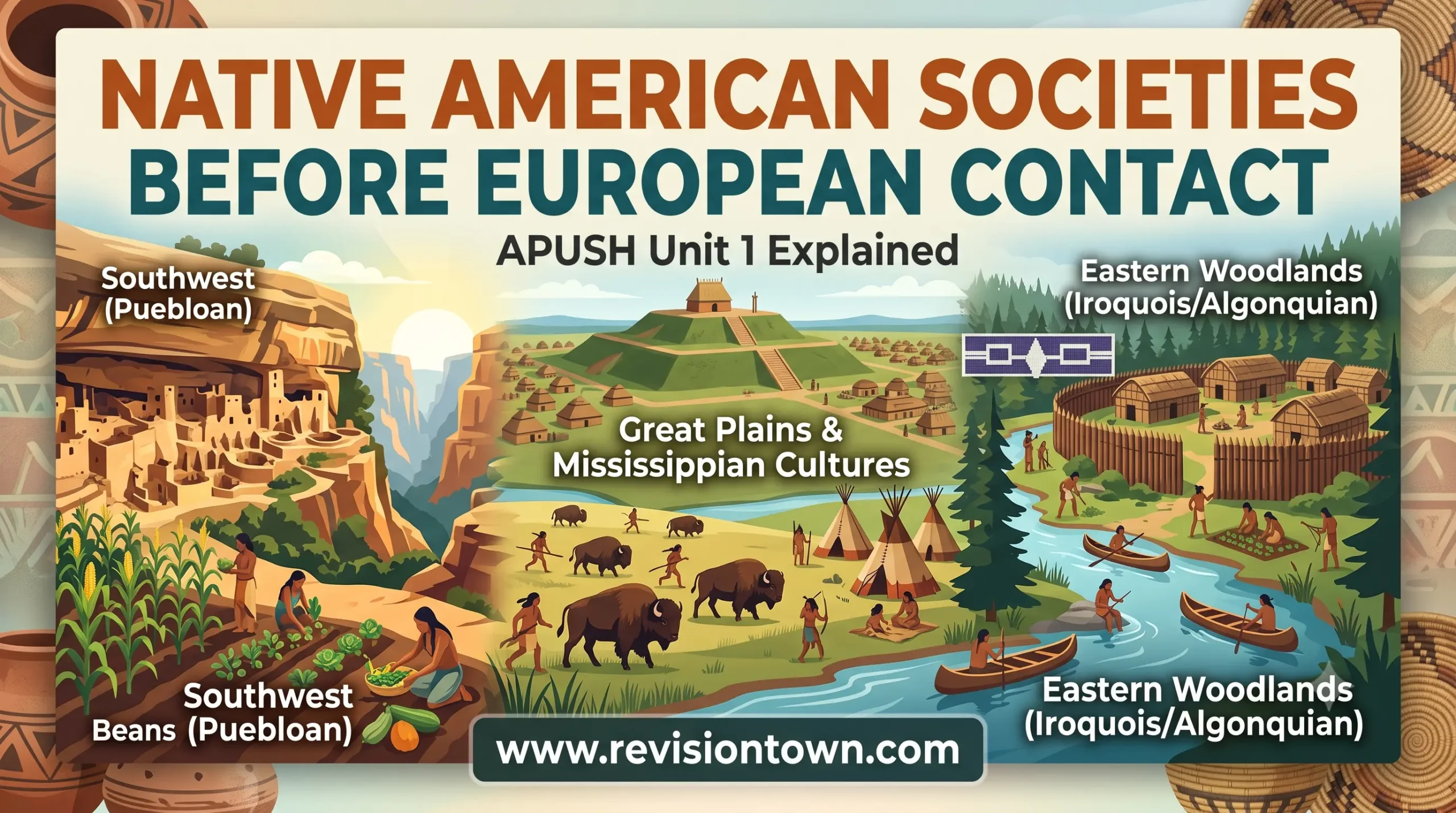
1.2 Native American Societies Before European Contact | Unit 1: Period 1 - 1491-1607 | APUSH
Native North America before European contact was not one single culture or one simple way of life. APUSH Topic 1.2 is about regional diversity: how Native peoples adapted to deserts, plains, forests, rivers and coasts, and how those environments shaped agriculture, mobility, settlement and social organization.
APUSH thesis in one sentence: Before European contact, Native American societies developed diverse economies and settlement patterns because they adapted creatively to different North American environments, from maize-based villages in the Southwest to mobile communities in arid or grassland regions and resource-rich coastal settlements in the Northwest and California.
Watch the video, then use the regional chart below to turn the lesson into specific APUSH evidence.
What APUSH Topic 1.2 Expects
For Topic 1.2, the exam skill is not memorizing every Native nation in North America. The core task is to identify and explain a historical development: Native societies interacted with their environments in different ways before European contact. Strong answers connect geography to historical outcomes, then support the explanation with specific examples.
The College Board places this topic under the theme Geography and the Environment. That means your answer should pay attention to climate, food sources, water, soil, rivers, forests, coastlines and migration routes. A weak answer says, "Native Americans lived off the land." A strong answer explains how particular societies used particular environments to build different forms of economy and community.
The biggest idea is adaptation, not sameness. Some Native peoples lived in permanent or semi-permanent villages. Some practiced intensive agriculture. Some followed seasonal resources. Some relied heavily on fishing, hunting or gathering. These choices were historical responses to local conditions, not signs that one society was more "advanced" than another.
Big Ideas to Remember
1. Environment Shaped Possibilities
Climate and geography affected what people could grow, hunt, gather, store or trade. Desert regions encouraged irrigation and water management. Forest and river regions supported mixed farming and hunting. Coastal regions offered rich marine resources.
2. Maize Changed Settlement
The spread of maize cultivation from present-day Mexico into the Southwest and beyond supported more stable food supplies in some regions. This made larger settlements, irrigation systems and social specialization more possible.
3. Diversity Is the Point
Native North America included hundreds of distinct societies with different languages, political structures, economies and religious traditions. APUSH rewards answers that compare regions instead of treating Indigenous peoples as a single group.
Regional Native Societies Before Contact
The easiest way to master Topic 1.2 is to organize evidence by region. The APUSH framework emphasizes four broad patterns: maize agriculture in the Southwest and beyond, mobile lifeways in the Great Basin and western Plains, mixed economies in the Northeast/Mississippi/Atlantic regions, and hunting-gathering or marine-supported settlements in the Northwest and California.
| Region | Environment | Common Adaptations | APUSH Evidence |
|---|---|---|---|
| Southwest | Arid and semi-arid land, limited rainfall, river valleys and desert landscapes. | Maize agriculture, irrigation, permanent or semi-permanent settlements, storage systems and social organization around farming. | Pueblo peoples, Hohokam irrigation, maize cultivation, adobe or stone village communities. |
| Great Basin and western Great Plains | Dry basins, mountains, grasslands and widely scattered resources. | Mobility, seasonal migration, hunting, gathering and flexible social organization suited to uncertain resources. | Shoshone, Ute, Apache and other mobile societies; pre-contact Plains life before the widespread horse culture of later centuries. |
| Northeast, Mississippi River Valley and Atlantic seaboard | Forests, rivers, fertile soils, coastal resources and seasonal variation. | Mixed agriculture, hunting, fishing and gathering; permanent or semi-permanent villages; regional trade and diplomacy. | Haudenosaunee, Lenape, Algonquian-speaking peoples, "three sisters" agriculture, village life and confederacies. |
| Northwest Coast and California | Pacific coastline, forests, rivers, salmon runs, shellfish, acorns and other abundant resources. | Fishing, hunting, gathering, food storage, trade networks and settled communities supported by rich non-agricultural resources. | Chinook, Tlingit, Unangan/Aleut and many California peoples; ocean and river resources as the base of social complexity. |
Southwest: Maize, Irrigation and Settled Life
The Southwest is the clearest example of how agriculture could transform society before European contact. Maize, first domesticated in present-day Mexico, spread northward over time. In dry environments, maize farming required careful water control, so some communities developed irrigation systems and settled villages near reliable water sources.
For APUSH, the key point is not just "they farmed." The key point is that agriculture supported economic development, settlement and social diversification. When a community can produce and store a more predictable food supply, it can support larger populations, more permanent architecture, specialized labor and more complex forms of religious and political life.
Pueblo communities are useful evidence because they show settled village life in the Southwest. Hohokam irrigation is useful evidence because it directly links environment, technology and agriculture. In an SAQ or LEQ, you could write that aridity did not prevent development; it encouraged water management and farming strategies adapted to local conditions.
Great Basin and Western Plains: Mobility as Adaptation
In the Great Basin and parts of the western Great Plains, rainfall was limited and resources were often spread across wide areas. In those conditions, mobility made sense. Many Native societies followed seasonal food sources, hunted, gathered seeds and roots, and organized communities in flexible ways that fit the environment.
APUSH students sometimes assume that permanent farming villages were automatically more successful than mobile societies. That is a mistake. Mobility was not a lack of development. It was a practical and sophisticated response to aridity, grassland ecology and resource distribution.
Another common mistake is projecting later horse-based Plains cultures backward into the pre-contact period. Horses became central to many Plains societies after Spanish contact, especially in later centuries. For Topic 1.2, be careful to describe pre-contact adaptations without making the horse the center of the story.
Northeast, Mississippi Valley and Atlantic Seaboard: Mixed Economies
In the Northeast, Mississippi River Valley and Atlantic seaboard, many societies combined agriculture with hunting, fishing and gathering. This mixed economy allowed communities to use forests, rivers, fields and seasonal resources. Some villages were permanent; others shifted seasonally while still maintaining strong ties to a homeland.
Maize, beans and squash, often called the "three sisters," supported many agricultural communities. These crops complemented one another and helped sustain larger village populations. But farming did not eliminate hunting, fishing or gathering. The strongest APUSH answer describes a blended system rather than a single food source.
The Haudenosaunee, also known as the Iroquois Confederacy, are useful evidence for political organization and diplomacy, especially in later contact-era topics. For Topic 1.2, they can help show that Native societies had complex governance, kinship and land-use systems before Europeans established colonies.
Northwest Coast and California: Abundance Without Maize
The Northwest Coast and parts of present-day California show why APUSH students should not equate agriculture with complexity. In some coastal and river environments, salmon, shellfish, sea mammals, forests, acorns and other resources were abundant enough to support settled communities without maize farming.
Groups such as the Chinook and Tlingit developed societies connected to fishing, trade, woodworking, ceremonial life and social status. In California, many communities used acorns, game, fish and local plants in highly developed seasonal systems. These societies demonstrate that different environments could support different routes to stability and complexity.
For the exam, this region is especially useful in comparison. If the Southwest shows agriculture plus irrigation, the Northwest Coast shows how ocean and river resources could support settled life through hunting, gathering, fishing and storage.
Key Terms for APUSH 1.2
Maize Cultivation
The growing of corn, which spread from present-day Mexico into North America. It supported settlement, irrigation, food storage and social diversification in some regions.
Irrigation
The movement or control of water for farming. In the Southwest, irrigation is strong evidence that Native societies engineered solutions to arid environments.
Mobile Lifestyles
Seasonal movement used to follow available food and resources. In APUSH, mobility should be explained as adaptation, not as simplicity.
Mixed Economy
A way of life combining agriculture, hunting, fishing and gathering. This was common in parts of the Northeast, Mississippi River Valley and Atlantic seaboard.
Permanent Villages
Settled communities supported by reliable food sources. They appeared in agricultural regions and in some resource-rich coastal environments.
Environmental Adaptation
The process of shaping social, economic and cultural life around local geography, climate and resources. This is the central concept of Topic 1.2.
How to Write About Topic 1.2 on the AP Exam
When you see a prompt about Native American societies before contact, your answer should do three things: name a region, describe the environment and explain the adaptation. Avoid vague language such as "they used resources." Instead, make the relationship explicit.
Strong SAQ sentence pattern
In the Southwest, arid conditions encouraged Native societies such as the Hohokam and Pueblo peoples to use maize agriculture and irrigation, which supported settled communities and more complex social organization.
Strong comparison sentence pattern
While Southwestern societies often relied on maize and irrigation to support village life, many Great Basin societies used mobility and seasonal gathering because resources were more scattered in dry environments.
Strong LEQ thesis pattern
Before European contact, Native American societies in North America developed different economies and settlement patterns largely because local environments shaped available resources; maize agriculture supported settled villages in some regions, while aridity, grasslands and coastal abundance encouraged mobility or marine-based communities elsewhere.
Common Mistakes to Avoid
- Treating Native peoples as one group: APUSH Topic 1.2 is built around diversity, so always specify region and adaptation.
- Calling mobile societies undeveloped: Mobility was a rational response to geography and resource distribution.
- Making the horse central before contact: Horse cultures became especially important after Spanish contact, not before 1492.
- Confusing agriculture with all complexity: Some coastal societies developed settled communities and social complexity without maize farming.
- Listing examples without explanation: Names like Pueblo, Hohokam or Chinook only help if you connect them to environment and adaptation.
Mini Timeline and Context
| Period | Development | Why It Matters for APUSH |
|---|---|---|
| Before 1491 | Native societies developed across North America over thousands of years. | Shows that complex societies existed long before European arrival. |
| By 1491 | Regional economies and settlement patterns were already diverse. | Supports the APUSH focus on environmental adaptation and regional variation. |
| 1492 and after | European contact began to transform Native societies through disease, trade, violence, diplomacy and cultural exchange. | Topic 1.2 provides the baseline for later topics about contact, colonization and the Columbian Exchange. |
| 1607 | English settlement at Jamestown marks the transition toward APUSH Period 2. | Native societies remained central historical actors as European colonies expanded. |
APUSH Practice Questions
Short-Answer Practice
- Identify one way Native societies in the Southwest adapted to the environment before European contact.
- Explain one difference between Native societies in the Southwest and Native societies in the Great Basin or western Great Plains.
- Explain one way coastal resources shaped Native societies in the Northwest or California.
Model SAQ Response
One way Native societies in the Southwest adapted to the environment was by developing irrigation systems to support maize agriculture in an arid region. This allowed communities such as the Hohokam and Pueblo peoples to sustain more settled village life than groups living in areas where resources were more scattered. By contrast, many Great Basin societies relied more heavily on mobility and seasonal gathering because their environment did not support the same type of intensive farming.
LEQ-Style Prompt
Evaluate the extent to which geography shaped Native American societies in North America before European contact.
Planning tip: Use two or three regions as body paragraphs. For example, compare the Southwest, Great Basin/western Plains and Northwest Coast.
Fast Review
- Topic 1.2 is mainly about regional diversity and environmental adaptation.
- Maize agriculture supported settlement, irrigation and social diversification in some regions.
- Mobile lifeways in arid and grassland regions were practical adaptations to scattered resources.
- Mixed agricultural and hunter-gatherer economies developed in parts of the Northeast, Mississippi River Valley and Atlantic seaboard.
- Northwest Coast and California societies show that abundant natural resources could support settled communities without maize agriculture.
- The best APUSH answers name specific regions and explain cause-and-effect relationships between geography and society.
FAQ
What is the main idea of APUSH 1.2?
The main idea is that Native American societies before European contact were diverse and adapted to different environments across North America. Geography shaped food production, settlement patterns, mobility, trade and social organization.
Why does APUSH emphasize maize?
Maize matters because its spread from present-day Mexico into North America helped support agriculture, settled villages, irrigation and social diversification in several regions, especially the Southwest.
Were all Native American societies agricultural?
No. Some societies practiced intensive agriculture, some combined farming with hunting and gathering, and others relied mainly on mobility, fishing, hunting, gathering or coastal resources.
What examples should I memorize for Topic 1.2?
Useful examples include Pueblo peoples, Hohokam irrigation, maize cultivation, Great Basin mobility, Haudenosaunee or Lenape mixed economies, and Chinook or Tlingit coastal resource use.
How does Topic 1.2 connect to later APUSH topics?
Topic 1.2 establishes what Native societies were like before European colonization. Later topics build on this baseline by examining the Columbian Exchange, Spanish conquest, trade, diplomacy, disease, conflict and cultural change.


