Yards to cm Converter
Use this yards to centimeters converter to change yard measurements into centimeters instantly, reverse the calculation from centimeters to yards, and understand the exact formula behind the answer. It is built for students, teachers, designers, sports users, fabric planning, international specifications, construction notes, landscaping estimates, and any practical situation where a customary yard value must be written in metric centimeters.
The conversion is exact: one yard contains 91.44 centimeters. Because the yard is defined through the international inch and the inch is exactly 2.54 centimeters, there is no approximation in the core factor.
To convert yards to centimeters, multiply by 91.44. To convert centimeters to yards, divide by 91.44. The same relationship also gives \(1 \text{ yd} = 0.9144 \text{ m}\).
Yards to cm Calculator
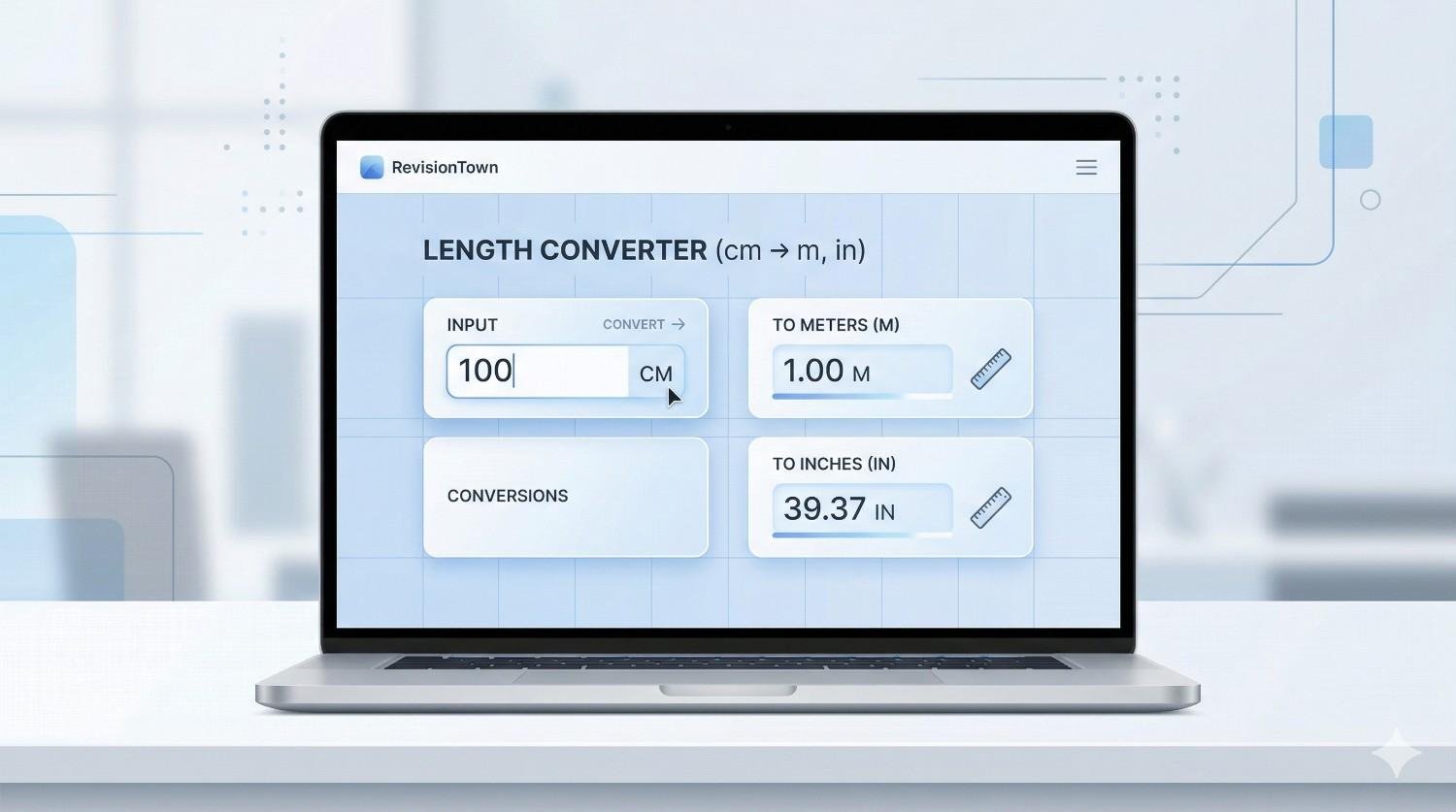
Enter a value, choose the starting unit, and select the output precision. The calculator shows the main answer and related units, including yards, centimeters, meters, millimeters, feet, inches, miles, and kilometers, so you can check the same length from both customary and metric viewpoints.
The yard-to-centimeter factor is exact. Rounding only changes how many digits are displayed in the final answer.
Enter a value above to calculate a custom conversion.
How to Convert Yards to Centimeters
To convert yards to centimeters, multiply the number of yards by 91.44. This is the direct yd to cm formula:
\( \text{centimeters} = \text{yards} \times 91.44 \)If the length is 6 yards, the calculation is:
\( 6 \text{ yd} \times 91.44 = 548.64 \text{ cm} \)So 6 yards equals 548.64 centimeters. The multiplication works because a centimeter is a much smaller unit than a yard, so the centimeter number should be larger than the yard number. A quick sense check is that every yard contributes slightly more than 91 centimeters.
The reverse formula is used when the starting value is in centimeters and the result should be in yards:
\( \text{yards} = \frac{\text{centimeters}}{91.44} \)If the length is 274.32 centimeters, the yard value is:
\( 274.32 \div 91.44 = 3 \text{ yd} \)This page focuses on the yards to cm direction. If your starting value is already in centimeters and your final answer must be yards, the centimeters to yards converter is the matching reverse tool.
Fast rule: multiply yards by 91.44 to get centimeters. Divide centimeters by 91.44 to get yards.
Why 1 Yard Equals 91.44 Centimeters
The yard is a customary length unit. The centimeter is a metric length unit. Their exact relationship comes from the internationally defined inch. One inch is exactly 2.54 centimeters, one foot is 12 inches, and one yard is 3 feet. Combining those relationships gives the yard-to-centimeter factor.
\( 1 \text{ ft} = 12 \text{ in} \) \( 1 \text{ yd} = 3 \text{ ft} = 36 \text{ in} \) \( 36 \text{ in} \times 2.54 \frac{\text{cm}}{\text{in}} = 91.44 \text{ cm} \)That is why 1 yard equals exactly 91.44 centimeters. The decimal does not come from measurement uncertainty; it comes from the way the two systems are related. The metric part is also simple because 100 centimeters make 1 meter:
\( 91.44 \text{ cm} = 0.9144 \text{ m} \)For metric-only work, it is sometimes easier to convert yards to meters first and then move the decimal point to centimeters. For example, 2 yards equals 1.8288 meters. Multiplying meters by 100 gives 182.88 centimeters. The direct formula gives the same result:
\( 2 \times 91.44 = 182.88 \text{ cm} \)If you need the meter form as your final answer, use the yards to meters converter. If you need smaller metric detail, the yards to mm converter can be more appropriate than reporting a very large centimeter number.
Yards to Centimeters Conversion Table
The table below gives common yard values and their exact centimeter equivalents. Use it for quick checks, classroom examples, sports dimensions, fabric estimates, and project notes.
| Yards (yd) | Centimeters (cm) | Meters (m) |
|---|---|---|
| 0.01 yd | 0.9144 cm | 0.009144 m |
| 0.1 yd | 9.144 cm | 0.09144 m |
| 0.25 yd | 22.86 cm | 0.2286 m |
| 0.5 yd | 45.72 cm | 0.4572 m |
| 0.75 yd | 68.58 cm | 0.6858 m |
| 1 yd | 91.44 cm | 0.9144 m |
| 2 yd | 182.88 cm | 1.8288 m |
| 3 yd | 274.32 cm | 2.7432 m |
| 5 yd | 457.2 cm | 4.572 m |
| 10 yd | 914.4 cm | 9.144 m |
| 25 yd | 2286 cm | 22.86 m |
| 50 yd | 4572 cm | 45.72 m |
| 100 yd | 9144 cm | 91.44 m |
Notice how each row is exactly 91.44 times the yard value. If your answer does not match that pattern, check whether you used the feet factor of 3, the inches factor of 36, or the meters factor of 0.9144 by mistake.
Centimeters to Yards Conversion
The reverse conversion is useful when a metric measurement must be expressed in yards. Use:
\( \text{yards} = \text{centimeters} \div 91.44 \)For example, 500 centimeters is:
\( 500 \div 91.44 = 5.468066... \text{ yd} \)So 500 cm is about 5.4681 yards. If you need a physical customary breakdown, convert the decimal yard part into feet and inches. Since 1 yard is 3 feet and 36 inches, the decimal portion can be converted into a more practical measuring form.
When centimeters convert to a repeating or long decimal in yards, do not assume the answer is wrong. The relationship is exact, but many centimeter values do not divide evenly by 91.44. A rounded decimal yard value is normal. For high-precision work, keep more digits during the calculation and round only at the final reporting step.
If you perform this reverse conversion frequently, use the dedicated centimeters to yards converter. Keeping separate pages for each direction helps users who search with a clear starting unit find the direct tool they need.
Worked Yards to cm Examples
Example 1: Convert 1 yard to centimeters
\( 1 \text{ yd} \times 91.44 = 91.44 \text{ cm} \)One yard equals 91.44 centimeters. This is the anchor relationship for the entire page.
Example 2: Convert 2.5 yards to centimeters
\( 2.5 \text{ yd} \times 91.44 = 228.6 \text{ cm} \)So 2.5 yards equals 228.6 centimeters. In meters, the same length is 2.286 meters.
Example 3: Convert 8 yards to centimeters
\( 8 \text{ yd} \times 91.44 = 731.52 \text{ cm} \)Eight yards equals 731.52 centimeters. This might describe a short sport distance, a garden feature, a roll of material, or a classroom measuring example.
Example 4: Convert 0.75 yard to centimeters
\( 0.75 \text{ yd} \times 91.44 = 68.58 \text{ cm} \)Three quarters of a yard equals 68.58 centimeters. In inches, the same length is 27 inches.
Example 5: Convert 12.25 yards to centimeters
\( 12.25 \text{ yd} \times 91.44 = 1120.14 \text{ cm} \)So 12.25 yards equals 1120.14 centimeters. You can check by splitting 12.25 into 12 yards and 0.25 yard. Twelve yards is 1097.28 cm and a quarter yard is 22.86 cm. The total is 1120.14 cm.
Example 6: Convert 100 centimeters to yards
\( 100 \text{ cm} \div 91.44 = 1.093613... \text{ yd} \)One meter, or 100 centimeters, is slightly longer than one yard. This is why a yard-to-meter or yard-to-centimeter conversion is not the same as simply changing the unit name.
Yards, Centimeters, Meters, and Millimeters
Centimeters sit between meters and millimeters in the metric system. That makes them useful for everyday dimensions, fabric sizes, object lengths, classroom measurements, and practical metric reporting. The same yard value can be written in several metric forms:
\( 1 \text{ yd} = 0.9144 \text{ m} \) \( 1 \text{ yd} = 91.44 \text{ cm} \) \( 1 \text{ yd} = 914.4 \text{ mm} \)The unit you choose should match the scale of the task. Centimeters are useful when the length is object-sized or person-sized. Meters are cleaner for larger spaces. Millimeters are better for technical detail, engineering drawings, small parts, or measurements that require fine precision.
For example, 15 yards equals 1371.6 centimeters. That is correct, but 13.716 meters may be easier to read for a room, court, stage, or outdoor layout. If the same value is used on a detailed metric drawing, 13716 millimeters may be the preferred form. The conversion is not only about arithmetic; it is also about communicating the answer in a unit that people can use.
If your starting point is already metric, the meters to cm converter and cm to mm converter can help keep the work inside the metric system. If the starting point is yards, this page gives the direct yd to cm path.
Using Centimeters With Feet and Inches
Many real measurements move through more than one unit system. A note may start in yards, a tape measure may show feet and inches, and a product specification may require centimeters. The safest method is to convert through exact relationships rather than estimating.
One yard equals 3 feet, 36 inches, and 91.44 centimeters. These three facts connect the customary and metric systems:
\( 1 \text{ yd} = 3 \text{ ft} = 36 \text{ in} = 91.44 \text{ cm} \)If a length is 4 yards, the equivalent forms are:
\( 4 \text{ yd} = 12 \text{ ft} = 144 \text{ in} = 365.76 \text{ cm} \)When inches are involved, remember that 1 inch is exactly 2.54 centimeters. Converting yards to inches and then inches to centimeters gives the same result as the direct formula:
\( \text{cm} = \text{yd} \times 36 \times 2.54 \) \( 36 \times 2.54 = 91.44 \)If your final answer needs feet, use the yards to feet converter. If the final answer needs inches, use the yards to inches converter. For direct customary-to-metric conversions that start in a smaller unit, the feet to cm converter and inches to cm converter are useful companions.
Converting Mixed Yards, Feet, and Inches to cm
Mixed customary measurements are common in construction, fabric work, classroom tasks, sports field notes, and DIY projects. A measurement might be written as 3 yd 2 ft, 4 yd 8 in, or 2 yd 1 ft 6 in. Do not treat those as decimals. Three yards 2 feet is not 3.2 yards, and four yards 8 inches is not 4.8 yards.
The safest method is to convert each part into inches or centimeters, then add. For 3 yd 2 ft:
\( 3 \text{ yd} = 3 \times 91.44 = 274.32 \text{ cm} \) \( 2 \text{ ft} = 2 \times 30.48 = 60.96 \text{ cm} \) \( 274.32 + 60.96 = 335.28 \text{ cm} \)So 3 yd 2 ft equals 335.28 centimeters.
For 4 yd 8 in, use the yard and inch factors:
\( 4 \text{ yd} = 365.76 \text{ cm} \) \( 8 \text{ in} = 8 \times 2.54 = 20.32 \text{ cm} \) \( 365.76 + 20.32 = 386.08 \text{ cm} \)For 2 yd 1 ft 6 in, convert all three parts: 2 yards is 182.88 cm, 1 foot is 30.48 cm, and 6 inches is 15.24 cm. The total is 228.6 cm. Notice that this also equals 2.5 yards, because 2 yd 1 ft 6 in is the same as 2.5 yards.
When mixed units appear in a problem, write the conversion line carefully. The calculator can handle single-unit inputs, but mixed-unit interpretation still depends on how the original measurement is written.
Yards to cm for Construction, Layout, and Landscaping
Construction and landscaping often combine customary and metric measurements. A supplier, plan, video, or imported product may describe dimensions in centimeters, while local estimates or field measurements use yards. Converting yards to centimeters helps align those measurements without guessing.
Suppose a garden border is 18 yards long. The centimeter length is:
\( 18 \times 91.44 = 1645.92 \text{ cm} \)For an installation note, you may prefer 16.4592 meters, but centimeters are useful if the related product specifications are written in centimeters. If edging clips are spaced every 30 cm, the baseline interval count is:
\( 1645.92 \div 30 = 54.864 \)That suggests 55 intervals before considering endpoints, corners, waste, overlap, and project-specific placement.
For fencing, rope, hose, cable, irrigation line, and edging, the yard value usually represents a linear run. Convert the run to centimeters when the parts, spacing, fasteners, or product details are metric. If a roll is 12 yards long, it contains \(12 \times 91.44 = 1097.28\) cm. If the installation needs 1050 cm, the roll has 47.28 cm of theoretical extra length before waste.
Do not use this linear conversion for area or volume without changing the rule. A yard-to-centimeter conversion handles one dimension only. Square yards to square centimeters and cubic yards to cubic centimeters require squared and cubed factors. This distinction matters for turf, fabric coverage, concrete, soil, gravel, and mulch.
Yards to cm in Sports and Field Measurements
Sports often use yards, but training equipment, stride measurements, classroom diagrams, and international comparisons may use centimeters. Converting yards to centimeters makes the physical size of a sports distance easier to compare with metric measurements.
A 10-yard distance is:
\( 10 \times 91.44 = 914.4 \text{ cm} \)That is also 9.144 meters. A 5-yard distance is 457.2 cm, and a 15-yard distance is 1371.6 cm. These values are especially useful when field instructions are in yards but agility cones, training spaces, measuring tapes, or equipment labels are metric.
American football field language uses yards. A first-down distance of 10 yards is 914.4 cm. A 5-yard penalty is 457.2 cm. A 100-yard field segment is 9144 cm, though meters are usually easier at that scale. The centimeter value is exact, but it may not always be the most readable final unit.
Golf distances are commonly reported in yards, while product dimensions and training aids may use centimeters. A 150-yard shot equals 13716 cm. That number is correct, but 137.16 meters is more compact. This shows why unit choice should follow the task: centimeters for object-level detail, meters for field-scale distances, and yards for sport-specific communication.
For very long outdoor distances, the yards to km converter or yards to miles converter may give a cleaner final answer. Centimeters are accurate at any scale, but they become visually large for route-length measurements.
Yards to cm for Fabric, Craft, and Product Dimensions
Fabric and craft materials are often sold by the yard, while pattern measurements, international product labels, and craft instructions may use centimeters. One yard of material is 91.44 cm long along the roll. Two yards is 182.88 cm, 3 yards is 274.32 cm, and 5 yards is 457.2 cm.
If a pattern requires 4.5 yards of fabric, the centimeter length is:
\( 4.5 \times 91.44 = 411.48 \text{ cm} \)That is 4.1148 meters. The yard value is useful for purchasing in a store that sells by the yard. The centimeter value is useful when checking pattern pieces, finished length, garment measurements, packaging, or international instructions.
For ribbon, trim, cord, elastic, webbing, and similar materials, the same logic applies. If a spool contains 10 yards, it contains 914.4 cm. If a project needs eight pieces of 110 cm each, the required total is 880 cm. The spool leaves 34.4 cm before waste, knots, joins, or miscuts.
Length along a roll is separate from width. A yard of fabric tells you the length purchased, but the fabric width could be 45 inches, 54 inches, 60 inches, 110 cm, 150 cm, or another value. If you need area, convert both length and width into compatible units before multiplying. A single yard-to-centimeter conversion does not describe the full surface area of the material.
Precision, Rounding, and Significant Figures
The factor 91.44 is exact, so any uncertainty in the converted answer usually comes from the input measurement or the rounding choice, not from the conversion relationship. If a value is exactly 2 yards, the centimeter result is exactly 182.88 cm. If a value is an estimate of about 2 yards, the result should be reported as about 183 cm or about 180 cm, depending on the precision of the original measurement.
Round only after completing the calculation. If you round the conversion factor to 91.4 too early, the result can drift. For 25 yards:
\( 25 \times 91.44 = 2286 \text{ cm} \)Using 91.4 gives 2285 cm. That may be acceptable for a rough estimate, but it is not the exact conversion. The calculator uses the exact factor and lets you decide how many decimal places to display.
For schoolwork, follow the requested decimal places or significant figures. If a question asks for centimeters to the nearest whole number, 3 yards becomes 274 cm because \(3 \times 91.44 = 274.32\). If it asks for one decimal place, the answer is 274.3 cm. If it asks for exact conversion, keep 274.32 cm.
For practical measurement, match the result to the tool. A tape measure marked in centimeters may not support hundredths of a centimeter. A cutting tool or technical drawing may require millimeters. If a result is 68.58 cm, a craft instruction might round to 68.6 cm, while a rough outdoor estimate might say about 69 cm. The arithmetic is fixed, but the displayed precision should serve the task.
Measurement Tolerance in Real Projects
A conversion can be exact while the measurement itself is approximate. This matters whenever a value is measured by hand, stepped off outdoors, taken from a rough plan, rounded in a conversation, or estimated from a map. The expression "about 7 yards" should not become "640.08 cm exactly" in a final report. A better statement is "about 640 cm" or "about 6.4 m."
If the original value is rounded to the nearest yard, the real length may be up to half a yard shorter or longer. Half a yard is 45.72 cm. That means a rounded 10-yard measurement may represent a true value near 914.4 cm, but the uncertainty could be several dozen centimeters. The conversion does not remove that uncertainty.
For fitting, clearance, cutting, and purchasing, build in a tolerance that matches the job. If a product must fit inside a 300 cm space, a calculated length of 299.8 cm may be too close if the measurement has error. If a cable route is calculated as 820 cm, ordering exactly 820 cm may be risky if bends, connectors, slack, and routing changes are involved.
A useful workflow is to keep three numbers: the measured value, the exact converted value, and the practical working value. For example: measured length = 9 yd, exact conversion = 822.96 cm, working order length = 850 cm. This keeps the calculation transparent while allowing real-world margin.
Spreadsheet Workflow for Multiple yd to cm Conversions
If you have many yard measurements, a spreadsheet can make the work faster and easier to audit. Put item names in one column, yard values in the next column, and centimeter results in a calculated column. If the yard value is in cell A2, the centimeter formula is:
\( \text{cm} = A2 \times 91.44 \)In a spreadsheet, that is usually written as A2*91.44. If the centimeter value is in B2 and you need yards, use B2/91.44. Keep the unit in the column heading, not only in the file name. Good headings include "Length (yd)" and "Length (cm)." That makes the sheet readable when copied, exported, or reviewed later.
For mixed values, use separate columns. If a measurement has yards, feet, and inches, do not place the full notation in one numeric cell. Use one column for yards, one for feet, and one for inches, then calculate centimeters with:
\( \text{cm} = (\text{yd} \times 91.44) + (\text{ft} \times 30.48) + (\text{in} \times 2.54) \)This structure prevents the common mistake of treating 3 yd 6 in as 3.6 yards. It also makes the spreadsheet easier to inspect because each unit has its own column.
For larger estimates, add columns for allowance, waste percentage, package size, and order quantity. For example, a required length may be 780 cm, a 5 percent allowance adds 39 cm, and the working total becomes 819 cm. If the product is sold in 100 cm increments, the purchase quantity might become 900 cm. The conversion is one step in a wider decision.
Material Planning With Yards and Centimeters
Material planning often starts in one unit and ends in another. A supplier may sell a roll in yards, while a project plan lists pieces in centimeters. Convert everything into one working unit before deciding whether there is enough material.
Suppose a roll contains 7 yards of material. Convert the roll length to centimeters:
\( 7 \times 91.44 = 640.08 \text{ cm} \)If the project needs five pieces of 120 cm each, the total piece length is:
\( 5 \times 120 = 600 \text{ cm} \)The theoretical remaining length is 40.08 cm. That may look enough, but the real decision depends on hems, trimming, pattern alignment, damaged edges, and cutting error. Converting the yard value to centimeters gives the arithmetic baseline, not the entire project plan.
For rope or cable, a route may need extra length for knots, clips, connectors, slack, or strain relief. A 20-yard cable equals 1828.8 cm. If the straight route is 1750 cm, the difference is 78.8 cm. That may be enough for a simple route and not enough for a complex one. Always separate the exact conversion from the installation allowance.
For landscaping, use centimeters for spacing and meters for larger runs. If plants are spaced every 45 cm along a 12-yard bed, convert 12 yards to 1097.28 cm. Dividing by 45 gives 24.384 intervals. The final count must consider whether plants are placed at both ends, whether the spacing is exact, and whether the bed shape is straight or curved.
Length, Area, and Volume: Do Not Use the Wrong Power
Yards to centimeters is a linear conversion. It applies to one-dimensional length: a distance, edge, run, height, width, depth, roll length, field measurement, or object dimension. Area and volume require different factors because the unit relationship is squared or cubed.
For length:
\( 1 \text{ yd} = 91.44 \text{ cm} \)For area:
\( 1 \text{ yd}^2 = (91.44)^2 \text{ cm}^2 = 8361.2736 \text{ cm}^2 \)For volume:
\( 1 \text{ yd}^3 = (91.44)^3 \text{ cm}^3 = 764554.857984 \text{ cm}^3 \)If a fabric area is given in square yards, do not multiply by 91.44. Multiply by 8361.2736 to get square centimeters. If a soil or concrete volume is given in cubic yards, do not multiply by 91.44 either. Use the cubic factor or convert the dimensions first, then calculate volume.
A good clue is the exponent in the unit. If the unit is yd, use 91.44. If the unit is yd2, use \(91.44^2\). If the unit is yd3, use \(91.44^3\). This simple check prevents a large category error.
Choosing Between cm, m, mm, Feet, and Inches
After converting yards to centimeters, decide whether centimeters are the most useful final unit. Centimeters are excellent for object sizes, product dimensions, craft work, smaller room measurements, classroom answers, and metric specifications where a meter-only answer would hide useful detail. They are less convenient for very long distances because the numbers become large.
Use centimeters when the result will be compared to another centimeter measurement. Use meters when the result describes a whole room, field, garden, court, or outdoor run. Use millimeters when the tolerance is small or the drawing is technical. Use feet and inches when the person doing the physical measuring is using a customary tape measure.
For example, 3 yards is 274.32 cm. In a product chart, 274.32 cm may be useful. In an architecture note, 2.7432 m may read better. In a workshop cutting note, 9 ft or 108 in may be more practical. All are correct, but they support different workflows.
The broader length converter, advanced length converter tool, and length conversion calculator are useful when you need to compare several final units at once. This page is best when the direct search intent is yd to cm.
Common Mistakes to Avoid
Using 100 instead of 91.44
One meter is 100 centimeters, but one yard is not one meter. One yard is 91.44 centimeters. Multiplying yards by 100 gives a rough estimate that is too large by about 9.36 percent.
Using 3 instead of 91.44
The factor 3 converts yards to feet, not centimeters. If 5 yards becomes 15 cm, the unit label is wrong. Five yards is 15 feet or 457.2 centimeters.
Using 36 instead of 91.44
The factor 36 converts yards to inches. To reach centimeters through inches, multiply by 36 and then by 2.54. The combined factor is 91.44.
Treating mixed units as decimals
Three yards 4 inches is not 3.4 yards. Convert each unit separately. Three yards 4 inches is \(3 \times 91.44 + 4 \times 2.54 = 284.48\) cm.
Confusing centimeters with millimeters
One centimeter equals 10 millimeters. One yard equals 91.44 cm and 914.4 mm. If your millimeter answer is not 10 times the centimeter answer, check the decimal place.
Applying a length factor to area or volume
Square yards and cubic yards use different factors. A length factor cannot be used unchanged for coverage or volume.
Manual Conversion Method Without a Calculator
The exact factor 91.44 is not as mentally simple as 3, but you can still estimate and check results by splitting the factor into convenient parts. Since 91.44 is close to 90, a rough estimate is:
\( \text{cm} \approx \text{yd} \times 90 \)This estimate is slightly low. For 8 yards, \(8 \times 90 = 720\) cm, while the exact answer is 731.52 cm. The estimate is close enough to catch a misplaced decimal or wrong conversion direction.
For exact manual work, split 91.44 into 90 + 1.44:
\( 8 \times 91.44 = (8 \times 90) + (8 \times 1.44) = 720 + 11.52 = 731.52 \)For values that include halves and quarters, use known benchmarks. Half a yard is 45.72 cm. A quarter yard is 22.86 cm. Three quarters of a yard is 68.58 cm. One tenth of a yard is 9.144 cm. These benchmarks are useful for fabric, schoolwork, and quick visual checks.
For the reverse direction, remember that 100 cm is a little more than 1 yard. More precisely:
\( 100 \text{ cm} \div 91.44 = 1.093613... \text{ yd} \)This means a meter is longer than a yard by about 8.56 cm. That difference is small for a quick conversation but important for precise work.
Scale Drawings and yd to cm Conversion
Scale drawings can involve two different kinds of conversion: unit conversion and scale conversion. Unit conversion changes the unit used for the same real length. Scale conversion changes the real length into a drawing length or model length. Keep those steps separate.
If a real garden path is 12 yards long, first convert the real length into centimeters:
\( 12 \times 91.44 = 1097.28 \text{ cm} \)If a plan scale says 1 cm on the drawing represents 100 cm in real life, the drawing length is:
\( 1097.28 \div 100 = 10.9728 \text{ drawing cm} \)The yard-to-centimeter calculation gives the real metric length. The scale ratio then converts real length into drawing length. Do not confuse real centimeters with drawing centimeters.
For model building, suppose a real object is 2 yards long. Its real length is 182.88 cm. At a 1:24 scale, the model length is:
\( 182.88 \div 24 = 7.62 \text{ cm} \)The same process works for architecture, maps, classroom diagrams, product mockups, scenery, and miniature layouts.
Related Length Conversions
Yards to centimeters is best when a customary yard value must become a practical metric centimeter value. Other conversions may be better when the starting or ending unit is different.
| Conversion | Formula | When to use it |
|---|---|---|
| yards to cm | \( \text{cm} = \text{yd} \times 91.44 \) | Object dimensions, fabric, metric specifications, classroom work |
| yards to meters | \( \text{m} = \text{yd} \times 0.9144 \) | Rooms, courts, field distances, larger metric reporting |
| yards to millimeters | \( \text{mm} = \text{yd} \times 914.4 \) | Technical drawings, precision measurement, fine tolerances |
| yards to feet | \( \text{ft} = \text{yd} \times 3 \) | Customary construction, field layout, room-scale notes |
| yards to inches | \( \text{in} = \text{yd} \times 36 \) | Cutting, craft, tape-measure detail, small customary dimensions |
| yards to kilometers | \( \text{km} = \text{yd} \times 0.0009144 \) | Long outdoor distances and route comparison |
For direct yard-to-metric pages, see the yards to meters converter, yards to mm converter, and yards to km converter. For customary outputs, use the yards to feet converter or yards to inches converter. For broader categories beyond this page, the unit converters, converters, and conversion pages collect more tools.
Classroom Strategy for yd to cm Problems
Yards to centimeters is a useful classroom conversion because it connects customary and metric units through exact definitions. It also shows why students must pay attention to direction, unit cancellation, and reasonableness. The unit factor can be written as:
\( 7 \text{ yd} \times \frac{91.44 \text{ cm}}{1 \text{ yd}} = 640.08 \text{ cm} \)The yard unit cancels, leaving centimeters. For the reverse direction:
\( 640.08 \text{ cm} \times \frac{1 \text{ yd}}{91.44 \text{ cm}} = 7 \text{ yd} \)This dimensional analysis format helps students decide whether to multiply or divide. If the unwanted unit does not cancel, the fraction is upside down.
Ask students to estimate first. Since 1 yard is a little less than 100 cm, the centimeter result should be slightly less than the yard value multiplied by 100. For 9 yards, a rough estimate is 900 cm. The exact result is 822.96 cm. That estimate catches impossible answers such as 8.2296 cm, 82.296 cm, or 82296 cm.
Word problems may include extra information. If a field marker is 20 yards from a line and the question asks for centimeters, use \(20 \times 91.44 = 1828.8\) cm. If the problem gives width and asks for area, the conversion changes because the unit becomes square centimeters. Reading the quantity type is as important as doing the arithmetic.
More Practical Examples
Example 7: Convert 0.333 yard to centimeters
\( 0.333 \times 91.44 = 30.44952 \text{ cm} \)If the intended value is exactly one third of a yard, use \( \frac{1}{3} \times 91.44 = 30.48\) cm. This shows why exact fractions can be better than rounded decimals.
Example 8: Convert 15 yards to centimeters and meters
\( 15 \times 91.44 = 1371.6 \text{ cm} \)In meters, 1371.6 cm is 13.716 m. The centimeter answer is exact, but the meter form is often easier to read for larger lengths.
Example 9: Convert 1.125 yards to centimeters
\( 1.125 \times 91.44 = 102.87 \text{ cm} \)This equals 1 yard plus one eighth of a yard. One eighth of a yard is 11.43 cm, so \(91.44 + 11.43 = 102.87\) cm.
Example 10: Convert 250 centimeters to yards
\( 250 \div 91.44 = 2.734033... \text{ yd} \)So 250 cm is about 2.734 yards. If you need a simpler metric expression, 250 cm is exactly 2.5 meters.
Example 11: Convert a 25-yard pool to centimeters
\( 25 \times 91.44 = 2286 \text{ cm} \)The pool length is 2286 cm, which is 22.86 m. In feet, the same pool is 75 ft.
How to Audit a Yards to cm Conversion
Auditing a conversion means checking whether the number, unit, direction, and context all make sense. This is useful for homework, online calculators, construction notes, product listings, spreadsheets, and international project documents.
Start with the direction check. Centimeters are smaller than yards, so the centimeter number must be much larger than the yard number. If 12 yards becomes 0.1312 cm, the conversion direction or decimal placement is wrong. The correct calculation is:
\( 12 \text{ yd} \times 91.44 = 1097.28 \text{ cm} \)Next, check the factor. The exact factor is 91.44, not 100, 3, 36, 0.9144, or 914.4. Each of those numbers belongs to a different nearby conversion. Using 0.9144 gives meters. Using 914.4 gives millimeters. Using 3 gives feet. Using 36 gives inches.
Then check the unit label. A final answer should show both original and converted units, such as 12 yd = 1097.28 cm. Unit labels prevent the answer from being mistaken for millimeters, meters, inches, or feet.
Finally, check whether centimeters are the right final unit. If the result is 9144 cm, it may be clearer to write 91.44 m unless the problem specifically requests centimeters. A good conversion answer is mathematically correct and useful for the reader.
Quality Checklist Before You Use the Result
- Confirm that the starting value is a linear yard measurement, not square yards or cubic yards.
- Use the exact factor \(1 \text{ yd} = 91.44 \text{ cm}\).
- Multiply yards by 91.44 when converting to centimeters.
- Divide centimeters by 91.44 when converting back to yards.
- Convert mixed yards, feet, and inches part by part before adding.
- Round only after completing the calculation.
- Check the scale: the centimeter value should be much larger than the yard value.
- Choose centimeters, meters, millimeters, feet, or inches according to how the result will be used.
- Keep unit labels visible in the final answer.
A complete conversion should read like a statement, not just a number. For example, 4.5 yd = 411.48 cm is clear. The number 411.48 alone is incomplete because it could refer to centimeters, millimeters, inches, grams, or another unit.
Practice Questions
Use the exact formula \( \text{cm} = \text{yd} \times 91.44 \) for each question. Try estimating first, then calculate.
- Convert 1.5 yards to centimeters.
- Convert 6 yards to centimeters.
- Convert 0.25 yard to centimeters.
- Convert 30 yards to centimeters.
- Convert 457.2 centimeters to yards.
- Convert 2 yd 1 ft 6 in to centimeters.
- Convert a 10-yard field distance to centimeters and meters.
- Explain why 1 yard is not 100 centimeters.
Show answers
- \(1.5 \times 91.44 = 137.16\) cm.
- \(6 \times 91.44 = 548.64\) cm.
- \(0.25 \times 91.44 = 22.86\) cm.
- \(30 \times 91.44 = 2743.2\) cm.
- \(457.2 \div 91.44 = 5\) yd.
- 2 yd = 182.88 cm, 1 ft = 30.48 cm, 6 in = 15.24 cm, total = 228.6 cm.
- 10 yd = 914.4 cm = 9.144 m.
- One meter is 100 cm, but one yard is 0.9144 m, so one yard is 91.44 cm.
Yards to cm FAQs
How many centimeters are in a yard?
There are exactly 91.44 centimeters in one yard.
What is the formula for yards to cm?
The formula is \( \text{cm} = \text{yd} \times 91.44 \). Multiply the yard value by 91.44 to get centimeters.
How do I convert centimeters to yards?
Use \( \text{yd} = \text{cm} \div 91.44 \). For example, 182.88 cm divided by 91.44 equals 2 yards.
Is 1 yard the same as 100 cm?
No. One yard is exactly 91.44 cm. One meter is 100 cm, and one yard is shorter than one meter.
How many cm are in 10 yards?
Ten yards equals \(10 \times 91.44 = 914.4\) cm.
How many cm are in 25 yards?
Twenty-five yards equals \(25 \times 91.44 = 2286\) cm. This is also 22.86 meters.
Why does the calculator show meters and millimeters too?
Meters and millimeters are nearby metric units. Showing them helps you decide whether centimeters are the clearest final unit for the task.
Can I use this for square yards?
No, not directly. This page converts linear yards to linear centimeters. Square yards require the squared factor \(91.44^2\), and cubic yards require the cubed factor \(91.44^3\).