
In brief: The future of artificial intelligence in 2026 is less about a single “super-intelligent” machine and more about AI becoming a dependable layer inside everyday software, classrooms, workplaces, laboratories, public services, and creative tools. The strongest near-term shift is from chatbots that answer questions to multimodal, tool-using systems that can plan a task, use approved data, call software, and ask a person to review important decisions. Progress will be real, but uneven: capability, cost, energy demand, regulation, safety, and access will determine who benefits.
What Is the Future of Artificial Intelligence in 2026?
Author: RevisionTown Team | Reviewer: RevisionTown Team | Published: August 23, 2026 | Updated: August 23, 2026
The Short Answer
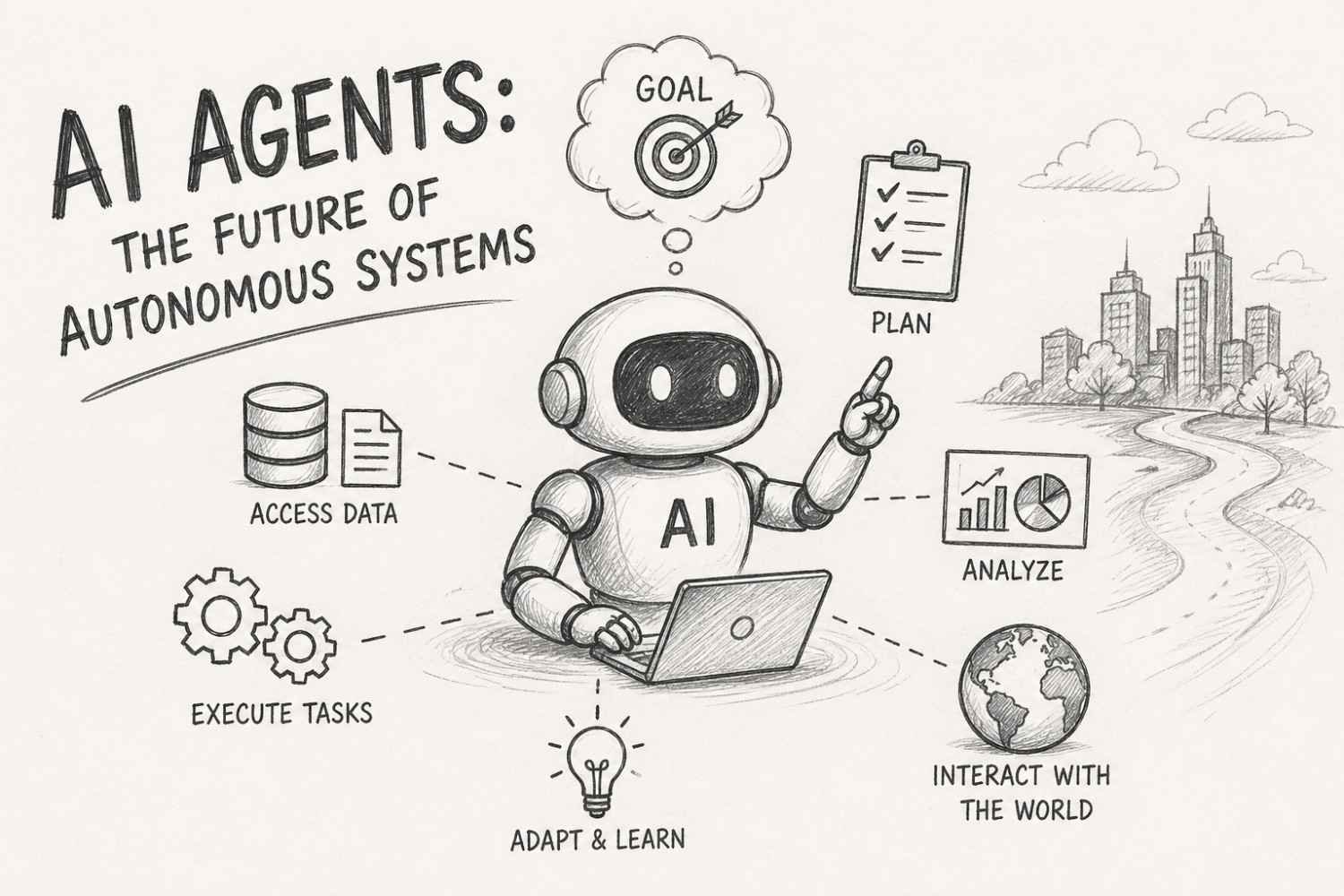
In 2026, artificial intelligence is moving from a novelty people visit to a capability built into the tools they already use. AI systems can summarize a document, generate or inspect code, interpret images and audio, retrieve information, and complete parts of a workflow. The next stage is agentic AI: software that can break a goal into steps and use other tools under clearly defined permissions.
That does not mean AI will replace every worker or become perfectly reliable. The most useful systems will combine machine speed with human accountability. Organizations that invest in high-quality data, verification, privacy, staff training, and clear boundaries are more likely to gain lasting value than organizations that simply add a chatbot to a website.
At a Glance
| Question | What 2026 most likely brings |
|---|---|
| What changes first? | AI assistants become embedded in search, office suites, customer support, coding tools, and learning platforms. |
| What is agentic AI? | A system that can plan and execute a sequence of actions with tools, permissions, and checkpoints—not just produce a reply. |
| Will AI replace jobs? | Many tasks will be redesigned or augmented. The ILO’s 2025 update says roughly one in four workers are in occupations with some GenAI exposure, while transformation is more likely than total replacement. |
| What limits progress? | Accuracy, privacy, cybersecurity, copyright, energy, cost, regulation, and unequal access. |
| What should people learn? | Subject expertise, critical thinking, data literacy, prompt and workflow design, communication, and the ability to verify AI output. |
| What is the safest expectation? | AI will become a powerful co-worker and infrastructure layer, but high-impact decisions will still need accountable people and auditable processes. |
In This Guide
- What artificial intelligence means in 2026
- The state of AI at the start of 2026
- Why AI agents are the next major interface
- Smaller, multimodal, and specialized models
- How AI may change jobs and workplaces
- Education, healthcare, science, and public services
- Comparison and data: hype, capability, and readiness
- Worked example: a responsible AI workflow
- Common mistakes and important risks
- Practical recommendations for 2026
- Frequently asked questions
- Methodology and sources
What artificial intelligence means in 2026
In brief
Artificial intelligence is a family of methods that allow software and machines to perform tasks associated with perception, prediction, language, reasoning, learning, or decision support. In 2026, the phrase includes traditional predictive models, recommendation systems, computer vision, speech recognition, generative models, and tool-using agents. It is not one product and it is not automatically conscious.
Explanation
Earlier consumer discussions often equated AI with a text chatbot. That view is too narrow. A modern system may accept text, photographs, diagrams, voice recordings, sensor readings, or structured data. It may then search a private knowledge base, write a draft, run a calculation, create a chart, or send a task to another service. The model is only one component; the surrounding data, interface, permissions, monitoring, and human review determine whether the overall system is useful and safe.
A practical way to think about AI in 2026 is as a stack. At the bottom are chips, data centres, networks, and energy. Above that are foundation models and smaller specialist models. Applications add retrieval, tools, memory, identity, and user interfaces. At the top are real-world outcomes: a completed lesson plan, a resolved customer issue, a tested software change, or a clinical hypothesis that a qualified professional evaluates.
Evidence
The Stanford AI Index 2025 documented rapid improvements on demanding benchmarks, growing business adoption, and sharply falling inference costs. It also noted that smaller and more efficient models are lowering the barrier to advanced capabilities. These are strong indicators of direction, not a guarantee that every model will be accurate in every situation.
Example
Suppose a school receives hundreds of questions about an exam timetable. A narrow AI system can retrieve the approved timetable, answer routine questions, identify a missing date, and route an unusual request to a staff member. The value comes from the combination of a model, trusted source documents, access controls, and escalation—not from fluent text alone.
The state of AI at the start of 2026
In brief
AI in 2026 is capable enough to produce meaningful productivity gains, but still unreliable enough that verification remains essential. Progress is being measured not only by bigger models, but also by better reasoning, lower cost, faster response, richer modalities, improved tool use, and more transparent evaluation.
Detailed explanation
Several forces are converging. First, model quality has improved across language, coding, image understanding, audio, and video. Second, inference has become more affordable, allowing schools, small companies, and developers to use capabilities that once required large research budgets. Third, open-weight and compact models make local or private deployment more practical for some use cases. Fourth, products are adding retrieval and tools so that a model can work with current, domain-specific information rather than rely only on its training data.
The result is a more competitive market. Users may choose a large general model for difficult reasoning, a small local model for privacy, a vision model for inspection, or a domain model for legal, scientific, or educational terminology. The winning system is often the one that fits the workflow, latency, budget, and risk tolerance—not the one with the largest parameter count.
Data and source context
Stanford’s AI Index reported that the cost of using a system at roughly GPT-3.5-level performance fell by more than 280-fold between late 2022 and late 2024. The same report highlighted rising organizational use and stronger performance by smaller models. Because costs and capabilities change quickly, readers should treat any model leaderboard or price as a dated snapshot and check the provider’s current documentation before making a purchase decision.
Original insight
The most important competitive advantage in 2026 is not simply access to a model. It is the ability to design a repeatable human–AI process. A company that defines what the model may see, what tools it may use, when a person must approve, and how errors are logged can create more reliable value than a company with a stronger model but no operating discipline.
Why AI agents are the next major interface
In brief
AI agents are systems that pursue a goal through multiple steps, often by calling tools such as search, a database, a calculator, a code interpreter, or a business application. In 2026, agents will expand from demonstrations into bounded, monitored workflows. They will not be universally autonomous; permissions, budgets, checkpoints, and fallback rules will remain central.
How an agent works
A responsible agent typically follows a loop:
- Understand: convert a request into a structured objective and identify missing information.
- Plan: propose a sequence of actions and estimate risk, time, and cost.
- Retrieve: obtain current information from approved sources.
- Act: call tools with the minimum permissions needed.
- Check: validate outputs against rules, tests, or a second source.
- Escalate: ask a person when the request is ambiguous, high-impact, or outside policy.
- Record: preserve an audit trail so the result can be reviewed.
This architecture matters because language models can be persuasive while wrong. Tool calls, schemas, tests, and approval gates turn an open-ended conversation into a controlled process. In a low-risk setting, the agent might automatically organize notes. In a high-risk setting, it may only prepare a recommendation for a qualified human.
Where agents will appear
Expect agents inside customer service, software development, sales operations, finance administration, research, IT help desks, and personal productivity tools. A coding agent may inspect a repository, suggest a patch, run tests, and open a review request. A research agent may search a set of permitted sources, compare claims, and produce a citation-backed brief. A school administration agent may draft parent communications but require staff approval before sending.
Agent limitations
Agents can fail through incorrect assumptions, stale data, prompt injection, permission mistakes, brittle integrations, or an inability to recognize when a task is outside their competence. “Autonomous” should therefore mean “able to operate within a defined envelope,” not “free to do anything without supervision.” A useful question is: what is the maximum harm if this step is wrong, and can the system detect the error before it reaches a person?
Smaller, multimodal, and specialized models
In brief
The future of AI in 2026 will not be dominated by one giant model. General-purpose systems will continue to improve, while smaller, faster, and specialized models will handle many routine tasks locally or at lower cost.
Why smaller models matter
A compact model can run on a laptop, phone, classroom device, or private server. Local processing may reduce latency and keep sensitive material inside an organization. It can also make AI available in places with unreliable connectivity. The trade-off is that smaller models may be weaker on broad reasoning, rare facts, or complex multi-step tasks. A hybrid design can route easy or private work locally and send difficult requests to a larger service after removing unnecessary personal data.
Multimodal systems
Multimodality means a system can work across text, images, audio, video, and structured information. A biology student might photograph a lab setup and ask for a checklist of observable variables. A maintenance technician could combine a sensor log with a video of a machine. A teacher could turn a diagram into a set of differentiated questions. These applications are promising because real work rarely arrives as plain text.
Specialization and retrieval
Specialization can improve performance by narrowing the task, vocabulary, and evaluation criteria. Retrieval-augmented generation connects a model to an approved document collection and asks it to cite the passages used. Fine-tuning can adapt style or behavior, but it does not automatically make facts current. In either case, organizations need document ownership, update schedules, access rules, and tests for missing or conflicting information.
What will improve most?
Look for better long-context handling, more dependable structured outputs, stronger coding and mathematical reasoning, lower latency, and improved ability to say “I do not know.” Progress in these practical properties may matter more to users than a small gain on a public benchmark.
How AI may change jobs and workplaces
In brief
AI will change the mix of tasks inside many jobs before it eliminates whole occupations. People who can combine domain expertise with AI-assisted research, analysis, communication, and quality control are likely to be in demand. The transition will not be equally distributed: clerical and highly digitized roles may face faster task changes, while infrastructure, care, skilled trades, and relationship-based work will evolve differently.
Evidence from labour research
The International Labour Organization’s 2025 update estimates that one in four workers globally are in an occupation with some degree of exposure to generative AI. It emphasizes that exposure describes the potential for tasks to change, not a forecast that the entire job will disappear. Because most occupations combine automatable and human tasks, transformation and augmentation are more likely outcomes than immediate replacement.
The ILO also identifies unequal exposure. High-income economies have a larger share of highly digitized occupations, and women are over-represented in some clerical roles. Its 2026 work with the World Bank warns that developing countries may experience disruption before they receive the full productivity benefits if digital infrastructure, skills, and access remain weak. This is why workforce policy matters as much as model capability.
Tasks that AI can assist
- Drafting routine emails, reports, lesson materials, and documentation.
- Summarizing long records and extracting structured fields.
- Generating first-pass code, tests, queries, and data transformations.
- Translating or adapting content for different audiences.
- Finding patterns in large datasets or images for expert review.
- Simulating scenarios and preparing options for a decision-maker.
Tasks that still require people
People remain essential for setting goals, understanding context, building trust, handling sensitive relationships, making accountable decisions, and recognizing when an answer is ethically or practically wrong. A generated contract clause may be grammatically excellent but unsuitable for a particular jurisdiction. A student essay may be fluent but show no original understanding. A medical suggestion may be plausible yet unsafe without examination and clinical history.
New roles and skills
Organizations will need AI product owners, evaluation specialists, data stewards, security engineers, domain reviewers, and educators who can teach critical AI literacy. The most portable skill is not memorizing one prompt formula. It is learning to specify an outcome, provide relevant context, set constraints, request evidence, test the output, and communicate uncertainty.
Education, healthcare, science, and public services
Education
AI can give students immediate explanations, language practice, feedback on drafts, and accessible formats. Teachers can use it to create examples, differentiate practice, analyze misconceptions, and reduce repetitive administrative work. The risk is that automation can hide learning: if a system writes every paragraph or solves every equation, a student may submit a polished answer without developing the underlying skill.
The UNESCO guidance on AI and the future of learning emphasizes human capacity, responsible use, and the need for teacher and student competencies. A sound 2026 classroom policy should define allowed uses, require disclosure when AI meaningfully contributes, protect student data, and assess process as well as final output.
Healthcare
AI may support medical imaging, documentation, triage, drug discovery, patient education, and operational scheduling. The future is likely to be “clinician plus AI,” not “AI replaces the clinician,” because accountability, physical examination, communication, and care ethics remain human responsibilities. High-impact systems need validation on representative populations, monitoring for drift, and a clear route to challenge or correct a result.
Science and engineering
AI can search the literature, propose experiments, generate code, analyze measurements, and explore chemical or material spaces. It can shorten the loop between hypothesis and test, but it cannot remove the need for reproducibility. Researchers must preserve data provenance, distinguish generated suggestions from measured results, and independently verify surprising claims.
Public services
Government agencies may use AI to translate information, triage service requests, detect fraud signals, or help staff navigate complex rules. Public-sector use requires transparency, procurement standards, accessibility, records retention, and due-process protections. A person should be able to understand how to appeal a decision that affects benefits, education, housing, employment, or immigration.
What Changes in Practice
The table below separates technical capability from organizational readiness. A high capability score does not guarantee a safe deployment.
| Dimension | Promising 2026 direction | What a responsible organization must add |
|---|---|---|
| Reasoning | Longer multi-step problem solving and better structured outputs | Tests, independent checks, and clear limits on high-impact decisions |
| Agents | Tool use, planning, memory, and workflow automation | Least-privilege permissions, approval gates, logs, and rollback |
| Multimodality | Text, images, audio, video, and sensor data in one workflow | Consent, quality checks, accessibility, and protection for sensitive media |
| Efficiency | Smaller models, quantization, caching, and local inference | Benchmark cost and accuracy on the real task, not only a public leaderboard |
| Workforce | Task augmentation and new AI-enabled roles | Training, worker consultation, job redesign, and fair transition plans |
| Governance | More standards, audits, and regulatory enforcement | Named owners, risk registers, incident response, and documentation |
| Energy | More efficient chips and data-centre operations alongside rapid demand growth | Measure energy and emissions, choose efficient workloads, and plan grid impact |
The International Energy Agency’s Energy and AI report estimates that data centres used about 1.5% of global electricity in 2024 and projects consumption could more than double to around 945 TWh by 2030. Its 2026 update reports that global data-centre electricity demand grew 17% in 2025, while AI-focused centres grew faster. Efficiency improvements matter, but they can be offset when people use more demanding video, reasoning, or agentic applications.
Worked example / real example: a responsible AI study assistant
The goal
Imagine a revision website that wants to help a student understand a difficult science topic. The goal is not to provide a shortcut answer; it is to help the learner build understanding and practice retrieval.
Step 1: Define the boundaries
The assistant may explain concepts, create practice questions, and give hints. It may not impersonate a teacher, make a high-stakes grade decision, or store unnecessary personal information. The student is told when AI is being used and is encouraged to check the explanation against the course materials.
Step 2: Use trusted material
The system retrieves the school’s approved notes and links to the relevant section. If the notes do not contain an answer, it says so rather than silently inventing one. The content owner reviews updates and removes outdated material.
Step 3: Teach, do not merely answer
For a question about energy transfer, the assistant asks what the student already knows, gives a short explanation, shows a worked example, and then asks the student to solve a similar problem. It offers a hint before revealing the solution. This design uses AI to increase practice rather than replace it.
Step 4: Evaluate
Teachers test the system with common misconceptions, ambiguous wording, multilingual questions, and deliberately misleading prompts. They measure factual accuracy, usefulness of hints, reading level, response time, and the frequency of unsafe or overconfident answers. Feedback is logged and used to improve the prompt, retrieval set, or model choice.
Step 5: Keep a human in the loop
When a student reports distress, asks for personal advice, or challenges an answer, the system routes the conversation to a qualified person. The human can see the source passages and the assistant’s reasoning trace or tool log without exposing hidden personal data. This is a realistic picture of the future: AI handles scale, while people provide judgment, care, and accountability.
Common mistakes
1. Treating fluency as truth
A confident paragraph is not evidence. Ask for sources, check the primary document, and test calculations independently. For current information, use retrieval from maintained sources instead of relying on model memory.
2. Assuming a benchmark predicts your workflow
Benchmarks are useful indicators, but they may not reflect your language, data quality, latency requirements, or failure costs. Run a small evaluation using real but safely anonymized examples.
3. Giving an agent excessive permissions
An agent that can read every file, send email, or approve payments is a security risk. Use least privilege, separate environments, confirmation for irreversible actions, and an easy stop control.
4. Uploading confidential data casually
Before sending personal, student, financial, health, or proprietary information to a provider, understand retention, training use, access controls, regional processing, and deletion options. Redact or summarize when the full record is unnecessary.
5. Ignoring prompt injection and manipulated content
Documents, web pages, emails, or images can contain instructions designed to hijack an agent. Treat retrieved content as data, not authority. Separate system rules from untrusted text and require validation before a tool action.
6. Measuring only speed or cost
A faster answer that creates rework, reputational damage, or unfair decisions is not a productivity gain. Track accuracy, correction time, user satisfaction, accessibility, privacy incidents, and outcomes for different groups.
7. Believing “human in the loop” solves everything
A person who clicks approve on hundreds of unreviewed outputs is not meaningful oversight. Give reviewers enough time, context, authority, and training to question the system and stop a process.
Important Considerations
Regulation is becoming practical
The European Union’s AI Act is a useful example of the direction of travel. The official implementation timeline says that most rules and enforcement for applicable provisions begin on August 2, 2026, while some high-risk obligations have later dates. Transparency rules for certain AI-generated or manipulated content also become important. Exact duties depend on the system’s role, risk category, provider, deployer, and market.
Regulation is not a substitute for engineering. A company can comply with a checklist and still build a confusing or unfair product. Conversely, a thoughtful risk-management program can help an organization meet legal duties while improving quality.
Energy and environmental trade-offs
AI’s energy story is mixed. New hardware and software can make each task more efficient, but demand may grow faster because users adopt more video, reasoning, and agentic features. The IEA notes that data centres are geographically concentrated, so local grid and water impacts can be more significant than the global percentage suggests. Organizations should measure workload energy, prefer smaller models when adequate, cache repeated results, and avoid generating unnecessary content.
Access and language diversity
Models may perform best in languages and contexts that dominate their training data. A system that works well for standard English may be less accurate for Arabic, Hindi, regional dialects, or local curriculum terms. Evaluate with representative users and provide a non-AI route when quality is not sufficient. Affordable connectivity, devices, and training are prerequisites for inclusive benefits.
Copyright, provenance, and synthetic media
In 2026, people will encounter more generated text, images, voice, and video. Provenance tools, disclosure labels, and media literacy can help, but no detector is perfect. Keep records of source materials, permissions, edits, and human contributions. Do not assume that a generated result is free of copyright or privacy concerns merely because a model produced it.
High-impact decisions
Hiring, education placement, credit, insurance, policing, healthcare, and public benefits deserve stricter controls than a marketing brainstorm. Use validated data, explainable criteria, appeal channels, bias testing, and accountable decision-makers. In some cases, the right answer is not to automate.
Practical Next Steps
For students
- Learn the subject first; use AI to explain, quiz, and give feedback rather than to produce every answer.
- Ask for sources and compare the response with your textbook or teacher’s notes.
- Practice writing your own explanation before asking AI to improve clarity.
- Protect personal information and never share a classmate’s private data.
- Build durable skills: reading, mathematics, coding basics, communication, and critical thinking.
For teachers and schools
- Publish a simple acceptable-use policy with examples of allowed, limited, and prohibited use.
- Teach source checking, bias awareness, privacy, and disclosure as part of digital literacy.
- Design assessments that include oral explanation, drafts, problem-solving steps, and reflection.
- Test tools with representative learners and provide an offline or human alternative.
- Keep student data minimised, access-controlled, and governed by a retention schedule.
For organizations
- Start with a real problem and a measurable outcome, not a fashionable model.
- Classify the use case by harm if wrong, sensitivity of data, and reversibility of actions.
- Run a small pilot with an evaluation set, baseline, human review, and incident log.
- Choose the smallest model that meets the quality target; compare total cost, including review and rework.
- Document data sources, prompts or policies, model versions, tool permissions, and change history.
- Train workers and involve them in redesigning tasks. Do not use AI surveillance as a substitute for management.
- Review the system regularly for drift, bias, security weaknesses, and new legal requirements.
A simple 90-day plan
| Period | Action | Deliverable |
|---|---|---|
| Days 1–15 | Map a low-risk workflow and interview users | Problem statement, baseline metric, risk rating |
| Days 16–30 | Prepare a representative evaluation set | Accuracy, quality, privacy, and accessibility tests |
| Days 31–60 | Run a limited pilot with human review | Incident log, user feedback, cost and time comparison |
| Days 61–90 | Decide whether to scale, redesign, or stop | Go/no-go decision, owner, monitoring and review schedule |
Frequently asked questions
Will artificial intelligence replace humans in 2026?
It will replace some tasks and reshape many jobs, but broad replacement of humans is not the most evidence-based expectation for 2026. The ILO finds that most occupations contain tasks requiring human involvement, making transformation and augmentation more likely than complete automation.
What are AI agents?
AI agents are software systems that pursue a goal through multiple steps, using tools and sometimes memory. Reliable agents operate within permissions, checkpoints, tests, and escalation rules.
Is AI safe to use for schoolwork?
It can be useful when a teacher or school allows it and when students disclose meaningful assistance. Use it for explanations, practice, translation, and feedback; verify facts and do not submit generated work as your own.
What is the biggest AI risk in 2026?
There is no single biggest risk. Incorrect high-confidence outputs, privacy breaches, cyberattacks, unfair decisions, manipulated media, and unequal access can all matter. Risk depends on the application and the harm if it fails.
Will AI make electricity more expensive?
AI is one driver of rising data-centre demand, and local grid effects can be significant. The IEA projects strong growth in data-centre electricity use, but prices and impacts depend on location, generation mix, grid investment, and regulation.
Should a small business build its own AI model?
Usually not as a first step. Start with a secure, well-supported model or application, define the task, and measure results. Consider a local or specialist model when privacy, latency, volume, or domain performance justifies the engineering cost.
How can I check an AI answer?
Ask for the source, open the primary document, check dates and definitions, recalculate important numbers, and compare with an independent authority. For high-stakes questions, consult a qualified professional.
What skills will be valuable?
Domain knowledge, critical thinking, communication, data literacy, workflow design, cybersecurity awareness, and the ability to evaluate AI output will remain valuable. Creativity and empathy matter because people still set goals and make responsible choices.
What is retrieval-augmented generation?
Retrieval-augmented generation, or RAG, supplies a model with relevant passages from a selected document collection before it answers. It can improve freshness and traceability, but it does not guarantee that the documents are correct or that the model interprets them properly.
Can AI be unbiased?
No system should be assumed unbiased. Data, labels, design choices, deployment context, and feedback loops can create unequal outcomes. Test performance across relevant groups and provide correction and appeal mechanisms.
Does a bigger model always work better?
No. A smaller model may be faster, cheaper, more private, and more reliable for a narrow task. Choose based on measured performance and risk, not size alone.
What does the EU AI Act mean for 2026?
The EU timeline says most rules and enforcement for applicable provisions begin on August 2, 2026, with some high-risk obligations later. Organizations should check the official text and determine whether they are a provider, deployer, importer, or distributor.
How will AI affect developing countries?
Benefits and disruption may arrive unevenly. The ILO and World Bank note that digital infrastructure, skills, electricity, and task composition influence whether countries receive augmentation gains or face disruption first. Local investment and inclusive policy are important.
Can AI create new jobs?
Yes. New work may grow in evaluation, data stewardship, AI security, integration, training, domain review, and governance. The scale and quality of those jobs will depend on investment, education, and how organizations redesign work.
What should I do if an AI system makes a harmful decision?
Record what happened, preserve the relevant output, request human review, and use the organization’s appeal or incident channel. Systems used for high-impact decisions should provide a clear route to correction.
How This Guide Was Researched
This article separates observed evidence from forward-looking analysis. Current statements are grounded in official or primary sources available in August 2026, including the Stanford AI Index, ILO labour research, IEA energy analysis, NIST risk-management guidance, UNESCO education guidance, and the European Union’s AI Act service desk. Predictions are scenario-based: they describe plausible directions if current capability, adoption, infrastructure, and policy trends continue. They are not guarantees, product endorsements, or financial, legal, medical, or educational advice.
We prioritised claims that can be checked, avoided fabricated model rankings or job-loss percentages, and treated exposure as different from actual displacement. Because AI products and rules change quickly, readers should verify dates, prices, model capabilities, and legal obligations before acting.
Sources
- Stanford Institute for Human-Centered Artificial Intelligence — 2025 AI Index Report
- International Labour Organization — Generative AI and Jobs: A 2025 Update
- ILO — Disruption without dividend? (2026)
- International Energy Agency — Energy and AI
- IEA — Key Questions on Energy and AI
- NIST — Artificial Intelligence Risk Management Framework
- NIST — Generative AI Profile
- UNESCO — AI and the Future of Learning
- European Commission AI Act Service Desk — Implementation Timeline
About This Guide
Written by: RevisionTown Team. Reviewed by: RevisionTown Team for clarity, source quality, and practical educational relevance. This is an educational explainer; it does not replace professional legal, medical, financial, or policy advice.
Keep Learning
AI will reward people who stay curious and careful. Use this guide as a starting point: choose one real problem, test an AI-assisted workflow with trusted sources, keep a human review step, and measure whether the result genuinely improves learning or work. Revisit the official sources above whenever capabilities, standards, or regulations change.


