American Government Guide
What Is a Republic? An In-Depth Exploration for the American Mind
A republic is a system of government in which political power is treated as a public trust, exercised under law, and ultimately derived from the people rather than inherited by a monarch. In a modern republic, citizens normally choose representatives, officials remain accountable through elections and legal limits, and the state is expected to serve the common good rather than the private interests of a ruler.
That short definition is useful, but it does not settle every question Americans ask about their political system. Is the United States a republic or a democracy? Does a republic mean that majority rule is limited? Can a country hold elections and still fail to be republican in a meaningful sense? And why did the Constitution’s framers place so much emphasis on representation, divided power, and individual rights?
This guide answers those questions carefully. It traces the idea from ancient Rome to the American founding, explains the institutions that make a constitutional republic work, and shows why the term still matters whenever citizens argue about elections, rights, courts, federal power, or civic responsibility.
What does “republic” mean?
The word republic comes from the Latin res publica, often translated as “public thing,” “public affair,” or “the commonwealth.” The phrase points to a basic idea: government concerns the community as a whole. It is not the personal possession of a king, dynasty, military commander, party, or wealthy family.
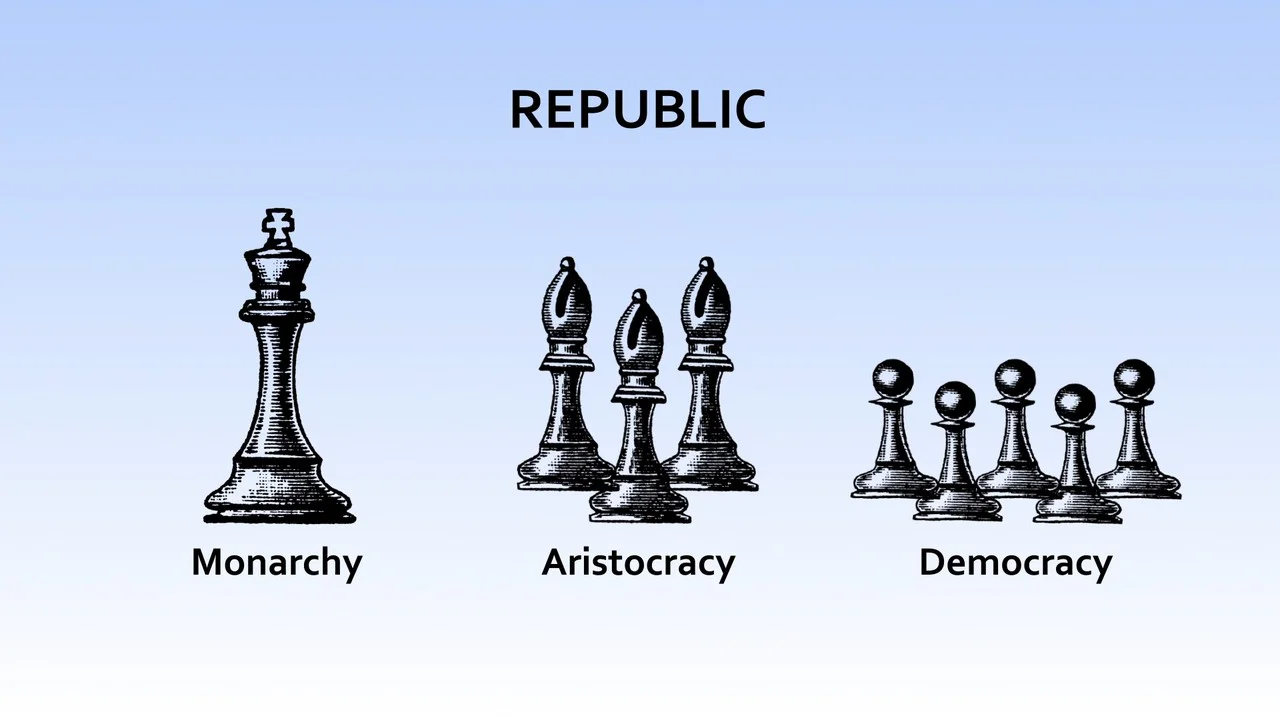
In the broadest modern sense, a republic is a state without a hereditary monarch as its head of state. That definition distinguishes a republic from a monarchy, but it is only a starting point. A one-party dictatorship may use the word republic in its official name while offering citizens little genuine political choice. For civic and constitutional purposes, a fuller definition is more helpful:
A republic is a political order in which public offices are held on behalf of the people, power is exercised according to law, and citizens have a meaningful role in choosing or controlling those who govern.
Several parts of that definition deserve attention. First, public office is a trust. A president, legislator, judge, mayor, or agency official has authority because the legal order grants a temporary responsibility, not because that person owns the office. The office survives the individual. Its powers and duties are defined in advance, and the officeholder is answerable for how those powers are used.
Second, a republic requires lawful government. Rules should apply before a dispute arises, should be knowable to the public, and should restrain officials as well as ordinary citizens. A government that can punish opponents, change election rules after the fact, or spend public funds without legal authority may call itself republican, but it lacks one of republican government’s central safeguards.
Third, republican government rests on popular authority. The people do not need to vote on every law for their authority to be real. In most large countries, they act through constitutional arrangements: choosing representatives, serving on juries, petitioning officials, participating in local government, joining civic organizations, and using peaceful political rights to demand correction.
Finally, a republic aims at the common good. This does not mean citizens will always agree about what the common good requires. They plainly will not. It means that public power should be justified in terms that reach beyond a leader’s personal enrichment, one faction’s permanent dominance, or a privileged group’s immunity from ordinary rules.
That is why the word is more substantial than a label. It directs attention to the quality of political life: Are offices open and accountable? Are laws binding on leaders? Can citizens replace officials? Do institutions protect equal standing? Does the government pursue public purposes in ways people can examine and challenge?
Is the United States a republic or a democracy?
The most accurate answer is that the United States is a constitutional republic and a representative democracy. These descriptions identify different, compatible features of the same system. Treating them as opposites usually creates more heat than clarity.
Democracy concerns popular rule: public authority is accountable to the people, usually through free and fair elections, political competition, participation, and majority decision-making. Republic concerns public office, representation, the rule of law, and government oriented toward the public rather than a monarch’s private rule. Constitutional describes the higher legal framework that structures institutions and protects certain rights from ordinary political reversal.
Direct democracy is one form of democracy. In a town meeting or referendum, eligible voters themselves decide a specific question. Representative democracy is another form. Voters choose people who deliberate, legislate, oversee the executive, and make policy on their behalf. The American national system is overwhelmingly representative, although state and local governments sometimes use initiatives, referendums, recalls, and public meetings.
The distinction matters because the phrase “a republic, not a democracy” can mislead when it implies that elections or popular consent are unimportant. The Constitution begins with “We the People,” and the House of Representatives, state legislatures, governors, presidents, and many local officials depend on elections. At the same time, the framers did not build a pure direct democracy. They designed institutions that channel popular power through representation, staggered terms, separated branches, and legal rights.
A useful way to keep the terms straight is to ask three questions:
- Who is the ultimate source of authority? In a democracy, it is the people rather than a hereditary sovereign.
- How is public authority exercised? In a republic, it is normally exercised through public institutions and representatives under law.
- What limits public power? In a constitutional republic, a higher law allocates authority and protects rights even when political majorities change.
Those features can reinforce one another. Elections make officeholders responsive. Representation gives citizens in a large country a practical means of governing themselves. Constitutional limits prevent temporary majorities or powerful officeholders from treating every political victory as permission to do anything. Courts, legislatures, executives, states, and civil society then contest and apply those limits in ordinary life.
For students, the language of republicanism appears throughout American government courses: popular sovereignty, limited government, consent of the governed, representation, federalism, separation of powers, and civil liberties. The AP U.S. Government score calculator and study guide is a useful companion when you want to connect these concepts to the course’s document-based and argument skills.
Where did the idea of a republic come from?
Republican ideas have deep and varied roots. Ancient Greek city-states developed influential practices of citizenship, public deliberation, and popular participation. Athens, for example, used forms of direct democracy for many decisions, though its citizenship was restricted and it excluded women, enslaved people, and resident foreigners. Greek experience helped later thinkers ask enduring questions about civic virtue, law, and the dangers of demagoguery.
Rome supplied the vocabulary most closely associated with the republic. After rejecting its kings, the Roman Republic combined popular assemblies, elected magistrates, a senate, and legal traditions. It was not democratic by modern standards. Social hierarchy was steep, political power was unevenly distributed, and citizenship itself was contested. Yet Roman writers developed powerful ideas about public office, civic duty, mixed government, and resistance to arbitrary rule.
Roman history also offered a cautionary tale. The republic’s institutions faced intense strain from inequality, military ambition, political violence, and competition among elites. In the first century BCE, repeated crises weakened republican norms and helped open the way to imperial rule. Later advocates of republican government drew two lessons: free institutions need capable structures, and structures cannot endure without citizens and leaders willing to respect them.
During the Renaissance and early modern period, European thinkers revisited classical republicanism. Some stressed active citizenship and public virtue; others emphasized constitutional balance and legal restraint. English political conflicts sharpened debates about Parliament, executive power, consent, rights, and resistance to tyranny. These debates traveled across the Atlantic in books, sermons, pamphlets, and political arguments.
American colonists were influenced by several traditions at once: British constitutionalism, Enlightenment theories of natural rights and consent, Protestant moral language, local self-government, and classical republican concerns about corruption and concentrated power. Their disagreement with Britain was not merely about taxes. It involved the question of whether distant authorities could govern free people without adequate representation and whether power could be kept within lawful bounds.
Independence did not instantly answer how a republic should be organized. The Articles of Confederation created a loose union of states but left the national government with limited capacity to raise revenue, regulate commerce, or enforce common decisions. The Constitutional Convention of 1787 responded by proposing a stronger national framework, but not a simple centralized democracy. The resulting Constitution combined national and state authority, elected institutions, an independent judiciary, and a system of checks intended to make liberty and effective government coexist.
For a chronological view of the revolutionary and constitutional period, RevisionTown’s APUSH Unit 3 guide can help place the founding debates in their historical setting. The key point is that the American republic was an experiment shaped by both hope and caution: hope that citizens could govern themselves, and caution that all people, including elected leaders, can misuse power.
How does the American constitutional republic work?
The Constitution does not use the phrase “constitutional republic” as a single label, but the structure it establishes fits the description. Article IV guarantees every state a “Republican Form of Government.” Across the document, power is made public, limited, divided, and accountable.
Popular sovereignty
Popular sovereignty means that legitimate government rests on the people’s authority. In the United States, this authority is expressed through the Constitution, elections, amendments, state constitutions, local institutions, and civic participation. It does not mean that every policy question must be decided by a nationwide vote. It means government cannot claim legitimate authority solely from inheritance, force, religious status, or private wealth.
Representative institutions
Congress is the national lawmaking body. Members of the House are elected from districts and face voters frequently; senators serve longer terms and represent states. The president is chosen through the Electoral College system, which rests on state-level electoral outcomes. Governors, legislators, mayors, school boards, county officials, and judges in some jurisdictions add further layers of representation.
Representation does more than reduce the number of people in a meeting. Ideally, it allows citizens with different regions, occupations, beliefs, and interests to have advocates in public decision-making. Representatives are expected to listen to constituents, exercise judgment, explain their choices, and face electoral consequences. The arrangement is imperfect, but its purpose is clear: turn a vast and diverse population into a government that can deliberate and act.
Separation of powers
The national government divides core functions among three branches. Congress legislates and controls appropriations. The president executes laws and leads the executive branch. Federal courts decide cases and controversies arising under the Constitution and laws. This is not a rigid mechanical separation. Each branch has tools that affect the others: presidents can veto bills, Congress can override vetoes and conduct oversight, courts can review legal claims, and the Senate confirms many executive and judicial appointments.
These checks can feel slow, especially during a crisis or partisan stalemate. That slowness is not always a defect. A republic that makes consequential action require more than one center of power reduces the chance that a temporary majority or a single official can transform the legal order overnight. The trade-off is real: safeguards against arbitrary action may also make agreement harder to achieve.
Limited government
A constitutional republic does not assume that government is powerless or unnecessary. It assumes power needs a source, a legal boundary, and a means of review. The federal government has enumerated powers, while the states retain broad governing authority subject to the Constitution. Officials must follow statutory procedures, respect due process, and use public money only as authorized. Legal challenges allow individuals and institutions to test whether government has stayed within those boundaries.
For readers who want to practice the legal vocabulary behind these questions—judicial review, due process, equal protection, federalism, and separation of powers—the verified constitutional law MBE flashcards provide a focused study resource.
Why representation matters in a large republic
Representation is often described as a practical convenience: a country with millions of people cannot gather everyone in one assembly. That is true, but the case for representation is deeper. It creates a process for turning many individual views into public decisions while encouraging deliberation, negotiation, and accountability.
Representatives can perform several roles at once. They may act as delegates, closely following constituent preferences. They may act as trustees, using their judgment when voters have not expressed a settled view or when information is complex. They may act as advocates for local needs, party platforms, constitutional principles, or vulnerable groups. In reality, most officials move among these roles depending on the issue.
A healthy representative system needs more than election day. Citizens need reliable information, opportunities to organize, accessible officials, transparent records, competitive elections, lawful campaign rules, and a press and civil society capable of scrutiny. Public debate can be messy, but it helps expose mistakes and gives people a chance to challenge powerful interests.
Representation also explains why district design, voting rules, ballot access, and census counts matter. These are not technical details detached from self-government. They shape whose voices are heard, how communities are grouped, and whether elected bodies reflect the people they are meant to serve. Fair procedures cannot guarantee wise policy, but unfair procedures can damage confidence before deliberation even begins.
Accountability has multiple forms. Voters can reward or remove officials. Legislatures can investigate executive conduct. Courts can require agencies to follow law. Journalists can report on official actions. Inspectors general, ethics offices, and public-record laws can expose misconduct. Citizens can petition, protest peacefully, attend meetings, and support organizations that advance public causes. No single safeguard is sufficient; their combined effect matters.
It is tempting to measure a republic only by whether one’s preferred candidate wins. A more durable test asks whether the system gives people a fair chance to compete, whether losers retain rights and a path to persuade others, and whether winners accept that their authority is temporary and bounded. Peaceful transfers of power are therefore more than ceremonial. They demonstrate that offices belong to the public order, not to the individuals who currently occupy them.
Representation can fail through corruption, exclusion, apathy, misinformation, or an electoral system that no longer produces meaningful competition. Calling a country a republic does not solve those problems. The word gives citizens a standard by which to identify and correct them.
Majority rule, minority rights, and the rule of law
One of the hardest questions in self-government is how to respect majority rule without allowing majorities to deny equal citizenship to everyone else. A republic answers by combining democratic decision-making with legal protections that are not supposed to disappear whenever public opinion shifts.
The Bill of Rights protects freedoms of speech, press, religion, assembly, petition, criminal procedure, and more. Later constitutional amendments abolished slavery, required equal protection of the laws, prohibited racial discrimination in voting, expanded voting rights, and established other protections. These provisions have not always been honored in practice. Their history includes exclusion, conflict, litigation, legislation, protest, and continuing disagreement. But they supply legal claims that citizens can invoke against government action.
Rights do not make democratic politics irrelevant. Legislatures still write laws; executives still enforce them; voters still choose officials. Rights establish a floor beneath ordinary political bargaining. A local majority may prefer a policy, but it cannot constitutionally silence peaceful criticism simply because the criticism is unwelcome. A state may regulate elections, but it must do so consistently with federal constitutional protections. Government may pursue public safety, but it must observe due process.
The rule of law complements rights. At minimum, it means that law is public, prospective, relatively stable, and administered through procedures rather than personal whim. Similar cases should be treated similarly. Officials should explain decisions and remain subject to review. Courts must be independent enough to decide cases without simply carrying out the preferences of the most powerful political actor.
“Equal before the law” is an aspiration requiring continuous work, not a magic phrase. Laws can be written or applied unfairly. Access to legal representation and public institutions can be unequal. Historical systems of racial hierarchy show how legal authority can be used to entrench injustice rather than protect citizenship. RevisionTown’s examination of apartheid and its legacy offers a stark comparative example of why formal government structures are not enough without equal rights and meaningful political inclusion.
Courts are important, but they are not the only guardians of republican principles. Legislators swear to support the Constitution. Executives take oaths to faithfully execute the law. Jurors participate in legal judgment. Citizens monitor officials and use elections to demand change. A constitutional republic relies on all of these actors, including ordinary people who understand that another person’s liberty is not merely a partisan advantage.
Factions, interests, and the common good
The framers were not naive about political conflict. James Madison’s Federalist No. 10 famously describes factions as groups of citizens united by a common impulse or interest adverse to the rights of others or the permanent and aggregate interests of the community. The concern was not that people would disagree. Disagreement is unavoidable in a free society. The concern was that a powerful group might use government to oppress others or secure benefits for itself at public expense.
Madison argued that eliminating the causes of faction would be worse than the disease because it would require destroying liberty or forcing everyone to hold the same opinions. His alternative was to manage faction’s effects through a large, representative republic. A wide republic could include many interests and viewpoints, making it harder for one faction to dominate permanently. Representation could also refine public views through deliberation.
This theory remains relevant, though it should not be treated as a machine that automatically produces wise outcomes. Modern political parties, media systems, interest groups, campaign finance, digital platforms, and economic inequality create challenges the framers did not fully anticipate. Pluralism can prevent domination, but it can also produce gridlock or allow well-organized interests to have disproportionate influence.
Republican government therefore needs habits as well as structures. Citizens and officials must distinguish ordinary disagreement from disloyalty, accept that opponents have legitimate rights, and submit arguments to evidence and lawful process. Public life becomes dangerous when every loss is treated as proof that the system is illegitimate, or when every institutional limit is dismissed as an obstacle to be swept aside.
The common good is not a demand for unanimous culture or unanimous policy. It is a discipline of asking whether a proposal can be defended as serving the country under principles that apply to others, not merely as helping “our side.” It includes goods such as public safety, fair courts, reliable elections, education, infrastructure, opportunity, and national defense. People may debate how to pursue them, but a republic is weakened when public power becomes only a tool of retaliation or patronage.
Political parties are not inherently anti-republican. They organize voters, develop platforms, recruit candidates, and help citizens make choices. The challenge is to keep party competition within constitutional bounds. Parties should seek victory, but they should not treat rules, rights, or peaceful transfers of power as expendable whenever those limits are inconvenient.
Federalism: one republic, many governments
The United States is not governed only from Washington, D.C. It is a federal system, meaning authority is divided between the national government and the states. States, in turn, contain counties, municipalities, school districts, special districts, tribal governments, and other local institutions. This layered arrangement is a major part of how American republicanism works in practice.
Federalism allows decisions to be made at different levels. National institutions address issues that cross state boundaries or require a common rule, such as national defense, foreign relations, currency, interstate commerce, and constitutional rights. States retain broad “police powers” relating to health, safety, welfare, property, education, and many aspects of daily life. Local governments manage services closest to residents, from zoning and parks to libraries and schools.
This distribution has advantages. It can bring government closer to citizens, preserve regional diversity, and allow states to test different approaches. If one state adopts a policy that succeeds, others may learn from it. Local participation can teach practical civic skills because residents see direct connections between meetings, budgets, services, and outcomes.
Federalism also creates conflict. State and national officials may disagree about authority. Residents can receive different rights, services, or burdens depending on where they live. Powerful local majorities can sometimes threaten individual rights, which is why federal constitutional protections matter. The Fourteenth Amendment, federal statutes, and judicial decisions have played important roles in making citizenship less dependent on state boundaries.
Rather than viewing these tensions as proof that the system is incoherent, it is better to see federalism as a continuing negotiation within constitutional rules. The question is not whether every issue has an obvious “correct” level of government. The question is which level has legal authority, practical capacity, democratic accountability, and an obligation to respect rights.
Local engagement is one of the clearest ways citizens experience republican government. A school board vote, city council hearing, county budget, jury summons, or state ballot initiative may affect daily life more directly than a national controversy. Participation at this scale can make the abstract phrase “government by the people” tangible.
What a republic is not
Clear definitions are easier when paired with common misunderstandings.
A republic is not simply any country without a king
Removing a monarch does not ensure public accountability, rights, or lawful government. Some states officially styled as republics have weak elections, censored opposition, politicized courts, or concentrated executive power. The absence of hereditary monarchy is relevant, but it is not enough.
A republic is not the opposite of democracy
Modern democratic republics depend on representative elections, popular sovereignty, political participation, and majority rule within legal limits. The useful contrast is usually between direct and representative democracy, not between democracy and republicanism. Americans can accurately describe their system with both terms when the context is clear.
A republic is not majority rule without boundaries
Majorities decide many matters, but constitutional rights, due process, and equal protection constrain what majorities can lawfully do. The purpose is not to make democracy meaningless. It is to ensure that political winners govern fellow citizens, not subjects with fewer rights.
A republic is not a guarantee of good policy
Republics can make mistakes. Officials can be corrupt, laws can be unjust, voters can be misinformed, and institutions can underperform. Republican government offers methods of correction—elections, courts, legislation, free speech, amendment, federalism, and public debate—not a promise that error will never occur.
A republic is not a demand for passive obedience
Citizenship includes respect for lawful outcomes and peaceful procedures, but it also includes criticism, petition, advocacy, journalism, protest, and reform. In the American tradition, loyalty to constitutional principles can require challenging officials who violate them. Healthy civic attachment is more demanding than either blind praise or permanent contempt.
For a related discussion of loyalty to country, shared principles, and constructive criticism, see RevisionTown’s guide to patriotism in American society. The distinction is important: patriotic feeling can support republican citizenship when it encourages care for the country and all of its people, rather than unquestioning loyalty to whichever leaders are in power.
How a republic changes without abandoning its principles
Republican government is not frozen at the moment a constitution is adopted. The American system has changed repeatedly through amendments, legislation, court decisions, political organizing, migration, economic development, and shifts in public understanding. Change is not a betrayal of the republic when it occurs through lawful processes and expands the ability of citizens to participate as equals.
The history of voting rights is a clear example. At the founding, political participation was far narrower than it is today. Property requirements, race, sex, and other legal barriers excluded many people. The abolition of slavery, the Reconstruction Amendments, women’s suffrage, civil-rights legislation, and later voting-rights reforms altered the practical meaning of “the people.” Those changes were contested, incomplete, and sometimes resisted, yet they demonstrate that a republic can use its own constitutional and political tools to correct exclusions built into earlier practice.
Amendment is the Constitution’s most formal method of change. It is deliberately demanding: proposals require broad support in Congress or among the states, and ratification requires agreement across the country. The difficulty protects constitutional stability, but it also means that not every reform needs or can obtain an amendment. Legislatures pass statutes; agencies implement authorized programs; courts resolve concrete disputes; states experiment with policies; and voters elect leaders who bring different priorities. These mechanisms allow a living political system to respond to new facts while remaining bound by higher law.
Reform becomes dangerous when it treats constitutional limits as optional simply because a desired result seems urgent. Ends and means both matter in a republic. A policy can pursue a worthy objective yet still require legal authorization, transparent procedures, and respect for rights. Conversely, a formal rule can be challenged and changed when it produces injustice, but the challenge should strengthen equal citizenship rather than replace law with personal power.
Public disagreement is therefore not proof that the constitutional order has failed. It is often how problems become visible. Journalists investigate, citizens organize, scholars argue, courts hear claims, legislators negotiate, and voters render judgment. These processes can be frustratingly slow. They can also prevent a momentary passion from becoming permanent coercion. The test is whether debate remains connected to evidence, rights, lawful procedures, and the possibility of peaceful revision.
This perspective helps explain why the American republic has both continuity and change. The constitutional system has preserved enduring principles—consent, representation, public office, and legal restraint—while its interpretation and reach have been repeatedly contested. Responsible reform does not demand that citizens ignore the past. It asks them to use historical knowledge and constitutional methods to make the promises of republican government more real for the people who live under it.
What does citizenship require in a republic?
No constitution can operate on paper alone. Institutions depend on people who use them, defend them, and improve them. Republican citizenship does not demand that every person become a full-time political expert. It does ask citizens to take public life seriously enough to make informed, lawful, and responsible choices.
Vote with care. Voting is one of the clearest mechanisms of accountability, but its value depends on more than turnout. Citizens should learn basic facts about offices, candidates, ballot measures, and the real powers attached to each office. National attention can be valuable, yet state and local elections often shape schools, policing, public health, transportation, housing, and courts.
Use reliable information. A free republic needs disagreement, but disagreement should be grounded in a willingness to check claims, distinguish reporting from commentary, read beyond a headline, and revise one’s views when evidence changes. Misinformation can make citizens less able to hold anyone accountable because it replaces public reasons with confusion or outrage.
Respect equal citizenship. Republican government is not a private club for people who share one ancestry, faith, party, or region. It rests on the proposition that fellow citizens have legal standing even when they vote differently or hold views we strongly oppose. Defending another person’s rights does not require agreeing with every opinion; it requires recognizing that political disagreement is not a license for exclusion.
Participate beyond elections. Contact representatives, attend a meeting, volunteer in the community, serve on a jury when called, join a neighborhood group, support a cause, or help a young person learn how government works. Small forms of participation build the associations and trust that make a large republic governable.
Accept the difference between principle and preference. Citizens should argue passionately for their views, but not every policy defeat is a constitutional crisis. At the same time, genuine violations of rights and lawful procedure should not be excused as ordinary politics. Civic judgment involves learning which disagreements should be settled by persuasion and compromise, and which require firm legal resistance.
Expect more from leaders than victory. Public officeholders should be judged by whether they tell the truth, follow law, protect institutions, explain decisions, and treat the public treasury and public power as trusts. A republic cannot remain healthy if its citizens reward officials for breaking the rules whenever the targets are political opponents.
Why the idea of a republic still matters
The word republic can sound historical, as though it belongs only to Latin mottos, powdered wigs, or schoolbook diagrams. In reality, it offers a practical framework for modern questions. Who draws electoral districts? Who can vote, and under what rules? How much authority should an agency have? What may a court decide? When can the federal government override a state? How should a platform regulate political speech? What obligations do officials owe when they lose an election?
Each question involves a recurring republican concern: how can a free people govern themselves without allowing power to become arbitrary? The answer is never supplied by one institution alone. Elections matter, but so do legal rights. Courts matter, but so do representative legislatures. National authority matters, but so do states and local communities. Civic unity matters, but so does the freedom to dissent.
Modern pressures can test these balances. Polarization can turn compromise into betrayal. Economic inequality can give some voices far more influence than others. Digital media can spread useful information quickly but also reward attention-grabbing falsehoods. Emergency powers can be necessary yet vulnerable to abuse. Distrust can make citizens doubt every institution, while complacency can make them ignore real abuses.
There is no final institutional arrangement that makes a republic self-executing. Its endurance depends on constitutional design, enforceable law, fair procedures, civic knowledge, and a willingness to recognize opponents as fellow citizens. Those requirements are demanding, but they are preferable to the alternatives: government by inherited privilege, by force, or by a faction unconstrained by law.
For another perspective focused more tightly on America’s political foundations, readers can compare this discussion with RevisionTown’s related guide to what a republic is. Together, the two resources can support a class discussion, a civics essay, or a careful review of the concepts behind American institutions.
Everyday examples of republican principles
Big constitutional ideas become clearer when seen in ordinary settings. Consider a few examples.
- A city council hearing: Residents speak for and against a zoning proposal. Elected officials listen, deliberate, vote, and record their reasons. The process is republican when the meeting follows public rules, permits lawful participation, and makes the decision accountable to voters and courts.
- A contested election: Candidates campaign, voters choose, results are counted under established procedures, and legal challenges follow evidence-based rules. The losing candidate may criticize the outcome or seek a recount, but cannot claim ownership of the office. The office belongs to the public.
- A court protecting speech: A government official dislikes a citizen’s harsh criticism. Constitutional protections mean the official cannot ordinarily punish that criticism merely because it is embarrassing or unpopular. This limit protects not only one speaker but the public’s capacity to monitor power.
- A state and federal disagreement: A state adopts a policy within its traditional authority, while a federal court evaluates whether the policy conflicts with constitutional rights or federal law. The dispute may be intense, but the process reflects federalism and the rule of law when each institution uses its lawful role.
- A jury trial: Ordinary citizens hear evidence, apply legal instructions, and reach a verdict. Jury service is a direct form of civic participation and a reminder that law is not administered only by remote officials.
These examples also show why procedure matters. Citizens do not need to agree with every decision to insist that it be made by the right institution, through fair rules, with reasons that can be questioned. That insistence is one of the everyday habits that keeps public power public.
How to evaluate whether a republic is functioning well
It is easy to use “republic” as a ceremonial word and difficult to evaluate the condition of an actual political system. A more useful approach is to look at observable questions rather than asking whether a country perfectly matches an ideal. No republic answers every question well all the time. The relevant issue is whether it has reliable ways to discover errors, curb abuses, and correct course without violence.
First, are elections meaningful? Citizens should be able to register, vote, campaign, organize, and receive credible information without intimidation. Votes must be counted under clear procedures, and officials should accept lawful results even when they lose. Meaningful elections require more than a ballot: they require real alternatives, transparent administration, and a practical path for voters to hold officeholders responsible.
Second, does the law bind the government? Ask whether officials can be investigated, whether courts can hear claims against government action, whether public funds are accounted for, and whether rules are applied consistently. A republic becomes fragile when leaders present themselves as above ordinary law or treat institutions as weapons to be used only against opponents.
Third, are basic rights protected in practice? A written guarantee matters, but practice matters too. Can people criticize leaders, worship or decline to worship freely, associate with others, obtain a fair hearing, and seek legal protection without discrimination? Are unpopular groups able to participate safely? Rights are strongest when people can invoke them before a crisis, not only after an abuse has become obvious.
Fourth, can power change hands and remain limited? Term limits, regular elections, judicial independence, legislative oversight, professional public administration, and clear succession rules all reduce the risk that public office becomes personal property. Transitions are a revealing test because they show whether loyalty lies with the constitutional system or with a particular person or party.
Fifth, is civic disagreement still possible? A republic needs room for persuasion, protest, satire, journalism, and organized opposition. Consensus can be valuable, but forced unanimity is not republican health. The better sign is whether people with sharp disagreements can use lawful institutions, recognize each other’s rights, and continue living as fellow citizens after a vote is over.
These questions are also useful for evaluating one’s own community. They direct attention away from slogans and toward the conditions that make self-government real: fair access, transparent rules, accountable officials, enforceable rights, and citizens willing to participate. A republic is strongest not when every controversy disappears, but when controversy can be handled openly and peacefully under rules that apply to everyone.
Frequently asked questions about republics
Can a monarchy have democratic institutions?
Yes. Constitutional monarchies such as the United Kingdom, Sweden, and Japan can have elected legislatures, competitive elections, rights protections, and democratic governments while retaining a hereditary monarch as head of state. A republic differs primarily in not having that hereditary head of state, although the quality of democracy depends on far more than the title.
Can a republic use referendums or ballot initiatives?
Yes. Representative government and limited direct-democracy tools can coexist. Many U.S. states allow citizens to vote directly on constitutional amendments, statutes, bonds, or recalls. The broader system remains republican because elected institutions, courts, and constitutional rules continue to play central roles.
Why do republics have constitutions?
A written constitution establishes the institutions of government, assigns powers, creates procedures, and protects rights. It makes public authority more predictable and gives citizens a standard for judging officials. Not every republic has a single written constitutional document, but constitutional rules are essential to limiting arbitrary power.
Does the Electoral College make the United States less democratic?
The Electoral College is a constitutional method for choosing the president through state-based electoral votes rather than a single national popular vote. Critics and defenders disagree about its fairness and effects. Whatever one’s view, the debate illustrates a central feature of the U.S. system: democratic legitimacy is mediated through constitutional institutions, federalism, and representation rather than direct national voting on every question.
What is the difference between a republic and a commonwealth?
Both terms can refer to political communities organized for the public good. “Commonwealth” is sometimes used as a near-synonym for republic and appears in the official names of several U.S. states. Its exact legal meaning varies by context; it does not automatically create a different form of government.
Why is civic education important?
Citizens cannot effectively supervise government if they do not know which institution has what power, how laws are made, or how rights can be asserted. Civic knowledge makes participation more purposeful and makes manipulation more difficult. It also gives people a shared vocabulary for disagreement without reducing every issue to party identity.
The enduring promise of a republic
A republic is not a claim that the people will always choose wisely or that institutions will never fail. It is a commitment to a better way of handling human imperfection: public power should come from the people, be limited by law, be divided so that no one person or group can easily dominate, and remain open to peaceful correction.
For Americans, the idea connects the Constitution’s structure to everyday civic life. Elections make officials answerable. Representation makes self-government possible at scale. Rights protect people who are outvoted. Courts and checks restrain power. Federalism allows multiple levels of public decision-making. Citizenship supplies the attention and character that written rules alone cannot provide.
Understanding the republic therefore means more than memorizing a definition. It means recognizing that freedom and self-government depend on institutions worth defending, rights worth extending, and public habits worth practicing. The American experiment remains unfinished precisely because a republic is not a possession handed down by leaders. It is a public responsibility renewed by each generation.