
What Is Apartheid: Understanding Its History, Impact, and Legacy
Apartheid was not simply prejudice or informal segregation. It was a legal and political system that organized South African society by race, restricted where people could live and work, denied political rights to the majority, and used state power to preserve white minority rule. Understanding apartheid means studying the laws, the daily controls, the resistance movements, the international pressure that helped weaken the system, and the long legacy that continued after the first democratic election in 1994.
Quick answer: Apartheid was South Africa's system of legally enforced racial segregation and discrimination, formally introduced after the National Party came to power in 1948 and dismantled through reforms and negotiations in the early 1990s. It classified people by race, separated residential areas, restricted movement through pass laws, created unequal education and services, denied national political rights to the Black majority, and protected white minority rule until South Africa's first democratic election with universal adult suffrage in 1994.
What Is Apartheid?
Apartheid was a system of institutionalized racial separation and domination in South Africa. The word comes from Afrikaans and is commonly translated as "apartness" or "separateness." In practice, apartheid meant that the state assigned people to racial categories and used those categories to determine legal rights, residential areas, schools, jobs, public facilities, movement, political participation, and access to resources.
The basic idea was separate development, but the reality was unequal development. The system gave political power, land access, better public services, and economic advantage to the white minority while restricting the rights of Black South Africans, Coloured South Africans, Indian South Africans, and other groups classified outside whiteness. It was enforced through legislation, police power, surveillance, forced removals, pass laws, censorship, imprisonment, and violent repression.
Apartheid is sometimes described too casually as "segregation." That is incomplete. Segregation means separation, but apartheid was more than separation. It was a state-backed structure of racial hierarchy. It did not simply divide people; it made one racial group dominant and made the majority politically, economically, and geographically subordinate. That is why apartheid is often discussed alongside human rights, colonialism, authoritarianism, and the international law concept of crimes against humanity.
In South African history, apartheid is usually dated from 1948 to the early 1990s because the National Party came to power in 1948 and made racial separation an explicit governing programme. However, apartheid built on older colonial and segregationist laws. Land dispossession, labour controls, racial hierarchy, and unequal political rights existed long before 1948. What changed after 1948 was the intensity, coherence, and legal architecture of the system.
For students studying rights and protest in a curriculum context, RevisionTown's IB History SL apartheid South Africa guide and IB History HL apartheid South Africa guide are useful companion pages because they connect the definition to exam-style historical analysis.
Why Understanding Apartheid Matters
Apartheid matters because it shows how discrimination can become a complete system of government. It was not only about private prejudice. It was about law, bureaucracy, policing, education, land, labour, public services, borders, citizenship, and political power. When racism is built into institutions, it can shape the life chances of millions of people across generations.
Studying apartheid also helps explain why the end of an unjust law does not instantly erase the effects of the law. When communities are forced into distant townships, schools are underfunded, land ownership is restricted, and political rights are denied for decades, the consequences continue after formal legal change. Inequality can remain in housing patterns, school quality, wealth distribution, employment, health, transport, and political trust.
It also matters because the anti-apartheid struggle became one of the most important global human rights campaigns of the twentieth century. South African activists, trade unions, churches, students, artists, lawyers, journalists, exiles, and political organizations challenged the system from inside and outside the country. International pressure, including sanctions, sports boycotts, cultural boycotts, divestment campaigns, and United Nations action, helped make apartheid increasingly difficult to defend.
Apartheid is often studied in comparison with other systems of inequality and authoritarian rule. It can be connected carefully to civil rights history, colonialism, fascism, racial capitalism, and debates about democracy and citizenship. For example, RevisionTown's page on the US civil rights movement in IB History SL gives a useful comparison for rights-based protest, while the article on what fascism is helps distinguish different forms of authoritarian ideology without treating them as identical.
Origins of Apartheid Before 1948
Apartheid did not appear suddenly. Its roots lie in colonial conquest, land dispossession, racial labour systems, and segregationist policies that developed under Dutch and British rule. European settlement at the Cape began in the seventeenth century, and colonial expansion created conflicts over land, labour, sovereignty, and political rights. Over time, racial categories became tied to power, ownership, movement, and access to work.
In the nineteenth and early twentieth centuries, South Africa's economy developed around mining, agriculture, and industrial growth. That economy depended heavily on cheap Black labour, while political power was concentrated in white hands. Laws restricted land ownership, urban residence, and movement. The 1913 Natives Land Act, for example, limited African land ownership to designated reserve areas and became one of the foundations of spatial and economic inequality. It was not yet formal apartheid, but it created patterns apartheid later intensified.
The Union of South Africa was formed in 1910, bringing together former British colonies and Boer republics. White political unity did not mean equal rights for all inhabitants. Black South Africans were largely excluded from national political power, and segregationist policies continued. These older systems set the stage for the National Party's 1948 victory and its promise of a more rigid racial order.
South African History Online emphasizes that apartheid was introduced at a time when the world was moving away from explicit racial policies after World War II. Decolonization, human rights language, and anti-racist movements made South Africa's racial system increasingly controversial internationally. That global context is important: apartheid was not only a domestic policy; it became a symbol of open racial rule in an era when many empires were collapsing and new nations were claiming sovereignty.
For broader background on how colonial societies created long-term racial and social structures, RevisionTown's colonial society and culture page provides useful context, especially for students comparing colonial systems across different regions.
Major Apartheid Laws and How They Worked
Apartheid depended on law. The system did not function only through custom or social pressure; it used legislation to classify, separate, control, and punish. These laws created a daily administrative machinery of racial rule. Each law served a different purpose, but together they formed a connected structure.
| Law or policy | Main purpose | Effect on people's lives |
|---|---|---|
| Population Registration Act, 1950 | Classified South Africans into racial categories. | Made racial identity a legal status that shaped residence, schooling, jobs, movement, and rights. |
| Group Areas Act, 1950 | Assigned residential and business areas by race. | Enabled forced removals, destroyed mixed communities, and produced racially segregated urban space. |
| Prohibition of Mixed Marriages Act, 1949 | Banned marriages across racial classifications. | Used state power to police intimate life and reinforce racial boundaries. |
| Immorality Amendment Act, 1950 | Criminalized sexual relationships across racial lines. | Expanded racial policing into private life. |
| Bantu Education Act, 1953 | Created a separate education system for Black South Africans. | Designed education around subordination and restricted future opportunities. |
| Separate Amenities Act, 1953 | Legalized segregated public facilities. | Created unequal access to transport, parks, toilets, beaches, libraries, and public spaces. |
| Pass laws | Controlled movement and urban presence of Black South Africans. | Required documents, restricted travel, and enabled arrest for being in the "wrong" place. |
| Promotion of Bantu Self-Government Act, 1959 | Strengthened the homeland system. | Claimed to give separate political development while denying full national citizenship and political rights. |
The Population Registration Act was foundational because it made racial classification official. Once the state assigned a person to a category, other laws could determine where that person could live, which school they could attend, which hospital they could use, which job they could pursue, and which political rights they had. Classification was not merely descriptive. It was a gateway to unequal treatment.
The Group Areas Act turned racial hierarchy into geography. Mixed neighbourhoods could be declared for one racial group, and people classified outside that group could be removed. South African History Online describes the Group Areas Act as a central law for racially segregated neighbourhoods and notes its role in displacing communities. This created what is often called spatial apartheid: a physical landscape where distance from jobs, schools, transport, and services reflected racial power.
Bantu Education was equally important because it shaped future opportunity. Education was not only separated; it was intentionally unequal. The aim was not to provide equal citizenship through schooling. It was to prepare Black South Africans for subordinate roles in the racial economy. The effects were generational because education affects employment, income, political participation, and social mobility.
Apartheid Timeline: Key Turning Points
A timeline helps show that apartheid developed, hardened, faced resistance, and eventually collapsed over a long period. It was not a single event. It was a system built through many laws and challenged through many waves of protest. The dates below are not every important moment, but they give students a strong framework for understanding cause, consequence, and change over time.
| Year | Event | Why it matters |
|---|---|---|
| 1910 | Union of South Africa formed. | White political power was consolidated while most Black South Africans were excluded from national political rights. |
| 1913 | Natives Land Act. | Restricted African land ownership and helped create long-term land inequality. |
| 1948 | National Party wins election. | Formal apartheid becomes the central programme of government. |
| 1950 | Population Registration Act and Group Areas Act. | Racial classification and spatial segregation became core legal tools of apartheid. |
| 1953 | Bantu Education Act and Separate Amenities Act. | Education and public facilities were organized around racial hierarchy. |
| 1960 | Sharpeville massacre. | State violence against anti-pass protesters drew international attention and intensified repression. |
| 1964 | Rivonia Trial sentences Mandela and others to life imprisonment. | Major anti-apartheid leaders were imprisoned, but the trial also amplified the movement's moral claims. |
| 1976 | Soweto uprising. | Student protest exposed the centrality of education in apartheid and energized national and global resistance. |
| 1980s | Mass protest, sanctions, states of emergency, and global divestment campaigns. | The apartheid state faced internal crisis and international isolation. |
| 1990 | Mandela released and liberation movements unbanned. | Negotiations toward a democratic transition became possible. |
| 1994 | First democratic election with universal adult suffrage. | Formal apartheid ended and Nelson Mandela became president. |
This timeline also shows why apartheid should be studied in stages. The 1950s were the years of legal construction. The 1960s saw repression, banning, imprisonment, and exile after Sharpeville. The 1970s brought renewed internal resistance, especially through students and Black Consciousness. The 1980s saw a combination of township mobilization, labour activism, international sanctions, and state emergency rule. The early 1990s were years of negotiation, uncertainty, violence, constitutional bargaining, and democratic transition.
For exam writing, timelines are useful only when linked to argument. Do not simply list dates. Explain what changed. For example, 1948 matters because apartheid became formal state policy. 1950 matters because racial classification and urban space were made more rigid. 1960 matters because repression escalated and international attention increased. 1976 matters because young people and education became central symbols of resistance. 1994 matters because political rights were transformed, even though social and economic inequalities remained.
Daily Life Under Apartheid
Apartheid was experienced in ordinary routines. It affected where a person woke up, how far they travelled to work, whether they could enter a city, which bus or train carriage they could use, what school their children attended, where they could sit, which hospital served them, who they could marry, what work they could do, and whether they could vote. That is why apartheid is best understood as a complete social system rather than a single law.
Pass laws were among the most humiliating and disruptive controls. Black South Africans had to carry documents proving permission to be in certain areas. Failure to produce documents could lead to arrest, fines, detention, removal, or loss of employment. This made movement conditional and precarious. A person could be treated as illegal in a city where they worked, travelled, or had family connections.
Housing was another central experience. Forced removals destroyed communities such as Sophiatown and District Six and pushed many people into townships far from economic centers. This created long commutes, overcrowding, weaker services, and social disruption. Families and communities lost not only homes but also networks, schools, businesses, religious institutions, and local identities.
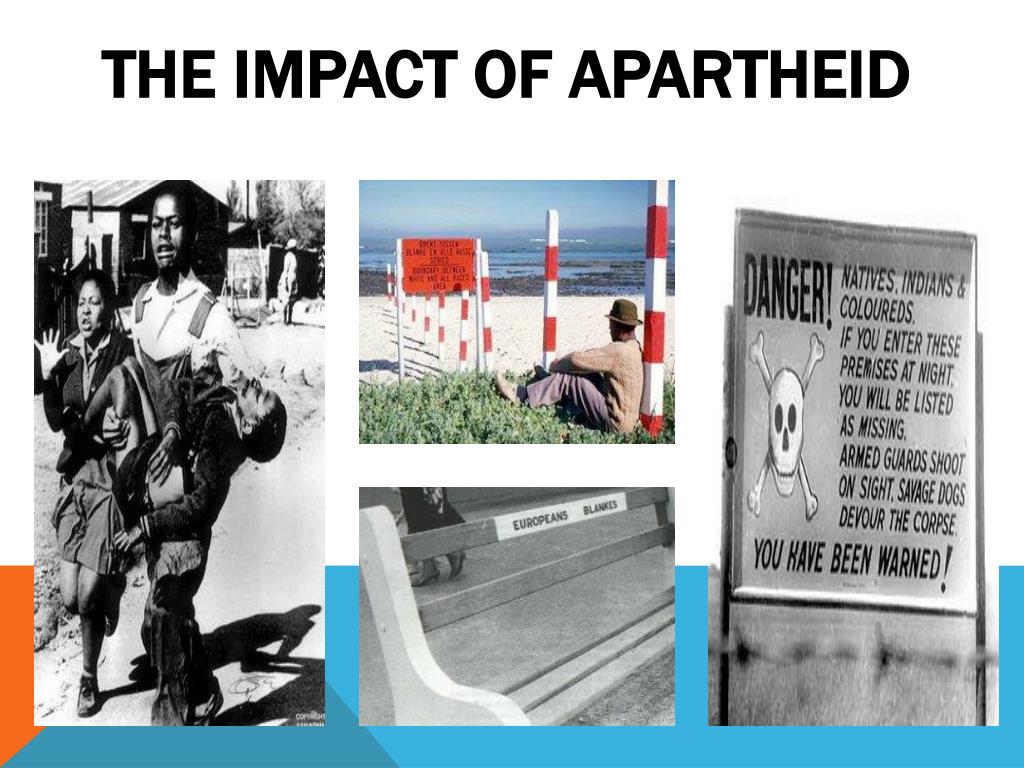
Public facilities carried daily signs of inequality. Separate entrances, benches, toilets, beaches, waiting rooms, schools, and transport facilities made racial hierarchy visible. These signs were not symbolic only. They reflected unequal funding and unequal dignity. White areas received better infrastructure, while Black, Coloured, and Indian communities often faced inferior services and heavy state control.
Political exclusion was central. The majority of the population could not choose the national government that ruled over them. The apartheid state claimed to offer separate political development through homelands, but this did not create equal citizenship. It fragmented political rights while preserving white minority control over South Africa's central state, economy, land, and security forces.
Economic and Spatial Impact of Apartheid
Apartheid was an economic system as well as a racial system. It organized labour, land, education, housing, and wages in ways that benefited the white minority and restricted the economic mobility of the majority. Many Black South Africans were pushed into low-paid labour while being denied equal access to land ownership, skilled employment, quality education, and urban residence.
Spatial planning made inequality durable. If people are forced to live far from jobs and services, they spend more time and money on transport. If schools in their areas are underfunded, children face weaker educational opportunities. If property ownership is restricted, families cannot build wealth in the same way. If political voice is denied, communities struggle to influence services and planning. These effects compound over time.
Labour controls were also central. Apartheid needed Black labour in mines, farms, factories, homes, and cities, but it tried to control that labour without granting equal rights. The system relied on movement controls, migrant labour, job reservation, unequal wages, and repression of labour organization. That meant economic growth and racial inequality were connected.
The legacy remains visible. South Africa has made major democratic changes since 1994, but inequality, unemployment, land distribution, school quality, and spatial separation remain major issues. The World Bank has described South Africa as one of the world's most unequal countries, and many scholars connect that inequality to the long effects of colonial and apartheid policies. The point is not that nothing changed after 1994. The point is that formal legal change had to confront deeply embedded structures.
When analysing apartheid's economic impact, avoid reducing it to poverty alone. Apartheid created poverty for many, but it also created wealth, advantage, and institutional power for others. It shaped who had access to land, capital, education, transport, skilled work, and political influence. A complete explanation must study both deprivation and privilege.
Resistance Inside South Africa
Apartheid faced resistance throughout its history. Resistance came from political organizations, trade unions, churches, students, community groups, women activists, journalists, lawyers, artists, and ordinary people who refused to accept the system. It included petitions, strikes, boycotts, civil disobedience, underground organizing, armed struggle, cultural resistance, international advocacy, and mass protest.
The African National Congress was founded in 1912, long before formal apartheid, and became one of the central organizations opposing white minority rule. In the 1950s, campaigns such as the Defiance Campaign challenged apartheid laws through civil disobedience. The Congress of the People produced the Freedom Charter in 1955, articulating a vision of nonracial democracy. Other organizations, including the Pan Africanist Congress, the Black Consciousness Movement, trade unions, civic groups, and student organizations, also played major roles.
The Sharpeville massacre in 1960 marked a turning point. Police opened fire on protesters opposing pass laws, killing and injuring many people. The state banned the ANC and PAC soon after, and resistance increasingly moved into underground and exile activity as well as armed struggle. Repression intensified, but resistance continued.
The Soweto uprising of 1976 became another watershed. Students protested against education policy and the use of Afrikaans in schools. The violent state response drew global attention and energized a new generation of resistance. The uprising revealed how education, language, youth politics, and state violence were connected under apartheid.
Resistance was not only led by famous figures. Nelson Mandela, Oliver Tambo, Walter Sisulu, Albertina Sisulu, Winnie Madikizela-Mandela, Steve Biko, Desmond Tutu, Chris Hani, Ruth First, and many others are central to the history, but apartheid was challenged by countless people whose names are less widely known. Workers, students, parents, teachers, clergy, nurses, domestic workers, miners, and township residents all contributed to the pressure that made the system increasingly ungovernable.
The Global Anti-Apartheid Movement
The anti-apartheid struggle became global because apartheid contradicted the emerging international language of human rights and self-determination. Activists around the world used boycotts, divestment campaigns, protests, church networks, student organizing, trade-union campaigns, cultural pressure, and diplomatic pressure to isolate the South African state.
The United Nations played a major role in turning apartheid into an international issue. UN bodies condemned apartheid, created committees, supported sanctions debates, and helped frame apartheid as a matter of international concern rather than merely domestic policy. The UN's anti-apartheid record shows a long chronology of resolutions, arms embargoes, cultural pressure, and support for the liberation struggle.
Sports and cultural boycotts were powerful because they attacked South Africa's international legitimacy. Exclusion from international competitions and cultural events sent a message that apartheid South Africa could not participate normally while denying basic rights to the majority of its own people. These boycotts were controversial in some countries, but they became symbols of moral pressure.
Economic sanctions and divestment campaigns also mattered. Universities, churches, cities, pension funds, and governments debated whether to withdraw investments from companies operating in South Africa. The goal was to create financial and reputational pressure on the apartheid state and on businesses that benefited from or tolerated the system.
The global campaign did not end apartheid by itself. Internal resistance, economic pressures, state crisis, regional conflict, political negotiations, and changing international conditions all mattered. But global solidarity strengthened South African resistance and made apartheid increasingly costly to defend.
Apartheid and International Law
Apartheid became more than a national political controversy. It became a term in international law and human rights debate. The international community increasingly treated apartheid as a crime because it involved systematic racial domination, denial of rights, and state-backed oppression. This legal framing matters because it moved the discussion beyond whether apartheid was merely an internal South African policy. It treated racial domination as an issue of international responsibility.
The 1973 International Convention on the Suppression and Punishment of the Crime of Apartheid defined apartheid in legal terms and connected it to inhuman acts committed for the purpose of maintaining domination by one racial group over another. Later international criminal law also treated apartheid as a crime against humanity. Students do not need to memorize every legal article, but they should understand the central point: apartheid became a global legal category because it represented an organized system of racial oppression, not only a set of local discriminatory practices.
This legal development is important for two reasons. First, it shows how human rights language changed after World War II and decolonization. The idea that a government could treat racial domination as a purely domestic matter became harder to defend. Second, it shows why the word apartheid carries such serious moral and legal weight today. It should not be used casually as a synonym for any separation or unfairness. In historical and legal contexts, apartheid refers to systematic domination and separation enforced by power.
International law did not replace activism inside South Africa. It supported it. Legal condemnation, UN action, sanctions debates, and diplomatic pressure gave anti-apartheid movements additional tools. South African activists could argue that their struggle was not only local but also part of a global fight against racial oppression. International legal language also helped campaigners persuade governments, universities, churches, trade unions, artists, and sports bodies that neutrality was not enough.
At the same time, international law had limits. Resolutions and conventions did not automatically free political prisoners, stop forced removals, or end police violence. The apartheid state survived for decades despite condemnation. This is an important lesson: law matters, but law usually works with political pressure, social movements, economic incentives, institutional change, and public memory. The anti-apartheid movement succeeded because legal criticism, domestic resistance, international solidarity, economic pressure, and political negotiation reinforced each other over time.
How Apartheid Ended
Apartheid ended through a combination of internal resistance, international pressure, economic difficulty, political crisis, and negotiation. By the late 1980s, the apartheid state faced mass unrest, global isolation, sanctions, labour militancy, and questions about the long-term survival of white minority rule. The system was powerful, but it was also increasingly unstable.
In 1990, President F.W. de Klerk announced major reforms, including the unbanning of liberation movements and the release of Nelson Mandela after 27 years in prison. Negotiations followed between the government, the ANC, and other political actors. The process was difficult and violent. There were assassinations, political clashes, distrust, and fears of civil war. The transition was not a simple handshake; it required sustained negotiation under severe pressure.
South Africa held its first democratic election with universal adult suffrage in April 1994. Nelson Mandela became president, and apartheid as a formal legal system ended. The new constitutional order promised equality, dignity, rights, and democratic citizenship. The Apartheid Museum describes its mission around the rise and fall of apartheid, which captures the central historical arc: a system built by law, resisted by people, and dismantled through struggle and negotiation.
The end of apartheid was not the end of history. It was the beginning of a difficult democratic project. South Africa had to build new institutions, write a constitution, integrate security forces, address past human rights violations, reform education and housing, and confront inequality inherited from the old system. The transition from legal apartheid to democratic citizenship was historic, but the social and economic reconstruction remained enormous.
Apartheid's Legacy Today
Apartheid's legacy can be seen in five major areas: space, wealth, education, memory, and democratic trust. These areas overlap. Spatial inequality affects school access and job access. Education affects income. Income affects housing. Memory affects politics. Democratic trust affects whether citizens believe institutions can address injustice fairly.
Spatial inequality remains one of the clearest legacies. Townships and former homeland areas often remain distant from economic opportunity. Transport costs and commuting time can still reflect apartheid-era planning. Housing reform and urban development have made changes, but geography remains a powerful reminder that legal segregation shaped the physical map.
Wealth inequality is another legacy. Apartheid restricted access to land, skilled jobs, capital, quality education, and property ownership for the majority. These restrictions affected the ability of families to accumulate assets over generations. Post-1994 policies have expanded rights and services, but wealth gaps do not disappear quickly when they were produced over decades.
Education remains central. The Bantu Education system was designed around inequality. A democratic government can change laws and curricula, but unequal school infrastructure, household income differences, language issues, and community conditions can continue to shape outcomes. Education reform is therefore both a moral issue and an economic issue.
Memory and reconciliation remain contested. South Africa's Truth and Reconciliation Commission created a public process for testimony about gross human rights violations. It helped record abuses and gave many victims a platform, but it also left debates about justice, reparations, accountability, and the limits of reconciliation. Some families continue to seek answers for unresolved cases. That tension is part of apartheid's legacy: truth matters, but truth does not automatically repair material harm.
The legacy also matters globally. Apartheid is now used as a warning about how law can normalize injustice. It reminds students, citizens, and policymakers that democratic rights, equal citizenship, free movement, and equal access to public services should not be taken for granted. RevisionTown's page on what a republic is can help students connect apartheid to broader questions about citizenship, representation, and political legitimacy.
Using Data to Understand Apartheid and Inequality
History is not only a story of laws and leaders. It also involves patterns that can be measured: population share, land access, political representation, school funding, employment, wages, and wealth. Data cannot capture the full human experience of apartheid, but it can help show how inequality was structured and how long its effects can last.
One useful starting point is population share. Under apartheid, a white minority held national political power while the majority was denied equal rights. A simple percentage formula helps students understand the scale of representation problems:
Representation can then be compared with political power:
Under apartheid, the representation gap for the Black majority was not a minor statistical imbalance. It reflected exclusion from the national political system. This is why apartheid cannot be understood as ordinary regional difference or cultural separation. It was a political structure that denied majority rule.
Economic inequality can be studied in many ways. Students may compare income, wealth, land ownership, school spending, unemployment, or access to services. A basic access-gap formula can help organize comparisons:
For example, if one group has much greater access to quality schools, property ownership, healthcare, or skilled jobs, the access gap helps show how institutions translate into life chances. The formula does not explain everything by itself. It must be interpreted historically. Under apartheid, access gaps were not accidental; they were produced by law and policy.
Data should be used carefully. A number can show scale, but it cannot replace testimony, memory, or local history. Forced removal is not only a housing statistic. It is also the loss of a home, neighbours, graves, shops, schools, churches, and identity. A good historical explanation combines numbers with human experience.
Apartheid Compared With Segregation, Colonialism, and Authoritarianism
Apartheid overlaps with other systems, but it should not be collapsed into them. It shared features with colonialism because it rested on land dispossession, racial hierarchy, and control of labour. It shared features with segregation because it separated people by race in housing, education, facilities, and public life. It shared features with authoritarianism because it used censorship, policing, detention, banning orders, and violence to suppress opposition.
However, apartheid had a specific South African structure. It developed through a legal system that combined racial classification, white minority rule, controlled urbanization, homelands, unequal education, labour regulation, and political exclusion. Comparing apartheid with other systems is useful only when the similarities and differences are both clear.
For example, the United States had legal segregation under Jim Crow, and the civil rights movement challenged racial exclusion in public facilities, voting, schools, and employment. But South Africa's apartheid system included a more explicit national project of racial classification, separate development, pass laws, and homeland citizenship. These systems can be compared, but they are not identical. RevisionTown's AP African American Studies cheatsheet and the page reaffirming commitment to AP African American Studies can support careful comparative study of racial history and scholarship.
Comparisons with authoritarianism should also be precise. Apartheid used authoritarian methods, but its central organizing principle was racial domination. A page on political ideology such as what conservatism means should not be treated as equivalent to apartheid; rather, it can help students separate political traditions, state structures, and historical contexts.
How to Study Apartheid Effectively
Students often memorize apartheid laws but struggle to explain how the laws worked together. A stronger method is to organize the topic around systems: classification, space, labour, education, politics, repression, resistance, and legacy. Each system had laws, institutions, and consequences.
Start with classification. Ask how the state decided who belonged to which racial group and why that mattered. Then study space. Ask how residential segregation shaped transport, work, schools, and wealth. Then study labour. Ask how the economy depended on Black labour while restricting Black rights. Then study education. Ask how schooling prepared different groups for unequal roles. Then study political power. Ask who could vote, who could govern, and who was denied citizenship.
Next, study resistance. Do not treat anti-apartheid activism as a single movement with one strategy. Identify different methods: petitions, legal challenges, civil disobedience, strikes, boycotts, armed struggle, international advocacy, community organizing, student protest, cultural resistance, and religious leadership. Then evaluate the strengths and limits of each method.
Finally, study legacy. Ask what changed in 1994 and what did not change immediately. Legal equality is essential, but inherited inequality can remain in property, education, employment, geography, health, and trust. A strong answer recognizes both achievement and unfinished work.
For broader history preparation, RevisionTown's History and Politics resources and Global History and Geography II Regents past papers can help students practise contextualizing apartheid within wider world history.
Common Misconceptions About Apartheid
Misconception 1: Apartheid was only social prejudice
Apartheid included prejudice, but it was fundamentally a legal and political system. The state classified people, enforced separation, controlled movement, and denied equal rights.
Misconception 2: Apartheid began from nothing in 1948
Formal apartheid began after the National Party victory in 1948, but it built on older colonial and segregationist structures, especially land and labour controls.
Misconception 3: Apartheid ended all at once
The system was dismantled through reforms, negotiations, resistance, and elections. The legal structure ended, but social and economic legacies continued.
Misconception 4: Nelson Mandela alone ended apartheid
Mandela was central, but apartheid ended through mass resistance, many organizations, international pressure, labour activism, negotiation, and the work of countless people.
Misconception 5: Apartheid was only a South African issue
Apartheid was South African, but it became a global issue through the United Nations, sanctions, boycotts, exile politics, and international solidarity campaigns.
Misconception 6: Legal equality automatically solves inequality
Legal equality is necessary, but apartheid's effects in land, education, wealth, and geography require long-term reform and public accountability.
What Is Apartheid? FAQs
What is apartheid in simple terms?
Apartheid was a legal system in South Africa that separated people by race and gave political, economic, and social power to the white minority while denying equal rights to the majority.
What does the word apartheid mean?
The word apartheid comes from Afrikaans and is usually translated as apartness or separateness. In history, it refers to South Africa's system of racial segregation and domination.
When did apartheid begin?
Apartheid formally began in 1948 when the National Party came to power in South Africa and made racial separation a central government policy. However, its roots go back to earlier colonial and segregationist laws.
When did apartheid end?
Apartheid was dismantled through reforms and negotiations in the early 1990s. South Africa's first democratic election with universal adult suffrage was held in 1994, and Nelson Mandela became president.
What were the main apartheid laws?
Major laws included the Population Registration Act, Group Areas Act, Bantu Education Act, pass laws, Separate Amenities Act, Prohibition of Mixed Marriages Act, Immorality Amendment Act, and laws creating the homeland system.
What was the Group Areas Act?
The Group Areas Act assigned residential and business areas by race. It made forced removals possible and destroyed many mixed communities by declaring areas for one racial group.
What were pass laws?
Pass laws controlled the movement of Black South Africans. People were required to carry documents proving permission to be in certain areas, and they could be arrested if they failed to produce them.
Who resisted apartheid?
Resistance came from many people and organizations, including the ANC, PAC, Black Consciousness Movement, trade unions, churches, students, community groups, women activists, artists, journalists, and international solidarity movements.
Why was Nelson Mandela important?
Nelson Mandela was a major anti-apartheid leader, political prisoner, negotiator, and South Africa's first democratically elected president. He became a global symbol of resistance, reconciliation, and democratic transition.
What is apartheid's legacy today?
Apartheid's legacy includes spatial inequality, wealth gaps, education inequality, land questions, trauma, contested memory, and ongoing debates about justice and democratic reform.
Final Takeaway
Apartheid was a legally enforced system of racial segregation and domination in South Africa. It classified people by race, separated communities, controlled movement, restricted education and work, denied political rights to the majority, and used state power to preserve white minority rule. It began formally in 1948, but it grew from older colonial and segregationist structures. It ended through resistance, negotiation, and democratic transition, culminating in the 1994 election.
The history of apartheid matters because it shows how law can be used to organize inequality and how people can resist that inequality through local, national, and international action. It also shows why the end of discriminatory law does not automatically erase the consequences of decades of unequal land access, education, wealth, and political power.
To understand apartheid well, study both structure and experience. Learn the laws, but also learn how those laws affected homes, schools, families, workers, students, prisoners, activists, and communities. Apartheid was built by institutions. It was challenged by people. Its legacy continues to demand serious historical memory, democratic accountability, and practical work toward equality.
Sources and Further Reading
This article was checked against historical and institutional sources on July 9, 2026. These sources are useful for students who want deeper context on apartheid history, major laws, museums, international response, human rights law, reconciliation, and continuing inequality.
- South African History Online: A history of Apartheid in South Africa
- South African History Online: The Group Areas Act of 1950
- Apartheid Museum
- United Nations: Partner in the Struggle Against Apartheid
- United Nations Digital Library: International Convention on the Suppression and Punishment of the Crime of Apartheid
- World Bank: Overcoming Poverty and Inequality in South Africa
- South Africa Department of Justice: Truth and Reconciliation Commission Report