⚡ Watts to kW Converter
Professional Watts to Kilowatts Calculator | Power Conversion Tool
⚡ Common Appliance Power Ratings
📚 Complete Guide to Watts and Kilowatts Conversion
Understanding Watts and Kilowatts
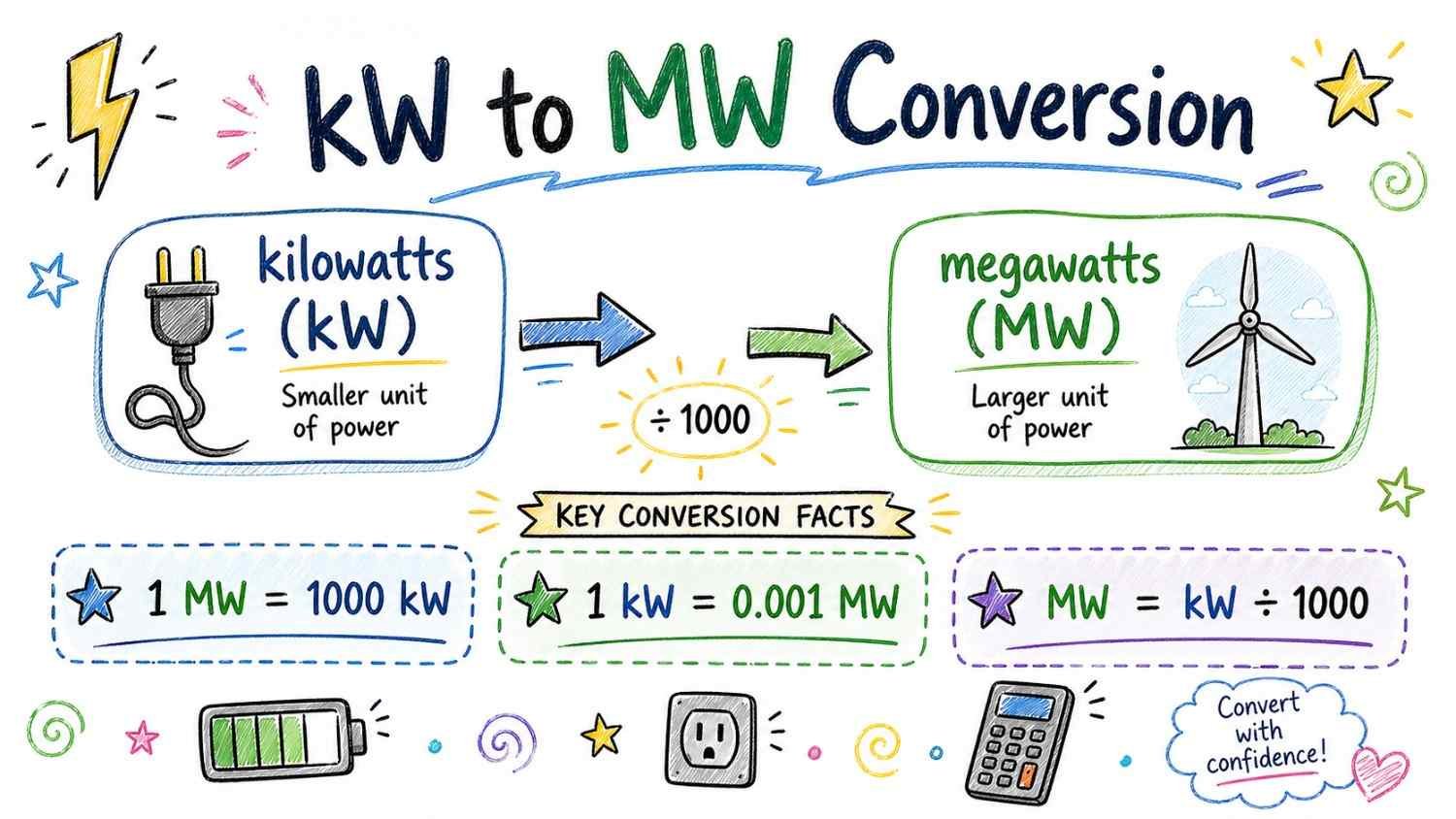
Watts (W) and kilowatts (kW) are SI units measuring electrical power at different scales. 1 kilowatt (kW) = 1,000 watts (W), representing the metric prefix "kilo" meaning one thousand. Both measure instantaneous power—the rate at which energy is consumed or produced. The watt is the SI base unit of power, defined as one joule per second (1 W = 1 J/s = 1 V × 1 A), named after Scottish inventor James Watt. Watts measure small to medium electrical loads: LED light bulbs 5-15 W (replacing 40-100 W incandescent bulbs that were standard before energy-efficient lighting); smartphone chargers 5-20 W (USB 5W standard; fast charging 18-65W USB-C Power Delivery); laptop computers 30-100 W (ultrabooks 30-45W; standard notebooks 45-65W; gaming laptops 100-300W); desktop monitors 20-50 W (24-inch LED 20-30W; 27-inch 30-40W; 32-inch 4K 40-60W); televisions 50-200 W (32-inch LED 50W; 55-inch LED 100W; 65-inch OLED 150-200W); desktop computers 100-500 W (office PC 100-200W; gaming PC 300-500W; workstation 500-1,000W); ceiling fans 15-75 W (DC motor 15-30W efficient; AC motor 50-75W traditional). Kilowatts measure large appliances, HVAC systems, industrial equipment, and renewable energy: microwave ovens 0.8-1.5 kW (800-1,500W typical home models); electric kettles 1.5-3 kW (boiling water quickly requires high power); hair dryers 1-2 kW (1,200-1,875W common US models); space heaters 1-1.5 kW (portable electric heaters for single rooms); clothes dryers 2-5 kW (electric dryers 2,000-5,000W vs gas 300-600W electric for controls/drum); electric ovens 2-5 kW (2,400W typical home oven; commercial 5-15 kW); air conditioners 1-5 kW residential (window unit 1-1.5 kW; central AC 2-5 kW; commercial rooftop units 10-50 kW); electric water heaters 3-4.5 kW (typical 240V 4,500W element); electric vehicle chargers 7-22 kW Level 2 (home charging 7.2-11.5 kW; public 22 kW; DC fast charging 50-350 kW); solar panel systems 5-20 kW residential (typical home 5-10 kW; large home 10-20 kW; commercial 50-500 kW; utility-scale 1-100 MW = 1,000-100,000 kW); electric motors 1-100+ kW (pool pump 1-2 kW; industrial compressor 10-50 kW; conveyor system 5-20 kW). Understanding this conversion enables homeowners to read utility bills (electricity charged by kWh = kW × hours: 2 kW AC × 8 hours = 16 kWh consumption), size solar systems (home using 30 kWh/day ÷ 5 sun-hours = 6 kW solar array needed), calculate energy costs (1 kW appliance × 24 hrs = 24 kWh × $0.12/kWh = $2.88/day), and design electrical systems (total load 15,000 W = 15 kW requires 15 kW ÷ 240V = 62.5A service; use 100A panel standard residential).
Conversion Formulas
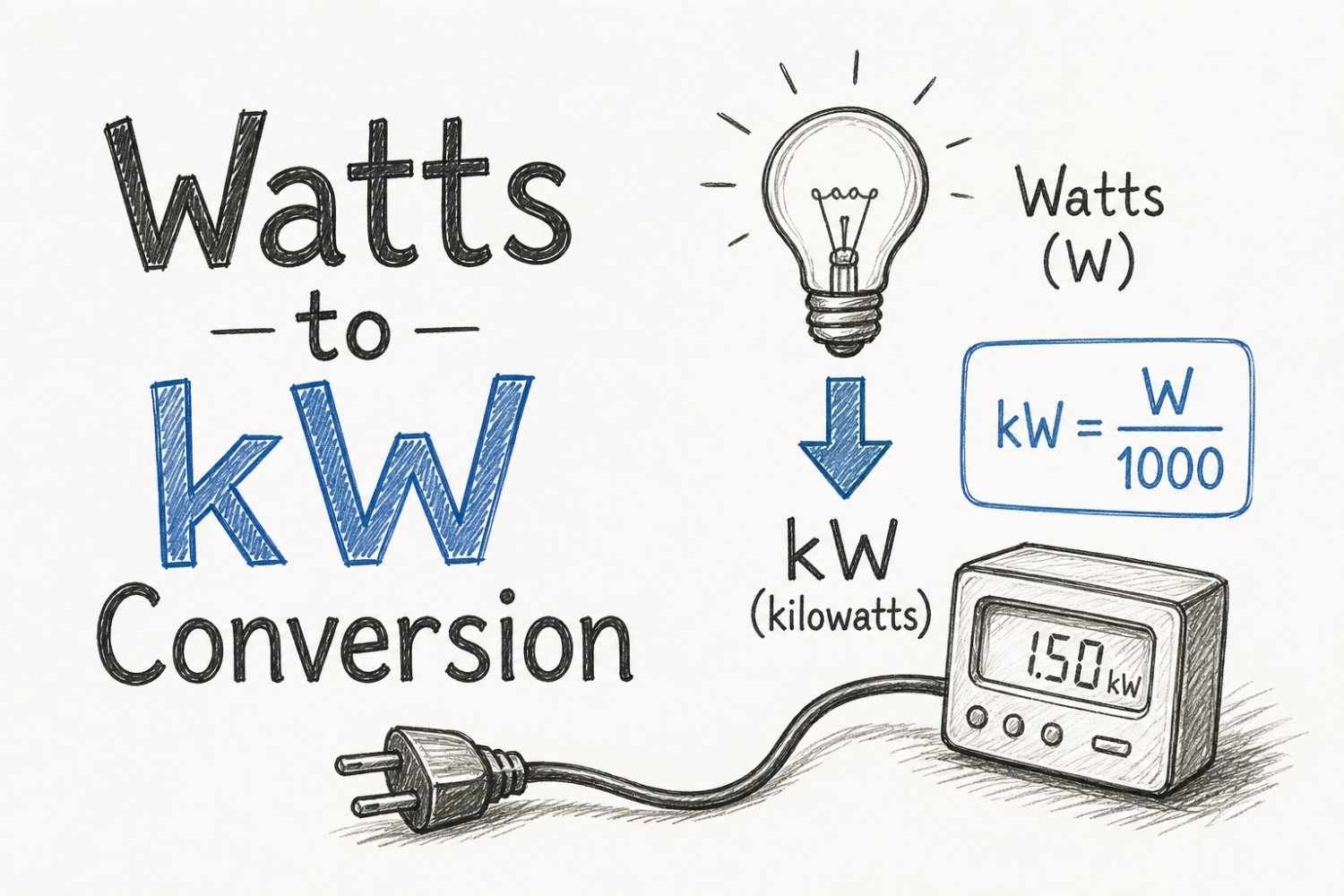
Watts to Kilowatts: \( \text{kW} = \frac{W}{1{,}000} \) or \( \text{kW} = W \times 0.001 \). Divide watts by 1,000 to convert to kilowatts. Examples: 10 W ÷ 1,000 = 0.01 kW (LED bulb 10W); 50 W ÷ 1,000 = 0.05 kW (ceiling fan, phone charger); 65 W ÷ 1,000 = 0.065 kW (laptop charger 65W typical); 100 W ÷ 1,000 = 0.1 kW (incandescent bulb 100W; LED TV 32-inch; laptop computer); 250 W ÷ 1,000 = 0.25 kW (desktop computer; game console; small power tool); 500 W ÷ 1,000 = 0.5 kW (gaming PC; blender; vacuum cleaner 500-1,000W); 750 W ÷ 1,000 = 0.75 kW (microwave low setting; toaster oven); 1,000 W ÷ 1,000 = 1 kW (microwave oven 1,000W; electric kettle 1,000-1,500W; space heater small); 1,200 W ÷ 1,000 = 1.2 kW (hair dryer 1,200-1,875W; toaster 1,200W; iron); 1,500 W ÷ 1,000 = 1.5 kW (space heater portable 1,500W max standard US outlet 15A × 120V = 1,800W max; hair dryer high); 2,000 W ÷ 1,000 = 2 kW (window AC 8,000-10,000 BTU 2,000-2,500W; electric oven single element); 2,400 W ÷ 1,000 = 2.4 kW (electric oven 240V 10A element typical); 3,000 W ÷ 1,000 = 3 kW (central AC small 1-2 ton 2,500-3,500W; clothes dryer element; water heater element); 3,600 W ÷ 1,000 = 3.6 kW (EV charger Level 2 240V 15A home); 4,500 W ÷ 1,000 = 4.5 kW (water heater 240V 4,500W typical element; electric range burner); 5,000 W ÷ 1,000 = 5 kW (central AC 2-3 ton; clothes dryer total; large electric oven 240V); 7,200 W ÷ 1,000 = 7.2 kW (EV charger Level 2 240V 30A typical home charging); 10,000 W ÷ 1,000 = 10 kW (whole house load peak; solar system residential medium 10kW capacity); 15,000 W ÷ 1,000 = 15 kW (whole house total load; large residential solar array); 50,000 W ÷ 1,000 = 50 kW (commercial building; DC fast EV charging station 50kW; small industrial motor). Kilowatts to Watts: \( W = \text{kW} \times 1{,}000 \). Multiply kilowatts by 1,000 to convert to watts. Examples: 0.01 kW × 1,000 = 10 W (LED bulb); 0.065 kW × 1,000 = 65 W (laptop charger); 0.1 kW × 1,000 = 100 W (laptop, TV); 0.5 kW × 1,000 = 500 W (desktop PC, blender); 1 kW × 1,000 = 1,000 W (microwave, kettle); 1.5 kW × 1,000 = 1,500 W (space heater, hair dryer); 2 kW × 1,000 = 2,000 W (window AC, oven element); 3 kW × 1,000 = 3,000 W (central AC small, dryer); 5 kW × 1,000 = 5,000 W (central AC, electric range); 7.2 kW × 1,000 = 7,200 W (EV charger home Level 2); 10 kW × 1,000 = 10,000 W (residential solar system, whole house); 50 kW × 1,000 = 50,000 W (commercial equipment, DC fast charging). This three-orders-of-magnitude conversion (move decimal three places left for W→kW, three places right for kW→W) enables electricians to aggregate circuit loads (kitchen: microwave 1,200W + oven 3,600W + dishwasher 1,800W + refrigerator 150W + lights 200W = 6,950W = 6.95 kW requires 240V 30A circuit or multiple 120V 20A circuits) and homeowners to understand utility billing where electricity sold by kilowatt-hour (kWh = kW × hours: AC 3 kW × 8 hrs/day × 30 days = 720 kWh/month × $0.12/kWh = $86.40 cooling cost).
Appliance Power Consumption Table
| Appliance/Device | Watts (W) | Kilowatts (kW) | Usage Pattern |
|---|---|---|---|
| LED bulb | 10-15 W | 0.01-0.015 kW | 4-6 hrs/day typical lighting |
| Phone charger | 5-20 W | 0.005-0.02 kW | 2-3 hrs charging daily |
| Laptop computer | 30-100 W | 0.03-0.1 kW | 4-8 hrs/day work/school |
| LED TV (55-inch) | 80-150 W | 0.08-0.15 kW | 3-5 hrs/day viewing |
| Desktop PC | 100-500 W | 0.1-0.5 kW | Office 100-200W; Gaming 300-500W |
| Refrigerator | 100-800 W | 0.1-0.8 kW | Cycles 8-10 hrs/day; 150-200W average |
| Microwave oven | 800-1,500 W | 0.8-1.5 kW | 10-30 min/day cooking |
| Hair dryer | 1,200-1,875 W | 1.2-1.875 kW | 5-15 min/day grooming |
| Space heater | 1,000-1,500 W | 1-1.5 kW | 4-8 hrs/day heating season |
| Window AC unit | 1,000-2,500 W | 1-2.5 kW | 6-12 hrs/day cooling season |
| Dishwasher | 1,200-2,400 W | 1.2-2.4 kW | 1-2 hrs/cycle; 1 cycle/day |
| Clothes washer | 400-1,400 W | 0.4-1.4 kW | 1 hr/load; 5-7 loads/week |
| Electric dryer | 2,000-5,000 W | 2-5 kW | 45-60 min/load; 5-7 loads/week |
| Central AC (3-ton) | 3,000-5,000 W | 3-5 kW | 8-12 hrs/day cooling season |
| Electric water heater | 3,000-4,500 W | 3-4.5 kW | Cycles 2-3 hrs/day total |
| EV charger Level 2 | 3,600-11,500 W | 3.6-11.5 kW | 4-8 hrs overnight charging |
| Whole house load | 10,000-20,000 W | 10-20 kW | Peak demand all systems running |
Energy Cost Calculations and Solar System Sizing
Understanding watts-kW conversions enables accurate energy cost analysis and renewable energy system design. Monthly Electricity Cost Calculation: Formula: Cost = Power (kW) × Hours × Days × Rate ($/kWh). Example household appliances daily usage: Refrigerator 150W average × 24 hrs = 3,600 Wh = 3.6 kWh/day; LED lighting 100W total × 6 hrs = 600 Wh = 0.6 kWh/day; TV 100W × 4 hrs = 400 Wh = 0.4 kWh/day; Laptop 50W × 6 hrs = 300 Wh = 0.3 kWh/day; Microwave 1,000W × 0.25 hrs (15 min) = 250 Wh = 0.25 kWh/day; Dishwasher 1,500W × 1 hr = 1,500 Wh = 1.5 kWh/day; Washing machine 500W × 1 hr = 500 Wh = 0.5 kWh/day; Dryer 3,000W × 1 hr = 3,000 Wh = 3 kWh/day; Water heater 4,000W × 2 hrs cycling = 8,000 Wh = 8 kWh/day; Central AC 3,500W × 8 hrs summer = 28,000 Wh = 28 kWh/day (seasonal). Total daily non-AC: 3.6 + 0.6 + 0.4 + 0.3 + 0.25 + 1.5 + 0.5 + 3 + 8 = 18.15 kWh/day. Monthly: 18.15 × 30 = 544.5 kWh/month base. Summer with AC: 18.15 + 28 = 46.15 kWh/day × 30 = 1,384.5 kWh/month. Cost at $0.12/kWh: Base 544.5 × $0.12 = $65.34/month; Summer 1,384.5 × $0.12 = $166.14/month (AC adds $100.80/month = $605/season 6 months). Solar System Sizing Example: House consuming 30 kWh/day average. Solar production calculation: Required system size = Daily consumption ÷ Peak sun hours ÷ System efficiency. Location: Southern California 5.5 peak sun hours/day average; System efficiency 0.80 (losses from inverter 4%, wiring 2%, shading 3%, soiling 2%, temperature 6%, mismatch 2% = 0.96 × 0.98 × 0.97 × 0.98 × 0.94 × 0.98 = 0.81 total efficiency factor). Calculation: 30 kWh/day ÷ 5.5 hrs ÷ 0.80 = 6.82 kW system size required. Specify: 7 kW solar array (conservative rounding). Panel specification: 400W panels (0.4 kW each). Number: 7,000W ÷ 400W = 17.5; install 18 panels = 7.2 kW system (provides margin). Annual production: 7.2 kW × 5.5 hrs/day × 365 days × 0.80 = 11,534 kWh/year production vs 30 kWh/day × 365 = 10,950 kWh/year consumption = 105% coverage (slight overproduction accounting for seasonal variation). Financial analysis: Cost $2.70/watt installed (2024 average post-incentives) × 7,200W = $19,440 total system cost. Annual savings: 10,950 kWh × $0.15/kWh average = $1,643/year electricity savings. Payback: $19,440 ÷ $1,643 = 11.8 years simple payback. 25-year value: $1,643 × 25 years = $41,075 savings (assuming constant rates; with 3%/year utility inflation = $56,000+ savings). EV Charging Energy Cost: Electric vehicle 75 kWh battery capacity. Home charging Level 2 at 7.2 kW: Charge time 75 kWh ÷ 7.2 kW = 10.4 hours 0-100% (typically charge 20-80% = 45 kWh in 6.25 hours overnight). Cost per charge: 75 kWh × $0.12/kWh = $9.00 full charge = $0.12/kWh home rate. Range: 75 kWh battery × 3.5 miles/kWh efficiency = 262.5 miles range. Cost per mile: $9.00 ÷ 262.5 miles = $0.034/mile = 3.4 cents/mile. Compare gasoline: 35 MPG car, $3.50/gallon gas = $0.10/mile = 10 cents/mile. EV saves $0.066/mile; at 15,000 miles/year = $990/year fuel savings. Monthly: 1,250 miles/month ÷ 3.5 mi/kWh = 357 kWh × $0.12 = $42.86/month EV charging vs $107.14 gasoline savings = $64.28/month ($771/year). DC fast charging public: 50 kW charger 10-80% = 52.5 kWh in 1.05 hours (63 minutes) at $0.35/kWh = $18.38 charge vs $9.00 home charging (2× cost premium convenience). Peak Demand Management: Utility demand charges commercial buildings $10-20/kW-month peak demand. Building peak load: HVAC 50 kW + lighting 10 kW + equipment 15 kW = 75 kW coincident peak. Monthly demand charge: 75 kW × $15/kW = $1,125/month demand ($13,500/year) plus energy charges (75 kW × 10 hrs/day × 22 business days × $0.10/kWh = $16,500 energy + $13,500 demand = $30,000/year total electricity). Load shedding reduces peak: Implement control system cycling HVAC, dimming lights during peak. New peak 65 kW saves 10 kW × $15 × 12 months = $1,800/year demand charge reduction justifying $10,000 control system investment = 5.6 year payback.
Why Choose RevisionTown's Watts to kW Converter?
RevisionTown's professional converter provides: (1) Standard SI Conversion—Precise 1,000× divider following International System of Units (kilo = 1,000); (2) Bidirectional Calculation—Convert W↔kW seamlessly for appliance ratings and energy analysis; (3) Integer and Decimal Support—Handles whole watts (1,500 W) and fractional kW (1.5 kW) for utility billing; (4) Bulk Processing—Convert multiple appliance ratings simultaneously for household energy audits and electrical system design; (5) Comprehensive Reference—Quick lookup from LED bulbs (10 W) to whole house loads (10,000 W = 10 kW); (6) Formula Transparency—View exact ÷1,000 calculations for energy cost analysis, solar sizing, and electrical specifications; (7) Mobile Optimized—Use on smartphones during appliance shopping, home energy audits, and electrical contractor consultations; (8) Zero Cost—Completely free with no registration or usage limitations; (9) Professional Accuracy—Trusted by electricians, energy auditors, solar installers, homeowners, facility managers, and students worldwide for appliance specifications (microwave 1,200W = 1.2 kW nameplate rating), utility bill analysis (monthly 850 kWh ÷ 720 hrs = 1.18 kW average continuous load), solar system sizing (daily 35 kWh ÷ 5 sun-hrs = 7 kW array required), electrical circuit design (kitchen load 6,500 W = 6.5 kW requires 240V 30A circuit minimum), energy cost calculations (3,000W AC × 8 hrs = 24 kWh × $0.12 = $2.88/day × 180 days = $518 season), EV charging planning (50 kW = 50,000W DC fast charging station electrical service requirements), demand charge optimization (peak load 85,000W = 85 kW × $15/kW-month = $1,275 demand charges), and all applications requiring accurate power conversions between watt appliance ratings and kilowatt utility billing units for professional electrical engineering, energy management, renewable energy design, and comprehensive residential and commercial power system analysis worldwide.
❓ Frequently Asked Questions
1,000 watts equals 1 kilowatt. Formula: 1,000 W = 1 kW. This is standard SI conversion: kilo prefix = 1,000. Examples: 100 W = 0.1 kW; 500 W = 0.5 kW; 1,000 W = 1 kW (microwave, kettle); 1,500 W = 1.5 kW (space heater, hair dryer); 2,000 W = 2 kW (window AC); 3,000 W = 3 kW (dryer, central AC); 5,000 W = 5 kW (electric range); 10,000 W = 10 kW (whole house, solar system).
Divide watts by 1,000. Formula: kW = W ÷ 1,000. Examples: 10 W = 0.01 kW (LED bulb); 65 W = 0.065 kW (laptop charger); 100 W = 0.1 kW (TV, laptop); 500 W = 0.5 kW (desktop PC); 1,000 W = 1 kW (microwave); 1,500 W = 1.5 kW (heater); 2,000 W = 2 kW (AC); 3,000 W = 3 kW (dryer); 5,000 W = 5 kW (range); 7,200 W = 7.2 kW (EV charger); 10,000 W = 10 kW (whole house). Move decimal three places left (W→kW).
1 kilowatt equals 1,000 watts. Formula: 1 kW = 1,000 W or 1 kW × 1,000 = 1,000 W. Examples: 0.01 kW = 10 W (LED); 0.1 kW = 100 W (laptop, TV); 0.5 kW = 500 W (desktop PC); 1 kW = 1,000 W (microwave, kettle); 1.5 kW = 1,500 W (space heater, hair dryer); 2 kW = 2,000 W (window AC, oven element); 3 kW = 3,000 W (central AC, dryer); 5 kW = 5,000 W (electric range, large AC); 10 kW = 10,000 W (whole house peak, solar system). Move decimal three places right (kW→W).
Thousand-fold difference. 1 kW = 1,000 W. Watts for small devices: LED bulbs 10 W, phone charger 20 W, laptop 65 W, TV 100 W, desktop 500 W. Kilowatts for large appliances: microwave 1 kW, space heater 1.5 kW, AC 2-5 kW, dryer 3 kW, EV charger 7.2 kW, solar system 5-10 kW residential. Both measure same quantity (power = energy per time); different scales. Utility bills use kWh (kilowatt-hours = kW × hours): 2 kW AC × 8 hrs = 16 kWh daily consumption.
Formula: Cost = (Watts ÷ 1,000) × Hours × Rate. Steps: (1) Convert watts to kW: W ÷ 1,000; (2) Multiply by hours used; (3) Multiply by electricity rate ($/kWh). Example: 1,500W space heater, 8 hrs/day, $0.12/kWh. Step 1: 1,500 ÷ 1,000 = 1.5 kW. Step 2: 1.5 kW × 8 hrs = 12 kWh/day. Step 3: 12 kWh × $0.12 = $1.44/day. Monthly: $1.44 × 30 = $43.20/month. Annual heating season (180 days): $1.44 × 180 = $259.20. Always convert watts to kW first for kWh energy calculation.
3,000 watts equals 3 kilowatts. Calculation: 3,000 W ÷ 1,000 = 3 kW. This is typical power for: clothes dryer electric (2,000-5,000W; 3,000W common); central AC small 1-2 ton (2,500-3,500W); water heater element (3,000-4,500W); electric range burner (2,500-3,500W single burner); portable generator small (3,000W continuous output). Monthly cost: 3 kW × 2 hrs/day × 30 days × $0.12/kWh = $21.60. Common residential high-load appliance requiring 240V circuit (3,000W ÷ 240V = 12.5A; use 20A circuit minimum).
5 kilowatts equals 5,000 watts peak capacity. Calculation: 5 kW × 1,000 = 5,000 W. Daily production depends on sun hours: 5 kW × 5 sun-hrs/day × 0.80 efficiency = 20 kWh/day average (location-dependent). Example locations: California 5.5 hrs: 5 kW × 5.5 × 0.80 = 22 kWh/day; Texas 5.0 hrs: 20 kWh/day; New York 4.0 hrs: 16 kWh/day. Annual: 20 kWh/day × 365 = 7,300 kWh/year typical. System value: 7,300 kWh × $0.15/kWh = $1,095/year savings. Typical house: 30 kWh/day = 900 kWh/month; 5 kW system covers 67% (20 ÷ 30 = 0.67) of usage reducing bills significantly.
Convenience for large power values. Kilowatts avoid large numbers: "central AC 3 kW" clearer than "3,000 W"; "solar system 10 kW" vs "10,000 W"; "whole house 15 kW peak" vs "15,000 W". Utility billing uses kWh (kilowatt-hours): Energy = kW × hours. Example: 2 kW AC × 8 hrs = 16 kWh (easy); vs 2,000 W AC = 16,000 Wh = 16 kWh (extra conversion). Industry standards: Utility meters display kWh; Solar systems rated kW capacity; EV chargers specified kW charging rate; Electrical service rated kW (200A panel = 48 kW max @ 240V). Use watts for small devices (< 1,000 W); kW for appliances and systems (≥ 1,000 W). Both measure same power; choose unit matching typical application range.