Electrical power conversion
Watts to kW Conversion
Convert watts to kilowatts instantly, then use the formulas, tables, examples, and cost calculations below to understand how W and kW work in appliances, electrical loads, solar sizing, EV charging, and utility billing.
Watts to kW Calculator
Enter a power value in watts. The calculator divides by \(1{,}000\) and returns the equivalent power in kilowatts. You can also use the reverse tab for kW to watts or the bulk tab for several appliance ratings.
Examples: 60, 100, 500, 1000, 1500, 3000, 7200, 10000.
Use this reverse check when a specification is already in kW.
Bulk mode is useful for appliance lists and energy audit notes.
Conversion result
1,000 W equals 1 kW.
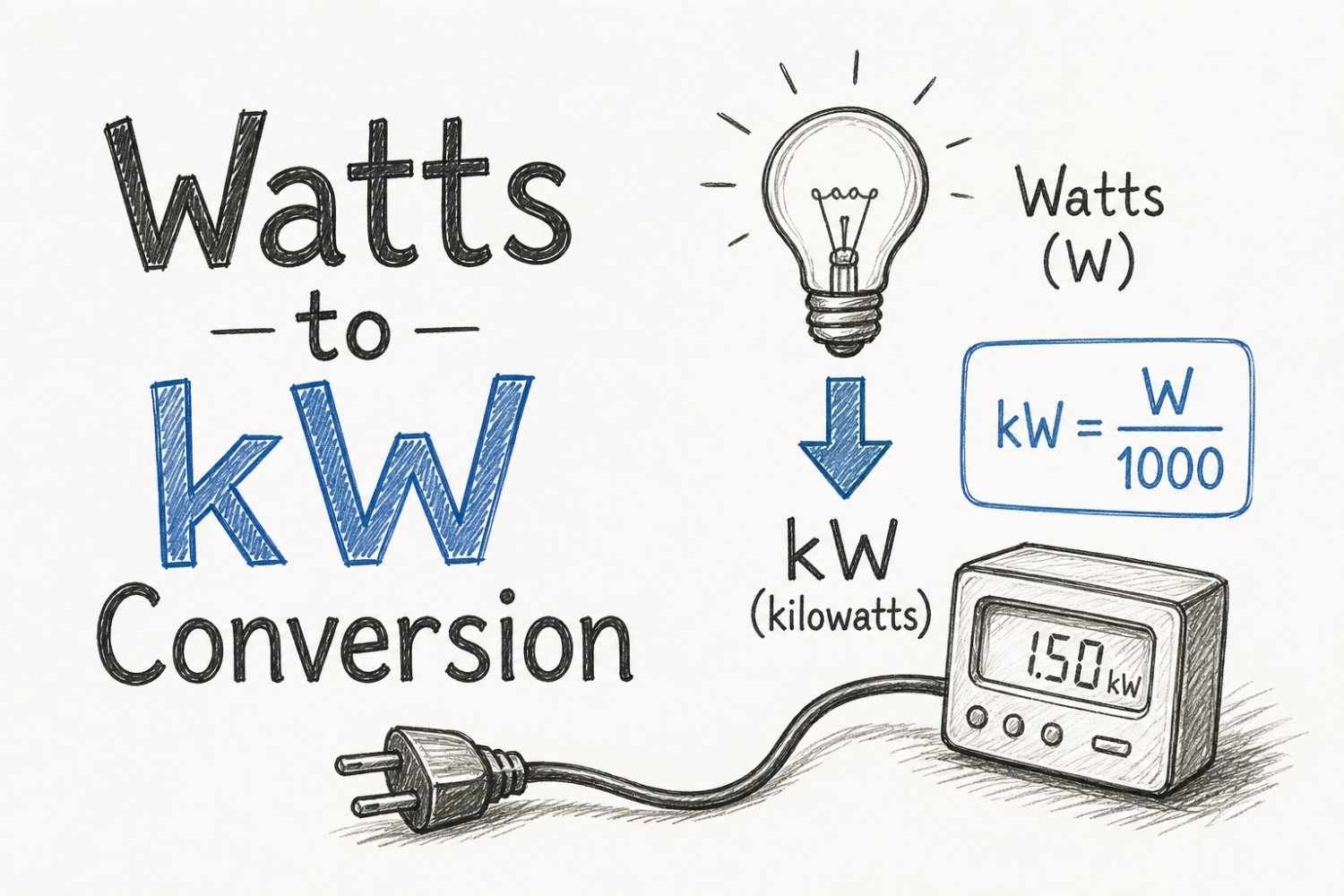
Fast answer: to convert watts to kW, divide watts by \(1{,}000\). In formula form, \(\text{kW}=\text{W}/1{,}000\). For example, \(1{,}500\,\text{W}=1.5\,\text{kW}\) and \(5{,}000\,\text{W}=5\,\text{kW}\).
What Does Watts to kW Conversion Mean?
Watts to kW conversion changes a power value written in watts into the same power value written in kilowatts. The amount of power does not change. Only the unit changes. A device rated at \(1{,}000\,\text{W}\) is the same size electrical load as a device rated at \(1\,\text{kW}\). The conversion is based on the metric prefix kilo, which means one thousand.
A watt, written as W, is a unit of power. Power is the rate at which energy is used, transferred, or produced. A kilowatt, written as kW, is also a unit of power, but it is a larger unit. Because \(1\,\text{kW}=1{,}000\,\text{W}\), watts are convenient for smaller devices such as lamps, chargers, laptops, televisions, and small appliances. Kilowatts are more convenient for larger loads such as space heaters, ovens, air conditioners, EV chargers, solar arrays, motors, and whole-building demand.
This page focuses on one clear intent: converting from watts to kilowatts. That focus matters because the related pages have different jobs. If your starting value is already in kilowatts and you need watts, use the dedicated kW to watts conversion page. If you need several power units beyond W and kW, the broader power conversion page is better. If you are comparing many unit types at once, use the advanced power converter. This page stays focused on \( \text{W} \rightarrow \text{kW} \).
The conversion is especially important because electricity bills, solar systems, and EV chargers often use kW and kWh, while appliance labels often use watts. A kettle might list \(1{,}800\,\text{W}\), a space heater might list \(1{,}500\,\text{W}\), and a microwave might list \(1{,}000\,\text{W}\). Converting those values into kW helps you estimate energy use over time. A \(1{,}500\,\text{W}\) heater is \(1.5\,\text{kW}\), so if it runs for \(4\) hours, it uses \(1.5\times 4=6\,\text{kWh}\).
When the unit changes from watts to kilowatts, the number becomes smaller because kilowatts are larger units. This is the opposite of converting kW to watts. A larger unit needs fewer units to describe the same power. That is why \(5{,}000\,\text{W}\) becomes \(5\,\text{kW}\), not \(5{,}000{,}000\,\text{kW}\). A quick sanity check is simple: watts to kW should divide by one thousand, so the numeric value should usually move three decimal places to the left.
Watts to kW Formula
The watts to kW formula is exact. It is not an estimate and it does not depend on voltage, current, power factor, country, or electricity price. Those details may matter in later electrical calculations, but the unit conversion itself is fixed.
Watts to Kilowatts
\[\text{kW}=\frac{\text{W}}{1{,}000}\]
\[\text{kW}=\text{W}\times 0.001\]
Both forms are equivalent. Dividing by \(1{,}000\) is usually easiest. Multiplying by \(0.001\) is useful in spreadsheets and programming.
Reverse Formula
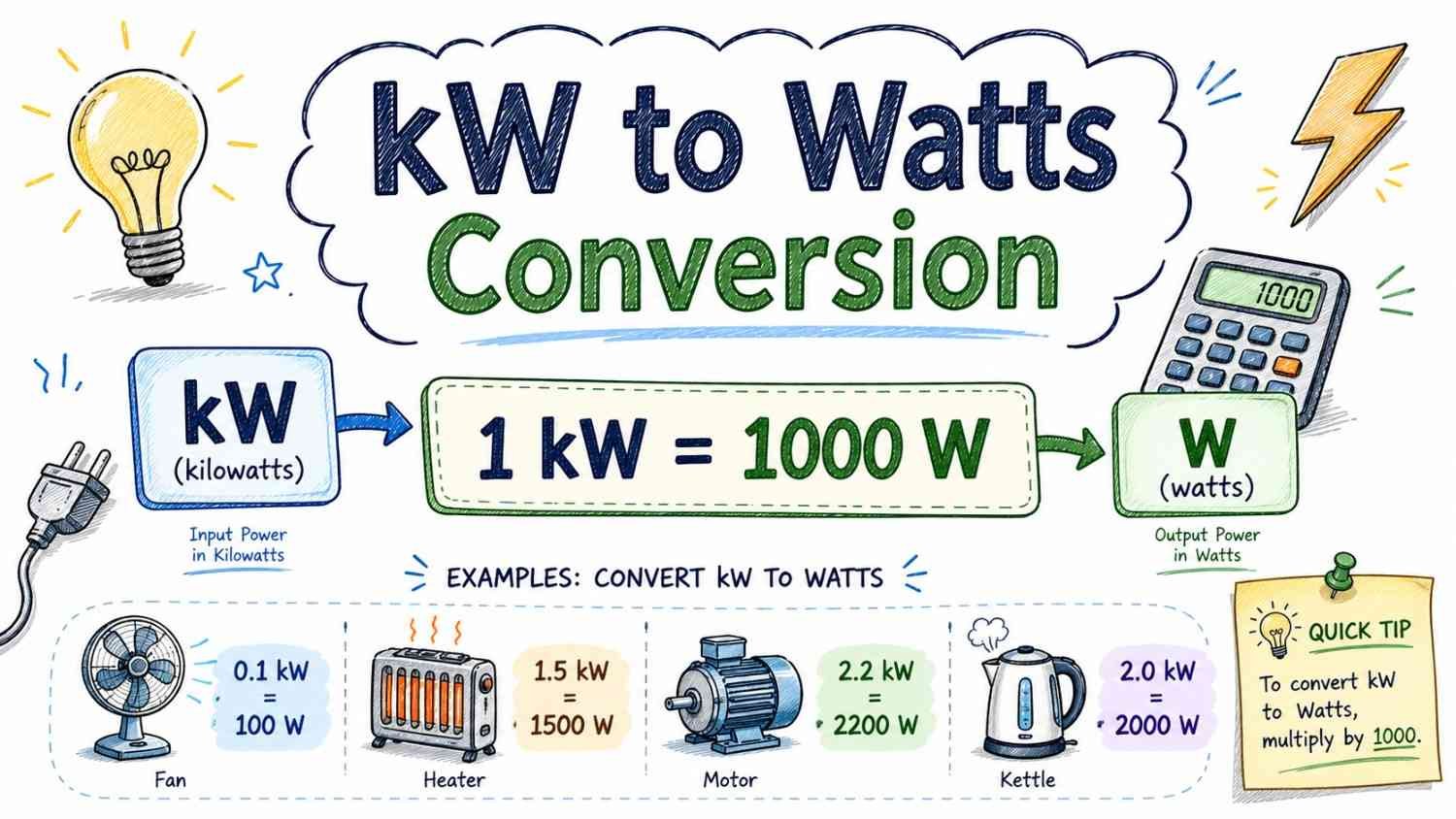
\[\text{W}=\text{kW}\times 1{,}000\]
The reverse formula is for kW to watts. Use it when the starting value is in kW and the answer should be W.
Step-by-Step Method
- Write down the power value in watts.
- Divide the watt value by \(1{,}000\).
- Move the decimal point three places to the left if converting mentally.
- Write the answer with the unit kW.
- If the kW value will be used for energy cost, multiply by time in hours to get kWh.
For example, convert \(2{,}400\,\text{W}\) into kW. The calculation is \(2{,}400/1{,}000=2.4\). Therefore, \(2{,}400\,\text{W}=2.4\,\text{kW}\). If that appliance runs for \(3\) hours, the energy use is \(2.4\times 3=7.2\,\text{kWh}\).
Decimal Movement Shortcut
Because dividing by \(1{,}000\) moves the decimal three places left, you can convert many values mentally. \(500\,\text{W}\) becomes \(0.500\,\text{kW}\), usually written as \(0.5\,\text{kW}\). \(1{,}250\,\text{W}\) becomes \(1.250\,\text{kW}\), usually written as \(1.25\,\text{kW}\). \(15{,}000\,\text{W}\) becomes \(15\,\text{kW}\). If you move the decimal in the wrong direction, the answer will be off by a factor of \(1{,}000{,}000\) compared with the correct reciprocal conversion.
What the Formula Does Not Include
The formula \(\text{kW}=\text{W}/1{,}000\) only changes the unit scale. It does not calculate energy cost, current, voltage, circuit size, or runtime. Those tasks use additional formulas. For example, energy uses \(\text{kWh}=\text{kW}\times \text{hours}\), while current for a simple DC or resistive load can use \(I=P/V\). Keep the unit conversion separate from the next calculation so each step is clear.
Watts to kW Conversion Table
The table below gives common watt values in kilowatts. Use it for quick checks when reading appliance labels, estimating household demand, checking generator capacity, or preparing a solar and battery worksheet.
| Watts (W) | Kilowatts (kW) | Formula | Typical context |
|---|---|---|---|
| 1 W | 0.001 kW | \(1/1{,}000\) | Very small electronics |
| 5 W | 0.005 kW | \(5/1{,}000\) | Small charger or LED indicator |
| 10 W | 0.01 kW | \(10/1{,}000\) | LED bulb |
| 60 W | 0.06 kW | \(60/1{,}000\) | Lighting or small fan |
| 100 W | 0.1 kW | \(100/1{,}000\) | TV, laptop, or small appliance |
| 250 W | 0.25 kW | \(250/1{,}000\) | Desktop computer or small tool |
| 500 W | 0.5 kW | \(500/1{,}000\) | Gaming PC, blender, or appliance cycle |
| 750 W | 0.75 kW | \(750/1{,}000\) | Small microwave or toaster oven |
| 1,000 W | 1 kW | \(1{,}000/1{,}000\) | Microwave or kettle scale |
| 1,200 W | 1.2 kW | \(1{,}200/1{,}000\) | Toaster, iron, or hair dryer |
| 1,500 W | 1.5 kW | \(1{,}500/1{,}000\) | Space heater |
| 2,000 W | 2 kW | \(2{,}000/1{,}000\) | Oven element or window AC scale |
| 3,000 W | 3 kW | \(3{,}000/1{,}000\) | Dryer, water heater, or HVAC load |
| 4,500 W | 4.5 kW | \(4{,}500/1{,}000\) | Water heater element |
| 7,200 W | 7.2 kW | \(7{,}200/1{,}000\) | Level 2 EV charger scale |
| 10,000 W | 10 kW | \(10{,}000/1{,}000\) | Residential solar or whole-house peak scale |
| 50,000 W | 50 kW | \(50{,}000/1{,}000\) | Commercial equipment or DC charging scale |
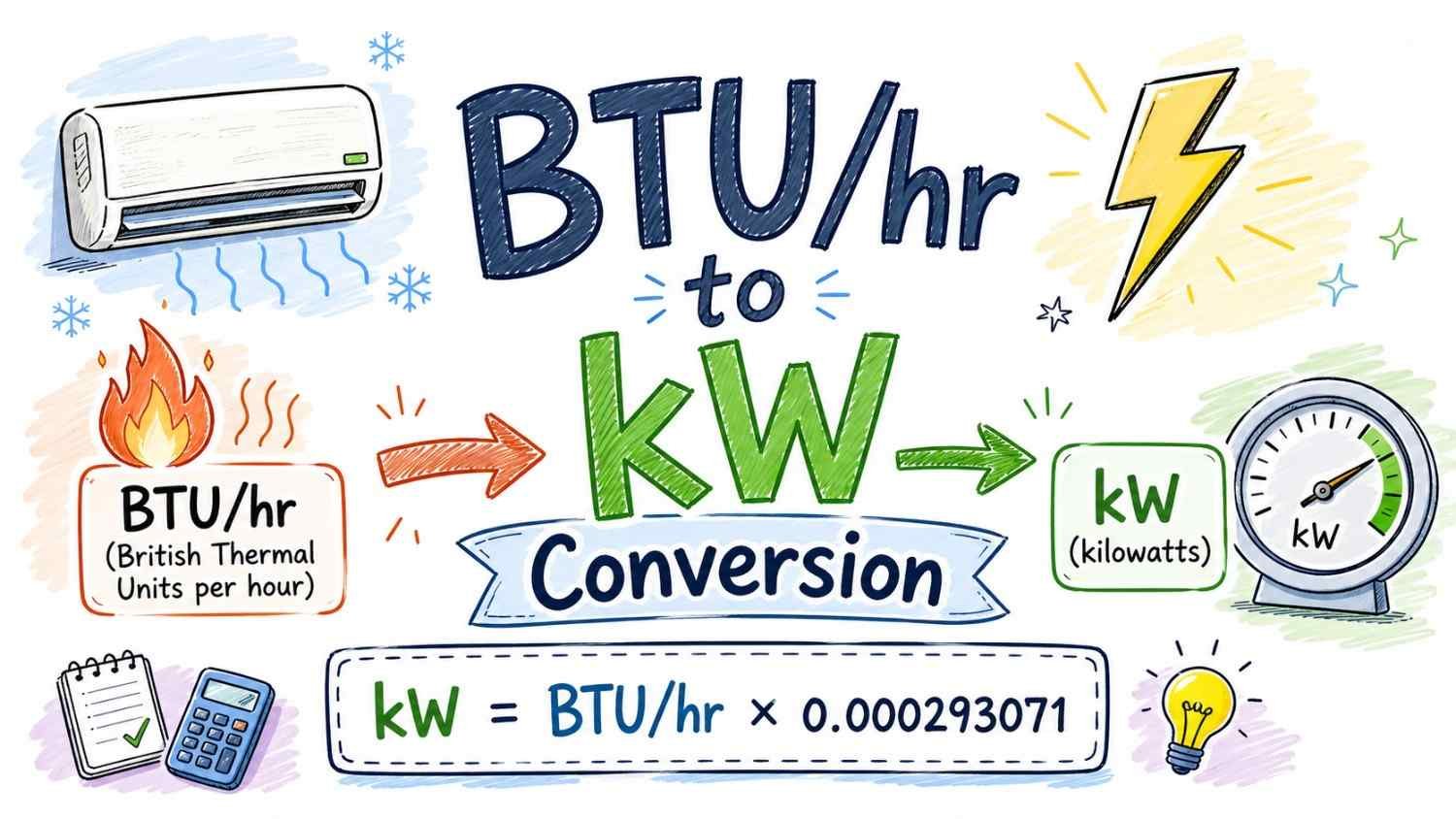
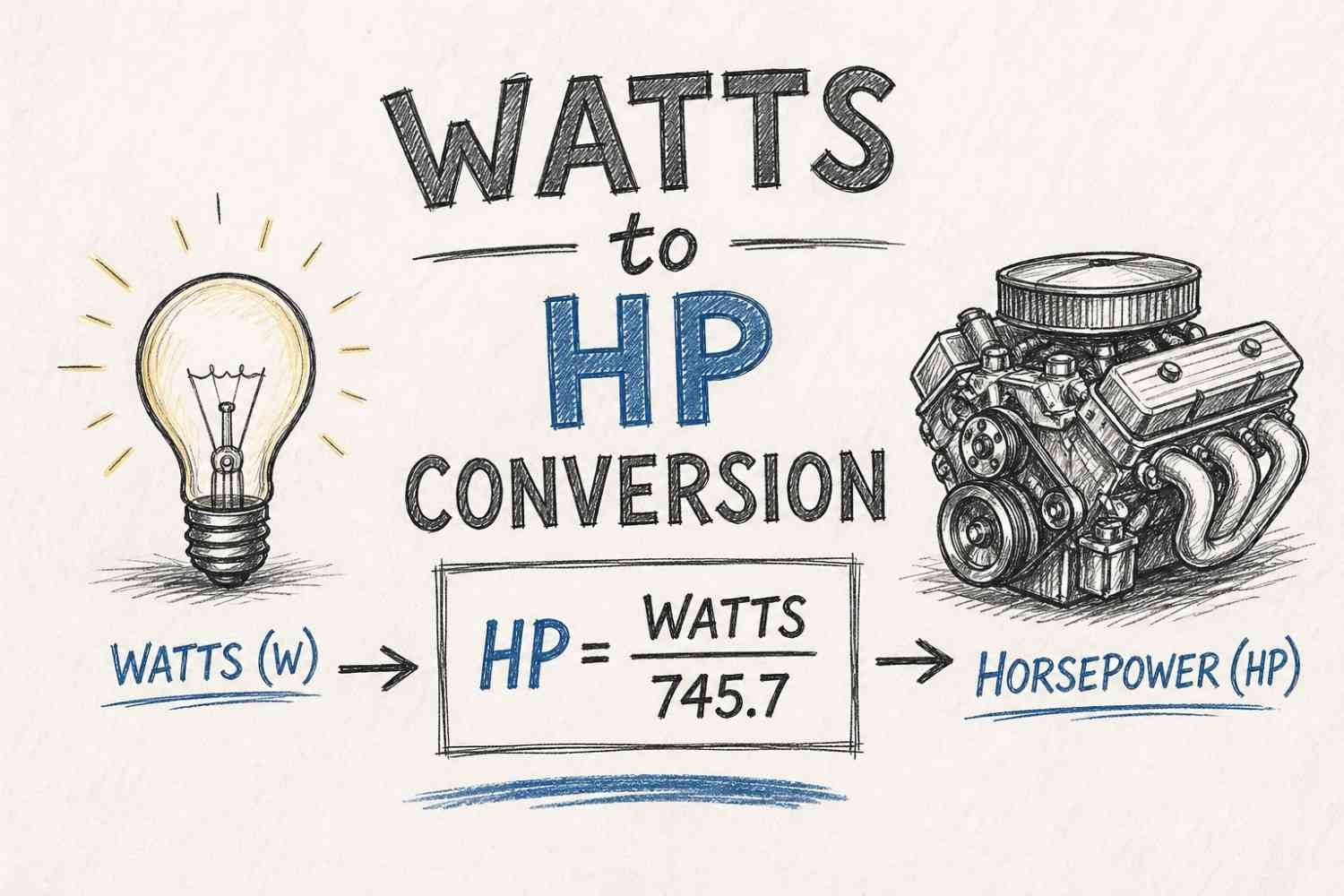
For conversions to different power units, use the correct page rather than forcing every calculation through kW. If your goal is horsepower, use the watts to horsepower conversion. If you are working with HVAC heat rate, the watts to BTU/hr conversion is the direct unit pair.
Worked Watts to kW Examples
Each worked example starts with watts and ends with kilowatts. The unit conversion step is the same every time: divide by \(1{,}000\). Later steps, such as energy use or cost, are separate calculations built from the converted kW value.
Example 1: Convert 100 W to kW
Use the formula:
\[\text{kW}=\frac{\text{W}}{1{,}000}\]
Substitute \(100\,\text{W}\):
\[\text{kW}=\frac{100}{1{,}000}=0.1\]
Therefore, \(100\,\text{W}=0.1\,\text{kW}\). This is a common scale for televisions, laptops, monitors, and small home electronics.
Example 2: Convert 500 W to kW
A \(500\,\text{W}\) load converts as follows:
\[\frac{500}{1{,}000}=0.5\]
So \(500\,\text{W}=0.5\,\text{kW}\). If the device runs for \(2\) hours, it uses \(0.5\times 2=1\,\text{kWh}\).
Example 3: Convert 1,500 W to kW
A portable heater is often rated around \(1{,}500\,\text{W}\):
\[\frac{1{,}500}{1{,}000}=1.5\]
Therefore, \(1{,}500\,\text{W}=1.5\,\text{kW}\). If it runs for \(8\) hours, the energy use is \(1.5\times 8=12\,\text{kWh}\). At a rate of \(\$0.15/\text{kWh}\), the cost would be \(12\times 0.15=\$1.80\) for that period.
Example 4: Convert 3,000 W to kW
A larger appliance rated at \(3{,}000\,\text{W}\) is:
\[\frac{3{,}000}{1{,}000}=3\]
So \(3{,}000\,\text{W}=3\,\text{kW}\). This power scale is common for dryers, water heaters, small central air-conditioning loads, and some cooking appliances.
Example 5: Convert 7,200 W to kW
A home EV charger may be listed around \(7{,}200\,\text{W}\):
\[\frac{7{,}200}{1{,}000}=7.2\]
Therefore, \(7{,}200\,\text{W}=7.2\,\text{kW}\). If the charger delivers \(7.2\,\text{kW}\) for \(5\) hours, the energy delivered is \(7.2\times 5=36\,\text{kWh}\), before considering charging losses.
Example 6: Convert 10,000 W to kW
A \(10{,}000\,\text{W}\) value appears in generator capacity, solar system size, and household peak-load estimates:
\[\frac{10{,}000}{1{,}000}=10\]
So \(10{,}000\,\text{W}=10\,\text{kW}\). This is much easier to read as \(10\,\text{kW}\) than as \(10{,}000\,\text{W}\), especially when comparing large systems.
Example 7: Convert 75 W to kW
For a smaller decimal result:
\[\frac{75}{1{,}000}=0.075\]
Therefore, \(75\,\text{W}=0.075\,\text{kW}\). Keep the leading zero before the decimal because it makes the value easier to read and less likely to be copied incorrectly.
Watts, kW, and kWh: Power vs Energy
One of the most important uses of watts to kW conversion is energy cost estimation. Watts and kW measure power. Kilowatt-hours, written as kWh, measure energy. The difference matters because a utility bill charges for energy used over time, not just the power rating printed on an appliance label.
Power to Energy
\[\text{kWh}=\text{kW}\times \text{hours}\]
\[\text{cost}=\text{kWh}\times \text{electricity rate}\]
If a device is rated in watts, convert to kW first. For a \(2{,}000\,\text{W}\) appliance, \(2{,}000\,\text{W}=2\,\text{kW}\). If it runs for \(3\) hours, it uses \(2\times 3=6\,\text{kWh}\). If electricity costs \(\$0.18/\text{kWh}\), the cost is \(6\times 0.18=\$1.08\).
This distinction helps explain why a high-wattage appliance is not always expensive if it runs briefly. A \(1{,}500\,\text{W}\) toaster running for \(5\) minutes uses \(1.5\,\text{kW}\times 5/60\,\text{h}=0.125\,\text{kWh}\). A \(100\,\text{W}\) device running all day uses \(0.1\,\text{kW}\times 24\,\text{h}=2.4\,\text{kWh}\). The lower-power device can use more energy if it runs much longer.
Do not confuse this page with energy-unit conversion. Watts to kW is a power conversion. If you are converting energy units such as joules and kilowatt-hours, use the relevant energy resources, such as the joules to kWh conversion, the kWh to joules conversion, or the broader energy converter.
Daily and Monthly Cost Example
Suppose a \(1{,}500\,\text{W}\) space heater runs \(6\) hours per day and electricity costs \(\$0.16/\text{kWh}\). First convert watts to kW:
\[1{,}500\,\text{W}=1.5\,\text{kW}\]
Then calculate daily energy:
\[1.5\,\text{kW}\times 6\,\text{h}=9\,\text{kWh}\]
Daily cost is:
\[9\,\text{kWh}\times \$0.16/\text{kWh}=\$1.44\]
For \(30\) days, the approximate monthly cost is \(\$1.44\times 30=\$43.20\). The conversion from watts to kW is only the first step, but it makes the rest of the bill calculation simple.
Common Appliance Loads in Watts and kW
Appliance wattages vary by model, efficiency, age, voltage, duty cycle, and usage setting. The table below gives practical planning ranges, not a substitute for checking the nameplate label or manufacturer specification. Use the converter above for the exact number from your device.
| Device or load | Typical watts | Typical kW | Planning note |
|---|---|---|---|
| LED bulb | 5 to 15 W | 0.005 to 0.015 kW | Small individually, but many lights add up |
| Phone charger | 5 to 30 W | 0.005 to 0.03 kW | Low power, usually short duration |
| Laptop | 30 to 100 W | 0.03 to 0.1 kW | Actual draw changes with charging and workload |
| Television | 50 to 200 W | 0.05 to 0.2 kW | Size and display type matter |
| Desktop computer | 100 to 600 W | 0.1 to 0.6 kW | Gaming and workstation loads can be higher |
| Refrigerator | 100 to 800 W while cycling | 0.1 to 0.8 kW | Average use is lower because compressor cycles |
| Microwave | 800 to 1,500 W | 0.8 to 1.5 kW | Input wattage can exceed cooking output wattage |
| Hair dryer | 1,200 to 1,875 W | 1.2 to 1.875 kW | High power but usually short runtime |
| Space heater | 1,000 to 1,500 W | 1 to 1.5 kW | Cost depends heavily on hours used |
| Dishwasher | 1,200 to 2,400 W | 1.2 to 2.4 kW | Heating phase usually dominates power draw |
| Electric dryer | 2,000 to 5,000 W | 2 to 5 kW | Large household load |
| Water heater element | 3,000 to 4,500 W | 3 to 4.5 kW | Cycles based on water use and thermostat |
| Level 2 EV charger | 3,600 to 11,500 W | 3.6 to 11.5 kW | Electrical service and vehicle limit both matter |
| Residential solar array | 5,000 to 12,000 W | 5 to 12 kW | Capacity rating, not constant production |
Nameplate Power vs Actual Power
An appliance label may show a rated maximum, not the average draw every minute it operates. A refrigerator might have a high compressor startup draw but a much lower daily average because it cycles on and off. A microwave might show input power and output cooking power separately. A computer power supply might be rated for a maximum capacity that is higher than typical use. The watts to kW conversion remains exact, but the source watt value must be chosen carefully.
Continuous Loads and Short Loads
A continuous load is a load expected to run for a long period, while a short load runs briefly. Two devices with the same wattage can have very different energy cost because runtime changes kWh. A \(1.5\,\text{kW}\) heater running all evening costs much more than a \(1.5\,\text{kW}\) toaster running for a few minutes. Always combine kW with hours when estimating usage.
Using Watts to kW for Solar, EV Charging, and Electrical Planning
Watts to kW conversion is practical in three common planning situations: solar system sizing, EV charging estimates, and electrical load summaries. These applications are related, but each uses kW in a specific way.
Solar Panel and Solar System Sizing
Solar panels are often rated in watts, while complete solar systems are usually discussed in kW. If a panel is rated at \(400\,\text{W}\), then each panel is \(0.4\,\text{kW}\). A system with \(18\) such panels has a panel capacity of:
\[18\times 400\,\text{W}=7{,}200\,\text{W}=7.2\,\text{kW}\]
That \(7.2\,\text{kW}\) value is the system's rated DC capacity under standard test conditions, not a guarantee that it produces \(7.2\,\text{kW}\) all day. Actual production depends on sun angle, temperature, shading, inverter limits, panel orientation, dirt, and local weather. If you are estimating panel needs from home usage, RevisionTown's solar panel wattage calculator can help connect load and system sizing.
A simple production estimate is:
\[\text{kWh per day}\approx \text{system kW}\times \text{peak sun hours}\times \text{efficiency factor}\]
For a \(7.2\,\text{kW}\) system with \(5\) peak sun hours and an \(0.80\) performance factor, estimated daily production is \(7.2\times 5\times 0.80=28.8\,\text{kWh}\). The watts-to-kW conversion is the first step that turns individual panel ratings into a whole-system size.
EV Charging
EV chargers are often discussed in kW because charging is a large power load. A \(7{,}200\,\text{W}\) charger is \(7.2\,\text{kW}\). If it delivers power for \(4\) hours, the energy delivered before losses is \(7.2\times 4=28.8\,\text{kWh}\). If charging losses are around \(10\%\), the energy drawn from the wall may be higher than the energy stored in the battery.
For cost estimation, use the kW value and charging duration. A charger drawing \(7.2\,\text{kW}\) for \(6\) hours uses \(43.2\,\text{kWh}\). At \(\$0.14/\text{kWh}\), the cost is \(43.2\times 0.14=\$6.05\), rounded to the nearest cent. The exact cost depends on the electricity plan, time-of-use pricing, vehicle limits, and charger settings.
Electrical Load and Circuit Planning
Electrical planning often starts with watt values and then converts to kW for summaries. A kitchen might include a \(1{,}200\,\text{W}\) microwave, a \(1{,}500\,\text{W}\) dishwasher heating cycle, a \(200\,\text{W}\) refrigerator average during compressor operation, and \(150\,\text{W}\) of lighting. The total is \(3{,}050\,\text{W}\), or \(3.05\,\text{kW}\). That total is useful for energy awareness, but circuit design must also consider voltage, current, breaker size, wiring, continuous load rules, local codes, and simultaneous operation.
For a simple resistive load, current can be estimated with:
\[I=\frac{P}{V}\]
Here \(P\) is power in watts and \(V\) is voltage. A \(1{,}500\,\text{W}\) heater on a \(120\,\text{V}\) circuit draws approximately \(1{,}500/120=12.5\,\text{A}\). This current calculation uses watts, not kW, so if you start from kW, convert back to watts first or multiply the kW value by \(1{,}000\).
Commercial Demand
Commercial bills may include demand charges based on peak kW. A building might consume many kWh over a month, but the demand charge is often tied to the highest measured kW during a short interval. Converting equipment watts to kW helps facility managers estimate which loads drive the peak. A \(50{,}000\,\text{W}\) process load is \(50\,\text{kW}\). If demand charges are \(\$15\) per kW for peak demand, that load can materially affect the monthly bill when it coincides with other large loads.
Watts to kW Compared with Related Power Conversions
Watts and kilowatts sit in the same SI power family. The watt is the smaller unit, and the kilowatt is one thousand watts. Other power conversions use different relationships and serve different tasks. Keeping these pages separate helps avoid accidental unit mixing.
| Conversion | Use when | Basic relationship | RevisionTown resource |
|---|---|---|---|
| Watts to kW | Appliance watts need utility-scale kW | \(\text{kW}=\text{W}/1{,}000\) | This page |
| kW to watts | A kW value must be expanded to watts | \(\text{W}=\text{kW}\times 1{,}000\) | kW to watts conversion |
| Watts to horsepower | Electrical or mechanical power is compared with hp | Depends on horsepower definition | watts to hp conversion |
| Watts to BTU/hr | Electrical power is compared with heating or cooling rate | \(1\,\text{W}\approx 3.412\,\text{BTU/hr}\) | watts to BTU/hr conversion |
| BTU/hr to kW | HVAC capacity is converted into kW | \(1\,\text{kW}\approx 3{,}412.142\,\text{BTU/hr}\) | BTU/hr to kilowatts conversion |
| All power units | You need several unit families at once | Varies by unit | easy power converter |
The key point is that watts to kW is a metric scale conversion. It should not be treated as a heat conversion, a horsepower conversion, or an energy conversion. Each of those has its own formula, assumptions, and use case.
Common Watts to kW Mistakes
Watts to kW is a straightforward conversion, but mistakes still happen because W, kW, and kWh appear together in appliances, utility bills, and solar estimates. Use these checks before relying on a result.
Multiplying Instead of Dividing
To convert W to kW, divide by \(1{,}000\). Multiplying by \(1{,}000\) converts kW to W. If \(1{,}500\,\text{W}\) becomes \(1{,}500{,}000\,\text{kW}\), the direction is wrong. The correct answer is \(1.5\,\text{kW}\).
Confusing kW with kWh
kW is power. kWh is energy. A \(2\,\text{kW}\) appliance is not automatically \(2\,\text{kWh}\). It uses \(2\,\text{kWh}\) only if it runs for \(1\) hour. If it runs for \(30\) minutes, it uses \(1\,\text{kWh}\). If it runs for \(5\) hours, it uses \(10\,\text{kWh}\).
Using Rated Power as Average Power
Many appliances do not draw their rated power continuously. Refrigerators, heat pumps, air conditioners, washing machines, dryers, and water heaters cycle or vary by setting. A nameplate value is useful for load planning, but daily energy estimates should use actual runtime, duty cycle, or measured consumption when possible.
Ignoring Starting Surge
Motors and compressors can draw a starting surge higher than their running wattage. This matters for generators, inverters, and some backup power systems. Converting the running wattage to kW is still useful, but it may not fully describe the momentary starting requirement.
Mixing AC Power Factor into a Simple Unit Conversion
Watts to kW is an active power conversion. In AC systems, apparent power may be listed in volt-amperes or kilovolt-amperes. Power factor affects the relationship between apparent power and real power. Do not treat VA, kVA, W, and kW as interchangeable without checking the equipment rating and power factor.
Copying Values Without Units
A bare number such as \(1.5\) is not enough. It could mean \(1.5\,\text{W}\), \(1.5\,\text{kW}\), \(1.5\,\text{kWh}\), or something else. Always write the unit. In tables, label columns clearly as W, kW, hours, kWh, and cost.
How to Check and Round a Watts to kW Answer
A watts to kW answer is easy to check because the conversion factor is a clean power of ten. The main question is whether the decimal point moved in the correct direction and whether the final value has a sensible number of digits. You do not need advanced math to catch most mistakes.
Check 1: The kW Number Should Be Smaller Than the Watt Number
Since \(1\,\text{kW}\) is \(1{,}000\,\text{W}\), the numeric value in kW should be smaller than the numeric value in W for any positive power above zero. If \(800\,\text{W}\) becomes \(800{,}000\,\text{kW}\), the conversion direction is wrong. The correct result is \(0.8\,\text{kW}\). If \(12{,}000\,\text{W}\) becomes \(12\,\text{kW}\), the size relationship makes sense.
Check 2: Use Anchor Values
Memorize three anchor conversions: \(100\,\text{W}=0.1\,\text{kW}\), \(1{,}000\,\text{W}=1\,\text{kW}\), and \(10{,}000\,\text{W}=10\,\text{kW}\). If your value is between \(1{,}000\) and \(10{,}000\,\text{W}\), the answer should be between \(1\) and \(10\,\text{kW}\). If the answer is outside that range, check the decimal placement before using it in a bill or load calculation.
Check 3: Convert Back to Watts
A reliable back-check is to multiply the kW answer by \(1{,}000\). If \(2.75\,\text{kW}\times 1{,}000=2{,}750\,\text{W}\), the conversion is consistent. This is useful when values have decimals, such as \(625\,\text{W}=0.625\,\text{kW}\) or \(8{,}450\,\text{W}=8.45\,\text{kW}\).
Rounding for Everyday Use
For most household estimates, two or three decimal places are enough. \(65\,\text{W}=0.065\,\text{kW}\) should keep three decimals because rounding to \(0.07\,\text{kW}\) changes the value noticeably. \(1{,}875\,\text{W}=1.875\,\text{kW}\) can be kept as \(1.875\,\text{kW}\) if you are calculating cost, or rounded to \(1.9\,\text{kW}\) for a rough conversation. \(10{,}000\,\text{W}=10\,\text{kW}\) does not need unnecessary zeros unless a spreadsheet or engineering format requires them.
Rounding for Appliance and Energy Cost Tables
When preparing an appliance table, use enough precision to preserve small loads. A phone charger at \(12\,\text{W}\) is \(0.012\,\text{kW}\), not \(0.01\,\text{kW}\) if you want a close calculation. A refrigerator averaging \(150\,\text{W}\) is \(0.15\,\text{kW}\). A water heater element at \(4{,}500\,\text{W}\) is \(4.5\,\text{kW}\). The smaller the load, the more important the decimal places can be if you are adding many items together.
Significant Figures
The unit conversion itself is exact, but the original watt rating may be approximate. A device labeled \(1{,}500\,\text{W}\) may not draw exactly \(1{,}500\,\text{W}\) in every operating condition. It might cycle, ramp, or operate differently by setting. When a wattage is a rough manufacturer rating, do not present the calculated kW value as if it were a precise measured value. \(1{,}500\,\text{W}=1.5\,\text{kW}\) is usually a better practical answer than \(1.500000\,\text{kW}\).
Where Watts to kW Fits in Power Equations
Watts and kilowatts both measure power, but different equations may expect the value in one form or the other. The conversion on this page helps you move between appliance labels, calculation formulas, and utility-style summaries. For a broader formula reference, see RevisionTown's power equations resource.
Electrical Power from Voltage and Current
For a simple DC load or a resistive AC load, electrical power can be written as:
\[P=VI\]
Here \(P\) is power in watts, \(V\) is voltage in volts, and \(I\) is current in amperes. If a device draws \(10\,\text{A}\) at \(120\,\text{V}\), then \(P=120\times 10=1{,}200\,\text{W}\). Convert that to kW by dividing by \(1{,}000\): \(1{,}200\,\text{W}=1.2\,\text{kW}\). The formula produces watts first, while the conversion makes the result easier to compare with energy billing and larger load summaries.
Power from Energy and Time
Power can also be described as energy per unit time:
\[P=\frac{E}{t}\]
One watt is one joule per second. This definition explains why kWh is an energy unit: a kilowatt multiplied by time gives energy. If a load uses \(6\,\text{kWh}\) over \(3\) hours, its average power is \(6/3=2\,\text{kW}\), or \(2{,}000\,\text{W}\). If the same energy is used over \(1\) hour, the average power is \(6\,\text{kW}\). Time changes energy use even when the appliance rating stays the same.
Average Power vs Peak Power
Peak power is the maximum power during a short interval. Average power is power averaged over time. A \(1{,}500\,\text{W}\) heater may be \(1.5\,\text{kW}\) while heating, but if a thermostat cycles it on half the time, its average over a long period may be closer to \(0.75\,\text{kW}\). For cost calculations, average kW over time is often more useful than the nameplate peak. For wiring, generator sizing, and inverter capacity, peak and starting loads may matter more.
AC Loads and Power Factor
In AC systems, real power in watts is not always the same as apparent power in volt-amperes. For many household estimates, the watt rating on the label is the value you convert to kW. For motors, commercial equipment, and industrial systems, power factor may matter. A load with poor power factor can draw more apparent current than the real kW alone suggests. The watts-to-kW conversion is still exact for real power, but it does not replace full electrical design.
Why the Unit Choice Changes the Readability
Equations often work cleanly in watts because volts and amperes multiply directly to watts. Bills and large system summaries often work cleanly in kilowatts because the numbers are shorter. A value such as \(8{,}400\,\text{W}\) is often easier to compare as \(8.4\,\text{kW}\). A value such as \(0.006\,\text{kW}\) is often easier to understand as \(6\,\text{W}\). The correct unit is the one that communicates the scale without hiding the calculation.
Detailed Load Planning Examples
Watts to kW conversion becomes more useful when several loads are combined. The examples below show how to move from individual watt ratings to a readable kW total and then, when appropriate, into kWh.
Example: Small Apartment Evening Load
Suppose an apartment has \(120\,\text{W}\) of lighting, a \(100\,\text{W}\) television, a \(60\,\text{W}\) laptop, a \(900\,\text{W}\) microwave used briefly, and a \(1{,}500\,\text{W}\) space heater. If all were on at the same moment, the total connected load would be:
\[120+100+60+900+1{,}500=2{,}680\,\text{W}\]
Convert the total to kW:
\[2{,}680/1{,}000=2.68\,\text{kW}\]
The peak connected load is \(2.68\,\text{kW}\). The energy use would depend on how long each device runs. The microwave may run for minutes, while the heater may run for hours.
Example: Laundry Load
A washing machine might draw \(500\,\text{W}\) during part of a cycle, and an electric dryer might draw \(4{,}000\,\text{W}\) while heating. Together, the connected power is \(4{,}500\,\text{W}\), or \(4.5\,\text{kW}\). If the dryer runs at high heat for \(45\) minutes, use \(0.75\) hours in the energy calculation:
\[4\,\text{kW}\times 0.75\,\text{h}=3\,\text{kWh}\]
The washer may use much less energy than the dryer because its power draw is lower and its high-power portions may not last the whole cycle. This is why kW and runtime should be considered together.
Example: Backup Generator Essentials
For a simple backup-power worksheet, list essential loads. Suppose the refrigerator running power is \(200\,\text{W}\), lights total \(150\,\text{W}\), internet equipment is \(40\,\text{W}\), a laptop is \(60\,\text{W}\), and a small pump is \(800\,\text{W}\) while running. The running total is:
\[200+150+40+60+800=1{,}250\,\text{W}=1.25\,\text{kW}\]
A generator choice should include safety margin and starting surge, especially for motors and compressors. The watts to kW conversion gives the steady running scale, but it is not the only selection criterion.
Example: Office Equipment Summary
An office with \(20\) laptops at \(65\,\text{W}\), \(20\) monitors at \(30\,\text{W}\), network equipment at \(250\,\text{W}\), and lighting at \(900\,\text{W}\) has a connected load of:
\[(20\times 65)+(20\times 30)+250+900=3{,}050\,\text{W}\]
Convert to kW:
\[3{,}050/1{,}000=3.05\,\text{kW}\]
If that average were maintained for \(8\) hours, energy would be \(3.05\times 8=24.4\,\text{kWh}\). In reality, laptop charging cycles, monitor sleep settings, occupancy sensors, and HVAC loads can change the total significantly.
These examples show why the calculator should sit at the start of the workflow, not the end. Converting W to kW makes the load readable. Estimating kWh, cost, capacity, or circuit requirements then requires time, voltage, equipment behavior, and safety assumptions.
Practical Workflows for Watts to kW Conversion
The conversion is simple, but a good workflow makes the result useful. The steps below apply to common situations where watts and kW appear together.
For a Home Energy Estimate
- List each appliance and its watt rating.
- Convert each watt value to kW by dividing by \(1{,}000\).
- Estimate daily runtime in hours.
- Calculate kWh using \(\text{kWh}=\text{kW}\times \text{hours}\).
- Multiply by the electricity rate to estimate cost.
Example: a \(100\,\text{W}\) TV used \(4\) hours per day is \(0.1\,\text{kW}\times 4=0.4\,\text{kWh/day}\). At \(\$0.15/\text{kWh}\), that is \(\$0.06\) per day, or about \(\$1.80\) per \(30\) days.
For Solar Planning
Start with the watt rating of each panel, convert the total panel wattage to kW, then estimate production using sun hours. A set of \(20\) panels rated at \(410\,\text{W}\) each has \(20\times 410=8{,}200\,\text{W}\), or \(8.2\,\text{kW}\). That kW number is the capacity used in solar production estimates, but real production still depends on site conditions.
For Generator and Inverter Sizing
Add the watt ratings of the loads you need to run, then convert the total to kW. If essential loads total \(4{,}800\,\text{W}\), they equal \(4.8\,\text{kW}\). A generator or inverter must be selected with appropriate continuous capacity, surge capacity, voltage, and safety margin. The conversion gives a clear power scale, but equipment selection should still follow manufacturer guidance and local electrical requirements.
For Spreadsheet Tracking
Use separate columns for watts, kW, hours, kWh, and cost. If cell A2 contains watts, the kW formula can be =A2/1000. If cell B2 contains kW and C2 contains hours, daily kWh can be =B2*C2. This keeps unit changes visible and reduces errors when updating appliance lists.
For Code and Automation
Use variable names that include units, such as powerWatts, powerKw, hours, and energyKwh. A clear conversion such as const powerKw = powerWatts / 1000; is easy to review. Avoid reusing a generic variable such as power for both watts and kW in the same calculation.
Practice Watts to kW Conversions
Try these without the calculator first. Divide each watt value by \(1{,}000\), then use the calculator to check your answer.
| Question | Setup | Answer |
|---|---|---|
| Convert 25 W to kW | \(25/1{,}000\) | \(0.025\,\text{kW}\) |
| Convert 60 W to kW | \(60/1{,}000\) | \(0.06\,\text{kW}\) |
| Convert 350 W to kW | \(350/1{,}000\) | \(0.35\,\text{kW}\) |
| Convert 900 W to kW | \(900/1{,}000\) | \(0.9\,\text{kW}\) |
| Convert 1,800 W to kW | \(1{,}800/1{,}000\) | \(1.8\,\text{kW}\) |
| Convert 2,500 W to kW | \(2{,}500/1{,}000\) | \(2.5\,\text{kW}\) |
| Convert 6,600 W to kW | \(6{,}600/1{,}000\) | \(6.6\,\text{kW}\) |
| Convert 12,000 W to kW | \(12{,}000/1{,}000\) | \(12\,\text{kW}\) |
If a result is larger than the original watt number, the direction is wrong. If a result has the same number but a different unit, the division step was skipped. The correct watts to kW answer should be the watt value divided by \(1{,}000\).
Watts to kW FAQ
How do you convert watts to kW?
Divide watts by \(1{,}000\). The formula is \(\text{kW}=\text{W}/1{,}000\). For example, \(1{,}500\,\text{W}=1.5\,\text{kW}\).
What is 1,000 watts in kW?
\(1{,}000\,\text{W}=1\,\text{kW}\). This is exact because kilo means one thousand.
What is 500 watts in kW?
\(500\,\text{W}=0.5\,\text{kW}\). Divide \(500\) by \(1{,}000\) to get \(0.5\).
What is 3,000 watts in kW?
\(3{,}000\,\text{W}=3\,\text{kW}\). This is a common scale for larger household appliances and some HVAC equipment.
Is kW bigger than W?
Yes. One kilowatt is \(1{,}000\) watts. That is why the numeric value becomes smaller when converting from watts to kW.
Is kW the same as kWh?
No. kW measures power. kWh measures energy over time. A \(2\,\text{kW}\) appliance running for \(3\) hours uses \(6\,\text{kWh}\).
Why are appliances often listed in watts but bills use kWh?
Appliance labels show power draw, usually in watts. Utility bills charge for energy use, which depends on both power and time. Converting watts to kW lets you calculate kWh with \(\text{kWh}=\text{kW}\times\text{hours}\).
How many kW is a 1,500 W heater?
A \(1{,}500\,\text{W}\) heater is \(1.5\,\text{kW}\). If it runs for \(8\) hours, it uses \(12\,\text{kWh}\).
How do I convert watts to kW in a spreadsheet?
If the watt value is in cell A2, use =A2/1000. Label the result column as kW so the unit is clear.
Should I use watts or kW for solar panels?
Individual panels are often rated in watts, such as \(400\,\text{W}\). Whole solar arrays are often described in kW. For example, \(20\) panels at \(400\,\text{W}\) each make \(8{,}000\,\text{W}\), or \(8\,\text{kW}\).
About RevisionTown
RevisionTown builds focused calculators and learning resources for students, teachers, homeowners, and professionals who need clear formulas and practical examples. This watts to kW calculator is designed to answer the conversion immediately while also explaining how the result connects to appliance labels, utility bills, solar systems, EV charging, and everyday electrical planning.