HVAC cooling capacity converter
Refrigeration Tons to kW Conversion
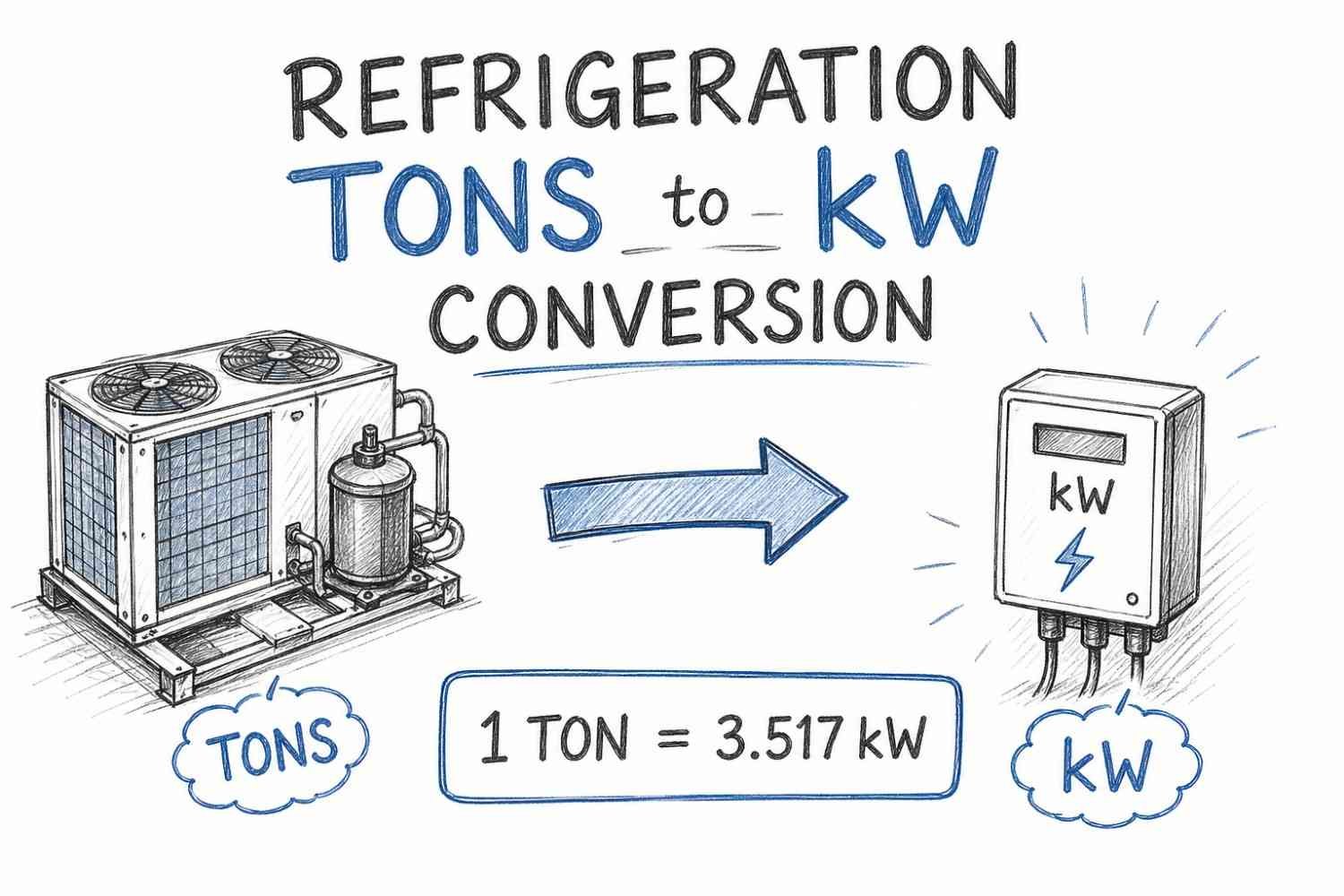
Convert refrigeration tons to kilowatts for chiller schedules, cooling load estimates, HVAC specifications, plant comparisons and engineering checks. The calculator uses the standard relationship \(1\ \mathrm{TR}=12{,}000\ \mathrm{BTU/hr}=3.51685\ \mathrm{kW}\), then separates cooling capacity from estimated electrical input so the result is easier to apply correctly.
Refrigeration Tons to kW Calculator
Enter a cooling capacity in refrigeration tons. Add a COP value if you also want an estimated electrical input. Leave COP unchanged if you only need the standard thermal conversion.
Quick Answer
To convert refrigeration tons to kilowatts, multiply the refrigeration ton value by \(3.51685\). The basic formula is:
For example, a \(50\ \mathrm{TR}\) cooling system has a nominal cooling capacity of \(50 \times 3.51685 = 175.8425\ \mathrm{kW}\). That result is thermal cooling capacity. It is not automatically the electrical power drawn by the compressor, condenser fans, pumps or cooling tower.
If your starting point is already in kilowatts and you need the opposite direction, use the related kW to refrigeration tons conversion. If your specification is written in BTU/hr, the nearby BTU/hr to kilowatts conversion is usually the cleaner first step.
What a Refrigeration Ton Means
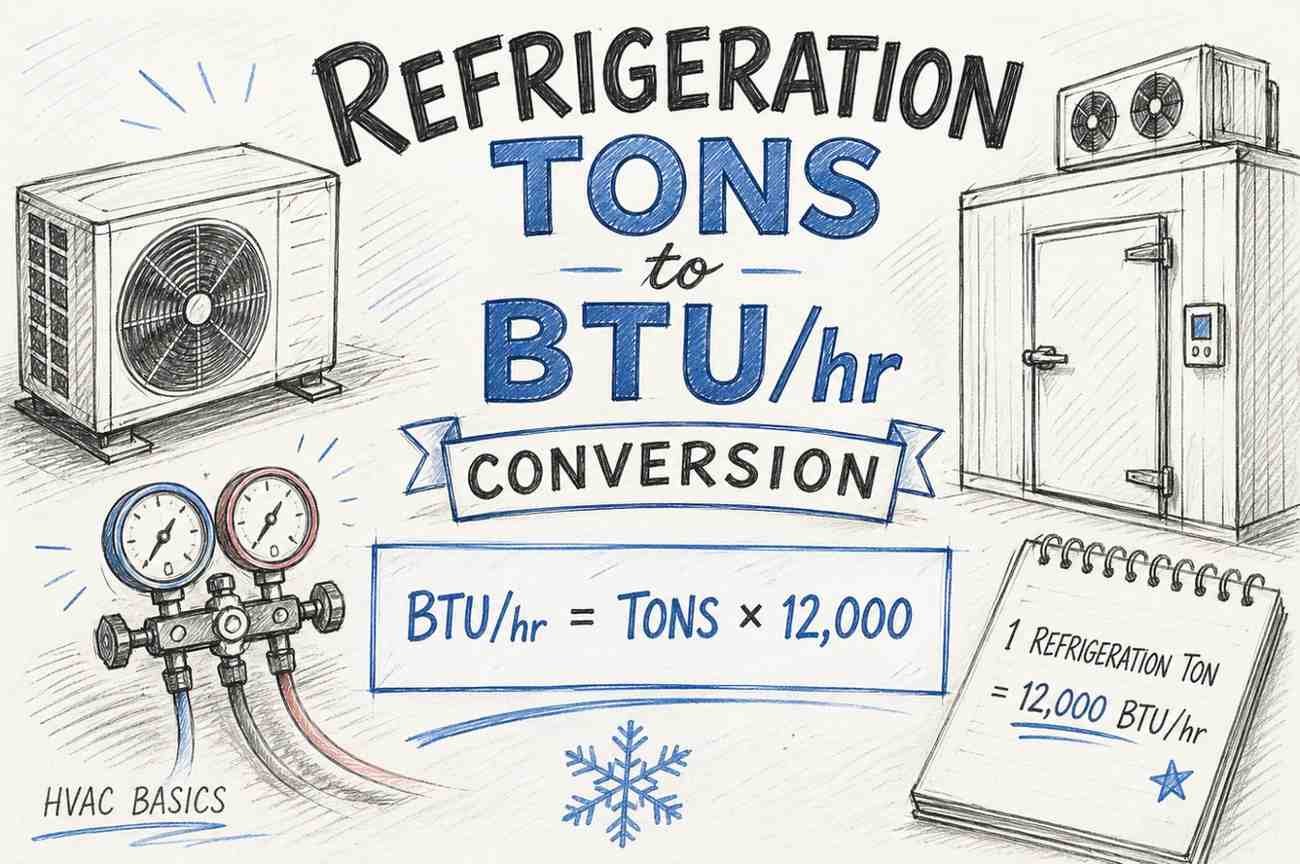
A refrigeration ton is a cooling capacity unit used in air conditioning, refrigeration and chiller design. It does not mean a ton of equipment weight, a short ton of mass or a metric tonne. In HVAC, one refrigeration ton describes a heat removal rate equal to \(12{,}000\ \mathrm{BTU/hr}\). When expressed in SI power units, that same heat removal rate is approximately \(3.51685\ \mathrm{kW}\). This is why a small residential air conditioner may be described as a 2 ton or 3 ton unit, while a commercial chiller may be described as 100 tons, 500 tons or more.
The historical origin is connected to the amount of heat associated with melting ice, but modern usage is practical rather than historical. Engineers, contractors, facility managers and students use refrigeration tons because it gives a compact way to describe cooling equipment capacity. Kilowatts are often preferred in international specifications, energy models, laboratory reports and electrical calculations because kW is part of the SI system and can be used consistently across thermal power, electrical power and mechanical power. The conversion connects those two ways of describing the same cooling load.
The most common error is to treat the converted kilowatt value as the electrical demand of the equipment. A \(100\ \mathrm{TR}\) chiller provides about \(351.685\ \mathrm{kW}\) of cooling capacity. It may not consume \(351.685\ \mathrm{kW}\) of electricity. A high-efficiency water-cooled chiller could draw much less at rated conditions because its coefficient of performance is greater than 1. For example, at \( \mathrm{COP}=5.5 \), the estimated compressor input for \(351.685\ \mathrm{kW}\) of cooling is \(351.685 \div 5.5 = 63.943\ \mathrm{kW}\), before considering pumps, towers, part-load behavior and auxiliary equipment.
That distinction makes the phrase "tons to kW" ambiguous unless the context is clear. In a cooling-capacity table, tons to kW normally means thermal kW. In an electrical demand study, the designer may be asking for compressor or plant input kW. This page focuses on converting refrigeration tons into thermal kilowatts first, then gives a separate COP-based estimate for electrical input. That keeps the page aligned with the conversion intent while still helping readers apply the result in real engineering and facilities work.
Core Refrigeration Tons to kW Formula
The exact working relationship used in HVAC conversion is based on \(1\ \mathrm{TR}=12{,}000\ \mathrm{BTU/hr}\) and \(1\ \mathrm{kW}=3412.141633\ \mathrm{BTU/hr}\). Dividing \(12{,}000\) by \(3412.141633\) gives \(3.516852842\). Many engineering tables round this to \(3.517\), \(3.5169\) or \(3.52\), depending on the level of precision needed. For most sizing notes, three significant figures is enough. For a calculation table or spreadsheet, retaining four or five decimal places is convenient.
Suppose a schedule lists an air conditioning plant as \(225\ \mathrm{TR}\). The cooling capacity in kilowatts is \(225 \times 3.516852842 = 791.2919\ \mathrm{kW}\), which is usually reported as \(791.29\ \mathrm{kW}\) or \(791\ \mathrm{kW}\). If the same plant is divided into three equal chillers, each chiller is \(75\ \mathrm{TR}\), which is \(263.764\ \mathrm{kW}\) of cooling. That kind of split matters when planning redundancy, staging, pipe sizing and maintenance operation.
If a European or international datasheet lists a cooling capacity of \(350\ \mathrm{kW}\), the equivalent in refrigeration tons is \(350 \div 3.516852842 = 99.52\ \mathrm{TR}\). In practice, that equipment would often be discussed as roughly a 100 ton unit. If the value is used for procurement, do not round too early; keep the exact rated capacity, operating conditions and tolerance from the manufacturer. If the value is used for a classroom conversion exercise, rounding at the final answer is normally acceptable.
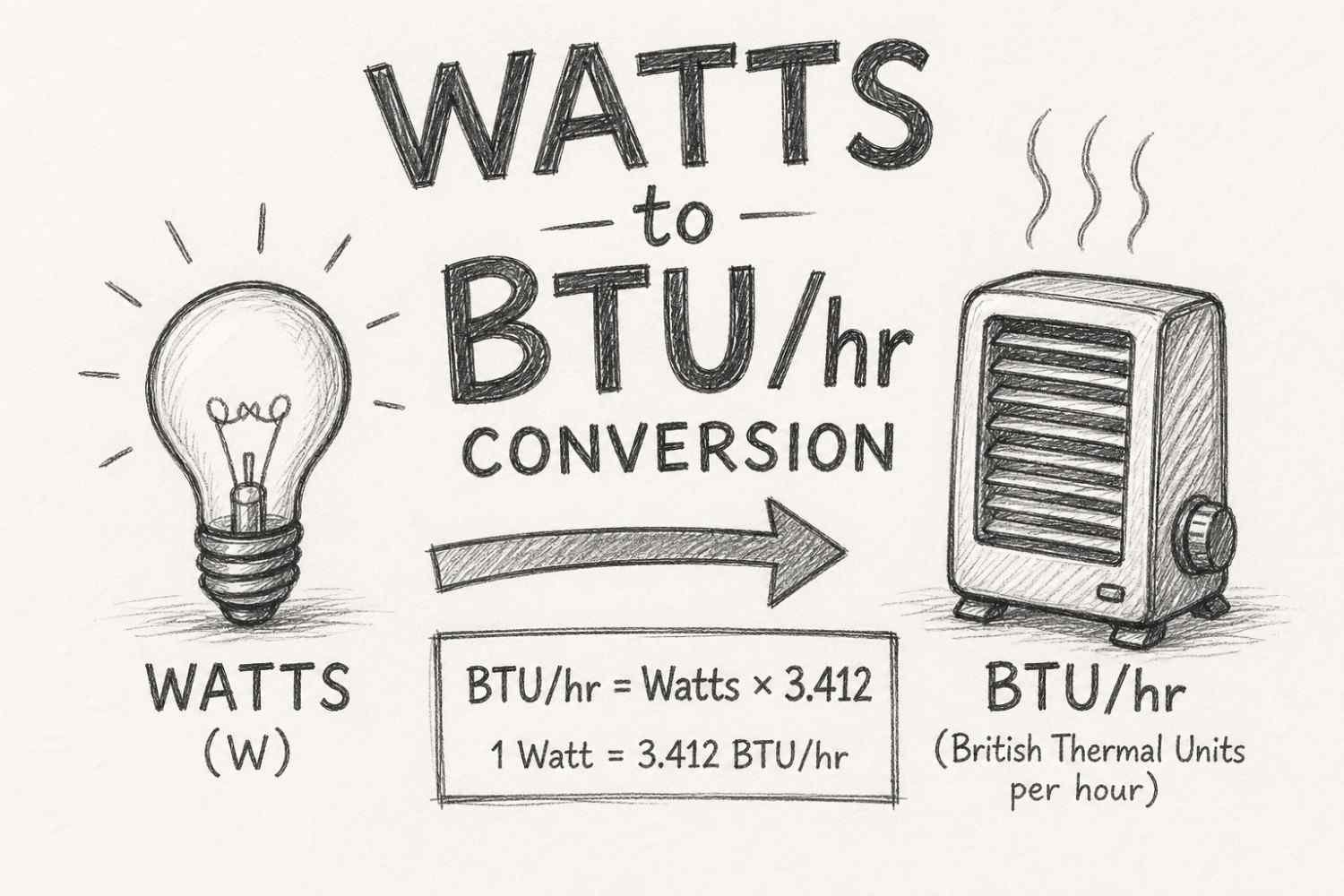
When the input is not in refrigeration tons but in watts or kilowatts from another power context, choose the correct path before converting. The watts to kW conversion is useful for electrical power, while this page is specifically about refrigeration tons as a cooling-capacity unit. For a broader set of mechanical and electrical power units, the power conversion hub can help you choose the right unit family before applying a chiller-specific interpretation.
Cooling kW vs Electrical kW
The converted value from refrigeration tons to kW is thermal power, often written as \( \mathrm{kW_{cooling}} \), \( \mathrm{kW_{th}} \), \( \mathrm{kW_r} \) or simply cooling capacity. It describes how quickly heat can be removed from a building, room, process, server space or chilled-water loop. Electrical power input is different. It describes how much power the equipment draws from the electrical supply. A heat pump, chiller or air conditioner can move more heat than the electrical energy it consumes, so the cooling output is usually greater than the electrical input.
The coefficient of performance, or COP, connects the two values. For cooling equipment, COP is the ratio of useful cooling output to electrical input at a stated operating condition. A COP of 4.0 means \(4\ \mathrm{kW}\) of cooling output for every \(1\ \mathrm{kW}\) of electrical input. A COP of 6.0 means \(6\ \mathrm{kW}\) of cooling output for every \(1\ \mathrm{kW}\) of electrical input. Because COP depends on evaporator temperature, condenser temperature, part-load conditions and equipment design, it should be taken from the manufacturer's performance data whenever possible.
For example, a \(60\ \mathrm{TR}\) unit provides \(60 \times 3.51685 = 211.011\ \mathrm{kW}\) of cooling. If the operating COP is 3.2, estimated electrical input is \(211.011 \div 3.2 = 65.94\ \mathrm{kW}\). If the operating COP is 5.8, estimated electrical input is \(211.011 \div 5.8 = 36.38\ \mathrm{kW}\). Both systems provide the same nominal cooling capacity, but their electrical demand is very different. That difference affects transformer sizing, generator sizing, utility demand charges and annual energy cost.
Do not use a single COP as a promise of actual annual consumption. Chiller performance varies with load, chilled-water temperature, condenser-water temperature, ambient wet-bulb temperature, fouling, controls, pump operation and maintenance condition. Still, the COP estimate is a useful first-order calculation because it prevents the common mistake of assuming that a 100 ton chiller automatically draws 351.7 electrical kW. The calculator's electrical estimate is therefore best used as a planning value, not as a substitute for an equipment submittal or full energy model.
Conversion Table for Common Refrigeration Ton Values
The table below gives common refrigeration ton capacities and their equivalent cooling capacity in kilowatts and BTU/hr. Values are rounded for readability. Use the calculator above for custom values, exact decimal inputs or COP-based electrical input estimates.
| Refrigeration tons | Cooling capacity in kW | Cooling capacity in BTU/hr | Typical context |
|---|---|---|---|
| 1 TR | 3.5169 kW | 12,000 BTU/hr | Small room or fractional equipment reference |
| 2 TR | 7.0337 kW | 24,000 BTU/hr | Residential split unit range |
| 3 TR | 10.5506 kW | 36,000 BTU/hr | Residential central air or small commercial unit |
| 5 TR | 17.5843 kW | 60,000 BTU/hr | Large residential or light commercial cooling |
| 10 TR | 35.1685 kW | 120,000 BTU/hr | Packaged rooftop unit or small process load |
| 25 TR | 87.9213 kW | 300,000 BTU/hr | Small chiller or multiple zone commercial load |
| 50 TR | 175.8426 kW | 600,000 BTU/hr | Commercial chiller or medium building section |
| 100 TR | 351.6853 kW | 1,200,000 BTU/hr | Common building chiller size |
| 250 TR | 879.2132 kW | 3,000,000 BTU/hr | Large commercial building or plant module |
| 500 TR | 1,758.4264 kW | 6,000,000 BTU/hr | Central plant chiller |
| 1,000 TR | 3,516.8528 kW | 12,000,000 BTU/hr | Campus, hospital, airport or district cooling scale |
If the load is given in BTU/hr and you need refrigeration tons first, use \( \mathrm{TR}=\mathrm{BTU/hr}\div 12{,}000 \). If you need the direct reverse path, the refrigeration tons to BTU/hr conversion and BTU per hour to refrigeration tons conversion pages cover that relationship separately. Keeping those conversions separate helps avoid mixing a cooling capacity problem with an electrical power problem.
Step-by-Step Method
A reliable refrigeration tons to kW conversion is simple, but the surrounding interpretation is important. Use this method when checking a drawing, revising a schedule, preparing a specification, studying HVAC formulas or comparing equipment data across unit systems.
- Confirm that the value is refrigeration tons. Look for context such as cooling capacity, chiller capacity, air-conditioning load, evaporator load or heat removal. Do not use this conversion for a mass ton, metric tonne, short ton of material, shipping ton or structural load.
- Convert the cooling capacity. Multiply the refrigeration tons by \(3.51685\) to obtain thermal kilowatts: \( \mathrm{kW_{cooling}}=\mathrm{TR}\times 3.51685 \).
- Record the BTU/hr equivalent if needed. Multiply refrigeration tons by \(12{,}000\) to obtain BTU/hr. This is useful when comparing US equipment datasheets, rooftop units or legacy schedules.
- Decide whether electrical input is required. If the task asks for load cooling capacity, stop at thermal kW. If it asks for electrical demand, power draw, energy cost or generator sizing, continue with COP, EER or manufacturer data.
- Estimate electrical input carefully. Use \( \mathrm{kW_{input}}=\mathrm{kW_{cooling}}\div \mathrm{COP} \). If COP is unknown, state the assumption and avoid presenting the result as a guaranteed equipment demand.
- Round after the final calculation. Use appropriate precision for the job. A classroom answer may use two decimals; an engineering schedule may keep one decimal or whole kW; an energy model may keep more decimals in intermediate calculations.
For a worked example, convert \(80\ \mathrm{TR}\) to kilowatts. Thermal capacity is \(80 \times 3.51685 = 281.348\ \mathrm{kW}\). BTU/hr capacity is \(80 \times 12{,}000 = 960{,}000\ \mathrm{BTU/hr}\). If the unit operates at \( \mathrm{COP}=4.8 \), estimated electrical input is \(281.348 \div 4.8 = 58.614\ \mathrm{kW}\). If you only needed cooling capacity, the answer is \(281.35\ \mathrm{kW}\). If you needed an electrical estimate, the answer must include the COP assumption.
For another example, convert a \(325\ \mathrm{TR}\) plant module. Cooling capacity is \(325 \times 3.51685 = 1{,}142.98\ \mathrm{kW}\). At \( \mathrm{COP}=6.0 \), estimated electrical input is \(190.50\ \mathrm{kW}\). At \( \mathrm{COP}=4.0 \), estimated input is \(285.75\ \mathrm{kW}\). The same refrigeration ton capacity can produce a very different electrical result depending on efficiency. This is why cooling capacity and electrical input should be written on separate lines in a calculation note.
When to Use Refrigeration Tons and When to Use kW
Refrigeration tons remain common in North America, the Gulf region, India, parts of Asia and many HVAC product catalogs. Building owners, technicians and contractors often speak in tons because the unit is familiar in air-conditioning practice. A \(5\ \mathrm{TR}\) packaged unit, a \(30\ \mathrm{TR}\) VRF outdoor unit or a \(500\ \mathrm{TR}\) chiller can be understood quickly by people who work with cooling equipment every day. In those contexts, tons are convenient for communication.
Kilowatts are often clearer in engineering calculations because they match SI units and connect directly to heat transfer equations. Chilled-water load can be calculated from mass flow and temperature difference using \(Q=\dot{m}c_p\Delta T\). Electrical demand is also measured in kW, while energy use is measured in kWh. Because the same word "kilowatt" can refer to thermal output or electrical input, good labels matter. Write \( \mathrm{kW_{cooling}} \) for capacity and \( \mathrm{kW_{input}} \) for electrical power whenever a document could be misunderstood.
For specifications, many teams include both units. A chiller may be listed as \(500\ \mathrm{TR}\) or \(1{,}758\ \mathrm{kW}\) cooling. A pump or fan motor may be listed only in electrical kW or horsepower. If horsepower appears in a mechanical schedule and you need kW, use the hp to kW conversion rather than a refrigeration ton conversion. Horsepower is mechanical power; refrigeration tons are cooling capacity. They can be related inside a system analysis, but they are not the same unit family.
In an energy model or cost analysis, kilowatts and kilowatt-hours become especially important. Once electrical input is known or estimated, energy is found by multiplying input power by operating time: \(E=\mathrm{kW}\times h\). A chiller that draws \(100\ \mathrm{kW}\) for \(2{,}000\) hours uses \(200{,}000\ \mathrm{kWh}\). If you are moving from power into energy units, use an energy-focused tool such as the energy conversion hub rather than treating kW and kWh as interchangeable. kW is a rate; kWh is accumulated energy.
Worked Examples
Example 1: Convert 12 refrigeration tons to kW
Start with \(12\ \mathrm{TR}\). Apply the conversion factor: \(12 \times 3.51685 = 42.2022\ \mathrm{kW}\). The cooling capacity is approximately \(42.20\ \mathrm{kW}\). The BTU/hr equivalent is \(12 \times 12{,}000 = 144{,}000\ \mathrm{BTU/hr}\). If the question only asks for tons to kW, the final answer is \(42.20\ \mathrm{kW}\) of cooling capacity. Do not add an electrical input value unless an efficiency or COP is provided.
Example 2: Estimate electrical input for a 100 TR chiller
Cooling capacity is \(100 \times 3.51685 = 351.685\ \mathrm{kW}\). If the operating COP is \(5.2\), electrical input is \(351.685 \div 5.2 = 67.632\ \mathrm{kW}\). A concise answer would be: \(100\ \mathrm{TR}\) equals \(351.69\ \mathrm{kW}\) cooling, and at \( \mathrm{COP}=5.2 \), the estimated electrical input is \(67.63\ \mathrm{kW}\). The phrase "at \( \mathrm{COP}=5.2 \)" should remain attached to the electrical estimate because a different COP changes the result.
Example 3: Compare two chiller options
Option A provides \(250\ \mathrm{TR}\) at \( \mathrm{COP}=4.6 \). Option B provides \(250\ \mathrm{TR}\) at \( \mathrm{COP}=5.8 \). Both provide \(250 \times 3.51685 = 879.213\ \mathrm{kW}\) of cooling. Option A input is \(879.213 \div 4.6 = 191.13\ \mathrm{kW}\). Option B input is \(879.213 \div 5.8 = 151.59\ \mathrm{kW}\). At the same cooling output, Option B reduces estimated input by \(39.54\ \mathrm{kW}\). If the plant operates many hours per year, that reduction may be financially significant.
Example 4: Convert a metric capacity back to tons
A datasheet lists \(700\ \mathrm{kW}\) of cooling. The refrigeration ton equivalent is \(700 \div 3.51685 = 199.04\ \mathrm{TR}\). In conversation, this might be called a 200 ton chiller. In a schedule, the actual listed capacity should remain \(700\ \mathrm{kW}\) or \(199.0\ \mathrm{TR}\), depending on the required units. This is a good case for the reverse kW to refrigeration tons conversion if the starting value is always in kilowatts.
Using Tons to kW in Chiller Schedules
Chiller schedules often include nominal capacity, cooling capacity at design conditions, evaporator flow, condenser flow, leaving chilled-water temperature, entering condenser-water temperature, compressor power, voltage, refrigerant and efficiency metrics. The refrigeration ton to kW conversion only addresses one part of that schedule: the cooling capacity. It does not replace the full performance data. A chiller can be called \(500\ \mathrm{TR}\), but its actual capacity at a specific set of entering and leaving temperatures may be slightly above or below the nominal value.
When converting a schedule, label the converted column clearly. A heading such as "Cooling capacity, kW" is better than just "kW." If there is also a column for compressor power or full-load input, label that separately as "Input power, kW" or "Compressor power, kW." This prevents a reader from comparing a thermal kW value with an electrical kW value as if they were the same measure. In a multidisciplinary project, that small wording choice can prevent significant confusion between mechanical and electrical teams.
Design conditions should also remain attached to the capacity. A \(500\ \mathrm{TR}\) water-cooled chiller may be rated at one chilled-water leaving temperature and condenser-water entering temperature, but it may provide a different capacity at another condition. If you are using the converted kW value for plant selection, verify the rating basis. If you are using it for a quick cross-unit comparison, the nominal conversion is usually enough. The conversion factor itself is stable, but the equipment capacity may be condition-dependent.
For equipment procurement, avoid converting rounded values repeatedly. If a schedule says \(1{,}750\ \mathrm{kW}\), converting to tons gives \(497.6\ \mathrm{TR}\). Rounding that to \(500\ \mathrm{TR}\) and later converting back gives \(1{,}758.4\ \mathrm{kW}\), which is not the original value. Use the manufacturer's rated value as the authority, and use conversions as labels or explanatory equivalents. This is especially important when guarantees, tolerances, testing procedures or contractual performance values are involved.
Chilled-Water Flow Checks
Refrigeration tons can also be checked against water flow and temperature difference. In US customary chilled-water practice, a common rule is:
This comes from \( \mathrm{BTU/hr}=500\times \mathrm{GPM}\times \Delta T_{\mathrm{F}} \) for water near typical HVAC conditions, then dividing by \(12{,}000\ \mathrm{BTU/hr}\) per ton. For example, \(240\ \mathrm{GPM}\) with a \(10^\circ\mathrm{F}\) chilled-water temperature difference gives \(240 \times 10 \div 24 = 100\ \mathrm{TR}\). That is \(351.685\ \mathrm{kW}\) of cooling. The calculation is approximate because water properties vary slightly with temperature and glycol concentration.
In SI form, heat transfer is commonly written as:
For water, \(c_p\) is often approximated as \(4.186\ \mathrm{kJ/(kg\cdot K)}\). If the mass flow rate is \(20\ \mathrm{kg/s}\) and the temperature difference is \(5^\circ\mathrm{C}\), cooling capacity is \(20 \times 4.186 \times 5 = 418.6\ \mathrm{kW}\). In refrigeration tons, that is \(418.6 \div 3.51685 = 119.0\ \mathrm{TR}\). This method is useful when a system report gives flow and temperatures rather than a stated tonnage.
Flow checks are practical during commissioning and troubleshooting. If a coil, air handler or chiller appears to be underperforming, measured flow and temperature difference can be used to estimate actual heat transfer. The result can then be compared with the nominal refrigeration ton value. A large difference may point to low flow, fouled heat exchangers, incorrect control valves, air in the system, sensor error, wrong setpoints or a load condition that differs from design. The tons to kW conversion is therefore not only a unit exercise; it can also support real diagnostic reasoning.
COP, EER and kW per Ton
HVAC efficiency can be expressed in several related ways. COP is dimensionless, though it is often described as kW of cooling per kW of electrical input. EER is usually expressed as BTU/hr per watt. kW per ton is a common chiller metric in plant operation because it directly states how many electrical kilowatts are required for each refrigeration ton of cooling. Lower kW per ton means better efficiency, while higher COP means better efficiency. These values can be converted when the same rating condition is being discussed.
For a chiller operating at \(0.70\ \mathrm{kW/ton}\), COP is \(3.51685 \div 0.70 = 5.024\). For a chiller operating at \(0.55\ \mathrm{kW/ton}\), COP is \(3.51685 \div 0.55 = 6.394\). A plant trend that moves from \(0.58\ \mathrm{kW/ton}\) to \(0.72\ \mathrm{kW/ton}\) at similar conditions may indicate reduced efficiency, poor condenser-water control, fouling, unnecessary auxiliaries, short cycling or a load range where the equipment is no longer operating near its optimum point.
Be careful when comparing efficiency metrics from different sources. Full-load COP, part-load COP, IPLV, NPLV, seasonal efficiency and actual plant kW per ton may all describe different test methods or operating profiles. A high nominal COP does not guarantee the best annual energy performance if the system spends most of the year at part load or if auxiliary pumps and cooling towers are not included in the same boundary. When using the calculator above, the COP input is best treated as a transparent assumption. For final design, use manufacturer curves and project-specific operating hours.
If you are converting motor, pump or fan power rather than cooling capacity, use a power-specific path such as kW to watts conversion or kW to hp conversion. A pump motor may be \(15\ \mathrm{kW}\), while the chiller may provide \(350\ \mathrm{kW}\) of cooling. Both are written in kilowatts, but one is electrical or mechanical input and the other is thermal output. The units look similar; the engineering meaning is different.
Practical HVAC Uses
Convert a load from tons into kW so SI-based product data and international schedules can be compared without changing the design intent.
Estimate input power from cooling kW and COP before requesting detailed manufacturer data for switchgear, transformers or generator checks.
Use kW input and operating hours to estimate kWh consumption, then compare plant options and control strategies.
Compare measured flow and temperature difference with expected refrigeration ton capacity to identify performance issues.
Connect BTU/hr, refrigeration tons, kilowatts, COP and heat transfer equations in one coherent unit framework.
Write schedules that show both TR and kW cooling values so local teams and international reviewers can read the same capacity clearly.
For a facility manager, the conversion may appear during budgeting and operation. A utility bill charges for energy in kWh and may also charge for peak demand in kW. A chiller nameplate or plant description may be in tons. Converting tons to cooling kW gives the output side; applying COP or measured kW per ton gives the input side. Once input kW is known, the annual cost estimate becomes a time and tariff problem. This chain of reasoning is much stronger than using the tonnage alone.
For a student, the conversion is a good example of dimensional thinking. A refrigeration ton is a rate of heat transfer, even though the word "ton" sounds like mass. A kilowatt is also a rate, equal to one kilojoule per second. BTU/hr is another rate. That is why refrigeration tons, BTU/hr and kW cooling can be converted directly. Electrical kWh, fuel consumption, water flow and mass of refrigerant cannot be converted directly from refrigeration tons without additional information because they describe different physical quantities.
Common Mistakes to Avoid
Confusing tons of refrigeration with mass
A refrigeration ton is not a short ton, long ton or metric tonne. It is a rate of heat removal. If a problem involves equipment shipping weight, structural load, material quantity or crane capacity, this conversion is not appropriate. The correct path would involve mass or weight units, not cooling capacity.
Calling cooling kW electrical kW
\(100\ \mathrm{TR}\) converts to \(351.685\ \mathrm{kW}\) of cooling. It does not automatically mean \(351.685\ \mathrm{kW}\) of electrical demand. Electrical input depends on COP, EER, kW per ton, operating point and auxiliary equipment.
Using nominal capacity as actual capacity
Nominal tonnage is a useful label, but actual capacity depends on test conditions, temperatures, flow rates, refrigerant circuit operation and manufacturer performance curves. Use rated data for final design and compliance work.
Rounding too early
Rounding \(3.51685\) to \(3.5\) may be acceptable for a quick mental estimate, but it creates visible differences in large plants. For large capacities, keep the standard factor until the final result.
Ignoring auxiliaries
Compressor input is not always the whole plant input. Pumps, condenser fans, cooling towers, controls and part-load sequencing can affect actual plant kW per ton.
Mixing capacity and energy
kW is a rate of power. kWh is accumulated energy. A chiller capacity in kW must be multiplied by time and adjusted for efficiency before it becomes an energy cost estimate.
How to Interpret Results in Real Projects
In a design report, a conversion result should be written with context. Instead of writing "100 tons = 351.7 kW," write "100 TR = 351.7 kW cooling capacity." If an electrical estimate is included, write "estimated electrical input = 63.9 kW at COP 5.5." The added words are not decoration; they define the boundary of the calculation. A reviewer can immediately see whether the result is a thermal capacity, a compressor input or a plant estimate.
In a construction drawing, unit consistency matters because multiple disciplines use kilowatts. The mechanical engineer may list cooling capacity in kW. The electrical engineer may list motor loads in kW or kVA. The energy consultant may list annual consumption in kWh. A single unlabeled "kW" column can create coordination problems. If the cooling capacity is converted from refrigeration tons, include a label such as "kW cooling" or "kW thermal." If the value comes from an electrical load calculation, label it as input power or electrical demand.
In retrofit work, the existing equipment may be described in tons while new equipment is offered in kW. The conversion helps compare like with like, but it should be paired with a review of actual load. An old \(300\ \mathrm{TR}\) plant does not prove that the building still needs \(300\ \mathrm{TR}\). Envelope upgrades, occupancy changes, controls, ventilation requirements and internal loads may have changed. The conversion can translate the existing nameplate, but a proper load assessment determines the replacement capacity.
In procurement, the safest comparison uses manufacturer data at the same rating conditions. Two chillers with the same nominal tonnage may not have the same capacity at the same leaving-water temperature. They may also differ in part-load efficiency, minimum turndown, sound, refrigerant, maintenance requirements and controls. Use refrigeration tons to kW conversion as a common language, then use the technical submittal for final decision-making.
Rounding and Precision
The standard factor \(3.516852842\) is precise enough for practical conversion. In classroom work, answers often use \(3.517\ \mathrm{kW}\) per refrigeration ton or \(3.52\ \mathrm{kW}\) per refrigeration ton. In engineering spreadsheets, using \(3.51685\) is a good balance between accuracy and readability. If the source value itself is approximate, too many decimals can imply false precision. For example, "about 100 tons" should not become "351.6852842 kW" in a final report; "about 352 kW cooling" is more honest.
Rounding should also match the use case. A small system may be discussed to one decimal place because a difference of \(0.1\ \mathrm{kW}\) is visible. A district cooling plant may be rounded to whole kilowatts or even tens of kilowatts because operational variation is larger than the rounding difference. If a value will be used in later formulas, keep extra precision in the calculation cell and round only the displayed result. This preserves numerical accuracy without making the public-facing result look unnecessarily complex.
When communicating with nontechnical stakeholders, it may be helpful to include both exact and rounded language. For example: "The existing plant is \(420\ \mathrm{TR}\), equal to approximately \(1{,}477\ \mathrm{kW}\) of cooling capacity." The exact calculation is \(420 \times 3.516852842 = 1{,}477.078\ \mathrm{kW}\), but the rounded value is easier to read. In a technical appendix, the exact formula can be shown. In an executive summary, the rounded value is usually better.
Relationship to BTU/hr, Watts and Other Power Units
Refrigeration tons, BTU/hr and kW are all ways of expressing power or heat transfer rate. The direct relationship is \(1\ \mathrm{TR}=12{,}000\ \mathrm{BTU/hr}=3.51685\ \mathrm{kW}\). Watts are smaller SI power units, so \(1\ \mathrm{kW}=1000\ \mathrm{W}\). Therefore, \(1\ \mathrm{TR}=3516.85\ \mathrm{W}\) of cooling capacity. If you see a unit written as W, kW or MW, make sure it is describing thermal capacity before comparing it with refrigeration tons.
Large plants may be discussed in megawatts of cooling. Since \(1\ \mathrm{MW}=1000\ \mathrm{kW}\), a \(1{,}000\ \mathrm{TR}\) plant is \(3{,}516.85\ \mathrm{kW}\), or \(3.51685\ \mathrm{MW}\) of cooling. That same plant is \(12{,}000{,}000\ \mathrm{BTU/hr}\). In district cooling or campus energy contexts, MW cooling can be easier to read than thousands of kW, while tons may still be used in local operations. The underlying conversion stays the same.
Horsepower appears in mechanical equipment, but it should not be treated as a direct synonym for refrigeration tons. Horsepower measures mechanical power. A compressor motor could be rated in horsepower, and that motor could drive a refrigeration system with a cooling output in tons. The relationship depends on efficiency, not a fixed direct conversion. If you need to convert a motor rating, use a power converter such as hp to kW conversion. If you need to convert cooling capacity, use this refrigeration tons to kW conversion.
BTU/hr is common in US air-conditioning specifications and can be converted directly. A \(36{,}000\ \mathrm{BTU/hr}\) unit is \(36{,}000 \div 12{,}000 = 3\ \mathrm{TR}\), which is \(3 \times 3.51685 = 10.5506\ \mathrm{kW}\) cooling. A \(240{,}000\ \mathrm{BTU/hr}\) commercial unit is \(20\ \mathrm{TR}\), or \(70.337\ \mathrm{kW}\) cooling. If you regularly move among these units, keep the three facts together: \(12{,}000\ \mathrm{BTU/hr}\), \(3.51685\ \mathrm{kW}\), and \(1\ \mathrm{TR}\) all describe the same heat removal rate.
Planning Electrical Demand from Cooling Capacity
Electrical planning begins after the cooling capacity is understood. A building may need \(600\ \mathrm{TR}\), which is \(2{,}110.11\ \mathrm{kW}\) of cooling. That does not mean the electrical service must provide \(2{,}110.11\ \mathrm{kW}\) just for the chiller compressors. If the expected full-load COP is 5.6, compressor input is \(2{,}110.11 \div 5.6 = 376.81\ \mathrm{kW}\). Then the designer must add chilled-water pumps, condenser-water pumps, cooling tower fans, controls, diversity, redundancy, starting method and any other project-specific electrical loads.
Demand charges make this distinction financially important. Suppose a plant input difference is \(60\ \mathrm{kW}\) during peak demand and the utility demand charge is charged monthly. Even if energy consumption is similar, peak input can affect the bill. This is why plant kW per ton is watched closely in many facilities. It connects cooling output to electrical input and gives operators a quick sense of efficiency. A plant running at \(0.60\ \mathrm{kW/ton}\) is generally more efficient than the same plant running at \(0.85\ \mathrm{kW/ton}\), assuming comparable load and conditions.
For generator sizing or emergency power, do not rely on the nominal tons-to-kW cooling conversion. Use electrical equipment data, starting current, variable-speed drive behavior, motor control strategy and required operating scenario. The tons-to-kW value tells you how much cooling capacity is available; it does not define the starting kVA or emergency electrical load. It can still help check whether the emergency strategy provides enough cooling for critical loads, but it is only one part of the electrical analysis.
For cost estimates, apply operating hours and load profile. A \(500\ \mathrm{TR}\) chiller at \( \mathrm{COP}=5.8 \) has estimated full-load input of \(1{,}758.43 \div 5.8 = 303.18\ \mathrm{kW}\). If it operates at equivalent full load for \(2{,}500\) hours, compressor energy is about \(757{,}950\ \mathrm{kWh}\). At \(0.12\) per kWh, that is \(90{,}954\) in energy cost before demand charges and auxiliaries. If the same cooling capacity operates at lower COP, the annual cost rises. The conversion is the first step in that chain, not the final cost model.
Checklist Before You Use the Result
- Confirm that the input unit is refrigeration tons, not mass tons.
- Label the result as cooling capacity or thermal kW.
- Use \(3.51685\ \mathrm{kW/TR}\) for standard conversion unless your course, code or table specifies a different rounding convention.
- If estimating input power, record the COP or kW per ton assumption.
- Do not use the thermal kW result alone for breaker, cable, generator or transformer sizing.
- Use manufacturer performance data for final equipment selection.
- Keep chilled-water and condenser-water design conditions attached to chiller capacity values.
- Use BTU/hr conversions when comparing US rooftop unit or packaged unit catalogs.
- Use energy calculations only after converting electrical input kW and operating hours into kWh.
- Round the final result to match the purpose of the calculation.
This checklist is especially useful when copying a value into a report or spreadsheet. The numeric conversion is simple, so errors usually come from context rather than arithmetic. A well-labeled line such as "\(150\ \mathrm{TR}=527.53\ \mathrm{kW}\) cooling; estimated input \(=105.51\ \mathrm{kW}\) at \( \mathrm{COP}=5.0 \)" gives enough information for another reader to understand and review the calculation.
Frequently Asked Questions
One refrigeration ton is approximately \(3.51685\ \mathrm{kW}\) of cooling capacity. It is also \(12{,}000\ \mathrm{BTU/hr}\). This is a thermal capacity value, not necessarily the electrical input of the equipment.
Multiply \(10\) by \(3.51685\). The result is \(35.1685\ \mathrm{kW}\) cooling, usually rounded to \(35.17\ \mathrm{kW}\). In BTU/hr, \(10\ \mathrm{TR}\) equals \(120{,}000\ \mathrm{BTU/hr}\).
A refrigeration machine moves heat rather than converting electricity directly into cooling one-for-one. COP expresses the ratio of cooling output to electrical input. If \( \mathrm{COP}=5 \), then \(5\ \mathrm{kW}\) of cooling output requires about \(1\ \mathrm{kW}\) of electrical input at that operating point.
The arithmetic conversion between BTU/hr and kW is still a power conversion, but the phrase refrigeration ton is normally used for cooling capacity. For heating equipment, use the heating capacity units listed by the manufacturer and clearly label whether the value is heating output, cooling output or electrical input.
kW per ton is an efficiency metric that describes electrical input per refrigeration ton of cooling. It is calculated as electrical input kW divided by refrigeration tons. Lower kW per ton indicates better efficiency when conditions and system boundaries are comparable.