
Electric charge unit converter
nC to Coulombs Conversion Calculator
Convert nanocoulombs (nC) to coulombs (C) instantly with the exact metric relationship . This page includes a working calculator, formula, conversion chart, scientific notation, capacitor examples, current-time relationships, and practical guidance for physics, electronics, and electrical engineering work.
Fast answer: to convert from nanocoulombs to coulombs, multiply the nanocoulomb value by , or divide by 1,000,000,000. For example, .
Explore all 44 guide sections
- Convert nC to coulombs
- Nanocoulombs to coulombs at a glance
- What does nC to coulombs conversion mean?
- The exact conversion factor
- Why the coulomb matters
- Why nanocoulombs are useful
- How to convert nC to C step by step
- Worked examples
- Nanocoulombs to coulombs conversion chart
- Scientific notation for charge conversions
- Picocoulombs, nanocoulombs, microcoulombs, and millicoulombs
- Where nC to C conversion is used
- Coulomb's law and why units matter
- Nanocoulombs in capacitor calculations
- Charge from current and time
- Battery capacity and charge
- Choosing the best charge unit
- Common mistakes when converting nC to C
- Accuracy, significant figures, and measurement limits
- Dimensional checking
- Nanocoulomb conversion in classroom problems
- Nanocoulomb conversion in electronics documentation
- Nanocoulombs and voltage, energy, and power
- Manual conversion shortcuts
- Calculator input tips
- When not to use nanocoulombs
- Quality checklist for nC to C answers
- How this page fits with other RevisionTown converters
- Deriving the conversion from SI prefixes
- Reading answers in decimal notation
- Reading answers in engineering notation
- Practice problems with worked answers
- Classroom electrostatics workflow
- Electronics lab workflow
- Using nC in graph labels and tables
- Unit conversion in spreadsheets
- Charge conversion and uncertainty
- Mini reference for charge-related formulas
- Realistic scale examples
- Short answer templates for homework
- Safety note for capacitor charge
- Related charge converters and physics tools
- FAQs
- Measurement references
Convert nC to coulombs
Enter a charge value in nanocoulombs. The result updates in coulombs, decimal form, and scientific notation. Use the swap button for the reverse conversion from coulombs to nanocoulombs.
Nanocoulombs to coulombs at a glance
A nanocoulomb is one billionth of a coulomb. The prefix nano means , so every value in nanocoulombs becomes a much smaller decimal when written in coulombs.
If a measurement looks inconvenient in decimal form, write it in scientific notation. For example, is usually clearer as .
One-line rule
Move the decimal point nine places to the left when converting from nC to C. Move it nine places to the right when converting from C to nC.
What does nC to coulombs conversion mean?
The phrase nC to coulombs conversion means changing an electric charge value from nanocoulombs into coulombs. Both units measure the same physical quantity, electric charge, but they are used at different scales. The coulomb is the SI derived unit of electric charge. The nanocoulomb is a metric subunit equal to coulombs. Because the relationship is based on an SI prefix, the conversion factor is exact: one nanocoulomb is exactly one billionth of a coulomb.
This conversion appears often in physics classes, electronics labs, capacitor data sheets, electrostatic discharge testing, charge amplifiers, sensor work, and electrical engineering calculations. A capacitor might store thousands of nanocoulombs; for example, 3000 nC is 0.000003 C. The units are equivalent; the better choice depends on readability and context.
For broader charge-unit work, use RevisionTown's electrical charge conversion page. This guide stays focused on nanocoulombs to coulombs because it is one of the most common charge conversions used in practical circuit analysis. If you are moving in the opposite direction, use the related coulombs to nC conversion page.

The exact conversion factor
The metric prefix nano represents one billionth. In powers of ten, that is . Therefore, a nanocoulomb is not an approximate or rounded unit; it is exactly coulombs.
From that identity, the calculator uses two equivalent forms:
Both formulas produce the same result. Multiplication by is often preferred in scientific writing because it makes the prefix relationship obvious. Division by 1,000,000,000 is often easier for everyday calculator use.
One charge, four ways to write it
A larger charge unit gives a smaller numerical value. These four expressions represent the same charge.
From nC to C, divide by 1000 three times. That is the same as dividing by . For other prefixes, see the electric charge unit guide.
Why the coulomb matters
The coulomb is the standard SI unit used to express electric charge. In circuit language, one coulomb can be understood as the amount of charge transported by one ampere of current in one second. That relationship is written as:
where is charge in coulombs, is current in amperes, and is time in seconds. If a current of 0.25 A flows for 4 seconds, the charge transferred is . This relationship is one reason charge conversions are important in electronics: current, time, capacitance, voltage, and charge are connected.
Since the 2019 SI redefinition, the elementary charge has the exact value . That means one coulomb corresponds to about elementary charges. A nanocoulomb is smaller by a factor of one billion, so it corresponds to about elementary charges.
Why nanocoulombs are useful
Nanocoulombs are useful because many practical electric charge values are too small to read conveniently in coulombs but too large to read conveniently in picocoulombs. A value such as 0.000000047 C is correct, but it is easier for many people to read as 47 nC. A small capacitor, MOSFET gate, or ESD calculation might produce 2200 nC, which is easier to compare mentally than 0.0000022 C.
Using a well-chosen prefix reduces mistakes. It also improves communication between engineers, students, technicians, and lab reports. A circuit designer may specify charge injection in picocoulombs, a capacitor bank in millicoulombs, and a battery in ampere-hours. The underlying quantity is still charge, but the best unit changes with scale.
How to convert nC to C step by step
- Write the given value. For example, suppose the measurement is .
- Use the conversion factor. Replace with .
- Multiply. .
- Add the unit. The result is .
- Check with reverse conversion. , so the result is consistent.
The most common mistake is moving the decimal point in the wrong direction. When converting from nanocoulombs to coulombs, the number becomes smaller because coulombs are the larger unit. When converting from coulombs to nanocoulombs, the number becomes larger because nanocoulombs are the smaller unit.
Worked examples
Example 1: convert 1 nC to coulombs
This is the base conversion. Every other conversion is a multiple of this relationship.
Example 2: convert 250 nC to coulombs
The result may also be written as .
Example 3: convert 5000 nC to coulombs
This is also , which equals 5 microcoulombs.
Example 4: convert 1,000,000,000 nC to coulombs
This example shows why the conversion factor is one billion.
Example 5: convert 0.75 nC to coulombs
Scientific notation is clearer here: .
Example 6: keep the sign of a negative charge
The negative sign describes the charge; changing units does not remove it. Zero charge also remains zero in either unit. When a formula asks for a force or field magnitude, distinguish the signed charge from its absolute value.
Nanocoulombs to coulombs conversion chart
Use this chart for quick reference. The scientific notation column is often the cleanest way to write very small charge values.
| Nanocoulombs | Coulombs | Scientific notation | Equivalent prefix |
|---|---|---|---|
| 0.1 nC | 0.0000000001 C | 100 pC | |
| 1 nC | 0.000000001 C | 1 nC | |
| 5 nC | 0.000000005 C | 5 nC | |
| 10 nC | 0.00000001 C | 10 nC | |
| 25 nC | 0.000000025 C | 25 nC | |
| 100 nC | 0.0000001 C | 0.1 microcoulombs | |
| 250 nC | 0.00000025 C | 0.25 microcoulombs | |
| 500 nC | 0.0000005 C | 0.5 microcoulombs | |
| 1000 nC | 0.000001 C | 1 microcoulomb | |
| 2500 nC | 0.0000025 C | 2.5 microcoulombs | |
| 10,000 nC | 0.00001 C | 10 microcoulombs | |
| 100,000 nC | 0.0001 C | 100 microcoulombs | |
| 1,000,000,000 nC | 1 C | 1 C |
Scientific notation for charge conversions
Scientific notation is not just a classroom formatting trick. It is the preferred way to prevent decimal-place errors in electrical calculations. The conversion has eight zeros between the decimal point and the first significant digit. That is easy to mistype. Written as , the scale is obvious.
When solving problems, keep values in powers of ten until the final answer. For example:
If you need more help with powers of ten and exponent formatting, the scientific notation converter is a useful companion tool.
Picocoulombs, nanocoulombs, microcoulombs, and millicoulombs
Charge units often appear with several SI prefixes. Understanding their order prevents prefix mistakes:
Each step from pico to nano to micro to milli to base unit changes by a factor of 1000. This is why , while and . For adjacent charge conversions, compare this page with pC to coulombs, microcoulombs to coulombs, and mC to coulombs.
Where nC to C conversion is used
The conversion appears anywhere charge is measured, stored, transferred, or specified. It is especially common when the charge is too large for picocoulombs but too small for whole coulombs.
Electronics and component testing
Capacitors, sensors, switching circuits, and charge pumps often involve nanocoulomb-scale values. A technician may measure charge storage in nC, while the formula being used expects coulombs. Converting first keeps the equation dimensionally correct.
Electrostatic discharge work
ESD events involve rapid charge movement. Depending on the testing standard and instrument, charge may be expressed in coulombs, nanocoulombs, or picocoulombs. Conversions help compare measurements and interpret the severity of a discharge.
Battery and energy storage calculations
Batteries are commonly labeled in ampere-hours or milliampere-hours, but the underlying quantity is charge. A small experimental cell may involve charge values that are easier to express in nanocoulombs, while larger consumer batteries are more naturally expressed in ampere-hours.
Physics lab reports
Students often use nanocoulombs in electrostatics problems because point-charge examples usually involve small charges. However, Coulomb's law uses SI units, so the charge must be converted to coulombs before substitution.
Coulomb's law and why units matter
Coulomb's law calculates the electrostatic force between two point charges. In SI form, charge should be entered in coulombs, distance in meters, and force comes out in newtons.
If and , do not enter 5 and 2 directly as coulombs. Convert first:
Using unconverted values would make the calculated force wrong by a factor of , because both charges would be one billion times too large. This is a common reason electrostatics answers can look wildly unrealistic.
For wider formula review, see basic physics equations and the physics calculator. Use this charge converter before substituting charge values into those physics equations.
Nanocoulombs in capacitor calculations
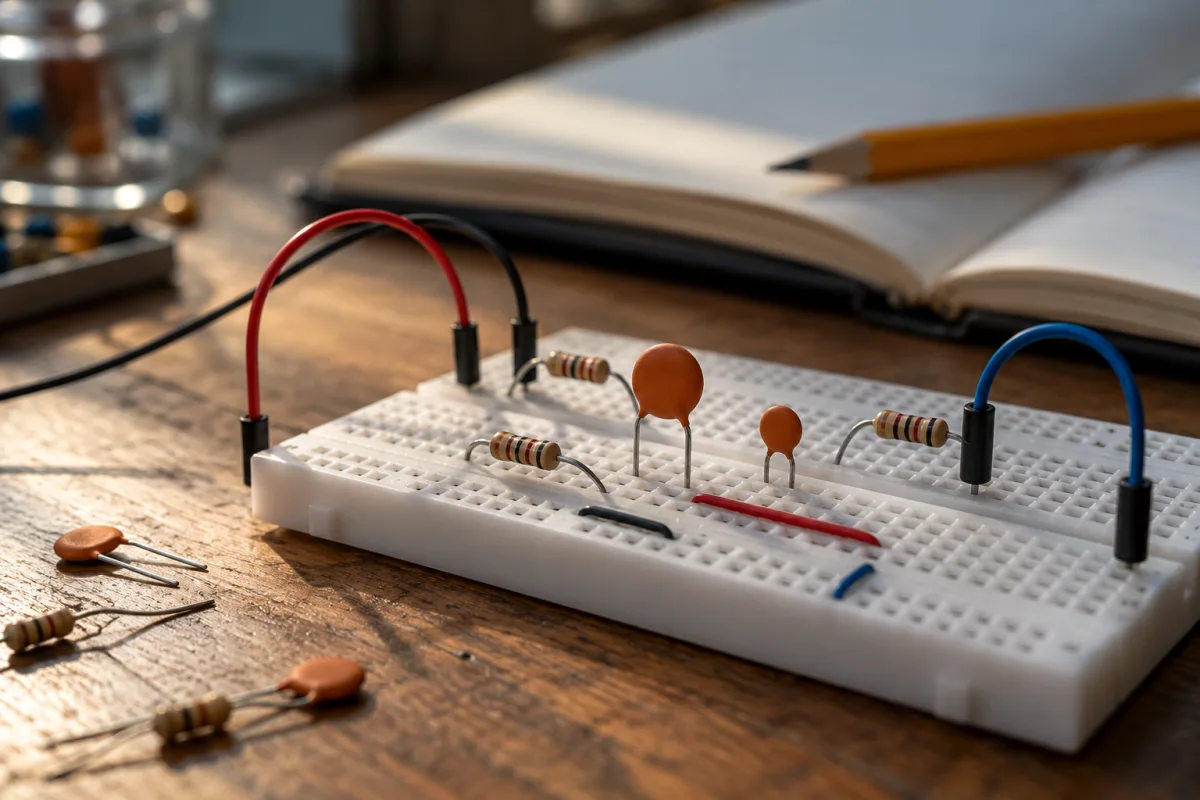
Capacitors are one of the most practical places to use nanocoulombs. The charge stored by a capacitor is:
Here is charge in coulombs, is capacitance in farads, and is voltage in volts. Notice that the symbol can mean either coulombs or capacitance depending on context. To avoid confusion, this page writes capacitance as .
Example: 100 pF at 12 volts
The charge may be read as or 1.2 nC. In a lab note, 1.2 nC is often easier to read.
Example: 470 pF at 25 volts
This example shows why nanocoulombs are useful for small capacitors, charge injection specifications, and low-level pulse calculations.
Charge from current and time
Another common route to charge is current over time. If current is constant, the charge transferred is:
If current is measured in amperes and time in seconds, is in coulombs. To express the result in nanocoulombs, multiply by .
Example: 2 nA for 3 seconds
This type of calculation appears in sensor circuits, capacitor charging, battery discharge tests, and pulse energy measurements.
Battery capacity and charge
Battery capacity is usually shown in ampere-hours or milliampere-hours. These are still charge units, because ampere-hour means current multiplied by time. The relationship is:
A 2500 mAh battery therefore stores an idealized charge of:
For larger batteries, coulombs or ampere-hours are usually more readable than nanocoulombs. For small lab cells and short pulses, nanocoulombs may still be practical. If you are converting between ampere-hours and charge, use Ah to coulombs or coulombs to Ah.
Choosing the best charge unit
The best unit is the one that keeps the number readable without hiding the scale. Here is a practical guide:
- Use picocoulombs for very small charge injection, sensor charge, and low-level measurement.
- Use nanocoulombs for small pulses, ESD values, and intermediate lab measurements.
- Use microcoulombs for larger small-capacitor results and many classroom electrostatics examples.
- Use millicoulombs for larger capacitor banks and short high-current pulses.
- Use coulombs for SI equations, battery charge, current-time calculations, and large charge transfer.
- Use ampere-hours for batteries and long-duration current capacity.
When a formula expects SI units, convert to coulombs first. When you are reporting a result for readability, choose the prefix that avoids too many leading or trailing zeros.
Common mistakes when converting nC to C
Moving the decimal the wrong way
From nanocoulombs to coulombs, the number becomes smaller. If becomes 500,000,000 C, the conversion direction is reversed. The correct result is .
Confusing micro and milli
Nano means , micro means , and milli means . A microcoulomb is 1000 nanocoulombs, while a millicoulomb is 1,000,000 nanocoulombs. Therefore .
Using capacitance symbol C as coulombs
In capacitor formulas, often means capacitance in farads. In charge units, C means coulomb. Always read the context. Writing capacitance as and charge as avoids ambiguity.
Forgetting to convert microfarads to farads
In , capacitance must be in farads if the result is in coulombs. A 100 microfarad capacitor is , not 100 F.
Rounding too early
If a calculation has several steps, keep enough significant figures until the final result. Rounding to 0.000000001 C too early can introduce a large relative error.
Accuracy, significant figures, and measurement limits
The conversion factor is exact, but the measurement being converted may not be exact. If an instrument reports , the converted value is , but the meaningful precision still depends on the original measurement. Do not add fake precision just because a calculator can display many decimal places.
A good rule is to keep the same number of significant figures as the input unless you have a reason to do otherwise. If the input is 2500 nC and the value is known to two significant figures, write . If the input is 2500.0 nC and all five digits are meaningful, write or .
When publishing lab work, include uncertainty if available. For example, converts to . The conversion factor applies to both the value and the uncertainty.
Dimensional checking
Dimensional checking is a simple way to catch errors. Treat the unit conversion as multiplying by a fraction equal to 1:
The nanocoulomb units cancel, leaving coulombs. If the units do not cancel the way you expect, the conversion fraction is probably upside down.
Nanocoulomb conversion in classroom problems
Many physics problems give charges in nanocoulombs because the numbers look friendly. For example, a problem may state that two charges are and , separated by 0.20 m. The values must become and before using Coulomb's law. The sign matters for direction, while the magnitude matters for force size.
Students often make mistakes by mixing units inside the same equation. A distance in centimeters, charge in nanocoulombs, and force constant in SI units will not produce a correct answer. Convert to SI units first: meters, coulombs, newtons, amperes, seconds, volts, and farads.
Nanocoulomb conversion in electronics documentation
In electronics documentation, nanocoulombs may appear in specifications for charge injection, gate charge, pulse charge, capacitor storage, or charge transfer. Sometimes the same device family uses nanocoulombs in one table and picocoulombs or microcoulombs in another. Converting to coulombs provides a common base for calculations, while converting back to a practical prefix improves readability for the final report.
For example, MOSFET gate charge is often specified in nanocoulombs, while a capacitor charge calculation may produce nanocoulombs. If you are comparing total charge movement in a switching event, convert both to coulombs or both to the same prefix before comparing. The coulombs to nC conversion and coulombs to pC conversion pages can help when moving between adjacent small-charge scales.
Nanocoulombs and voltage, energy, and power
Charge does not exist in isolation in circuit calculations. Voltage, energy, and power often appear next to it. For a charge moving through a potential difference, energy can be written as:
If is in coulombs and is in volts, energy is in joules. A charge of at 12 V gives:
That is why converting nC to C is often the first step before using voltage or energy equations. For related unit families, RevisionTown also covers voltage conversion, energy conversion, and power conversion.
Energy transferred and energy stored are different
The example above describes electrical work through a fixed potential difference. For an ideal capacitor charged from zero to its final voltage, the stored energy is
The factor of one-half matters because the capacitor voltage rises during charging. OpenStax explains the capacitor-energy relation.
Manual conversion shortcuts
When you do not have a calculator, use decimal movement and prefix landmarks.
Once you know these landmarks, interpolate mentally. For example, 4700 nC is 4.7 times 1000 nC, so it is 4.7 microcoulombs or 0.0000047 C.
Calculator input tips
The calculator accepts ordinary decimals and scientific notation. You can type 2500, 2.5e3, 0.75, or 7.5e-1. For very small or very large numbers, scientific notation is often easier and less error-prone than counting zeros. The output field is read-only to prevent confusion between input and calculated result.
If you use the swap button, the calculator changes direction and converts C to nC. This is helpful when a formula produces coulombs but a component table, class answer, or engineering note expects nanocoulombs. The reset button returns the page to the default nC to C mode.
When copying results into a lab report, spreadsheet, or homework solution, keep the unit beside the number until the final line. A value such as 0.00000025 is ambiguous without context, while , , and are clear. If you switch notation, write the equivalence once so the reader can see that the numerical change came from a unit conversion, not a new measurement.
When not to use nanocoulombs
Nanocoulombs are not always the best unit. For a phone battery or car battery, nanocoulombs create huge numbers that are difficult to read. Ampere-hours or coulombs are better. For tiny charge injection in precision analog circuits, nanocoulombs may be too large; picocoulombs are clearer. For electrochemical mole-scale charge, faradays or coulombs may be more appropriate.
The purpose of conversion is not to force every result into one unit. The purpose is to keep equations correct and communication clear. Convert to coulombs for SI formulas, then choose the most readable unit for the final answer.
Quality checklist for nC to C answers
- The coulomb result should be one billion times smaller than the nanocoulomb input.
- The formula should use , not , for nC to C.
- The reverse conversion should return the original value within rounding precision.
- Scientific notation should have the correct exponent sign.
- Capacitance should be converted to farads before using .
- Current should be in amperes and time in seconds before using .
- Use significant figures that match the precision of the original measurement.
How this page fits with other RevisionTown converters
If you need a wider unit workflow, start with the unit converters page or the unit conversion calculator chart. For this specific charge family, the advanced electrical charge conversion tool is useful when you need many charge units at once. This page remains focused on one task: converting nanocoulombs to coulombs accurately and explaining how to use that result in physics and electronics.
Deriving the conversion from SI prefixes
The most reliable way to remember the conversion is to derive it from the prefix rather than memorizing a random decimal. The word nano is an SI prefix meaning one billionth. Written mathematically, nano means . Since the base unit here is the coulomb, adding the prefix to coulomb gives:
That single line tells you the direction of the conversion. A nanocoulomb is a small part of a coulomb, not a larger unit. Therefore, when you convert a number from nC to C, the numerical value must shrink. When you convert from C to nC, the numerical value must grow.
Students sometimes try to memorize "divide by one billion" without understanding why. That works for this conversion, but it becomes fragile when the next problem uses microcoulombs, milliamperes, microfarads, or kilovolts. Prefix logic is stronger. If the prefix is nano, use . If the prefix is micro, use . If the prefix is milli, use . If the prefix is kilo, use . The same method works across SI unit families.
For example, suppose a problem gives . Replace the prefix first:
Then simplify the coefficient and exponent:
The decimal form is . The scientific notation form is usually better because it shows the scale without forcing the reader to count zeros.
Reading answers in decimal notation
Decimal notation is useful when the result is not too small. For example, is still readable as a decimal. However, is much easier to misread. In such cases, scientific notation is more professional:
If you must use decimal notation, count nine places carefully. A practical technique is to group the zeros in threes: . This makes it clearer that the value is in the billionths range. In lab notebooks and engineering notes, use whichever form reduces ambiguity. For very small values, that is almost always scientific notation.
Reading answers in engineering notation
Engineering notation is similar to scientific notation, but the exponent is a multiple of 3. This makes it line up naturally with SI prefixes. For charge, common exponent steps are for pico, for nano, for micro, for milli, and for coulombs.
For example:
The exponent corresponds to micro, so the same value is . Engineering notation is useful because it lets you move between coulombs and convenient metric prefixes without losing the SI base relationship.
A technician reading a scope note, component test sheet, or capacitor discharge calculation may prefer over . A physics equation may still require coulombs, but the final explanation can use microcoulombs when it improves readability.
Practice problems with worked answers
Use these practice problems to check whether you can move between nanocoulombs, coulombs, decimal notation, and scientific notation.
Problem 1: convert 12 nC to C
Decimal answer: .
Problem 2: convert 875 nC to C
Decimal answer: .
Problem 3: convert 42,000 nC to C
Equivalent prefix answer: .
Problem 4: convert 0.0045 C to nC
This is the reverse direction, so the number grows.
Problem 5: convert a capacitor charge of 0.000033 C to nC
This result may be easier to read as 33 microcoulombs, but 33,000 nC is the direct nanocoulomb conversion.
Classroom electrostatics workflow
When solving electrostatics problems, use this workflow before calculating force, electric field, or potential:
- Copy the charges exactly as given, including their signs.
- Convert every charge to coulombs before using SI equations.
- Convert every distance to meters.
- Substitute values into the formula only after the unit conversion is complete.
- Calculate the magnitude and then use the signs to determine direction.
- Round the final answer using the significant figures in the original data.
This sequence prevents two common errors: using nanocoulombs as if they were coulombs, and mixing centimeters with meters. The first error changes force by enormous factors because charge terms are often multiplied together. The second error changes distance-squared terms and can also create very large mistakes.
As a quick check, ask whether the result is physically plausible. If two classroom charges separated by a moderate distance produce a force larger than a rocket engine, the unit conversion probably failed. In most introductory problems, nanocoulomb charges produce reasonable forces only after they are converted to coulombs.
Electronics lab workflow
In an electronics lab, the conversion is usually part of a larger measurement process. A capacitor is charged, discharged, or pulsed. A meter, oscilloscope, data acquisition device, or calculation produces a charge value. The engineer or student then needs to report it in the unit expected by the design note or lab question.
A practical workflow is:
- Record the raw measurement and instrument unit exactly.
- Convert the raw value to coulombs for calculations involving joules, amperes, seconds, or volts.
- Perform the calculation using coherent SI units.
- Convert the final answer to the most readable unit for the report.
- State the unit clearly in every table heading and graph axis.
For example, if a data sheet says a pulse transfers , write before computing energy with . If the voltage is 24 V, the energy is:
The charge can still be reported as 180 nC, but the energy calculation used coulombs.
Using nC in graph labels and tables
Good unit formatting prevents confusion. In a graph, table, or spreadsheet, put the unit in the heading rather than repeating it in every cell. For example, use "Charge (nC)" as the column heading when all rows are nanocoulomb values. Use "Charge (C)" when all rows are coulomb values. If the table mixes units, add a separate unit column or convert all entries to one unit before comparison.
When exporting data to plain-text systems, use "nC" consistently and define it once. For example, write "nC means nanocoulombs." Do not switch between nC, nano C, and informal wording in the same document. Consistency is more important than style.
For formal reports, MathJax notation such as is clear and professional. In plain text data files, "nC" is acceptable because it avoids encoding problems. This page uses visible nC notation in headings and formulas while keeping the HTML source compatible with ASCII through entities and MathJax commands.
Unit conversion in spreadsheets
Spreadsheet work is a common place for decimal errors. If column A contains charge in nanocoulombs, the coulomb value in column B should be:
In spreadsheet syntax, that is usually:
For the reverse direction from coulombs to nanocoulombs, use:
Format the output column carefully. If the sheet rounds small coulomb values to 0, the calculation may be correct but the display format may be hiding the result. Use scientific notation formatting or increase the number of displayed decimal places.
Charge conversion and uncertainty
Suppose a lab instrument reports . Convert both the measured value and the uncertainty using the same factor:
The converted result can be written as:
The conversion does not change the relative uncertainty. It only changes the unit scale. If the measurement has about 0.64% uncertainty before conversion, it still has about 0.64% uncertainty after conversion.
Mini reference for charge-related formulas
These formulas commonly require charge in coulombs:
| Formula | Meaning | Unit warning |
|---|---|---|
| Charge from current and time | Use amperes and seconds to get coulombs. | |
| Charge stored in a capacitor | Use farads and volts to get coulombs. | |
| Energy transferred through a fixed potential difference | Use coulombs and volts to get joules. | |
| Electrostatic force | Use coulombs and meters in SI form. | |
| Electric potential from a point charge | Use coulombs and meters. | |
| Electric field magnitude from a point charge | Use coulombs and meters. |
The symbol can mean energy or electric field depending on context. The symbol can mean coulombs or capacitance. Good notation and clear units are not optional in electrical calculations; they are the easiest way to prevent wrong answers.
Realistic scale examples
Scale sense helps you catch mistakes. A few nanocoulombs is common in classroom electrostatics and small charge measurements. Thousands of nanocoulombs can appear in capacitor calculations. Billions of nanocoulombs equal whole coulombs, which are more natural for battery and current-time problems.
- is a small charge, but it is still billions of elementary charges.
- , a value often seen in small capacitor or pulse examples.
- , which is 1 millicoulomb.
- , a common battery charge unit.
If your answer says a small capacitor stores billions of coulombs, the issue is not the physics; it is almost certainly the unit conversion.
Short answer templates for homework
These templates can make homework and lab answers clearer:
- "Since , ."
- "The charge must be converted to SI units before substitution into Coulomb's law."
- "The decimal answer is correct, but scientific notation is clearer because the value is very small."
- "The final answer is expressed in nanocoulombs for readability, after performing the calculation in coulombs."
- "The reverse conversion checks the result: ."
Using consistent language like this shows the conversion step explicitly and makes it easier for a teacher, examiner, or reviewer to follow the work.
Safety note for capacitor charge
Unit conversion can make capacitor charge easier to understand, but it does not by itself determine safety. Energy, voltage, discharge path, current limit, and the human or equipment contact scenario matter. A capacitor with modest charge but high voltage can still be dangerous. A large capacitor bank can store substantial energy even if a charge value looks manageable after conversion.
For safety-related work, calculate both charge and energy, discharge capacitors using appropriate procedures, and follow the equipment manual or lab safety rules. This page is a unit conversion and education tool, not an electrical safety assessment.
When in doubt, treat stored electrical energy conservatively and verify the circuit condition before touching, measuring, replacing, or documenting charged components.
Related charge converters and physics tools
FAQs
How many coulombs are in 1 nanocoulomb?
There are coulombs in 1 nanocoulomb. In scientific notation, .
What is the formula for nC to C?
The formula is . You can also divide the nanocoulomb value by 1,000,000,000.
Is nanocoulomb the same as coulomb?
No. They measure the same physical quantity, electric charge, but they are different sizes. One nanocoulomb is one billionth of one coulomb.
How do you convert 1000 nC to coulombs?
. This is also 1 microcoulomb.
How do you convert coulombs to nanocoulombs?
Multiply coulombs by . For example, .
Why do physics problems use nanocoulombs?
Point-charge examples often involve small charges. Writing those values in nanocoulombs keeps the given numbers readable, but the values must be converted to coulombs before using SI equations.
What is the difference between nC and mC?
is nanocoulombs, equal to C. mC is millicoulombs, equal to C. Therefore, .
Can I use this converter for capacitor charge?
Yes. If a capacitor calculation gives charge in nanocoulombs, this calculator converts it to coulombs. If a formula such as gives coulombs, use the swap mode to convert back to nanocoulombs.
Is the nC to C conversion exact?
Yes. The nano prefix is exactly , so the conversion factor between nanocoulombs and coulombs is exact. Measurement uncertainty comes from the measured value, not from the unit conversion.
What does nC mean?
nC is the standard symbol for nanocoulombs: n is the SI prefix nano, and C is the unit symbol for coulomb.
Practical note for lab and homework use
Always check the required unit before substituting charge into a formula. If the equation is written in SI form, use coulombs. If the final answer asks for nanocoulombs, convert back after solving.
Measurement references
The conversion factor on this page is based on the SI nano prefix and the SI unit of charge. The elementary charge value used in modern SI definitions is exact, and the coulomb is connected to the ampere-second relationship.