
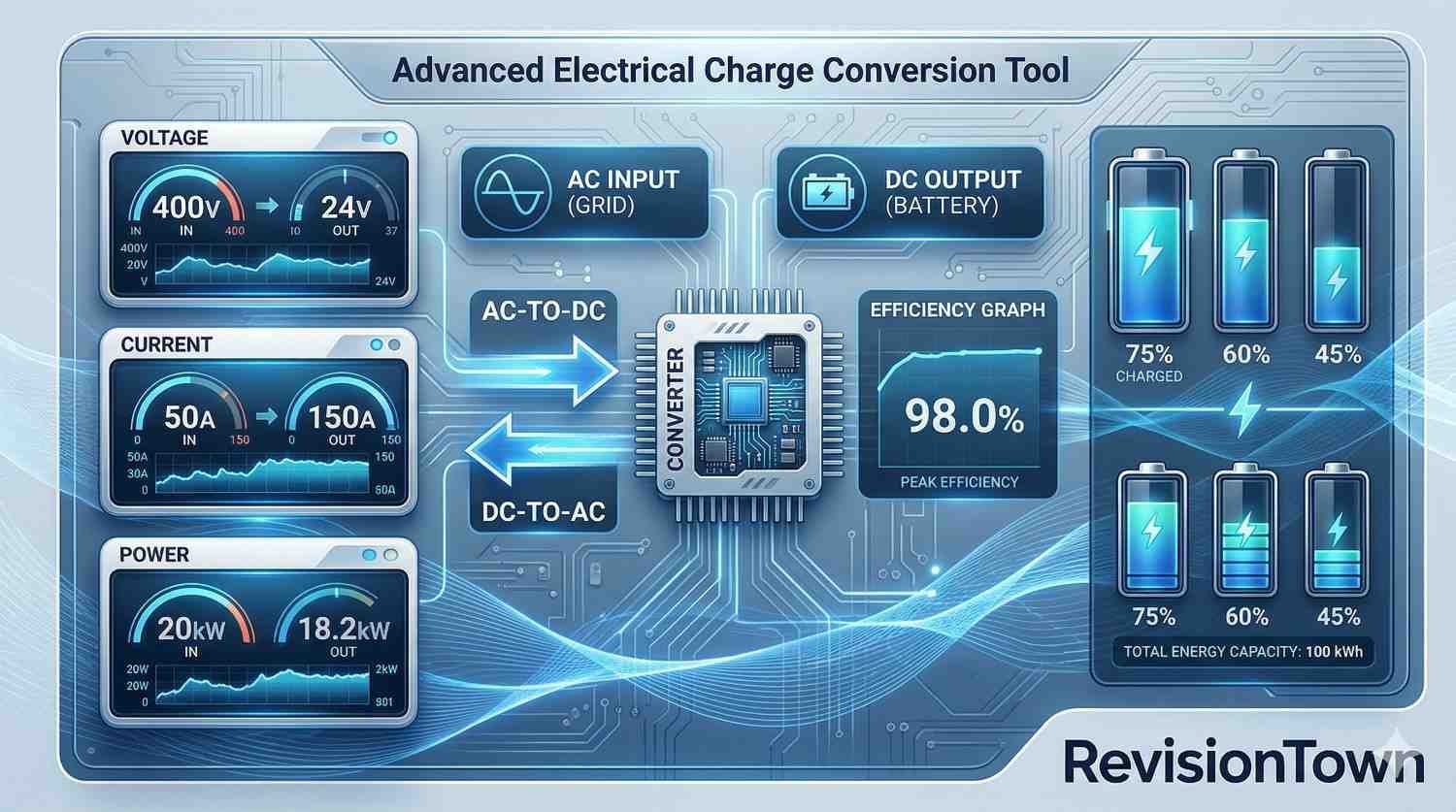
Convert coulombs, millicoulombs, microcoulombs, ampere-hours, milliampere-hours, elementary charges, Faradays, statcoulombs and abcoulombs in one accurate calculator.
Electrical charge appears in circuits, batteries, electrochemistry, capacitors, particle physics and electrostatics. This tool converts every input through coulombs first, then shows the result in the selected target unit plus practical reference outputs for electrons, ampere-hours, milliampere-hours and moles of electrons.
1 coulomb equals 1 coulomb.
All conversions pass through coulombs.
Magnitude only; electron charge has negative sign.
Useful for battery capacity comparisons.
1 mAh equals 3.6 coulombs.
Based on the Faraday constant.
Electrical Charge Conversion Formulas
The SI unit of electric charge is the coulomb (C). One coulomb is the amount of charge transported by a current of one ampere in one second. The converter stores every unit as a factor in coulombs, so the method is stable across tiny particle-scale values and large battery-capacity values.
charge in coulombs = input value x source unit factor
target value = charge in coulombs / target unit factor
Q = I x t, where Q is charge in coulombs, I is current in amperes and t is time in seconds
1 Ah = 3600 C, so C = Ah x 3600 and Ah = C / 3600
number of elementary charges = Q / e, where e = 1.602176634 x 10^-19 C
moles of electrons = Q / F, where F = 96485.33212... C mol^-1
Exact SI Relationships
The elementary charge is exact in the modern SI: e = 1.602176634 x 10⁻¹⁹ C. The coulomb is linked to current and time, so 1 C is also 1 A s.
Battery Capacity
Ampere-hours and milliampere-hours describe charge capacity. 1 Ah = 3600 C and 1 mAh = 3.6 C. Energy still requires voltage: Wh = Ah x V.
Electrochemistry
The Faraday constant is the charge per mole of elementary charges. It is used in electrolysis, redox calculations, plating, batteries and electrochemical stoichiometry.
Common Electrical Charge Conversion Table
Use this table for quick reference. The calculator above carries more digits internally, then formats the visible result so very small or very large charge values remain readable.
| Unit | Symbol | Value in coulombs | Typical use |
|---|---|---|---|
| Coulomb | C | 1 C | Base SI derived unit of electric charge |
| Millicoulomb | mC | 0.001 C | Laboratory and electronics calculations |
| Microcoulomb | µC | 0.000001 C | Capacitors, sensors and electrostatics |
| Nanocoulomb | nC | 0.000000001 C | Small capacitor and ESD charge values |
| Picocoulomb | pC | 0.000000000001 C | Partial discharge, detector and insulation testing |
| Ampere-hour | Ah | 3600 C | Battery capacity |
| Milliampere-hour | mAh | 3.6 C | Portable electronics and small batteries |
| Elementary charge | e | 1.602176634 x 10⁻¹⁹ C | Particle physics and electron/proton charge magnitude |
| Faraday | F | 96485.33212... C | Charge of one mole of elementary charges |
| Statcoulomb / Franklin | statC / Fr | 3.33564095198152 x 10⁻¹⁰ C | Legacy CGS electrostatic unit systems |
| Abcoulomb | abC | 10 C | Legacy CGS electromagnetic unit systems |
Worked Electrical Charge Examples
Example 1: mAh to coulombs
Problem: Convert 2.5 mAh to coulombs.
Method: 1 mAh = 3.6 C, so 2.5 x 3.6 = 9 C.
Example 2: microcoulombs to electrons
Problem: Convert 10 µC to elementary charge count.
Method: 10 µC = 1.0 x 10⁻⁵ C. Divide by e to get about 6.241509 x 10¹³ elementary charges.
Example 3: moles of electrons to coulombs
Problem: Convert 0.025 mol e- to coulombs.
Method: Q = nF = 0.025 x 96485.33212... = 2412.133303 C.
Example 4: picocoulombs to nanocoulombs
Problem: Convert 500 pC to nC.
Method: 1 nC = 1000 pC, so 500 pC = 0.5 nC.
How to Choose the Right Charge Unit
Electrical charge has a wide range of scale. A capacitor leakage measurement may involve picocoulombs, a static shock may involve microcoulombs, a phone battery may be rated in milliampere-hours, and an electrochemistry calculation may use Faradays. The right unit depends on the context and the precision required.
Circuits and Capacitors
Use C, mC, µC, nC or pC. Capacitor charge commonly follows Q = C x V, where capacitance is in farads and voltage is in volts. Do not confuse the farad capacitance unit with the Faraday charge unit.
Batteries
Use Ah or mAh for charge capacity. A 3000 mAh battery stores 3000 x 3.6 = 10800 C of charge. To estimate energy, multiply Ah by nominal voltage to get Wh.
Particle and Atomic Scale
Use elementary charge for protons, electrons and ions. The converter reports charge count as a magnitude; sign depends on whether the charge carrier is positive or negative.
Electrochemistry
Use Faradays or moles of electrons when balancing redox reactions, calculating electrolysis products, or comparing current, time and amount of substance.
Legacy CGS Units
Use statcoulomb, franklin, ESU charge, abcoulomb and EMU charge only when reading older physics texts or legacy data. For new calculations, convert to coulombs.
Rounding
Keep extra digits during calculation and round only the final answer. For engineering reports, match the result precision to measured inputs rather than listing every calculator digit.
Common Mistakes in Charge Conversion
- Mixing charge and current: amperes measure current, while coulombs measure total charge. Convert A to C only when a time interval is known.
- Treating mAh as energy: mAh is charge capacity. Energy requires voltage, so two batteries with the same mAh can store different energy if their voltages differ.
- Dropping the sign too early: the elementary charge value in this converter is magnitude. Electron charge is negative; proton charge is positive.
- Confusing F and farad: F is often the symbol for farad in capacitance. The Faraday charge constant is written as F in electrochemistry, so context matters.
- Using CGS units in SI equations: statcoulomb and abcoulomb belong to legacy CGS systems. Convert them to coulombs before using SI circuit formulas.
Related RevisionTown Conversion Tools
Use these related pages when you need a narrower converter or a nearby physics calculation:
- Electrical charge conversion
- Coulombs to electron charge conversion
- Coulombs to Ah conversion
- Ah to coulombs conversion
- mAh to Ah conversion
- Energy conversion
- Frequency conversion
Data Sources and Precision Notes
This converter uses the coulomb as the base charge unit. Elementary charge, Avogadro constant and Faraday constant values follow NIST CODATA data. Decimal display is rounded for readability, but the calculator keeps full JavaScript numeric precision for the conversion factors used internally.
- Elementary charge: 1.602176634 x 10⁻¹⁹ C, exact.
- Avogadro constant: 6.02214076 x 10²³ mol-1, exact.
- Faraday constant: 96485.33212... C mol-1, derived from F = NAe.
- Statcoulomb/franklin: 10/c coulomb, using the exact speed of light in SI.
- Abcoulomb: 10 coulombs in the electromagnetic CGS relationship.