Calorie Calculator
Calculate Your Daily Calorie Needs for Weight Loss, Maintenance & Gain
Daily Calorie Calculator
Calculate Your Calorie Needs
Calorie Adjustments by Goal
| Goal | Calorie Adjustment | Expected Rate |
|---|---|---|
| Extreme Weight Loss | -1000 cal/day | 2 lbs/week |
| Weight Loss | -500 cal/day | 1 lb/week |
| Mild Weight Loss | -250 cal/day | 0.5 lbs/week |
| Maintain Weight | 0 cal/day | Maintain |
| Mild Weight Gain | +250 cal/day | 0.5 lbs/week |
| Weight Gain | +500 cal/day | 1 lb/week |
Understanding Calories
A calorie (kcal) is a unit of energy measuring how much energy food provides to the body. Technically, one calorie is the amount of energy needed to raise the temperature of 1 kilogram of water by 1 degree Celsius. Food labels display "Calories" (with capital C), which are actually kilocalories (kcal)—1 Calorie = 1,000 small calories. When someone says "this apple has 80 calories," they mean 80 kcal. The body converts calories from food into ATP (adenosine triphosphate), the energy currency used by cells to power all physiological processes: muscle contraction, nerve transmission, protein synthesis, digestion, breathing, heartbeat, and maintaining body temperature.
Energy balance is the relationship between calories consumed (food/drinks) and calories expended (metabolism + activity). Weight management follows the fundamental law of thermodynamics: Calories In vs. Calories Out (CICO). When calorie intake equals expenditure, weight remains stable. When intake exceeds expenditure, excess energy is stored as fat (and some glycogen/muscle with proper training), causing weight gain. When expenditure exceeds intake, the body mobilizes stored energy (primarily fat, but also muscle without adequate protein and resistance training), causing weight loss. This energy balance principle is absolute—all successful diets work by creating calorie deficits or surpluses, regardless of specific food choices or meal timing.
However, "a calorie is a calorie" is oversimplified. While energy balance determines weight changes, calorie sources affect hunger, satiety, energy levels, body composition, metabolic health, and adherence. Protein has the highest thermic effect of food (TEF)—20-30% of protein calories burned during digestion versus 5-10% for carbs, 0-3% for fats. Protein also increases satiety and preserves muscle during weight loss. Fiber-rich whole foods require more energy to digest and promote fullness versus processed foods rapidly absorbed with minimal energy expenditure. 500 calories from chicken, vegetables, and brown rice provides sustained energy, fullness, and nutrients versus 500 calories from candy providing quick energy spike, crash, minimal satiety, and no nutrients. For weight loss, calorie quantity matters most; for health and sustainability, calorie quality matters significantly.
Components of Total Daily Energy Expenditure (TDEE)
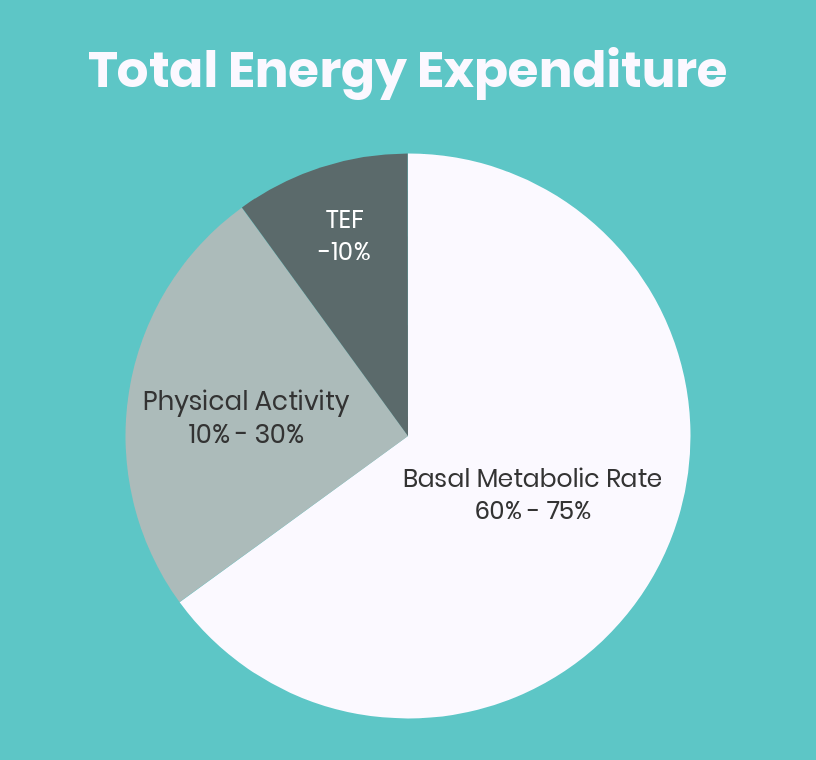
BMR/RMR: Basal Metabolic Rate (60-75% of TDEE)
Basal Metabolic Rate (BMR) is the energy required to keep the body functioning at complete rest—breathing, circulation, cell production, nutrient processing, and maintaining body temperature. BMR represents the largest component of daily calorie burn for most people, accounting for 60-75% of TDEE. BMR is primarily determined by lean body mass (muscle burns ~6 cal/lb/day, fat burns ~2 cal/lb/day), age (decreases 1-2% per decade after 30), gender (men 5-10% higher due to more muscle), genetics (10-15% variation between individuals), and hormones (thyroid function significantly impacts BMR). Common BMR formulas include Mifflin-St Jeor (most accurate for general population), Harris-Benedict (tends to overestimate), and Katch-McArdle (best for those with known body fat percentage).
NEAT: Non-Exercise Activity Thermogenesis (15-30% of TDEE)
Non-Exercise Activity Thermogenesis (NEAT) includes all physical activity outside of structured exercise: occupational activities, fidgeting, maintaining posture, spontaneous movement, household chores, walking for transportation, playing with kids, and standing versus sitting. NEAT varies dramatically between individuals—sedentary office workers may burn 300-500 calories daily from NEAT, while construction workers or servers burn 1,500-2,500+ calories. NEAT explains why some people seem to "eat whatever they want" without gaining weight—they unconsciously move significantly more throughout the day. Increasing NEAT is one of the most effective fat loss strategies: walking 10,000+ steps daily, using standing desks, taking stairs, parking farther away, pacing while on phone calls, and maintaining active hobbies can add 200-500 calories daily without formal exercise.
EAT: Exercise Activity Thermogenesis (5-15% of TDEE)
Exercise Activity Thermogenesis (EAT) represents structured, intentional physical activity: gym workouts, running, cycling, swimming, sports, yoga, etc. For most people, EAT contributes only 5-15% of TDEE despite perceived significant calorie burn. A 30-minute moderate-intensity workout burns approximately 200-400 calories—easily outpaced by overeating. "You can't out-exercise a bad diet" reflects this reality. However, exercise provides benefits beyond direct calorie burn: increases muscle mass (raising BMR), improves insulin sensitivity, enhances mood, preserves muscle during calorie restriction, creates afterburn effect (EPOC—elevated metabolism post-exercise), and supports cardiovascular health. Resistance training is particularly valuable for body composition despite burning fewer calories than cardio during the activity itself.
TEF: Thermic Effect of Food (8-15% of TDEE)
Thermic Effect of Food (TEF) is the energy required to digest, absorb, and process nutrients from food. Different macronutrients have vastly different TEF values: protein 20-30% (100 calories protein requires 20-30 calories to process), carbohydrates 5-10%, fats 0-3%. This means eating 2,000 calories of high-protein foods results in ~300-400 calories burned through digestion, while 2,000 calories of mostly fat burns only ~50 calories during processing. TEF explains why high-protein diets slightly increase daily calorie burn without additional activity. Whole, minimally processed foods also have higher TEF than refined foods—the body expends more energy breaking down fibrous vegetables, whole grains, and lean meats compared to processed foods pre-digested during manufacturing. However, TEF's contribution to TDEE is relatively small compared to BMR and NEAT.
How to Count Calories Effectively
- Use tracking apps (MyFitnessPal, Cronometer, LoseIt): Food tracking apps have massive databases with barcode scanners making logging quick and accurate. Track everything consumed for at least 2-4 weeks to understand portion sizes and calorie content. Most people significantly underestimate intake without tracking—studies show 30-50% underreporting is common.
- Invest in a digital food scale: Measuring cups and eyeballing portions are notoriously inaccurate. A digital kitchen scale (±0.1g precision) eliminates guesswork. Weigh calorie-dense foods (oils, nuts, cheese, meat) meticulously—40g peanut butter can vary 50-100 calories based on how tightly it's packed into a measuring spoon. Scale weight is always correct; volume measurements vary.
- Log food before eating: Pre-logging meals prevents end-of-day surprises where macros don't add up. Planning tomorrow's meals the night before ensures hitting targets and reduces decision fatigue. It's much easier to adjust a meal before eating than to realize you've exceeded calories after dinner.
- Account for cooking oils and condiments: Tablespoon of olive oil: 120 calories. Tablespoon mayo: 90 calories. Ketchup, BBQ sauce, salad dressings add 50-200 calories per serving. These "hidden calories" sabotage progress if not logged. Cook with minimal oil or use non-stick spray to reduce unnecessary calories.
- Verify database entries: User-submitted food databases contain errors. Always double-check entries against nutrition labels or USDA database. A "medium banana" can range from 80-150 calories depending on who entered it. Use verified entries or create custom foods from labels for accuracy.
- Weigh raw ingredients when possible: Nutrition labels typically reflect raw/uncooked weight. Meat loses 20-30% weight during cooking from water loss. 100g raw chicken breast ≠ 100g cooked chicken breast. Weigh before cooking or use database entries specifically marked "cooked" for accuracy.
- Don't obsess over perfection: Calorie tracking doesn't need to be perfect—90-95% accuracy is sufficient. Being within ±50-100 calories daily doesn't impact results. The goal is awareness and consistency, not neurotic precision causing stress and unsustainability.
- Track consistently for at least 3-4 weeks: Initial water weight fluctuations and measurement errors make weekly assessments unreliable. Track 3-4 weeks minimum before adjusting calories. Weight trends over time matter more than daily fluctuations of 2-5 lbs from water, food volume, and sodium.
- Adjust based on real-world results: Calculated TDEE is an estimate with ±200-300 calorie error margin. If not losing weight after 2-3 weeks despite adherence, reduce intake by 10-15% (200-300 calories). If losing too rapidly (>1% bodyweight weekly), increase slightly. Individual metabolism varies—trust results over calculators.
- Plan for social eating and flexibility: Save 200-300 calories for unexpected eating situations, restaurant meals, or social events. Banking calories by eating 100-150 fewer earlier in the week allows higher intake on weekends without exceeding weekly targets. Sustainability requires flexibility, not rigid daily targets causing anxiety.
Common Calorie Counting Mistakes
- Overestimating activity level: Most people overestimate daily activity. Unless exercising intensely 5-7 days weekly with physically demanding job, "lightly active" or "moderately active" is appropriate. Overestimating inflates TDEE by 200-400 calories, preventing fat loss despite perceived adherence.
- Not tracking weekends: "Eating clean" Monday-Friday but untracked weekend eating easily erases weekly deficit. Two days of overeating by 1,000 calories eliminates 5 days of 400-calorie deficits. Track every day or accept weight maintenance as likely outcome.
- Forgetting liquid calories: Soda, juice, alcohol, flavored coffee drinks, smoothies, and protein shakes contain 100-500+ calories without satiety benefits of solid food. Liquid calories don't trigger fullness mechanisms like solid foods, making overconsumption easy. Stick to water, black coffee, unsweetened tea.
- Using generic database entries: "Homemade lasagna" or "restaurant burger" entries vary wildly. Restaurant meals often contain 2-3x more calories than estimated due to butter, oil, cream, and large portions. Use specific brand names or create custom recipes with exact ingredients for home-cooked meals.
- Not accounting for nibbling and tasting: Bites while cooking, finishing kids' plates, handfuls of snacks, and "just a taste" can add 200-500 untracked calories daily. Every bite, lick, and taste counts—either track it or eliminate mindless eating entirely.
- Eating back all exercise calories: Fitness trackers and gym equipment overestimate calorie burn by 20-50%. If tracking says you burned 400 calories, actual burn may be 200-300. Eating back all estimated exercise calories prevents deficits. Use exercise as bonus deficit, not license to eat more.
- Expecting linear progress: Weight fluctuates 2-5 lbs daily from water retention (sodium, carbs, inflammation, hormones), food volume in digestive system, and glycogen stores. Weekly average weight matters, not daily weigh-ins. Fat loss plateaus occur every 3-4 weeks despite perfect adherence—patience required.
- Setting calories too low initially: Starting with aggressive deficits (1,200 cal for women, 1,500 for men) leaves nowhere to go when plateaus occur. Start with modest deficit (300-500 cal), monitor progress, and reduce gradually only when necessary. Preserves metabolic rate and allows diet flexibility.
- Ignoring protein requirements: Focusing only on total calories while neglecting protein (1.6-2.2g/kg) causes excessive muscle loss during deficits. Losing 20 lbs with inadequate protein may include 8-10 lbs muscle loss versus 1-2 lbs muscle with proper protein, dramatically affecting metabolism and physique.
- Comparing your needs to others: Individual calorie needs vary 200-400+ calories between people with identical stats due to genetics, NEAT levels, metabolic efficiency, and training history. Your friend losing weight on 2,000 calories doesn't mean you will—everyone's TDEE is unique.
Zigzag Calorie Cycling Strategy
Zigzag calorie cycling (also called calorie cycling or refeeds) alternates daily calorie intake while maintaining the same weekly average. Instead of eating 2,000 calories every day (14,000 weekly), you might eat 1,800 five days and 2,500 two days (still 14,000 weekly). The theory is that varying intake prevents metabolic adaptation—the body's tendency to reduce metabolism in response to consistent calorie restriction. By including higher-calorie days, leptin (satiety hormone) temporarily increases, hunger decreases, and metabolism receives a brief boost, potentially preventing plateaus.
Example Zigzag Schedule (2,000 cal average)
Schedule 1: Weekend Refeed
- Monday-Friday: 1,800 calories (5 days × 1,800 = 9,000 cal)
- Saturday-Sunday: 2,500 calories (2 days × 2,500 = 5,000 cal)
- Weekly Total: 14,000 calories (2,000 cal/day average)
Schedule 2: Gradual Wave Pattern
- Monday: 2,200 cal | Tuesday: 1,900 cal | Wednesday: 1,800 cal
- Thursday: 1,800 cal | Friday: 2,100 cal | Saturday: 2,000 cal | Sunday: 2,200 cal
- Weekly Total: 14,000 calories (2,000 cal/day average)
Benefits and limitations: Calorie cycling may improve diet adherence by allowing higher-calorie social eating on weekends while maintaining weekly deficit. Psychologically, knowing a higher-calorie day is coming makes restriction easier. However, scientific evidence for metabolic advantages is mixed—most studies show minimal difference in fat loss between consistent daily deficits and calorie cycling when weekly totals are identical. The main benefit is psychological and behavioral, not metabolic. Calorie cycling works best for those who struggle with consistent daily restriction or have social commitments requiring flexibility. It's unnecessary for those comfortable eating the same daily calories.
Medical Disclaimer
This calorie calculator provides estimates based on established formulas (Mifflin-St Jeor, Harris-Benedict) and standard activity multipliers, but cannot account for individual metabolic variations, medical conditions, medications, genetics, NEAT levels, training history, or adaptive thermogenesis. Calculated TDEE may vary ±200-400 calories from actual expenditure due to factors including thyroid function, genetic metabolic efficiency, gut microbiome composition, muscle mass, previous dieting history, and individual NEAT patterns. People with metabolic disorders (diabetes, metabolic syndrome, PCOS, thyroid disorders), eating disorders history, cardiovascular disease, kidney disease, liver disease, or taking medications affecting metabolism should consult endocrinologists or registered dietitians before implementing calculated calorie targets. Very low-calorie diets (<1,200 cal women, <1,500 cal men) should only be attempted under medical supervision to prevent nutrient deficiencies, muscle loss, metabolic damage, gallstones, electrolyte imbalances, and hormonal disruptions. Pregnant and breastfeeding women, children, adolescents, older adults, and competitive athletes have unique calorie requirements not captured by standard adult formulas. Rapid weight loss (>1% bodyweight weekly) increases muscle loss, metabolic slowdown, and regain likelihood compared to moderate rates (0.5-1% weekly). Eating disorders, disordered eating patterns, body dysmorphia, and unhealthy relationships with food require professional mental health treatment—calorie calculators should not be used as substitutes for therapy or tools for restriction in these populations. Weight loss should prioritize health, sustainable behaviors, adequate nutrition, and psychological wellbeing over achieving specific numbers. This calculator is for educational purposes only, not medical advice, diagnosis, treatment, or nutrition prescription. Always consult physicians, registered dietitians, or certified nutritionists for personalized calorie guidance, especially when managing chronic health conditions, implementing significant calorie changes, or addressing disordered eating patterns.
About the Author
Adam
Co-Founder @ RevisionTown
Math Expert specializing in various curricula including IB, AP, GCSE, IGCSE, and more
This Calorie Calculator is based on several equations, and the results of the calculator are based on an estimated average. The Harris-Benedict Equation was one of the earliest equations used to calculate basal metabolic rate (BMR), which is the amount of energy expended per day at rest. It was revised in 1984 to be more accurate and was used up until 1990, when the Mifflin-St Jeor Equation was introduced. The Mifflin-St Jeor Equation also calculates BMR, and has been shown to be more accurate than the revised Harris-Benedict Equation. The Katch-McArdle Formula is slightly different in that it calculates resting daily energy expenditure (RDEE), which takes lean body mass into account, something that neither the Mifflin-St Jeor nor the Harris-Benedict Equation do. Of these equations, the Mifflin-St Jeor Equation is considered the most accurate equation for calculating BMR with the exception that the Katch-McArdle Formula can be more accurate for people who are leaner and know their body fat percentage. The three equations used by the calculator are listed below:
where:
H is body height in cm
A is age
F is body fat in percentage
The value obtained from these equations is the estimated number of calories a person can consume in a day to maintain their body-weight, assuming they remain at rest. This value is multiplied by an activity factor (generally 1.2-1.95) dependent on a person’s typical levels of exercise, which accounts for times during the day when a person is not at rest. 1 pound, or approximately 0.45 kg, equates to about 3,500 calories. As such, in order to lose 1 pound per week, it is recommended that 500 calories be shaved off the estimate of calories necessary for weight maintenance per day. For example, if a person has an estimated allotment of 2,500 calories per day to maintain body-weight, consuming 2,000 calories per day for one week would theoretically result in 3,500 calories (or 1 pound) lost during the period.
It is important to remember that proper diet and exercise is largely accepted as the best way to lose weight. It is inadvisable to lower calorie intake by more than 1,000 calories per day, as losing more than 2 pounds per week can be unhealthy, and can result in the opposite effect in the near future by reducing metabolism. Losing more than 2 pounds a week will likely involve muscle loss, which in turn lowers BMR, since more muscle mass results in higher BMR. Excessive weight loss can also be due to dehydration, which is unhealthy. Furthermore, particularly when exercising in conjunction with dieting, maintaining a good diet is important, since the body needs to be able to support its metabolic processes and replenish itself. Depriving the body of the nutrients it requires as part of heavily unhealthy diets can have serious detrimental effects, and weight lost in this manner has been shown in some studies to be unsustainable, since the weight is often regained in the form of fat (putting the participant in a worse state than when beginning the diet). As such, in addition to monitoring calorie intake, it is important to maintain levels of fiber intake as well as other nutritional necessities to balance the needs of the body.
Calorie Counting as a Means for Weight Loss
Calorie counting with the intent of losing weight, on its simplest levels, can be broken down into a few general steps:
- Determine your BMR using one of the provided equations. If you know your body fat percentage, the Katch-McArdle Formula might be a more accurate representation of your BMR. Remember that the values attained from these equations are approximations and subtracting exactly 500 calories from your BMR will not necessarily result in exactly 1 pound lost per week – it could be less, or it could be more!
- Determine your weight loss goals. Recall that 1 pound (~0.45 kg) equates to approximately 3500 calories, and reducing daily caloric intake relative to estimated BMR by 500 calories per day will theoretically result in a loss of 1 pound a week. It is generally not advisable to lose more than 2 pounds per week as it can have negative health effects, i.e. try to target a maximum daily calorie reduction of approximately 1000 calories per day. Consulting your doctor and/or a registered dietician nutritionist (RDN) is recommended in cases where you plan to lose more than 2 pounds per week.
- Choose a method to track your calories and progress towards your goals. If you have a smartphone, there are many easy-to-use applications that facilitate tracking calories, exercise, and progress, among other things. Many, if not all of these, have estimates for the calories in many brand-name foods or dishes at restaurants, and if not, they can estimate calories based on the amount of the individual components of the foods. It can be difficult to get a good grasp on food proportions and the calories they contain – which is why counting calories (as well as any other approach) is not for everyone – but if you meticulously measure and track the number of calories in some of your typical meals, it quickly becomes easier to accurately estimate calorie content without having to actually measure or weigh your food each time. There are also websites that can help to do the same, but if you prefer, manually maintaining an excel spreadsheet or even a pen and paper journal are certainly viable alternatives.
- Track your progress over time and make changes to better achieve your goals if necessary. Remember that weight loss alone is not the sole determinant of health and fitness, and you should take other factors such as fat vs. muscle loss/gain into account as well. Also, it is recommended that measurements are taken over longer periods of time such as a week (rather than daily) as significant variations in weight can occur simply based on water intake or time of day. It is also ideal to take measurements under consistent conditions, such as weighing yourself as soon as you wake up and before breakfast, rather than at different times throughout the day.
- Keep at it!
The above steps are an attempt at the most basic form of calorie counting. Calorie counting is not an exact science, and can be as complex as you want to make it. The above does not consider the proportions of macronutrients consumed. While there is no exactly known, ideal proportion of macronutrients (fats, proteins, carbohydrates), some balance is certainly advisable, and different foods have been found to have different effects on health, feelings of hunger, and number of calories burned. Generally, minimally processed plant and animal foods tend to be more conducive to healthy weight loss and maintenance.
There are many approaches to weight loss and there is no set ideal method that works for all people, which is why so many different diets and exercise regimens exist. While some methods are more effective for each individual person, not all weight loss methods are equivalent, and studies suggest that some approaches are healthier than others. That being said, one of the most commonly effective weight loss methods is counting calories. In its most basic form, calories consumed minus calories expended will result in weight gain if the result is positive, or weight loss if the result is negative. However, this is far from a comprehensive picture, and many other factors play a role in affecting healthy, sustainable weight loss. For example, there exist conflicting studies addressing whether or not the type of calories or foods consumed, or how they are consumed, affects weight loss. Studies have shown that foods that require a person to chew more and are more difficult to digest result in the body burning more calories, sometimes referred to as the thermic effect of food. While the increase in burned calories may be marginal, foods that are more difficult to digest such as vegetables generally tend to be healthier and provide more nutrients for fewer calories than many processed foods.
Consistent with the view that in regards to weight loss, only net calories are important and not their source, there exist cases such as the Twinkie diet, where a person that solely counted calories while eating a variety of cake snacks managed to lose 27 pounds over two months. As effective as this can be, it is certainly not suggested. While the participant did not seem to suffer any noticeable health detriments in this particular case, there are other less measurable factors that should be considered such as long-term effects of such a diet on potential for developing cancers, heart disease, and diabetes. However, ignoring efficiency and health, sustained, significant reduction of caloric intake or increase of physical activity should result in weight loss, and counting calories can be an effective way to achieve this sole result.
Aside from being one viable method for facilitating weight loss, calorie counting has other somewhat less quantifiable advantages including helping to increase nutritional awareness. Many people are completely unaware of, or grossly underestimate their daily caloric intake. Counting calories can help raise awareness of different types of foods, the number of calories they contain, and how these calories have a different effect on a person’s feelings of satiety. Once a person has a better understanding of how many calories are actually in that bag of chips that they can so easily inhale within minutes, how much of their daily caloric intake it consumes, and how little the chips do to satiate their hunger, portion control and avoidance of foods with empty calories tends to become easier.
Having actual caloric measurements can also assist in weight loss, since tangible calorie goals can be set, rather than simply trying to eat less. Also, although this is not necessarily directly related to calorie counting, studies have shown that portion control by simply eating from a smaller plate can help reduce calorie intake, since people tend to fill their plates and eat everything on their plates. Many people do not realize that they are overeating, since they have become accustomed to restaurant-sized portions being the norm, when said portions can be up to three or more times larger than necessary for a typical meal.
Tracking calories also puts exercise in a quantifiable perspective, increasing a person’s awareness regarding how much exercise is really required to counteract a 220-calorie bag of M&M’s. Once a link is made between the amount of exercise that some snack equates to, many people find abstaining from that bag of chips to be the preferred option rather than performing an equivalent amount of exercise – which can lead to healthier eating habits.
In the end, however, what’s important is picking a strategy that works for you. Calorie counting is only one method used to achieve weight loss amongst many, and even within this method, there are many possible approaches a person can take. Finding an approach that fits within your lifestyle that you think you would be able to adhere to is likely going to provide the most sustainable option and desirable result.
Zigzag Calorie Cycling
Zigzag calorie cycling is a weight loss approach that aims to counteract the human body’s natural adaptive tendencies. Counting and restricting calories, as described above, is a viable method to lose weight, but over a period of time, it is possible for the body to adapt to the lower number of calories consumed. In cases where this happens, a plateau in weight loss that can be difficult to surmount can result. This is where zigzag calorie cycling can help, by not allowing the body to adapt to the lower calorie environment.
Zigzag calorie cycling involves alternating the number of calories consumed on a given day. A person on a zigzag diet should have a combination of high-calorie and low-calorie days to meet the same overall weekly calorie target. For example, if your target calorie intake is 14,000 calories per week, you could consume 2,300 calories three days a week, and 1,775 the other four days of the week, or you could consume 2,000 calories each day. In both cases, 14,000 calories would be consumed over the week, but the body wouldn’t adapt and compensate for a 2,000-calorie diet. This also allows a person more flexibility in their diet, allowing them to plan around occasions, such as work or family gatherings, where a person may consume more calories. Consuming a lower number of calories on other days can allow a person to enjoy these gatherings or even have a “cheat day” where they eat whatever they want without feeling guilty, since they can make up for the excess calories on their low-calorie days.
There is no concrete rule or study that dictates the most effective way to alternate or spread out calorie consumption. How to vary calorie intake is largely up to personal discretion. Depending on a person’s activity, it is generally recommended that the high-calorie and low-calorie days vary by approximately 200-300 calories, where the high-calorie day is often the number of calories a person needs to consume to maintain their current weight. For a person with a higher activity level, the calorie difference should be larger. The calculator presents two zigzag diet schedules. The first schedule has two higher calorie days and five lower calorie days. The second schedule increases and reduces calories gradually. In either case, the total weekly calorie consumption is the same.
In the end, regardless of what method you choose to use when approaching weight loss, what’s important is picking a strategy that works for you. Calorie counting and zigzag calorie cycling are only two methods (that are fairly interrelated) used to achieve weight loss among many, and even within these methods, there are many possible approaches a person can take. Finding an approach that fits within your lifestyle that you think you would be able to adhere to is likely going to provide the most sustainable and desirable result.
How Many Calories Do You Need?
Many people seek to lose weight, and often the easiest way to do this is to consume fewer calories each day. But how many calories does the body actually need in order to be healthy? This largely depends on the amount of physical activity a person performs each day, and regardless of this, is different for all people – there are many different factors involved, not all of which are well-understood or known.
Some factors that influence the number of calories a person needs to remain healthy include age, weight, height, sex, levels of physical activity, and overall general health. For example, a physically active 25-year-old male that is 6 feet in height requires considerably higher calorie intake than a 5-foot-tall, sedentary 70-year-old woman. Though it differs depending on age and activity level, adult males generally require 2,000-3000 calories per day to maintain weight while adult females need around 1,600-2,400 according to the U.S Department of Health.
The body does not require many calories to simply survive. However, consuming too few calories results in the body functioning poorly, since it will only use calories for functions essential to survival, and ignore those necessary for general health and well-being. Harvard Health Publications suggests women get at least 1,200 calories and men get at least 1,500 calories a day unless supervised by doctors. As such, it is highly recommended that a person attempting to lose weight monitors their body’s caloric necessities and adjusts them as necessary to maintain its nutritional needs.
Calories: Different Kinds and Their Effects
The main sources of calories in a typical person’s diet are carbohydrates, proteins, and fat, with alcohol also being a significant portion of calorie intake for many people (though ideally this should be limited since alcohol contains many empty calories). Some studies have shown that the calories displayed on nutrition labels and the calories actually consumed and retained can vary significantly. This hints at the complex nature of calories and nutrition and is why many conflicting points of view on the “best” methodology for losing weight exist. For example, how a person chews their food has been shown to affect weight loss to some degree; generally speaking, chewing food more increases the number of calories that the body burns during digestion. People that chew more also tend to eat less, since the longer period of time necessary to chew their food allows more time to reach a state of satiety, which results in eating less. However, the effects of how food is chewed and digestion of different foods are not completely understood and it is possible that other factors exist, and thus this information should be taken with a grain of salt (in moderation if weight loss is the goal).
Generally, foods that take more effort to chew – fruit, vegetables, lean meats, whole grains, etc. – require the body to burn more calories since more calories are required to digest them. It also results in the feeling of satiety for longer periods of time. Furthermore, certain foods like coffee, tea, chilies, cinnamon, and ginger have been found to increase the rate of calories burned, due to the ingredients they contain.
The “quality” of calories consumed is also important. There are different classifications of foods in terms of calories. This includes high-calorie foods, low-calorie foods, and empty calories. Consistent with their naming, high-calorie foods are foods that are calorically dense, meaning that there are a high number of calories relative to serving size, while low-calorie foods have fewer calories relative to serving size. Foods such as fat, oils, fried foods, and sugary foods are examples of high-calorie foods. Being a high-calorie food does not inherently mean that the food is unhealthy however – avocados, quinoa, nuts, and whole grains are all high-calorie foods that are considered healthful in moderation. Low-calorie foods include vegetables and certain fruits, among other things, while empty calories, such as those in added sugars and solid fats, are calories that contain few to no nutrients. Studies have shown that there is a measurable difference between consuming 500 calories of carrots compared to 500 calories of popcorn. As previously mentioned, this in part can be attributed to differences in how the foods are consumed and processed. Carrots require far more chewing and can result in more calories burned during digestion. Again, the mechanism for these differences is not fully defined, but simply note that for weight loss purposes, the general formula of calories in minus calories out determining weight gain or loss does hold, but that the number of calories on a nutrition label is not necessarily indicative of how many calories the body actually retains. While there is no clear-cut or ideal amount of macronutrient proportions a person should consume to maintain a healthy diet or lose weight, eating a “healthy” diet replete with a variety of unprocessed foods such as vegetables, fruits, and lean meats is correlated with being healthier, and is more likely to result in sustainable weight loss. Also, remember that calories from drinks comprise an estimated 21% of a typical person’s diet. Many of these calories fall under the category of empty calories. While sodas are an obvious culprit, drinks such as juices and even milk have large amounts of sugar and should be consumed in moderation to avoid negating their nutritional benefits. Ideally, a person should drink water, tea, and coffee without adding sugar in order to reduce calories gained from drinks.
Remember: All foods, including “healthful foods,” should be consumed in moderation, and distinctions can often be misleading since even natural foods like fruits can have large amounts of sugar, and foods labeled as “health foods” such as low-calorie foods, reduced-fat foods, etc. can potentially replace one unhealthy component with another. Many reduced-fat foods have large amounts of added sugar to compensate for taste lost through fat reduction. It is important to pay attention to, and consider the different components in a food product in order to determine whether said food should have a place within your diet.
Calories in Common Foods
| Food | Serving Size | Calories | kJ |
| Fruit | |||
| Apple | 1 (4 oz.) | 59 | 247 |
| Banana | 1 (6 oz.) | 151 | 632 |
| Grapes | 1 cup | 100 | 419 |
| Orange | 1 (4 oz.) | 53 | 222 |
| Pear | 1 (5 oz.) | 82 | 343 |
| Peach | 1 (6 oz.) | 67 | 281 |
| Pineapple | 1 cup | 82 | 343 |
| Strawberry | 1 cup | 53 | 222 |
| Watermelon | 1 cup | 50 | 209 |
| Vegetables | |||
| Asparagus | 1 cup | 27 | 113 |
| Broccoli | 1 cup | 45 | 188 |
| Carrots | 1 cup | 50 | 209 |
| Cucumber | 4 oz. | 17 | 71 |
| Eggplant | 1 cup | 35 | 147 |
| Lettuce | 1 cup | 5 | 21 |
| Tomato | 1 cup | 22 | 92 |
| Proteins | |||
| Beef, regular, cooked | 2 oz. | 142 | 595 |
| Chicken, cooked | 2 oz. | 136 | 569 |
| Tofu | 4 oz. | 86 | 360 |
| Egg | 1 large | 78 | 327 |
| Fish, Catfish, cooked | 2 oz. | 136 | 569 |
| Pork, cooked | 2 oz. | 137 | 574 |
| Shrimp, cooked | 2 oz. | 56 | 234 |
| Common Meals/Snacks | |||
| Bread, white | 1 slice (1 oz.) | 75 | 314 |
| Butter | 1 tablespoon | 102 | 427 |
| Caesar salad | 3 cups | 481 | 2014 |
| Cheeseburger | 1 sandwich | 285 | 1193 |
| Hamburger | 1 sandwich | 250 | 1047 |
| Dark Chocolate | 1 oz. | 155 | 649 |
| Corn | 1 cup | 132 | 553 |
| Pizza | 1 slice (14″) | 285 | 1193 |
| Potato | 6 oz. | 130 | 544 |
| Rice | 1 cup cooked | 206 | 862 |
| Sandwich | 1 (6″ Subway Turkey Sandwich) | 200 | 837 |
| Beverages/Dairy | |||
| Beer | 1 can | 154 | 645 |
| Coca-Cola Classic | 1 can | 150 | 628 |
| Diet Coke | 1 can | 0 | 0 |
| Milk (1%) | 1 cup | 102 | 427 |
| Milk (2%) | 1 cup | 122 | 511 |
| Milk (Whole) | 1 cup | 146 | 611 |
| Orange Juice | 1 cup | 111 | 465 |
| Apple cider | 1 cup | 117 | 490 |
| Yogurt (low-fat) | 1 cup | 154 | 645 |
| Yogurt (non-fat) | 1 cup | 110 | 461 |
* 1 cup = ~250 milliliters, 1 table spoon = 14.2 gram
2000, 1500, and 1200 Calorie Sample Meal Plans
| Meal | 1200 Cal Plan | 1500 Cal Plan | 2000 Cal Plan |
| Breakfast | All-bran cereal (125) Milk (50) Banana (90) | Granola (120) Greek yogurt (120) Blueberries (40) | Buttered toast (150) Egg (80) Banana (90) Almonds (170) |
| Snack | Cucumber (30) Avocado dip (50) | Orange (70) | Greek yogurt (120) Blueberries (40) |
| Total | 345 Calories | 350 Calories | 650 Calories |
| Lunch | Grilled cheese with tomato (300) Salad (50) | Chicken and vegetable soup (300) Bread (100) | Grilled chicken (225) Grilled vegetables (125) Pasta (185) |
| Snack | Walnuts (100) | Apple (75) Peanut butter (75) | Hummus (50) Baby carrots (35) Crackers (65) |
| Total | 450 Calories | 550 Calories | 685 Calories |
| Dinner | Grilled Chicken (200) Brussel sprouts (100) Quinoa (105) | Steak (375) Mashed potatoes (150) Asparagus (75) | Grilled salmon (225) Brown rice (175) Green beans (100) Walnuts (165) |
| Total | 405 Calories | 600 Calories | 665 Calories |
Calories Burned from Common Exercises:
| Activity (1 hour) | 125 lb person | 155 lb person | 185 lb person |
| Golf (using cart) | 198 | 246 | 294 |
| Walking (3.5 mph) | 215 | 267 | 319 |
| Kayaking | 283 | 352 | 420 |
| Softball/Baseball | 289 | 359 | 428 |
| Swimming (free-style, moderate) | 397 | 492 | 587 |
| Tennis (general) | 397 | 492 | 587 |
| Running (9 minute mile) | 624 | 773 | 923 |
| Bicycling (12-14 mph, moderate) | 454 | 562 | 671 |
| Football (general) | 399 | 494 | 588 |
| Basketball (general) | 340 | 422 | 503 |
| Soccer (general) | 397 | 492 | 587 |
Energy from Common Food Components
| Food Components | kJ per gram | Calorie (kcal) per gram | kJ per ounce | Calorie (kcal) per ounce |
| Fat | 37 | 8.8 | 1,049 | 249 |
| Proteins | 17 | 4.1 | 482 | 116 |
| Carbohydrates | 17 | 4.1 | 482 | 116 |
| Fiber | 8 | 1.9 | 227 | 54 |
| Ethanol (drinking alcohol) | 29 | 6.9 | 822 | 196 |
| Organic acids | 13 | 3.1 | 369 | 88 |
| Polyols (sugar alcohols, sweeteners) | 10 | 2.4 | 283 | 68 |