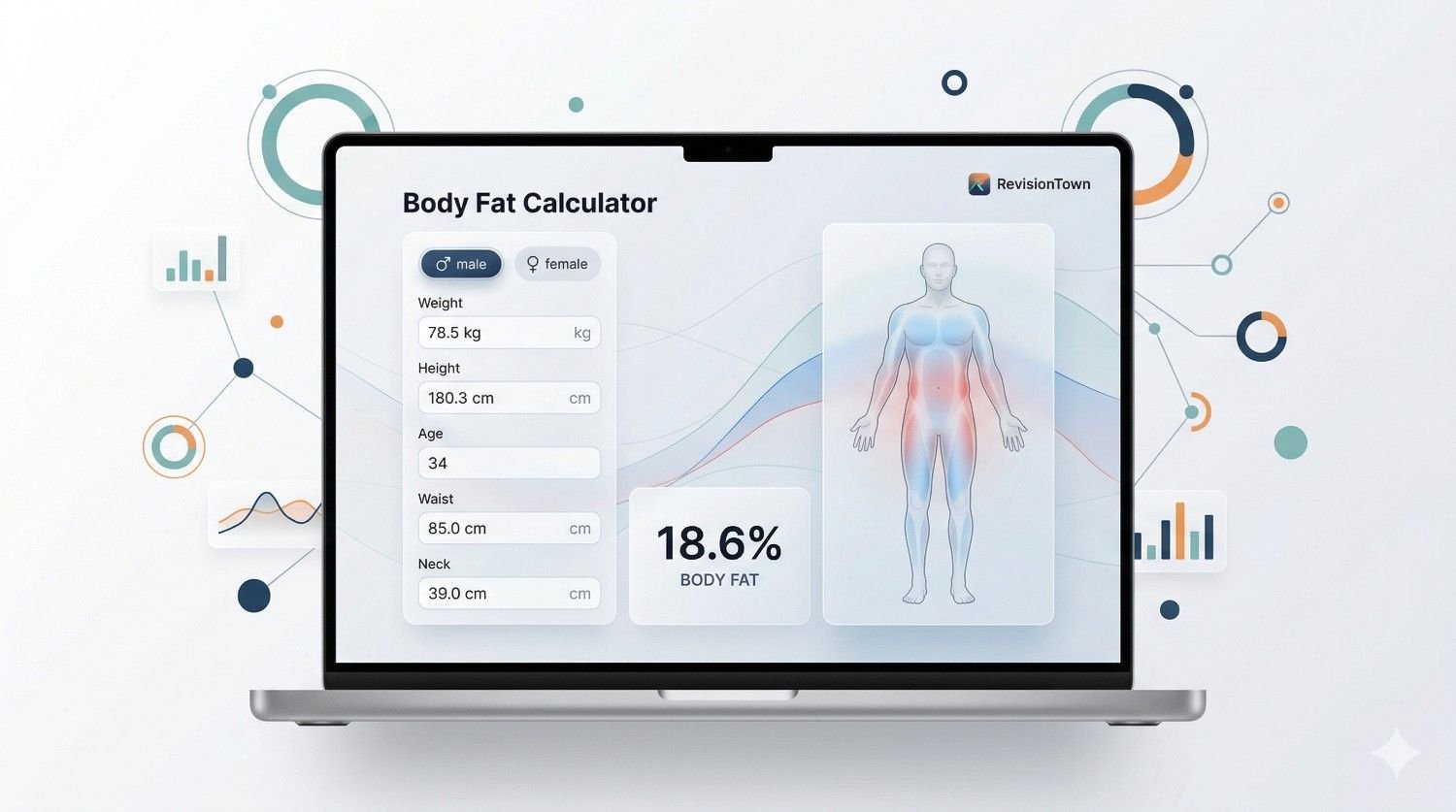
Body Fat Calculator
Calculate Your Body Fat Percentage & Body Composition
Body Fat Percentage Calculator
Calculate Your Body Fat %
Body Fat Percentage Categories
Men
| Category | Body Fat % |
|---|---|
| Essential Fat | 2-5% |
| Athletes | 6-13% |
| Fitness | 14-17% |
| Average | 18-24% |
| Obese | 25%+ |
Women
| Category | Body Fat % |
|---|---|
| Essential Fat | 10-13% |
| Athletes | 14-20% |
| Fitness | 21-24% |
| Average | 25-31% |
| Obese | 32%+ |
Understanding Body Fat Percentage
Body fat percentage is the proportion of fat mass to total body weight, expressed as a percentage. Unlike weight or BMI, body fat percentage directly measures body composition—distinguishing between fat mass and lean mass (muscle, bone, organs, water). Two people with identical height, weight, and BMI can have drastically different body fat percentages and health risks. A muscular athlete at 200 lbs with 10% body fat (20 lbs fat, 180 lbs lean mass) is metabolically healthy, while a sedentary person at 200 lbs with 30% body fat (60 lbs fat, 140 lbs lean mass) faces increased disease risk despite same weight and BMI.
Body fat serves essential physiological functions beyond energy storage: insulation and temperature regulation, protecting vital organs from trauma, hormone production (leptin, estrogen, testosterone), vitamin absorption (A, D, E, K are fat-soluble), and cell membrane structure. However, fat exists in two categories with different health implications. Essential fat is necessary for basic physiological functioning—men require minimum 2-5% (primarily in bone marrow, organs, central nervous system), women require 10-13% (includes essential fat plus sex-specific fat in breasts, pelvis, hips supporting reproductive function). Dropping below essential fat levels causes hormonal disruption, amenorrhea in women, immune dysfunction, and serious health consequences.
Storage fat accumulates in adipose tissue and varies widely between individuals based on genetics, diet, exercise, age, and hormones. Storage fat is further categorized by location: subcutaneous fat (beneath skin, comprises ~90% of total body fat, relatively benign metabolically) and visceral fat (surrounds organs in abdominal cavity, comprises ~10% of total fat but carries highest disease risk). Visceral fat is metabolically active, releasing inflammatory cytokines and free fatty acids that impair insulin sensitivity, promote cardiovascular disease, increase cancer risk, and drive metabolic dysfunction. Waist circumference and waist-to-hip ratio better predict visceral fat than total body fat percentage. Men storing fat primarily in abdomen ("apple shape") face higher risks than those storing in hips/thighs ("pear shape"). Women naturally store more subcutaneous fat in hips/thighs due to estrogen, providing some protective effects versus male fat distribution patterns.
Body Fat Measurement Methods
US Navy Method (Used by This Calculator)
The US Navy circumference method estimates body fat using simple tape measurements of neck, waist, and (for women) hips along with height. Developed for military fitness assessment, it's convenient, non-invasive, requires no special equipment, and reasonably accurate (±3-5% error compared to DEXA). The method assumes relationships between circumferences and body fat—larger waist relative to neck indicates higher body fat. For men: BF% = 495 / (1.0324 - 0.19077 × log₁₀(waist - neck) + 0.15456 × log₁₀(height)) - 450. For women: BF% = 495 / (1.29579 - 0.35004 × log₁₀(waist + hip - neck) + 0.22100 × log₁₀(height)) - 450. Accuracy depends on proper measurement technique—measure at specified locations, keep tape level and snug (not tight), and measure multiple times for consistency.
DEXA Scan (Gold Standard)
Dual-Energy X-ray Absorptiometry (DEXA) is considered the clinical gold standard for body composition analysis. Originally developed for bone density assessment, DEXA uses low-dose X-rays at two different energies to differentiate bone mineral, lean tissue, and fat tissue throughout the body. DEXA provides regional body composition data (arms, legs, trunk), bone density measurements, and visceral fat estimates with ±1-2% accuracy. Advantages: highly accurate, comprehensive data, tracks changes over time. Disadvantages: expensive ($50-150 per scan), requires specialized equipment and trained technician, involves minimal radiation exposure (similar to airplane flight), not suitable for pregnant women. DEXA is ideal for serious athletes, bodybuilders tracking body composition changes, or medical assessment of osteoporosis and body composition disorders.
Skinfold Calipers (Widely Used)
Skinfold measurements use calipers to measure subcutaneous fat thickness at specific body sites (chest, abdomen, thigh, tricep, suprailiac, subscapular, midaxillary). Multiple sites (3-site, 7-site protocols) are measured, summed, and entered into prediction equations (Jackson-Pollock, Durnin-Womersley) to estimate total body fat percentage. Accuracy is ±3-5% with experienced technician using proper technique and high-quality calipers. Advantages: inexpensive, portable, quick (<10 minutes), tracks changes well when same person measures repeatedly. Disadvantages: requires skill and practice, inter-tester variability high (different measurers get different results), difficult on obese individuals, only measures subcutaneous fat (misses visceral fat), discomfort from pinching. Best for tracking relative changes over time versus absolute values.
Other Measurement Methods
Bioelectrical Impedance Analysis (BIA): Sends weak electrical current through body—fat resists current, lean mass conducts it. Common in home scales and handheld devices. Accuracy ±5-8%, highly variable based on hydration status, food intake, exercise timing. Inexpensive and convenient but less reliable. Hydrostatic (underwater) weighing: Measures body density by comparing weight on land versus underwater—fat floats, lean mass sinks. Accuracy ±2-3%. Requires specialized tank, uncomfortable (full underwater submersion), time-consuming. Rarely used today. Bod Pod (Air Displacement Plethysmography): Similar principle to hydrostatic weighing but uses air displacement instead of water. Accuracy ±2-4%. More comfortable than underwater weighing but expensive and requires specialized equipment. Visual estimation: Comparing physique to reference photos. Accuracy ±5-10% for trained eyes, worse for untrained. Free but highly subjective—useful for general ballpark estimates only.
Healthy Body Fat Ranges
Optimal body fat percentage varies by age, gender, genetics, and individual goals. Generally, men have lower body fat than women at equivalent health status due to hormonal differences (testosterone promotes muscle, estrogen promotes fat storage), higher essential fat requirements for women (reproductive function), and evolutionary adaptations. Body fat naturally increases with age due to hormonal changes (declining testosterone, growth hormone), reduced activity levels, muscle loss (sarcopenia), and metabolic slowdown—5-10% increase from age 20 to 60 is normal and not necessarily unhealthy if within acceptable ranges.
Body Fat Ranges by Category (ACE Guidelines)
Men:
- Essential Fat: 2-5% (athletes only, health risks if sustained)
- Athletes: 6-13% (competitive bodybuilders, fitness models)
- Fitness: 14-17% (active individuals, visible abs)
- Average/Acceptable: 18-24% (healthy range for most men)
- Obese: 25%+ (increased health risks)
Women:
- Essential Fat: 10-13% (athletes only, menstrual irregularities common)
- Athletes: 14-20% (competitive athletes, fitness professionals)
- Fitness: 21-24% (active individuals, toned appearance)
- Average/Acceptable: 25-31% (healthy range for most women)
- Obese: 32%+ (increased health risks)
Health risks of extremely low body fat: Below essential fat levels causes hormonal disruption—amenorrhea (loss of menstrual cycle) in women, low testosterone in men, decreased bone density (osteoporosis risk), weakened immune system, constant fatigue, depression, impaired cognitive function, and increased injury risk. Female athletes with <12% body fat commonly experience menstrual irregularities; <10% almost always causes amenorrhea. Very low body fat is unsustainable long-term for non-athletes. Health risks of excessive body fat: Body fat >25% (men) or >32% (women) increases risks for type 2 diabetes, cardiovascular disease, high blood pressure, stroke, sleep apnea, certain cancers, joint problems, fatty liver disease, and reduced life expectancy. Visceral fat (belly fat) carries highest risk regardless of total body fat percentage.
How to Reduce Body Fat Percentage
- Create sustainable calorie deficit: Fat loss requires consuming fewer calories than expended—aim for 300-500 calorie daily deficit for sustainable loss of 0.5-1% bodyweight weekly. Larger deficits cause muscle loss, metabolic adaptation, extreme hunger. Track intake accurately using apps or food journals.
- Prioritize protein intake (1.6-2.4g/kg): High protein preserves lean mass during calorie restriction, increases satiety (reduces hunger), has highest thermic effect (burns most calories during digestion). Aim for 25-40g protein per meal distributed across 3-5 meals daily.
- Strength train 3-5 days weekly: Resistance training is critical for preserving muscle during fat loss. Without strength training, 20-40% of weight lost comes from muscle versus fat-only loss with proper training. More muscle = higher metabolism + better body composition at goal weight.
- Include cardio strategically: Cardiovascular exercise burns calories and improves heart health but prioritize strength training first. Add 150-300 minutes moderate cardio weekly (walking, cycling, swimming) or 75-150 minutes vigorous (running, HIIT). Excessive cardio can impair muscle growth and increase hunger.
- Manage stress and sleep: Chronic stress elevates cortisol, promoting belly fat storage and muscle breakdown. Poor sleep (<7 hours) disrupts hunger hormones, increases cravings, reduces willpower, impairs recovery. Prioritize 7-9 hours quality sleep and stress management practices (meditation, hobbies, therapy).
- Track progress beyond the scale: Body weight fluctuates 2-5 lbs daily from water, food volume, sodium, hormones. Track weekly average weight, monthly progress photos, measurements (waist, hips, thighs), how clothes fit, and strength performance. Recomposition (losing fat while gaining muscle) shows minimal scale change despite improved body composition.
- Be patient with realistic expectations: Healthy fat loss is 0.5-1% bodyweight weekly (1-2 lbs for 200 lb person). Losing 10% body fat (e.g., 30% to 20%) takes 5-12 months minimum depending on starting point, adherence, and muscle preservation. Rapid fat loss promises (10 lbs in 7 days) are water/muscle loss, not fat.
- Avoid extreme diets and quick fixes: Ketogenic, intermittent fasting, low-carb, etc. work only if they create calorie deficit—no metabolic magic exists. Choose sustainable approach matching lifestyle and preferences. Extreme restriction triggers binging, metabolic adaptation, muscle loss, and inevitable regain.
- Consider diet breaks: After 8-12 weeks in deficit, take 1-2 week maintenance break (eat at TDEE) to restore leptin, reduce hunger, improve energy, and prevent metabolic adaptation. This improves long-term adherence and results despite temporarily pausing fat loss.
- Focus on body composition over body fat %: A man at 200 lbs and 12% body fat looks dramatically better and is healthier than at 150 lbs and 12% body fat—first has 176 lbs lean mass (muscular), second has 132 lbs (skinny-fat). Build muscle while losing fat for optimal physique and health.
Medical Disclaimer
This body fat calculator provides estimates using the US Navy circumference method, which has ±3-5% error margin compared to clinical gold standards like DEXA scanning. Calculated body fat percentages are approximations that cannot account for individual variations in fat distribution, muscle mass, bone density, hydration status, or measurement technique accuracy. Measurement errors (incorrect tape placement, inconsistent tension, poor posture) significantly affect results. People with very high or very low body fat, unusual fat distribution patterns, high muscle mass, edema, or body shape variations may receive inaccurate estimates. This calculator cannot distinguish subcutaneous versus visceral fat—visceral (abdominal organ) fat carries highest health risks but isn't directly measured by circumference methods. Body fat percentage is one health indicator among many—metabolic health markers (blood pressure, glucose, lipids, inflammation), cardiovascular fitness, strength, flexibility, and functional capacity provide more complete health pictures than body fat alone. Extremely low body fat (<5% men, <12% women) causes serious health consequences: hormonal disruption, amenorrhea in women, bone density loss, immune dysfunction, organ dysfunction, mood disorders, and increased mortality risk. Very low body fat should only be achieved temporarily under professional supervision for competitive purposes. Conversely, very high body fat (>30% men, >40% women) increases risks for diabetes, cardiovascular disease, certain cancers, joint problems, sleep apnea, fatty liver disease, and reduced lifespan. People with eating disorders, body dysmorphia, disordered eating patterns, or unhealthy relationships with body image should not use body fat calculators without professional mental health support. Pregnant and breastfeeding women, children, adolescents, older adults, competitive athletes, and people with medical conditions (diabetes, cardiovascular disease, hormonal disorders) require specialized body composition assessment and medical guidance. Body fat reduction should be gradual and sustainable—rapid fat loss causes muscle loss, metabolic damage, gallstones, nutrient deficiencies, and hormonal disruption. This tool is for educational purposes only, not medical advice, diagnosis, treatment, or fitness prescription. Always consult physicians, registered dietitians, certified personal trainers, or healthcare providers for personalized body composition assessment and guidance, especially when implementing fat loss programs, managing medical conditions, or addressing body image concerns.
About the Author
Adam
Co-Founder @ RevisionTown
Math Expert specializing in various curricula including IB, AP, GCSE, IGCSE, and more
Reference
The American Council on Exercise Body Fat Categorization
| Description | Women | Men |
| Essential fat | 10-13% | 2-5% |
| Athletes | 14-20% | 6-13% |
| Fitness | 21-24% | 14-17% |
| Average | 25-31% | 18-24% |
| Obese | 32+% | 25+% |
Jackson & Pollock Ideal Body Fat Percentages
| Age | Women | Men |
| 20 | 17.7% | 8.5% |
| 25 | 18.4% | 10.5% |
| 30 | 19.3% | 12.7% |
| 35 | 21.5% | 13.7% |
| 40 | 22.2% | 15.3% |
| 45 | 22.9% | 16.4% |
| 50 | 25.2% | 18.9% |
| 55 | 26.3% | 20.9% |
Body Fat, Overweight, and Obesity
The scientific term for body fat is “adipose tissue.” Adipose tissue serves a number of important functions. Its primary purpose is to store lipids from which the body creates energy. In addition, it secretes a number of important hormones, and provides the body with some cushioning as well as insulation.
Body fat includes essential body fat and storage body fat. Essential body fat is a base level of fat that is found in most parts of the body. It is necessary fat that maintains life and reproductive functions. The amount of essential fat differs between men and women, and is typically around 2-5% in men, and 10-13% in women. The healthy range of body fat for men is typically defined as 8-19%, while the healthy range for women is 21-33%. While having excess body fat can have many detrimental effects on a person’s health, insufficient body fat can have negative health effects of its own, and maintaining a body fat percentage below, or even at the essential body fat percentage range is a topic that should be discussed with a medical professional.
Storage fat is fat that accumulates in adipose tissue, be it subcutaneous fat (deep under the dermis and wrapped around vital organs) or visceral fat (fat located inside the abdominal cavity, between organs), and references to body fat typically refer to this type of fat. While some storage fat is ideal, excess amounts of storage fat can have serious negative health implications.
Excess body fat leads to the condition of being overweight and eventually to obesity given that insufficient measures are taken to curb increasing body fat. Note that being overweight does not necessarily indicate an excess of body fat. A person’s body weight is comprised of multiple factors including (but not limited to) body fat, muscle, bone density, and water content. Thus, highly muscular people are often classified as overweight.
The rate at which body fat accumulates is different from person to person and is dependent on many factors including genetic factors as well as behavioral factors such as lack of exercise and excessive food intake. Due to varying factors, it can be more difficult for certain people to reduce body fat stored in the abdominal region. However, managing diet and exercise has been shown to reduce stored fat. Note that both women and men store body fat differently and that this can change over time. After the age of 40 (or after menopause in some cases for women), reduced sexual hormones can lead to excess body fat around the stomach in men, or around the buttocks and thighs of women.
Potential Complications of Excess Body Fat
The World Health Organization (WHO) classifies obesity as one of the leading preventable causes of death worldwide that is estimated to claim 111,909 to 365,000 deaths per year in the U.S. This has been a growing cause for concern because 36.5% of U.S. adults are defined as obese according to the Centers for Disease Control and Prevention.
Obesity is associated with a reduction in quality of life, poorer mental health outcomes, obstructive sleep apnea, as well as multiple leading causes of death worldwide such as cardiovascular disease, stroke, certain cancers and diabetes. All of these potential complications have the ability to reduce a person’s life expectancy, and as such, obesity is a medical condition that is studied by many researchers.
As previously mentioned, fat produces a number of essential hormones that affect a person’s body. An excess or a lack of critical hormones can have negative effects that preclude proper body function. On a related note, studies have found that excess body fat, particularly abdominal fat, disrupts the normal balance and function of some of these hormones. Furthermore, body fat, specifically visceral fat, has a role in the release of specific cytokines, which are a broad category of proteins involved in cell signaling, that can potentially increase the risk of cardiovascular disease. Visceral fat is also directly associated with higher levels of low-density lipoprotein (LDL) cholesterol, lower high-density lipoprotein (HDL) cholesterol, and insulin resistance. LDL cholesterol is commonly referred to as “bad cholesterol” while HDL is referred to as “good cholesterol.” High levels of LDL cholesterol can clog arteries and lead to complications including heart attacks. Insulin resistance involves cells not properly responding to the hormone insulin, which can lead to high blood sugar levels, and eventually to type 2 diabetes. As can be seen, excess visceral fat can have measurable negative impacts to a person’s health.
Measuring Body Fat Percentage
There are many specific techniques used for measuring body fat. The calculator above uses a method involving equations developed at the Naval Health Research Center by Hodgdon and Beckett in 1984. The method for measuring the relevant body parts as well as the specific equations used are provided below:
- Measure the circumference of the subject’s waist at a horizontal level around the navel for men, and at the level with the smallest width for women. Ensure that the subject does not pull their stomach inwards to obtain accurate measurements.
- Measure the circumference of the subject’s neck starting below the larynx, with the tape sloping downward to the front. The subject should avoid flaring their neck outwards.
- For women only: Measure the circumference of the subject’s hips at the largest horizontal measure.