Imperial to metric length conversion
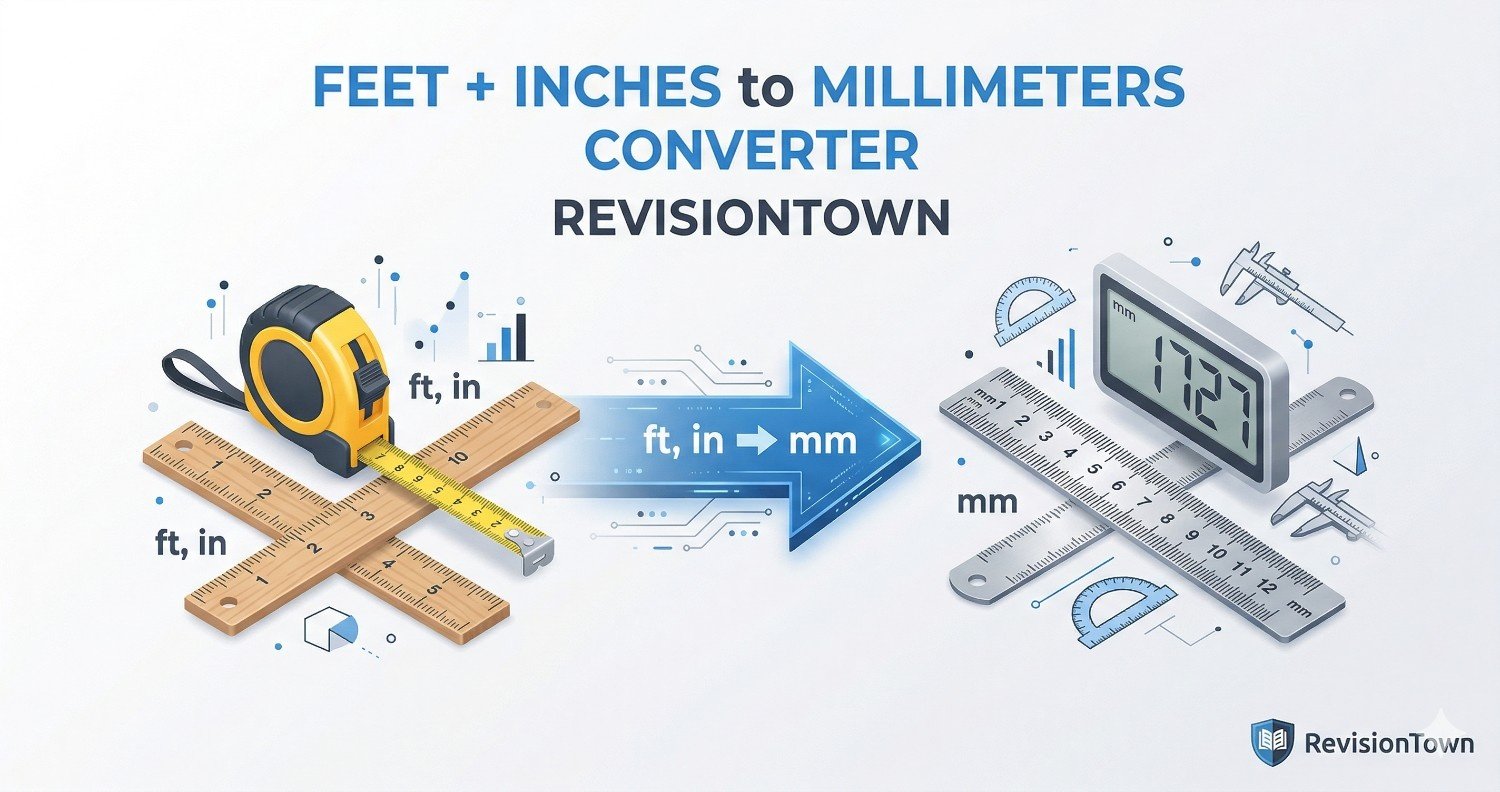
Feet+Inches to MM (ft+in to mm) Converter
Convert feet plus inches to millimeters using the exact international conversion \(1\text{ inch}=25.4\text{ mm}\). Enter a mixed imperial length such as 5 ft 10 in, 2 ft 6.5 in, or 0 ft 3/4 in, and the calculator returns millimeters, centimeters, meters, total inches, and decimal feet.
This page is focused on the mixed-format conversion from feet+inches to millimeters. If you already have millimeters and need the reverse mixed imperial result, use the dedicated mm to feet+inches converter. If you need a wider set of units, use the main length converter. Keeping each converter focused helps you get the correct formula without mixing up similar unit pages.
Convert Feet+Inches to Millimeters
Enter feet and inches. Decimals are allowed in the inches field, so 5 ft 10.5 in and 0 ft 0.75 in both work.
Feet+Inches to MM Formula
The conversion is exact because the inch is internationally defined as exactly 25.4 millimeters. First convert feet to inches, add the remaining inches, then multiply by 25.4.
For example, 5 ft 10 in is \(((5\times12)+10)\times25.4=70\times25.4=1778\text{ mm}\).
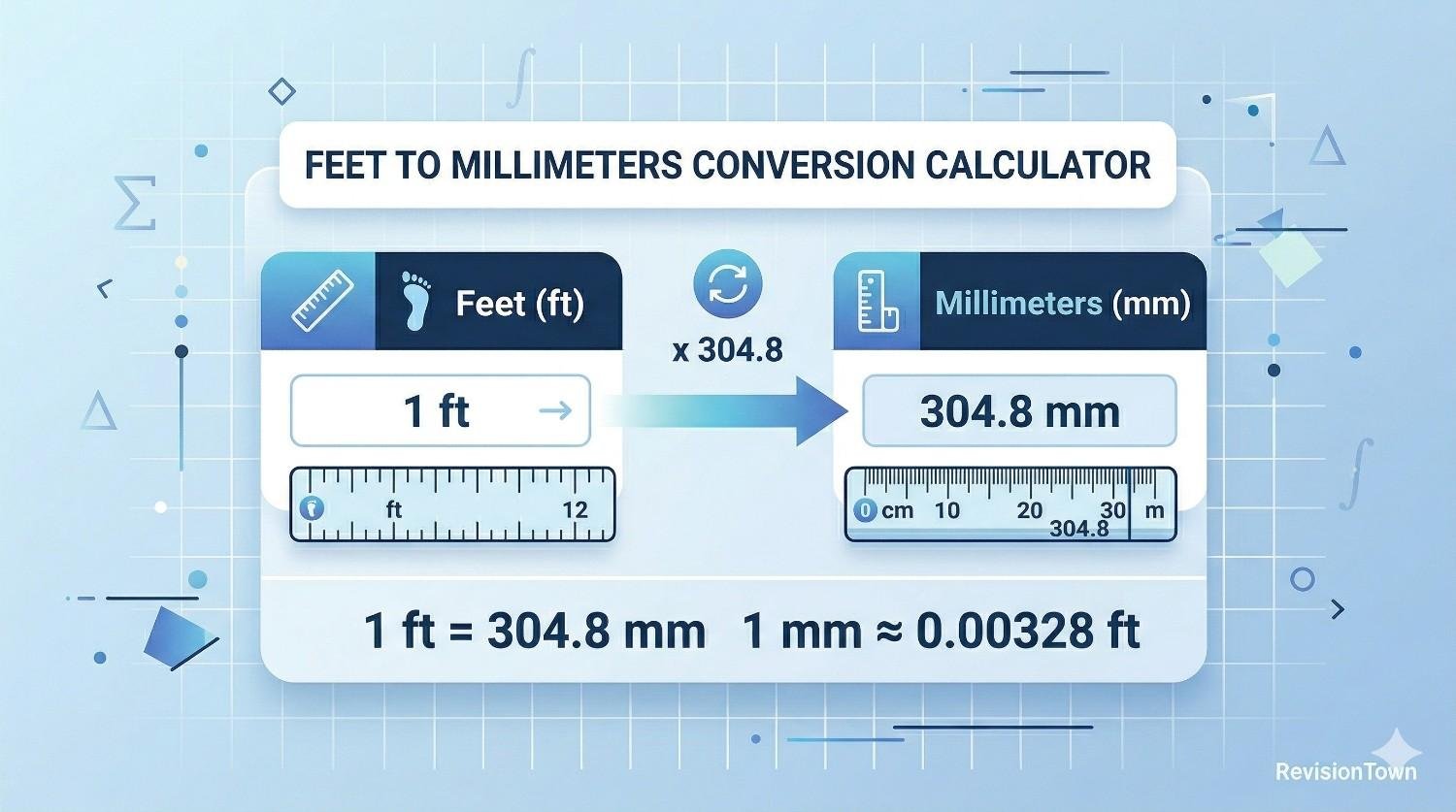
Exact conversion: \(1\text{ in}=25.4\text{ mm}\), so \(1\text{ ft}=12\text{ in}=304.8\text{ mm}\).
What Does Feet+Inches to MM Mean?
Feet+inches to millimeters means converting a mixed imperial length into a metric length expressed in millimeters. The mixed imperial format is common in the United States and in many construction, woodworking, height, and product-dimension contexts. A length such as 6 ft 2 in contains two parts: whole feet and additional inches. Millimeters are metric units, commonly used in engineering, manufacturing, technical drawings, product specifications, hardware sizing, and international documentation.
The key point is that feet and inches must be combined into one total before converting. You do not convert the feet and inches separately and then round each part early. You convert feet to inches, combine the total inches, and multiply by 25.4. This gives a precise millimeter result that can be rounded only at the end. The exact conversion is:
Because \(25.4\) is exact, the only uncertainty comes from the measurement you enter. If the original measurement is rounded to the nearest inch, the millimeter result is also approximate even though the conversion factor is exact. If the original measurement is 5 ft 10.25 in from a careful measurement, the millimeter result can be more precise. Precision depends on the source measurement, not only on the calculator.
How to Convert Feet+Inches to Millimeters Step by Step
The safest method is a three-step process. First, multiply feet by 12 to convert feet into inches. Second, add the remaining inches. Third, multiply total inches by 25.4 to convert inches into millimeters. Written as a sequence:
Here, \(f\) is the number of feet and \(i\) is the number of inches. If inches include a decimal or fraction, convert that fractional inch to a decimal first or enter it directly if your source already gives a decimal. For example, \(3/4\text{ in}=0.75\text{ in}\), so 2 ft 3/4 in becomes \(2\) feet and \(0.75\) inches.
Suppose you want to convert 4 ft 9 in to millimeters. First, convert 4 feet to inches: \(4\times12=48\). Add the remaining 9 inches: \(48+9=57\) total inches. Multiply by 25.4: \(57\times25.4=1447.8\). Therefore, 4 ft 9 in equals 1447.8 mm. If a drawing or order form needs whole millimeters, this would usually be rounded to 1448 mm, but the unrounded value is 1447.8 mm.
The same process works for decimal inches. For 6 ft 2.5 in, the total inches are \(6\times12+2.5=74.5\). The millimeter result is \(74.5\times25.4=1892.3\text{ mm}\). Decimal inches are common in machining, furniture dimensions, product listings, and mixed-unit measurements copied from digital tools.
Why 1 Inch Equals Exactly 25.4 Millimeters
The inch is defined exactly in terms of the meter. Since one inch is exactly 25.4 millimeters, conversion from inches to millimeters does not require an approximate factor. This matters in technical work because repeated approximate conversions can accumulate errors. A converter should therefore use \(25.4\), not \(25\), \(25.399\), or a rounded mental estimate unless you are deliberately making a rough field estimate.
Feet follow from inches. One foot contains 12 inches, so one foot is exactly \(12\times25.4=304.8\) millimeters. This is why a 6 ft length is \(6\times304.8=1828.8\) mm. The relationship is exact even if real-world materials are not. Lumber, pipe, fabric, and manufactured products may have nominal sizes that differ from their actual measured sizes. The conversion factor is exact; the object may not match the nominal label.
For single-unit conversions, RevisionTown also has focused pages such as feet to millimeters and inches to millimeters. This page is specifically for the mixed \(ft+in\) format, which is why the formula begins by combining feet and inches into total inches.
Worked Feet+Inches to MM Examples
Example 1: Convert 5 ft 10 in to mm
This is a common height-style measurement, but the same calculation works for any length. Convert feet to inches, then multiply by 25.4:
So 5 ft 10 in equals 1778 mm, 177.8 cm, or 1.778 m.
Example 2: Convert 2 ft 6 in to mm
Two feet is 24 inches. Add 6 inches to get 30 total inches:
This size appears often in furniture, table, counter, and short panel measurements.
Example 3: Convert 0 ft 3/4 in to mm
A fractional inch can be converted by using its decimal equivalent. Since \(3/4=0.75\), the conversion is:
This is the same reason 3/4 in plywood is often described as approximately 19 mm, although actual sheet thickness may vary by product and standard.
Example 4: Convert 8 ft 0 in to mm
An 8 ft length is common in construction sheets, boards, and room dimensions:
In many practical documents this is rounded to 2438 mm, but the exact converted value is 2438.4 mm.
Example 5: Convert 6 ft 2.5 in to mm
Decimal inches are handled directly:
So 6 ft 2.5 in equals 1892.3 mm.
Feet+Inches to Millimeters Quick Conversion Table
The table below gives common mixed imperial lengths and their metric equivalents. Use it for quick checks, but use the calculator for exact values with decimal inches or unusual measurements.
| Feet+Inches | Total inches | Millimeters | Centimeters |
|---|---|---|---|
| 1 ft 0 in | 12 in | 304.8 mm | 30.48 cm |
| 2 ft 0 in | 24 in | 609.6 mm | 60.96 cm |
| 2 ft 6 in | 30 in | 762 mm | 76.2 cm |
| 3 ft 0 in | 36 in | 914.4 mm | 91.44 cm |
| 4 ft 0 in | 48 in | 1219.2 mm | 121.92 cm |
| 5 ft 0 in | 60 in | 1524 mm | 152.4 cm |
| 5 ft 6 in | 66 in | 1676.4 mm | 167.64 cm |
| 5 ft 10 in | 70 in | 1778 mm | 177.8 cm |
| 6 ft 0 in | 72 in | 1828.8 mm | 182.88 cm |
| 6 ft 6 in | 78 in | 1981.2 mm | 198.12 cm |
| 7 ft 0 in | 84 in | 2133.6 mm | 213.36 cm |
| 8 ft 0 in | 96 in | 2438.4 mm | 243.84 cm |
When to Use Millimeters Instead of Inches
Millimeters are preferred when small differences matter. A millimeter is much smaller than an inch: \(1\text{ mm}\approx0.03937\text{ in}\). In manufacturing, engineering, 3D printing, product design, medical measurements, hardware sizing, and technical drawings, millimeters give a compact way to express precise dimensions without fractions. Instead of writing 0.118 in, a drawing can write 3 mm. Instead of writing 0.748 in, a specification can write 19 mm.
Inches and feet remain useful for everyday imperial measurements, especially in building dimensions, heights, furniture, and many US product listings. But when those measurements need to be shared with a metric workflow, converted into CAD, compared with metric hardware, or checked against international specifications, millimeters are usually clearer. This converter exists for that handoff: a measurement that begins as feet+inches can be converted cleanly into millimeters.
If your task is not specifically mixed feet+inches, another converter may be more direct. Use feet+inches to inches when you only need total inches, feet+inches to centimeters when the target is cm, or advanced length converter for a wider multi-unit workflow.
Precision, Rounding, and Tolerance
Precision is not the same as accuracy. A calculator can display many decimal places, but the accuracy of the final millimeter result depends on the accuracy of the original measurement. If a board is measured as 4 ft 0 in with a tape measure marked only to the nearest inch, reporting 1219.200000 mm creates a false sense of precision. A better practical result is 1219 mm or 1219.2 mm, depending on the context.
Rounding should match the job. For rough room layout, whole millimeters are usually more than enough. For construction, rounding to the nearest millimeter is common. For machining, a drawing may require decimal millimeters and tolerances such as \(\pm0.1\text{ mm}\). For woodworking, the precision may be limited by material movement, tool setup, and measurement technique. The conversion formula is exact, but real objects have tolerances.
A tolerance tells the acceptable variation around a target dimension. If a part is specified as \(100\pm0.5\text{ mm}\), any measured length from 99.5 mm to 100.5 mm is within tolerance. Converting feet+inches to millimeters gives the nominal dimension; tolerance describes how close the real object must be. In technical work, always keep the converted size and the tolerance separate.
Fractions of an Inch to Millimeters
Feet+inches measurements often include fractions such as \(1/2\), \(1/4\), \(1/8\), \(1/16\), or \(3/4\) inch. These can be converted by turning the fraction into a decimal and multiplying by 25.4. For example, \(1/2\text{ in}=0.5\text{ in}\), so \(0.5\times25.4=12.7\text{ mm}\). A quarter inch is \(0.25\times25.4=6.35\text{ mm}\).
| Fractional inch | Decimal inch | Millimeters | Typical use |
|---|---|---|---|
| 1/16 in | 0.0625 in | 1.5875 mm | Fine layout and small offsets |
| 1/8 in | 0.125 in | 3.175 mm | General measuring increments |
| 1/4 in | 0.25 in | 6.35 mm | Hardware, spacing, material thickness |
| 3/8 in | 0.375 in | 9.525 mm | Fasteners and small parts |
| 1/2 in | 0.5 in | 12.7 mm | Panels, drywall, rough material |
| 5/8 in | 0.625 in | 15.875 mm | Board and sheet dimensions |
| 3/4 in | 0.75 in | 19.05 mm | Plywood and furniture dimensions |
| 1 in | 1.0 in | 25.4 mm | Base inch conversion |
When entering a fraction into this calculator, use the decimal equivalent in the inches field. For example, enter 0.75 for \(3/4\) inch, 0.5 for \(1/2\) inch, or 2.625 for \(2\frac{5}{8}\) inches. If you need help converting fractions, use the math calculator or a dedicated fraction tool before entering the value here.
Construction and Carpentry Uses
Feet and inches are common on job sites, while millimeters are common in product documentation, hardware specifications, imported materials, and technical drawings. A carpenter may measure an opening as 2 ft 8 in but need to check it against a door or panel listed in millimeters. A designer may receive room dimensions in feet and inches and need metric dimensions for a CAD layout. A contractor may compare imperial rough openings with metric hardware clearances.
In construction, be careful with nominal sizes. A "2 by 4" does not measure 2 inches by 4 inches in finished lumber. A 3/4 in sheet may be sold as a nominal size and may not measure exactly 19.05 mm in every product. The converter changes the unit, not the material standard. When ordering materials, use the manufacturer's actual specification if available.
For area-style property conversions, a length converter is not the right tool. If you need land or floor area conversions, use the appropriate area calculator or converter. For this page, stay with one dimensional length: feet plus inches to millimeters. If you need a general feet-and-inches arithmetic helper, the feet and inches calculator can support addition and subtraction of mixed imperial lengths.
Engineering, Manufacturing, and CAD Uses
Engineering and manufacturing workflows often require millimeters because metric dimensions are easier to use in drawings, tolerances, and part files. A mixed imperial dimension such as 1 ft 7.25 in is awkward in CAD if the project is metric. Converting it to \(489.0\text{ mm}\) gives a clean metric value. The conversion is:
In CAD, decide whether the converted value should be rounded. A furniture model may use whole millimeters. A machined part may need tenths or hundredths of a millimeter. A laser-cut panel may need kerf compensation. The converter gives the unit conversion; the design process determines the tolerance, clearance, and manufacturing allowance.
Be especially careful when converting values copied from old drawings. Some drawings use decimal inches, some use fractional inches, and some use feet+inches notation. A value written as 6.5 in is not the same as 6 ft 5 in. A value written as 6' 5" means 77 inches, not 6.5 inches. This converter is for the explicit feet plus inches format.
Height Conversion: Feet+Inches to MM, CM, and Meters
Human height is often written in feet and inches in the United States, but medical records, sports data, visas, product ergonomics, and international forms may use centimeters or millimeters. The same formula applies. A height of 6 ft 0 in equals 1828.8 mm, 182.88 cm, or 1.8288 m. A height of 5 ft 7 in equals:
If your main task is height conversion with body measurements or health context, use the height calculator. This page is broader for any mixed feet+inches length that needs millimeters.
Common Mistakes When Converting Feet+Inches to MM
How This Converter Fits With Other Length Tools
This converter has a narrow purpose: mixed imperial feet+inches to millimeters. RevisionTown has other length pages for adjacent tasks. Use mm to feet+inches for the reverse direction. Use feet to inches when your value is only feet. Use cm to mm when both values are metric. Use meters to feet+inches when your source is meters.
For a full directory of unit tools, use unit converters or converters. This converter stays focused on one common task: turning a feet+inches measurement into a millimeter value that can be used in metric drawings, specifications, shopping lists, forms, and calculations.
Detailed Conversion Workflow for Technical Documents
When a feet+inches measurement will be used in a technical document, follow a consistent workflow. First, copy the source value exactly, including feet, inches, and fractional inches. Second, convert any fractional inches to decimal inches. Third, calculate total inches. Fourth, multiply by 25.4. Fifth, decide the correct rounding based on the document's precision. Sixth, include units on the final value. A number without units is incomplete in technical work.
For example, if a sketch gives 3 ft 4 7/8 in, convert \(7/8\) to \(0.875\). The inches portion is \(4.875\). Total inches are \(3\times12+4.875=40.875\). The millimeter result is \(40.875\times25.4=1038.225\text{ mm}\). If the drawing uses whole millimeters, write 1038 mm. If the drawing uses tenths of a millimeter, write 1038.2 mm. If the tolerance is broad, avoid unnecessary decimals.
Always keep the original source value somewhere in the working notes if the conversion is part of a project. This makes the result auditable. If someone later asks why a panel is 1038 mm wide, you can show that it came from 3 ft 4 7/8 in using the exact inch-to-millimeter conversion.
Reading Feet+Inches Measurements Correctly
A mixed feet+inches measurement is compact, but it can be misread when copied into forms, spreadsheets, drawings, or calculator fields. The foot mark \( '\) and inch mark \( "\) carry important meaning. The notation \(5' 10"\) means 5 feet plus 10 inches. It does not mean 5.10 feet, 5.10 inches, or 5.10 meters. The first number is a count of feet, and the second number is a count of inches remaining after the whole feet have been counted.
The safest way to read any mixed measurement is to say the units out loud in your head before converting: "5 feet and 10 inches." Then translate the feet into inches, add the remaining inches, and convert the total inches into millimeters. This prevents a common spreadsheet error where 5' 10" is typed as 5.10. In decimal feet, 5 ft 10 in is approximately \(5.8333\text{ ft}\), not \(5.10\text{ ft}\).
Fractional inches add another layer. A size written as 2 ft 7 1/2 in means 2 feet plus 7.5 inches. The whole-inch and fractional-inch parts belong together before the feet are added. The total inches are:
Then multiply by 25.4:
When converting values from handwritten notes, take a moment to identify whether a mark is a foot symbol, an inch symbol, a decimal point, or a fraction slash. A quick review often prevents an error of hundreds or thousands of millimeters.
Decimal Feet, Decimal Inches, and Feet+Inches Are Different
Feet+inches notation is not the same as decimal feet or decimal inches. This matters because construction plans, engineering tables, survey records, product descriptions, and online forms may use different formats. Before using any converter, confirm the format of the source value.
A value in decimal feet, such as \(6.25\text{ ft}\), already expresses the entire length in feet. To convert decimal feet to millimeters, multiply by 304.8:
A value in decimal inches, such as \(6.25\text{ in}\), expresses the entire length in inches. To convert decimal inches to millimeters, multiply by 25.4:
A value in feet+inches, such as 6 ft 2.5 in, must first become total inches:
These three examples all contain the number 6.25 or a similar-looking value, but they produce very different millimeter results. That is why this converter separates feet and inches into two fields instead of asking for a single decimal number. The two-field layout matches the way the measurement is normally written and reduces the chance of entering the wrong kind of value.
If your source number is a pure decimal feet value, convert it with a feet-to-millimeters method. If your source number is a pure decimal inches value, convert it with an inches-to-millimeters method. If your source value is written as feet plus leftover inches, this page is the correct format.
Choosing Millimeters, Centimeters, or Meters
The output of this converter is millimeters because millimeters are the most useful metric unit for precise physical dimensions. However, the same converted length may also be expressed in centimeters or meters depending on context. The relationship is simple:
For example, 5 ft 10 in equals 1778 mm. The same length is 177.8 cm or 1.778 m. A furniture dimension might be written as 1778 mm. A body height might be written as 177.8 cm. A room-length estimate might be written as 1.778 m if the precision is not critical. The numerical size changes, but the physical length does not.
Millimeters are usually best for objects, components, panels, sheet goods, brackets, hardware, spacing, clearances, and technical drawings. Centimeters are common for body measurements, classroom examples, and general comparisons. Meters are useful for longer spans such as rooms, walls, pipes, cable runs, or site measurements. When a converted value will be shared with someone else, choose the unit expected in that workflow rather than the unit that simply looks shortest.
Do not mix unit labels casually. A value of 1828.8 mm is the same as 182.88 cm, but writing "1828.8 cm" would make the length ten times too large. Likewise, converting from mm to cm requires division by 10, not multiplication. After you convert feet+inches to millimeters, any later metric conversion should follow the metric place-value system.
Rounding Feet+Inches to MM by Purpose
Rounding is not only a mathematical choice; it is a practical choice. A perfectly exact conversion can contain decimals that are not useful in the final document. The exact conversion of 2 ft 7 1/2 in is 800.1 mm, but whether you should write 800.1 mm, 800 mm, or 0.800 m depends on how the number will be used.
For general home measurements, whole millimeters are usually enough. A shelf, desk, frame, box, or curtain rod rarely needs more than the nearest millimeter when the source was measured with a tape measure. For a classroom calculation, you may keep one decimal place to show the exact factor was used. For machining, 3D printing, laser cutting, or mechanical fitting, the required precision depends on the tolerance of the process and the material.
A useful rule is to avoid pretending the result is more precise than the original measurement. If a tape measurement was read to the nearest \(1/8\) inch, the original uncertainty is about 3.175 mm. In that case, a converted result with hundredths of a millimeter may look exact, but it does not represent the real measurement quality. A source value rounded to the nearest half inch has an even wider uncertainty.
For documents, choose a rounding convention and keep it consistent. A parts list might use whole millimeters throughout. A CAD model might use one decimal place. A quality-control sheet might use two decimal places only when the measuring equipment supports that precision. Consistency helps readers compare dimensions without wondering whether some values were converted differently.
Reverse-Checking a Millimeter Result
A reverse check is a quick way to catch a conversion mistake before a value is used. After converting feet+inches to millimeters, divide the millimeter result by 25.4 to return to total inches. Then divide by 12 to see whether the result is close to the original feet+inches measurement.
Suppose a value of 4 ft 3 in is converted to 1295.4 mm. Reverse-check it:
The reverse check returns 4 ft 3 in, so the conversion is consistent. If you accidentally converted 4 ft 3 in as 4.3 ft, the result would be \(4.3\times304.8=1310.64\text{ mm}\). That is close enough to look plausible but not equal to the correct 1295.4 mm. Reverse-checking exposes that kind of format error.
Reverse checks are especially useful when a converted number will be entered into a supplier order, manufacturing file, building plan, form, or shared spreadsheet. They take only a few seconds and can prevent mistakes that are expensive to correct later.
Measurement Checklist Before Converting
Before converting a physical measurement, check the source itself. A calculator can convert units accurately, but it cannot know whether the original measurement was taken correctly. If the source value is wrong, the converted millimeter value will also be wrong.
Start by confirming that the tape measure or ruler begins at a true zero. Some tape hooks move slightly to account for inside and outside measurements; that movement is intentional, but a damaged hook can introduce error. Make sure the tape is straight, not bowed or angled. If measuring across a diagonal, label the result as a diagonal rather than a width or height. For furniture, doors, windows, and frames, measure in more than one place because real objects may not be perfectly square.
Next, record the units clearly. Write "6 ft 2 in" rather than "6.2" if the value is mixed feet and inches. If a fraction is involved, write it plainly, such as "6 ft 2 1/4 in." If the measurement comes from another person, ask whether they mean feet+inches, decimal feet, or inches alone. This is a small question that prevents large conversion errors.
Finally, decide whether the converted result should be a design dimension, a cut dimension, a clearance dimension, or a reference dimension. A design dimension describes the target size. A cut dimension may need allowance for saw kerf, trimming, sanding, or finishing. A clearance dimension may need extra space so a part can slide, open, rotate, or be installed. Unit conversion is exact, but practical measurement still requires judgment.
Using Feet+Inches to MM in Drawings and Specifications
Technical drawings and specifications should make dimensions unambiguous. If you convert an imperial measurement into millimeters, include the unit symbol and keep the same precision style throughout the document. A note such as "Length: 914 mm" is clearer than "Length: 914" because the reader does not have to infer the unit.
When converting older imperial drawings into metric drawings, it may be helpful to keep the original value in parentheses during review. For example, a preliminary note might say "Height: 1067 mm (3 ft 6 in)." Once the metric drawing is approved, the project can decide whether to keep the imperial reference or remove it. In regulated, contractual, or manufacturing settings, follow the document standard used by the project.
Do not round every converted dimension the same way without thinking about fit. A wall panel can often be rounded to the nearest millimeter. A shaft diameter, hinge position, fastener spacing, or slot width may require tighter control. If several converted dimensions stack together, small rounding differences can accumulate. For example, rounding three adjacent lengths separately may produce a total that differs from converting the overall length directly.
For assemblies, convert and review both the individual dimensions and the total dimension. If the total matters, make it explicit. This is common in cabinetry, metalwork, printing, packaging, and interior fit-out work, where many smaller measurements must add up cleanly.
Product Sizing and Online Shopping
Feet+inches to millimeters conversion is useful when buying products across markets. A U.S. listing may describe an item in feet and inches, while an international manufacturer or marketplace may list dimensions in millimeters. Converting the measurement helps you compare sizes without guessing.
For example, a product listed as 2 ft 8 in wide is:
If another listing shows a width of 800 mm, the difference is 12.8 mm, or a little over half an inch. That may not matter for a rug, but it may matter for a drawer insert, appliance opening, equipment rack, enclosure, or replacement part. Millimeters make these comparisons more precise because the numbers are smaller increments than inches.
When comparing products, check whether the listed dimension is external, internal, assembled, packed, nominal, or usable. A storage box may have a larger outside dimension and a smaller inside dimension. A screen may be sold by diagonal size while the actual width and height are different. A board may have nominal dimensions that differ from its finished dimensions. Convert the correct measurement, not just the largest or most visible one in the listing.
For shipping, millimeters may also be used alongside centimeters and kilograms. If a carrier form asks for centimeters, convert feet+inches to millimeters first and then divide by 10. A length of 3 ft 0 in is 914.4 mm, which is 91.44 cm. Depending on the carrier rules, that may be rounded up to 92 cm.
More Worked Feet+Inches to MM Conversions
The examples below show how the same formula works across small, medium, and large mixed measurements. Each example first converts feet to inches, then adds the remaining inches, then multiplies by 25.4.
| Feet+inches | Total inches | Millimeters | Use case |
|---|---|---|---|
| 1 ft 0 in | 12 in | 304.8 mm | Short panel, ruler reference, shelf depth |
| 1 ft 6 in | 18 in | 457.2 mm | Drawer width, cabinet component, small opening |
| 2 ft 3 in | 27 in | 685.8 mm | Frame member, tabletop depth, equipment clearance |
| 3 ft 9 in | 45 in | 1143 mm | Counter section, rail length, display width |
| 4 ft 11 in | 59 in | 1498.6 mm | Height reference, furniture, layout dimension |
| 7 ft 2 in | 86 in | 2184.4 mm | Door clearance, ceiling feature, long panel |
For a fractional example, consider 4 ft 11 3/8 in. Convert \(3/8\) to 0.375, then add it to 11 inches:
Rounded to the nearest millimeter, that is 1504 mm. Rounded to one decimal place, it is 1504.1 mm. The best final form depends on whether the result is used for a rough layout, a shop drawing, a manufactured part, or a comparison.
Writing Converted Values Clearly
A clear converted value includes the number, the unit, and enough context to explain what was measured. Instead of writing "1778" by itself, write "overall height: 1778 mm." Instead of writing "914 mm" in a table with mixed units, label the column "Length (mm)." This reduces errors when the number is later copied into another document.
Use a consistent spacing style. Both "1778 mm" and "1778 mm" are understandable in HTML, but the number and unit should stay together visually. Avoid mixing "millimeters," "millimetres," "mm," and unlabeled values in the same table unless there is a reason. The abbreviation "mm" is standard and compact for technical and calculator pages.
If a converted value is approximate because the source measurement was approximate, say so. For example, "about 1830 mm" is better than "1828.8 mm" when the original length was simply described as "about 6 ft." If the original measurement was exact or contractual, keep the exact conversion and then state the chosen rounding separately. Clear wording is as important as the arithmetic.
Understanding Tolerance After Conversion
Tolerance describes how much a real-world dimension may vary from the target dimension. Unit conversion does not remove tolerance; it only expresses the same target in a different unit. If a part is specified as 2 ft 0 in with a tolerance of plus or minus \(1/16\) in, the metric target is 609.6 mm and the tolerance is:
The metric specification could therefore be written as \(609.6\text{ mm}\pm1.6\text{ mm}\), depending on the precision rules of the project. If the drawing rounds the target to 610 mm but keeps a tolerance of plus or minus 1.6 mm, reviewers should understand that the rounded target has shifted slightly from the exact conversion. In most practical work this may be acceptable, but for precision work it should be intentional.
Tolerance also explains why a converted number may not match a measured finished object exactly. Wood can move with moisture. Fabric can stretch. Printed material can shrink or expand. Metal parts may be cut, bent, welded, or finished after measurement. A calculator gives the mathematical equivalent; the real object still depends on material behavior and process control.
Feet+Inches to MM for Education and Exams
Students often learn unit conversion by using a chain of equalities. Feet+inches to millimeters is a good example because it combines two steps: feet to inches, then inches to millimeters. The key is to make the units cancel correctly.
The inch unit appears in the numerator of the first result and the denominator of the conversion factor, so it cancels. The remaining unit is millimeters. This method helps students avoid memorizing separate formulas for every mixed measurement. Once the measurement is converted to one unit, the rest of the calculation becomes straightforward.
When showing work, include at least one line for total inches. This makes the answer easier to check. If the total inches are wrong, the final millimeters will be wrong. If the total inches are correct but the final result is wrong, the error is likely in multiplication or rounding.
Practical Reference Values to Remember
You do not need to memorize every conversion, but a few reference values make mental checks easier. One inch is 25.4 mm. One foot is 304.8 mm. Two feet are 609.6 mm. Three feet are 914.4 mm. Six feet are 1828.8 mm. These values help you spot results that are clearly too small or too large.
For instance, any 5 ft something measurement should be a little above 1524 mm because 5 ft equals \(5\times304.8=1524\text{ mm}\). Any 6 ft something measurement should be above 1828.8 mm. If a 6 ft 2 in conversion produces 1575 mm, the feet were probably not converted correctly. If a 2 ft value produces more than 2000 mm, the input may have been typed into the wrong field or multiplied by 304.8 twice.
Reference values are not a substitute for exact conversion, but they are excellent for reviewing work. Professionals often use this kind of rough check before trusting a detailed number, especially when moving between imperial and metric systems.
Batch Conversions for Lists and Spreadsheets
Sometimes you need to convert more than one feet+inches measurement. A renovation schedule, product catalogue, classroom worksheet, estimating sheet, or cut list may contain dozens of imperial measurements that need metric equivalents. The same formula works for every row, but the input should be structured carefully so the feet value and inches value are not mixed together in one unclear cell.
In a spreadsheet, use one column for feet, one column for inches, and one column for millimeters. If column A contains feet and column B contains inches, the millimeter formula for row 2 is:
This layout makes checking easier because anyone reviewing the sheet can see the original measurement parts. It also prevents entries such as 5' 10" from being interpreted as text, dates, or decimal numbers. If a row contains a fractional inch, convert the fraction to a decimal before applying the formula. For example, \(7\frac{1}{4}\) inches becomes 7.25 inches.
For professional lists, add a note explaining the rounding rule. A column heading such as "Millimeters (nearest whole mm)" or "Millimeters (1 decimal place)" is clearer than simply writing "mm." If the spreadsheet will drive purchasing or fabrication, keep the original imperial columns even after adding the metric column. That record makes it easier to audit a value, correct an input mistake, or compare against the source drawing later.
When converting many rows, sort or filter the results to find outliers. A small bracket should not suddenly convert to several thousand millimeters, and a room-width measurement should not convert to a few hundred millimeters. Outliers often reveal that a feet value was typed into the inches column, a decimal point was misplaced, or a measurement was copied in the wrong format.
Frequently Asked Questions
What is the formula for feet+inches to millimeters?
The formula is \(\text{mm}=((\text{feet}\times12)+\text{inches})\times25.4\). Convert feet to inches, add the remaining inches, then multiply by 25.4.
How many millimeters are in one inch?
One inch is exactly 25.4 millimeters. This exact factor is the basis for converting feet+inches to millimeters.
How many millimeters are in one foot?
One foot is 12 inches, so one foot is \(12\times25.4=304.8\) millimeters.
What is 5 ft 10 in in millimeters?
5 ft 10 in equals 70 total inches. \(70\times25.4=1778\), so 5 ft 10 in equals 1778 mm.
Can I enter decimal inches?
Yes. Decimal inches such as 10.5, 2.25, or 0.75 can be entered in the inches field. This is useful for fractional-inch measurements converted to decimal form.
Should I round feet+inches to mm conversions?
Round according to your use case. Whole millimeters are usually fine for general construction and layout. Technical drawings, machining, or manufacturing may require decimal millimeters and a stated tolerance.