
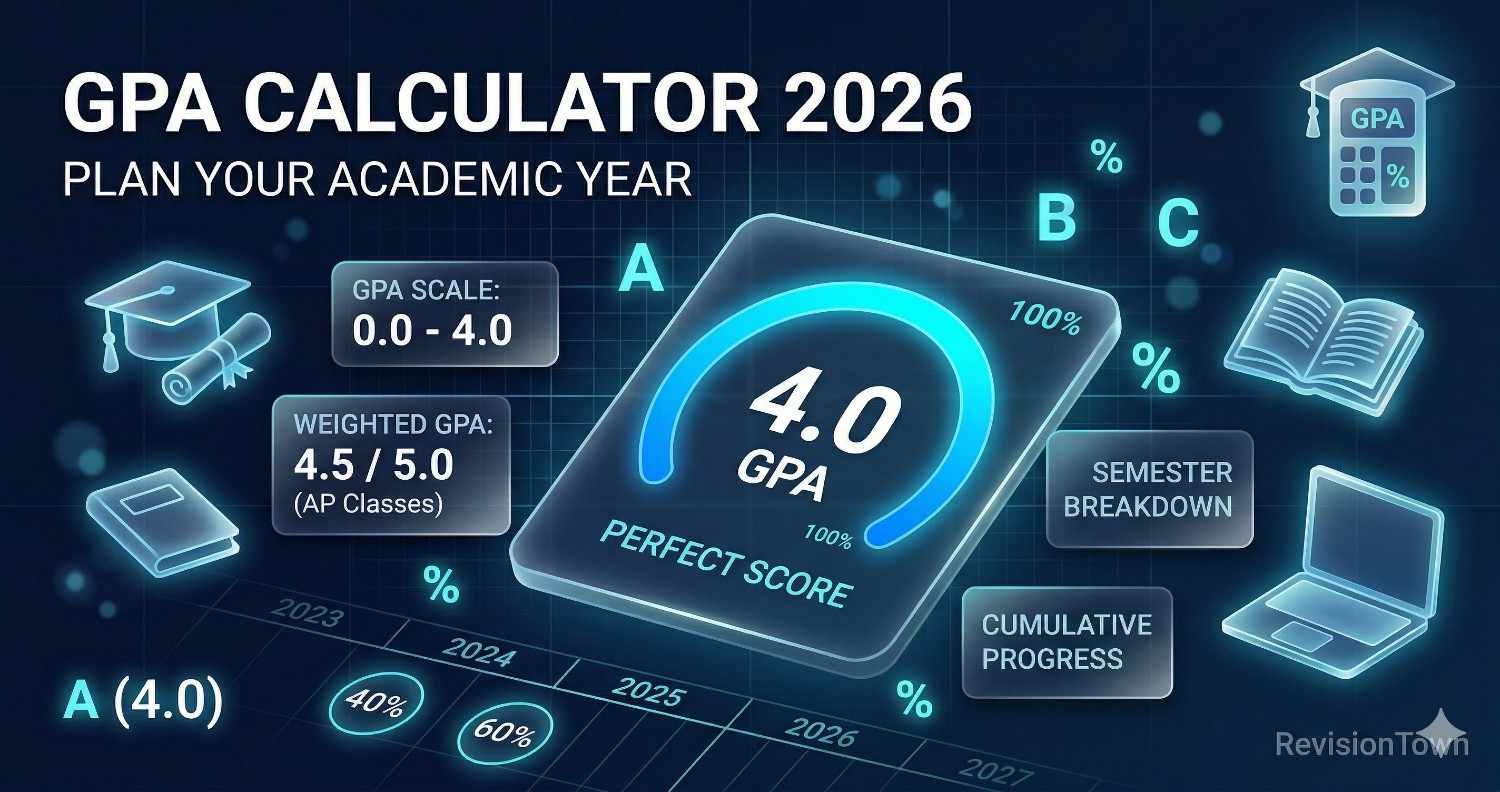
GPA Calculator 2026
GPA Calculator — Calculate Your GPA Online, Track Your Grades, and Predict Your Cumulative GPA
Use this free GPA calculator to calculate your GPA online in seconds. Enter your courses, grades, and credit hours to find your GPA on the standard 4.0 scale. This all-in-one GPA estimator works as a GPA tracker, GPA checker, and GPA predictor — calculate your semester GPA, cumulative GPA, or plan what grades you need to reach your target. Supports weighted and unweighted scales, plus/minus grading, and college or high school courses. Built by RevisionTown — free, private, no signup required.
How it works: Enter each course name, select the letter grade, and set the credit hours. The calculator multiplies each grade's point value by its credit hours, sums the quality points, and divides by total credit hours — giving you your GPA score instantly.
Calculate Your GPA
Your GPA Results
Add your courses and grades, then click calculate to see your GPA score, letter grade equivalent, and detailed breakdown.
Course-by-Course Breakdown
GPA Prediction
How to Use the GPA Calculator
This online GPA calculator offers three modes to help students calculate GPA, track academic progress, and predict future grades. Here is how each mode works.
Mode 1: Semester GPA Calculator
The semester GPA calculator computes your grade point average for a single term. This is the most common way students find their GPA.
- Select your grading scale — Choose the standard 4.0 scale, plus/minus 4.3 scale, or weighted 5.0 scale (for AP and Honors courses).
- Add your courses — Click "+ Add Course" for each class. Enter the course name, select the letter grade you received, and enter the credit hours.
- Click "Calculate GPA" — Your semester GPA, total quality points, credit hours, and a course-by-course breakdown appear instantly.
Mode 2: Cumulative GPA Calculator
The cumulative GPA calculator combines your previous cumulative GPA with your current semester grades to produce an updated overall GPA. This is your GPA tracker across multiple semesters.
- Enter your previous cumulative GPA — This is your GPA before the current semester.
- Enter your previous total credits — The total credit hours completed before this semester.
- Add your current semester courses — Same as the semester mode.
- Calculate — The calculator combines both to show your updated cumulative GPA.
Mode 3: GPA Predictor (Target GPA Calculator)
The GPA predictor tells you what GPA you need in your remaining courses to reach a target cumulative GPA. This is essential for students aiming for Dean's List, Latin Honors, or graduate school admission thresholds.
- Enter your current GPA and credits completed.
- Enter your target GPA — the GPA you want to achieve.
- Enter remaining credits — how many credit hours you have left.
- Calculate — The calculator tells you exactly what GPA you need in remaining courses, and whether your goal is achievable.
How GPA Is Calculated — The Formula
Your GPA score is calculated by taking a weighted average of your letter grades, where the weights are the credit hours for each course. Here is the standard formula used by virtually every college and university in the United States.
Semester GPA Formula
In plain language: multiply each course's grade point value by its credit hours to get quality points. Sum all quality points and divide by total credit hours.
Step-by-Step Example
A student takes four courses this semester:
| Course | Grade | Grade Points | Credits | Quality Points |
|---|---|---|---|---|
| English 101 | A | 4.00 | 3 | 12.00 |
| Calculus I | B+ | 3.30 | 4 | 13.20 |
| History 201 | A- | 3.70 | 3 | 11.10 |
| Chemistry 101 | B | 3.00 | 4 | 12.00 |
Cumulative GPA Formula
To combine a previous cumulative GPA with new semester grades:
Example: if your previous GPA was 3.20 over 60 credits and your new semester GPA is 3.45 over 14 credits:
Target GPA Formula (GPA Predictor)
To find the GPA needed in remaining courses to reach a target cumulative GPA:
Example: if your current GPA is 3.20 over 60 credits and you want a 3.50 cumulative with 30 remaining credits:
This means you would need a 4.10 GPA in your remaining 30 credits — challenging but achievable on a 4.3 scale with plus/minus grading.
GPA Chart — Letter Grade to GPA Conversion Table
Use this GPA chart as a quick reference for converting letter grades to grade point values. This chart covers the three most common grading scales.
| Letter Grade | Standard 4.0 | Plus/Minus 4.3 | Weighted 5.0 (AP/Honors) | Percentage Equivalent |
|---|---|---|---|---|
| A+ | 4.00 | 4.30 | 5.30 | 97–100% |
| A | 4.00 | 4.00 | 5.00 | 93–96% |
| A- | 3.70 | 3.70 | 4.70 | 90–92% |
| B+ | 3.30 | 3.30 | 4.30 | 87–89% |
| B | 3.00 | 3.00 | 4.00 | 83–86% |
| B- | 2.70 | 2.70 | 3.70 | 80–82% |
| C+ | 2.30 | 2.30 | 3.30 | 77–79% |
| C | 2.00 | 2.00 | 3.00 | 73–76% |
| C- | 1.70 | 1.70 | 2.70 | 70–72% |
| D+ | 1.30 | 1.30 | 2.30 | 67–69% |
| D | 1.00 | 1.00 | 2.00 | 63–66% |
| D- | 0.70 | 0.70 | 1.70 | 60–62% |
| F | 0.00 | 0.00 | 0.00 | Below 60% |
Note: Not all institutions use plus/minus grading. Some cap the 4.0 scale so that A+ = 4.0 (same as A). The weighted 5.0 scale adds 1.0 to the standard value for AP, IB, or Honors courses. Check your school's specific policy.
What Is a Good GPA? GPA Benchmarks and Their Significance
Understanding where your GPA score falls is critical for academic planning, scholarships, and career opportunities. Here are widely recognized thresholds.
Latin Honors (College Graduation)
- Summa Cum Laude: 3.90 – 4.00 (top ~5% of class)
- Magna Cum Laude: 3.70 – 3.89 (top ~10–15%)
- Cum Laude: 3.50 – 3.69 (top ~20–30%)
These thresholds vary by institution. Some schools use class rank percentiles instead of fixed GPA cutoffs.
Graduate School Admission
- Top-tier programs (Ivy League, Stanford, MIT): GPA of 3.7+ is generally competitive
- Competitive programs: GPA of 3.3–3.6 is typically expected
- Minimum requirements: Most graduate schools require at least a 3.0 GPA
Professional School Requirements
- Medical school: Average matriculant GPA is 3.73 (AAMC data)
- Law school: Top 14 schools average 3.75+; most schools accept 3.0+
- MBA programs: Top 10 schools average 3.6; many accept 3.0+
Dean's List
Most colleges require a 3.5 or higher semester GPA for the Dean's List, though some set the bar at 3.3 or use the top percentage of students. Check your institution's specific criteria.
Employer Expectations
Many large employers and consulting firms historically screened for a minimum 3.0 GPA, though this practice is declining in favor of skills-based hiring. Some finance and technology firms still use a 3.5 cutoff. In general, a GPA above 3.0 is considered acceptable by most employers, and above 3.5 is considered strong.
GPA Categories at a Glance
| GPA Range | Letter | Description | Percentile (approx.) |
|---|---|---|---|
| 3.70 – 4.00 | A / A- | Excellent — Honors level | Top 15% |
| 3.30 – 3.69 | B+ / A- | Very good — Dean's List range | Top 30% |
| 3.00 – 3.29 | B | Good — meets most grad school requirements | Top 45% |
| 2.50 – 2.99 | B- / C+ | Satisfactory — may limit graduate options | Top 60% |
| 2.00 – 2.49 | C | Below average — minimum for most degrees | Top 75% |
| Below 2.00 | D / F | Academic probation risk | Bottom 25% |
Strategies to Improve Your GPA
Whether you are trying to raise your GPA from a 2.8 to a 3.0 or from a 3.5 to a 3.8, these evidence-based strategies can help.
1. Prioritize High-Credit Courses
Because GPA is weighted by credit hours, a high grade in a 4-credit course has more impact than in a 1-credit course. Focus your study effort on courses with the most credit hours. An A in a 4-credit course adds 16 quality points, while an A in a 1-credit course adds only 4.
2. Use the Grade Replacement / Retake Policy
Many colleges allow you to retake a course and replace the original grade in your GPA calculation. If you received a C or D in a foundational course, retaking it for an A can significantly boost your cumulative GPA — especially early in your academic career when you have fewer total credits.
3. Take Strategic Course Loads
Heavy course loads (18+ credits) can spread your study time thin. Consider taking 15 credits per semester and achieving higher grades versus 18 credits with lower grades. The GPA impact of better grades will compound over multiple semesters.
4. Leverage Pass/Fail Options Wisely
Some schools allow you to take electives on a pass/fail basis. These courses do not affect your GPA. Use this option for challenging electives outside your major, where a low grade might drag down your GPA unnecessarily.
5. Front-Load Easier Courses Strategically
Building a strong GPA foundation early makes it easier to maintain later, since cumulative GPA becomes harder to move as total credits increase. This is a mathematical reality: with 120 credits completed, a single 3-credit A only moves your GPA by about 0.01.
6. Use Office Hours and Tutoring
Students who regularly attend professor office hours earn, on average, 0.3 GPA points higher than those who do not (according to multiple higher education studies). Most schools also offer free tutoring centers — these are underutilized resources that can make a measurable difference.
Weighted vs. Unweighted GPA: What Is the Difference?
Understanding the distinction between weighted and unweighted GPA is crucial, especially for high school students applying to colleges.
Unweighted GPA (Standard 4.0 Scale)
An unweighted GPA treats all courses equally. The maximum possible GPA is 4.0, regardless of course difficulty. An A in Physical Education counts the same as an A in AP Calculus. This is the most commonly used scale in colleges and universities.
Weighted GPA (5.0 Scale)
A weighted GPA adds extra grade points for advanced courses (AP, IB, Honors). Typically, AP/IB courses add 1.0 point and Honors courses add 0.5 points. This means a student can have a GPA above 4.0 — a weighted GPA of 4.5 or even 5.0 is possible. Weighted GPAs are primarily used at the high school level to reward students who take challenging courseloads.
Which One Do Colleges Look At?
Most colleges recalculate your GPA using their own formula when evaluating applications. They typically consider the unweighted GPA but also look at course rigor separately. A 3.7 unweighted GPA with AP/Honors courses is generally viewed more favorably than a 4.0 unweighted GPA with only standard courses. Both factors matter — GPA and course difficulty.
Frequently Asked Questions
How do I calculate my GPA?
Multiply each course's grade points (A=4.0, B=3.0, etc.) by its credit hours to get quality points. Add all quality points together and divide by total credit hours. The result is your GPA on a 4.0 scale. Use this calculator to do it automatically — just enter your courses and grades.
What is a GPA and what scale is used?
GPA stands for Grade Point Average. In the U.S., the standard scale is 0.0 to 4.0, where A = 4.0, B = 3.0, C = 2.0, D = 1.0, and F = 0.0. Some schools use a 4.3 scale (where A+ = 4.3) or a weighted 5.0 scale for advanced courses.
What is the difference between semester GPA and cumulative GPA?
Semester GPA reflects your grades for a single term. Cumulative GPA averages all grades across all semesters of your academic career. Cumulative GPA is what appears on your transcript and is used by employers and graduate schools.
Can my GPA go above 4.0?
On a standard unweighted scale, the maximum GPA is 4.0 (or 4.3 with plus/minus grading). On a weighted scale, your GPA can exceed 4.0 if you take AP, IB, or Honors courses. Weighted GPAs above 4.0 are common in high school but are not typically used in college.
How accurate is this GPA calculator?
This calculator uses the universally accepted quality-point-weighted-average formula. It is accurate for any institution that uses the standard 4.0, 4.3, or 5.0 grading scale. However, some schools have unique rounding rules or exclude certain courses (e.g., P/F, W). Always verify with your registrar for official GPA.
How do I use this as a GPA predictor?
Select the "GPA Predictor" tab. Enter your current cumulative GPA, credits completed, your target GPA, and remaining credits. The calculator uses the target GPA formula to determine the exact GPA you need in your remaining courses. If the required GPA exceeds 4.0 (or 4.3), your target may not be achievable.
Does this GPA calculator work for high school?
Yes. Select the "Weighted 5.0" scale if your high school uses weighted GPA for AP/Honors courses. For standard high school grading, use the 4.0 scale. Enter each class and its credit value (usually 1.0 for a year-long course or 0.5 for a semester course).
What is a good GPA for college?
A GPA of 3.0 or above is generally considered good. A 3.5+ puts you in the top 30% and qualifies for most Dean's Lists and honors. A 3.7+ is excellent and competitive for top graduate programs. See our detailed GPA benchmarks section above.
How do I do a quick GPA check?
A quick GPA check can be done by entering your courses above, but you can also estimate mentally: count your A's, B's, C's etc., multiply by their point values, and divide by the number of courses (if all courses have equal credits). For exact results with varying credit hours, use this calculator.
Do employers really look at GPA?
It depends on the industry and your career stage. For recent graduates, about 40% of employers consider GPA in hiring decisions. Finance, consulting, and engineering firms are most likely to screen for GPA (often 3.0+ or 3.5+). After 2–3 years of work experience, GPA becomes much less important and is rarely asked about.
Related Resources
Explore more calculators and study tools from RevisionTown:
- Salary Calculator — Convert hourly to annual salary and calculate take-home pay
- Income Tax Calculator — Estimate your federal and state tax burden
- Simple Interest Formula Guide — Learn interest calculations for math and finance
- RevisionTown Home — Free study tools, calculators, and revision guides
About This GPA Calculator
This GPA calculator was built by the RevisionTown team to provide a fast, accurate, and transparent way to calculate GPA online. The formulas used are the standard quality-point-weighted-average method adopted by the vast majority of U.S. colleges and universities.
Disclaimer: This calculator provides estimates for informational purposes only. Individual institutions may have specific grading policies, capping rules, course exclusions, and rounding methods that affect your official GPA. Always verify your GPA with your school's registrar office or official student portal.
Last updated: March 2026 | Sources: Common U.S. academic grading standards, AAMC medical school data, BLS higher education statistics | Built by RevisionTown
Complete GPA Guide 2026 — Everything You Need to Know
Updated March 23, 2026. Whether you're a high school student planning for college, an undergraduate tracking your academic progress, or a graduate student aiming for scholarships and fellowships, understanding your GPA is essential. This comprehensive GPA guide explains every aspect of the 4.0 scale, how different schools calculate GPA, what constitutes a good GPA, and practical strategies to improve your grade point average.
The Complete 4.0 GPA Scale — Letter Grades, Percentages & Grade Points
The 4.0 GPA scale is the most widely used grading system in the United States and many international institutions. As of March 2026, virtually all US colleges, universities, and most high schools use some variant of this scale for calculating and reporting academic performance.
| Letter Grade | Percentage Range | 4.0 Scale Points | Quality Description |
|---|---|---|---|
| A+ | 97–100% | 4.0 | Exceptional / Perfect |
| A | 93–96% | 4.0 | Excellent |
| A− | 90–92% | 3.7 | Excellent |
| B+ | 87–89% | 3.3 | Above Average |
| B | 83–86% | 3.0 | Good |
| B− | 80–82% | 2.7 | Good |
| C+ | 77–79% | 2.3 | Average |
| C | 73–76% | 2.0 | Average / Satisfactory |
| C− | 70–72% | 1.7 | Below Average |
| D+ | 67–69% | 1.3 | Poor |
| D | 63–66% | 1.0 | Poor / Minimum Passing |
| D− | 60–62% | 0.7 | Poor / Minimum Passing |
| F | Below 60% | 0.0 | Failing |
The GPA Formula — How GPA is Calculated (Worked Examples)
The GPA formula is straightforward once you understand it. Every course contributes to your GPA based on two factors: the grade you received (converted to grade points) and the number of credit hours the course carries. Courses worth more credits have a proportionally larger effect on your GPA.
GPA = Σ (Grade Points × Credit Hours) ÷ Σ (Total Credit Hours)Where Σ means "sum of all courses."
Worked Example 1 — Freshman Semester
| Course | Credits | Grade | Grade Points | Quality Points |
|---|---|---|---|---|
| English Composition | 3 | A | 4.0 | 12.0 |
| Calculus I | 4 | B+ | 3.3 | 13.2 |
| Introduction to Biology | 4 | B | 3.0 | 12.0 |
| History 101 | 3 | A− | 3.7 | 11.1 |
| Physical Education | 1 | A+ | 4.0 | 4.0 |
Worked Example 2 — Recovering from a Difficult Semester
A student had a rough first semester with a 2.3 GPA (15 credits). In their second semester they earned a 3.6 GPA (15 credits). What is their cumulative GPA?
Cumulative GPA = (2.3 × 15 + 3.6 × 15) ÷ (15 + 15) = (34.5 + 54.0) ÷ 30 = 88.5 ÷ 30 = 2.95Even after one excellent semester, the cumulative GPA only rose from 2.3 to 2.95 — demonstrating why early semesters matter so much. It takes multiple strong semesters to significantly raise a low cumulative GPA.
What is a Good GPA? — 2026 Benchmarks
The definition of a "good" GPA depends entirely on context: your institution, intended career path, graduate school ambitions, and the grading standards of your major. Here is a comprehensive breakdown of GPA benchmarks as of March 2026:
Average GPA by Major — What to Expect in 2026
GPA standards vary significantly by academic discipline. STEM fields (Science, Technology, Engineering, Mathematics) typically have lower average GPAs due to rigorous grading curves, while humanities and social sciences tend to have higher averages. Understanding your major's typical GPA range helps you contextualize your academic performance:
| Major / Field | Typical Avg GPA | Notes |
|---|---|---|
| Education | 3.36 | Highest avg GPA across all majors |
| Social Sciences / Psychology | 3.28 | High averages common |
| English / Humanities | 3.33 | Grading tends to be more generous |
| Business / Economics | 3.17 | Moderate; varies significantly by program |
| Biology / Life Sciences | 3.02 | Lower than avg due to rigorous science courses |
| Computer Science / IT | 3.13 | Varies; top programs grade more stringently |
| Engineering | 2.90 | One of the lowest avg GPAs — highly rigorous |
| Chemistry / Physics | 2.78 | Lowest avg GPA fields nationally |
GPA Requirements for Graduate Programs — 2026
If your goal is to continue to graduate school, law school, medical school, or an MBA program, understanding GPA requirements is critical. Here are the typical GPA ranges for competitive programs as of March 2026:
| Program Type | Minimum GPA | Competitive GPA | Top Program GPA |
|---|---|---|---|
| Master's Degree (MS) | 2.75 | 3.3+ | 3.7+ |
| PhD / Doctoral | 3.0 | 3.5+ | 3.8+ |
| MBA (Business School) | 2.7 | 3.3+ | 3.7+ (M7 schools) |
| Law School (JD) | 2.75 | 3.5+ | 3.8+ (T14 schools) |
| Medical School (MD) | 3.0 | 3.6+ | 3.9+ (Top 20 MD) |
| Education (MEd/EdD) | 2.75 | 3.0+ | 3.5+ |
How to Raise Your GPA — Proven Strategies for 2026
If you're dissatisfied with your current GPA, there are concrete, actionable steps you can take. The earlier in your academic career you implement these strategies, the more significant their impact on your cumulative GPA. Here are the most effective GPA improvement strategies:
1. Grade Replacement / Academic Renewal
Many US colleges offer a grade forgiveness policy (also called academic renewal or grade replacement) where you can retake a failed or low-grade course and have the new grade replace the old one in your GPA calculation. Check your institution's specific policy — some only allow this for a limited number of courses. Grade replacement can have a dramatic positive effect on your GPA.
2. Strategic Course Load Management
Taking too many difficult courses simultaneously is a common GPA mistake. Spread out your most challenging courses across semesters. If you know a semester will be demanding, take fewer credit hours or balance hard core requirements with lighter electives. Quality of performance matters far more than quantity of courses attempted per semester.
3. Attend Office Hours Weekly
Research consistently shows that students who regularly attend professors' office hours earn higher grades. Professors notice engaged students, clarify exam expectations, and often provide valuable insight into exactly what they want to see in essays and assignments. Set a goal to visit at least 2 office hours sessions per course per semester.
4. Withdraw Strategically (W Grade)
If you're heading for a D or F in a course and the withdrawal deadline hasn't passed, consider withdrawing. A "W" on your transcript does not affect your GPA — it simply shows the course was not completed. While withdrawal should not become a habit, it is far better than a poor grade when facing overwhelming circumstances. Always check your institution's withdrawal deadline and financial aid implications first.
5. Use the GPA Calculator to Set Targets
One of the most motivating uses of a GPA calculator is setting concrete targets. Enter your current GPA and remaining credit hours, then calculate the semester GPA you need to achieve your goal. This transforms an abstract ambition ("raise my GPA") into a specific target ("I need a 3.7 this semester to bring my cumulative to 3.3").
Semester GPA vs Cumulative GPA — Key Differences
Two GPA figures that students frequently encounter are the semester GPA (or term GPA) and the cumulative GPA. Understanding the difference is essential for academic planning:
Semester GPA
- Calculated only from the current semester's courses
- Resets to 0 each new semester
- Reflects your most recent academic performance
- Useful for tracking improvement/decline trends
- Shown on semester transcripts and progress reports
Cumulative GPA
- All semesters combined, weighted by credit hours
- The GPA shown on your official transcript
- Used for honor rolls, academic standing, graduation
- What employers and grad schools see and use
- Changes slowly as it incorporates all prior work
GPA Conversion — International Grading Systems
Students from international educational systems often need to convert their grades to the US 4.0 GPA scale for college applications, graduate programs, or employment. Here is a comprehensive comparison of common international grading systems as of March 2026:
| Country / System | Their Scale | Equivalent US GPA | Notes |
|---|---|---|---|
| UK (England/Wales) | First Class (70%+) | 3.7 – 4.0 | Upper Second (2:1) ≈ 3.3–3.7 |
| Canada | A (80–100%) | 3.7 – 4.0 | Scale varies by province |
| Australia | High Distinction (85%+) | 3.7 – 4.0 | Distinction (75–84%) ≈ 3.3 |
| Germany | 1.0 – 1.5 (Sehr gut) | 3.7 – 4.0 | German scale: 1.0 best, 4.0 minimum pass |
| India | 75–100% (First Class Dist.) | 3.5 – 4.0 | 60–75% ≈ 3.0 (First Class) |
| France | 16–20/20 (Très bien) | 3.7 – 4.0 | 12–13/20 ≈ 2.5–3.0 |