Weighted GPA Calculator 2026: Free Weighted High School GPA Calculator (5.0 Scale)
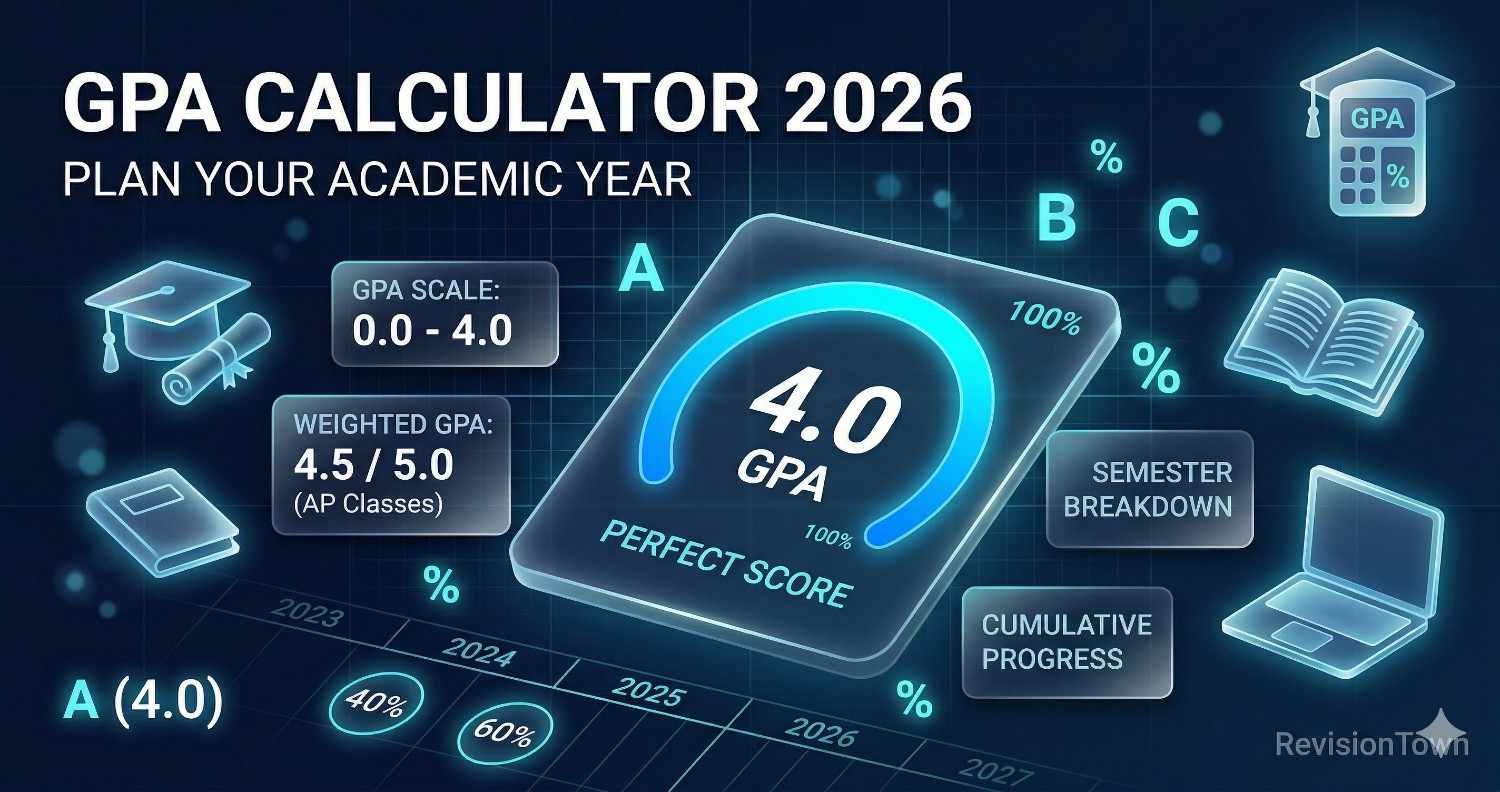
Use this weighted GPA calculator to estimate your high school GPA on a common 5.0 scale. Enter Regular, Honors, AP, and IB courses to compare weighted GPA with unweighted GPA, see the exact weight boost, and test how course rigor affects your transcript for 2026 planning.
Calculate Weighted and Unweighted GPA
Add each high school course, select its grade and level, and enter the credit value. The calculator shows unweighted GPA, weighted GPA, credits, quality points, and the weight boost created by advanced courses.
Optional Cumulative GPA Fields
Leave these blank for a single semester or school year estimate. Fill all three fields if you want to combine previous credits with the courses entered above.
Course Breakdown
What a Weighted GPA Measures
A weighted GPA is a grade point average that gives extra value to advanced courses. The purpose is to show both achievement and course rigor. A student who earns an A in AP Biology usually completed a more demanding course than a student who earns an A in a standard biology course. A weighted GPA attempts to reflect that difference by adding extra grade points for AP, IB, Honors, or similarly advanced courses.
On a common 5.0 scale, a Regular A is worth 4.0, an Honors A is worth 4.5, and an AP or IB A is worth 5.0. The base grade still matters. An AP course does not automatically make a GPA stronger if the grade drops too far. A B in AP may equal 4.0 weighted on a standard scale, while an A in a Regular course also equals 4.0 weighted. The weighted number rewards rigor, but it does not erase the importance of earning strong grades.
Weighted GPA is especially important in high school because advanced courses can influence class rank, honors recognition, scholarship review, and college application context. Still, it is not the only GPA number that matters. Unweighted GPA shows raw grade performance on the same 4.0 scale for every course. Weighted GPA shows how much course rigor increases the grade point average. Many students should track both numbers side by side.
This page is designed for high school students, parents, counselors, and tutors who need a practical calculator and a clear explanation. If you need a direct 4.0 calculation without course weighting, use the Unweighted High School GPA Calculator. If you want to understand how the two numbers compare in admissions and class planning, the Weighted vs Unweighted GPA Comparison explains the difference in more detail.
How the 5.0 Weighted GPA Scale Works
The common 5.0 weighted GPA scale starts with a standard 4.0 grade scale and then adds a course-level bonus. The exact bonus depends on school policy. The most common model adds 1.0 point for AP or IB courses and 0.5 point for Honors courses. Some schools use smaller increments. Some weight Honors and AP the same. Some schools do not weight GPA at all and instead let the transcript show course difficulty directly.
The calculator supports three practical weighting systems. The standard system gives AP and IB plus 1.0 and Honors plus 0.5. The half-point system gives AP and IB plus 0.5 and Honors plus 0.25. The full-point advanced system gives AP, IB, and Honors plus 1.0. If your school uses another system, use the calculator as an estimate and verify the official GPA with your counselor or transcript platform.
| Letter grade | Base points | Regular | Honors standard | AP / IB standard |
|---|---|---|---|---|
| A+ / A | 4.0 | 4.0 | 4.5 | 5.0 |
| A- | 3.7 | 3.7 | 4.2 | 4.7 |
| B+ | 3.3 | 3.3 | 3.8 | 4.3 |
| B | 3.0 | 3.0 | 3.5 | 4.0 |
| B- | 2.7 | 2.7 | 3.2 | 3.7 |
| C+ | 2.3 | 2.3 | 2.8 | 3.3 |
| C | 2.0 | 2.0 | 2.5 | 3.0 |
| D | 1.0 | 1.0 | 1.5 | 2.0 |
| F | 0.0 | 0.0 | 0.0 | 0.0 |
Most schools do not add a weighting bonus to a failing grade. Some schools also limit weighting for D grades, cap the total weighted GPA, or weight only approved advanced courses. For example, an Honors course may receive a bonus only if the school officially labels it Honors. A course that feels difficult does not automatically receive a weighted boost.
Weighted GPA Formula
The weighted GPA formula is a credit-weighted average. Each course receives a weighted point value, that point value is multiplied by the course credits, and all weighted quality points are divided by total credits.
Weighted GPA = total weighted quality points divided by total credits.
Weighted quality points = weighted grade points times course credits.
The unweighted GPA formula uses the same structure, but it uses base grade points instead of weighted grade points. That means an A in AP Calculus and an A in Regular English both count as 4.0 for unweighted GPA, but they count differently for weighted GPA if your school weights AP courses.
Credit values matter. If every class is worth 1.0 credit, the calculation is easy to follow. If some semester courses are 0.5 credits and year-long courses are 1.0 credit, the GPA becomes a weighted average by credits. A 0.5-credit elective has half the GPA weight of a 1.0-credit year-long course. The calculator includes a credit field so you can match your school transcript more closely.
Important: Use the credit values your school uses. Some schools count semester courses as 0.5, year-long courses as 1.0, and labs or special programs differently. If your transcript uses another credit system, use the official values from your school.
Worked Example: AP, Honors, and Regular Courses
Suppose a student takes six courses. AP Calculus earns an A, AP English earns a B+, Honors Chemistry earns an A-, Honors U.S. History earns an A, Spanish earns an A, and Art earns an A. Five courses are 1.0 credit and Art is 0.5 credit. On the standard weighted system, AP courses receive plus 1.0 and Honors courses receive plus 0.5.
| Course | Level | Grade | Base points | Weighted points | Credits | Unweighted QP | Weighted QP |
|---|---|---|---|---|---|---|---|
| AP Calculus | AP | A | 4.0 | 5.0 | 1.0 | 4.0 | 5.0 |
| AP English | AP | B+ | 3.3 | 4.3 | 1.0 | 3.3 | 4.3 |
| Honors Chemistry | Honors | A- | 3.7 | 4.2 | 1.0 | 3.7 | 4.2 |
| Honors U.S. History | Honors | A | 4.0 | 4.5 | 1.0 | 4.0 | 4.5 |
| Spanish | Regular | A | 4.0 | 4.0 | 1.0 | 4.0 | 4.0 |
| Art | Regular | A | 4.0 | 4.0 | 0.5 | 2.0 | 2.0 |
The unweighted quality points total 21.0 across 5.5 credits. The unweighted GPA is 21.0 divided by 5.5, or 3.82. The weighted quality points total 24.0 across 5.5 credits. The weighted GPA is 24.0 divided by 5.5, or 4.36. The weight boost is 4.36 minus 3.82, or plus 0.54.
This is a strong example of why weighted and unweighted GPA should be read together. The 3.82 unweighted GPA shows strong grades. The 4.36 weighted GPA shows that the student earned those grades while taking several advanced courses. The two numbers tell a fuller story than either number alone.
How to Use This Weighted GPA Calculator
Start by selecting the weighting system that best matches your school. If you do not know the policy, use the standard system as a planning estimate, then confirm with your school counselor or handbook. Next, add each course. Enter the course name, choose the letter grade, choose the course level, and enter the credit value. Use 1.0 for a full-year course if that is how your school credits it, or 0.5 for a semester course if your transcript uses half credits.
After adding courses, click calculate. The results show unweighted GPA, weighted GPA, total credits, weight boost, AP/IB count, Honors count, and a course-by-course breakdown. The breakdown is useful because it shows exactly how each course contributes to the result. If the weighted GPA looks too high or too low, check the grade, level, and credit value for each advanced class first.
The optional cumulative fields are for students who already have a previous GPA record. Enter previous unweighted GPA, previous weighted GPA, and previous credits if you want to estimate cumulative weighted and unweighted GPA after the current courses are added. Leave those fields blank if you only want the current semester, current year, or current schedule GPA.
If you need a broader multi-term view, calculate the current weighted result here and then track GPA direction with the Cumulative GPA Tracker & Semester Averager. If you are still trying to predict the final grade inside one course before entering it here, use the Final Grade Calculator or the What-If Grade Scenario Simulator first.
Weighted GPA vs Unweighted GPA
Unweighted GPA answers a direct grade-performance question: what is the average grade point value of the student's courses on a 4.0 scale? Weighted GPA answers a different question: what is the average after advanced courses receive extra value? Both numbers are useful, but they should not be confused.
A student with all A grades in Regular courses may have a 4.00 unweighted GPA and a 4.00 weighted GPA. A student with A grades in AP courses may have a 4.00 unweighted GPA and a 5.00 weighted GPA if the school uses a full AP plus 1.0 system. The unweighted number says both students earned A grades. The weighted number says the second student took a more rigorous course load.
The opposite can also happen. A student with several AP classes and B grades may have a weighted GPA that looks strong while the unweighted GPA is lower. That is not automatically bad. It shows rigor, but it also shows that grades dropped under the harder schedule. Colleges, counselors, and scholarship committees often look at the combination: grades, course rigor, trend, and school context.
If you are choosing between weighted and unweighted planning, do not choose only one. Track both. Weighted GPA can influence rank and local honors. Unweighted GPA is often easier to compare across schools. For a deeper comparison, use the Weighted vs Unweighted GPA Calculators or the direct comparison guide linked earlier.
AP, IB, and Honors Weighting
AP and IB courses usually receive the largest weight because they are designed as advanced academic programs. Honors courses usually receive a smaller weight because they are above regular level but may not be considered equivalent to AP or IB. The exact policy depends on the school district or private school. Some schools weight dual-enrollment courses. Some weight only core academic courses. Some do not weight electives, even if they are advanced.
The standard model used in this calculator gives AP and IB plus 1.0 and Honors plus 0.5. In that system, an A in AP or IB is 5.0, an A in Honors is 4.5, and an A in Regular is 4.0. A B in AP is 4.0, a B in Honors is 3.5, and a B in Regular is 3.0. This creates a GPA incentive to take rigorous courses, but the incentive works best when the student can still earn strong grades.
If you want to isolate the effect of a specific AP course, the AP Class Weighted GPA Booster Calculator can help test that single-course boost. If you are comparing Honors coursework separately, the Honors Class GPA Bump Calculator focuses on the common plus 0.5 boost.
Students should avoid treating weighting as a reason to overload. Taking the most difficult schedule possible is not always the strongest strategy if it creates lower grades, burnout, or weak extracurricular balance. The best schedule is challenging, realistic, and aligned with the student's academic strengths and goals.
When an Advanced Course Helps or Hurts GPA
The easiest way to evaluate an advanced course is to compare likely outcomes. On the standard system, an A in Regular equals 4.0 weighted. A B in AP also equals 4.0 weighted. If the AP course changes an expected A into a B, the weighted GPA may not improve at all, while the unweighted GPA drops from 4.0 to 3.0 for that course. If the likely AP grade is B+ or A-, the AP course may create a stronger weighted result while still keeping the unweighted GPA solid.
Honors classes often create a useful middle ground. An A in Honors is 4.5 weighted on the standard system. A B in AP is 4.0. If a student is likely to earn an A in Honors but a B in AP, Honors may be stronger for GPA and may also be better for learning confidence. If a student can earn an A or A- in AP, AP may show stronger rigor and produce a higher weighted result.
This is why GPA planning should be course-specific. A student may be ready for AP English but not AP Chemistry. Another student may be ready for AP Calculus but not AP Literature. Weighted GPA strategy should match strengths, prerequisites, teacher expectations, time available, and long-term goals. Use the calculator to test likely grades, not only ideal grades.
Weighted GPA and Class Rank
Many high schools use weighted GPA to calculate class rank because weighted GPA rewards students who take harder courses. If class rank is based on weighted GPA, students taking advanced courses can rank higher than students with the same unweighted grades in regular courses. This can matter for school honors, local scholarships, competitive programs, and state admission policies that consider rank.
Class rank depends on the whole cohort, not only your GPA. A 4.30 weighted GPA may rank very high at one school and be more common at another. The number of AP courses offered, the school weighting policy, grade distribution, and course access all affect rank. If your school reports decile, percentile, or exact rank, weighted GPA may be one part of that calculation.
If you need a rank estimate, use this calculator first to estimate the GPA, then use the Class Rank Estimator with Cohort Data only when you have meaningful cohort data. A GPA number without cohort context cannot accurately predict rank.
Weighted GPA and College Applications
Weighted GPA can help colleges see that a student attempted a rigorous curriculum, but the reported weighted GPA is not always compared directly across schools. High schools use different scales, different maximums, different course labels, and different credit systems. A 4.60 at one school may not mean the same thing as a 4.60 at another school. For that reason, colleges often review the transcript, course rigor, school profile, grade trend, and context rather than relying only on the printed weighted GPA.
For students, the practical lesson is simple: do not chase a weighted number without protecting learning and grades. A strong transcript usually shows solid grades in appropriately challenging courses. A schedule full of advanced classes with weak grades can raise concerns. A schedule with no rigor may also raise questions if advanced courses were available and appropriate. The strongest plan usually balances challenge with performance.
Use weighted GPA as one planning signal. If you can handle more advanced work and maintain strong grades, the weighted GPA may improve and the transcript may look more rigorous. If advanced work causes grades to fall sharply, the extra weight may not compensate. Your school counselor can help compare your course plan against what is available at your school and what is realistic for your goals.
Building a Four-Year Weighted GPA Plan
Weighted GPA is cumulative, so course choices in grade 9 and grade 10 can affect the final GPA just like junior and senior classes. A common pattern is to begin with Honors courses in the strongest subjects, add AP or IB courses once prerequisites are completed, and build toward the most rigorous realistic senior-year schedule. The goal is not to take every advanced class. The goal is to build a transcript that shows growth, rigor, and consistent performance.
Freshman year is often about adjustment and foundation. Sophomore year is a good time to increase rigor in subjects where the student is ready. Junior year is often the most important academic year for college review because many applications are prepared before senior grades are complete. Senior year still matters because colleges review the schedule and may review midyear grades, but overloading senior year only to inflate weighted GPA can backfire if performance drops.
Use the calculator to map scenarios. Try one version with two Honors courses and one AP course. Try another with three AP courses. Compare the weighted GPA, unweighted GPA, and course load. Then ask whether the schedule is realistic with sports, work, family responsibilities, test preparation, activities, and sleep. GPA planning should support a sustainable academic plan, not just a higher number.
If you want to track GPA direction across semesters, the Predictive GPA Trend Graph Generator can help visualize whether weighted and unweighted GPA are moving in the right direction over time.
Grade-by-Grade Planning for Weighted GPA
Weighted GPA planning looks different in each year of high school. In grade 9, many students are still learning how high school grading works. The priority should be strong foundations, consistent study habits, and careful placement into the right level of math, English, science, social studies, and world language. If Honors courses are available and the student is prepared, they can create an early weighted boost. But a freshman schedule that is too aggressive can create a low starting GPA that takes several semesters to repair.
In grade 10, students usually have a clearer sense of strengths. This is a good year to increase rigor in subjects where grade 9 performance was strong. A student who earned A grades in regular English and history may be ready for Honors or AP options if the school offers them. A student who struggled in math may be better served by a regular course with strong performance than an advanced course with a weak grade. The calculator helps test this tradeoff because it shows both weighted and unweighted effects.
In grade 11, course rigor often becomes most visible in college planning. Many students take their first larger set of AP, IB, dual-enrollment, or advanced Honors courses during junior year. This can raise weighted GPA and show readiness for college-level work, but junior-year grades also matter heavily because they are often the most recent complete year available when applications begin. A schedule that produces a small weighted boost but lowers several core grades may not be worth the risk.
In grade 12, students should keep an appropriately rigorous schedule, but they should also protect performance. Senior-year courses can support applications, scholarships, and final transcript review. However, adding advanced courses only for a last-minute GPA boost is risky if the workload is unrealistic. Senioritis, application deadlines, activities, and major projects can all affect grades. A balanced senior schedule with strong grades can be better than an overloaded schedule that creates avoidable grade drops.
The best four-year plan is not identical for every student. A future engineering applicant may need advanced math and science. A future humanities applicant may prioritize AP English, history, language, and research-based courses. A student applying locally may need to meet class-rank or scholarship requirements. A student applying broadly may need a transcript that shows rigor across core subjects. Use the calculator to support the plan, but let academic readiness and long-term goals lead the decision.
School Policy Details That Can Change the Result
The calculator uses common weighting models, but school policies can be more detailed. Some schools weight only courses in core academic subjects. Others weight all approved Honors, AP, and IB courses, including electives. Some schools weight dual-enrollment courses as AP-level, while others treat them separately. Some schools cap the total weighted GPA, cap the number of weighted courses per year, or remove weighting from courses below a certain grade.
Some schools calculate weighted GPA by semester, while others calculate it by year. Some schools include plus and minus grades, while others use only whole letters. Some schools treat A+ as 4.0, while others may use 4.3. Some schools round to two decimals, while others keep more precision internally. These details can create small differences, and small differences matter near rank, honor, or scholarship thresholds.
Another policy issue is whether repeated courses replace old grades. If a student repeats a class, the new grade may replace the old grade in GPA, both attempts may count, or the old grade may remain on the transcript but stop affecting GPA. If the course was weighted, the repeat policy can change both the unweighted and weighted calculation. This is especially important for students trying to recover from a low grade in an advanced course.
Middle school courses can also create confusion. Some high schools include Algebra I, Geometry, or world language credits from middle school on the high school transcript. Some include the credit but not the GPA. Some include both. If those courses appear in the GPA, include them with the course level and credit value shown by the high school. If they appear only as placement or credit, leave them out of GPA planning.
The safest approach is to use the calculator as a planning model and then compare it with the school transcript. If your calculated result is close but not identical, the difference is probably a local policy detail. If the result is very different, check course levels, credits, plus-minus values, repeated courses, and whether every course should be included. For a simpler broad high school calculation, the High School GPA Calculator can also help compare the overall structure of your record.
Scenario Planning: AP vs Honors vs Regular
Weighted GPA planning becomes clearer when you compare scenarios instead of relying on instinct. Suppose a student is deciding between AP Chemistry, Honors Chemistry, and Regular Chemistry. The likely grades may be B in AP, A- in Honors, and A in Regular. On a standard weighting system, those outcomes are 4.0 weighted for AP B, 4.2 weighted for Honors A-, and 4.0 weighted for Regular A. In this case, Honors may produce the best weighted GPA and a stronger unweighted GPA than AP.
Now change the likely AP grade to A-. AP A- is 4.7 weighted on the standard system, while Honors A is 4.5 and Regular A is 4.0. If the student can realistically earn A- in AP, the AP choice may be strongest for both rigor and weighted GPA. The decision changes because the likely grade changes. This is why students should avoid one-size-fits-all advice like "always take AP" or "protect the A at all costs."
Scenario planning should include workload. A student may be capable of earning an A- in one AP course but not in five AP courses at once. The cumulative schedule matters. If adding one more AP course causes grades to drop in several other courses, the total GPA effect may be negative. The calculator helps by letting you test the whole schedule rather than one class in isolation.
For each uncertain course, test three versions: realistic, optimistic, and conservative. The realistic version uses the grade most likely based on current performance. The optimistic version assumes improvement but not perfection. The conservative version assumes the course is harder than expected. If the plan only works in the optimistic version, it is risky. If the plan still works in the conservative version, it is stronger.
Students can also compare the GPA effect against non-GPA goals. AP courses may offer stronger preparation for college work, potential exam credit, and stronger subject depth. Honors courses may offer challenge with a more manageable workload. Regular courses may be appropriate when a student needs to strengthen fundamentals. GPA is one factor in the choice, but learning, prerequisites, mental bandwidth, and long-term goals should matter too.
Cumulative Weighted GPA Scenarios
A single semester weighted GPA can look impressive, but the cumulative effect depends on how many credits are already on the transcript. A freshman with only a few previous credits can move GPA quickly. A junior with many completed credits will see smaller changes from one new semester. This is why the optional previous GPA fields matter. They help estimate whether the current schedule can meaningfully change the cumulative number.
For example, imagine a student with a previous unweighted GPA of 3.60, a previous weighted GPA of 4.05, and 12 previous credits. The student earns a current weighted GPA of 4.50 and an unweighted GPA of 3.90 across 6 credits. The new cumulative unweighted GPA is based on previous unweighted quality points plus current unweighted quality points divided by 18 total credits. The new weighted GPA uses the same credit total but weighted quality points. The current term is strong, but the prior 12 credits still shape the final number.
Now imagine the same current term for a senior with 24 previous credits. The improvement will be smaller because the current 6 credits are only one-fifth of the combined total. This does not mean senior-year grades do not matter. It means the GPA number becomes more stable as more credits accumulate. Late improvement still helps with trend and final transcript strength, but it may not dramatically change the cumulative GPA.
Students trying to reach a specific threshold should calculate how many credits remain before graduation. If the current GPA is 3.40 unweighted and the goal is 3.70, the required future GPA may be very different for a sophomore than for a senior. A GPA goal is realistic only when the remaining credits are considered. If the target cannot be reached with one semester, build a multi-semester plan rather than assuming the calculator is wrong.
Use scenario planning for scholarships and honors as well. If a scholarship threshold is based on cumulative weighted GPA, a strong current term may help. If the threshold is based on unweighted GPA, AP and Honors boosts may not solve the problem. If the threshold is based on rank, the student's GPA must be interpreted relative to the cohort. The correct scenario depends on the exact rule being checked.
How Letter Grades and Percentages Fit Into Weighted GPA
Weighted GPA begins with a letter grade or a grade point value. If your teacher reports a percentage first, the percentage must be converted to a letter grade according to the course or school grading scale. That conversion is not universal. In one class, a 90 may be A-. In another school system, a 90 may be A. Some classes use weighted categories, exam curves, standards-based grading, or final exam rules before a letter grade is issued.
Do not enter a percentage directly into a weighted GPA calculator unless it has already been converted into the correct letter grade. A 91 in one school could map to A-, while another school could map it to A. That difference affects both unweighted and weighted GPA. If you need to convert a grade label first, the Letter Grade to GPA Converter can help with grade point mapping.
Course grades should also be final or realistically projected. If the semester is not over, use the current grade only if you understand how remaining assignments and finals can change it. A current A may become B+ if the final exam is heavily weighted. A current B may become A- if major remaining work goes well. Calculate the course grade first, then calculate GPA.
This order prevents a common planning error. Students sometimes enter desired final grades into the GPA calculator and then treat the result as a forecast. A better method is to create realistic course-grade scenarios, then enter those scenarios into the GPA calculator. That gives a useful range instead of a single optimistic number.
Common Weighted GPA Mistakes
The first mistake is using the wrong weighting system. A student may calculate AP as plus 1.0 when the school uses plus 0.5, or may weight Honors classes that the school reports as Regular. Always use the school policy for official planning.
The second mistake is ignoring credits. A 0.5-credit semester course should not count the same as a 1.0-credit year-long course if your transcript uses those values. The calculator includes credits to prevent that error.
The third mistake is assuming that every advanced-looking class receives weight. Some schools weight only approved AP, IB, Honors, or dual-enrollment courses. A difficult elective may not count as weighted unless the school labels it that way.
The fourth mistake is focusing only on weighted GPA and ignoring unweighted GPA. Weighted GPA can look strong because of course bonuses, but unweighted GPA still shows grade performance. A large gap between weighted and unweighted GPA should be interpreted carefully.
The fifth mistake is comparing weighted GPA across schools without context. Different schools use different maximums and policies. Compare your own progress and use your school profile or counselor guidance for admissions context.
How to Read the Weight Boost
The weight boost is the difference between weighted GPA and unweighted GPA. If your unweighted GPA is 3.80 and weighted GPA is 4.25, the weight boost is plus 0.45. That means advanced courses added nearly half a point to the GPA under the selected system. A boost of zero means all counted courses are Regular or no course received a weighting bonus.
A higher boost usually means a more advanced course load, but it does not automatically mean a stronger transcript. A student with a 3.95 unweighted GPA and a 4.20 weighted GPA may have fewer advanced courses but excellent grades. A student with a 3.30 unweighted GPA and a 4.10 weighted GPA may have a large boost but lower raw performance. The numbers need to be read together.
Use the boost to understand how much course rigor is affecting the GPA, not as a competition by itself. If the boost is small and the student is ready for more challenge, adding an appropriate Honors or AP course may make sense. If the boost is large and grades are slipping, the student may need a more balanced schedule.
Semester Courses, Year-Long Courses, and Credits
High schools do not all use credits the same way. Some schools count each semester course as 0.5 credit and each year-long course as 1.0 credit. Others use one credit per semester course or another local system. The GPA formula can work with any system as long as you use the same system consistently. Do not mix credit systems in one calculation.
If you are calculating one semester only, enter each semester course with the semester credit value. If you are calculating a full school year, enter year-long courses with the full-year value and semester-only courses with the appropriate smaller value. If your transcript reports quarter credits or block-schedule credits, use those official values.
Credit weighting matters because a half-credit course should have half the impact of a full-credit course if that is how your school treats it. A half-credit A can help, but it should not outweigh a full-credit AP B unless the credit system says so. When in doubt, match the transcript.
Using Weighted GPA for Scholarship Planning
Some scholarships use GPA thresholds, class rank, course rigor, or a combination of measures. A weighted GPA may help if the scholarship uses weighted class rank or weighted GPA directly. Other scholarships may ask for unweighted GPA or may recalculate the applicant's academic record. Read the scholarship instructions carefully before deciding which number matters.
If a scholarship requires a GPA threshold, use this calculator to estimate the current weighted and unweighted result, then compare the correct number to the scholarship policy. If the scholarship uses unweighted GPA, the weighted number is not the deciding number. If the scholarship uses rank, weighted GPA may matter indirectly through your school's rank calculation.
For a more direct threshold check, use the Scholarship Eligibility GPA Checker after you know which GPA the scholarship uses. This avoids a common mistake: meeting a weighted GPA target when the scholarship actually requires an unweighted GPA.
Weighted High School GPA vs College GPA
Weighted high school GPA and college GPA are not the same system. High school weighting usually rewards course rigor with extra points. College GPA usually weights by credit hours but does not add AP-style bonus points for harder courses. A college course may be difficult, but the GPA value usually depends on the grade and credits rather than a separate Honors or AP boost.
If you are calculating college or university coursework, use the College & University Credit-Weighted GPA Tool instead. If you are calculating a high school semester without advanced-course weighting, use the unweighted tool. The right calculator depends on the grading system behind the transcript.
Dual-enrollment courses can be tricky because they may appear on both a high school and a college record. Your high school may weight the course for high school GPA, while the college transcript may calculate it as a normal college course. Check both policies if dual enrollment is important for your plan.
Checklist Before You Trust the Number
- Use the weighting system your school actually uses.
- Enter only courses that count toward the GPA category you are calculating.
- Use official course levels: Regular, Honors, AP, IB, or the local equivalent.
- Use transcript credit values, especially for semester and year-long courses.
- Check whether your school weights D grades, repeated courses, or non-core courses differently.
- Track unweighted GPA alongside weighted GPA.
- Do not compare weighted GPA across schools without context.
- Confirm official GPA, class rank, and scholarship eligibility with the school.
If the checklist is clean, the calculator result should be useful for planning. It is still an estimate, because your official GPA is controlled by your school transcript system and local policies.
Weighted GPA Calculator FAQs
What is a weighted GPA?
A weighted GPA adds extra grade points for advanced courses such as AP, IB, and Honors. It is meant to reflect course rigor as well as grades. On a common 5.0 system, an A in AP or IB can be worth 5.0 instead of 4.0.
How do I calculate weighted GPA?
Convert each letter grade to base points, add the course-level weight, multiply by credits, add all weighted quality points, and divide by total credits. The calculator does this automatically and also shows the unweighted GPA.
What is the highest possible weighted GPA?
On the common 5.0 scale, the highest possible weighted GPA is 5.0 if every counted course is AP or IB and every grade earns the maximum base points. Some schools use different maximums, so check your local policy.
Does Honors GPA use the same boost as AP?
Usually no. A common system gives Honors plus 0.5 and AP or IB plus 1.0. Some schools give different values, and some weight all advanced courses equally. Use your school's policy when accuracy matters.
Should I take AP if I might earn a B?
It depends on the likely alternative. A B in AP may equal an A in Regular on the weighted scale, but it lowers unweighted GPA. If you can earn a B+ or higher and the course fits your goals, AP may be a strong choice. If the likely grade is much lower, Honors or Regular may be better.
Do colleges care more about weighted or unweighted GPA?
Colleges can consider both, but they also review course rigor, school context, grade trend, and transcript details. Many colleges do not compare reported weighted GPAs directly across schools because weighting policies differ.
Does weighted GPA affect class rank?
At many high schools, yes. Weighted GPA is often used for rank because it rewards advanced coursework. However, rank policies vary by school, and some schools do not report rank.
Can weighted GPA be lower than unweighted GPA?
In a normal weighting system, weighted GPA should not be lower than unweighted GPA for the same courses because weights are nonnegative. If it appears lower, check the selected weighting system, grades, course levels, and credits.
Should I include middle school high school credits?
Include them only if your high school transcript includes those courses in GPA. Some schools count middle school algebra or language credits; others show them without GPA impact. Match your transcript policy.
Is this calculator an official GPA report?
No. It is a planning estimate. Your official GPA, rank, honors status, and transcript values come from your school. Use this calculator to understand the math and test scenarios before confirming with your counselor.
Final Guidance for 2026 GPA Planning
A weighted GPA calculator is most useful when it supports better decisions, not when it creates pressure to take every advanced class available. The strongest schedule is challenging enough to show ambition and realistic enough to support strong grades, health, and meaningful activities. Weighted GPA rewards rigor, but the transcript still shows the actual grades earned.
For 2026 planning, track weighted GPA, unweighted GPA, course rigor, and grade trend together. Use the calculator to test possible schedules, compare AP and Honors choices, understand the weight boost, and check how current classes affect cumulative GPA. Then confirm official requirements with your school counselor, especially if the number affects class rank, scholarship eligibility, graduation honors, or college application strategy.