
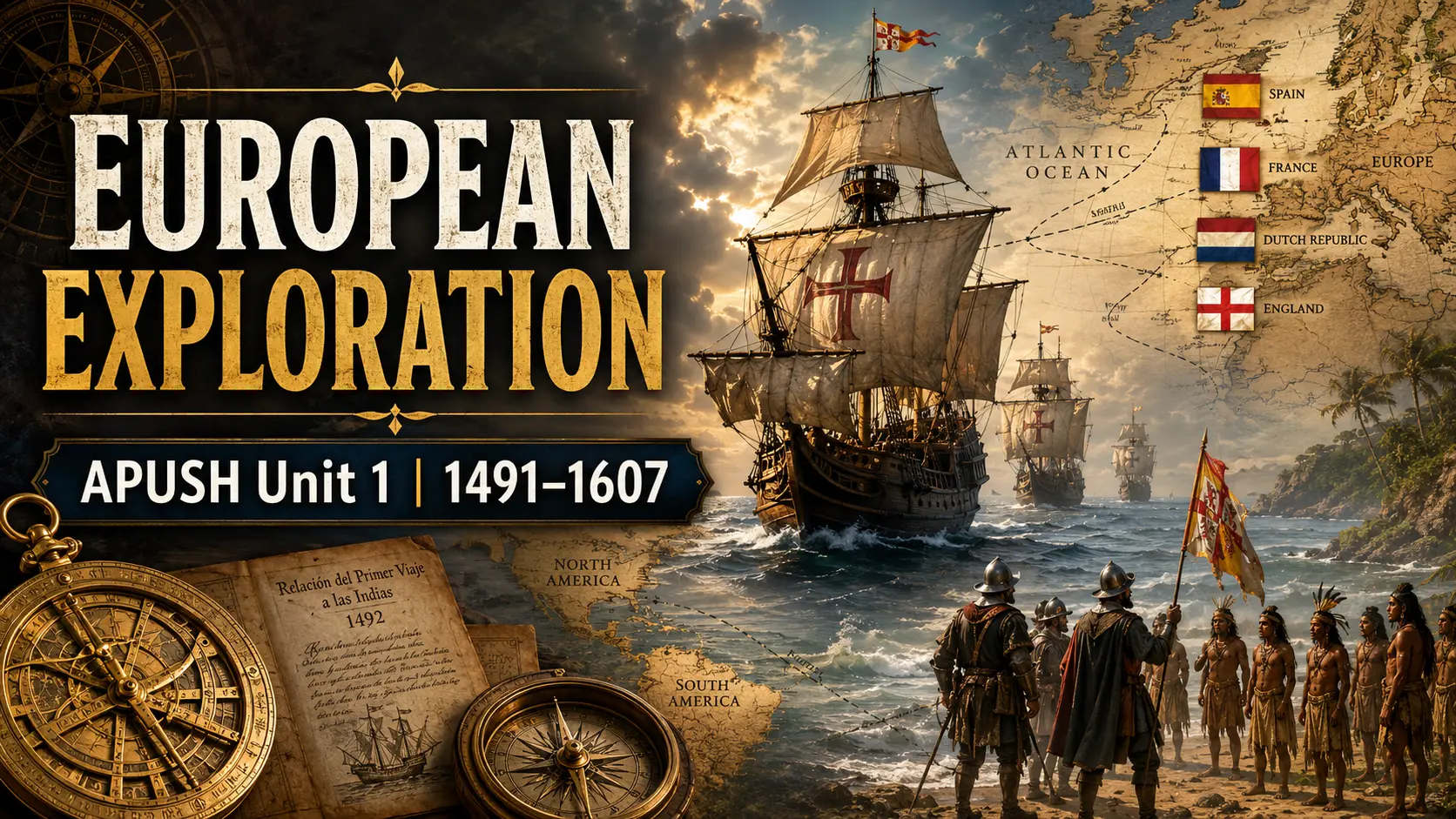
Overview (CED-Aligned)
Period: Period 1 (1491–1607)
Unit: Unit 1
Topic: 1.3 European Exploration in the Americas
CED Framework: This topic examines the motivations behind European exploration, the diverse colonial strategies employed by Spain, France, England, and other European powers, and the immediate consequences of sustained contact between Europeans and indigenous peoples of the Americas.
- Explain the economic, religious, and political motivations that drove European exploration and colonization of the Americas
- Compare and contrast the colonial strategies and goals of different European powers (Spain, France, England, Netherlands)
- Analyze how technological innovations enabled transoceanic exploration and European conquest
- Evaluate the immediate effects of European exploration on both Native American societies and European nations
- Describe the role of conquistadors and the methods used in Spanish conquest of indigenous empires
- Contextualize European exploration within the broader patterns of global trade and competition
Detailed Notes (Comprehensive but Skimmable)
Context: What Came Before European Exploration
European exploration of the Americas emerged from specific historical circumstances in late 15th-century Europe. The Renaissance stimulated intellectual curiosity and technological innovation, while the Protestant Reformation intensified religious competition between Catholic and Protestant nations. The fall of Constantinople to the Ottoman Turks in 1453 disrupted overland trade routes to Asia, motivating European powers to seek alternative maritime routes to access lucrative Asian spices, silk, and other luxury goods. Portugal pioneered oceanic exploration under Prince Henry the Navigator, establishing trading posts along the African coast and eventually reaching India via the Cape of Good Hope. This created both the knowledge base and competitive pressure that drove further exploration.
Technological advances made transoceanic voyages feasible. The caravel, a light and maneuverable ship developed by the Portuguese, could sail against the wind and navigate coastal waters. Improvements to the compass, astrolabe, and cartography allowed more accurate navigation. The printing press spread geographic knowledge and maps throughout Europe. These innovations, combined with improvements in naval artillery and weaponry, gave Europeans significant military advantages over indigenous peoples. Economically, the rise of mercantilism created demand for precious metals and new markets. Politically, the consolidation of nation-states under powerful monarchs provided the resources and organizational capacity to sponsor expensive expeditions. Spain's completion of the Reconquista in 1492 freed resources and created momentum for overseas expansion.
What Happened: European Exploration and Conquest
Spanish Exploration and Conquest: Spain dominated early exploration and colonization of the Americas. Christopher Columbus's 1492 voyage, sponsored by Ferdinand and Isabella, initiated sustained European contact with the Americas. Although Columbus never realized he had reached a "New World," his voyages opened the Americas to Spanish colonization. The Spanish quickly established colonies in the Caribbean islands, where they experimented with labor systems and began decimating indigenous populations through disease and exploitation.
Spanish conquistadors then turned to the mainland, achieving stunning military victories despite being vastly outnumbered. Hernán Cortés conquered the Aztec Empire (1519-1521) by exploiting internal divisions, forming alliances with indigenous groups who resented Aztec tribute demands, and leveraging European diseases that killed millions. The capture of Emperor Montezuma II and the siege of Tenochtitlan demonstrated Spanish military tactics combining superior weaponry (steel swords, armor, firearms, horses) with psychological warfare and indigenous allies. Francisco Pizarro employed similar tactics to conquer the Inca Empire (1532-1533), capturing Atahualpa during a civil war and exploiting the Inca road system and centralized authority structure to consolidate Spanish control.
Spanish colonization focused on extracting wealth, particularly precious metals. The discovery of massive silver deposits at Potosí (in present-day Bolivia) and Zacatecas (Mexico) created immense wealth that flowed back to Spain, financing European wars and fueling inflation. To organize colonial economies, Spain established the encomienda system, granting conquistadors authority over indigenous peoples who were forced to provide labor and tribute in exchange for supposed protection and Christian instruction. This system evolved into the more formal repartimiento and eventually hacienda systems. Spanish colonization also emphasized religious conversion through missions established by Catholic orders, particularly Franciscans, Dominicans, and Jesuits. These missions concentrated Native American populations, making them more vulnerable to disease while attempting to suppress indigenous cultural practices.
French Exploration: France entered American colonization later than Spain, focusing initially on the North Atlantic. Jacques Cartier explored the St. Lawrence River in the 1530s, claiming the region for France. French colonization strategy differed markedly from Spain's approach. Rather than seeking gold and silver, France pursued the fur trade, particularly beaver pelts highly valued in European fashion markets. This economic focus encouraged cooperative relationships with Native American groups. French traders and coureurs de bois (woods runners) often lived among indigenous peoples, learned their languages, and married Native American women. These alliances proved essential for French survival and economic success. French Jesuit missionaries also took a more accommodating approach to conversion than Spanish friars, sometimes tolerating syncretism and indigenous cultural practices. French colonial settlements remained sparse, concentrated along waterways in present-day Canada and the Mississippi River valley.
English Exploration: England came late to American colonization, initially focusing on piracy against Spanish treasure fleets. Sir Francis Drake circumnavigated the globe (1577-1580) while raiding Spanish ships and ports. England's first colonization attempts failed dramatically. The Roanoke Colony (1585-1590), sponsored by Sir Walter Raleigh, mysteriously disappeared, highlighting the challenges of establishing permanent settlements. Unlike Spain's immediate conquest of densely populated empires or France's fur trading posts, England's eventual colonial strategy would emphasize agricultural settlements and displacing indigenous peoples—patterns that would become clear in Period 2 with Jamestown (1607) and Plymouth (1620).
Dutch and Other Powers: The Netherlands, newly independent from Spain, established New Netherland in the Hudson River valley, focusing on the fur trade through the Dutch West India Company. Like the French, the Dutch maintained generally cooperative trade relationships with Native Americans, particularly the Iroquois. Portugal concentrated on Brazil, establishing sugar plantations that would become the model for later Caribbean and southern colonial agriculture.
Why It Matters: Historical Significance
European exploration fundamentally transformed world history by connecting previously isolated hemispheres in sustained contact. The immediate effects included catastrophic demographic collapse of Native American populations through disease, the beginning of the transatlantic slave trade to replace indigenous labor, and the transfer of enormous wealth from the Americas to Europe. Spanish silver financed European wars, fueled economic development, and caused significant inflation. The Columbian Exchange initiated in this period would eventually transform global agriculture, diet, and population patterns.
Different European colonial strategies established patterns that would shape subsequent American development. Spanish extraction economies and rigid social hierarchies based on racial ancestry (the casta system) created different colonial societies than French fur-trading alliances or the English agricultural settlements that would dominate Period 2. Understanding these differences is essential for comparison essays on colonial regions. The military conquests of the Aztec and Inca empires demonstrated how European technology, disease, and political divisions enabled relatively small forces to conquer vast empires, patterns that would repeat throughout colonial encounters. For DBQ and LEQ essays, this topic provides rich evidence for arguments about causation (what motivated and enabled European exploration), comparison (different colonial strategies), and continuity and change (how Native Americans responded to European contact with both resistance and adaptation).
Continuity vs. Change (CCOT)
What Changed: European exploration initiated the most significant transformations in world history. The Americas, previously isolated, became integrated into global trade networks. Native American societies faced demographic catastrophe through disease, military conquest disrupted major empires like the Aztecs and Incas, and indigenous peoples confronted European cultural imperialism through forced conversion and suppression of traditional practices. European nations gained enormous wealth through American resources, particularly Spanish acquisition of silver. New foods from the Americas began spreading to Europe, Africa, and Asia, while European crops, animals, and diseases transformed American environments. The transatlantic slave trade began, establishing racial slavery as a cornerstone of colonial economies. European worldviews expanded as they encountered peoples and places unknown to them, challenging medieval geographic and religious assumptions.
What Persisted: Despite devastating disruption, many aspects of indigenous life continued. Native American cultural practices, languages, and social structures persisted, particularly in regions beyond direct European control. Indigenous peoples maintained political autonomy in many areas, adapting to European presence through selective adoption of European goods and technologies while preserving core cultural values. Trade remained central to inter-group relations, though now incorporating Europeans into existing networks. Native Americans continued to resist European encroachment through warfare and diplomacy. European motivations for exploration—pursuit of wealth, religious conversion, and geopolitical competition—remained constant throughout the period, driving continued colonization efforts. The basic pattern of European technological advantages in metallurgy and weapons persisted as a factor in colonial encounters.
Complexity: Tensions & Historical Debates
- Motivations—Economics vs. Religion: Historians debate whether European exploration was primarily driven by economic desires for wealth (gold, silver, trade routes) or religious zeal to spread Christianity. Evidence supports both motivations operating simultaneously, sometimes in tension. Spanish conquistadors sought personal enrichment while also claiming religious duty to convert indigenous peoples. This contradiction between stated ideals (Christian charity) and actual practices (brutal exploitation) reveals the complexity of colonial motivations. Some colonizers genuinely believed in their religious mission, while others cynically used religion to justify economic exploitation.
- Conquest vs. Genocide: Scholars debate whether Spanish and other European conquests constituted genocide. While European diseases caused far more deaths than warfare—and disease spread was largely unintentional—the debate centers on European intentions and actions. Spanish encomienda system exploitation killed many indigenous people through overwork and abuse. Some historians argue this constitutes genocidal intent, while others distinguish between intentional genocide and demographic catastrophe resulting from disease and callous indifference. This debate has implications for understanding colonial legacy and indigenous rights claims today.
- Native American Agency: Earlier historiography portrayed Native Americans as passive victims of European conquest, but recent scholarship emphasizes indigenous agency and strategic choices. Native Americans formed alliances with Europeans against rival indigenous groups (Tlaxcalans with Cortés, Hurons with French), adapted European technologies and goods for their own purposes, and employed diplomacy to play European powers against each other. However, acknowledging agency risks minimizing the overwhelming challenges indigenous peoples faced from disease and military technology. Balancing recognition of Native American resistance and adaptation with honest assessment of European violence and disease impact remains an ongoing historiographical challenge.
Key Terms & Definitions
| Term | Meaning | Why It Matters for DBQ/LEQ |
|---|---|---|
| Conquistadors | Spanish military leaders who conquered Native American empires in the 16th century, including Hernán Cortés (Aztecs) and Francisco Pizarro (Incas) | Central evidence for Spanish conquest methods; shows combination of military technology, disease, and political exploitation enabling small forces to conquer empires |
| Encomienda System | Spanish labor system granting colonists control over indigenous peoples who provided labor and tribute in exchange for supposed protection and Christian instruction | Key evidence of Spanish exploitation and colonial labor systems; shows how Spain organized conquered territories economically |
| Caravel | Light, maneuverable Portuguese sailing ship with triangular lateen sails that could sail against the wind; essential technology for oceanic exploration | Evidence of technological context enabling European exploration; useful for causation arguments about what made exploration possible |
| Mercantilism | Economic theory that national power depends on accumulating precious metals through favorable trade balance; colonies exist to benefit the mother country | Explains economic motivations for colonization; useful for comparing different European colonial strategies and their economic goals |
| Columbian Exchange | Transfer of plants, animals, diseases, peoples, and ideas between Eastern and Western hemispheres following 1492 | Central to understanding global transformation resulting from exploration; evidence for causation and continuity/change essays |
| Montezuma II (Moctezuma II) | Aztec emperor when Cortés arrived in 1519; initially welcomed Spanish but was captured and died during the conquest of Tenochtitlan | Specific historical figure demonstrating Native American responses to European arrival; shows complexity of indigenous reactions to contact |
| Hernán Cortés | Spanish conquistador who conquered the Aztec Empire (1519-1521) by exploiting internal divisions and forming alliances with indigenous groups | Key historical figure for discussing conquest methods; demonstrates how Spanish used indigenous allies and political divisions |
| Francisco Pizarro | Spanish conquistador who conquered the Inca Empire (1532-1533), capturing Emperor Atahualpa during an Incan civil war | Evidence of Spanish conquest patterns in South America; shows similarity to Cortés's methods and exploitation of political instability |
| Treaty of Tordesillas (1494) | Agreement between Spain and Portugal dividing the non-European world; gave Spain most of the Americas and Portugal Brazil and Africa | Shows European assumptions about right to divide the world; demonstrates geopolitical competition and papal authority in exploration era |
| Roanoke Colony | Failed English settlement attempt (1585-1590) on present-day North Carolina; mysteriously disappeared, known as the "Lost Colony" | Evidence of early English colonization challenges; useful for comparing English failures with Spanish successes in this period |
| Coureurs de Bois | French fur traders ("woods runners") who lived among Native Americans, learned indigenous languages, and often married Native American women | Evidence of French colonial strategy emphasizing cooperation with Native Americans; useful for comparing French approach to Spanish conquest |
| Joint-Stock Company | Business entity where investors pooled capital to fund colonial ventures, sharing profits and risks; used by English and Dutch | Explains economic mechanisms funding colonization; shows emerging capitalism and private investment in exploration |
| Astrolabe | Navigation instrument measuring latitude by determining the angle of stars or sun above the horizon; essential for oceanic navigation | Technological evidence enabling exploration; useful for causation arguments about prerequisites for European transoceanic voyages |
| Potosí | Massive silver mine in present-day Bolivia discovered in 1545; produced enormous wealth for Spain using forced indigenous labor | Concrete example of Spanish extraction economy; shows scale of resource exploitation and indigenous labor abuse |
| Missions | Religious outposts established by Catholic orders (Franciscans, Dominicans, Jesuits) to convert Native Americans to Christianity | Evidence of Spanish cultural imperialism and religious motivations; shows how colonization combined economic and religious goals |
Timeline: European Exploration 1492–1607
Columbus's First Voyage: Christopher Columbus, sponsored by Spain, reaches the Caribbean islands (San Salvador, Cuba, Hispaniola), initiating sustained European contact with the Americas.
Treaty of Tordesillas: Spain and Portugal divide the non-European world with papal approval; Spain receives most of the Americas, Portugal gains Brazil and African coast.
Balboa Reaches Pacific Ocean: Vasco Núñez de Balboa crosses the Isthmus of Panama, becoming the first European to see the Pacific Ocean from the Americas, revealing the continent's vastness.
Cortés Conquers Aztec Empire: Hernán Cortés and indigenous allies besiege Tenochtitlan, conquering the Aztec Empire and establishing Spanish control over central Mexico.
Magellan Expedition Circumnavigates Globe: Ferdinand Magellan's expedition (completed by Juan Sebastián Elcano after Magellan's death) completes first circumnavigation, proving Earth's spherical shape and revealing Pacific Ocean's size.
Pizarro Conquers Inca Empire: Francisco Pizarro captures Inca Emperor Atahualpa during civil war, conquers the Inca Empire, giving Spain control of Peru and access to rich silver mines.
Cartier Explores St. Lawrence River: Jacques Cartier makes three voyages exploring the St. Lawrence River for France, claiming the region (future Quebec) and establishing French interest in North America.
Spanish Explore American Southwest: Hernando de Soto explores southeastern North America; Francisco Vásquez de Coronado explores southwestern North America searching for legendary wealth, establishing Spanish claims to these regions.
Discovery of Potosí Silver Mines: Spanish discover massive silver deposits at Potosí (present-day Bolivia), creating enormous wealth but requiring extensive indigenous forced labor that kills thousands.
St. Augustine Founded: Spain establishes St. Augustine in Florida, the oldest continuously occupied European settlement in continental United States, to protect shipping routes and counter French presence.
Roanoke Colony: England attempts to establish colony on Roanoke Island; colony mysteriously disappears, demonstrating challenges of early English colonization and contrasting with Spanish success.
Jamestown Founded: Virginia Company establishes Jamestown, first permanent English settlement in North America, marking transition from exploration to sustained English colonization (beginning of Period 2).
Historical Thinking Skills (Topic-Specific)
Causation: Causes & Effects of European Exploration
Causes of European Exploration:
- Economic motivations: Desire for direct access to Asian trade goods (spices, silk, porcelain); search for gold and silver; disruption of overland routes after Ottoman expansion; rise of mercantilism emphasizing accumulation of precious metals
- Religious motivations: Catholic desire to spread Christianity; competition with Islam after centuries of conflict; Protestant Reformation intensifying religious rivalries among European powers
- Technological innovations: Development of caravel ships, improvements to compass and astrolabe, better cartography, printing press spreading geographic knowledge, advances in naval artillery
- Political factors: Consolidation of nation-states under powerful monarchs with resources to sponsor expeditions; completion of Spanish Reconquista freeing resources for overseas expansion; inter-European competition for prestige and power
- Renaissance curiosity: Intellectual interest in geography and science; desire to test classical geographic theories; individual ambition of explorers seeking fame and fortune
Effects of European Exploration:
- Demographic catastrophe: Native American populations collapsed by 80-95% due to European diseases (smallpox, measles, influenza); millions died within decades of contact
- Spanish wealth and power: Massive influx of American silver enriched Spain, financed European wars, caused inflation; Spain became dominant European power in 16th century
- Columbian Exchange initiated: Transfer of crops, animals, diseases, peoples between hemispheres began transforming global agriculture and demographics
- Indigenous conquest: Major Native American empires (Aztec, Inca) destroyed; Spanish colonial system established with encomienda labor exploitation
- Slavery expansion: Demographic collapse of Native populations led to importation of enslaved Africans; transatlantic slave trade began
- Global trade networks: First truly worldwide trade connections established; European colonization of Americas integrated hemisphere into global economy
- European worldview expansion: Discovery of Americas challenged European geographic and religious assumptions; stimulated scientific inquiry
Causal Chain Example: Portuguese development of caravel and navigation techniques → successful voyages to Africa and Asia → Spanish sponsorship of Columbus seeking westward route → 1492 arrival in Caribbean → Spanish conquest of Caribbean and mainland → discovery of silver at Potosí → enormous wealth flowing to Spain → other European powers motivated to establish American colonies → competition for colonial territories throughout 16th-17th centuries.
Continuity & Change Over Time
| Aspect | What Changed | What Stayed the Same |
|---|---|---|
| Global Connections | Americas integrated into global trade; first sustained contact between Eastern and Western hemispheres; emergence of Atlantic World economy | Regional trade networks within Americas persisted; some Native American groups maintained autonomy and continued traditional exchange patterns |
| Native American Societies | Major empires destroyed; catastrophic population loss; forced conversion to Christianity; encomienda exploitation; introduction of European crops and animals | Many cultural practices persisted through syncretism and resistance; indigenous languages survived; political structures continued in areas beyond European control |
| European Economies | Massive wealth influx transformed European economies; inflation from American silver; new foods from Americas; shift in trade patterns toward Atlantic | Mercantilist economic theory remained dominant; competition for trade and resources continued; monarchical control of exploration persisted |
| Colonial Strategies | Different European powers developed distinct approaches (Spanish extraction, French trade alliances, English settlement attempts); colonial institutions established | All European colonization combined economic and religious motivations; military technology advantages persisted; geopolitical competition continued |
| Warfare & Conflict | European weapons (steel, firearms, horses) gave military advantages; biological warfare through disease (mostly unintentional); new forms of colonial violence | Native American resistance continued through warfare and diplomacy; inter-tribal conflicts persisted; violence remained central to territorial expansion |
Why Patterns Changed or Persisted: The dramatic changes resulted primarily from disease, which killed the vast majority of Native Americans before European colonizers could consolidate control. This unprecedented demographic catastrophe created a power vacuum enabling Spanish conquest and colonization that might otherwise have been impossible. European technological advantages in metallurgy, weapons, and maritime navigation gave them military superiority that persisted throughout the period. However, continuities remained because European colonization was initially limited to certain regions—vast areas of the Americas remained under indigenous control. Native Americans also demonstrated remarkable resilience, adapting to European presence while maintaining core cultural practices. European motivations and methods showed continuity because the same economic, religious, and political factors driving exploration continued to motivate colonization.
Comparison: Spanish vs. French Colonial Approaches
| Dimension | Spanish Colonization | French Colonization |
|---|---|---|
| Primary Economic Goal | Extraction of precious metals (gold, silver); plantation agriculture in Caribbean; tribute from conquered peoples | Fur trade (beaver pelts for European markets); establishing trade partnerships rather than extracting resources |
| Settlement Strategy | Large-scale colonization with permanent towns, missions, and administrative centers; displacement of indigenous peoples | Sparse settlement with trading posts and forts; minimal permanent settlements; traders living among Native Americans |
| Conquest vs. Alliance | Military conquest of major empires (Aztec, Inca); subjugation and forced labor of indigenous peoples | Alliance-based relationships; cooperation with Native American groups for mutual economic benefit |
| Labor Systems | Encomienda system forcing Native Americans to provide labor and tribute; later reliance on African slavery for plantations | Trade relationships based on exchange rather than coerced labor; some intermarriage creating métis population |
| Relations with Indigenous Peoples | Exploitative and violent; forced conversion; suppression of indigenous culture; racial hierarchy (casta system) | More cooperative; cultural exchange; French traders learned Native languages and customs; Jesuits somewhat accommodating |
| Religious Approach | Aggressive forced conversion through missions; destruction of indigenous religious practices and artifacts | Jesuit missionaries emphasized persuasion over force; more tolerance of syncretism; focus on trading relationships |
| Territorial Control | Direct political control over large territories; establishment of colonial administration and laws | Claimed vast territories but exercised limited actual control; reliance on Native American allies for territorial defense |
| Population Demographics | Large Spanish population migrated; significant mestizo (mixed) population developed; rigid racial hierarchies | Small French population; coureurs de bois married Native women; more fluid racial categories; smaller métis population |
DBQ/LEQ Evidence Bank
How to use: Perfect evidence for Spanish conquest methods. Argue that Cortés succeeded through combination of superior military technology (steel, firearms, horses), indigenous allies (Tlaxcalans), disease (smallpox epidemic), and exploitation of internal divisions (tribute resentment). Shows Native American agency through alliances and complexity of conquest beyond simple European dominance.
How to use: Key evidence of Spanish labor exploitation and colonial economic organization. Use to argue that Spanish colonization prioritized extraction economy requiring forced indigenous labor. Compare to French trade relationships or later English indentured servitude. Shows contradiction between stated religious mission (Christian instruction) and actual brutal exploitation.
How to use: Concrete example of Spanish extraction economy and indigenous suffering. Argue that silver from Potosí enriched Spain, financed European wars, caused inflation, but required brutal forced labor killing thousands. Use for causation essays on economic motivations and effects of colonization.
How to use: Evidence of European assumptions about right to divide non-European world. Shows geopolitical competition between Spain and Portugal, role of papacy in legitimizing colonization, and European disregard for indigenous sovereignty. Useful for contextualization of European worldview.
How to use: Evidence of technological prerequisites enabling exploration. In causation essays, argue that innovations in ship design, navigation instruments (compass, astrolabe), and cartography made transoceanic voyages feasible. Shows how technology shaped historical change.
How to use: Evidence of early English colonization challenges. Use to compare English struggles with Spanish successes, showing that European colonization wasn't inevitable or easy. Demonstrates importance of sustained resources, relationships with Native Americans, and geographic knowledge.
How to use: Evidence of alternative colonial strategy emphasizing cooperation over conquest. Argue that French economic goals (fur trade) required Native American partnerships, creating different power dynamics than Spanish extraction. Use for comparison essays on colonial approaches.
How to use: Evidence of religious motivations and cultural imperialism. Shows how colonization combined economic and religious goals. Argue that missions concentrated Native populations (making them vulnerable to disease), suppressed indigenous practices, and served Spanish colonial control beyond religious functions.
How to use: Central to any essay on exploration's global effects. Argue that exchange of crops, animals, and diseases transformed both hemispheres. Emphasize disease as most devastating impact (90% Native American mortality). Use for both causation (exploration led to exchange) and continuity/change essays.
How to use: Explains economic theory motivating colonization. Argue that mercantilist belief that national power required accumulating precious metals drove Spanish focus on gold/silver and all powers' desire for colonies. Compare how different nations applied mercantilist principles in colonial strategies.
How to use: Evidence of Spanish conquest patterns similar to Cortés. Shows how Pizarro exploited Inca civil war, captured Emperor Atahualpa, and used centralized Inca administration for Spanish control. Use to demonstrate continuity in Spanish conquest methods across different regions.
How to use: Evidence of French territorial claims and exploration methods. Shows French interest in North America before successful permanent settlements. Use to contextualize French colonial strategy and compare timing of different European powers' colonization efforts.
FAQ
European exploration was driven by multiple interconnected motivations. Economically, Europeans sought direct access to Asian spices and luxury goods after Ottoman control disrupted overland routes, discovery of gold and silver, and new markets for European goods. Religious motivations included spreading Christianity and competing with Islam after centuries of conflict. Political factors included competition among European monarchies for prestige, power, and territory. Technological advances (better ships, navigation instruments) made exploration feasible, while Renaissance intellectual curiosity stimulated geographic inquiry. These motivations often reinforced each other—conquistadors sought both personal wealth and claimed religious duty to convert indigenous peoples. Understanding that exploration combined economic, religious, political, and intellectual factors is essential for complexity in essays.
Spanish military success resulted from multiple factors working together. Superior military technology—steel weapons, armor, firearms, and especially horses (unknown in the Americas)—gave Spanish forces significant advantages. However, disease was far more devastating than military conquest. Smallpox and other European diseases killed 80-95% of Native Americans, weakening resistance before major battles. Spanish also exploited political divisions, forming alliances with indigenous groups who resented Aztec or Inca rule (like the Tlaxcalans allying with Cortés). Psychological factors included Native American surprise at European technology and tactics. Additionally, capturing indigenous leaders (Montezuma, Atahualpa) disrupted centralized command structures. The conquest succeeded through this combination, not Spanish military prowess alone.
French and Spanish colonization differed fundamentally in goals and methods. Spain focused on extracting precious metals and establishing large permanent settlements with missions, using forced indigenous labor through the encomienda system and military conquest. France pursued the fur trade, which required cooperative relationships with Native Americans who trapped and processed furs. This led to sparse French settlements (trading posts rather than towns), intermarriage between French traders (coureurs de bois) and Native women, and alliances rather than conquest. French Jesuits took more accommodating approaches to conversion than Spanish friars. These differences stemmed from different economic goals—Spain sought gold/silver, France sought furs—and different geographic contexts. Understanding these contrasts is essential for comparison essays on colonial regions and strategies.
Several factors explain early English failures compared to Spanish success. Timing mattered—Spain arrived first, conquering wealthy empires with gold and silver that financed further colonization. England entered colonization later, attempting settlements in less densely populated regions without comparable mineral wealth. Spanish conquistadors conquered existing indigenous civilizations with agricultural surplus and centralized administration that could be exploited. English settlers attempted to create new agricultural communities in unfamiliar environments without sufficient supplies or indigenous knowledge. The Roanoke Colony failed due to inadequate resources, hostile relations with nearby Native Americans, and disconnection from England during conflicts with Spain. Spain's success in extracting immediate wealth (gold, silver) created momentum, while English colonization required long-term investment that wouldn't pay off until permanent settlements in Period 2 (Jamestown, Plymouth).
The encomienda system was Spain's primary method of organizing colonial labor and controlling indigenous populations. Spanish conquistadors received grants giving them authority over Native Americans in specific regions. Indigenous peoples were forced to provide labor (mining, agriculture) and tribute in exchange for supposed "protection" and Christian instruction. In practice, this was brutal exploitation leading to Native American deaths through overwork, abuse, and concentration in areas where disease spread rapidly. The system is important because it demonstrates Spanish colonial priorities (wealth extraction), the contradiction between religious justifications (converting Native Americans) and actual practices (exploitation and violence), and the establishment of forced labor systems that would evolve into other forms of coerced labor. It's perfect evidence for essays on Spanish colonization, colonial labor systems, and the gap between colonial ideals and reality.
Demonstrating Native American agency means showing indigenous peoples as active participants making strategic choices, not passive victims. Discuss how Native Americans formed alliances with Europeans against rival indigenous groups (Tlaxcalans with Cortés against Aztecs; various groups with French against Iroquois). Explain how they selectively adopted European technologies (metal tools, firearms) while maintaining cultural practices. Show how they used diplomacy and trade to play European powers against each other. Describe resistance through warfare and adaptation. However, avoid the trap of using agency arguments to minimize the devastating impacts of disease and violence. The best approach acknowledges both Native American strategic responses AND the overwhelming challenges they faced from epidemic disease and European military technology. This nuanced view demonstrates complexity essential for high-scoring essays.
Effective comparison essays should organize around clear categories rather than simply describing each power separately. Compare economic goals (Spanish extraction of gold/silver vs. French fur trade vs. English attempts at agricultural settlement), relations with Native Americans (Spanish conquest and encomienda vs. French trade alliances and intermarriage vs. English displacement in later periods), settlement patterns (Spanish towns and missions vs. French trading posts vs. English agricultural colonies), religious approaches (Spanish forced conversion through missions vs. French Jesuit persuasion), and territorial control (Spanish direct administration vs. French claims without control). For each dimension, explain why differences emerged—usually due to different economic objectives, timing of colonization, and characteristics of Native American societies encountered. Always use specific examples (Cortés, coureurs de bois, Roanoke) rather than generalizations. The key is showing how different goals produced different strategies and outcomes.
Practice & Additional Resources
- College Board AP U.S. History Course Homepage - Official curriculum framework and exam information
- National Archives - Primary source documents from the colonial period
- Library of Congress Digital Collections - Maps, documents, and images from European exploration era
- Gilder Lehrman Institute of American History - Primary sources and teaching resources on exploration and colonization
