⚡ Watts to MW Converter
Professional Watts to Megawatts Calculator | Utility-Scale Power Tool
⚡ Utility-Scale Power Generation Reference
📚 Complete Guide to Watts and Megawatts Conversion
Understanding Watts and Megawatts
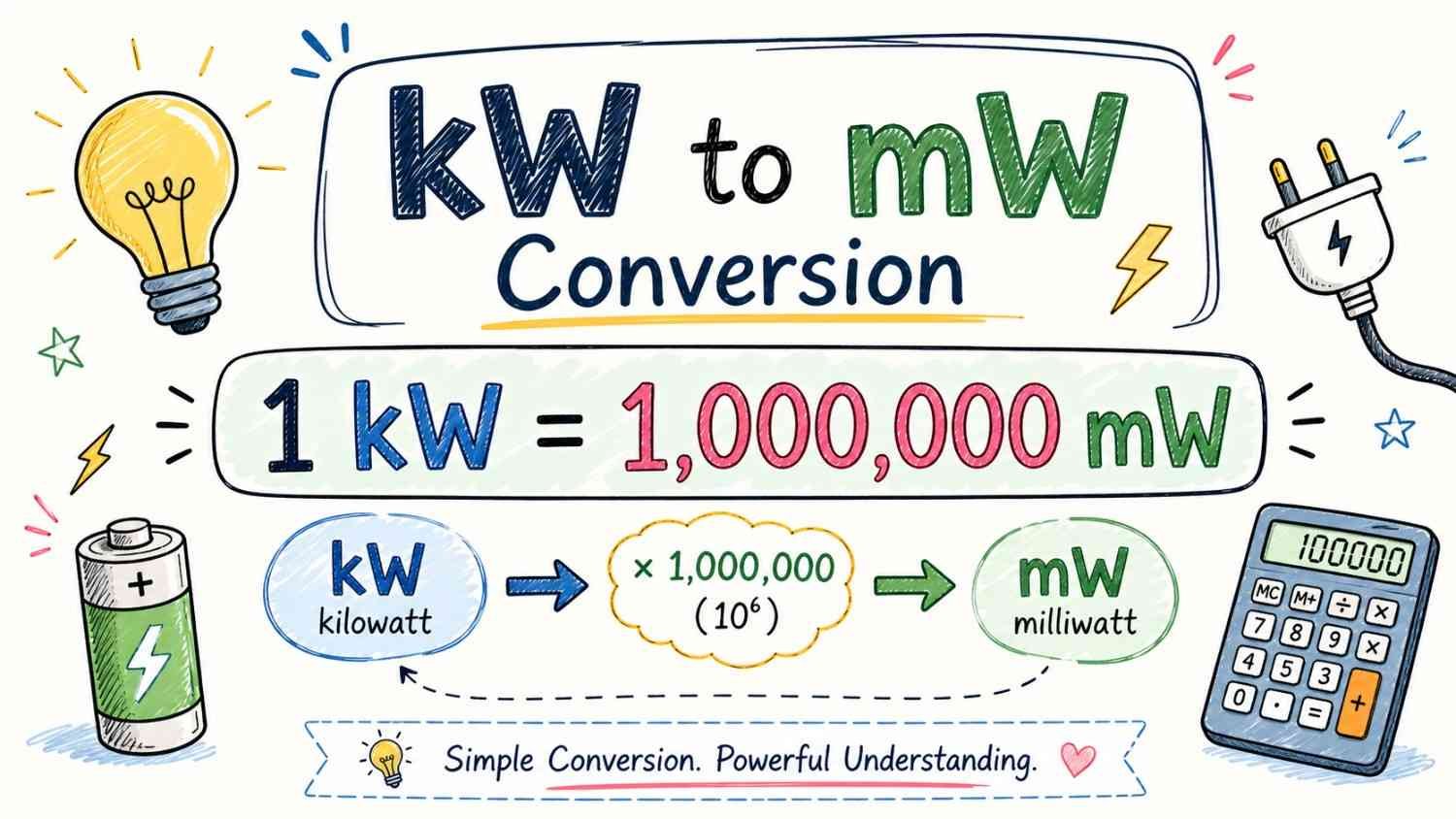
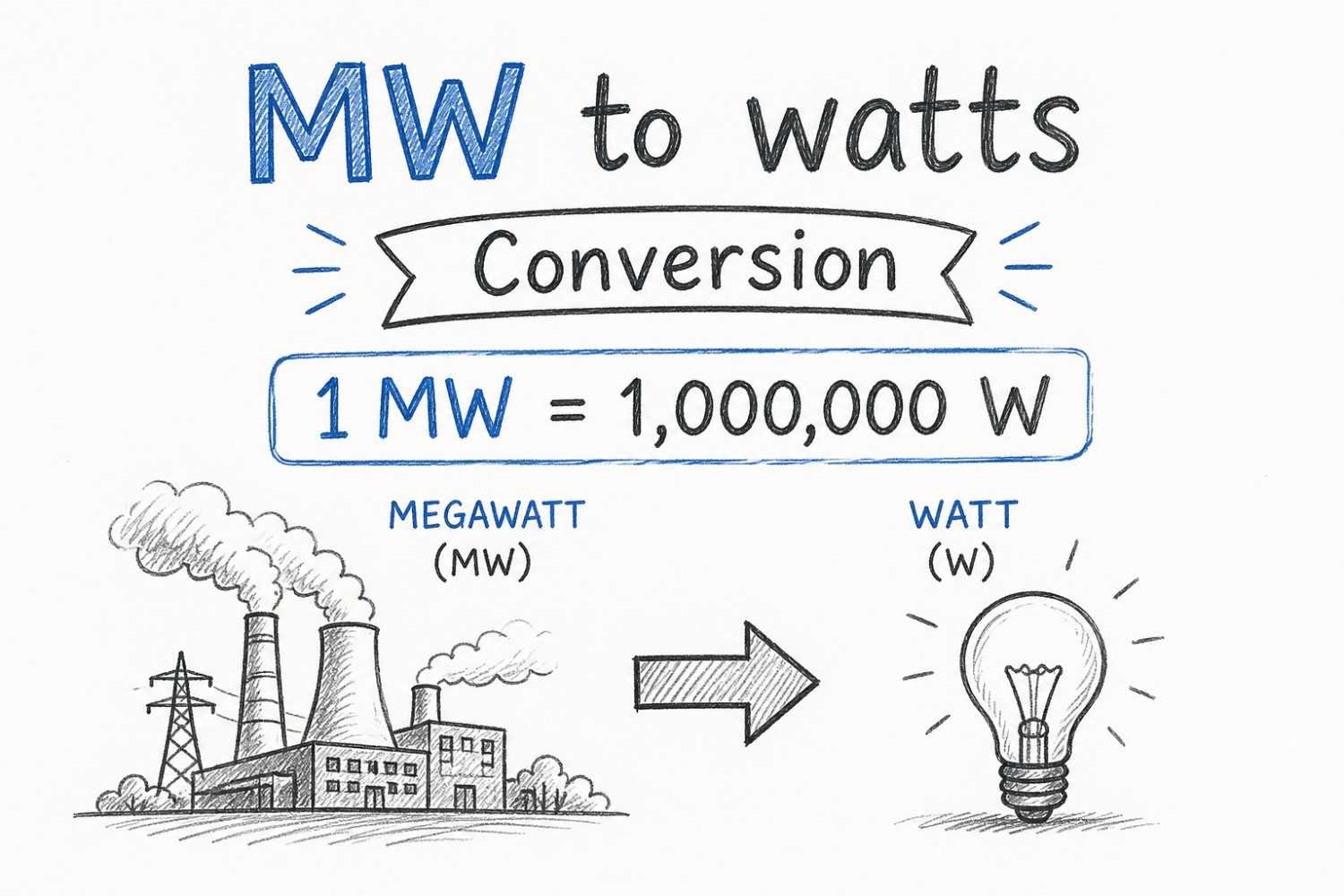
Watts (W) and megawatts (MW) are SI units measuring electrical power at vastly different scales. 1 megawatt (MW) = 1,000,000 watts (W) = \( 10^6 \) W, representing the metric prefix "mega" meaning one million. Both measure instantaneous power—the rate at which energy is generated or consumed. Watts measure small-scale power suitable for consumer devices and appliances, while megawatts measure utility-scale generation and industrial facilities where watt values would be impractically large. The watt is the SI base unit of power (1 W = 1 J/s = 1 V × 1 A), named after James Watt, but utility companies, power plants, and renewable energy developers universally specify capacity in megawatts for commercial-scale operations. Household and commercial power: LED bulb 10 W = 0.00001 MW (ten-millionth of a megawatt—illustrating vast scale difference); home solar system 5,000-10,000 W = 0.005-0.01 MW (5-10 kW residential); electric vehicle 50,000-150,000 W motor = 0.05-0.15 MW (50-150 kW drive power); commercial building 500,000-2,000,000 W = 0.5-2 MW peak demand (500 kW-2 MW electrical service). Utility-scale renewable energy: Commercial solar installations 1-100 MW capacity (small solar farm 1-5 MW = 1,000,000-5,000,000 W serves 200-1,000 homes; medium solar park 10-50 MW = 10,000,000-50,000,000 W serves 2,000-10,000 homes; large utility-scale solar 50-300 MW = 50,000,000-300,000,000 W serves 10,000-60,000 homes; world's largest solar parks 1,000-2,000+ MW); onshore wind turbines 2-5 MW each (2,000,000-5,000,000 W per turbine; modern GE 2.5 MW; Vestas V150 4.2 MW; Siemens Gamesa 5.X MW; typical wind farm 20-50 turbines = 50-250 MW total capacity = 50,000,000-250,000,000 W); offshore wind turbines 8-15 MW each (8,000,000-15,000,000 W larger rotors enable higher capacity; GE Haliade-X 13-14 MW; Vestas V236 15 MW world's most powerful 2024; offshore wind farms 500-1,200 MW common European installations = 500,000,000-1,200,000,000 W). Conventional power plants: Natural gas combined-cycle 500-1,000 MW (500,000,000-1,000,000,000 W; efficient baseload/peaker plants); coal-fired plants 500-2,000 MW (500,000,000-2,000,000,000 W; older technology being phased out; typical unit 500-800 MW); nuclear power plants 1,000-1,650 MW per reactor (1,000,000,000-1,650,000,000 W; US reactors average 1,000 MW; newest AP1000 design 1,100 MW; EPR design 1,650 MW; multi-reactor sites 2,000-4,000+ MW total = 2-4 billion watts = 2,000-4,000 MW). Understanding this six-orders-of-magnitude difference (million-fold) enables energy professionals to specify projects (300 MW wind farm = 300,000,000 W capacity), calculate generation (100 MW solar × 5 sun-hours × 365 days = 182,500 MWh annual = 182,500,000 kWh), and compare technologies (1,000 MW nuclear plant occupies 1-2 square miles vs equivalent solar 4,000-8,000 acres = 6-12 square miles for same capacity due to ~20% capacity factor solar vs ~90% nuclear).
Conversion Formulas
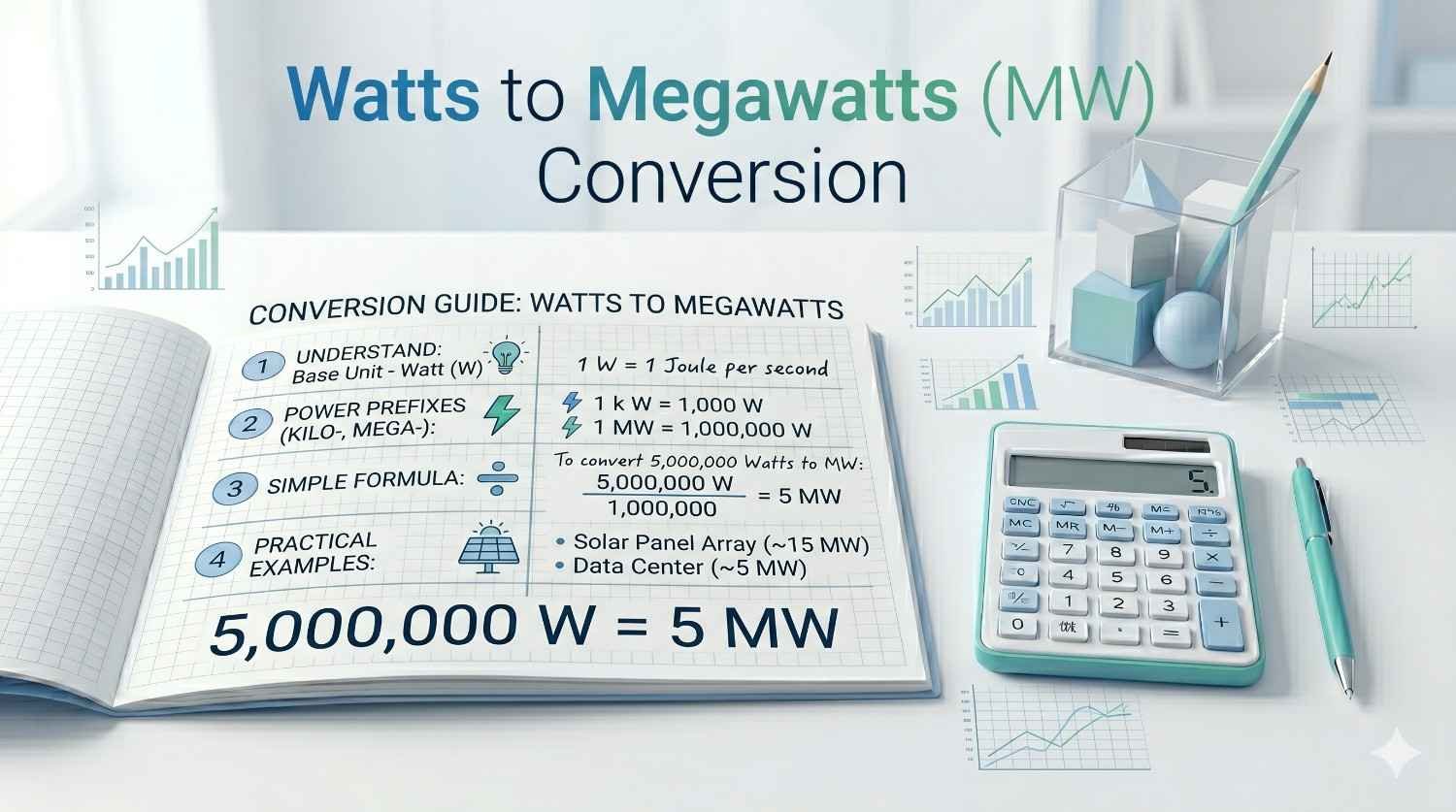
Watts to Megawatts: \( \text{MW} = \frac{W}{1{,}000{,}000} \) or \( \text{MW} = W \times 10^{-6} \). Divide watts by 1,000,000 (one million) to convert to megawatts. Examples: 10,000 W ÷ 1,000,000 = 0.01 MW (10 kW commercial solar array); 50,000 W ÷ 1,000,000 = 0.05 MW (50 kW EV motor); 100,000 W ÷ 1,000,000 = 0.1 MW (100 kW small commercial solar); 500,000 W ÷ 1,000,000 = 0.5 MW (500 kW commercial rooftop solar; small industrial facility); 1,000,000 W ÷ 1,000,000 = 1 MW (large commercial solar; small wind turbine; industrial electric motor; data center section); 2,000,000 W ÷ 1,000,000 = 2 MW (modern onshore wind turbine; community solar farm; industrial facility peak demand); 5,000,000 W ÷ 1,000,000 = 5 MW (large onshore wind turbine Vestas/GE models; small solar farm; industrial cogeneration); 10,000,000 W ÷ 1,000,000 = 10 MW (solar farm serving 2,000 homes; offshore wind turbine early models; industrial manufacturing plant); 20,000,000 W ÷ 1,000,000 = 20 MW (medium solar park; small wind farm 4-10 turbines; large industrial facility; district energy plant); 50,000,000 W ÷ 1,000,000 = 50 MW (large solar park 150-250 acres; medium wind farm 10-25 turbines 2-5 MW each; combined-cycle peaker plant small; large industrial complex); 100,000,000 W ÷ 1,000,000 = 100 MW (utility-scale solar farm 400-600 acres serving 20,000 homes; large wind farm 20-50 turbines; gas turbine simple-cycle; biomass plant; geothermal plant small-medium); 200,000,000 W ÷ 1,000,000 = 200 MW (large utility solar park 800-1,200 acres; major wind farm 40-100 turbines; combined-cycle gas plant small unit); 500,000,000 W ÷ 1,000,000 = 500 MW (major solar installation world-class park; large wind farm 100-250 turbines offshore/onshore; coal plant single unit; combined-cycle gas plant 2-3 units; serves 100,000-150,000 homes); 1,000,000,000 W ÷ 1,000,000 = 1,000 MW = 1 GW (gigawatt—nuclear reactor typical; large coal plant 2 units; major combined-cycle gas facility; world's largest wind farms 500+ turbines; world's largest solar parks 2,000+ acres; serves 200,000-300,000 homes). Megawatts to Watts: \( W = \text{MW} \times 1{,}000{,}000 \) or \( W = \text{MW} \times 10^6 \). Multiply megawatts by 1,000,000 to convert to watts. Examples: 0.01 MW × 1,000,000 = 10,000 W = 10 kW (small commercial solar); 0.1 MW × 1,000,000 = 100,000 W = 100 kW (large commercial solar rooftop); 1 MW × 1,000,000 = 1,000,000 W (1 million watts—large solar array serves 200 homes); 2 MW × 1,000,000 = 2,000,000 W (wind turbine typical onshore); 5 MW × 1,000,000 = 5,000,000 W (large wind turbine; solar farm small); 10 MW × 1,000,000 = 10,000,000 W (solar farm; offshore wind early); 50 MW × 1,000,000 = 50,000,000 W (large solar park; medium wind farm); 100 MW × 1,000,000 = 100,000,000 W (utility-scale solar; large wind farm; gas turbine); 500 MW × 1,000,000 = 500,000,000 W (major renewable project; coal plant unit); 1,000 MW × 1,000,000 = 1,000,000,000 W = 1 billion watts (nuclear reactor; major power plant). This six-orders-of-magnitude conversion (move decimal six places left W→MW, six places right MW→W) enables project developers to communicate scale (500 MW wind farm = 500,000,000 W = 500,000 kW capacity) and calculate energy production (100 MW solar × 1,500 full-load equivalent hours = 150,000 MWh annual = 150 million kWh serves 15,000 homes @ 10,000 kWh/home/year).
Power Generation Capacity Table
| Power Source | Watts (W) | Megawatts (MW) | Typical Serving Capacity |
|---|---|---|---|
| Residential solar | 5,000-10,000 W | 0.005-0.01 MW | 1 home (self-consumption) |
| Commercial rooftop | 100,000-500,000 W | 0.1-0.5 MW | 20-100 homes equivalent |
| Small wind turbine | 1,000,000 W | 1 MW | 200-300 homes |
| Onshore wind turbine | 2,000,000-5,000,000 W | 2-5 MW | 400-1,000 homes per turbine |
| Offshore wind turbine | 8,000,000-15,000,000 W | 8-15 MW | 1,600-3,000 homes per turbine |
| Solar farm (small) | 5,000,000-10,000,000 W | 5-10 MW | 1,000-2,000 homes |
| Solar park (medium) | 50,000,000 W | 50 MW | 10,000 homes |
| Solar park (large) | 100,000,000-300,000,000 W | 100-300 MW | 20,000-60,000 homes |
| Wind farm (medium) | 50,000,000-150,000,000 W | 50-150 MW | 10,000-30,000 homes |
| Gas turbine | 100,000,000-200,000,000 W | 100-200 MW | 20,000-40,000 homes |
| Combined-cycle gas | 500,000,000-1,000,000,000 W | 500-1,000 MW | 100,000-200,000 homes |
| Coal plant (unit) | 500,000,000-800,000,000 W | 500-800 MW | 100,000-160,000 homes |
| Nuclear reactor | 1,000,000,000-1,650,000,000 W | 1,000-1,650 MW | 200,000-330,000 homes |
| Hydroelectric dam (large) | 1,000,000,000-6,800,000,000 W | 1,000-6,800 MW | 200,000-1,360,000 homes |
Renewable Energy Economics and Capacity Factor Analysis
Understanding watts-MW conversions enables comprehensive renewable energy project analysis accounting for capacity factor, capital costs, and electricity generation. 100 MW Solar Farm Example: Capacity: 100 MW = 100,000,000 W = 100,000 kW nameplate. Location: Arizona desert 6.0 peak sun hours/day average (excellent solar resource). Capacity factor: 25% annual (accounts for nighttime zero production, weather, seasonal variation, maintenance). Calculation: 6 peak sun hours × 365 days = 2,190 peak-equivalent hours/year ÷ 8,760 total hours = 25% capacity factor. Annual generation: 100 MW × 8,760 hours × 0.25 capacity factor = 219,000 MWh = 219,000,000 kWh (219 million kWh). Homes served: 219,000 MWh ÷ 11 MWh average home = 19,909 homes ≈ 20,000 homes equivalent. Land requirement: 100 MW ÷ 6-7 MW per 100 acres (fixed-tilt) = 1,400-1,700 acres = 2.2-2.7 square miles (single-axis tracking improves 15-20% generation same land). Capital cost: $0.90-1.10/watt installed (2024 utility-scale pricing post-ITC) × 100,000,000 W = $90-110 million total project cost including modules, inverters, racking, electrical, land, development, financing. Revenue: 219,000 MWh × $35-50/MWh PPA (Power Purchase Agreement wholesale price regional variation) = $7.7-11.0 million annual. Operating costs: $15-20/kW-year O&M × 100,000 kW = $1.5-2.0 million/year (cleaning, monitoring, inverter replacement reserve, insurance, land lease, property tax, administration). Net income: $7.7-11.0 million revenue - $1.8 million OPEX = $5.9-9.2 million/year. Payback: $100 million capital ÷ $7.5 million average annual = 13.3 years simple payback (actual project IRR 6-10% with tax equity financing structures and ITC benefits accelerating returns). 150 MW Wind Farm Example: Configuration: 50 turbines × 3 MW each = 150 MW = 150,000,000 W total capacity. Location: Great Plains (Kansas/Oklahoma) Class 4-5 wind resource. Capacity factor: 35-40% annual (wind produces more consistently than solar; higher capacity factors possible). Using 38%: Annual generation: 150 MW × 8,760 hrs × 0.38 = 499,320 MWh = 499,320,000 kWh. Homes served: 499,320 MWh ÷ 11 MWh = 45,393 homes ≈ 45,000 homes. Land requirement: 50 turbines × 60 acres per turbine (turbine spacing) = 3,000 acres = 4.7 square miles total project area (actual turbine/road footprint only 2-5% of total; 95%+ remains agricultural use continuing farming/ranching). Capital cost: $1.30-1.50/watt installed (wind higher than solar) × 150,000,000 W = $195-225 million including turbines, towers, foundations, electrical collection, substation, transmission interconnection, roads, development, financing. Revenue: 499,320 MWh × $25-35/MWh PPA (wind slightly lower pricing than solar; tax credit impacts) = $12.5-17.5 million annual. Operating costs: $40-50/kW-year O&M (wind higher than solar; moving parts, gearboxes, blade maintenance) × 150,000 kW = $6.0-7.5 million/year. Net income: $15 million average revenue - $6.5 million OPEX = $8.5 million/year. Payback: $210 million ÷ $8.5 million = 24.7 years (longer than solar but 30-year turbine design life; PTC Production Tax Credit improves economics $25/MWh × 499,320 = $12.5 million additional first 10 years accelerating payback to 10-12 years with tax benefits). 500 MW Combined-Cycle Gas Plant: Capacity: 500 MW = 500,000,000 W = 500,000 kW. Technology: Natural gas combined-cycle (gas turbine + steam turbine recovering exhaust heat 60% efficiency vs 35-40% simple-cycle). Capacity factor: 50-70% (dispatchable baseload/intermediate; cycles to complement renewables). Using 60% assuming intermediate dispatch: Annual generation: 500 MW × 8,760 hrs × 0.60 = 2,628,000 MWh = 2.628 TWh (terawatt-hours). Homes served: 2,628,000 MWh ÷ 11 MWh = 238,909 homes ≈ 240,000 homes. Fuel consumption: 2,628,000 MWh ÷ 0.60 efficiency = 4,380,000 MWh thermal input = 14,949,000 MMBtu natural gas (3.41 BTU per Wh thermal). Capital cost: $800-1,000/kW (gas significantly cheaper than nuclear, competitive with wind) × 500,000 kW = $400-500 million. Revenue: 2,628,000 MWh × $45-60/MWh wholesale (gas sets marginal price; higher than renewables) = $118-158 million annual. Fuel cost: 14,949,000 MMBtu × $4.00/MMBtu gas price (variable; $2-8 range historically) = $59.8 million/year fuel (dominates operating costs). Other OPEX: $15/kW-year × 500,000 = $7.5 million maintenance/labor. Total OPEX: $67.3 million/year. Net income: $138 million revenue - $67.3 million OPEX = $70.7 million/year (highly sensitive to gas prices and electricity market prices). Payback: $450 million ÷ $70.7 million = 6.4 years (faster than renewables due to dispatchability commanding higher prices but fuel cost risk vs zero-fuel renewables). Carbon emissions: 14,949,000 MMBtu × 53.06 kg CO₂/MMBtu natural gas = 793,200 metric tons CO₂/year (vs zero for renewables; carbon pricing $50/ton adds $39.7 million/year cost impacting economics shifting advantage toward renewables).
Why Choose RevisionTown's Watts to MW Converter?
RevisionTown's professional converter provides: (1) Standard SI Conversion—Precise 1,000,000× divider following International System of Units (mega = \( 10^6 \)); (2) Bidirectional Calculation—Convert W↔MW seamlessly for utility-scale project specifications; (3) Scientific Notation Support—Handles million-scale values common in power generation (100,000,000 W = 100 MW); (4) Bulk Processing—Convert multiple power plant capacities simultaneously for portfolio analysis; (5) Comprehensive Reference—Quick lookup from residential solar (5,000 W = 0.005 MW) to nuclear plants (1 billion W = 1,000 MW); (6) Formula Transparency—View exact ÷1,000,000 calculations for engineering documentation and project feasibility studies; (7) Mobile Optimized—Use on smartphones during site visits, project meetings, and power plant inspections; (8) Zero Cost—Completely free with no registration or usage limitations; (9) Professional Accuracy—Trusted by power engineers, renewable energy developers, utility planners, project managers, electrical engineers, and students worldwide for project specifications (150 MW wind farm = 150,000,000 W capacity = 50 turbines × 3,000,000 W each), generation calculations (100 MW solar × 1,500 full-load hours = 150,000 MWh annual = 150,000,000 kWh production), financial modeling (200 MW project × $1,000,000 per MW = $200 million capital cost), grid interconnection studies (500 MW plant = 500,000,000 W requires 500 kV transmission capacity), capacity factor analysis (30% capacity factor: 100 MW nameplate = 30 MW average = 30,000,000 W continuous equivalent), power purchase agreements (50 MW × 8,760 hrs × 35% = 153,300 MWh contracted delivery), carbon emission calculations (500 MW gas × 60% CF × 8,760 hrs = 2,628,000 MWh × 0.5 tons/MWh = 1,314,000 tons CO₂), and all applications requiring accurate power conversions between watt equipment ratings and megawatt utility-scale specifications for professional power systems engineering, renewable energy development, electricity generation analysis, and comprehensive grid planning worldwide.
❓ Frequently Asked Questions
1,000,000 watts equals 1 megawatt. Formula: 1,000,000 W = 1 MW = \( 10^6 \) W. This is standard SI conversion: mega prefix = 1 million. Examples: 100,000 W = 0.1 MW (100 kW commercial solar); 500,000 W = 0.5 MW (industrial facility); 1,000,000 W = 1 MW (large solar array, small wind turbine); 2,000,000 W = 2 MW (wind turbine typical); 5,000,000 W = 5 MW (large wind turbine); 10,000,000 W = 10 MW (solar farm); 100,000,000 W = 100 MW (utility-scale solar/wind); 1,000,000,000 W = 1,000 MW = 1 GW (nuclear reactor).
Divide watts by 1,000,000. Formula: MW = W ÷ 1,000,000. Examples: 500,000 W = 0.5 MW; 1,000,000 W = 1 MW (1 million watts); 2,000,000 W = 2 MW; 5,000,000 W = 5 MW; 10,000,000 W = 10 MW; 50,000,000 W = 50 MW; 100,000,000 W = 100 MW; 500,000,000 W = 500 MW; 1,000,000,000 W = 1,000 MW = 1 GW (gigawatt). Move decimal six places left (W→MW). Utility-scale generation always specified in MW: wind turbine 3 MW = 3,000,000 W; solar farm 100 MW = 100,000,000 W.
1 megawatt equals 1,000,000 watts (one million watts). Formula: 1 MW = 1,000,000 W or 1 MW × 1,000,000 = 1,000,000 W. Examples: 0.1 MW = 100,000 W (100 kW); 0.5 MW = 500,000 W; 1 MW = 1,000,000 W (large solar array serves 200 homes); 2 MW = 2,000,000 W (wind turbine); 5 MW = 5,000,000 W (large turbine); 10 MW = 10,000,000 W (solar farm 2,000 homes); 100 MW = 100,000,000 W (utility solar 20,000 homes); 500 MW = 500,000,000 W (coal plant unit); 1,000 MW = 1,000,000,000 W = 1 billion watts (nuclear reactor serves 200,000-300,000 homes). Move decimal six places right (MW→W).
Million-fold difference. 1 MW = 1,000,000 W. Watts for consumer/commercial: home appliances 100-5,000 W; commercial facilities 50,000-500,000 W (0.05-0.5 MW). Megawatts for utility-scale: wind turbine 2-5 MW (2,000,000-5,000,000 W); solar farm 10-300 MW; gas plant 100-1,000 MW; coal plant 500-1,000 MW; nuclear 1,000-1,650 MW per reactor. Both measure same quantity (power = energy/time); vastly different scales. Energy generation uses MW for capacity (100 MW solar farm) and MWh for production (100 MW × 1,500 hrs = 150,000 MWh annual). 1 MW serves approximately 200-300 homes depending on regional consumption patterns.
1 megawatt powers approximately 200-300 homes average (regional variation). Calculation: Average US home 10,000-11,000 kWh/year = 1.14 kW average continuous load. 1 MW = 1,000 kW ÷ 1.14 kW per home = 877 homes instantaneous capacity. However, capacity factor matters: Solar 25% CF: 1 MW solar × 0.25 = 0.25 MW average = 250 kW ÷ 1.14 = 219 homes. Wind 35% CF: 1 MW wind × 0.35 = 350 kW ÷ 1.14 = 307 homes. Nuclear/coal 90% CF: 1 MW × 0.90 = 790 kW ÷ 1.14 = 693 homes. Rule of thumb: 1 MW renewable capacity ≈ 200-300 homes annually; 1 MW baseload ≈ 600-800 homes. Examples: 100 MW solar farm serves 20,000-25,000 homes; 500 MW coal plant serves 300,000-400,000 homes.
100 megawatts equals 100,000,000 watts (one hundred million watts). Calculation: 100 MW × 1,000,000 = 100,000,000 W. This is typical capacity for: utility-scale solar farm (100 MW = 400-600 acres serves 20,000 homes annual); large wind farm (25-50 turbines × 2-4 MW each); gas turbine simple-cycle peaker plant; biomass power plant; geothermal plant; small combined-cycle section. Annual generation (assuming 30% capacity factor renewables): 100 MW × 8,760 hrs × 0.30 = 262,800 MWh = 262,800,000 kWh serves 23,891 homes @ 11,000 kWh/home. Capital cost: $90-110 million solar; $130-150 million wind; $80-100 million gas.
Formula: Energy (MWh) = Capacity (MW) × Hours × Capacity Factor. Steps: (1) Determine capacity in MW; (2) Calculate hours (8,760 hrs/year); (3) Apply capacity factor (solar 20-30%; wind 30-45%; gas 40-70%; nuclear 90%); (4) Result in MWh megawatt-hours. Example: 150 MW wind farm, 38% capacity factor. Annual: 150 MW × 8,760 hrs × 0.38 = 499,320 MWh = 499,320,000 kWh. Homes: 499,320 MWh ÷ 11 MWh per home = 45,393 homes. Revenue: 499,320 MWh × $30/MWh PPA = $14,979,600/year. Always account for capacity factor—MW is nameplate capacity; actual generation much lower for renewables.
Convenience for utility-scale values. Megawatts avoid unwieldy numbers: "wind turbine 3 MW" clearer than "3,000,000 W"; "solar farm 100 MW" vs "100,000,000 W"; "nuclear plant 1,000 MW" vs "1,000,000,000 W" (billion). Industry standards: Power plants rated MW capacity; Utilities purchase power MW/MWh; Grid operators manage MW supply/demand; Project developers specify MW sizing; Financial models use $/MW capital costs. Kilowatts (kW) for commercial/residential (5 kW home solar = 5,000 W; 500 kW commercial = 500,000 W = 0.5 MW). Megawatts (MW) for utility-scale (≥1 MW = 1,000,000 W). Gigawatts (GW) for regional grids (1 GW = 1,000 MW = 1,000,000,000 W). Choose unit matching typical application scale for readability and industry convention.