
Algebra and polynomial functions guide
The Factor and Remainder Theorem
The factor theorem and remainder theorem are two connected tools for working with polynomials. They help you evaluate polynomials quickly, find remainders without full long division, test whether a linear expression is a factor, identify zeros, and break higher-degree expressions into smaller pieces.
Factor and Remainder Checker
Enter polynomial coefficients from highest degree to constant term. Then enter the value \(c\) for the divisor \(x-c\). The checker evaluates \(f(c)\), gives the remainder, and states whether \(x-c\) is a factor.
The Main Ideas
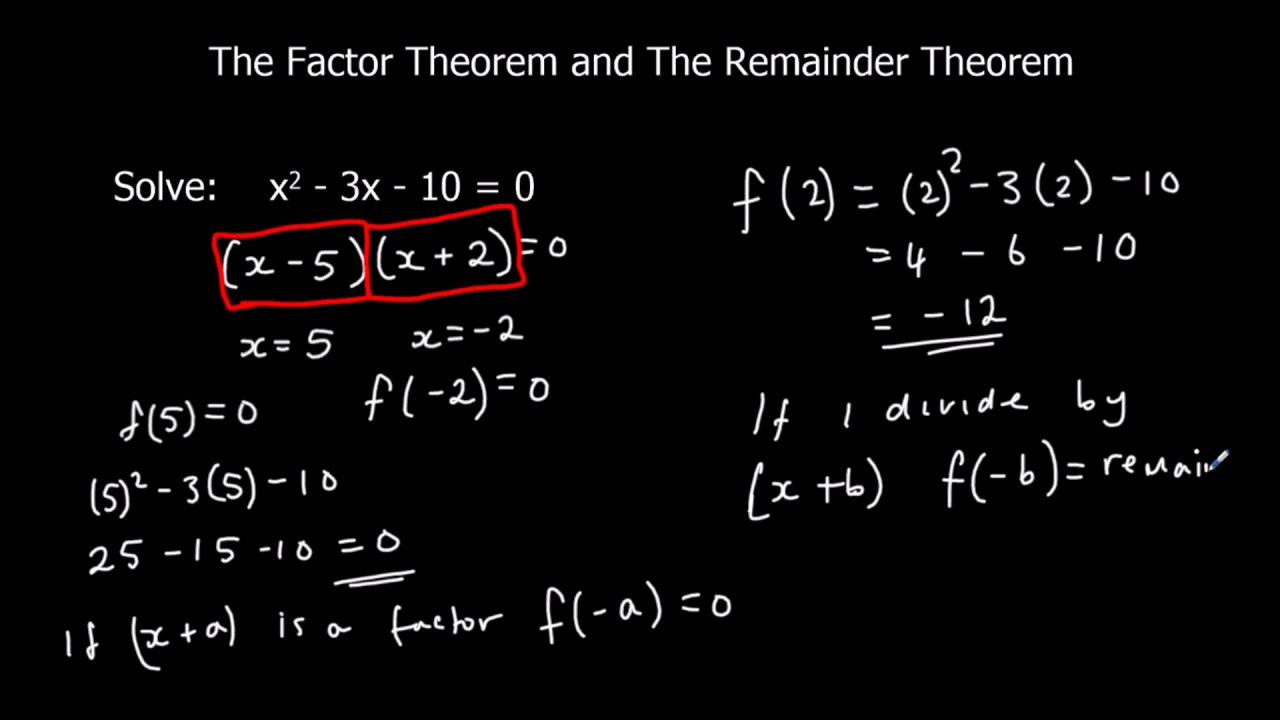
If \(f(x)\) is divided by \(x-c\), the remainder is \(f(c)\). This is the remainder theorem. If \(f(c)=0\), then the remainder is zero, so \(x-c\) is a factor. This is the factor theorem.
This page focuses on the reasoning and problem-solving method. If you are reviewing the wider algebra unit, the algebra table of contents and polynomials page are useful companion resources.
What the Remainder Theorem Means
The remainder theorem says that if a polynomial \(f(x)\) is divided by \(x-c\), then the remainder is exactly \(f(c)\). This means a division question can be answered by substitution. Instead of performing polynomial long division every time, you can put \(x=c\) into the polynomial and the value you get is the remainder.
For example, if \(f(x)=2x^3-3x^2+4x-5\) and the divisor is \(x-1\), then \(c=1\). The remainder is \(f(1)\):
So the remainder when \(2x^3-3x^2+4x-5\) is divided by \(x-1\) is \(-2\). No long division is needed to find that remainder. Polynomial division would still be needed if you wanted the full quotient, but the remainder theorem answers the remainder question directly.
The theorem comes from the division algorithm for polynomials. When a polynomial \(f(x)\) is divided by a nonzero polynomial \(d(x)\), it can be written as:
When the divisor is linear, \(d(x)=x-c\), the remainder must have degree less than \(1\). That means the remainder is a constant, which we can call \(r\). So:
Now substitute \(x=c\). The factor \(x-c\) becomes \(0\), so the quotient part disappears:
That short proof explains why the theorem is true. The remainder is not a coincidence or a trick; it follows directly from the structure of polynomial division. This reasoning is important because it also explains the factor theorem.
What the Factor Theorem Means
The factor theorem is the zero-remainder version of the remainder theorem. It says that \(x-c\) is a factor of \(f(x)\) if and only if \(f(c)=0\). The phrase "if and only if" matters: the theorem works in both directions. If \(x-c\) is a factor, then \(f(c)=0\). If \(f(c)=0\), then \(x-c\) is a factor.
For example, let \(f(x)=x^3-4x^2+x+6\). Test whether \(x-2\) is a factor. Since the divisor is \(x-2\), use \(c=2\):
Because \(f(2)=0\), the factor theorem tells us that \(x-2\) is a factor of \(f(x)\). The result also tells us that \(x=2\) is a zero or root of the polynomial. These ideas are connected: a factor \(x-c\), a zero \(x=c\), and a point where the graph crosses or touches the \(x\)-axis all refer to the same algebraic relationship, though the graph behavior depends on multiplicity.
Be careful with signs. If the factor is \(x+3\), then it is the same as \(x-(-3)\), so \(c=-3\). To test \(x+3\), calculate \(f(-3)\), not \(f(3)\). Many factor theorem mistakes are sign mistakes. A useful habit is to rewrite the factor in the form \(x-c\) before substituting.
The factor theorem becomes powerful when combined with other polynomial topics. Once one factor is found, division reduces the degree of the polynomial. A cubic can become a quadratic; a quartic can become a cubic. After reduction, methods such as the quadratic formula, factoring by grouping, or known root relationships may finish the problem.
Remainder Theorem vs Factor Theorem
The two theorems are often taught together because the factor theorem follows from the remainder theorem. Still, they answer slightly different questions. The remainder theorem answers: "What is the remainder when \(f(x)\) is divided by \(x-c\)?" The factor theorem answers: "Is \(x-c\) a factor of \(f(x)\)?"
| Theorem | Question it answers | Calculation | Conclusion |
|---|---|---|---|
| Remainder theorem | What is the remainder after division by \(x-c\)? | Evaluate \(f(c)\) | The remainder is \(f(c)\) |
| Factor theorem | Is \(x-c\) a factor of \(f(x)\)? | Evaluate \(f(c)\) | If \(f(c)=0\), then \(x-c\) is a factor |
| Zero or root test | Is \(x=c\) a zero of \(f(x)\)? | Evaluate \(f(c)\) | If \(f(c)=0\), then \(x=c\) is a zero |
Notice that all three rows use the same calculation: substitute \(c\) into the polynomial. The difference is the interpretation of the result. If the value is nonzero, it is the remainder. If the value is zero, the remainder is zero, the divisor is a factor, and \(c\) is a zero of the polynomial.
This connection is central to polynomial functions. It links algebraic division, equation solving and graph interpretation. For a broader look at polynomial behavior, see polynomial functions and rates of change and polynomial functions and complex zeros.
How to Use the Remainder Theorem Step by Step
- Write the divisor in the form \(x-c\). If the divisor is \(x-4\), then \(c=4\). If the divisor is \(x+5\), then \(c=-5\).
- Substitute \(c\) into the polynomial. Calculate \(f(c)\) carefully using the correct order of operations.
- Simplify the value. The result may be positive, negative, zero or fractional.
- State the remainder. The remainder when dividing by \(x-c\) is \(f(c)\).
- If needed, interpret zero. If the remainder is zero, the divisor is also a factor.
Example: Find the remainder when \(f(x)=3x^4-2x^3+x-7\) is divided by \(x+2\). Since \(x+2=x-(-2)\), use \(c=-2\):
The remainder is \(55\). Since the remainder is not zero, \(x+2\) is not a factor of the polynomial.
Students often make errors with negative substitution. Parentheses are essential. The expression \((-2)^4\) is positive, while \((-2)^3\) is negative. If a term is \(-2x^3\), then substituting \(-2\) gives \(-2(-8)=16\). A sign error in one term can change the entire conclusion.
How to Use the Factor Theorem Step by Step
- Identify the proposed factor. Write it as \(x-c\).
- Evaluate the polynomial at \(c\). Substitute \(x=c\) into \(f(x)\).
- Check whether the result is zero. If \(f(c)=0\), the proposed factor works.
- Divide if you need the remaining factor. Use synthetic division or long division to reduce the polynomial.
- Continue factoring if possible. The quotient may factor further.
Example: Show that \(x+1\) is a factor of \(f(x)=x^3+2x^2-x-2\). Since \(x+1=x-(-1)\), use \(c=-1\):
Because \(f(-1)=0\), \(x+1\) is a factor. To factor the cubic fully, divide \(x^3+2x^2-x-2\) by \(x+1\). Synthetic division with \(-1\) gives quotient \(x^2+x-2\), so:
The roots are \(x=-1\), \(x=-2\), and \(x=1\). One factor theorem test opened the door to a full factorisation.
Synthetic Division and the Theorems
Synthetic division is a compact way to divide a polynomial by \(x-c\). It gives the quotient coefficients and the remainder. The last number in the synthetic division row is exactly \(f(c)\), so synthetic division is closely connected to the remainder theorem. If the last number is zero, the divisor is a factor.
Divide \(2x^3-3x^2+4x-5\) by \(x-1\). The coefficients are \(2,-3,4,-5\). Use \(c=1\):
| Step | Numbers | Explanation |
|---|---|---|
| Coefficients | \(2,\ -3,\ 4,\ -5\) | List every coefficient, including zeros if a term is missing. |
| Bring down | \(2\) | The first quotient coefficient is \(2\). |
| Multiply and add | \(-3+2=-1\) | Multiply \(2\) by \(1\), then add to the next coefficient. |
| Continue | \(4+(-1)=3\) | Multiply \(-1\) by \(1\), then add. |
| Remainder | \(-5+3=-2\) | The last value is the remainder. |
The quotient is \(2x^2-x+3\), and the remainder is \(-2\). Therefore:
This matches the remainder theorem because \(f(1)=-2\). Synthetic division is useful when you need more than the remainder. If the question only asks for the remainder, direct substitution is usually faster. If the question asks you to factor the polynomial after proving a factor, synthetic division is often the fastest next step.
Remember to include missing terms. If \(f(x)=x^4-3x^2+5\), the coefficients are \(1,0,-3,0,5\), not \(1,-3,5\). Leaving out zero coefficients changes the degree positions and gives the wrong quotient and remainder.
Worked Example 1: Find a Remainder
Find the remainder when \(f(x)=4x^3-7x^2+2x+9\) is divided by \(x-3\).
Since the divisor is \(x-3\), use \(c=3\). Apply the remainder theorem:
The remainder is \(60\). Since the remainder is not zero, \(x-3\) is not a factor of \(f(x)\). A full division is unnecessary unless the quotient is also required.
This example is straightforward, but it illustrates the most common theorem use: a division question becomes a substitution question. The substitution \(x=3\) is not random; it comes from the divisor \(x-3\). If the divisor had been \(x+3\), the substitution would have been \(x=-3\).
Worked Example 2: Test a Factor
Determine whether \(x-4\) is a factor of \(f(x)=x^3-6x^2+5x+12\).
Use \(c=4\):
Because \(f(4)=0\), \(x-4\) is a factor. Now divide to find the quotient. Synthetic division with \(4\) and coefficients \(1,-6,5,12\) gives quotient \(x^2-2x-3\). Therefore:
The zeros are \(x=4\), \(x=3\), and \(x=-1\). The factor theorem test was the first step, but synthetic division and quadratic factoring completed the solution.
Worked Example 3: Find an Unknown Coefficient
Suppose \(f(x)=x^3+kx^2-5x+6\), and \(x-2\) is a factor. Find \(k\).
If \(x-2\) is a factor, then \(f(2)=0\). Substitute \(x=2\):
Set this equal to zero:
So \(k=-1\). The polynomial becomes \(x^3-x^2-5x+6\), and \(x-2\) is a factor. You can check:
This type of question is common because it tests whether you understand the condition \(f(c)=0\). The unknown coefficient is found by turning the factor statement into an equation.
Worked Example 4: Use a Remainder to Find a Parameter
Let \(f(x)=2x^3+ax^2-3x+1\). When \(f(x)\) is divided by \(x+2\), the remainder is \(11\). Find \(a\).
Because the divisor is \(x+2=x-(-2)\), use \(c=-2\). The remainder theorem says \(f(-2)=11\):
Set equal to the given remainder:
The unknown coefficient is \(a=5\). This example shows that the remainder theorem is not only for finding remainders; it can also turn a remainder condition into an algebraic equation.
Worked Example 5: Factor a Cubic Completely
Factor \(f(x)=2x^3+x^2-13x+6\) completely.
Possible rational zeros can be tested by substitution. Try \(x=2\):
Therefore \(x-2\) is a factor. Divide \(2x^3+x^2-13x+6\) by \(x-2\). Synthetic division gives quotient \(2x^2+5x-3\). Now factor the quadratic:
So the full factorisation is:
The zeros are \(2\), \(\frac12\), and \(-3\). This example shows a common strategy: find one rational zero, reduce the polynomial degree, then factor the remaining quadratic. If the remaining quadratic is not easily factorable, use the quadratic formula.
Common Mistakes and How to Avoid Them
For \(x+5\), use \(c=-5\). Rewrite the divisor as \(x-c\) before substituting.
In synthetic division, include zero coefficients for missing powers. \(x^4-3x+2\) uses \(1,0,0,-3,2\).
Finding \(x-c\) may only be the first step. The quotient may factor further.
If \(x=c\) is a root, the corresponding factor is \(x-c\), not always \(x+c\).
If \(f(c)\neq0\), you still found the remainder. It only means \(x-c\) is not a factor.
If only the remainder is needed, direct substitution is faster than polynomial division.
Most errors in this topic come from notation rather than difficult algebra. Write the divisor carefully, identify \(c\), use parentheses for negative values, and state what the value means. A clean final line might say, "Since \(f(-3)=0\), \(x+3\) is a factor." That sentence connects the calculation to the theorem.
Connections to Zeros, Roots and Graphs
The factor theorem connects algebraic factors with zeros of a polynomial function. If \(x-c\) is a factor of \(f(x)\), then \(f(c)=0\), so the graph of \(y=f(x)\) has an \(x\)-intercept at \(x=c\). Conversely, if the graph has an \(x\)-intercept at \(x=c\), then \(x-c\) is a factor, provided \(f(x)\) is a polynomial.
For example, if \(f(x)=(x-2)(x+1)(x-5)\), then the zeros are \(2\), \(-1\), and \(5\). The graph intersects or touches the \(x\)-axis at those values, depending on multiplicity. A factor with odd multiplicity usually crosses the axis; a factor with even multiplicity usually touches and turns. The factor theorem identifies the zeros, while graph behavior requires more information about multiplicity and the polynomial's leading term.
This topic prepares students for the fundamental theorem of algebra, which describes how many roots a polynomial has over the complex numbers. It also supports work on sums and products of roots, because once a polynomial is factored or its roots are known, relationships among coefficients and roots become easier to see.
Graphs can help check factor theorem results. If you believe \(x-3\) is a factor, then the graph should pass through \((3,0)\). If a graphing tool shows the function far from zero at \(x=3\), recheck your substitution or the polynomial. Graphs do not replace algebraic proof, but they are useful for spotting mistakes.
How the Theorems Fit into Polynomial Problem Solving
The factor and remainder theorem sit in the middle of polynomial algebra. Before this topic, students usually learn polynomial operations, expanding, collecting like terms, substitution, and simple factoring. After this topic, students can solve more advanced polynomial equations, analyze roots, and connect factors with graphs.
A typical polynomial problem-solving sequence looks like this:
- Write the polynomial in standard form.
- Use the theorem to test possible roots or find remainders.
- If a factor is found, divide by the factor.
- Factor the quotient if possible.
- Solve the resulting linear or quadratic factors.
- Check the roots by substitution or graphing.
For higher-degree polynomial equations, this sequence can be much faster than trying to factor by inspection. If a cubic has one obvious integer root, the factor theorem confirms it, synthetic division reduces the problem to a quadratic, and then standard quadratic methods finish it. If no rational root works, the problem may require numerical methods, graphing, or a different algebraic approach.
This topic also supports rational functions. Factoring the numerator and denominator of a rational expression helps identify zeros, excluded values, holes, and asymptotes. If you are moving from polynomial factors into rational expressions, review rational functions after mastering the theorem.
Exam Strategy
In exams, factor theorem and remainder theorem questions usually reward a clear method. Begin by identifying \(c\) from the divisor. Then write the substitution explicitly. If the question asks for a remainder, state the numerical remainder. If the question asks whether something is a factor, state whether the value is zero and write the conclusion in theorem language.
For a divisor \(x-a\), use \(f(a)\). For a divisor \(x+a\), use \(f(-a)\). For a divisor such as \(2x-3\), the simple form \(x-c\) is not immediate. Since \(2x-3=2\left(x-\frac32\right)\), the zero of the divisor is \(x=\frac32\). The remainder theorem in its basic form applies cleanly to divisors \(x-c\), but evaluating at the zero of the divisor is still central. If the question is specifically about division by \(2x-3\), take care with the quotient and remainder form because the divisor is not monic.
When the problem includes an unknown coefficient, convert the condition into an equation. If \(x-2\) is a factor, write \(f(2)=0\). If the remainder when divided by \(x+1\) is \(7\), write \(f(-1)=7\). If two different remainder conditions are given, you may get simultaneous equations for two unknown coefficients.
Show enough working to make the theorem visible. A single number without context may be hard to credit. A line such as \(f(-2)=11\), followed by "therefore the remainder is \(11\)," is clear. If the result is zero, write "therefore \(x+2\) is a factor." The conclusion should match the question.
Finding Possible Rational Roots
The factor theorem is often used after you make a short list of possible rational roots. For a polynomial with integer coefficients, rational roots are usually tested by looking at factors of the constant term and factors of the leading coefficient. This idea is closely related to the rational root theorem. If the polynomial is monic, meaning the leading coefficient is \(1\), the likely integer roots are factors of the constant term.
For example, consider \(f(x)=x^3-7x+6\). The constant term is \(6\), so possible integer roots include \(\pm1,\pm2,\pm3,\pm6\). Test small values first:
Since \(f(1)=0\), \(x-1\) is a factor. Divide by \(x-1\) to get \(x^2+x-6\), then factor the quotient:
So \(x^3-7x+6=(x-1)(x+3)(x-2)\). The roots are \(1\), \(-3\), and \(2\). Notice that the factor theorem did not require testing every possible root. Once one root was found, the degree was reduced and the rest of the problem became easier.
If the leading coefficient is not \(1\), rational candidates may include fractions. For \(f(x)=2x^3-3x^2-8x+12\), possible rational roots include factors of \(12\) divided by factors of \(2\), such as \(\pm1,\pm2,\pm3,\pm4,\pm6,\pm12,\pm\frac12,\pm\frac32\). Testing every value can be inefficient, so use clues from the graph, grouping, sign changes, or small integer substitutions first. If \(f(2)=0\), then \(x-2\) is a factor and the cubic reduces to a quadratic.
This is where the theorem becomes a strategy rather than a one-step rule. You are not randomly substituting numbers; you are testing likely roots that could create useful linear factors. The process is especially helpful for cubics and quartics that are not immediately factorable by grouping. Once a linear factor is found, polynomial division lowers the degree and makes the remaining expression more manageable.
For more work with polynomial roots and how they relate to function behavior, the pages on polynomial functions and rates of change and polynomial functions and complex zeros extend the same ideas into graphs and higher-degree equations.
Divisors That Are Not Written as \(x-c\)
The cleanest version of the remainder theorem is stated for division by \(x-c\). Many questions use this exact form. However, you may also meet divisors such as \(x+4\), \(2x-3\), or \(3x+5\). The key is to identify the value that makes the divisor equal zero. For \(x+4\), the zero is \(-4\). For \(2x-3\), the zero is \(\frac32\). For \(3x+5\), the zero is \(-\frac53\).
For a monic divisor \(x-c\), the remainder is simply \(f(c)\). For a non-monic linear divisor \(ax-b\), the zero is \(x=\frac{b}{a}\). Evaluating \(f\left(\frac{b}{a}\right)\) gives the numerical remainder when the divisor is treated in the standard polynomial division form, but students must be careful when also writing the quotient because the divisor has leading coefficient \(a\), not \(1\). The theorem still begins with the zero of the divisor.
Example: Find the remainder when \(f(x)=2x^2+5x-1\) is divided by \(2x-1\). The divisor is zero when \(2x-1=0\), so \(x=\frac12\). Evaluate:
The remainder is \(2\). You can check this with division:
This works because substituting \(x=\frac12\) makes the product \((2x-1)(x+3)\) equal zero, leaving only the remainder. The proof idea is the same as before: at the zero of the divisor, the divisor term disappears.
In many school courses, teachers first focus on divisors of the form \(x-c\) because that is the simplest and most common case. When you see a different linear divisor, do not abandon the theorem. Find the zero of the divisor, substitute it into the polynomial, and then interpret the result carefully.
Multiplicity and Repeated Factors
The factor theorem can identify a factor, but a factor may occur more than once. If \((x-c)^2\) divides \(f(x)\), then \(x=c\) is a repeated root with multiplicity at least \(2\). If \((x-c)^3\) divides \(f(x)\), then the multiplicity is at least \(3\). Multiplicity affects both algebra and graph behavior.
For example, \(f(x)=(x-2)^2(x+1)\). Since \(x-2\) is a factor, \(f(2)=0\). But \(x-2\) appears twice, so \(x=2\) is a repeated root. If you divide \(f(x)\) by \(x-2\), the quotient still contains another factor \(x-2\). A single factor theorem test confirms that \(x-2\) is a factor, but it does not by itself tell you whether it appears once, twice, or more times.
To investigate multiplicity by division, divide repeatedly. If \(f(x)\) divided by \(x-c\) has remainder zero, divide once and examine the quotient. If the quotient is also divisible by \(x-c\), the factor repeats. Continue until the quotient is no longer divisible by \(x-c\). The number of successful divisions is the multiplicity.
Graphically, multiplicity changes how the graph behaves at the \(x\)-axis. A factor with odd multiplicity usually crosses the axis. A factor with even multiplicity usually touches the axis and turns around. For instance, \((x-2)^2\) gives a bounce at \(x=2\), while \((x-2)^3\) gives a flatter crossing. The factor theorem identifies the location of the zero; multiplicity explains the shape near that zero.
Repeated factors also appear when solving equations. If \(f(x)=0\) and \(f(x)=(x-1)^2(x+3)\), then the solutions are \(x=1\) and \(x=-3\), but \(x=1\) has multiplicity \(2\). In many basic solving questions, the solution list includes \(x=1,-3\). In graphing and advanced polynomial analysis, the multiplicity should also be mentioned.
Using the Theorems with Unknown Coefficients
Unknown-coefficient problems are one of the most useful applications of the factor and remainder theorem. These questions give a polynomial with a parameter, such as \(a\), \(b\), or \(k\), and a condition about a factor or remainder. The theorem turns the condition into an equation that can be solved.
If a question says \(x-3\) is a factor of \(f(x)\), write \(f(3)=0\). If it says the remainder when divided by \(x+2\) is \(5\), write \(f(-2)=5\). If it says \(x+1\) and \(x-4\) are both factors, write two equations: \(f(-1)=0\) and \(f(4)=0\). These equations can be solved for the unknown coefficients.
Example: \(f(x)=x^3+ax^2+bx+6\), and \(x-1\) and \(x+2\) are factors. Find equations for \(a\) and \(b\). Since \(x-1\) is a factor:
Since \(x+2\) is a factor:
Now solve the simultaneous equations:
Adding gives \(3a=-6\), so \(a=-2\). Then \(b=-5\). The polynomial is \(x^3-2x^2-5x+6\). This is the kind of problem where the theorem saves time because it avoids long division until the coefficient values are known.
When two conditions are given, use them separately. Do not try to combine them mentally. Write each condition as a clear equation, then solve the system. This keeps the algebra organized and reduces sign errors.
Long Division, Synthetic Division, or Substitution?
Students often ask which method to use. The answer depends on the question. If the question asks only for a remainder when dividing by \(x-c\), substitution is the fastest method. If the question asks whether \(x-c\) is a factor, substitution is also the fastest method. If the question asks for the quotient, factorisation, or full solution of a polynomial equation, division is needed after the factor is identified.
Synthetic division is efficient for divisors of the form \(x-c\). It is shorter than polynomial long division and works well when coefficients are listed clearly. It also gives the remainder in the last position. Long division is more general and works for any polynomial divisor, including quadratic divisors. If the divisor is not linear, the simple factor theorem test is not enough.
Use this practical guide:
- If the problem says "find the remainder when divided by \(x-c\)," use \(f(c)\).
- If the problem says "show that \(x-c\) is a factor," use \(f(c)=0\).
- If the problem says "hence factor fully," use synthetic division after finding the factor.
- If the problem uses a divisor such as \(x^2+1\), use polynomial long division or another method appropriate to a quadratic divisor.
- If the problem gives unknown coefficients, turn the given factor or remainder condition into equations first.
One good habit is to decide the purpose before calculating. Are you finding a remainder, proving a factor, finding a quotient, or solving an equation? The purpose determines the method. Many students do more work than necessary because they use long division when substitution would answer the question immediately.
How to Write Clear Solutions
A clear solution has three parts: identify \(c\), evaluate \(f(c)\), and interpret the result. The interpretation is important because the same number can mean different things depending on the question. If \(f(2)=5\), the remainder is \(5\). If the question asks whether \(x-2\) is a factor, the answer is no because the value is not zero. If \(f(2)=0\), the remainder is \(0\), \(x-2\) is a factor, and \(x=2\) is a root.
Here is a strong layout for a factor test:
Then write: "Since \(f(3)=0\), the remainder on division by \(x-3\) is \(0\), so \(x-3\) is a factor of \(f(x)\)." This sentence shows the theorem, the remainder, and the factor conclusion. It is much clearer than simply writing "yes."
Here is a strong layout for a remainder question:
Then write: "Therefore the remainder when \(f(x)\) is divided by \(x+1\) is \(14\)." This makes the sign connection explicit: \(x+1=x-(-1)\).
For unknown coefficients, state the condition before solving. For example: "Since \(x-4\) is a factor, \(f(4)=0\)." Then substitute and solve. This opening sentence is a bridge between the words of the problem and the algebra. Without it, the equation can look unmotivated.
Links with Other Algebra Topics
The factor and remainder theorem rarely appear in isolation. They depend on substitution, polynomial notation, factoring, and equation solving. They also support later work with roots, graphs, rational functions, and complex numbers. If you understand the theorem well, many later algebra topics become less mechanical because you can see why factors and zeros are connected.
When studying polynomial expressions, it is helpful to review binomial expansion because expanded and factored forms often appear in the same problem. A polynomial may be given in expanded form, but the goal may be to write it in factored form. Conversely, a factored expression may be expanded to compare coefficients or verify an identity.
Function notation also matters. The expression \(f(c)\) means the value of the function when \(x=c\). If function notation feels uncertain, review types of functions and rearranging functions. The theorem is much easier when \(f(c)\) is understood as substitution rather than a mysterious symbol.
Complex numbers also enter the picture when real factors are not enough. A quadratic quotient may have no real roots, but it can still have complex roots. The complex numbers page is a natural next step once you are comfortable finding real factors and reducing polynomial degree.
Practice Questions with Guided Solutions
Find the remainder when \(f(x)=x^3+5x^2-2x+4\) is divided by \(x-2\).
Use \(c=2\). \(f(2)=8+20-4+4=28\). The remainder is \(28\).
Is \(x+2\) a factor of \(f(x)=x^3+x^2-4x-4\)?
Use \(c=-2\). \(f(-2)=-8+4+8-4=0\). Since \(f(-2)=0\), \(x+2\) is a factor.
If \(x-1\) is a factor of \(f(x)=x^3+ax^2+3x-6\), find \(a\).
Since \(x-1\) is a factor, \(f(1)=0\). So \(1+a+3-6=0\), which gives \(a-2=0\), so \(a=2\).
When \(f(x)=2x^3+bx+5\) is divided by \(x+1\), the remainder is \(9\). Find \(b\).
Use \(c=-1\). \(f(-1)=2(-1)^3+b(-1)+5=-2-b+5=3-b\). Set \(3-b=9\), so \(-b=6\) and \(b=-6\).
Factor \(x^3-2x^2-5x+6\) completely, given that \(x-1\) is a factor.
Divide by \(x-1\) to get \(x^2-x-6\). Then factor \(x^2-x-6=(x-3)(x+2)\). Therefore \(x^3-2x^2-5x+6=(x-1)(x-3)(x+2)\).
When the Theorems Are Not Enough
The factor theorem and remainder theorem are powerful because they turn a division question into a substitution question, but they do not solve every polynomial problem by themselves. They are most direct when the divisor is linear, such as \(x-2\), \(x+5\), or \(2x-3\). If the divisor has degree \(2\) or higher, substitution at one value no longer gives the complete remainder, because the remainder may itself be a polynomial. For example, division by \(x^2+1\) can leave a remainder of the form \(ax+b\). In that situation, polynomial long division, coefficient comparison, or algebraic identities may be needed.
Another limitation is that a zero remainder tells you a factor exists, but it does not automatically give every factor. If \(f(3)=0\), then \(x-3\) is one factor, and the next step is to divide the polynomial by \(x-3\). The quotient may factor neatly, may require the quadratic formula, or may have complex zeros. A common exam mistake is to stop after finding one factor when the instruction says "factor completely" or "solve the equation." The theorem opens the door; division and further algebra finish the work.
The theorem also depends on exact arithmetic. If you test \(c=2\) in \(f(x)=x^4-6x^3+11x^2-6x\), then \(f(2)=0\), so \(x-2\) is a factor. If a small calculation error gives \(f(2)=1\), the conclusion changes completely. This is why organised substitution matters. Write powers first, keep signs visible, and avoid skipping too many steps when negative values are involved. For \(x+4\), the value is \(c=-4\), so powers such as \((-4)^3\) and \((-4)^2\) must be handled carefully.
When no simple rational factor appears, do not keep guessing without a plan. Use the rational root theorem if it is part of your course, inspect the graph if technology is allowed, or move to numerical methods where appropriate. In a pure algebra setting, likely integer roots often come from factors of the constant term, but that is only a search strategy, not a guarantee of success. A polynomial can have irrational roots, repeated roots, or complex roots, and a neat integer factor may not exist. This is where broader topics such as the fundamental theorem of algebra help explain why roots exist even when they are not easy to find by inspection.
It is also worth separating a root from a factor in your language. The number \(c\) is a root or zero when \(f(c)=0\). The expression \(x-c\) is the corresponding factor. Saying "\(2\) is a factor" is imprecise; saying "\(2\) is a root" or "\(x-2\) is a factor" is correct. This distinction becomes more important in higher algebra, where the same polynomial may be discussed in terms of roots, factors, intercepts, multiplicities, and quotient polynomials. Clear vocabulary makes your working easier to follow and reduces the chance of losing marks on interpretation.
For problem solving, a reliable decision path is: first identify the divisor and the value \(c\); next decide whether the question asks only for a remainder or asks for factoring; then evaluate \(f(c)\); finally choose the next tool. If the result is non-zero, you have the remainder and the proposed linear factor is not exact. If the result is zero, use synthetic division or long division to reduce the polynomial. After that, factor the quotient if possible, or apply a method suited to the quotient's degree. This keeps the theorem in its proper role: a fast test and a gateway to deeper polynomial analysis, not a replacement for every other algebra technique.
Revision Checklist
- Can you identify \(c\) correctly from \(x-c\)?
- Can you handle \(x+a\) by using \(c=-a\)?
- Can you evaluate \(f(c)\) with negative numbers and powers?
- Can you state the remainder theorem in words and symbols?
- Can you state the factor theorem in words and symbols?
- Can you use \(f(c)=0\) to find an unknown coefficient?
- Can you use synthetic division after finding a factor?
- Can you include zero coefficients for missing polynomial terms?
- Can you connect factors with zeros and graph intercepts?
- Can you decide whether substitution or division is the faster method?
If you can answer all of these questions, you are ready for most standard factor and remainder theorem problems. If not, review the worked examples and practise with a mix of remainder questions, factor tests, and unknown-coefficient questions. For wider algebra revision, the algebra learning resources page can help you revisit prerequisite skills.
Frequently Asked Questions
What is the easiest way to remember the remainder theorem?
Remember this sentence: dividing \(f(x)\) by \(x-c\) gives remainder \(f(c)\). The number you substitute is the number that makes the divisor equal zero.
Is the factor theorem different from the remainder theorem?
It is a special case. The remainder theorem gives the remainder \(f(c)\). If that remainder is zero, the division is exact, so \(x-c\) is a factor. That zero-remainder case is the factor theorem.
What if the divisor is \(x+7\)?
Rewrite \(x+7\) as \(x-(-7)\). Use \(c=-7\). The remainder is \(f(-7)\), and \(x+7\) is a factor if \(f(-7)=0\).
Do I need synthetic division to use the factor theorem?
No. To test a factor, you only need substitution. Synthetic division is useful after the factor is confirmed, especially if you need to factor the polynomial fully or solve the equation.
How does this topic connect to quadratics?
After one factor is found in a cubic, the quotient is often a quadratic. You can then factor the quadratic or use methods from quadratic equations.