Steps in the Process of Starting Up a Business
A complete beginner-friendly guide to turning a business idea into a real, registered, funded, launched, and measurable venture. This page includes a startup process diagram, readiness scorecard, checklist, cost formulas, break-even formulas, timeline, legal structure comparison, launch plan, and FAQ section.
What Is the Process of Starting Up a Business?
The process of starting up a business is the structured journey of converting an idea into a legally operating, financially planned, customer-focused, and scalable organization. It begins with a problem, continues through research and planning, moves into registration and funding, and finally reaches launch, customer acquisition, measurement, and improvement.
A strong startup process matters because many new founders fail not because the idea is impossible, but because the sequence is weak. They build before validating. They spend before calculating. They register before understanding liability. They launch without a customer segment. They market without a positioning strategy. A professional startup process reduces these risks by forcing the founder to test assumptions early.
For students, entrepreneurs, and first-time business owners, this page works like a practical mini-course. It explains what to do first, what to calculate, which decisions matter, how to compare business structures, how to estimate startup costs, and how to track readiness before launching.
Important: The exact registration, tax, licensing, and reporting requirements depend on your country, state, city, industry, and business structure. Use this guide for education and planning, then confirm legal and tax requirements with the relevant official authority or a qualified professional.
Startup Process Diagram
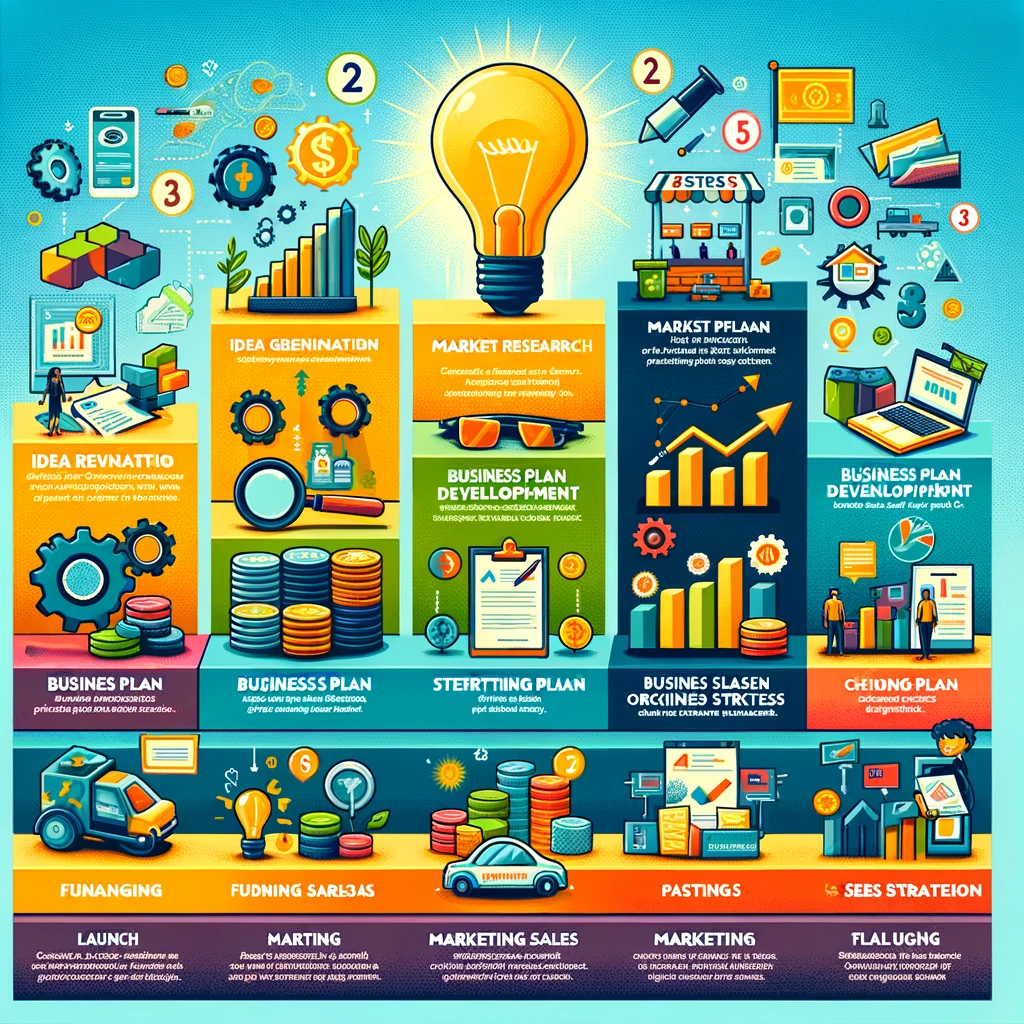
The startup process is not only a checklist. It is a sequence of decisions. The diagram below shows a clear path from idea discovery to growth measurement.
Complete Steps in the Process of Starting Up a Business
Identify the Problem and Business Idea
Every strong business begins with a real problem. A business idea is not just something a founder likes; it must solve a need that people understand and are willing to pay for. The first step is to write a clear problem statement. For example, instead of saying “I want to start an online tutoring company,” a sharper problem statement is: “Busy high school students need fast, affordable, and exam-specific tutoring support because traditional tutoring is expensive and difficult to schedule.”
A good idea should pass three early tests: the problem is specific, the audience is identifiable, and the customer has enough motivation to act. A weak idea is vague, broad, and based only on assumption. A strong startup idea is built around pain, urgency, and practical value.
- Define the problem in one sentence.
- Identify who has the problem.
- Explain why existing solutions are not enough.
- List the customer’s desired outcome.
- Describe how your solution creates a better result.
Conduct Market Research
Market research helps a founder understand customers, competitors, pricing, demand, and trends. It reduces guesswork. Before investing heavily, founders should collect evidence from real users, industry reports, keyword research, competitor websites, reviews, surveys, and interviews. The purpose is not to prove that the idea is perfect. The purpose is to discover whether the opportunity is real enough to continue.
Market research includes primary research and secondary research. Primary research means collecting new information directly from potential customers through interviews, surveys, polls, prototype testing, and observation. Secondary research means studying existing information such as government reports, market reports, competitor analysis, search data, social media discussions, and public databases.
Use the following opportunity formula as a planning model:
\[ \text{Opportunity Score} = \frac{\text{Problem Urgency} + \text{Market Size} + \text{Ability to Pay} + \text{Competitive Gap}}{4} \]
If the opportunity score is low, the founder should improve the idea before continuing. If it is high, the next step is to build a business plan and test the offer.
Define the Target Customer
A business cannot serve everyone at the beginning. A startup should begin with a narrow customer segment because marketing, product development, pricing, and support become easier when the audience is specific. A target customer profile should include demographic, geographic, behavioral, financial, and emotional details.
For a B2C business, define age group, location, income level, lifestyle, interests, problems, buying triggers, and objections. For a B2B business, define company size, industry, decision maker, budget, existing workflow, pain points, and purchase process.
| Customer Element | Questions to Answer | Example |
|---|---|---|
| Segment | Who exactly is the customer? | Parents of Grade 9–12 students preparing for international exams. |
| Pain Point | What problem do they face? | They need reliable exam practice and personalized feedback. |
| Budget | How much can they pay? | Monthly subscription or course package. |
| Decision Trigger | What makes them buy now? | Upcoming exam, poor mock test score, school pressure. |
| Objection | Why might they avoid buying? | Trust, price, lack of proof, unclear result. |
Validate the Business Idea
Validation means testing whether people want the solution before building a complete business. It is one of the most important startup steps because it protects the founder from wasting time and money. Validation can be done through landing pages, waitlists, pre-orders, surveys, interviews, prototype demos, pilot projects, and small paid tests.
A simple validation formula is:
\[ \text{Validation Rate} = \frac{\text{Number of Interested Prospects}}{\text{Number of People Reached}} \times 100 \]
If 100 people see your offer and 20 join the waitlist, the validation rate is \(20\%\). This does not guarantee success, but it is stronger than only asking friends for opinions. Paid validation is even stronger because payment shows commitment.
Founders should measure actions, not compliments. “This is a nice idea” is weak evidence. “I joined the waitlist,” “I booked a demo,” “I paid a deposit,” or “I referred someone” is stronger evidence.
Write the Business Plan
A business plan is a structured document that explains what the business will do, who it will serve, how it will make money, how it will operate, how it will compete, and how it will grow. The plan does not need to be complicated, but it must be clear enough to guide decisions and communicate the opportunity to partners, lenders, investors, or team members.
A strong business plan normally includes executive summary, problem statement, solution, market analysis, target customer, business model, pricing, marketing plan, operations plan, team, financial forecast, risk analysis, and milestones. For a small business, a lean one-page plan may be enough at the beginning. For funding, a deeper plan is usually required.
The business model should answer: who pays, what they pay for, how often they pay, how much it costs to deliver the product, and how profit is generated. Without this clarity, the startup may gain attention but still lose money.
Calculate Startup Costs and Funding Needs
Startup cost calculation is essential before launch. Many founders underestimate costs because they only think about product development and forget legal fees, licenses, website costs, branding, software, equipment, inventory, rent, marketing, insurance, accounting, and working capital. A realistic startup budget helps avoid cash shortages.
The basic formula is:
\[ \text{Total Startup Cost} = \text{One-Time Costs} + \text{Monthly Operating Costs} \times \text{Months of Runway} \]
For example, if one-time setup costs are \( \$5{,}000 \), monthly operating costs are \( \$2{,}000 \), and the founder wants 6 months of runway, then:
\[ \text{Total Startup Cost} = 5000 + 2000 \times 6 = 17000 \]
This means the founder should plan for approximately \( \$17{,}000 \) before launch or secure enough funding to cover this requirement.
Choose the Business Structure
The business structure affects ownership, taxes, liability, decision-making, compliance, and fundraising. Common structures include sole proprietorship, partnership, limited liability company, private limited company, corporation, and nonprofit entity. The correct structure depends on the country, risk level, number of owners, funding plan, and long-term goals.
| Structure | Best For | Main Advantage | Main Limitation |
|---|---|---|---|
| Sole Proprietorship | Solo small business, freelancer, low-risk activity | Simple and low cost | Owner may have personal liability |
| Partnership | Two or more founders | Shared resources and responsibilities | Disputes and liability issues must be managed |
| LLC / Limited Liability Entity | Small to medium businesses seeking liability separation | Liability protection with flexible management | More compliance than sole proprietorship |
| Private Limited Company | Scalable businesses, startups, fundraising plans | Separate legal identity and investment readiness | More reporting and governance requirements |
| Corporation | High-growth companies and larger organizations | Strong fundraising and ownership structure | Higher complexity and formal compliance |
Do not choose a structure only because it looks professional. Choose it based on risk, tax, fundraising, control, and compliance needs.
Choose the Business Name and Brand Identity
A business name should be memorable, legally available, easy to pronounce, relevant to the offer, and usable online. Before finalizing a name, check domain availability, trademark conflicts, social media handles, local business registry rules, and customer clarity. A clever name is not useful if customers cannot remember it or if it creates legal problems.
Brand identity includes name, logo, colors, tone of voice, tagline, promise, and visual style. At the startup stage, branding does not need to be expensive, but it must be consistent. Customers should quickly understand what the business does, who it helps, and why it is different.
Register the Business and Complete Legal Setup
Registration gives the business a formal identity. Depending on location and structure, this may include registering a business name, forming a company, obtaining a tax identification number, applying for business licenses, registering for sales tax or VAT/GST, setting up employer accounts, and creating required legal documents.
Common legal setup tasks include founder agreements, partnership agreements, shareholder agreements, terms and conditions, privacy policy, refund policy, employment contracts, supplier contracts, and customer agreements. A founder should not copy legal templates blindly. Templates can help, but important legal documents should match the business model and jurisdiction.
Set Up Business Banking, Accounting, and Financial Controls
Separating business and personal money is a professional requirement. A business bank account helps with accounting, tax records, investor confidence, and financial discipline. The founder should also set up bookkeeping software, invoice templates, expense categories, payment gateways, payroll systems if needed, and monthly financial reporting.
Important financial metrics include revenue, gross profit, net profit, cash runway, customer acquisition cost, customer lifetime value, contribution margin, break-even point, and monthly burn rate. These metrics help the founder manage decisions based on numbers instead of emotion.
\[ \text{Cash Runway} = \frac{\text{Available Cash}}{\text{Monthly Burn Rate}} \]
If a startup has \( \$30{,}000 \) cash and spends \( \$5{,}000 \) per month, the runway is \(6\) months.
Build the Product, Service, or Minimum Viable Offer
A minimum viable product or minimum viable offer is the simplest version of the solution that can create value for early customers. It should not include every dream feature. It should solve the main problem clearly enough for customers to use, pay, test, or give meaningful feedback.
For a physical product, this could be a small batch. For software, it could be a core feature set. For consulting, it could be a pilot project. For an education business, it could be one course, one tutoring package, or one practice test system. The goal is to learn quickly and improve based on real market behavior.
Create the Marketing and Sales Plan
A marketing plan explains how customers will discover the business. A sales plan explains how interest becomes revenue. Startups need both. Marketing channels may include SEO, social media, paid ads, referrals, partnerships, email marketing, local networking, influencer campaigns, marketplaces, webinars, and direct outreach.
A practical startup marketing plan should define the offer, audience, message, proof, channel, budget, content plan, conversion path, and follow-up system. A founder should not use every marketing channel at once. It is better to test two or three channels properly and measure results.
The customer acquisition cost formula is:
\[ \text{CAC} = \frac{\text{Total Sales and Marketing Cost}}{\text{Number of New Customers Acquired}} \]
If a campaign costs \( \$1{,}000 \) and brings 50 customers, CAC is \( \$20 \) per customer.
Prepare Operations and Customer Support
Operations are the systems that keep the business running. This includes suppliers, inventory, delivery, software tools, customer support, quality control, refunds, data security, scheduling, documentation, and team responsibilities. A good business is not only good at selling; it is also good at delivering consistently.
Before launch, write simple operating procedures. For example: how to handle new orders, how to reply to customer questions, how to process refunds, how to store customer data, how to track expenses, how to manage complaints, and how to measure customer satisfaction.
Launch the Business
A business launch is not just posting “we are live.” A strong launch has a clear offer, landing page, payment method, customer support process, launch announcement, email sequence, social content, referral push, early buyer incentive, and feedback collection system. The first launch should be treated as a learning event.
Launch goals may include first 10 customers, first 100 leads, first 1,000 website visitors, first 20 consultations, first 50 product sales, or first paid pilot. The goal should be measurable and realistic.
Measure, Improve, and Scale
After launch, the founder must measure what is working. Key questions include: Which channel brought the best leads? Which product feature was used most? Which price created the highest conversion? What did customers complain about? What prevented people from buying? What can be automated? What can be removed?
Growth should happen after the business has evidence. Scaling too early can increase losses. A startup is ready to scale when the offer is validated, customer acquisition is measurable, delivery is reliable, unit economics are healthy, and cash flow is controlled.
\[ \text{Gross Profit Margin} = \frac{\text{Revenue} - \text{Cost of Goods Sold}}{\text{Revenue}} \times 100 \]
A healthy margin gives the business space to pay for marketing, salaries, software, taxes, and reinvestment.
Startup Calculators
Use these simple tools to estimate startup cost, break-even point, and runway. These are educational planning tools, not financial advice.
Startup Cost Calculator
\[ C_s = C_o + (C_m \times R) \]
Break-Even Calculator
\[ Q = \frac{F}{P - V} \]
Cash Runway Calculator
\[ R_c = \frac{A}{B} \]
Startup Readiness Scorecard
This scorecard replaces exam-style scoring for this business topic. Use it to evaluate whether your startup is ready for launch.
| Score Range | Readiness Level | Meaning | Recommended Action |
|---|---|---|---|
| 0–30 | Idea Stage | The concept is not ready for launch. | Research customers, refine problem, and validate demand. |
| 31–55 | Planning Stage | The idea has potential but lacks enough evidence. | Build a lean business plan and test the offer. |
| 56–75 | Pre-Launch Stage | Core pieces are ready but risk remains. | Finalize legal, finance, operations, and marketing systems. |
| 76–90 | Launch Ready | The business can launch with controlled risk. | Start selling, track metrics, and improve quickly. |
| 91–100 | Scale Ready | The business has strong evidence and systems. | Increase marketing, hire carefully, and optimize operations. |
Calculate Your Readiness Score
Score Formula
The score is based on five major launch factors:
\[ \text{Readiness Score} = R_m + R_v + R_p + R_f + R_l \]
- \(R_m\) = market research score
- \(R_v\) = validation score
- \(R_p\) = planning score
- \(R_f\) = financial readiness score
- \(R_l\) = legal readiness score
The maximum score is \(100\). A score above \(76\) means the startup is likely ready for a controlled launch, but the founder should still check legal, tax, and industry-specific requirements.
Suggested Startup Timeline
There is no universal exam timetable for starting a business. Instead, use a practical startup execution timetable. The timeline below is suitable for many small businesses, online businesses, education businesses, service businesses, and early-stage startups.
| Phase | Timeframe | Main Work | Output |
|---|---|---|---|
| Phase 1 | Week 1 | Problem discovery, customer profile, competitor scan | Clear business idea and target audience |
| Phase 2 | Week 2 | Market research, interviews, survey, pricing assumptions | Evidence of demand |
| Phase 3 | Week 3 | Business model, cost estimate, revenue model, break-even calculation | Lean business plan |
| Phase 4 | Week 4 | Name, brand, structure, registration research, compliance checklist | Legal and brand setup plan |
| Phase 5 | Weeks 5–6 | MVP or service package, website, payment, support process | Launch-ready offer |
| Phase 6 | Week 7 | Marketing assets, launch content, email list, early outreach | Launch campaign |
| Phase 7 | Week 8 | Launch, sales tracking, customer feedback, improvements | First customers and learning data |
| Phase 8 | Weeks 9–12 | Optimize pricing, marketing, operations, and customer retention | Growth plan |
Interactive Business Startup Checklist
Tick each completed task. The progress bar helps you stay focused and avoid jumping into too many tasks at once.
0% completed
Complete Course Notes: Starting Up a Business
1. Why Business Startups Need a Process
Starting a business is exciting, but excitement alone is not a strategy. A process gives the founder direction. It helps answer what to do first, what to delay, what to test, and what to measure. Without a process, the founder may spend money on branding before confirming demand, build a product before understanding the customer, or register a company before knowing whether the idea has real commercial value.
A professional startup process also helps manage risk. Business risk comes from many areas: market risk, financial risk, legal risk, operational risk, team risk, technology risk, and reputation risk. The goal is not to remove all risk. The goal is to identify the most dangerous assumptions early and test them before large investment.
2. Business Idea vs Business Opportunity
A business idea is a possible product, service, platform, shop, app, agency, tool, or solution. A business opportunity is stronger. It means the idea is connected to a real market need, a clear customer group, a possible revenue model, and a competitive gap. Many people have ideas, but fewer people shape those ideas into opportunities.
For example, “create a fitness app” is an idea. “Create a vegetarian meal and fitness planning app for busy Indian professionals who want simple home-based diet and exercise guidance” is closer to an opportunity because it defines the audience, need, and positioning. The more specific the opportunity, the easier it becomes to design, price, market, and sell.
3. Market Size: TAM, SAM, and SOM
Founders often say their market is huge. But a huge market is not useful unless the founder knows which part of the market they can realistically serve. Three useful terms are TAM, SAM, and SOM.
\[ \text{TAM} = \text{Total Addressable Market} \]
\[ \text{SAM} = \text{Serviceable Available Market} \]
\[ \text{SOM} = \text{Serviceable Obtainable Market} \]
TAM is the total demand if the business could serve everyone. SAM is the part of the market the business can serve with its model, geography, language, pricing, and capabilities. SOM is the realistic share the business can win in the near term. A startup should focus more on SOM at the beginning because realistic execution matters more than impressive market size.
4. Competitive Analysis
Competitor analysis is not about copying competitors. It is about understanding what already exists, where customers are satisfied, where they are frustrated, how prices are structured, what features are expected, and where the founder can differentiate. A competitor can be direct or indirect. A direct competitor sells a similar solution. An indirect competitor solves the same problem in a different way.
Good competitor research includes product features, pricing, customer reviews, website messaging, social media activity, SEO visibility, sales process, guarantee, customer support, and brand positioning. Customer reviews are especially useful because they reveal what people love and hate about existing solutions.
5. Value Proposition
The value proposition is the promise of value. It tells customers why they should choose this business instead of alternatives. A strong value proposition is specific, outcome-based, and easy to understand. Weak value propositions use vague words such as “best,” “premium,” “innovative,” and “high quality” without explaining the actual benefit.
A practical value proposition formula is:
\[ \text{Value Proposition} = \text{Target Customer} + \text{Problem} + \text{Solution} + \text{Measurable Benefit} \]
Example: “We help small online sellers reduce manual order tracking by using a simple dashboard that connects orders, inventory, and customer messages in one place.” This is stronger than saying “We provide business software.”
6. Revenue Model
The revenue model explains how the business earns money. Common revenue models include one-time product sales, subscriptions, service fees, commissions, advertising, licensing, freemium upgrades, consulting retainers, marketplace fees, transaction fees, and affiliate income. The best model depends on customer behavior, purchase frequency, value delivered, and cost structure.
A startup should avoid choosing a revenue model only because it is popular. Subscription models are attractive, but customers will only subscribe if the product provides continuous value. A one-time product may be better for some markets. A service retainer may be better for consulting or agency businesses. A marketplace model may be powerful but usually requires solving supply and demand at the same time.
7. Pricing Strategy
Pricing is one of the most important startup decisions. If the price is too low, the business may attract customers but fail to make profit. If the price is too high without proof of value, customers may not buy. Pricing should consider cost, competitor prices, customer willingness to pay, value delivered, brand position, and long-term margin.
The contribution margin formula is:
\[ \text{Contribution Margin} = \text{Price Per Unit} - \text{Variable Cost Per Unit} \]
The contribution margin must be high enough to cover fixed costs and create profit. If a product sells for \( \$100 \) and variable cost is \( \$40 \), contribution margin is \( \$60 \). If fixed costs are \( \$3{,}000 \), the business must sell \(50\) units to break even because \(3000 \div 60 = 50\).
8. Funding Options
Funding means finding the money needed to start and operate the business. Common funding sources include personal savings, family support, loans, grants, angel investors, venture capital, crowdfunding, revenue-based financing, customer prepayments, and bootstrapping. Each option has advantages and trade-offs.
Bootstrapping gives control but may slow growth. Loans preserve ownership but require repayment. Investors bring capital and sometimes expertise, but they usually require ownership or return expectations. Grants are attractive but competitive and often have rules. Pre-orders can validate demand and provide working capital, but they create delivery responsibility.
9. Legal and Compliance Planning
Legal and compliance planning protects the founder, customers, team, and business. The required steps depend on location and industry. A food business, healthcare business, finance business, education business, and software business may all face different rules. Legal setup may involve business registration, permits, tax registration, data protection, employment law, intellectual property, consumer protection, and contracts.
Ignoring compliance may look faster at the start, but it can create serious future problems. A business should keep records, maintain contracts, protect customer data, respect intellectual property, and follow industry-specific regulations.
10. Building the MVP
The minimum viable product should be small but useful. It must solve the core problem. A common mistake is building too many features before testing the main promise. The MVP should help the founder answer: Will people use this? Will they pay? What do they value most? What confuses them? What must be improved?
An MVP is not an excuse for poor quality. It can be simple, but it should be reliable enough to test the business assumption. A broken product may produce false negative results because customers may reject the execution rather than the idea.
11. Marketing Before Launch
Marketing should begin before launch. A founder can share educational content, collect emails, publish behind-the-scenes updates, build a waitlist, run surveys, test ads, create founder stories, and connect with early adopters. Pre-launch marketing gives the business a starting audience.
For online businesses, useful channels include SEO content, social media posts, newsletters, short videos, community engagement, and partnerships. For local businesses, useful channels include Google Business Profile, local directories, community groups, local influencers, flyers, partnerships, and referral incentives.
12. Launch Metrics
A launch should be measured. Important launch metrics include website visitors, conversion rate, leads, sales, cost per lead, customer acquisition cost, refund rate, customer satisfaction, support tickets, repeat purchases, and average order value.
\[ \text{Conversion Rate} = \frac{\text{Number of Conversions}}{\text{Number of Visitors}} \times 100 \]
If 1,000 visitors produce 50 purchases, conversion rate is \(5\%\). The founder can then improve the landing page, offer, proof, pricing, checkout process, or follow-up system.
13. Common Mistakes When Starting a Business
- Starting with a vague idea instead of a specific problem.
- Skipping customer interviews and market research.
- Building a full product before validating demand.
- Choosing a business structure without understanding liability and tax impact.
- Underestimating startup costs and monthly burn rate.
- Using personal bank accounts for business transactions.
- Ignoring contracts, licenses, and data protection requirements.
- Trying too many marketing channels at once.
- Pricing too low and creating an unsustainable business.
- Scaling before the offer, operations, and unit economics are proven.
14. Best Practices for First-Time Founders
First-time founders should keep the first version focused. Choose one customer segment, one core problem, one main offer, one primary marketing channel, and one measurable launch goal. Focus reduces confusion. A founder who tries to build five products, target ten audiences, and use every marketing channel will usually move slower.
Build a weekly review habit. Every week, review leads, sales, costs, customer feedback, product issues, and next actions. This turns the business into a learning system. Consistent improvement is more powerful than random motivation.
Frequently Asked Questions
What is the first step in starting up a business?
The first step is identifying a real problem and a specific target customer. A business should not begin with only a product idea. It should begin with a customer need that is clear, urgent, and valuable enough for people to take action.
Do I need a business plan before starting?
Yes, but it does not always need to be a long document. A lean business plan can be enough at the beginning. It should explain the problem, customer, solution, revenue model, startup costs, marketing plan, and launch milestones.
How much money do I need to start a business?
The amount depends on the type of business, location, product, legal requirements, and monthly expenses. Use the formula: total startup cost equals one-time costs plus monthly operating costs multiplied by desired runway months.
What is a break-even point?
The break-even point is the sales level where total revenue equals total costs. At break-even, the business is not making profit or loss. It is calculated by dividing fixed costs by price per unit minus variable cost per unit.
Which business structure should I choose?
The best structure depends on liability risk, taxes, ownership, funding plans, and compliance requirements. Common structures include sole proprietorship, partnership, LLC or limited liability entity, private limited company, and corporation. Consult local official guidance or a professional before deciding.
When should I register my business?
You should register when you are ready to operate formally, accept payments, sign contracts, apply for licenses, hire employees, or separate business finances. However, research and validation can often begin before full registration, depending on local rules.
What is the difference between an idea and a startup?
An idea is a concept. A startup is an organized attempt to solve a problem through a product or service, supported by research, validation, business model, legal setup, operations, and customer acquisition.
How long does it take to start a business?
Some simple service businesses can launch in days or weeks. More complex businesses may require months because of product development, licensing, funding, hiring, and compliance. A practical early-stage timeline is 8 to 12 weeks for research, planning, setup, and first launch.