
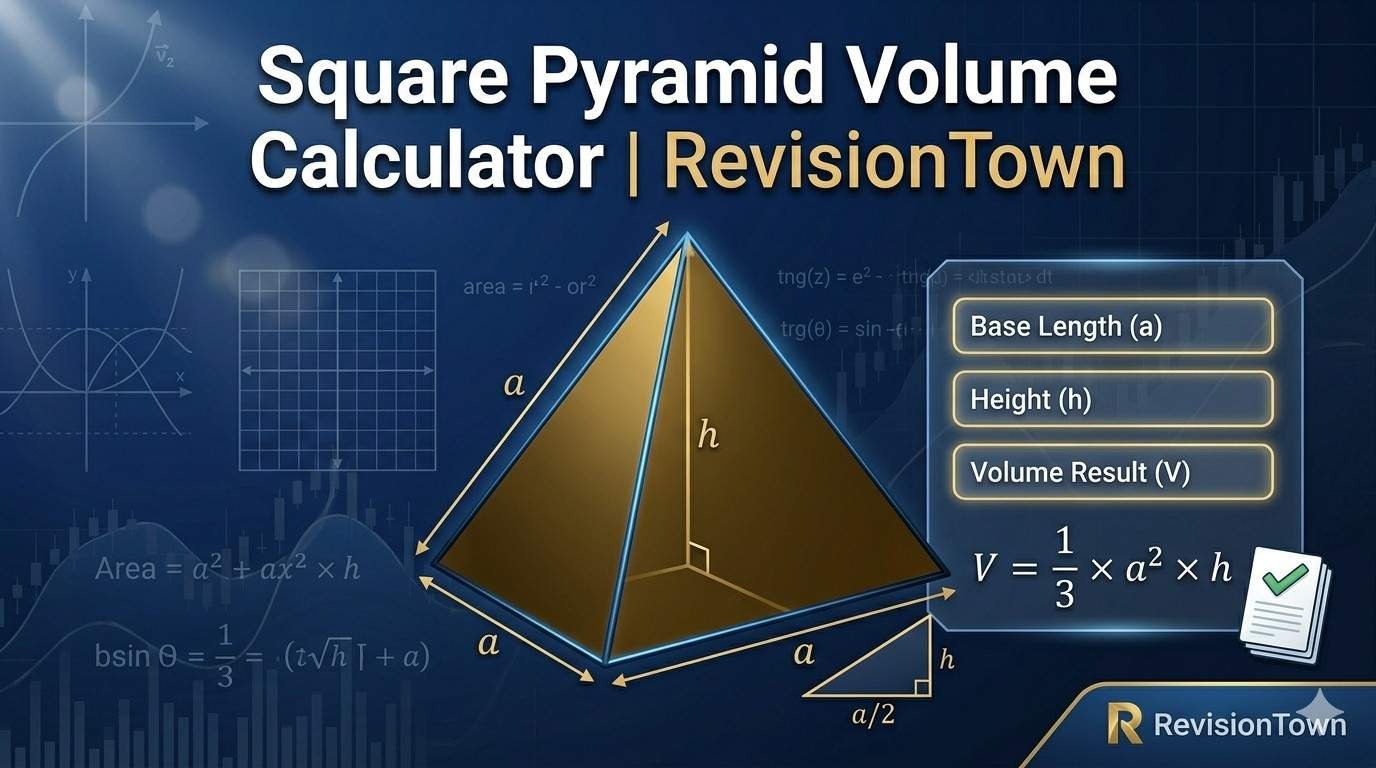
🔷 Square Pyramid Volume Calculator
📚 Complete Guide to Square Pyramid Volume Calculations
What is a Square Pyramid? Definition and Geometry
A square pyramid is a three-dimensional polyhedron with a square base and four triangular faces that meet at a single apex point. Key geometric characteristics: (1) The base is a perfect square with all four sides equal length (s); (2) All four triangular faces are congruent isosceles triangles; (3) The height (h) is the perpendicular distance from the center of the base to the apex; (4) The pyramid has five faces total (one square base + four triangles); (5) The pyramid has eight edges and five vertices. Square pyramids appear extensively in architecture (Egyptian pyramids, decorative roof elements), engineering (structural components, containers), packaging design, and mathematics education. Understanding pyramid geometry is fundamental to many practical applications and advanced mathematical concepts.
Mathematical Formulas for Square Pyramid Calculations
| Property | Formula | Explanation |
|---|---|---|
| Pyramid Volume | V = (1/3)s²h | Main volume formula using base area and height |
| Base Area | A_base = s² | Area of square base |
| Slant Height | l = √(h² + (s/2)²) | Distance from apex to midpoint of base edge |
| Lateral Surface Area | A_lateral = 2sl | Area of four triangular faces |
| Total Surface Area | SA = s² + 2sl | Base plus all four triangular faces |
| Lateral Edge | e = √(h² + (s√2/2)²) | Distance from apex to base corner |
| Relation to Prism | V_pyramid = (1/3)V_prism | Pyramid volume is 1/3 of prism with same base |
Understanding the Square Pyramid Volume Formula
The formula V = (1/3)s²h elegantly expresses how square pyramid volume depends on two parameters: the base side length (s) and the height (h). Breaking down the formula: (1) The term s² represents the square base area; (2) The factor 1/3 is fundamental to pyramid geometry—it shows that a pyramid with identical base and height to a prism has exactly 1/3 the volume; (3) The height h represents the perpendicular distance from base center to apex; (4) For example, with s = 10 cm and h = 12 cm: V = (1/3) × 100 × 12 = 400 cm³. This formula derives from calculus integration of horizontal square cross-sections, each decreasing in area linearly with distance from the base. The 1/3 factor is a universal constant for all pyramid volumes, regardless of base shape.
Calculating Slant Height and Understanding Pyramid Dimensions
Slant height (l) is the distance from the apex to the midpoint of a base edge, measured along the triangular face surface. Calculate using the Pythagorean theorem: l = √(h² + (s/2)²), where h is height and s/2 is the distance from base center to edge midpoint. Example: h = 12 cm, s = 10 cm: l = √(144 + 25) = √169 = 13 cm. Slant height is crucial for calculating lateral surface area and understanding pyramid geometry. Each triangular face has base s and height l, giving area (1/2)sl per face. Slant height represents the altitude of the triangular faces and determines the pyramid's surface characteristics.
Surface Area Calculations and Applications
The total surface area of a square pyramid combines the base area and lateral (side) area: SA = s² + 2sl, where s is base side length and l is slant height. The base area is s² (square), and the four triangular faces have combined area 2sl. Example: s = 10 cm, l = 13 cm: SA = 100 + 2(10)(13) = 100 + 260 = 360 cm². Surface area calculations are essential for: (1) Determining material requirements for covering or painting; (2) Heat transfer and thermal analysis; (3) Manufacturing cost estimation; (4) Architectural planning and material selection; (5) Structural design and optimization. Understanding both volume and surface area enables comprehensive pyramid analysis.
Real-World Applications and Practical Uses
Architecture and Construction: Designing pyramid-shaped buildings, roofs, monuments, and decorative structures. Calculating interior space and material requirements. Engineering Design: Creating pyramid-shaped components, containers, funnels, and structural elements. Packaging and Manufacturing: Designing pyramidal boxes, containers, and product packaging. Optimizing material usage and production efficiency. Surveying and Land Measurement: Analyzing pyramid-shaped geological formations and topographic features. Mathematics Education: Teaching geometry, volume calculations, and three-dimensional spatial reasoning. Astronomy and Physics: Studying pyramid-shaped celestial objects and structures. Historical Research: Analyzing Egyptian pyramids and ancient structures. Game and 3D Design: Creating pyramid-shaped models and game elements. Agricultural Applications: Designing pyramidal storage structures and crop arrangements.
Why Choose RevisionTown's Square Pyramid Volume Calculator?
Our advanced calculator provides comprehensive, accurate calculations by: (1) Implementing precise mathematical formulas with high-precision computations; (2) Supporting multiple units (mm, cm, m, km, inches, feet) with automatic conversions; (3) Validating input constraints to prevent geometric impossibilities; (4) Displaying results in multiple formats for maximum usefulness; (5) Providing detailed geometric analysis and comparative metrics; (6) Showing all formulas with step-by-step calculations; (7) Offering three calculation modes (basic volume, with slant height, complete analysis); (8) Including comprehensive educational content and FAQs. Whether you're an architect designing buildings, an engineer creating components, a student learning geometry, or a professional solving real-world problems, RevisionTown provides the tools and knowledge for accurate square pyramid calculations.
❓ Frequently Asked Questions - Square Pyramid Volume
The fundamental square pyramid volume formula is V = (1/3)s²h, where V is volume, s is the base side length, and h is the height (perpendicular distance from base center to apex). This formula shows that volume increases with the square of base side length and linearly with height. For example, with s = 10 cm and h = 12 cm: V = (1/3) × 100 × 12 = 400 cm³. The factor 1/3 is universal for all pyramids—it shows that pyramid volume is exactly 1/3 of a prism with identical base and height. This relationship comes from calculus integration of horizontal cross-sections.
Slant height (l) is the distance from the apex to the midpoint of a base edge, measured along the triangular face surface. Calculate using: l = √(h² + (s/2)²), where h is pyramid height and s is base side length. Example: h = 12 cm, s = 10 cm: l = √(144 + 25) = √169 = 13 cm. Slant height is crucial for: (1) Calculating lateral surface area using A = 2sl; (2) Understanding pyramid geometry and proportions; (3) Determining the actual distance along the sloped face; (4) Architectural and structural design. Slant height represents the altitude of each triangular face.
The total surface area combines the square base and four triangular faces: SA = s² + 2sl, where s is base side length and l is slant height. The base area is s², and each triangular face has area (1/2)sl. Example: s = 10 cm, l = 13 cm: SA = 100 + 2(10)(13) = 360 cm². The lateral area alone is 2sl = 260 cm². These formulas are essential for: (1) Determining material requirements for painting, coating, or covering; (2) Heat transfer and thermal calculations; (3) Manufacturing cost estimation; (4) Architectural planning and design optimization.
A pyramid with identical base and height to a prism has exactly 1/3 the volume of the prism. This fundamental relationship comes from calculus integration. For a square base: Prism volume = s²h, while Pyramid volume = (1/3)s²h. The factor of 1/3 shows that three identical pyramids can fit inside one prism of the same base and height. Example: prism with s = 10 cm, h = 12 cm has volume 1200 cm³, while pyramid with same dimensions has volume 400 cm³ (exactly 1/3). This relationship validates the pyramid formula and provides geometric intuition.
From base side length (s) and height (h), the calculator computes: (1) Base area: A = s²; (2) Pyramid volume: V = (1/3)s²h; (3) Slant height: l = √(h² + (s/2)²); (4) Lateral surface area: A_lateral = 2sl; (5) Total surface area: SA = s² + 2sl; (6) Lateral edge (apex to corner): e = √(h² + (s√2/2)²); (7) Base diagonal; (8) Volume-to-surface ratio. These comprehensive calculations provide complete geometric analysis.
Square pyramid geometry must satisfy: (1) Base side length must be positive: s > 0; (2) Height must be positive: h > 0; (3) Both measurements must be real numbers; (4) Slant height must satisfy: l ≥ s/2 (equality occurs only with zero height). These constraints ensure valid geometry. When h = 0, the pyramid degenerates to a flat square. The calculator automatically validates these constraints and prevents invalid inputs.
Square pyramid volume calculations have extensive applications: (1) Architecture—monument design, roof elements, decorative structures; (2) Engineering—component production, container design; (3) Packaging—pyramidal box and container design; (4) Construction—volume estimation, material planning; (5) Surveying—pyramid-shaped terrain analysis; (6) Manufacturing—cost estimation, material optimization; (7) Education—geometry and volume teaching; (8) Historical research—Egyptian pyramid analysis; (9) Game design—3D model calculations; (10) Astronomy—theoretical pyramid-shaped structures. Understanding pyramid volumes is essential across diverse professional fields.
The calculator automatically converts between unit systems: (1) Metric: millimeters (mm), centimeters (cm), meters (m), kilometers (km); (2) Imperial: inches (inch), feet (ft). Conversion factors: 1 cm = 10 mm, 1 m = 100 cm, 1 km = 1000 m, 1 inch = 2.54 cm, 1 ft = 12 inches. Volume units scale by the cube of linear conversions. For example: 1 cm³ = 1000 mm³, 1 m³ = 1,000,000 cm³. The calculator handles all conversions automatically, displaying results in both input and converted units for convenience.