📡 mW to dBm Converter
Professional Milliwatts to dBm Calculator | RF Power Conversion Tool
📡 Common RF Power Levels
📚 Complete Guide to mW and dBm Conversion
Understanding Milliwatts and dBm
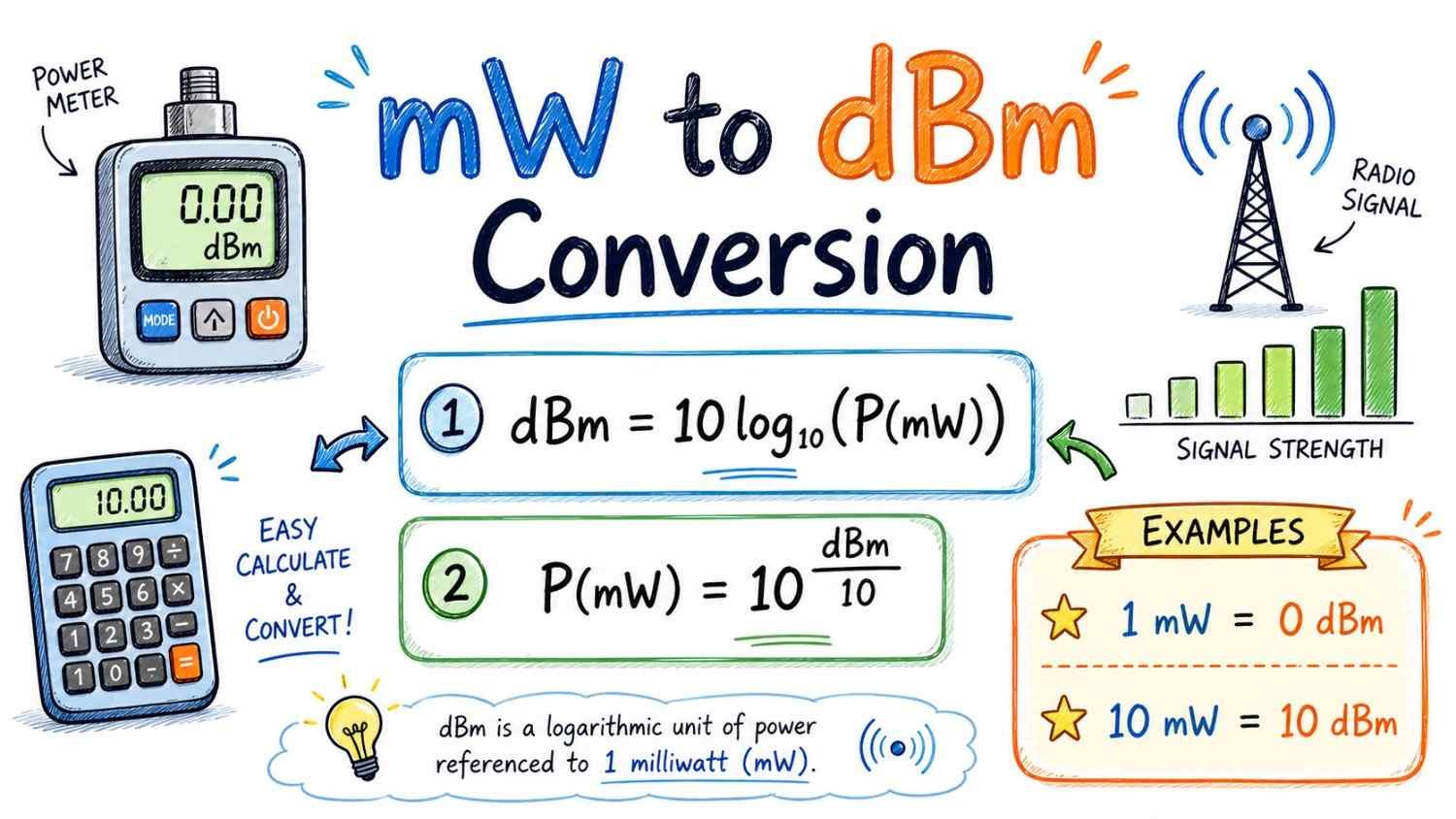
Milliwatts (mW) and dBm (decibel-milliwatts) both measure RF power but use fundamentally different scales. Milliwatts (mW) represent absolute power in linear scale—straightforward multiplication applies: 2 mW is twice 1 mW; 10 mW is ten times 1 mW. Used for direct power measurements in laboratory instruments, power supplies, and engineering calculations. dBm (decibel-milliwatts) represents power in logarithmic scale referenced to 1 milliwatt. Definition: \( \text{dBm} = 10 \times \log_{10}(P_{\text{mW}}) \), where \( P_{\text{mW}} \) is power in milliwatts. Key reference: 0 dBm = 1 mW (the anchor point). Positive dBm indicates power greater than 1 mW; negative dBm indicates power less than 1 mW. Logarithmic scale compresses enormous power ranges into manageable numbers: -30 to +30 dBm spans 0.001 to 1,000 mW—six orders of magnitude (million-fold range) represented in just 60 dB. This compression enables RF engineers to work with readable numbers instead of exponential notation (0.000001 mW = -60 dBm vs 1×10⁻⁶ mW). Advantages of dBm: Simple addition/subtraction for gain/loss calculations (+3 dBm gain doubles power; -3 dBm loss halves power); system cascade analysis (amplifier +20 dBm output + cable -2 dBm loss = +18 dBm received); standardized RF engineering units across telecommunications, wireless systems, and antenna design. Understanding both scales enables RF engineers to specify transmitter power (100 mW = +20 dBm), calculate link budgets (add dB gains/losses), measure receiver sensitivity (-90 dBm = 0.000000001 mW = 1 picowatt), and comply with regulatory limits (FCC Part 15: WiFi 2.4 GHz max +30 dBm = 1 W EIRP with 6 dBi antenna).
Conversion Formulas
Milliwatts to dBm (Logarithmic Conversion): \( \text{dBm} = 10 \times \log_{10}(P_{\text{mW}}) \). Take base-10 logarithm of milliwatts, multiply by 10. Examples with step-by-step calculation: 0.001 mW: log₁₀(0.001) = log₁₀(10⁻³) = -3; -3 × 10 = -30 dBm (very weak signal, near noise floor); 0.01 mW: log₁₀(0.01) = -2; -2 × 10 = -20 dBm (Bluetooth receive sensitivity); 0.1 mW: log₁₀(0.1) = -1; -1 × 10 = -10 dBm (weak WiFi signal); 1 mW: log₁₀(1) = 0; 0 × 10 = 0 dBm (reference level—critical anchor point); 2 mW: log₁₀(2) = 0.301; 0.301 × 10 = +3.01 dBm (approximately +3 dBm, double the reference); 5 mW: log₁₀(5) = 0.699; +6.99 dBm ≈ +7 dBm; 10 mW: log₁₀(10) = 1; 1 × 10 = +10 dBm (Bluetooth Low Energy max transmission); 20 mW: log₁₀(20) = 1.301; +13.01 dBm ≈ +13 dBm (typical WiFi 802.11b/g); 50 mW: log₁₀(50) = 1.699; +16.99 dBm ≈ +17 dBm; 100 mW: log₁₀(100) = 2; 2 × 10 = +20 dBm (WiFi 2.4 GHz US FCC limit point-to-multipoint); 200 mW: log₁₀(200) = 2.301; +23.01 dBm ≈ +23 dBm; 500 mW: log₁₀(500) = 2.699; +26.99 dBm ≈ +27 dBm (WiFi 5 GHz with restrictions); 1,000 mW (1 W): log₁₀(1000) = 3; 3 × 10 = +30 dBm (CB radio handheld, amateur HT, WiFi max with proper antenna). dBm to Milliwatts (Exponential Conversion): \( P_{\text{mW}} = 10^{(\text{dBm}/10)} \). Divide dBm by 10, raise 10 to that power. Examples: -30 dBm: 10^(-30/10) = 10^(-3) = 0.001 mW; -20 dBm: 10^(-2) = 0.01 mW; -10 dBm: 10^(-1) = 0.1 mW; 0 dBm: 10^0 = 1 mW (reference); +3 dBm: 10^(0.3) = 1.995 ≈ 2 mW (double power); +6 dBm: 10^(0.6) = 3.98 ≈ 4 mW (quadruple); +10 dBm: 10^1 = 10 mW; +13 dBm: 10^1.3 = 19.95 ≈ 20 mW; +17 dBm: 10^1.7 = 50.1 ≈ 50 mW; +20 dBm: 10^2 = 100 mW; +23 dBm: 10^2.3 = 199.5 ≈ 200 mW; +27 dBm: 10^2.7 = 501 ≈ 500 mW; +30 dBm: 10^3 = 1,000 mW = 1 W. Key dBm Rules: +3 dBm = double power (2×); -3 dBm = half power (0.5×); +10 dBm = 10× power; -10 dBm = 0.1× power (1/10); +20 dBm = 100× power; -20 dBm = 0.01× power (1/100). These logarithmic conversions enable RF engineers to design link budgets (transmit +20 dBm + antenna +6 dBi - cable -2 dB - free-space -80 dB + receiver antenna +3 dBi = -53 dBm received vs -90 dBm sensitivity: 37 dB fade margin), specify equipment (transmitter output, receiver sensitivity), and ensure regulatory compliance (FCC/ETSI limits in dBm or EIRP).
RF Power Level Reference Table
| dBm | Milliwatts (mW) | Watts (W) | Typical Application |
|---|---|---|---|
| -60 dBm | 0.000001 mW (1 pW) | 10⁻⁹ W | Ultra-weak signal, near thermal noise |
| -50 dBm | 0.00001 mW (10 pW) | 10⁻⁸ W | GPS satellite signal at Earth |
| -40 dBm | 0.0001 mW (0.1 nW) | 10⁻⁷ W | Deep space probe signals |
| -30 dBm | 0.001 mW (1 μW) | 10⁻⁶ W | Weak cellular signal, noise floor |
| -20 dBm | 0.01 mW (10 μW) | 10⁻⁵ W | Bluetooth receive sensitivity, RFID |
| -10 dBm | 0.1 mW (100 μW) | 10⁻⁴ W | Weak WiFi, distant cellular tower |
| 0 dBm | 1 mW | 0.001 W | Reference level, optical transceiver |
| +3 dBm | 2 mW | 0.002 W | Double reference power |
| +6 dBm | 4 mW | 0.004 W | Quadruple reference (2× voltage) |
| +10 dBm | 10 mW | 0.01 W | Bluetooth Low Energy max, ZigBee |
| +13 dBm | 20 mW | 0.02 W | WiFi 802.11b/g typical transmission |
| +17 dBm | 50 mW | 0.05 W | LoRa gateway, WiFi client device |
| +20 dBm | 100 mW | 0.1 W | WiFi 2.4 GHz FCC limit (point-to-multipoint) |
| +23 dBm | 200 mW | 0.2 W | WiFi 5 GHz, cellular modem peak |
| +27 dBm | 500 mW | 0.5 W | WiFi 5 GHz UNII-3 band maximum |
| +30 dBm | 1,000 mW (1 W) | 1 W | CB radio, amateur HT, WiFi max EIRP |
| +33 dBm | 2,000 mW (2 W) | 2 W | Amateur radio mobile, FRS radio |
| +40 dBm | 10,000 mW (10 W) | 10 W | Amateur radio HF, commercial base station |
RF Link Budget Calculations
dBm enables straightforward RF link budget analysis through logarithmic addition/subtraction. Basic Link Budget Formula: Received Power (dBm) = Transmit Power (dBm) + Transmit Antenna Gain (dBi) - Transmit Cable Loss (dB) - Free Space Path Loss (dB) + Receive Antenna Gain (dBi) - Receive Cable Loss (dB). All values in decibels add/subtract algebraically. Example: WiFi 2.4 GHz Link Budget (100m indoor). Transmitter: Output power +20 dBm (100 mW WiFi router); Antenna gain +2 dBi (dipole); Cable loss -1 dB (short coaxial run). EIRP: +20 +2 -1 = +21 dBm equivalent isotropic radiated power. Path loss at 2.4 GHz, 100m indoor: Free space loss FSPL = 20×log₁₀(distance_m) + 20×log₁₀(frequency_MHz) + 32.45 = 20×log₁₀(100) + 20×log₁₀(2400) + 32.45 = 40 + 67.6 + 32.45 = 140 dB theoretical. Add wall/obstruction losses: -10 to -30 dB depending on construction. Total path loss: -70 dB (indoor typical with obstructions). Receiver: Antenna gain +2 dBi; Cable loss -0.5 dB; Receive gain: +2 -0.5 = +1.5 dB. Received signal strength: +21 EIRP -70 path loss +1.5 receiver = -47.5 dBm. WiFi sensitivity typically -80 to -90 dBm for minimum data rate (1-6 Mbps 802.11g). Fade margin: -47.5 received - (-80 sensitivity) = +32.5 dB margin—excellent link quality supporting maximum data rates (54 Mbps 802.11g requires ~-65 dBm). Convert received power to mW: -47.5 dBm = 10^(-47.5/10) = 10^(-4.75) = 0.0000178 mW = 17.8 nanowatts—tiny absolute power yet 32 dB above sensitivity threshold demonstrates logarithmic scale utility. Cellular Link Example: Base station +43 dBm (20 W) transmission, 2 km distance to smartphone. Transmit EIRP: +43 +17 dBi sector antenna -2 dB cable = +58 dBm. Path loss 1800 MHz, 2 km: FSPL = 20×log₁₀(2000) + 20×log₁₀(1800) + 32.45 = 66 + 65.1 + 32.45 = 163.6 dB. Urban environment: add -15 dB shadow fading. Total loss: -178.6 dB. Phone receive: 0 dBi omnidirectional antenna. Received: +58 -178.6 +0 = -120.6 dBm. Cellular sensitivity LTE: -120 to -130 dBm depending on modulation. Margin: -120.6 - (-125) = +4.4 dB—marginal link, supports low data rates. Convert: -120 dBm = 10^(-12) mW = 0.000000000001 mW = 1 picowatt—extraordinarily weak absolute power requiring sensitive receiver, yet analyzable via dBm arithmetic.
Why Choose RevisionTown's mW to dBm Converter?
RevisionTown's professional converter provides: (1) Logarithmic Precision—Accurate base-10 logarithm calculations maintaining full floating-point precision for critical RF engineering; (2) Bidirectional Conversion—Convert mW→dBm (logarithmic) and dBm→mW (exponential) with separate optimized tabs; (3) Wide Dynamic Range—Handles picowatts (-90 dBm) to kilowatts (+60 dBm) spanning 15 orders of magnitude; (4) Negative dBm Support—Correctly processes signals below 1 mW (negative dBm) critical for receiver sensitivity and weak signal analysis; (5) Bulk Processing—Convert multiple power levels simultaneously for link budget tables and system cascade analysis; (6) Quick Reference—Common RF power levels from GPS (-130 dBm) to amateur radio (+40 dBm) with real-world applications; (7) Formula Transparency—View exact logarithmic/exponential calculations for educational verification and documentation; (8) Mobile Optimized—Use on smartphones during RF site surveys, antenna alignment, spectrum analyzer measurements, and field installations; (9) Zero Cost—Completely free with no registration or usage limits; (10) Professional Accuracy—Trusted by RF engineers, wireless system designers, telecommunications technicians, antenna engineers, ham radio operators, EMC test engineers, cellular network planners, and students for transmitter specifications, receiver sensitivity analysis, link budget calculations, regulatory compliance verification (FCC Part 15, ETSI EN 300 328), antenna system design, spectrum analyzer measurements, and all applications requiring accurate RF power conversions between linear (mW) and logarithmic (dBm) scales for professional wireless system engineering, telecommunications infrastructure, and precision RF measurements worldwide.
❓ Frequently Asked Questions
Use logarithmic formula: dBm = 10 × log₁₀(mW). Take base-10 logarithm of milliwatts, multiply by 10. Examples: 1 mW: log₁₀(1) = 0; 0 × 10 = 0 dBm (reference); 10 mW: log₁₀(10) = 1; 1 × 10 = +10 dBm; 100 mW: log₁₀(100) = 2; 2 × 10 = +20 dBm; 0.1 mW: log₁₀(0.1) = -1; -1 × 10 = -10 dBm; 0.01 mW: log₁₀(0.01) = -2; -2 × 10 = -20 dBm. Calculator or log table required for non-powers-of-10 (e.g., 50 mW = +17 dBm).
0 dBm equals exactly 1 milliwatt. This is the reference level for dBm scale. Formula: mW = 10^(dBm/10) = 10^(0/10) = 10^0 = 1 mW. All other dBm values reference this anchor: positive dBm > 1 mW (e.g., +10 dBm = 10 mW); negative dBm < 1 mW (e.g., -10 dBm = 0.1 mW). Critical concept: 0 dBm is NOT zero power—it's 1 mW power. Zero power would be -∞ dBm (negative infinity).
Use exponential formula: mW = 10^(dBm/10). Divide dBm by 10, raise 10 to that power. Examples: 0 dBm: 10^(0/10) = 10^0 = 1 mW; +10 dBm: 10^(10/10) = 10^1 = 10 mW; +20 dBm: 10^(20/10) = 10^2 = 100 mW; +30 dBm: 10^3 = 1,000 mW = 1 W; -10 dBm: 10^(-10/10) = 10^(-1) = 0.1 mW; -20 dBm: 10^(-2) = 0.01 mW; -30 dBm: 10^(-3) = 0.001 mW. Calculator exponential function (10^x or EXP) required.
mW is linear scale; dBm is logarithmic scale. Milliwatts (mW): absolute power, linear—2 mW is twice 1 mW; 10 mW is ten times 1 mW. Simple multiplication/division. dBm (decibel-milliwatts): logarithmic power referenced to 1 mW (0 dBm)—compresses wide power ranges; +3 dBm = double power; +10 dBm = 10× power; -10 dBm = 1/10 power. Addition/subtraction for gain/loss. Example: 0.001 to 1,000 mW (million-fold) = -30 to +30 dBm (60 dB range). dBm preferred in RF engineering for compact notation and simple arithmetic; mW for absolute power measurements and laboratory instruments.
+20 dBm equals 100 milliwatts (0.1 watts). Calculation: mW = 10^(20/10) = 10^2 = 100 mW. This is typical WiFi 2.4 GHz transmit power (US FCC Part 15 limit for point-to-multipoint without antenna gain), LoRa gateway output, and cellular modem transmission. Also equals 100× reference power (0 dBm = 1 mW; +20 dBm = 100× = 100 mW). Rule: every +10 dBm multiplies power by 10× (+10 dBm = 10 mW; +20 dBm = 100 mW; +30 dBm = 1,000 mW).
+3 dBm doubles power; -3 dBm halves power. Calculation: 10^(3/10) = 10^0.3 = 1.995 ≈ 2.0 (double). Examples: 0 dBm (1 mW) + 3 dBm gain = +3 dBm (2 mW); +10 dBm (10 mW) + 3 dBm = +13 dBm (20 mW); +20 dBm (100 mW) - 3 dBm loss = +17 dBm (50 mW). Related: +6 dBm = 4× power (double voltage); +10 dBm = 10× power; +20 dBm = 100× power; +30 dBm = 1,000× power. These rules enable quick mental math for RF system calculations without calculator.
dBm advantages: (1) Compact notation—wide power ranges compressed: -90 to +30 dBm (0.000000001 to 1,000 mW) vs unwieldy exponential notation; (2) Simple arithmetic—add gains, subtract losses: +20 dBm transmit - 2 dB cable + 6 dBi antenna = +24 dBm EIRP vs mW multiplication: 100 mW × 0.631 loss × 3.98 gain = complex; (3) Link budgets—cascade analysis using addition/subtraction; (4) Standardized—universal in RF/telecommunications; (5) Receiver sensitivity—easily compare -85 dBm received vs -95 dBm sensitivity = 10 dB margin. Disadvantages: requires logarithm understanding; not intuitive for absolute power. Use dBm for RF design; mW for lab power measurements.
WiFi transmit power: +13 to +23 dBm depending on band and standard. 2.4 GHz 802.11b/g/n: +15 to +20 dBm (32-100 mW) typical; US FCC limit +30 dBm EIRP (1 W with antenna). 5 GHz 802.11a/n/ac: +17 to +23 dBm (50-200 mW); varies by channel (UNII-1/2/3 bands have different limits). 6 GHz 802.11ax (WiFi 6E): +23 to +30 dBm depending on regulatory domain. Receiver sensitivity: -75 to -95 dBm depending on data rate—higher rates (54 Mbps, 150 Mbps) require stronger signals (-70 dBm); lower rates (6 Mbps, MCS0) work at -90 dBm weak signals. Home router 20m away typically -50 to -65 dBm received signal strength.