
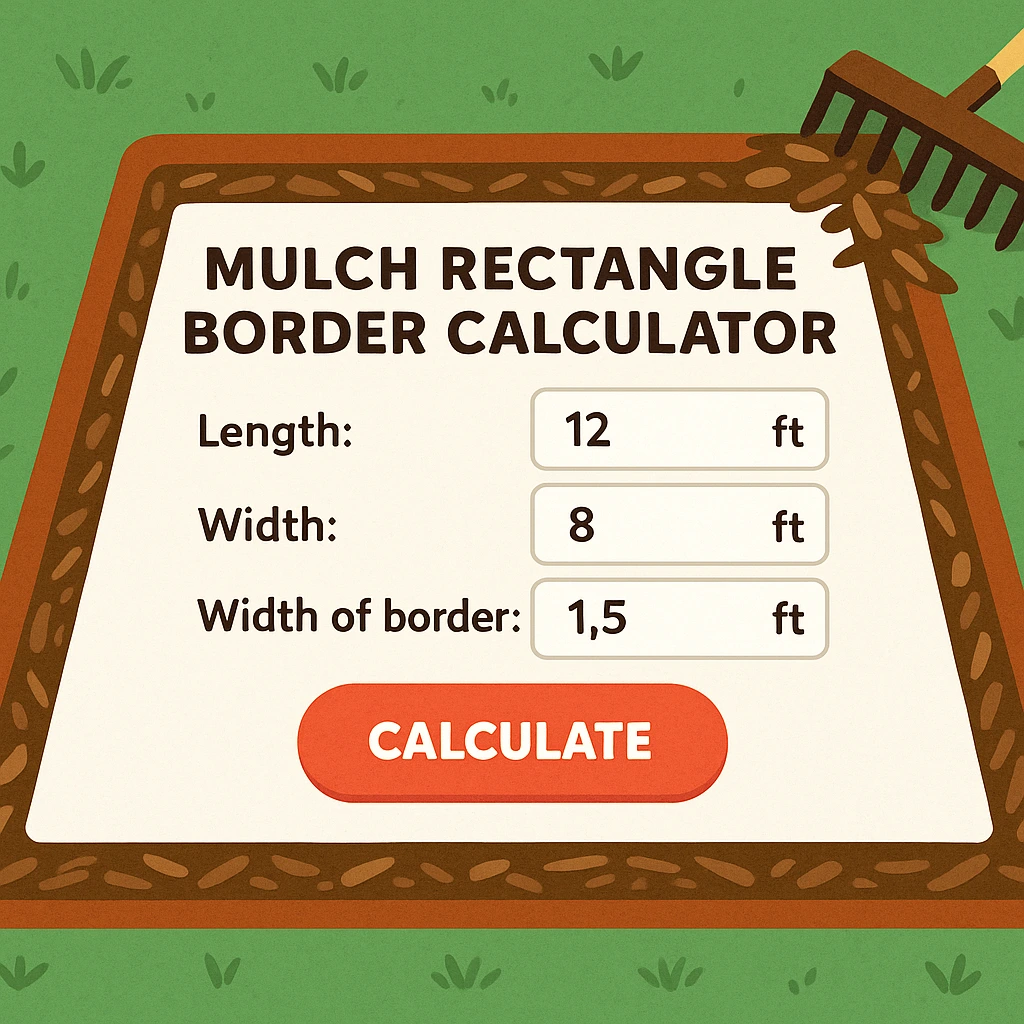
Mulch Rectangle Border Calculator: Calculate Mulch for Rectangular Borders
A mulch rectangle border calculator is a specialized landscaping tool that accurately computes the volume of mulch needed for rectangular border beds, perimeter plantings, and frame-style landscape features surrounding patios, pools, lawns, driveways, or buildings. By inputting outer and inner rectangle dimensions (or border width) along with desired mulch depth, this calculator determines cubic yards, bags required, and cost estimates for the border area only—excluding the interior space—ensuring efficient material ordering for decorative borders, foundation plantings, walkway edges, and perimeter gardens that enhance property aesthetics while avoiding wasteful over-ordering.
🖼️ Interactive Mulch Rectangle Border Calculator
Calculate mulch for rectangular borders, frames, and perimeter beds
Rectangle Border Visualization
The mulched area (brown) is the border between outer and inner rectangles
Step 1: Choose Input Method
Border Width Method
Enter the outer rectangle size and uniform border width
Exact Dimensions Method
Enter both outer and inner rectangle dimensions
Step 2: Mulch Specifications
Understanding Rectangle Border Calculations
A rectangle border (also called a frame or perimeter bed) is the area between two concentric rectangles—an outer boundary and an inner boundary. This creates a border strip that surrounds a central area like a patio, pool, lawn section, or building foundation.
Border Area Formula
The area of a rectangular border equals the outer rectangle's area minus the inner rectangle's area.
Rectangle Border Area Formula:
\[ A_{\text{border}} = A_{\text{outer}} - A_{\text{inner}} \]
\[ A_{\text{border}} = (L_{\text{outer}} \times W_{\text{outer}}) - (L_{\text{inner}} \times W_{\text{inner}}) \]
Where:
\[ L = \text{Length}, \quad W = \text{Width} \]
Border Width Method Formula
When the border has uniform width on all sides, the inner dimensions can be calculated from the outer dimensions.
Inner Dimensions from Border Width:
\[ L_{\text{inner}} = L_{\text{outer}} - (2 \times b) \]
\[ W_{\text{inner}} = W_{\text{outer}} - (2 \times b) \]
Where \( b \) = border width on one side
Multiply by 2 because border exists on both opposite sides
Border Width Calculation Example:
Given: Outer rectangle 20' × 15', border width 3 feet on all sides
Calculate inner dimensions:
\[ L_{\text{inner}} = 20 - (2 \times 3) = 20 - 6 = 14 \text{ feet} \]
\[ W_{\text{inner}} = 15 - (2 \times 3) = 15 - 6 = 9 \text{ feet} \]
Calculate areas:
\[ A_{\text{outer}} = 20 \times 15 = 300 \text{ sq ft} \]
\[ A_{\text{inner}} = 14 \times 9 = 126 \text{ sq ft} \]
\[ A_{\text{border}} = 300 - 126 = 174 \text{ sq ft} \]
Volume Calculation for Border Mulch
Once you've determined the border area, calculate mulch volume by multiplying by the desired depth.
Mulch Volume Formula
Border Mulch Volume:
\[ V = A_{\text{border}} \times D \]
Where:
\[ V = \text{Volume (cubic feet)} \]
\[ A_{\text{border}} = \text{Border area (square feet)} \]
\[ D = \text{Depth in feet (inches ÷ 12)} \]
Complete Step-by-Step Example
Detailed Example: Pool Border Bed
Scenario: Mulch border around a rectangular pool deck
- Outer rectangle (property boundary): 30' × 20'
- Inner rectangle (pool deck edge): 24' × 14'
- Border width: 3 feet on all sides
- Mulch depth: 3 inches
- Bag size: 2 cubic feet
- Price: $4.50 per bag
Step 1 - Calculate Outer Area:
\[ A_{\text{outer}} = 30 \times 20 = 600 \text{ square feet} \]
Step 2 - Calculate Inner Area:
\[ A_{\text{inner}} = 24 \times 14 = 336 \text{ square feet} \]
Step 3 - Calculate Border Area:
\[ A_{\text{border}} = 600 - 336 = 264 \text{ square feet} \]
Step 4 - Convert Depth to Feet:
\[ D = \frac{3}{12} = 0.25 \text{ feet} \]
Step 5 - Calculate Volume:
\[ V = 264 \times 0.25 = 66 \text{ cubic feet} \]
Step 6 - Convert to Cubic Yards:
\[ \text{Cubic Yards} = \frac{66}{27} = 2.44 \text{ yd}^3 \]
Step 7 - Calculate Bags:
\[ \text{Bags} = \frac{66}{2} = 33 \text{ bags} \]
Step 8 - Calculate Cost:
\[ \text{Cost} = 33 \times \$4.50 = \$148.50 \]
Common Border Applications
Pool Borders
Mulch borders around pools create transition zones between deck and landscape, reduce maintenance, and prevent grass clippings from entering the pool.
- Typical width: 3-5 feet around pool deck
- Recommended depth: 3-4 inches
- Best mulch: Rubber mulch (won't track into pool), large bark chunks
- Consider: Non-slip surface near pool area
Patio Borders
Borders around patios soften hardscape edges, provide planting areas, and define outdoor living spaces.
- Typical width: 2-4 feet around patio perimeter
- Recommended depth: 2-3 inches
- Best mulch: Shredded bark, decorative stone
- Consider: Edging to prevent mulch on patio
Foundation Plantings
Borders around building foundations accommodate shrubs and provide consistent mulch coverage.
- Typical width: 3-6 feet from foundation
- Recommended depth: 3-4 inches
- Best mulch: Hardwood bark, cedar mulch
- Caution: Keep mulch away from siding and foundation
Driveway Borders
Edging along driveways defines boundaries and reduces grass trimming near pavement.
- Typical width: 2-3 feet along driveway
- Recommended depth: 3 inches
- Best mulch: Large bark nuggets, wood chips
- Consider: Erosion control on sloped driveways
Border Width Recommendations
| Application | Minimum Width | Recommended Width | Maximum Width |
|---|---|---|---|
| Foundation Plantings | 3 feet | 4-6 feet | 8 feet |
| Pool Surrounds | 3 feet | 4-5 feet | 8 feet |
| Patio Borders | 2 feet | 3-4 feet | 6 feet |
| Walkway Edging | 1.5 feet | 2-3 feet | 4 feet |
| Driveway Borders | 2 feet | 2-3 feet | 5 feet |
Installation Best Practices for Border Beds
Professional Border Installation Steps:
- Measure accurately: Verify outer and inner rectangle dimensions at multiple points
- Mark boundaries: Use stakes and string to outline both inner and outer edges
- Remove vegetation: Clear grass, weeds, and debris from entire border area
- Install inner edging: Place edging along inner boundary to separate mulch from patio/lawn
- Install outer edging: Define outer boundary with landscape edging
- Grade for drainage: Slope away from structures, toward outer edge
- Apply landscape fabric: Cover entire border area, overlap seams
- Cut plant openings: Create X-cuts in fabric for existing or new plants
- Distribute mulch evenly: Spread to desired depth across border
- Create clean edges: Rake mulch away from both inner and outer edging for crisp lines
Calculating Border Perimeter
The perimeter calculation helps determine edging material needed for both inner and outer boundaries.
Border Perimeter Formulas
Outer Perimeter:
\[ P_{\text{outer}} = 2(L_{\text{outer}} + W_{\text{outer}}) \]
Inner Perimeter:
\[ P_{\text{inner}} = 2(L_{\text{inner}} + W_{\text{inner}}) \]
Total Edging Needed:
\[ P_{\text{total}} = P_{\text{outer}} + P_{\text{inner}} \]
Perimeter Calculation Example:
Outer rectangle: 20' × 15'
Inner rectangle: 14' × 9'
Outer perimeter: 2(20 + 15) = 70 feet
Inner perimeter: 2(14 + 9) = 46 feet
Total edging: 70 + 46 = 116 linear feet
Cost Considerations for Border Projects
Materials Costs
| Material | Typical Cost | Application |
|---|---|---|
| Bagged Mulch (2 cu ft) | $3-$6 per bag | Small to medium borders |
| Bulk Mulch | $25-$50 per yard | Large borders (2+ yards) |
| Landscape Fabric | $0.10-$0.50 per sq ft | Weed barrier under mulch |
| Plastic Edging | $0.50-$1.50 per linear ft | Budget-friendly borders |
| Metal Edging | $2-$4 per linear ft | Durable, clean lines |
| Stone Edging | $3-$8 per linear ft | Decorative, permanent |
Common Mistakes to Avoid
❌ Border Calculation Errors
- Forgetting to subtract inner area: Calculating outer rectangle only wastes mulch and money
- Inconsistent border width: Assuming uniform width when sides vary
- Wrong inner dimensions: Forgetting to subtract 2× border width (both sides)
- Inadequate edging: Skipping inner or outer edging allows mulch to spread
- No landscape fabric: Weeds will penetrate mulch in border areas
- Mulching against structures: Piling mulch against foundations causes moisture damage
- Ignoring drainage: Flat borders can pool water near structures
Maintenance for Border Beds
Regular Maintenance Tasks
- Edge redefining: Maintain crisp inner and outer edges monthly during growing season
- Mulch redistribution: Rake border smooth, fill low spots quarterly
- Weed control: Pull weeds promptly before they establish
- Annual refresh: Add 1-2 inches new mulch each spring
- Erosion check: Monitor for mulch washout, especially on slopes
- Plant pruning: Keep plants from overgrowing into inner clearance zones
Seasonal Considerations
- Spring: Fluff existing mulch, add fresh layer, pull winter weeds
- Summer: Monitor moisture levels, redistribute after heavy rains
- Fall: Remove fallen leaves, consider final mulch top-dressing
- Winter: Borders provide root insulation for perennial plants
📝 About the Author
Adam Kumar
Co-Founder at RevisionTown
Adam is a mathematics expert specializing in diverse international curricula including IB (International Baccalaureate), AP (Advanced Placement), GCSE, IGCSE, and various national education systems. With extensive expertise in geometric calculations, area subtraction formulas, and spatial problem-solving, Adam develops practical educational tools that help students, homeowners, and landscaping professionals apply mathematical principles to real-world projects including border bed planning, material estimation, and efficient space utilization in landscape design and property improvement.
Connect with Adam:
🔗 LinkedIn: linkedin.com/in/kumar-k-87346a153
📧 Email: info@revisiontown.com
🌐 RevisionTown: Comprehensive educational resources combining theoretical mathematics with practical calculation tools for IB, AP, GCSE, IGCSE, and everyday applications
"At RevisionTown, we believe mathematical literacy empowers individuals to solve complex spatial problems with confidence. Our calculators transform abstract geometric formulas into practical tools for landscaping projects, ensuring accurate material estimation and cost-effective planning for beautiful outdoor spaces."
Frequently Asked Questions
How do I calculate mulch for a rectangular border?
Calculate the outer rectangle area, subtract the inner rectangle area to get border area, then multiply by depth in feet. Example: 20'×15' outer, 14'×9' inner at 3" depth: (300 - 126) × 0.25 = 43.5 cubic feet ÷ 2 cu ft bags = 22 bags. Use the calculator above for instant results.
What border width should I use around a patio?
Most patio borders work well at 3-4 feet wide, providing adequate planting space while maintaining visual proportion. Smaller patios (under 200 sq ft) look best with 2-3 foot borders, while larger patios (300+ sq ft) can accommodate 4-6 foot borders. Consider access needs and maintenance when determining width.
Do I need landscape fabric under border mulch?
Yes, landscape fabric is highly recommended for border beds. Borders are typically permanent features requiring long-term weed control. Use commercial-grade fabric rated 3-4 oz minimum, install before mulching, overlap seams 6 inches, and secure with landscape staples every 2-3 feet for best results.
How much edging do I need for a border?
Calculate both outer and inner perimeters, then add them together. For a 20'×15' outer and 14'×9' inner rectangle: Outer perimeter = 2(20+15) = 70 feet, Inner perimeter = 2(14+9) = 46 feet, Total = 116 linear feet of edging needed. Purchase 10% extra for waste and corners.
Can border width vary on different sides?
Yes, borders don't need uniform width. You might have a 4-foot border on the visible front side and 2-foot borders on less prominent sides. Calculate by measuring actual outer and inner dimensions rather than using the border width method, entering exact measurements for each rectangle into the calculator.
What's the best mulch depth for borders?
Border beds typically need 2-3 inches of mulch for pathways and decorative areas, or 3-4 inches for shrub and perennial borders. Never exceed 4 inches as excessive depth suffocates roots. Maintain 2-3 inch clearance from building foundations, siding, and patio edges to prevent moisture damage.
Key Takeaways
Calculating mulch for rectangular borders requires understanding area subtraction—determining the frame area between outer and inner rectangles. Accurate measurement of both boundaries ensures proper material ordering for pool surrounds, patio borders, foundation plantings, and walkway edging.
Essential principles to remember:
- Border area = Outer rectangle area - Inner rectangle area
- For uniform borders: Inner dimension = Outer dimension - (2 × border width)
- Volume = Border area × Depth in feet (inches ÷ 12)
- Total edging = Outer perimeter + Inner perimeter
- Recommended border width: 3-4 feet for most applications
- Install edging on both inner and outer boundaries
- Use landscape fabric under all border mulch for weed control
- Maintain 2-3 inch clearance from structures and hardscape
- Annual refresh with 1-2 inches new mulch maintains appearance
Getting Started: Use the interactive rectangle border calculator at the top of this page to determine exactly how much mulch you need. Choose the easier border width method if your border is uniform on all sides, or use the exact dimensions method for custom borders. Enter measurements, specify mulch depth, and receive instant calculations for cubic yards, bags needed, total edging length, and estimated cost.