
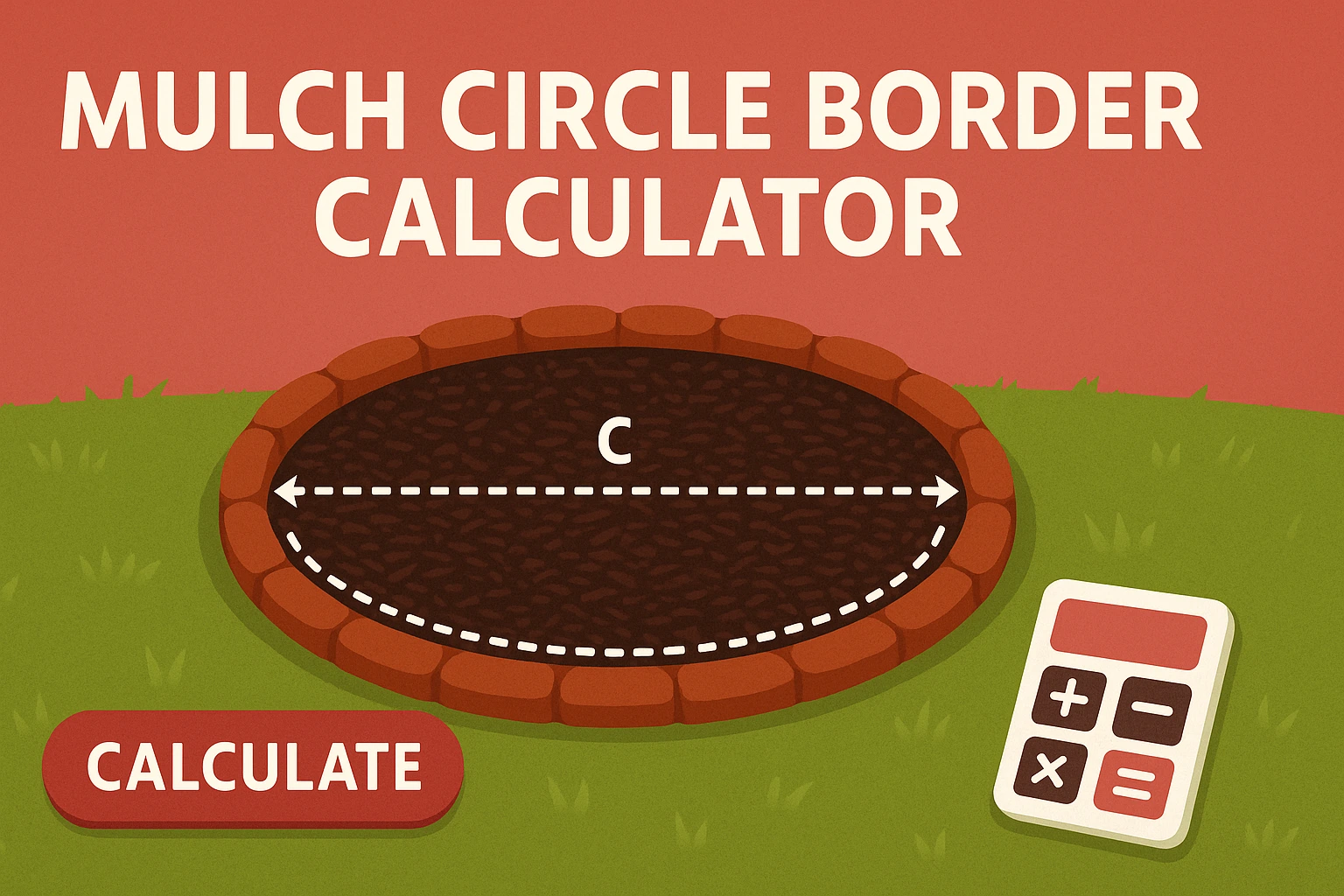
Uniform circular border mulch estimator
Mulch Circle Border Calculator
Use this Mulch Circle Border Calculator to estimate mulch for a circular border strip around a pool, patio, fountain, fire pit, round planter, tree clearance zone, or other circular feature. Enter the outside diameter and border width, or enter exact inner and outer measurements, then calculate border area, cubic feet, cubic yards, cubic meters, bag count, edging for both circular boundaries, and optional material cost.
Calculate Mulch for a Circular Border
Choose border width when the mulch strip is meant to be the same width all the way around the circular feature. Choose exact dimensions when you already know both the outside circle and the inside circle. The calculator subtracts the inner circle from the outer circle, applies the mulch depth, then adds your settling and overage allowance.
Results
What the Mulch Circle Border Calculator Does
The Mulch Circle Border Calculator estimates material for a circular border strip, meaning the mulched band around a circular feature. This is the shape used around above-ground pools, round patios, fountains, circular fire-pit seating zones, garden sculptures, bird baths, round planters, tree clearance areas, and feature beds where the center is not mulched. The calculator finds the outside circle, removes the center opening, and converts the remaining border strip into volume.
This page is focused on a practical border workflow: you usually know the central feature and the intended border width. If you need to mulch a complete round area with no clear center, use the mulch circle volume calculator. If you want the broader geometric ring calculator for any annular area between two circles, use the mulch annulus calculator. For non-circular beds, use the mulch rectangle calculator, mulch square calculator, mulch triangle calculator, or mulch trapezoid calculator.
The output includes border area, cubic feet, cubic yards, cubic meters, bag count, total curved edging, and optional cost. The edging result matters because a circular border often needs two edges: the outside curve that separates the bed from lawn and the inside curve that separates mulch from the pool, patio, fountain, fire pit, or central planting feature.
Circular Border Area Formula
A circular border is calculated by subtracting the inner circle area from the outer circle area. The circle area formula is \(A=\pi r^2\), so the border area is:
Here, \(R\) is the outer radius and \(r\) is the inner radius. If you measure diameters instead of radii, divide each diameter by 2, or use the diameter version directly:
Here, \(D\) is the outside diameter and \(d\) is the inside diameter. The formula assumes the inside and outside circles share the same center. If the border width changes around the feature, the exact result may need a more detailed site sketch, but the exact-dimensions method can still give a practical estimate when the shape is close to circular.
Border Width Formula
Many circle-border projects start with a simple design decision: make the border 2 feet, 3 feet, or 4 feet wide around the feature. If the outside diameter is known and the border width is uniform, the inside diameter is:
If the inside diameter is known and you want to add a border outward, the outside diameter is:
The factor of 2 appears because the border width is added on both sides of the diameter line. A 14 foot patio with a 3 foot mulch border has an outside diameter of \(14+2(3)=20\) feet. A 20 foot outside circle with a 3 foot border has an inside diameter of \(20-2(3)=14\) feet. The calculator includes both workflows because site measurements may begin from either boundary.
Mulch Volume for a Circular Border
After the border area is known, mulch quantity is volume. Area is measured in square feet, so depth must be converted to feet before multiplying. The volume formula is:
If the circular border area is 160.22 square feet and the desired mulch depth is 3 inches, the depth is \(3/12=0.25\) feet. Raw volume is \(160.22\times0.25=40.06\) cubic feet. With 10% overage, order \(40.06\times1.10=44.07\) cubic feet. In cubic yards, \(44.07/27=1.63\) cubic yards.
Bags are calculated by dividing cubic feet by the bag yield and rounding up:
If bags hold 2 cubic feet and the order volume is 44.07 cubic feet, \(44.07/2=22.04\), so buy at least 23 bags before any optional extra reserve. The calculator includes an extra-bag input because circular borders often need a little touch-up after watering, settling, or edging work.
Worked Example: Pool Border
A round pool area has a 14 foot inner diameter, and the planned landscape border is 3 feet wide. The outside diameter is \(14+2(3)=20\) feet. The outer radius is 10 feet and the inner radius is 7 feet. The border area is:
At 3 inches deep, raw volume is \(160.22\times0.25=40.06\) cubic feet. With 10% overage, order 44.07 cubic feet, or 1.63 cubic yards. With 2 cubic foot bags, buy 23 bags, or 24 if you want one extra bag for touch-up.
Worked Example: Fountain Border
A fountain base has a 4 foot inner diameter, and the decorative mulch border should extend 2.5 feet outward. The outside diameter is \(4+2(2.5)=9\) feet. The outer radius is 4.5 feet and the inner radius is 2 feet. The border area is:
At a 2.5 inch depth, \(D=2.5/12=0.2083\) feet. Raw volume is \(51.05\times0.2083=10.64\) cubic feet. With 10% overage, order 11.70 cubic feet. With 2 cubic foot bags, buy 6 bags before any extra reserve.
Circle Border vs Annulus vs Full Circle
A circle border, an annulus, and a full circle are related but not identical search intents. A full circle means the entire round bed is covered. A circle border usually means a practical landscaping strip of known width around a central object. An annulus is the broader geometry term for the ring-shaped region between any two concentric circles. This page emphasizes the border-strip workflow because that is how many landscaping projects are measured: start with the feature, choose a border width, calculate mulch.
For example, a 16 foot circular patio with a 3 foot border has an outside diameter of 22 feet. The mulch is not the 22 foot full circle; it is only the band from the patio edge to the outside edge. A full-circle calculation would include the patio surface and overstate the order. A border-width calculation keeps the paved center out of the mulch estimate.
If the center opening is a tree trunk clearance zone, patio, pool deck, fountain base, fire pit gravel zone, statue pedestal, or round planter, use circle border math. If there is no inner opening, use full circle math. If you are studying or calculating any ring shape independent of landscaping workflow, the annulus page is a natural companion.
How to Measure a Circular Border
For a new border, choose a center point first. Drive a stake or place a marker at the center of the pool, patio, fountain, fire pit, or planned feature. Tie a string to the center and mark the inner radius, which is the distance from the center to the feature edge. Then add the border width to mark the outer radius. If the border width is 3 feet, the outer radius is 3 feet longer than the inner radius.
For an existing border, measure the inner diameter across the feature and the outer diameter across the outside edge. If the circle is hard to measure because of plants or furniture, measure in two directions and average the results. If the border is meant to be uniform but one side is wider, use the exact-dimensions method or adjust the design before ordering material.
Do not measure around the circumference when the calculator asks for diameter. Circumference is the distance around the circle. Diameter is the straight distance across the circle through the center. If you only know circumference, convert it using \(D=C/\pi\). For edging orders, circumference is useful. For border area, diameter or radius is more direct.
Edging Requirements for Circular Borders
Circular borders usually need flexible edging on the outside boundary, the inside boundary, or both. The outside edge keeps mulch out of lawn or gravel. The inside edge keeps mulch away from paving, pool material, fountain bases, fire pit zones, or central planting features. The total edging estimate is the sum of both circumferences:
For a 20 foot outer diameter and 14 foot inner diameter, outer edging is \(\pi\times20=62.83\) feet and inner edging is \(\pi\times14=43.98\) feet. Total edging is 106.81 feet. Add 10% to 15% for overlap, connectors, cutting waste, and layout changes. A practical purchase may be 118 to 123 feet depending on the edging product length.
Flexible edging is usually the right material for circular borders. Rigid boards or straight pavers can approximate a circle only with many small segments, which changes the border shape. Metal, plastic, rubber, and composite edging products are commonly available in flexible rolls. Stone edging can also work, but it requires more planning because gaps and joint sizes affect the finished curve.
Recommended Border Widths
Border width affects appearance, planting space, maintenance access, and material quantity. A 1 foot border may look like a narrow outline and leave little room for plants. A 6 foot border may look generous but can be harder to weed, rake, and water. Most circular borders work well between 2 and 4 feet wide, with larger features supporting wider borders.
| Feature | Common width | Planning guidance |
|---|---|---|
| Pool border | 3 to 4 feet | Choose material that will not easily track or blow into the pool area. |
| Round patio border | 2.5 to 4 feet | Allow space for planting without blocking steps, chairs, or pathways. |
| Fountain surround | 2 to 3 feet | Keep access to pumps, valves, and splash zones clear. |
| Fire pit transition border | 3 to 5 feet | Check safety clearances and consider stone near heat sources. |
| Tree clearance border | 3 to 6 feet | Keep mulch away from trunk and visible root flare. |
Use visual proportion as a check. A border width of 3 feet around a 14 foot patio usually looks balanced. A 3 foot border around a 3 foot fountain may dominate the feature unless the design calls for a large planting ring. Wider borders can be effective when they hold layered plantings, but they should include maintenance access if plants need pruning or seasonal care.
Depth, Refresh Depth, and Existing Mulch
Depth is the vertical thickness of the mulch layer. A new circular border often uses 2 to 4 inches depending on plants, material, and site conditions. A refresh project usually needs less because some mulch remains from the previous installation. The calculator subtracts existing depth from target depth:
If a border has 1 inch of existing mulch and the target is 3 inches, the new depth is 2 inches. A 160 square foot border at 2 inches needs \(160\times(2/12)=26.67\) cubic feet before overage. Adding a full 3 inches would require 40 cubic feet before overage, which is 50% more material than needed.
Measure existing depth in several places around the circle. Mulch may drift toward the outside edge, collect against edging, or thin near the inner edge where feet, water, or tools disturb it. For a refresh, rake and loosen old mulch first, measure after fluffing, and then add only what is needed to restore the planned depth.
Material Selection for Circle Borders
Material choice depends on the central feature and how people use the space. Around pools, choose mulch or stone that does not track easily into water and is not likely to float or blow into the pool. Around patios, consider furniture movement, foot traffic, and color coordination with pavers. Around fountains, choose material that tolerates splash. Around fire pits, organic mulch may not be appropriate near heat, so verify safe clearance and consider stone in the closest zone.
| Material | Good fit | Watch for |
|---|---|---|
| Shredded bark | General borders, patios, planted beds | Can compact if applied too deeply. |
| Pine bark nuggets | Decorative borders and larger beds | May move on slopes or in heavy runoff. |
| Cedar mulch | Formal borders and visible feature beds | Usually costs more than basic bark mulch. |
| Rubber mulch | Some high-traffic or pool-adjacent borders | Does not improve soil and may not suit planting beds. |
| Decorative stone | Fire pit transitions, drainage zones, permanent borders | Use a stone-specific estimate because depth and density differ from mulch. |
If the border will be planted, organic mulch is often useful because it moderates soil temperature and gradually decomposes. If the border is primarily decorative and adjacent to water, hardscape, or heat, stone may be more practical. If you switch from mulch to stone, compare quantities with the gravel calculator, since bag yield and bulk density are different.
Bagged Mulch vs Bulk Mulch
Small circular borders are often easiest with bags. Bags are clean, easy to carry around the curve, and simple to stage evenly along the border. Larger pool or patio borders may be better with bulk mulch if the total is more than about one cubic yard and delivery access is good. The calculator reports both cubic feet and cubic yards so you can compare bagged and bulk options.
One cubic yard equals 27 cubic feet:
If a border needs 1.63 cubic yards after overage, that is \(1.63\times27=44.01\) cubic feet. With 2 cubic foot bags, the project needs about 23 bags before an extra reserve. If the supplier sells bulk mulch by half-yard increments, a 1.5 or 2 yard order may be the closest practical choice, depending on whether you have other beds to refresh.
When comparing cost, include delivery, taxes, storage space, cleanup, and labor. A cheaper bulk price may not be cheaper if delivery minimums are high. A higher bag price may be worthwhile if the border is in a tight backyard where a wheelbarrow route is difficult. The cubic yard calculator and square feet to cubic yards calculator can help if you want to focus on volume conversions alone.
Installation Workflow
- Mark the center point of the circular feature or intended border.
- Use a string, tape, hose, or marking paint to lay out the inner and outer circles.
- Verify that the border width is consistent at several points.
- Remove turf, weeds, debris, and old material from the border area.
- Install flexible edging where the border needs a crisp curve.
- Check drainage and slope so water does not collect against the central feature.
- Spread mulch in light passes around the circle instead of dumping piles in one place.
- Rake the mulch to the target depth and keep it clear of hardscape joints, trunks, and stems.
- Water lightly or wait for rain, then touch up thin spots with reserved material.
A circular border looks best when both curves are clean. If edging is flexible, set it gradually rather than forcing tight bends. If the border touches a patio or pool deck, keep mulch slightly below the hardscape edge so it does not wash or kick onto the surface. If the border surrounds a tree, avoid deep digging and keep mulch away from bark.
Irregular and Partial Circular Borders
Some circular borders are not complete 360 degree rings. A patio may have a walkway cutting through the border. A pool border may stop at a fence. A fountain surround may be a half circle against a wall. If the border covers only a fraction of the circle, calculate the full circular border and multiply by the fraction used.
Here, \(\theta\) is the angle of the border in degrees. A half-circle border uses \(\theta=180\), so it is half the full border. A three-quarter border uses \(\theta=270\), so it is 75% of the full border. If the missing part is a walkway or gate opening, subtract that area before ordering or reduce the overage if the gap is small.
If the border is oval rather than circular, do not rely on a circular formula unless the difference is minor. Measure it as a practical approximation or break the area into simpler shapes. The area calculator and volume calculator can help compare alternative shape estimates before you purchase material.
Common Mistakes to Avoid
- Calculating the full outer circle and forgetting to subtract the central feature.
- Entering a border width that is larger than the outer radius.
- Using diameter values in the radius formula without dividing by 2.
- Measuring circumference when the calculator asks for diameter.
- Assuming a border is uniform without checking width at several points.
- Buying edging for only the outside circle when the inside circle also needs a border.
- Applying a full new layer during refresh work instead of subtracting existing depth.
- Using too much organic mulch near fire pits, heat sources, or structures.
- Letting mulch sit above patio, pool, or walkway edges where it can wash onto hardscape.
- Ignoring overage for cuts, curves, settling, and irregular edge details.
A quick reasonableness check helps. The border area must be smaller than the outer circle area. If the border is narrow, the area should feel like a strip, not like a full circle. At 3 inches deep, one cubic foot covers about 4 square feet before overage, and a 2 cubic foot bag covers about 8 square feet before overage. If your bag count feels wildly higher or lower than that, recheck the unit, method, and inner measurement.
Practice Problems
Problem 1: Patio border width
A round patio has a 12 foot inner diameter and a planned 3 foot mulch border. The outside diameter is \(12+2(3)=18\) feet. The outer radius is 9 feet and the inner radius is 6 feet. Area is \(\pi(9^2-6^2)=\pi(81-36)=141.37\) square feet. At 3 inches deep, raw volume is \(141.37\times0.25=35.34\) cubic feet. With 10% overage, order 38.87 cubic feet.
Problem 2: Exact diameter border
A fountain border has a 10 foot outer diameter and a 5 foot inner diameter. Area is \(\pi(5^2-2.5^2)=\pi(25-6.25)=58.90\) square feet. At 2.5 inches deep, raw volume is \(58.90\times(2.5/12)=12.27\) cubic feet. With 10% overage, order 13.50 cubic feet. With 2 cubic foot bags, buy 7 bags before extra reserve.
Problem 3: Edging estimate
A circular border has a 22 foot outer diameter and a 16 foot inner diameter. Outer edging is \(\pi\times22=69.12\) feet. Inner edging is \(\pi\times16=50.27\) feet. Total edging is 119.39 feet. With 10% extra, purchase about 131.33 feet, rounded to available product lengths.
Problem 4: Refresh depth
A circular border has an area of 180 square feet and already has 1 inch of mulch. The target depth is 3 inches, so new depth is 2 inches, or \(2/12=0.1667\) feet. Raw volume is \(180\times0.1667=30\) cubic feet. With 10% overage, order 33 cubic feet, or 1.22 cubic yards. With 3 cubic foot bags, buy 11 bags.
Using This Page with Other Outdoor Calculators
A circular border often appears in a larger project that includes non-circular beds, gravel paths, edging, plants, lighting, or construction materials. Calculate each shape separately and add the final quantities. Use the circle border calculator for the curved strip, the full circle calculator for round beds with no center opening, and the rectangle, square, triangle, or trapezoid tools for straight-edged beds. For broader project planning, the square footage calculator, cost calculator, and construction calculator can support the remaining estimates.
Keep shape intent clear. A pool border is not a full circle because the pool is not mulched. A patio border is not a rectangle because the curves control both area and edging. A tree clearance border may look like an annulus, but if the design task starts from border width around the tree, this page is the practical workflow. Matching the calculator to the actual shape prevents over-ordering and makes installation easier to plan.
Unit Conversions Used by the Calculator
Circular border projects often mix units. The pool label may give diameter in feet, a site plan may use meters, mulch depth is often described in inches, bags are sold by cubic feet, and bulk deliveries are sold by cubic yards. The calculator converts all linear measurements to feet and all depth values to feet before calculating volume. That consistent unit chain is what makes the result reliable.
| Conversion | Formula | Where it is used |
|---|---|---|
| Inches to feet | \(\text{ft}=\text{in}\div12\) | Mulch depth, narrow border widths, small feature measurements. |
| Yards to feet | \(\text{ft}=\text{yd}\times3\) | Large outdoor layouts and delivery planning. |
| Meters to feet | \(\text{ft}=\text{m}\times3.28084\) | Metric site plans and international product dimensions. |
| Centimeters to feet | \(\text{ft}=\text{cm}\div30.48\) | Small depth and border-width measurements. |
| Cubic feet to cubic yards | \(\text{yd}^3=\text{ft}^3\div27\) | Bulk mulch orders from landscape suppliers. |
The most common unit mistake is multiplying square feet by inches and treating the result as cubic feet. If a border area is 160 square feet and depth is 3 inches, the volume is not 480 cubic feet. Convert 3 inches to 0.25 feet first, then multiply: \(160\times0.25=40\) cubic feet. This single conversion prevents large ordering errors.
Another common mistake is confusing diameter and radius. A 20 foot diameter has a 10 foot radius. If 20 is entered as a radius, the outside circle becomes 40 feet across and the calculated material can be roughly four times too high. When measuring with a tape, write down whether each number is a full width across the circle or a center-to-edge distance.
Depth Sensitivity for Circular Borders
Depth changes mulch quantity directly. If the border area stays the same, a 4 inch layer needs twice as much mulch as a 2 inch layer. That may sound obvious, but it is easy to underestimate on a circular border because the shape looks like a narrow strip. A 160 square foot border still has a large surface area; every extra inch of depth adds meaningful volume.
| Border area | Depth | Raw volume | With 10% overage |
|---|---|---|---|
| 160 ft² | 2 inches | 26.67 ft³ | 29.33 ft³ |
| 160 ft² | 3 inches | 40.00 ft³ | 44.00 ft³ |
| 160 ft² | 4 inches | 53.33 ft³ | 58.67 ft³ |
For low groundcovers, a 2 inch layer may be sufficient and less likely to bury stems. For shrub borders, 3 inches may be more appropriate. For pool or patio borders where weed suppression is important and planting is sparse, 3 to 4 inches can be reasonable if edging contains the material. Avoid exceeding the planned depth simply because extra mulch is available; too much organic mulch can hold excess moisture, compact, and spill onto hardscape.
Depth should be checked after the material is raked, not while it is still piled. Use a ruler or depth gauge at the inner edge, center of the border strip, and outer edge. Circular borders are easy to overfill near the inside curve because workers pull material inward from the outer edge. A few depth checks keep the strip consistent.
Overage, Settling, and Ordering Practical Quantities
Mulch settles after installation. It also shifts during edging, watering, foot traffic, and wind. The calculator includes a percentage allowance so you can account for settling and small layout differences. A 10% allowance is a practical starting point for most circular borders. Clean, hard-edged patio borders may need less. Root-filled or sloped borders may need more. Very small borders may be better handled with one extra bag rather than a precise percentage.
Here, \(p\) is the overage percentage. If raw volume is 40 cubic feet and overage is 10%, order \(40\times1.10=44\) cubic feet. If the bag yield is 2 cubic feet, that is 22 bags before any extra reserve. If the calculator adds one extra bag, the final bag count becomes 23 bags.
Do not confuse overage with finished depth. The target depth remains the target depth. Extra material should handle settling, low spots, and future touch-up, not create a deeper layer across the whole border. If a supplier rounds bulk orders up, plan where the remainder will go. A small leftover pile can refresh another bed, but a large surplus can be inconvenient to store.
Budgeting a Circle Border Project
Budgeting a circular border includes more than mulch volume. Edging, landscape fabric if used, staples, plants, delivery, soil amendments, disposal of removed turf, and tools can all affect the project cost. The calculator gives a material estimate for mulch, but the final budget should include the whole installation plan. This is especially true for pool and patio borders, where curved edging and clean hardscape protection can cost as much as the mulch itself.
Consider a border that needs 44 cubic feet of mulch after overage. With 2 cubic foot bags, the project needs 22 bags before extra reserve. At 4.50 dollars per bag, material cost is \(22\times4.50=99.00\text{ dollars}\). If bulk mulch costs 40 dollars per cubic yard and the volume is \(44/27=1.63\) cubic yards, the material cost is \(1.63\times40=65.20\text{ dollars}\), before delivery. If delivery is 45 dollars, the total becomes 110.20 dollars. In that case, bagged mulch may be cheaper and more convenient unless other beds are included in the delivery.
Labor also matters. Bagged mulch can be carried and opened around the curve, which makes spreading even. Bulk mulch may require a tarp, shovel, wheelbarrow, and a staging area. If the border is in a backyard with narrow access, bags may save time even if the per-cubic-foot price is higher. If the border is large and close to a driveway, bulk delivery may be faster.
Pool, Patio, Fountain, and Fire Pit Considerations
Each circular feature has its own constraints. Around a pool, loose material should not track easily into the water. Large bark, rubber mulch, or stone may behave better than very fine mulch, depending on the pool setting. Keep material below the pool deck edge so it does not wash across walking surfaces. Leave access for ladders, filters, skimmers, and service points.
A patio border should not block seating, steps, or furniture movement. If chairs slide off the patio edge, leave a gap or use a stable transition material. A 3 foot border around a round patio may be visually balanced, but access points should be planned before edging is installed. If a walkway intersects the border, subtract the walkway opening or treat the border as a partial circle.
Fountain borders need splash awareness. Constant water splash can move light mulch, discolor material, or keep organic mulch damp. Stone may be better near the splash zone, with organic mulch farther out if plants need it. Keep pump access, electrical covers, and maintenance panels clear.
Fire pit borders require extra caution. Organic mulch should not be placed close to heat, sparks, or embers. Use local safety guidance and manufacturer clearances. In many designs, the immediate fire pit zone is gravel, pavers, or stone, while mulch begins farther out as a landscape transition. If the inner zone is stone and the outer border is mulch, calculate each material separately.
Partial Circle Borders and Openings
Many circular borders are not complete circles. A pool border may stop at a deck. A patio border may have a walkway passing through it. A fountain border may sit against a wall. A fire pit border may be interrupted by seating pads. When the border is only part of a circle, calculate the full border first and then multiply by the fraction that remains.
If \(\theta=180^\circ\), the border is a half circle. If \(\theta=270^\circ\), the border is three quarters of a circle. If the shape is almost complete but has a rectangular path cut through it, subtract the path area. A 3 foot by 5 foot walkway opening removes 15 square feet. At 3 inches deep, that opening represents \(15\times0.25=3.75\) cubic feet before overage.
Partial borders also change edging. A half-circle border does not need the full inside and outside circumference, but it may need straight edging at the two cut ends. If the calculator's full edging estimate is used for a partial border, reduce the circular portion and add the two straight end widths. For example, a half-circle border with a 3 foot width needs half of the inner circumference, half of the outer circumference, and two 3 foot end pieces.
Maintenance Schedule for Circular Borders
Circular borders show unevenness quickly because the eye follows the curve. A thin spot near the inside edge or a spill across the outside curve is easy to see. Good maintenance keeps the border crisp and reduces the need for large annual corrections.
| Timing | Task | Reason |
|---|---|---|
| Monthly in growing season | Pull weeds and clean hardscape edges. | Small weeds are easier to remove before roots establish. |
| After heavy rain | Rake displaced material back into the border. | Curved edges can collect washout near low points. |
| Each spring | Measure depth and refresh only the missing amount. | Prevents over-mulching and keeps cost controlled. |
| Every few years | Remove compacted excess if layers have built up. | Restores air and water movement at the soil surface. |
| When edging shifts | Reset the inner and outer curves. | Maintains a consistent border width and clean appearance. |
During refresh work, loosen matted mulch before measuring. Old mulch can look shallow when compacted, then expand after raking. If it is already near target depth, a color refresh or light top dressing may be enough. If the border has become too high near hardscape, remove excess rather than adding more.
Troubleshooting Unusual Results
If the result seems too large, check three things first: diameter versus radius, inches versus feet, and whether the inner circle was included correctly. Entering a diameter as a radius can make the outer circle four times too large. Entering 3 feet instead of 3 inches makes the depth twelve times too large. Forgetting the inner opening turns the border into a full circle.
If the calculator says the inner circle must be smaller than the outer circle, recheck the selected method. In the outer diameter plus border width method, the border width must be less than the outer radius. A 10 foot outside diameter has a 5 foot outer radius, so a 6 foot border width would leave no center opening. In the inner diameter plus border width method, the outside diameter is created by adding width on both sides, so positive measurements should always produce a valid outer circle.
If the bag count seems too high, compare coverage per bag. At 3 inches deep, one cubic foot covers 4 square feet before overage. A 2 cubic foot bag covers about 8 square feet. A 160 square foot circular border therefore needs about 20 bags before overage. If your result is far from that, the input units or dimensions probably need review.
If the border is not a true circle, decide whether the difference matters. A slightly uneven garden border can be estimated with average diameters and a sensible overage. A strongly oval pool border, however, should be measured with a different method. If the site shape is mixed, divide it into simpler areas and add the volumes.
Checking Border Width Before You Install
Before buying material, walk the proposed circle and check the border width at several points. A circular border can look uniform from one angle but drift wider or narrower around obstacles. Measure from the inner edge to the outer edge at the north, south, east, and west points of the circle, then check any entry points, steps, service panels, gates, or planting pockets. If the numbers are close, use the planned border width. If they differ by a lot, use exact inner and outer dimensions or divide the project into sections.
Consistent width matters for both appearance and quantity. A 3 foot border around a patio creates a clean, intentional band. If one side quietly expands to 5 feet, the area increases and the mulch may run short. If another side narrows to 1 foot, the border may not hold plants or edging well. Measuring the width before installation also helps you decide where to adjust the curve. It is easier to move a hose or marking paint before cutting turf than to fix a lopsided bed after edging is installed.
If the feature is not perfectly centered in the available space, decide whether the border should remain mathematically concentric or visually balanced with the surrounding yard. Around a formal fountain, concentric curves usually look best. Around a pool near a fence or a patio beside a wall, a slightly adjusted border may be more practical. In that case, use the calculator as a strong estimate, then keep a modest overage allowance for field adjustments.
Frequently Asked Questions
Calculate the outer circle area, subtract the inner circle area, then multiply the border area by mulch depth in feet. The main formula is \(A=\pi(R^2-r^2)\), followed by \(V=A\times D\).
If you know the outside diameter, subtract twice the border width to get the inside diameter: \(d=D-2w\). If you know the inside diameter, add twice the border width to get the outside diameter: \(D=d+2w\).
Most circular mulch borders work well at 2 to 4 feet wide. Use narrower borders for small fountains or decorative outlines, and wider borders for pools, patios, layered plantings, and larger features.
Add the outer circumference and inner circumference. Use \(C_{\text{outer}}=\pi D_{\text{outer}}\) and \(C_{\text{inner}}=\pi D_{\text{inner}}\), then add extra for overlap, connectors, and cuts.
Geometrically, a circular border is an annular area. Practically, this calculator is focused on border-width landscaping around a central feature, while the annulus calculator covers the broader ring-shaped geometry workflow.