
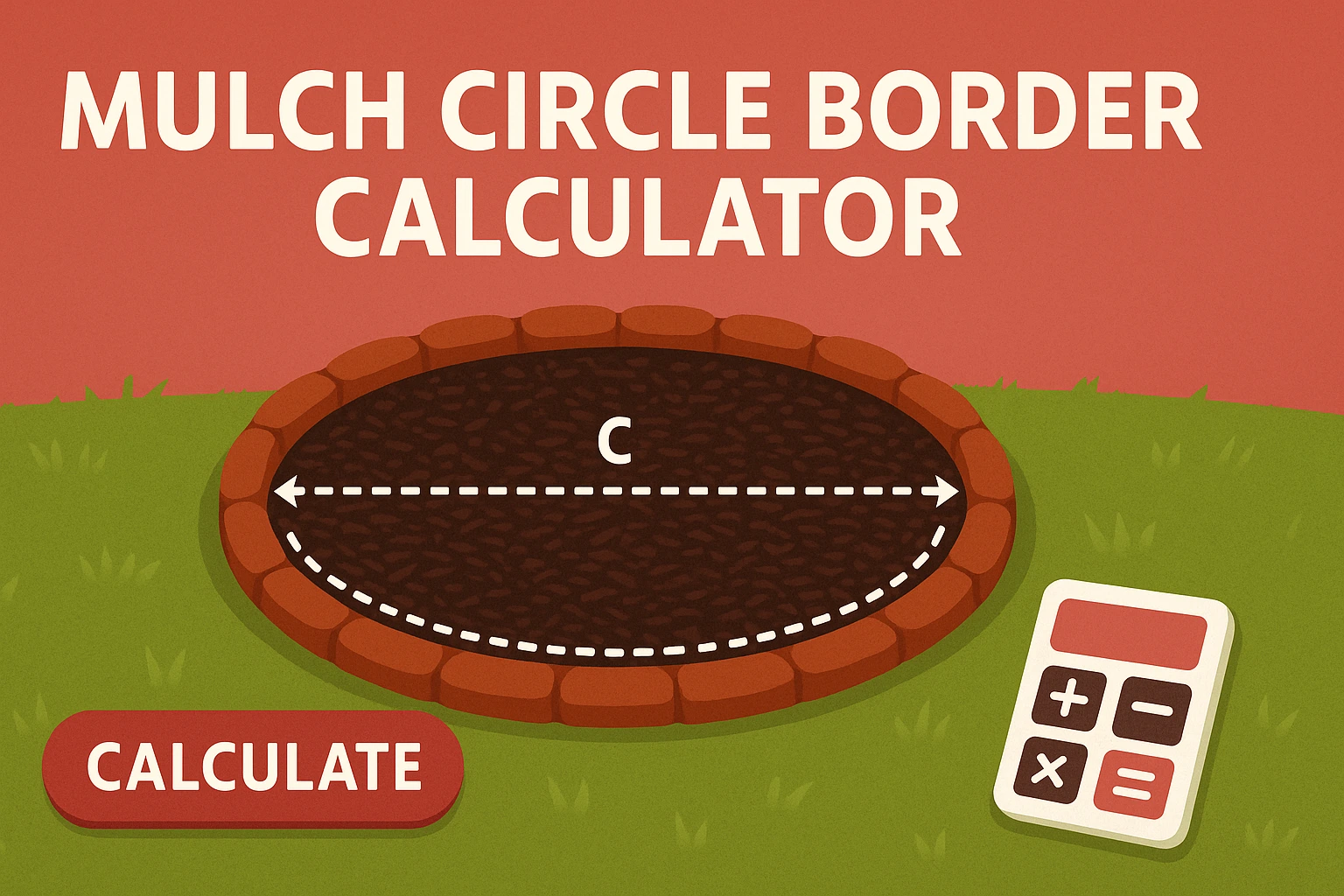
Mulch Circle Border Calculator: Calculate Mulch for Circular Borders
A mulch circle border calculator is a specialized landscaping tool that accurately computes the volume of mulch, decorative stone, or ground cover needed for circular border beds, ring-shaped plantings around pools, patios, or fountains, and donut-style gardens surrounding central features. By inputting outer border dimensions and inner clearance measurements (or border width), this calculator determines the ring area between two concentric circles, then calculates cubic yards, bags required, and cost estimates—ensuring precise coverage for these elegant curved borders that enhance outdoor spaces with geometric beauty while avoiding material waste or shortages in circular landscape design projects.
⭕ Interactive Mulch Circle Border Calculator
Calculate mulch for circular borders, ring beds, and donut-shaped gardens
Circular Border Visualization
The teal ring is the circular border—mulch area between inner and outer circles
Step 1: Choose Input Method
Border Width Method
Enter the outer diameter and uniform border width
Exact Dimensions Method
Enter both outer and inner circle diameters
Step 2: Mulch Specifications
Understanding Circular Border Geometry
A circular border is the ring-shaped area between two concentric circles (circles sharing the same center). This geometric shape creates elegant borders around pools, patios, fountains, tree clearance zones, and decorative landscape features.
Circular Border Area Formula
The area of a circular border equals the outer circle area minus the inner circle area.
Circle Border Area Formula:
\[ A_{\text{border}} = A_{\text{outer}} - A_{\text{inner}} \]
\[ A_{\text{border}} = \pi R^2 - \pi r^2 = \pi(R^2 - r^2) \]
Where:
\[ R = \text{Outer radius (from center to border outer edge)} \]
\[ r = \text{Inner radius (from center to border inner edge)} \]
\[ \pi \approx 3.14159 \]
Border Width Calculation
When the border has uniform width all around, the inner diameter can be calculated from outer diameter and border width.
Inner Diameter from Border Width:
\[ d_{\text{inner}} = d_{\text{outer}} - (2 \times w) \]
\[ r_{\text{inner}} = r_{\text{outer}} - w \]
Where:
\[ w = \text{Border width (perpendicular distance across ring)} \]
\[ d = \text{Diameter}, \quad r = \text{Radius} \]
Border Calculation Example:
Given: Outer diameter = 14 feet, Border width = 3 feet
Step 1 - Calculate Inner Diameter:
\[ d_{\text{inner}} = 14 - (2 \times 3) = 14 - 6 = 8 \text{ feet} \]
Step 2 - Calculate Radii:
\[ R = \frac{14}{2} = 7 \text{ feet (outer radius)} \]
\[ r = \frac{8}{2} = 4 \text{ feet (inner radius)} \]
Step 3 - Calculate Border Area:
\[ A = \pi(R^2 - r^2) = 3.14159(7^2 - 4^2) \]
\[ A = 3.14159(49 - 16) = 3.14159 \times 33 = 103.67 \text{ sq ft} \]
Volume Calculation for Border Mulch
After determining the border area, calculate mulch volume by multiplying by the desired depth.
Border Volume Formula
Mulch Volume for Circular Border:
\[ V = A_{\text{border}} \times D \]
\[ V = \pi(R^2 - r^2) \times D \]
Where:
\[ V = \text{Volume (cubic feet)} \]
\[ D = \text{Depth in feet (inches ÷ 12)} \]
Complete Step-by-Step Example
Detailed Example: Pool Border Planting Bed
Project Specifications:
- Application: Circular border around pool deck
- Outer diameter: 20 feet (landscape boundary)
- Inner diameter: 14 feet (pool deck edge)
- Border width: 3 feet on all sides
- Mulch depth: 3 inches
- Bag size: 2 cubic feet
- Price: $4.50 per bag
Step 1 - Determine Radii:
\[ R = \frac{20}{2} = 10 \text{ feet (outer radius)} \]
\[ r = \frac{14}{2} = 7 \text{ feet (inner radius)} \]
Step 2 - Calculate Border Area:
\[ A = \pi(10^2 - 7^2) = 3.14159(100 - 49) \]
\[ A = 3.14159 \times 51 = 160.22 \text{ square feet} \]
Step 3 - Convert Depth to Feet:
\[ D = \frac{3}{12} = 0.25 \text{ feet} \]
Step 4 - Calculate Volume:
\[ V = 160.22 \times 0.25 = 40.06 \text{ cubic feet} \]
Step 5 - Convert to Cubic Yards:
\[ \text{Cubic Yards} = \frac{40.06}{27} = 1.48 \text{ yd}^3 \]
Step 6 - Calculate Bags Needed:
\[ \text{Bags} = \frac{40.06}{2} = 20.03 \rightarrow \text{Round up to 21 bags} \]
Step 7 - Calculate Cost:
\[ \text{Total Cost} = 21 \times \$4.50 = \$94.50 \]
Common Circular Border Applications
Pool Borders
Circular above-ground pools or round pool decks benefit from mulched borders that transition to landscape.
- Outer boundary: Desired landscape extent (18-25 feet diameter)
- Inner boundary: Pool deck or pool edge (12-18 feet diameter)
- Border width: Typically 3-4 feet for planting and mulch
- Material: Rubber mulch or large bark (won't track into pool area)
- Purpose: Creates buffer zone, reduces lawn maintenance near pool
Patio Borders
Round patios look elegant when surrounded by uniform circular borders.
- Outer diameter: Landscape bed extent (16-22 feet)
- Inner diameter: Patio edge (10-16 feet)
- Border width: 3-4 feet for plantings and walkway
- Material: Decorative bark, colored mulch, or stone
- Purpose: Softens hardscape, provides planting space
Fountain and Water Feature Surrounds
Circular fountains create focal points enhanced by mulched borders.
- Feature diameter: Fountain base (3-6 feet)
- Outer ring: Border extent (8-12 feet)
- Border width: 2-4 feet of decorative mulch
- Material: Fine bark, river rock, or decorative stone
- Purpose: Highlights feature, prevents grass encroachment
Fire Pit Borders
Circular fire pits require safety clearance zones enhanced with mulch borders.
- Inner diameter: Fire pit and immediate gravel area (8-10 feet)
- Outer diameter: Seating and landscape area (14-18 feet)
- Border width: 3-4 feet transition zone
- Material: Stone mulch or large bark (fire-resistant)
- Purpose: Safety buffer, defines gathering space
Recommended Border Widths
| Feature Type | Minimum Border Width | Recommended Width | Maximum Width |
|---|---|---|---|
| Pool Border | 2 feet | 3-4 feet | 6 feet |
| Patio Border | 2 feet | 3-4 feet | 5 feet |
| Fountain Surround | 1.5 feet | 2-3 feet | 4 feet |
| Fire Pit Border | 3 feet | 3-4 feet | 6 feet |
| Tree Clearance Ring | 2 feet | 3-5 feet | 8 feet |
| Garden Feature Border | 2 feet | 2-4 feet | 5 feet |
Installation Best Practices
Professional Circle Border Installation:
- Mark both circles: Use stake-and-string compass for outer and inner boundaries
- Verify center alignment: Ensure both circles share exact same center point
- Clear border area: Remove all grass, weeds, and debris from ring
- Install outer edging: Use flexible circular edging along outer perimeter
- Install inner edging: Define inner boundary to contain mulch and separate from feature
- Grade for drainage: Create slight slope away from central feature
- Apply landscape fabric: Cut donut-shaped fabric for entire border ring
- Leave clearances: Maintain 2-3 inch gap at inner edge if surrounding structure
- Distribute mulch uniformly: Spread evenly across entire border width
- Create clean edges: Define sharp borders at both inner and outer edges
Calculating Edging Requirements
Circular borders require edging on both inner and outer circles to maintain clean lines.
Total Edging Formula
Outer Circumference:
\[ C_{\text{outer}} = \pi D_{\text{outer}} \]
Inner Circumference:
\[ C_{\text{inner}} = \pi D_{\text{inner}} \]
Total Edging Needed:
\[ C_{\text{total}} = C_{\text{outer}} + C_{\text{inner}} \]
Edging Calculation Example:
Border: 20-foot outer diameter, 14-foot inner diameter
Outer circumference: π × 20 = 62.8 feet
Inner circumference: π × 14 = 44.0 feet
Total edging: 62.8 + 44.0 = 106.8 feet
Recommended purchase: 118 feet (includes 10% extra for overlap)
Design Principles for Circular Borders
Proportional Width Guidelines
- Visual balance: Border width should be 20-40% of inner diameter
- Minimum width: At least 2 feet to accommodate plants and edging
- Maximum width: No more than 6 feet unless very large feature (becomes difficult to maintain)
- Uniform vs. varied: Consistent width creates formal look; varied width adds interest
Plant Selection for Borders
- Low borders (2-3 feet): Ground covers, small perennials, ornamental grasses
- Medium borders (3-4 feet): Mixed perennials, small shrubs, seasonal annuals
- Wide borders (4-6 feet): Layered plantings with shrubs, perennials, and ground covers
- Color schemes: Monochromatic for elegance, multi-color for vibrancy
Common Mistakes to Avoid
❌ Circle Border Calculation Errors
- Forgetting to subtract inner area: Calculating only outer circle wastes 30-50% more mulch
- Using diameter in radius formula: Must convert diameter to radius (÷ 2) first
- Off-center circles: Inner and outer must share exact center for proper ring
- Border too narrow: Less than 2 feet looks cramped and limits planting options
- Inadequate inner clearance: Mulch against structures causes moisture damage
- Ignoring π (pi): Circles require π in calculations, not rectangle formulas
- Straight edging on curves: Must use flexible edging designed for circles
- Inconsistent width: If claiming uniform width, measure to verify
Material Selection for Circle Borders
Organic Mulch Options
| Mulch Type | Best For | Longevity | Appearance |
|---|---|---|---|
| Shredded Bark | General borders, formal designs | 2-3 years | Rich brown, uniform texture |
| Pine Bark Nuggets | Decorative borders, slopes | 2-3 years | Reddish-brown, chunky |
| Cedar Mulch | Aromatic borders, insect control | 3-4 years | Golden to reddish, fine texture |
| Rubber Mulch | Pool borders, high-traffic | 10+ years | Various colors, uniform |
| River Rock | Permanent borders, drainage | Permanent | Natural stone, smooth |
Color Considerations
- Natural brown: Classic, complements most plants and architecture
- Black/dark: Modern, dramatic contrast with greenery
- Red/rust: Warm tones, southwestern aesthetic
- Gold/tan: Light, airy appearance, formal gardens
- White stone: Contemporary, high-contrast borders
Maintenance Schedule
Regular Maintenance Tasks
- Monthly during growing season: Edge redefinition, weed removal
- Quarterly: Mulch redistribution, fill low spots, fluff compacted areas
- Annually (spring): Add 1-2 inches fresh mulch to refresh appearance
- Every 3-4 years: Complete mulch replacement if heavily decomposed
- After storms: Redistribute displaced mulch, repair edging
Seasonal Considerations
- Spring: Best time for mulch refresh, plant division, edging repair
- Summer: Monitor for mulch displacement, maintain adequate depth
- Fall: Optional final mulch layer for winter protection
- Winter: Minimal maintenance; mulch protects plant roots
📝 About the Author
Adam Kumar
Co-Founder at RevisionTown
Adam is a mathematics expert specializing in diverse international curricula including IB (International Baccalaureate), AP (Advanced Placement), GCSE, IGCSE, and various national education systems. With extensive expertise in geometric calculations, particularly circular border area formulas and the practical application of π (pi) in landscape design, Adam develops educational tools that help students, homeowners, and landscaping professionals confidently apply mathematical principles to real-world circular border projects including pool surrounds, patio borders, and ring-shaped garden beds.
Connect with Adam:
🔗 LinkedIn: linkedin.com/in/kumar-k-87346a153
📧 Email: info@revisiontown.com
🌐 RevisionTown: Comprehensive educational resources combining theoretical mathematics with practical calculation tools for IB, AP, GCSE, IGCSE, and everyday applications
"At RevisionTown, we believe mathematical literacy transforms abstract geometric concepts into practical solutions for stunning landscapes. Our calculators help individuals apply circular geometry confidently to create beautiful borders that enhance outdoor living spaces while optimizing material use and project budgets."
Frequently Asked Questions
How do I calculate mulch for a circular border?
Calculate the area of the outer circle, subtract the area of the inner circle to get the border ring area, then multiply by depth in feet. Formula: π(R² - r²) × depth. Example: 20' outer and 14' inner diameters at 3" depth = π(10² - 7²) × 0.25 = 40 cubic feet = 20 bags (2 cu ft size). Use the calculator above for instant results.
What's the ideal width for a circular border?
Circular borders should typically be 2-4 feet wide for most applications. Minimum 2 feet allows adequate planting space and avoids cramped appearance. Maximum 4-6 feet remains manageable for maintenance. For pool borders use 3-4 feet, patio borders 3-4 feet, fountain surrounds 2-3 feet. Border width should be 20-40% of inner diameter for visual proportion.
How do I ensure my border circles are concentric?
Use the stake-and-string compass method: drive a stake at the exact center point, tie string to stake, measure and mark outer radius first (creating outer circle), then measure shorter inner radius from same center stake (creating inner circle). Verify by measuring from center to multiple points on each circle—all measurements should be consistent for true concentric circles.
Can I use different border widths on different sides?
Yes, but this creates non-concentric circles requiring exact dimension measurements rather than uniform border width calculations. Measure actual outer and inner diameters at widest points, use the exact dimensions method in the calculator. Variable-width borders can accommodate property lines, buildings, or design features but require more complex layout and measurement.
How much edging do I need for a circular border?
Calculate circumference of both circles: outer (π × outer diameter) plus inner (π × inner diameter). Example: 20' outer and 14' inner = 62.8 + 44.0 = 106.8 feet total edging. Purchase 10-15% extra (120 feet) for overlap, cutting, and installation. Use flexible edging specifically designed for curves on both inner and outer boundaries.
What mulch depth should I use for borders?
Most circular borders need 2-3 inches mulch depth for ground covers and small perennials, or 3-4 inches for shrub borders. Never exceed 4 inches as excessive depth suffocates plant roots. Pool borders may use 3-4 inches for better weed suppression. Always maintain 2-3 inch clearance if border touches structures, decking, or features.
Key Takeaways
Calculating mulch for circular borders requires understanding the geometry of concentric circles and applying area subtraction formulas. Accurate measurement of both outer and inner boundaries ensures proper material ordering for elegant ring-shaped borders that enhance pools, patios, fountains, and landscape features.
Essential principles to remember:
- Circular border area = π(R² - r²) = Outer circle minus inner circle
- Border width = (Outer diameter - Inner diameter) ÷ 2 for uniform rings
- Inner diameter = Outer diameter - (2 × border width)
- Volume = Border area × Depth in feet (inches ÷ 12)
- Both circles must share the same center point (concentric)
- Total edging = Outer circumference + Inner circumference
- Recommended border width: 2-4 feet for most applications
- Minimum width: 2 feet for adequate planting and proportions
- Recommended depth: 2-3 inches for most borders, 3-4 inches for shrubs
- Use flexible edging designed for curves on both boundaries
Getting Started: Use the interactive mulch circle border calculator at the top of this page to determine exactly how much mulch you need for your circular border bed. Choose the easier border width method if your ring has uniform width, or use exact dimensions for custom borders. Enter measurements, specify mulch depth, and receive instant calculations for border area, volume in cubic yards, bags needed, total edging required, and estimated cost.