❄️ kW to Refrigeration Tons Converter
Professional Kilowatts to Tons Calculator | HVAC & Chiller Design Tool
❄️ Common Chiller & AC Capacities
📚 Complete Guide to kW and Refrigeration Tons Conversion
Understanding Kilowatts and Refrigeration Tons
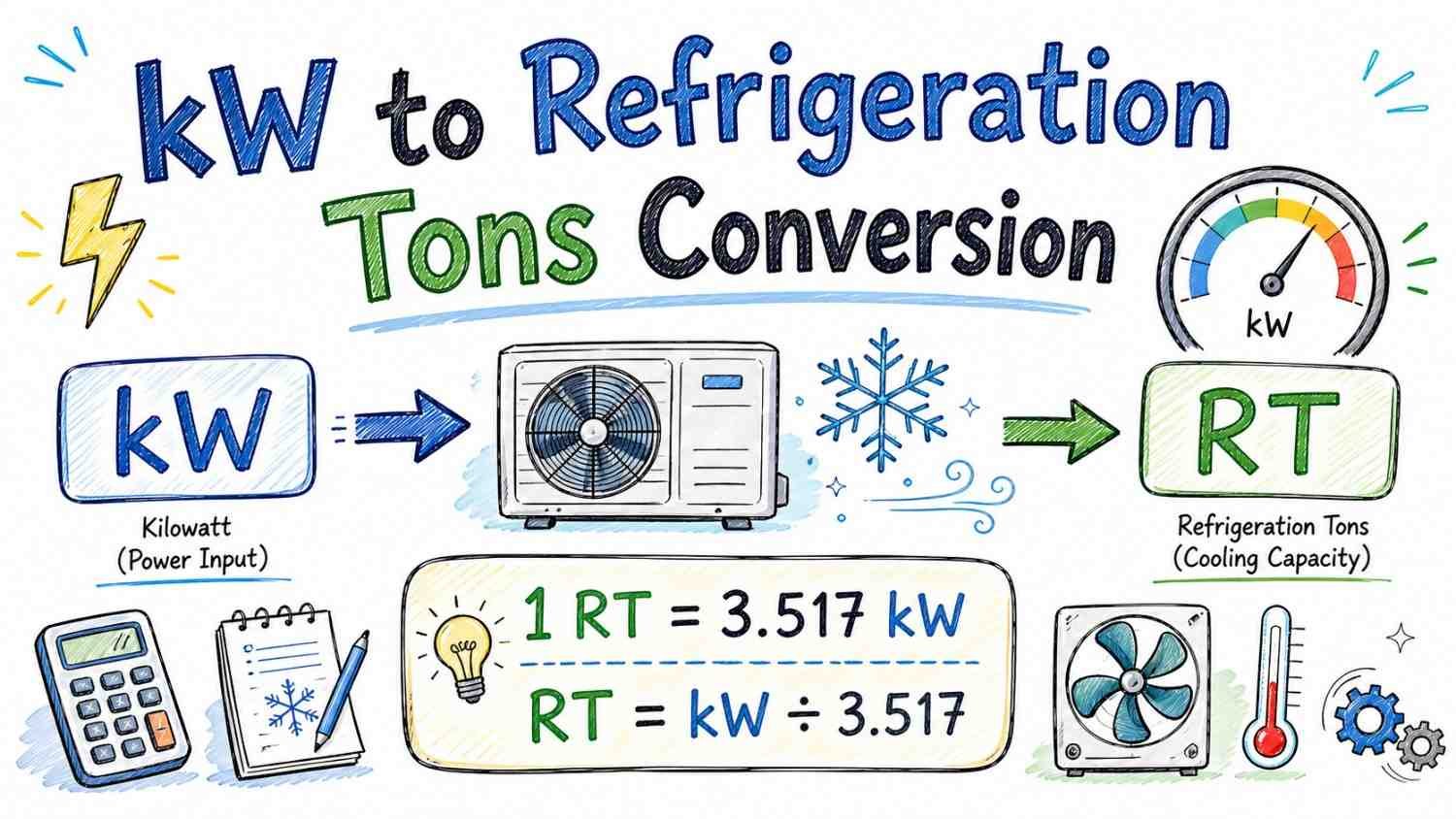
Kilowatts (kW) and refrigeration tons (RT) measure cooling capacity in HVAC systems but use different scales. 1 ton of refrigeration = 3.517 kilowatts = 12,000 BTU/hr—the amount of heat removed to melt 1 ton (2,000 lbs) of ice at 32°F in 24 hours. This standard emerged from early refrigeration systems using ice blocks for cooling. Modern air conditioners and chillers specify capacity in tons (US/UK) or kW (international metric standard). Understanding this conversion enables HVAC engineers to design cooling systems, calculate electrical loads, and compare equipment across different measurement systems for residential, commercial, and industrial applications.
Conversion Formulas
Kilowatts to Refrigeration Tons: \( \text{RT} = \frac{\text{kW}}{3.517} \) or \( \text{RT} = \text{kW} \times 0.2844 \). Divide cooling capacity in kilowatts by 3.517 to get tons. Examples: 3.517 kW = 1 ton; 7.034 kW = 2 tons; 17.585 kW = 5 tons; 35.17 kW = 10 tons; 70.34 kW = 20 tons; 175.85 kW = 50 tons; 351.7 kW = 100 tons; 703.4 kW = 200 tons. Refrigeration Tons to Kilowatts: \( \text{kW} = \text{RT} \times 3.517 \). Multiply tons by 3.517 to get cooling capacity in kilowatts. Examples: 1 ton × 3.517 = 3.517 kW; 5 tons = 17.585 kW; 10 tons = 35.17 kW; 20 tons = 70.34 kW; 50 tons = 175.85 kW; 100 tons = 351.7 kW; 200 tons = 703.4 kW; 500 tons = 1,758.5 kW. Important Note: These formulas convert cooling capacity output, not electrical power input. Electrical consumption depends on system efficiency (COP or kW/ton rating). A 10-ton chiller (35.17 kW cooling) might draw 6-12 kW electrical depending on efficiency: high-efficiency (COP 5.9): 6 kW electrical; standard (COP 4.0): 8.8 kW; lower-efficiency (COP 2.9): 12 kW. This distinction is critical for proper electrical sizing and energy cost calculations.
Cooling Capacity Comparison Table
| Refrigeration Tons (RT) | Kilowatts (kW) | BTU/hr | Typical Application |
|---|---|---|---|
| 1 ton | 3.52 kW | 12,000 | Small window AC, 400-600 sq ft |
| 2 tons | 7.03 kW | 24,000 | Large window AC, 800-1,200 sq ft |
| 3 tons | 10.55 kW | 36,000 | Small central AC, 1,200-1,800 sq ft |
| 5 tons | 17.59 kW | 60,000 | Residential central AC, 2,000-3,000 sq ft |
| 10 tons | 35.17 kW | 120,000 | Small commercial unit |
| 20 tons | 70.34 kW | 240,000 | Restaurant, retail store |
| 50 tons | 175.85 kW | 600,000 | Small office building |
| 100 tons | 351.7 kW | 1,200,000 | Medium office, hotel |
| 200 tons | 703.4 kW | 2,400,000 | Large commercial building |
| 500 tons | 1,758.5 kW | 6,000,000 | Hospital, data center |
HVAC System Efficiency and Electrical Demand
Understanding the relationship between cooling capacity (tons/kW) and electrical consumption is essential for proper system design. Chiller Efficiency Metrics: COP (Coefficient of Performance) = cooling output ÷ electrical input. Higher COP means better efficiency. Typical values: high-efficiency water-cooled centrifugal chiller COP 5.0-7.0; standard centrifugal COP 4.0-5.0; screw chiller COP 3.5-5.0; air-cooled chiller COP 2.5-3.5. kW per Ton Rating: Electrical power per ton of cooling. Lower kW/ton is better. Calculated as: kW/ton = 3.517 ÷ COP. Examples: COP 6.0 = 0.586 kW/ton; COP 5.0 = 0.703 kW/ton; COP 4.0 = 0.879 kW/ton; COP 3.0 = 1.172 kW/ton. Practical Example: A 100-ton chiller (351.7 kW cooling capacity) with different efficiencies: At 0.55 kW/ton (COP 6.4): 100 × 0.55 = 55 kW electrical demand; At 0.70 kW/ton (COP 5.0): 70 kW electrical; At 0.90 kW/ton (COP 3.9): 90 kW electrical; At 1.20 kW/ton (COP 2.9): 120 kW electrical. The efficiency difference impacts operating costs significantly. Over 3,000 hours/year at $0.12/kWh: High-efficiency (55 kW) = $19,800/year; Standard (70 kW) = $25,200/year; Lower-efficiency (90 kW) = $32,400/year. The $12,600 annual savings justifies investing in high-efficiency equipment. When converting kW to tons, always clarify whether discussing cooling capacity output or electrical power input to avoid sizing errors.
Why Choose RevisionTown's kW to Tons Converter?
RevisionTown's professional converter provides: (1) Exact Precision—Uses standardized factor 3.517 kW per ton for accurate HVAC calculations; (2) Bidirectional Conversion—Convert kW↔tons seamlessly with dedicated tabs; (3) Bulk Processing—Convert multiple chiller capacities simultaneously for multi-zone systems; (4) Quick Reference—Common AC and chiller sizes from 1-500 tons with applications; (5) Formula Display—View exact calculations for verification and documentation; (6) Mobile Optimized—Use on smartphones during site visits and equipment inspections; (7) Zero Cost—Completely free with no registration or limitations; (8) Professional Accuracy—Trusted by HVAC engineers, mechanical designers, facility managers, and contractors for chiller selection, cooling load calculations, electrical sizing, and energy analysis in commercial, industrial, and residential air conditioning systems worldwide.
❓ Frequently Asked Questions
1 kilowatt of cooling capacity equals 0.284 tons of refrigeration. Formula: 1 kW ÷ 3.517 = 0.284 RT. This converts cooling capacity, not electrical input. For electrical power consumption: a 1-ton AC (3.517 kW cooling) might draw 0.5-1.2 kW electrical depending on efficiency. Example: 3.5 kW cooling = 0.995 tons ≈ 1 ton; 10 kW = 2.84 tons; 35.17 kW = 10 tons.
Divide kilowatts by 3.517. Formula: RT = kW ÷ 3.517. Examples: 3.517 kW = 1 ton; 7.034 kW = 2 tons; 17.585 kW = 5 tons; 35.17 kW = 10 tons; 70.34 kW = 20 tons; 175.85 kW = 50 tons; 351.7 kW = 100 tons. Reverse: multiply tons by 3.517 to get kW. This conversion enables HVAC engineers to translate between metric (kW) and imperial (tons) cooling capacity specifications.
1 ton equals 3.517 kW cooling capacity (heat removal rate). For electrical consumption (kW per ton input), it depends on efficiency: High-efficiency chiller: 0.50-0.60 kW/ton electrical (COP 5.9-7.0); Standard: 0.70-0.90 kW/ton (COP 3.9-5.0); Air-cooled: 0.90-1.20 kW/ton (COP 2.9-3.9). Example: 10-ton AC uses 3.517 × 10 = 35.17 kW cooling capacity, but draws 5-12 kW electrical depending on efficiency.
A ton of refrigeration (RT) measures cooling capacity—the rate of heat removal. 1 ton = 12,000 BTU/hr = 3.517 kW = 3,024 kcal/hr. Origin: heat required to melt 1 ton (2,000 lbs) of ice at 32°F in 24 hours. Applications: residential AC 1-5 tons; commercial chillers 20-500 tons; industrial systems 500-2,000+ tons. Rule of thumb: 1 ton cools approximately 400-600 sq ft depending on climate, insulation, and internal loads.
kW/ton shows electrical power per unit of cooling—lower is better. Typical values: High-efficiency: 0.50-0.60 kW/ton (COP 5.9-7.0); Standard: 0.70-0.90 kW/ton (COP 3.9-5.0); Air-cooled: 0.90-1.20 kW/ton (COP 2.9-3.9). Example: 100-ton chiller at 0.60 kW/ton draws 60 kW electrical; at 0.80 kW/ton draws 80 kW—33% more power for same cooling. Annual cost difference: 20 kW × 3,000 hours × $0.12/kWh = $7,200 savings with efficient unit.
1,000 square feet typically requires 2-3 tons of cooling (7-10.5 kW or 24,000-36,000 BTU/hr). Rule of thumb: Hot climates (Arizona, Texas): 300-400 sq ft per ton = 2.5-3.3 tons; Moderate climates: 400-500 sq ft per ton = 2.0-2.5 tons; Mild climates: 500-600 sq ft per ton = 1.7-2.0 tons. Factors affecting size: insulation quality, ceiling height, window area, occupancy, equipment loads. Professional Manual J load calculation recommended for accurate sizing.
COP (Coefficient of Performance) = cooling output ÷ electrical input (both in kW). Higher COP = better efficiency. Relationship: kW/ton = 3.517 ÷ COP. Examples: COP 3.0 → 1.172 kW/ton; COP 4.0 → 0.879 kW/ton; COP 5.0 → 0.703 kW/ton; COP 6.0 → 0.586 kW/ton; COP 7.0 → 0.502 kW/ton. EER (Energy Efficiency Ratio) = BTU/hr output ÷ watts input. Conversion: COP = EER ÷ 3.412. Minimum standards: ASHRAE 90.1 requires COP 2.8+ for commercial chillers.