km to feet Converter
Convert kilometers to feet using the exact international foot definition \(1\text{ ft}=0.3048\text{ m}\) and the metric relationship \(1\text{ km}=1000\text{ m}\). Use the calculator for instant results, then review the formula, chart, examples, reverse conversion, rounding guidance, scale checks, engineering notes, route interpretation and classroom methods.
Use the Converter
Enter a value, choose the direction, and select how many decimal places you want. This page focuses on kilometers to feet, but a reverse feet-to-kilometers option is included for checking a converted value or reviewing imported data.
Example: \(1\text{ km}\approx3280.8399\text{ ft}\), because \(1000\div0.3048\approx3280.8399\).
Quick Formula
\(1\text{ km}=1000\text{ m}\).
\(1\text{ ft}=0.3048\text{ m}\) exactly.
\(1\text{ km}=\frac{1000}{0.3048}\text{ ft}\approx3280.8398950131\text{ ft}\).
\(\text{feet}=\text{kilometers}\times3280.8398950131\).
Best use: Use this page for direct km to feet conversion. For nearby unit pairs, use km to inches, km to yards, km to miles, or km to meters.
How to Convert Kilometers to Feet
To convert kilometers to feet, multiply the kilometer value by \(3280.8398950131\). This factor comes from two exact relationships: \(1\text{ km}=1000\text{ m}\) and \(1\text{ ft}=0.3048\text{ m}\). Since a foot is much smaller than a kilometer, the number of feet will be much larger than the number of kilometers.
\[1\text{ km}=1000\text{ m}\]
\[1\text{ ft}=0.3048\text{ m}\]
\[1\text{ km}=\frac{1000}{0.3048}\text{ ft}\]
\[1\text{ km}\approx3280.8398950131\text{ ft}\]
\[\text{feet}=\text{kilometers}\times3280.8398950131\]
For example, \(3\text{ km}\) converts to feet as follows:
\[3\times3280.8398950131\approx9842.5196850394\text{ ft}\]
So, \(3\text{ km}\approx9842.52\text{ ft}\) when rounded to two decimal places. The physical distance has not changed; only the unit has changed from metric kilometers to customary feet.
Why the Factor Is \(3280.8398950131\)
The factor is not a whole number because kilometers and feet belong to different measurement systems. Kilometers are metric. Feet are customary and imperial units, now defined exactly in terms of meters. Since \(1\text{ ft}=0.3048\text{ m}\), the number of feet in \(1000\text{ m}\) is \(1000\div0.3048\).
\[\frac{1000}{0.3048}=3280.839895013123\ldots\]
This differs from km to meters, km to centimeters, and km to millimeters, where the target remains metric and the conversion factor is a power of ten. Kilometers to feet crosses from metric into the foot-based customary system.
The foot definition is exact, but the decimal representation of \(1000\div0.3048\) is normally rounded for display. That is why explanatory text often uses \(\approx\) when showing decimal feet.
Kilometers to Feet Chart
The chart below shows common kilometer values converted to feet. Values are rounded for readability; use the calculator when you need a specific decimal setting.
| Kilometers | Feet | Common context |
|---|---|---|
| \(0.0003048\text{ km}\) | \(1\text{ ft}\) | one foot |
| \(0.001\text{ km}\) | \(3.2808\text{ ft}\) | one meter |
| \(0.01\text{ km}\) | \(32.8084\text{ ft}\) | ten meters |
| \(0.1\text{ km}\) | \(328.0840\text{ ft}\) | one hundred meters |
| \(0.5\text{ km}\) | \(1640.4199\text{ ft}\) | half kilometer |
| \(1\text{ km}\) | \(3280.8399\text{ ft}\) | one kilometer |
| \(2\text{ km}\) | \(6561.6798\text{ ft}\) | two kilometers |
| \(5\text{ km}\) | \(16{,}404.1995\text{ ft}\) | 5K distance |
| \(10\text{ km}\) | \(32{,}808.3990\text{ ft}\) | 10K distance |
| \(42.195\text{ km}\) | \(138{,}435.0394\text{ ft}\) | marathon distance |
Step-by-Step Examples
These examples show the formula for whole kilometers, decimal kilometers, route distances and reverse conversion.
Example 1: Convert \(1\text{ km}\) to feet
\[1\times3280.8398950131\approx3280.8399\text{ ft}\]
So, \(1\text{ km}\approx3280.8399\text{ ft}\).
Example 2: Convert \(0.25\text{ km}\) to feet
\[0.25\times3280.8398950131\approx820.2099737533\text{ ft}\]
So, \(0.25\text{ km}\approx820.2100\text{ ft}\).
Example 3: Convert \(7.5\text{ km}\) to feet
\[7.5\times3280.8398950131\approx24{,}606.2992125984\text{ ft}\]
So, \(7.5\text{ km}\approx24{,}606.2992\text{ ft}\).
Example 4: Convert \(10{,}000\text{ ft}\) to km
\[10{,}000\times0.0003048=3.048\text{ km}\]
So, \(10{,}000\text{ ft}=3.048\text{ km}\).
Reverse Conversion: Feet to Kilometers
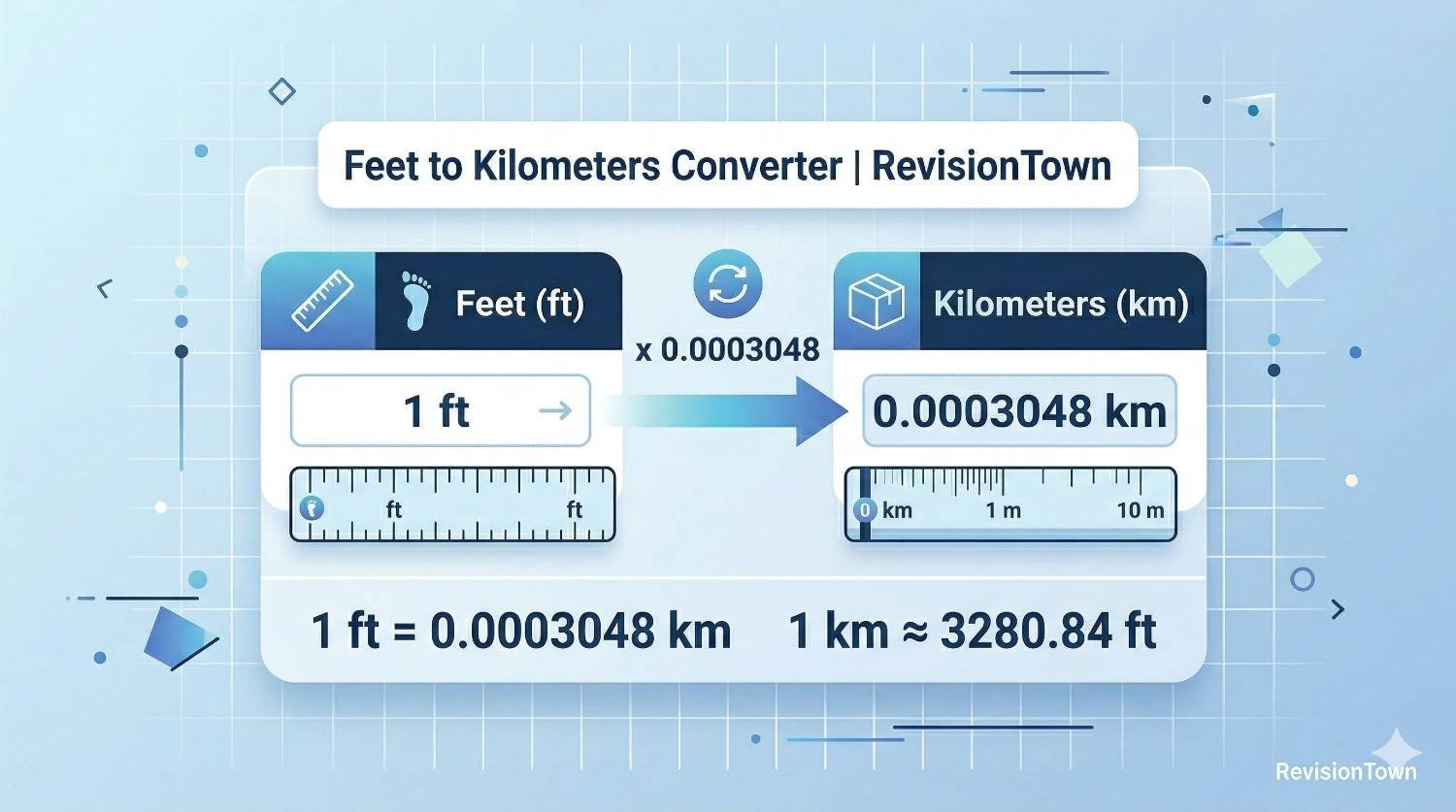
To convert feet to kilometers, multiply the foot value by \(0.0003048\). This works because \(1\text{ ft}=0.3048\text{ m}=0.0003048\text{ km}\). You can also divide feet by \(3280.8398950131\).
\[\text{kilometers}=\text{feet}\times0.0003048\]
\[\text{kilometers}=\frac{\text{feet}}{3280.8398950131}\]
For \(5000\text{ ft}\), the kilometer value is:
\[5000\times0.0003048=1.524\text{ km}\]
So, \(5000\text{ ft}=1.524\text{ km}\). For a reverse-focused page, use feet to kilometers. For feet to other units, use feet to meters, feet to inches, feet to yards, or feet to miles.
Unit Cancellation Method
Unit cancellation is a reliable written method because it shows how kilometers become feet. The setup uses a kilometer-to-meter step and a meter-to-foot step. The kilometer and meter units cancel, leaving feet as the final unit.
\[\text{distance in feet}=\text{distance in km}\times\frac{1000\text{ m}}{1\text{ km}}\times\frac{1\text{ ft}}{0.3048\text{ m}}\]
For \(1.2\text{ km}\), the setup is:
\[1.2\text{ km}\times\frac{1000\text{ m}}{1\text{ km}}\times\frac{1\text{ ft}}{0.3048\text{ m}}\]
\[1.2\times\frac{1000}{0.3048}\approx3937.0078740157\text{ ft}\]
If the final unit is meters, the conversion stopped too early. If the final unit is inches, yards or miles, a different customary conversion step was used. Unit cancellation is especially useful in worksheets, engineering notes and data reviews because it documents the conversion path.
Manual Conversion Without the Calculator
You can convert manually by using a two-step route: kilometers to meters, then meters to feet. First multiply kilometers by \(1000\). Then divide meters by \(0.3048\), because each foot is exactly \(0.3048\text{ m}\).
\[\text{meters}=\text{kilometers}\times1000\]
\[\text{feet}=\text{meters}\div0.3048\]
For \(0.8\text{ km}\), first convert to meters:
\[0.8\times1000=800\text{ m}\]
Then convert meters to feet:
\[800\div0.3048\approx2624.6719160105\text{ ft}\]
The one-step formula gives the same result:
\[0.8\times3280.8398950131\approx2624.6719160105\text{ ft}\]
Manual conversion is slower than the calculator, but it is useful when you need to explain the factor, audit a spreadsheet, or show the method in a class answer.
When Kilometers to Feet Is Useful
Kilometers and feet are far apart in scale and belong to different measurement systems. Kilometers describe long distances such as roads, route lengths, map paths and race distances. Feet are used for shorter customary measurements, elevation, building dimensions, field distances and many US-based construction or land-measurement contexts.
Direct km-to-feet conversion is useful when a long metric distance must be expressed in a foot-based system. A GIS dataset may store route length in kilometers while a local report expects feet. A field note may describe a corridor in kilometers but a construction drawing may use feet. A classroom problem may ask students to bridge metric and customary units directly.
It is not always the best public display unit. A \(10\text{ km}\) route is easier to read than \(32{,}808.399\text{ ft}\) for most readers. Use feet when feet are required by the task, audience or downstream system. Otherwise, kilometers, meters or miles may be more readable.
Metric to Customary Context
The metric system uses powers of ten. \(1\text{ km}=1000\text{ m}=100{,}000\text{ cm}=1{,}000{,}000\text{ mm}\). Feet are not part of that prefix ladder. Instead, the international foot is exactly defined as \(0.3048\text{ m}\). This exact definition makes modern conversion precise, but it does not make the factor a simple power of ten.
Because the conversion crosses systems, do not move the decimal point alone. Decimal movement works for km to meters, km to centimeters, and km to millimeters. It does not work for feet, inches, yards or miles without the correct customary relationship.
If the target is another customary unit, use a direct converter such as km to inches, km to yards, or km to miles. Direct converters reduce the chance of applying an intermediate factor incorrectly.
Feet, Inches, Yards and Miles
Feet connect naturally to inches, yards and miles. \(1\text{ ft}=12\text{ in}\), \(1\text{ yd}=3\text{ ft}\), and \(1\text{ mi}=5280\text{ ft}\). These relationships can be used to cross-check a km-to-feet result.
\[1\text{ km}\approx3280.8398950131\text{ ft}\]
\[1\text{ km}\approx3280.8398950131\times12=39{,}370.0787401575\text{ in}\]
\[1\text{ km}\approx\frac{3280.8398950131}{3}=1093.6132983377\text{ yd}\]
\[1\text{ km}\approx\frac{3280.8398950131}{5280}=0.6213711922\text{ mi}\]
If the foot result does not match these relationships, check the unit label. A common mistake is confusing feet with inches. Since inches are \(12\) times smaller than feet, the inch value should be \(12\) times larger than the foot value.
Maps, Routes and Elevation Notes
Maps often use kilometers for horizontal route distance and feet for elevation, especially in mixed-unit contexts. A trail might be \(8\text{ km}\) long with \(1200\text{ ft}\) of elevation gain. These are different dimensions: the route length is horizontal or along-path distance, while elevation gain is vertical change.
If you convert the route length \(8\text{ km}\) to feet, the value is:
\[8\times3280.8398950131\approx26{,}246.71916010499\text{ ft}\]
The route is about \(26{,}247\text{ ft}\) long, while the elevation gain might be \(1200\text{ ft}\). Do not compare those values as if they measure the same thing. They use the same unit after conversion, but one is route distance and the other is vertical climb.
For public hiking or travel descriptions, kilometers or miles may still be better for route length. Feet are often best for elevation, building height or local land-measurement context. The converter is useful when a document requires all length values in feet.
Scale Drawings and Plans
Scale drawings can involve real-world kilometers and drawing feet. A site corridor may be \(1.5\text{ km}\) long in the real world, but a plan may use feet as the working unit. First convert the real distance to feet:
\[1.5\times3280.8398950131\approx4921.2598425197\text{ ft}\]
If the drawing uses a scale factor, apply that scale after the real-world conversion. For a \(1:1000\) scale, the drawing length would be:
\[\frac{4921.2598425197\text{ ft}}{1000}\approx4.9213\text{ ft}\]
The km-to-feet conversion gives the real-world foot value. The scale factor turns that real-world length into the drawing length. Confusing those two values can make a drawing wildly too large or too small.
Engineering, Surveying and Field Work
Engineering and surveying projects often mix metric source data with foot-based drawings, reports or legacy systems. A route alignment, cable run, pipeline segment or roadway section may be measured in kilometers, but a downstream drawing set may expect feet. The conversion factor provides a consistent bridge.
For example, \(2.75\text{ km}\) is:
\[2.75\times3280.8398950131\approx9022.3097112861\text{ ft}\]
A technical note should keep both values visible: "\(2.75\text{ km}\approx9022.31\text{ ft}\)." This is easier to review than writing only \(9022.31\). It also lets another person verify the unit path if the data is later imported into a CAD model, report or estimate.
When using feet in technical workflows, confirm whether the receiving system expects decimal feet, feet-and-inches, survey feet, or another local convention. This page uses the international foot, \(1\text{ ft}=0.3048\text{ m}\), which is the standard modern definition for general conversion.
Rounding and Precision
The foot definition is exact, and the kilometer-to-meter relationship is exact. However, a kilometer input may be approximate. A route listed as \(2\text{ km}\) may be rounded to the nearest kilometer, nearest tenth of a kilometer, or another practical level. Converting it to \(6561.6798\text{ ft}\) does not make the original route exact to a tenth of a foot.
Use enough decimals for the task, but do not imply false precision. A classroom problem may ask for two decimal places. A field report may round to the nearest foot. A data export may preserve more decimals internally. The calculator lets you choose a display precision, but the source accuracy still matters.
A good pattern is to calculate with the full factor and round at the end. Rounding the factor to \(3281\) before multiplying may be acceptable for a rough estimate, but it can create noticeable differences over long distances. For final work, use \(3280.8398950131\) and then round the result.
Exact Equals or Approximate Equals?
The exact expression for \(1\text{ km}\) in feet is \(\frac{1000}{0.3048}\text{ ft}\). The decimal \(3280.8398950131\) is a rounded display of that quotient. For this reason, decimal foot results are usually written with \(\approx\), especially in explanatory text.
\[1\text{ km}=\frac{1000}{0.3048}\text{ ft}\]
\[1\text{ km}\approx3280.8398950131\text{ ft}\]
If the source distance is approximate, the converted result is approximate too. A trail described as "about \(3.4\text{ km}\)" is about \(11{,}154.86\text{ ft}\), not exactly that length. Use "about" or \(\approx\) when the source value or displayed result is rounded.
Common Mistakes to Avoid
Using \(1000\) only
\(1000\) converts kilometers to meters. To reach feet, divide meters by \(0.3048\) or multiply kilometers by \(3280.8398950131\).
Confusing feet and inches
\(1\text{ ft}=12\text{ in}\). A kilometer is about \(3280.84\text{ ft}\), but about \(39{,}370.08\text{ in}\).
Moving the decimal point
Decimal movement works inside the metric system. Kilometers to feet crosses systems, so use the exact foot definition.
Using a length factor for area
Kilometers to feet is a linear conversion. Square kilometers to square feet requires the factor squared.
Area and Volume Caution
Kilometers to feet is a length conversion. It applies to distance, length, width, height and depth. It does not directly convert square kilometers to square feet or cubic kilometers to cubic feet. Area and volume require squared and cubed factors.
\[1\text{ km}\approx3280.8398950131\text{ ft}\]
\[1\text{ km}^2\approx(3280.8398950131)^2\text{ ft}^2\]
\[1\text{ km}^3\approx(3280.8398950131)^3\text{ ft}^3\]
If a square area is \(1\text{ km}\) by \(1\text{ km}\), each side is about \(3280.8399\text{ ft}\). The area is the foot side length multiplied by itself. Multiplying by the linear factor only once would be incorrect.
Spreadsheet and Data Workflow
If a kilometer value is stored in a spreadsheet cell such as \(A2\), the foot formula is:
\[\text{feet}=A2\times3280.8398950131\]
Use clear column names such as "distance_km" and "distance_ft". A generic label such as "distance" is risky when a dataset includes several unit systems. Store the original kilometer value in one column, the calculated foot value in another column, and any rounded display value separately.
For reverse checking, use:
\[\text{kilometers}=\text{feet}\times0.0003048\]
If the reverse value does not match the original within the expected rounding, check the factor and direction. A common spreadsheet error is multiplying kilometers by \(0.3048\), which is the wrong direction and creates a result that is far too small.
Batch Conversion for Lists
Batch conversion is useful for route tables, construction records, GIS exports, survey notes, classroom exercises and software tests. Apply the same factor to every kilometer value and keep the source values visible for review.
| Source distance | Formula | Foot result |
|---|---|---|
| \(0.05\text{ km}\) | \(0.05\times3280.8398950131\) | \(164.0420\text{ ft}\) |
| \(0.5\text{ km}\) | \(0.5\times3280.8398950131\) | \(1640.4199\text{ ft}\) |
| \(1.25\text{ km}\) | \(1.25\times3280.8398950131\) | \(4101.0499\text{ ft}\) |
| \(8\text{ km}\) | \(8\times3280.8398950131\) | \(26{,}246.7192\text{ ft}\) |
After converting a list, scan for scale outliers. If one row is thousands of times smaller than nearby values, the source may have been meters rather than kilometers. If it is twelve times too large, inches may have been used accidentally. Unit-specific column names and reverse checks prevent these errors.
Quality Checks Before Using the Result
A correct km-to-feet result should be about \(3280.84\) times the kilometer value. If \(1\text{ km}\) becomes \(1000\text{ ft}\), the conversion stopped at meters. If \(1\text{ km}\) becomes \(39{,}370\text{ ft}\), the result is closer to inches, not feet. The correct value is about \(3280.84\text{ ft}\).
Use these anchor points for quick checking:
- \(0.001\text{ km}=3.2808\text{ ft}\)
- \(0.01\text{ km}=32.8084\text{ ft}\)
- \(0.1\text{ km}=328.0840\text{ ft}\)
- \(1\text{ km}=3280.8399\text{ ft}\)
- \(10\text{ km}=32{,}808.3990\text{ ft}\)
If the converted value will be used in a drawing, data table or technical report, include both source and converted units. A note such as "\(0.75\text{ km}\approx2460.63\text{ ft}\)" is easier to audit than a foot value by itself.
Working With Small Kilometer Values
Small kilometer values often produce practical foot values. \(0.001\text{ km}\) is \(1\text{ m}\), which is about \(3.2808\text{ ft}\). \(0.0003048\text{ km}\) is exactly one foot. These small values are common when a dataset stores all lengths in kilometers but some entries represent object-scale or room-scale distances.
For example, \(0.002\text{ km}=2\text{ m}\), and \(2\text{ m}\approx6.5617\text{ ft}\). A value like \(0.002\text{ km}\) may look tiny, but in feet it is a familiar human-scale distance. Keep leading zeros carefully: \(0.02\text{ km}\), \(0.002\text{ km}\), and \(0.0002\text{ km}\) differ by factors of ten.
Large Kilometer Values
Large kilometer values generate very large foot values. \(100\text{ km}\) is about \(328{,}083.9895\text{ ft}\). \(1000\text{ km}\) is about \(3{,}280{,}839.8950\text{ ft}\). These values are mathematically correct, but they are not always the clearest display for people.
Use feet for long kilometer distances only when a foot-based system requires it. For travel, kilometers or miles are usually easier. For field work, meters or feet may be useful depending on the local convention. For engineering, the required unit should follow the project standard.
Scientific Notation for Large Values
Scientific notation can make large foot results easier to review. One kilometer is about \(3.280839895\times10^3\text{ ft}\). Ten kilometers is about \(3.280839895\times10^4\text{ ft}\). One hundred kilometers is about \(3.280839895\times10^5\text{ ft}\).
\[1\text{ km}\approx3.280839895\times10^3\text{ ft}\]
\[10\text{ km}\approx3.280839895\times10^4\text{ ft}\]
\[100\text{ km}\approx3.280839895\times10^5\text{ ft}\]
For public text, comma grouping is usually friendlier. For data, code or scientific comparison, scientific notation can reduce long digit strings and make powers of ten easier to inspect.
When Not to Display Feet
Even though the conversion is valid, feet are not always the best display unit. A road route of \(100\text{ km}\) is clearer than \(328{,}083.99\text{ ft}\). A metric science problem may prefer meters. A fine technical part may prefer inches or millimeters. A long trip may prefer miles or kilometers.
Use feet when the receiving system, audience or problem specifically asks for feet. Otherwise, choose a unit that matches the scale of the distance. The best answer is not only mathematically correct; it is usable for the reader.
Cross-Checking Through Inches, Yards and Miles
A useful way to verify a km-to-feet answer is to compare it with neighboring customary units. Since \(1\text{ ft}=12\text{ in}\), the inch result should be twelve times the foot result. Since \(1\text{ yd}=3\text{ ft}\), the yard result should be one third of the foot result. Since \(1\text{ mi}=5280\text{ ft}\), the mile result should be the foot result divided by \(5280\).
\[3280.8398950131\times12\approx39{,}370.0787401575\text{ in}\]
\[3280.8398950131\div3\approx1093.6132983377\text{ yd}\]
\[3280.8398950131\div5280\approx0.6213711922\text{ mi}\]
If a table lists \(1\text{ km}\) as about \(3280.84\text{ ft}\), then the corresponding inch, yard and mile values should match these relationships. Cross-checking catches mislabeled columns before the data is used.
Speed and Pace Caution
Kilometers to feet is a distance conversion. Speed and pace include time, so the time unit must also be handled. A speed of \(1\text{ km/h}\) is about \(3280.8399\text{ ft/h}\). To convert that to feet per second, divide by \(3600\).
\[1\text{ km/h}\approx3280.8399\text{ ft/h}\]
\[3280.8399\div3600\approx0.9113\text{ ft/s}\]
Do not label a distance conversion as a speed conversion unless the time unit is included. Similarly, a pace such as minutes per kilometer cannot be converted by changing only the distance number. The denominator matters.
How to Format a Final Answer
A clear final answer includes the original value, the converted value and the unit. For example, write "\(1.25\text{ km}\approx4101.05\text{ ft}\)" rather than "1.25 equals 4101.05." If the result is rounded, use \(\approx\). If you use the exact fraction form, an equals sign is acceptable.
\[1.25\text{ km}=\frac{1250}{0.3048}\text{ ft}\]
\[1.25\text{ km}\approx4101.0499\text{ ft}\]
For technical writing, state the rounding rule. For example: "Converted to feet and rounded to two decimal places, \(1.25\text{ km}\approx4101.05\text{ ft}\)." This prevents readers from assuming more precision than the source supports.
Choosing a Display Precision
The calculator can show several decimal places, but the best display is not always the longest one. Precision should match the source measurement, the purpose of the answer and the tolerance of the task. A school exercise may ask for two decimal places. A rough site estimate may use the nearest foot. A technical data table may keep four or more decimal places so later calculations do not lose accuracy too early.
Start by asking how the kilometer value was measured. If a route length is listed as \(2\text{ km}\), that value may be rounded to the nearest kilometer, so showing \(6561.6797900262\text{ ft}\) suggests detail that the source does not support. A display such as \(2\text{ km}\approx6562\text{ ft}\) is usually more honest. If the source is \(2.0000\text{ km}\) from a controlled dataset, additional decimals in feet may be more appropriate.
A good rule is to preserve more precision during calculation than you display in the final answer. For example, if a spreadsheet converts \(3.7\text{ km}\), calculate with the full factor \(3280.8398950131\), then format the displayed result as needed:
\[3.7\times3280.8398950131=12{,}139.1076115485\text{ ft}\]
\[\text{nearest foot}=12{,}139\text{ ft}\]
\[\text{two decimal places}=12{,}139.11\text{ ft}\]
The stored value can keep the full result while the page, report or drawing shows a cleaner number. This approach is especially useful when several converted distances will later be added, averaged or compared. Rounding every intermediate result can create small cumulative differences.
For public-facing content, use a precision that readers can act on. A walking route does not need hundredths of a foot. A laboratory setup or engineering specification might. The correct number of decimals is a communication decision as well as a mathematical decision.
Decimal Feet vs Feet and Inches
A kilometer-to-feet result is usually expressed in decimal feet, such as \(3280.84\text{ ft}\). Decimal feet are convenient for formulas because they remain a single number. In building, furniture, height descriptions and some practical measurements, readers may prefer feet plus inches, such as \(5\text{ ft }8\text{ in}\). The two formats are related, but they are not interchangeable without an extra step.
To convert decimal feet to feet and inches, keep the whole feet and multiply the decimal remainder by \(12\). For example, suppose a converted length is \(41.3386\text{ ft}\). The whole-foot part is \(41\text{ ft}\). The decimal remainder is \(0.3386\text{ ft}\). Convert that remainder to inches:
\[0.3386\text{ ft}\times12\approx4.0632\text{ in}\]
\[41.3386\text{ ft}\approx41\text{ ft }4.06\text{ in}\]
This matters because \(41.5\text{ ft}\) is not \(41\text{ ft }5\text{ in}\). It is \(41\text{ ft }6\text{ in}\), because half a foot is six inches. Many mistakes happen when decimal digits are read as inches. A decimal after a foot value is a fraction of a foot, not a count of inches.
For kilometer-scale distances, feet plus inches is rarely the best display because the inch part is tiny compared with the total distance. It can be useful for small kilometer values, such as \(0.003\text{ km}\), which equals about \(9.8425\text{ ft}\), or roughly \(9\text{ ft }10.11\text{ in}\). For ordinary route lengths, keep the answer in decimal feet or round to whole feet.
Estimating Before You Calculate
Estimation is a useful habit because it lets you see whether a calculator or spreadsheet output is realistic. Since \(1\text{ km}\) is a little more than \(3000\text{ ft}\), a rough estimate can use \(3300\text{ ft}\) per kilometer. This mental factor is close enough for checking scale, though it should not replace the exact calculation when precision matters.
\[1\text{ km}\approx3300\text{ ft}\quad\text{for a quick estimate}\]
\[1\text{ km}\approx3280.8399\text{ ft}\quad\text{for calculation}\]
For \(4\text{ km}\), the quick estimate gives about \(13{,}200\text{ ft}\). The more precise result is \(13{,}123.3596\text{ ft}\). The estimate is close enough to confirm the order of magnitude. If a tool returned \(1312\text{ ft}\) or \(131{,}200\text{ ft}\), you would immediately know that a factor, decimal point or unit label is wrong.
Another useful estimate is to remember that \(5\text{ km}\) is about \(16{,}400\text{ ft}\). That anchor point helps with running routes, map distances and classroom examples. Half of that is \(2.5\text{ km}\approx8200\text{ ft}\), and one tenth is \(0.5\text{ km}\approx1640\text{ ft}\). Estimation does not need to be exact; it needs to be close enough to catch an unreasonable answer before it is reused.
Using the Conversion in Word Problems
Many word problems hide the unit conversion inside a larger task. The safest method is to separate the steps. First identify the distance in kilometers, then convert that distance to feet, then continue with the rest of the problem. Mixing every operation into one long expression can make unit errors harder to see.
Suppose a walking path is \(1.8\text{ km}\) long and markers are placed every \(300\text{ ft}\). Convert the total path length first:
\[1.8\text{ km}\times3280.8398950131\approx5905.5118\text{ ft}\]
Then compare the result with the marker spacing:
\[5905.5118\div300\approx19.685\]
This means the path contains nineteen full \(300\text{ ft}\) intervals and a remaining distance. Depending on the problem wording, you may need twenty marker spaces or twenty-one physical markers including the start point. The conversion alone does not answer the whole problem; it prepares the distance in the unit needed for the next step.
For construction or field-layout problems, write units on every line. A line such as \(5905.5118\div300\) is less clear than \(5905.5118\text{ ft}\div300\text{ ft}\). The units cancel, leaving a count. Unit cancellation shows why the answer is a number of intervals, not a distance.
Data Import and Unit Label Checks
When kilometer values come from imported files, check the column labels before converting. CSV files, map exports, fitness logs and planning systems may abbreviate columns in ways that are easy to misread. A label such as "dist" is not enough. Look for documentation, metadata, sample rows or known reference values that confirm whether the column is in kilometers, meters, miles or feet.
A practical check is to choose one row with a known approximate distance. If a route that should be \(10\text{ km}\) appears as \(10\), the column may indeed be kilometers. If it appears as \(10000\), the column is probably meters. If it appears as \(6.2137\), it may be miles. If it appears as \(32808.4\), it may already be feet. Convert only after the unit is confirmed.
For imported data, create a small audit table before processing the full file:
| Observed value | Possible unit | Check |
|---|---|---|
| \(10\) | kilometers | \(10\text{ km}\approx32{,}808.4\text{ ft}\) |
| \(10000\) | meters | \(10000\text{ m}=10\text{ km}\) |
| \(6.2137\) | miles | \(6.2137\text{ mi}\approx10\text{ km}\) |
| \(32808.4\) | feet | Already near \(10\text{ km}\) in feet |
After confirming the unit, rename columns clearly. For example, use "distance_km_source", "distance_ft_calculated" and "distance_ft_display". Clear labels reduce mistakes when someone else opens the file later.
Calculator Design Notes for Users
This converter is intentionally narrow: it converts kilometers and feet. A narrow tool is useful when the search task is direct and the user needs an immediate answer, formula and explanation for a single pair of units. A broad unit tool is better when the same task involves several length units at once.
The calculator keeps the conversion direction visible because the two factors are very different. Kilometers to feet uses multiplication by \(3280.8398950131\). Feet to kilometers uses multiplication by \(0.0003048\). If the wrong factor is applied, the answer can be off by millions of percent for large distances. Keeping the direction selector explicit reduces that risk.
The result panel includes related outputs such as meters, inches, yards and miles so users can check the scale without leaving the page. These are supporting values, not a replacement for the main km-to-feet answer. The main conversion remains the direct relationship:
\[\text{feet}=\text{kilometers}\times3280.8398950131\]
For best results, enter the original value exactly as given, choose the correct direction and use the decimal selector only for display. If you need to reuse the answer in another calculation, keep a copy with more decimals than the final report requires.
Teaching the Conversion
Students often remember conversion factors better when they see where the factor comes from. The kilometer-to-feet factor is not arbitrary. It follows from two exact relationships: \(1\text{ km}=1000\text{ m}\) and \(1\text{ ft}=0.3048\text{ m}\). Since a foot is \(0.3048\) meters, the number of feet in \(1000\) meters is \(1000\div0.3048\).
\[\frac{1000}{0.3048}=3280.8398950131\]
A classroom explanation can use a three-column layout: known relationship, operation and result. First write the known metric relationship. Then divide by the meter length of one foot. Then show the final conversion factor. This sequence helps students understand why kilometers are multiplied by a number larger than one when converting to feet. A kilometer is a large unit; feet are smaller units; therefore more feet are needed to cover the same distance.
It is also useful to compare with meters. Because \(1\text{ km}=1000\text{ m}\) and \(1\text{ m}\approx3.28084\text{ ft}\), multiplying \(1000\) by \(3.28084\) gives the same scale. This second route reinforces the factor and gives students another way to check their work.
Professional Reporting Examples
Professional reports should make the conversion easy to audit. Include the original value, converted value, unit and rounding convention. Avoid placing a converted number in a table without its source unit. If several units are present, put units in column headings rather than repeating them inconsistently in each cell.
A clear table might use columns such as "Route length (km)", "Route length (ft)" and "Rounded display". A note below the table can state: "Feet values are calculated using \(1\text{ km}=3280.8398950131\text{ ft}\) and rounded to two decimal places for display." This gives readers enough information to reproduce the conversion without adding clutter to every row.
For drawings and specifications, decide whether converted values are informational or controlling. If a design is controlled in metric units, the foot value may be a reference. If a contractor must build from foot values, the foot value may become operational. The difference affects rounding and tolerance. A reference conversion can be rounded for readability; a controlling dimension may need project-specific precision and review.
When values are legally, commercially or technically sensitive, document the source of the original measurement and the conversion factor used. Unit conversions are simple, but mistakes in unit direction, rounding or labeling can create expensive misunderstandings.
Common Input Scenarios
Users often arrive with values written in different styles. The mathematical conversion is the same, but the input needs to be interpreted correctly. A value written as \(0.75\text{ km}\) is three quarters of a kilometer. A value written as \(750\text{ m}\) is the same distance, but it is not a kilometer input until it has been converted to \(0.75\text{ km}\). A value written as \(0.75\) without a unit should not be assumed unless the surrounding context clearly says kilometers.
Here are common input forms and how to handle them:
- If the value is already in kilometers, multiply by \(3280.8398950131\).
- If the value is in meters, first divide by \(1000\), then convert kilometers to feet.
- If the value is in miles, use a mile-to-feet or mile-to-kilometer conversion instead of treating it as kilometers.
- If the value is a range, convert both endpoints and keep the same rounding rule for both.
- If the value includes uncertainty, convert the uncertainty as well as the central value.
For example, a measured route of \(2.4\pm0.1\text{ km}\) can be converted by applying the same factor to the center value and the uncertainty:
\[2.4\text{ km}\approx7874.0157\text{ ft}\]
\[0.1\text{ km}\approx328.0840\text{ ft}\]
\[2.4\pm0.1\text{ km}\approx7874.02\pm328.08\text{ ft}\]
This preserves the meaning of the original measurement. Converting only the central value and ignoring the uncertainty can make a result look more certain than it really is.
Unit Consistency in Multi-Step Calculations
Some tasks combine distance with rates, counts, costs or time. Convert the distance to the unit required by the next formula before substituting it. If a cost is given per foot, use feet. If a rate is given per kilometer, keep kilometers. If a speed is given in feet per second, convert both the distance and the time if necessary.
Suppose a cable route is \(0.6\text{ km}\) and installation costs \(2.50\) per foot. First convert the route length:
\[0.6\text{ km}\times3280.8398950131\approx1968.5039\text{ ft}\]
Then multiply by the foot-based cost:
\[1968.5039\times2.50\approx4921.26\]
If the cost is instead given per meter, converting to feet is unnecessary and may introduce extra rounding. Use the unit that matches the rate. A good unit workflow minimizes conversions while still providing the final answer in the requested format.
When a multi-step calculation produces a surprising answer, trace the units backward. A result with units of feet, feet per second, square feet or cost cannot be checked by looking only at the number. The unit tells you which formula path was used.
Reference Values Worth Memorizing
You do not need to memorize the full decimal factor for everyday work, but a few reference values make checking faster. The exact factor can always be used for calculation, while rounded anchors help with mental review.
| Reference | Approximate value | Use |
|---|---|---|
| \(1\text{ km}\) | \(3280.84\text{ ft}\) | Main anchor |
| \(0.5\text{ km}\) | \(1640.42\text{ ft}\) | Half-kilometer checks |
| \(0.1\text{ km}\) | \(328.08\text{ ft}\) | Small route segments |
| \(5\text{ km}\) | \(16{,}404.20\text{ ft}\) | Race and route examples |
These values make it easier to spot misplaced decimals. For instance, \(0.5\text{ km}\) should be around \(1600\text{ ft}\), not \(160\text{ ft}\) or \(16{,}000\text{ ft}\). If your result is far from the reference anchor, check whether the input was entered in kilometers, meters or miles.
Choosing the Right Related Converter
Use the direct converter that matches your target unit. Direct conversion reduces the chance of using an inch, yard, mile or meter factor when the requested unit is feet.
Metric outputs
Use km to meters, km to centimeters, or km to millimeters when the target remains metric.
Customary outputs
Use km to inches, km to yards, or km to miles when feet are not the final target.
General tools
Use the length converter or unit converters collection when a task involves several unit pairs.
Practical Word Problems
Route segment
A route segment is \(0.8\text{ km}\). Convert it to feet.
\[0.8\times3280.8398950131\approx2624.6719\text{ ft}\]
The segment is about \(2624.67\text{ ft}\).
Scale plan
A real distance is \(1.5\text{ km}\). Convert it to real-world feet.
\[1.5\times3280.8398950131\approx4921.2598\text{ ft}\]
The real-world distance is about \(4921.26\text{ ft}\).
5K distance
A race is \(5\text{ km}\). Convert it to feet.
\[5\times3280.8398950131\approx16{,}404.1995\text{ ft}\]
The race is about \(16{,}404.20\text{ ft}\).
Reverse value
A stored value is \(3280.8399\text{ ft}\). Convert it to kilometers.
\[3280.8399\times0.0003048\approx1\text{ km}\]
The stored value is about \(1\text{ km}\).
Practice Questions
Try these conversions before checking the answer. Use \(3280.8398950131\) for kilometers to feet and \(0.0003048\) for feet to kilometers.
Kilometers to feet
- \(0.001\text{ km}\approx3.2808\text{ ft}\)
- \(0.01\text{ km}\approx32.8084\text{ ft}\)
- \(0.1\text{ km}\approx328.0840\text{ ft}\)
- \(0.5\text{ km}\approx1640.4199\text{ ft}\)
- \(1\text{ km}\approx3280.8399\text{ ft}\)
- \(2.4\text{ km}\approx7874.0157\text{ ft}\)
- \(10\text{ km}\approx32{,}808.3990\text{ ft}\)
Feet to kilometers
- \(1\text{ ft}=0.0003048\text{ km}\)
- \(3.2808\text{ ft}\approx0.001\text{ km}\)
- \(328.0840\text{ ft}\approx0.1\text{ km}\)
- \(3280.8399\text{ ft}\approx1\text{ km}\)
- \(5000\text{ ft}=1.524\text{ km}\)
- \(10{,}000\text{ ft}=3.048\text{ km}\)
Frequently Asked Questions
How do I convert kilometers to feet?
Multiply kilometers by \(3280.8398950131\). For example, \(2\text{ km}\times3280.8398950131\approx6561.6798\text{ ft}\).
How many feet are in \(1\text{ km}\)?
\(1\text{ km}\approx3280.8398950131\text{ ft}\).
What is \(0.001\text{ km}\) in feet?
\(0.001\text{ km}=1\text{ m}\approx3.2808\text{ ft}\).
What is \(5\text{ km}\) in feet?
\(5\text{ km}\approx16{,}404.1995\text{ ft}\).
How do I convert feet to kilometers?
Multiply feet by \(0.0003048\), or divide feet by \(3280.8398950131\).
Is the km to feet conversion exact?
The definitions are exact, but the decimal factor is rounded for display. The exact form is \(1\text{ km}=\frac{1000}{0.3048}\text{ ft}\).
Why is the result so large?
A foot is much smaller than a kilometer. Since one kilometer contains more than three thousand feet, the foot number becomes large quickly.
Can I convert km to inches from the foot result?
Yes. Multiply the foot result by \(12\), but using the direct km to inches converter is usually cleaner.
Can I use this for square kilometers?
No. This is a linear conversion. Square kilometers to square feet requires the length factor squared.
What is the shortest reliable formula?
\(\text{feet}=\text{kilometers}\times3280.8398950131\).
Final Conversion Checklist
- Use \( \text{feet}=\text{kilometers}\times3280.8398950131 \) for kilometers to feet.
- Use \( \text{kilometers}=\text{feet}\times0.0003048 \) for feet to kilometers.
- Remember that \(1\text{ ft}=0.3048\text{ m}\) exactly.
- Do not stop at meters by using only the \(1000\) factor.
- Do not confuse feet with inches; \(1\text{ ft}=12\text{ in}\).
- Use \(\approx\) when showing rounded decimal foot results.
- Use squared or cubed factors for area and volume.
- Keep source and converted units visible in data tables, drawings and technical notes.