Kilograms to Ounces Converter
Convert between kilograms (kg) and ounces (oz) instantly
Conversion Result:
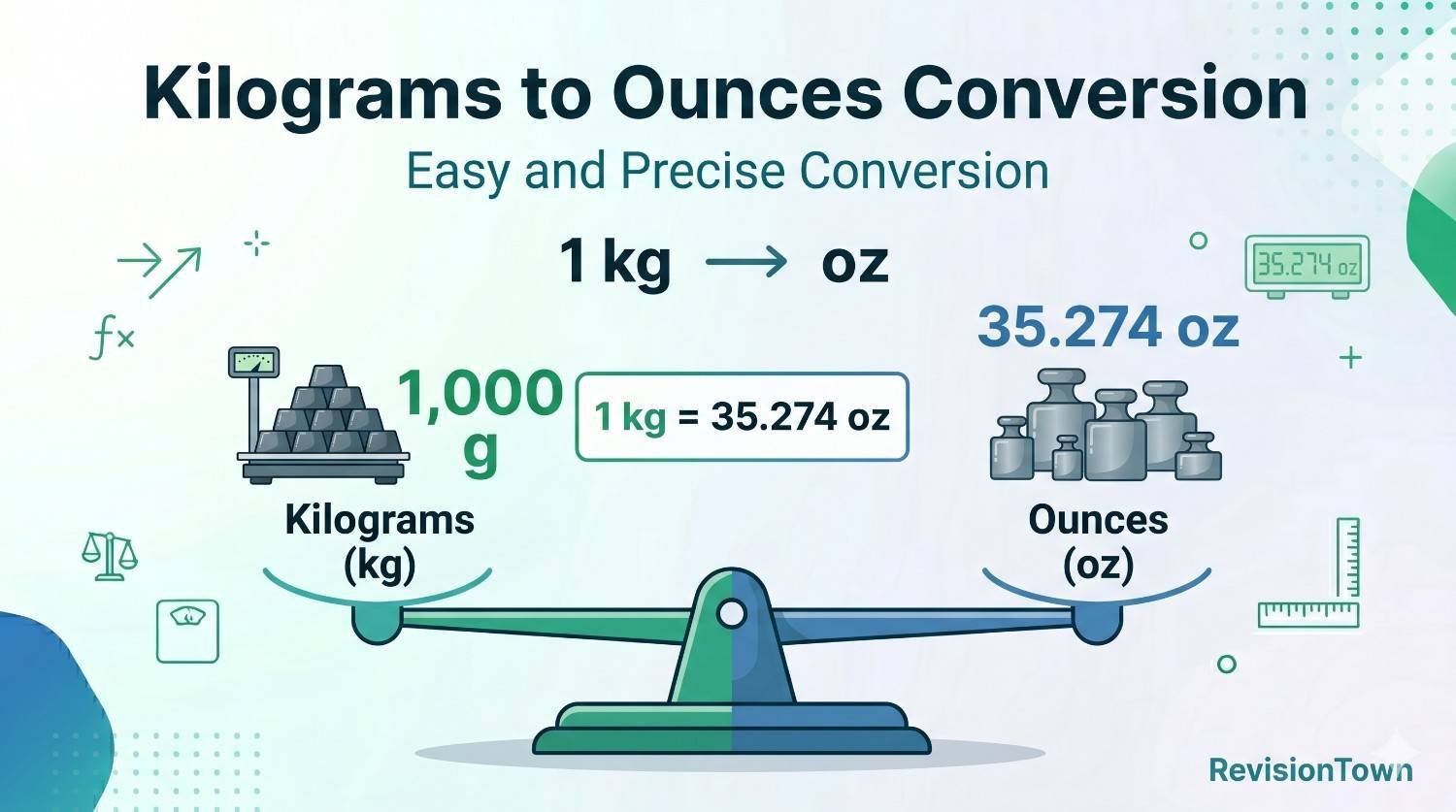
1 kg = 35.274 oz
Quick Conversion Reference
Understanding Kilograms and Ounces
Kilograms and ounces represent two different measurement systems: the metric system and the imperial (or US customary) system. The kilogram is the base unit of mass in the International System of Units (SI), used globally for scientific and everyday measurements. The ounce is part of the imperial system, primarily used in the United States for measuring weight in cooking, shipping, and commerce.
• Kilogram (kg): The SI base unit of mass, defined by the Planck constant. One kilogram equals approximately 2.205 pounds or 35.274 ounces.
• Ounce (oz): A unit of weight in the imperial system. One ounce equals 1/16 of a pound or approximately 28.35 grams.
The relationship between kilograms and ounces is not based on simple decimal conversion like metric units. Instead, it requires a fixed conversion factor. Understanding this conversion is essential for international trade, cooking with recipes from different countries, shipping packages, and scientific work that involves both measurement systems.
Conversion Formula Explained
Converting between kilograms and ounces requires using a specific conversion factor that relates the metric and imperial systems. The standard conversion is based on the international avoirdupois ounce.
Kilograms to Ounces Formula
For practical purposes, this is usually rounded to:
To convert kilograms to ounces, multiply the kilogram value by 35.274. This conversion factor is derived from the fact that 1 kilogram equals 1000 grams, and 1 ounce equals approximately 28.35 grams.
Ounces to Kilograms Formula
Alternatively:
To convert ounces to kilograms, divide the ounce value by 35.274, or multiply by 0.0283495. Both methods yield the same result.
The conversion factor (35.274) comes from the relationship:
1 kg = 1000 g
1 oz = 28.349523125 g
Therefore: 1 kg = 1000 ÷ 28.349523125 ≈ 35.274 oz
Step-by-Step Conversion Guide
How to Convert Kilograms to Ounces
- Identify the Kilogram Value: Determine the weight in kilograms you need to convert.
- Apply the Conversion Factor: Multiply the kilogram value by 35.274.
- Calculate the Result: Perform the multiplication to get ounces.
- Round Appropriately: Round to the desired number of decimal places (typically 2 for practical use).
Practical Example 1: Converting 3 kg to Ounces
Formula: oz = kg × 35.274
Calculation: 3 × 35.274 = 105.822
Result: 3 kg ≈ 105.82 oz
How to Convert Ounces to Kilograms
- Identify the Ounce Value: Determine the weight in ounces you need to convert.
- Apply the Conversion Factor: Divide the ounce value by 35.274 (or multiply by 0.0283495).
- Calculate the Result: Perform the division to get kilograms.
- Round Appropriately: Round to the desired precision.
Practical Example 2: Converting 100 oz to Kilograms
Formula: kg = oz ÷ 35.274
Calculation: 100 ÷ 35.274 = 2.835
Result: 100 oz ≈ 2.84 kg
Comprehensive Conversion Table
Use this detailed conversion table for quick reference when converting between kilograms and ounces:
| Kilograms (kg) | Ounces (oz) | Common Items |
|---|---|---|
| 0.1 kg | 3.53 oz | Small apple, bar of soap |
| 0.25 kg | 8.82 oz | Cup of flour, stick of butter |
| 0.5 kg | 17.64 oz | Package of pasta, loaf of bread |
| 1 kg | 35.27 oz | Liter of water, bag of sugar |
| 2 kg | 70.55 oz | Large pineapple, laptop |
| 5 kg | 176.37 oz | Bag of flour, small dog |
| 10 kg | 352.74 oz | Bowling ball, toddler |
| 25 kg | 881.85 oz | Large suitcase, medium dog |
| 50 kg | 1,763.70 oz | Average adult weight |
Real-World Applications
Understanding how to convert between kilograms and ounces is essential in many practical situations, especially when dealing with international contexts:
Cooking and Baking
- International Recipes: European recipes use kilograms and grams, while American recipes use pounds and ounces. Converting between them ensures accurate measurements.
- Ingredient Scaling: Professional bakers often scale recipes up or down, requiring conversions between metric and imperial units.
- Portion Control: Restaurants and meal prep services may need to convert between systems for international standards.
- Food Packaging: Products sold internationally display weights in both systems (e.g., 500g / 17.6 oz).
Shipping and Postal Services
- Package Weight: International shipping requires weight declarations in both kilograms (for customs) and pounds/ounces (for US domestic shipping).
- Shipping Costs: Carriers calculate fees based on weight, often requiring conversion between systems.
- Baggage Limits: Airlines specify luggage weight limits in kilograms internationally and pounds in the US.
- Freight Shipping: International freight requires accurate weight conversions for documentation and pricing.
Commerce and Retail
- Product Labeling: Consumer products must display weights in local units (oz in US, kg in most other countries).
- E-commerce: Online retailers selling internationally need to display weights in multiple units.
- Wholesale Trade: Bulk commodities may be quoted in different units depending on the market.
- Precious Metals: Gold, silver, and other precious metals are measured in troy ounces, requiring different conversions.
Fitness and Health
- Body Weight Tracking: International standards use kilograms, while US health systems often use pounds and ounces.
- Nutrition Information: Food labels show serving sizes in both grams/kilograms and ounces.
- Exercise Equipment: Gym equipment may display weights in either system.
- Medical Records: Healthcare providers need to convert between systems for international patients.
Understanding Different Types of Ounces
It's important to understand that there are different types of ounces used in various contexts:
Avoirdupois Ounce (Common Ounce)
This is the standard ounce used for everyday measurements in the United States:
- 1 avoirdupois ounce = 28.349523125 grams
- 16 avoirdupois ounces = 1 pound
- Used for food, body weight, and general commerce
Troy Ounce
Used specifically for precious metals and gemstones:
- 1 troy ounce = 31.1034768 grams
- 12 troy ounces = 1 troy pound
- About 10% heavier than an avoirdupois ounce
- Standard for gold, silver, platinum trading
Fluid Ounce
A measure of volume, not weight:
- Used for liquids in the US customary system
- 1 US fluid ounce ≈ 29.5735 milliliters
- Not directly convertible to kilograms without knowing liquid density
Metric vs Imperial System Comparison
| Aspect | Metric System (kg) | Imperial System (oz) |
|---|---|---|
| Countries Using | 195+ countries worldwide | Primarily United States |
| Base Unit | Kilogram (kg) | Pound (lb), divided into ounces |
| Decimal System | Yes (base 10) | No (16 oz = 1 lb) |
| Scientific Use | Universal standard | Rarely used in science |
| Ease of Conversion | Simple (powers of 10) | Complex (non-decimal ratios) |
| Common Applications | Science, medicine, international trade | US retail, cooking, body weight |
Common Conversion Mistakes to Avoid
- Confusing Ounces Types: Don't confuse avoirdupois ounces (weight) with fluid ounces (volume) or troy ounces (precious metals).
- Rounding Too Early: Use the full conversion factor (35.27396195) for calculations, round only the final answer.
- Wrong Conversion Direction: Remember: kg to oz = multiply; oz to kg = divide.
- Decimal Point Errors: Be careful with decimal placement when multiplying by 35.274.
- Mixing Pounds and Ounces: Don't confuse ounces with pounds (16 oz = 1 lb = 0.4536 kg).
- Unit Label Omission: Always specify whether you're using kg, oz, lb, or g to avoid confusion.
- Calculator Input Mistakes: Double-check that you entered 35.274, not 35.27 or 352.74.
Tips for Accurate Conversions
- Memorize Key Conversions: Remember that 1 kg ≈ 35.3 oz as a quick reference.
- Use Reliable Tools: For important conversions, use calibrated calculators like this one.
- Understand Context: Know when you need precision (science, medicine) vs. approximation (cooking).
- Check Your Work: Verify that ounces are larger numbers than kilograms for the same weight.
- Learn Related Conversions: Understanding that 1 kg ≈ 2.2 lb helps verify oz calculations (1 lb = 16 oz).
- Consider Regional Standards: Know which system your audience uses (metric for international, imperial for US).
- Use Consistent Precision: Match decimal places to your measurement accuracy (kitchen scale vs. lab scale).
- Practice Mental Math: For quick estimates, remember that 1 kg is slightly more than 2 pounds (32 oz).
Frequently Asked Questions
How many ounces are in one kilogram?
There are approximately 35.274 ounces in one kilogram. More precisely, 1 kilogram equals 35.27396195 avoirdupois ounces. This conversion factor is fixed and based on the international definitions of the kilogram and ounce. For most practical purposes, using 35.27 or 35.3 ounces per kilogram is sufficiently accurate.
How do I convert 2.5 kg to ounces?
To convert 2.5 kg to ounces, multiply 2.5 by 35.274. The calculation is: 2.5 × 35.274 = 88.185 ounces. Rounded to two decimal places, 2.5 kg equals approximately 88.19 oz, which is equivalent to about 5.5 pounds (since 16 oz = 1 lb).
Is 16 ounces equal to 1 kilogram?
No, 16 ounces does not equal 1 kilogram. 16 ounces equals 1 pound, which is approximately 0.454 kilograms. One kilogram equals about 35.27 ounces, which is 2.2 pounds. The confusion often arises because 16 oz = 1 lb, but pounds and kilograms are different units.
Why is the conversion factor 35.274 instead of a round number?
The conversion factor is 35.274 because kilograms and ounces were developed independently in different measurement systems. The kilogram is based on the mass of water (metric system), while the ounce comes from the Roman libra (imperial system). The conversion factor reflects the historical relationship between these independent standards, which were later precisely defined relative to each other.
How do I convert ounces to kilograms?
To convert ounces to kilograms, divide the number of ounces by 35.274. For example, 100 ounces ÷ 35.274 = 2.835 kilograms. Alternatively, you can multiply ounces by 0.0283495 to get kilograms. Both methods produce the same result.
What's the difference between avoirdupois ounces and troy ounces?
Avoirdupois ounces (28.35 g) are used for everyday weight measurements like food and body weight. Troy ounces (31.10 g) are used exclusively for precious metals and gemstones. A troy ounce is about 10% heavier than an avoirdupois ounce. When converting kilograms to ounces for general purposes, always use avoirdupois ounces (1 kg = 35.274 oz).
Can I use this conversion for fluid ounces?
No, this conversion is only for weight (mass) measurements, not volume. Fluid ounces measure volume, not weight. To convert fluid ounces to metric volume, you would use milliliters or liters (1 fl oz ≈ 29.57 mL). The weight of a fluid ounce varies depending on the liquid's density.
Which countries use ounces instead of kilograms?
The United States is the primary country that uses ounces and pounds for everyday weight measurements. Liberia and Myanmar also officially use the imperial system, though metric is increasingly common. The United Kingdom uses a mixed system with both metric and imperial units. Nearly all other countries worldwide use the metric system (kilograms and grams) exclusively.
How precise do I need to be when converting kg to oz?
Precision depends on your application. For cooking and everyday use, rounding to one decimal place (35.3) is usually sufficient. For commercial purposes, use two decimal places (35.27). For scientific applications, use the full conversion factor (35.27396195) or as many decimal places as your measurement accuracy requires. Always match your conversion precision to your measurement precision.
Historical Background
The kilogram and ounce have vastly different historical origins, which explains why their relationship isn't a simple round number.
Origin of the Kilogram
The kilogram was established in 1795 during the French Revolution as part of the new metric system. It was originally defined as the mass of one liter (1000 cubic centimeters) of water at its maximum density (4°C). The International Prototype Kilogram, a platinum-iridium cylinder, served as the world standard from 1889 to 2019. Since May 20, 2019, the kilogram has been defined using the Planck constant, providing an unchanging physical basis.
Origin of the Ounce
The ounce has ancient origins, deriving from the Roman "uncia," which was 1/12 of a Roman pound (libra). The avoirdupois ounce emerged in medieval England for weighing wool and other commodities. It was standardized as 1/16 of an avoirdupois pound. The word "avoirdupois" comes from Old French "aveir de peis" meaning "goods of weight."
Modern Standardization
In 1959, the international yard and pound agreement standardized the relationship between imperial and metric units. The avoirdupois pound was defined as exactly 0.45359237 kilograms, which established the precise conversion factor we use today. This agreement ensured consistency in international trade and scientific communication.