
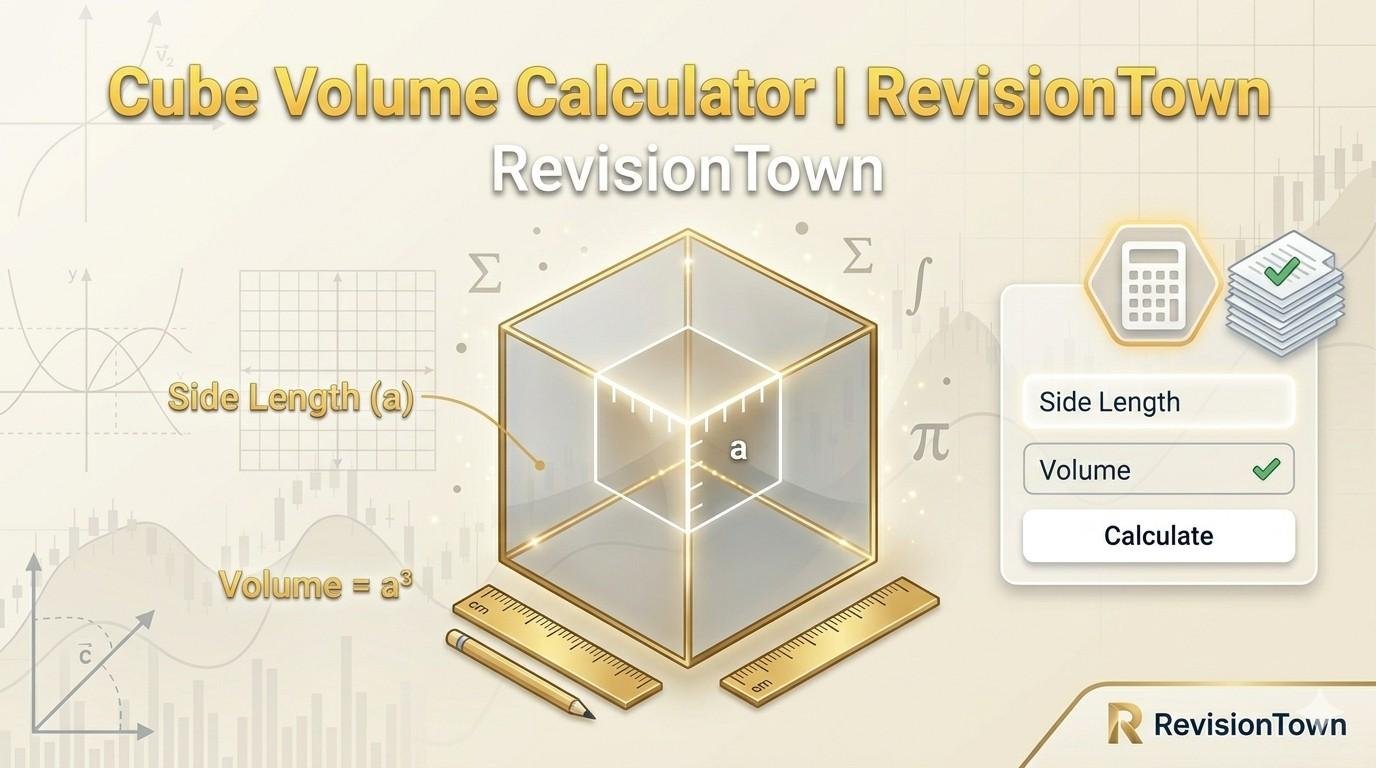
📦 Cube Volume Calculator
📚 Understanding Cube Volume and Geometry
What is a Cube and Its Definition?
A cube is a three-dimensional geometric shape with six equal square faces, twelve equal edges, and eight vertices. All angles are right angles (90 degrees), making it a regular hexahedron or one of the five Platonic solids. The defining characteristic of a cube is that all dimensions are equal: length = width = height. This uniformity makes cubes fundamental in mathematics, physics, engineering, and architecture. Cubes appear naturally in crystal structures, molecular arrangements, and are widely used in games, construction, and design applications.
Cube Volume Formula and Calculations
| Property | Formula | Description |
|---|---|---|
| Volume | V = a³ | Volume equals side length cubed |
| Surface Area | SA = 6a² | Total area of all six square faces |
| Face Diagonal | d_face = a√2 | Diagonal across one square face |
| Space Diagonal | d_space = a√3 | Diagonal through cube interior |
| Edge Length (from Volume) | a = ∛V | Cube root of volume |
| Perimeter of One Face | P = 4a | Perimeter of one square face |
| Total Edge Length | L = 12a | Sum of all 12 edges |
Understanding Cubic Relationships
The volume of a cube exhibits a cubic relationship with its side length, meaning volume grows dramatically as side length increases. Doubling the side length increases volume by a factor of 8 (2³ = 8). Tripling the side length increases volume by a factor of 27 (3³ = 27). This cubic growth explains why small increases in dimension produce large volume changes. For example, cubes with side lengths 1 cm, 2 cm, and 3 cm have volumes 1 cm³, 8 cm³, and 27 cm³ respectively. Understanding this cubic relationship is fundamental to geometry, physics, and engineering calculations.
Practical Applications of Cube Volume
Storage and Packaging: Determining box capacity and storage volume requirements. Construction: Calculating concrete volume for cubic structures and foundations. Manufacturing: Volume requirements for cubic components and production planning. Shipping: Determining container size and calculating shipping costs based on cubic volume. Architecture: Spatial planning and room volume calculations. Science: Molecular structure analysis, crystal calculations, and material science. Education: Geometry and mathematics instruction. Engineering: Volume calculations for cubic components in mechanical design and structural analysis.
Cube Properties and Surface Area Relationship
While volume and surface area both depend on side length, they have different relationships: Volume V = a³ increases cubically, while surface area SA = 6a² increases quadratically. Doubling side length quadruples surface area (6 × 4a² = 24a²) but increases volume eightfold (8a³). As cubes grow larger, volume increases much faster than surface area. The ratio of surface area to volume changes with size: small cubes have higher surface-to-volume ratios, while large cubes have lower ratios. This relationship is important in physics (heat transfer), chemistry (reaction rates), and biology (cell function).
Calculating Related Measurements
Face Diagonal: The diagonal across one square face of a cube is calculated as d = a√2, where a is the side length. For a cube with 10 cm side, the face diagonal is 10√2 ≈ 14.14 cm. Space Diagonal (Body Diagonal): The diagonal through the cube's interior connecting opposite vertices is d = a√3. For the same 10 cm cube, the space diagonal is 10√3 ≈ 17.32 cm. Perimeter of One Face: Since each face is a square, the perimeter is P = 4a. For a 10 cm cube, the face perimeter is 40 cm. Total Edge Length: All 12 edges combined: L = 12a = 120 cm for a 10 cm cube.
Why RevisionTown's Cube Volume Calculator?
Calculating cube volume and related properties requires accurate mathematical computations, proper unit conversions, and understanding geometric relationships. Our advanced calculator eliminates errors by automatically computing volume using V = a³, calculating side length from volume using a = ∛V, displaying all related properties (surface area, diagonals, edge count), and supporting multiple units (mm, cm, m, km, inches, feet, yards). Whether studying geometry, designing cubic structures, planning storage, or solving engineering problems, this calculator ensures accuracy and provides comprehensive geometric analysis.
❓ Frequently Asked Questions About Cube Volume
The cube volume formula is V = a³, where V is volume and a is the side length. Since a cube has all edges equal, the volume equals the side length multiplied by itself three times: V = a × a × a. For example, a cube with 5 cm side length has volume V = 5³ = 125 cm³. This formula applies to all cubes regardless of size. The result is always in cubic units (cm³, m³, inch³, etc.) matching the linear unit of the side length.
A cube has 12 equal edges, 8 vertices, and 6 square faces. All edges have the same length. All vertices are points where three edges meet. Each of the 6 faces is an identical square. These properties make a cube one of the five Platonic solids—regular polyhedra with identical faces, equal edges, and equivalent vertices. The uniformity of these properties is what defines a cube mathematically.
Cube surface area is calculated using the formula SA = 6a², where a is the side length. Since a cube has six equal square faces, and each face has area a², the total surface area is six times this area: SA = 6a². For example, a cube with 4 cm side length has surface area SA = 6 × 4² = 6 × 16 = 96 cm². Surface area represents the total area of all outer surfaces. This is important for applications like painting, coating, or material requirements.
The relationship between side length and volume is cubic (V = a³), meaning volume increases dramatically with side length. Doubling the side length increases volume by a factor of eight: (2a)³ = 8a³. Tripling the side length increases volume by a factor of 27: (3a)³ = 27a³. This cubic relationship shows that small increases in side length produce large volume changes. For example, cubes with side lengths 1 cm, 2 cm, and 3 cm have volumes 1 cm³, 8 cm³, and 27 cm³ respectively.
To find side length from volume, take the cube root: a = ∛V, where V is volume. For example, a cube with volume 1000 cm³ has side length a = ∛1000 = 10 cm. The cube root is the inverse operation of cubing—if V = a³, then a = ∛V. This formula is useful when volume is known but side length must be determined. Calculators with root functions make this calculation straightforward. Scientific calculators compute cube roots using x^(1/3) or ∛ functions.
A cube has two types of diagonals: (1) Face diagonal—diagonal across one square face: d_face = a√2, where a is side length; (2) Space diagonal (body diagonal)—diagonal through the cube's interior connecting opposite vertices: d_space = a√3. For example, a cube with 5 cm side length has face diagonal d = 5√2 ≈ 7.07 cm and space diagonal d = 5√3 ≈ 8.66 cm. These diagonals are used in geometry, distance calculations, and architectural applications.
Cube volume calculations have numerous applications: (1) Storage and packaging—determining box capacity; (2) Construction—calculating concrete volume; (3) Shipping—determining container size; (4) Manufacturing—production volume planning; (5) Architecture—spatial planning and floor area; (6) Science—molecular structure and crystal analysis; (7) Education—geometry instruction; (8) Engineering—volume calculations for cubic components. Understanding cube volumes is essential across many professional fields and educational contexts.
While both volume and surface area depend on side length, they have different relationships: Volume V = a³ increases cubically, while surface area SA = 6a² increases quadratically. Doubling side length quadruples surface area but increases volume eightfold. As cubes get larger, volume increases much faster than surface area. The surface-to-volume ratio changes with size: small cubes have higher ratios, large cubes have lower ratios. This relationship is important in physics (heat transfer), chemistry (reaction rates), and biology (cell function).