
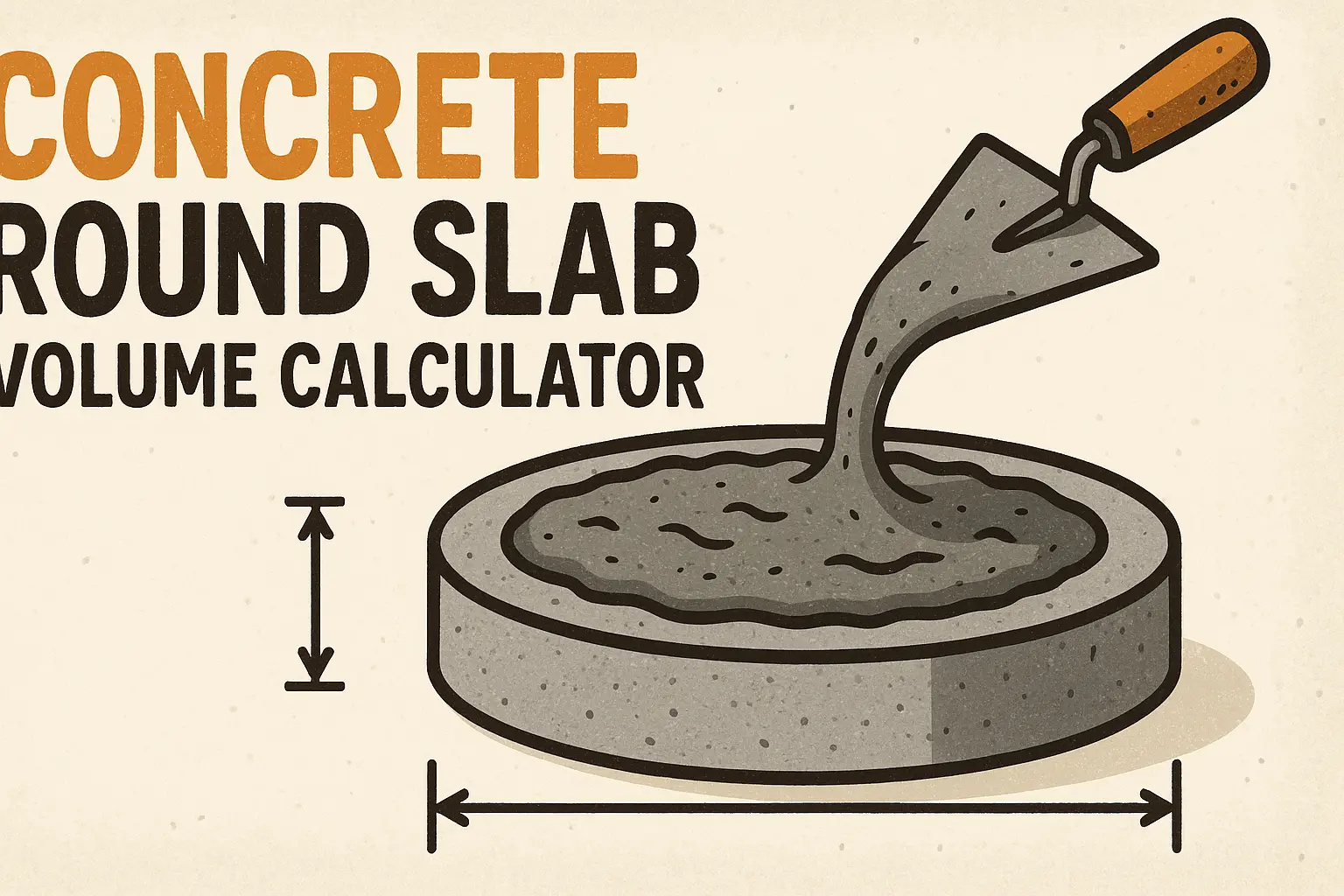
Round concrete slab volume, bags, and ordering quantity
Concrete Round Slab Volume Calculator
Use this concrete round slab volume calculator to estimate how much concrete is needed for a circular slab, round patio pad, hot tub base, fire pit pad, tank base, pier cap, stepping pad, or any flat cylindrical pour. Enter diameter or radius, slab thickness, quantity, and optional waste, then view cubic feet, cubic yards, cubic meters, approximate bag counts, and cost.
Calculate round slab concrete volume
Enter the slab diameter or radius and thickness. The calculator treats the slab as a short cylinder, computes volume, applies optional overage, estimates common bag counts, and shows a ready-mix quantity in cubic yards.
What this calculator is designed to estimate
A concrete round slab volume calculator estimates the amount of concrete needed for a circular slab with a uniform thickness. The shape is mathematically a short cylinder: a circular top area multiplied by a depth. This applies to round patios, hot tub pads, circular shed pads, tank bases, small equipment pads, round stepping pads, fire pit bases, pier caps, decorative concrete circles, and similar flat pours where the outside edge is circular and the slab thickness is reasonably consistent.
The main output is volume. Concrete is often ordered by cubic yard for ready-mix delivery in the United States, by cubic meter in many metric contexts, or by bag count for smaller hand-mixed projects. The calculator reports cubic feet, cubic yards, cubic meters, and approximate bag quantities so you can translate the geometry into a practical order. It also includes an optional overage percentage because real pours almost always need more than the exact mathematical volume.
This page is not intended to replace structural design. It estimates volume from dimensions. It does not decide whether the slab is thick enough, whether reinforcement is required, whether a vapor barrier is needed, whether the subgrade is suitable, whether frost depth matters, or whether permits or engineering review are required. Those decisions depend on load, soil, climate, local code, reinforcement, drainage, and use. For a broad concrete project estimate, a general concrete calculator can be used alongside this round-slab-specific calculator.
The calculator is also distinct from a general cylinder volume calculator. A cylinder calculator solves any cylinder, while this page is written for concrete slab planning: thickness, cubic yards, overage, bag estimates, ready-mix ordering, and field measurement concerns. If your project is not a circular slab, choose a shape-specific calculator. For steps, use a concrete steps calculator. For general volume comparisons, use the volume calculator.
Round concrete slab volume formulas
A round slab is calculated from circle area and thickness. If \(r\) is radius, \(d\) is diameter, \(h\) is slab thickness, and \(V\) is volume, the circular area is:
Since radius is half the diameter, \(r=d/2\). The same area formula can be written using diameter:
The volume of a round slab is area multiplied by thickness:
Substituting the diameter form gives:
Substituting the radius form gives:
If there are \(Q\) identical round slabs, multiply by quantity:
If overage is \(w\) percent, the ordering volume is:
For ready-mix concrete in cubic yards, use the relationship \(1\text{ yd}^3 = 27\text{ ft}^3\):
For metric work, \(1\text{ m}^3\) equals 1000 liters. It is also approximately 35.3147 cubic feet and approximately 1.30795 cubic yards:
These formulas are simple, but unit consistency is critical. Diameter and thickness must use compatible length units before multiplication. A diameter in feet and thickness in inches should not be multiplied directly until thickness is converted to feet. For example, 4 inches is \(4/12 = 0.3333\) ft.
Worked examples
The examples below show how the calculator turns diameter, thickness, quantity, and overage into concrete volume. They also show why small changes in diameter and thickness can significantly affect the order.
Example 1: Round patio slab in feet and inches
A circular patio pad has a 12 ft diameter and a 4 in slab thickness. First convert thickness to feet:
The radius is \(12/2 = 6\) ft. The circular area is:
The volume is:
Convert to cubic yards:
With 10 percent overage, order about \(1.40\times 1.10 = 1.54\) cubic yards before applying supplier minimums or rounding rules.
Example 2: Small round equipment pad
A small equipment pad has a 5 ft diameter and a 6 in thickness. The thickness is 0.5 ft. The radius is 2.5 ft.
This is small enough that bagged concrete may be considered, depending on site access and local pricing. Because bag yields vary by product, bag counts should be treated as approximate and checked against the bag label.
Example 3: Metric round slab
A circular concrete base has a 2.4 m diameter and 120 mm thickness. Convert 120 mm to 0.12 m. The radius is 1.2 m.
With 8 percent overage, the order volume is \(0.543\times 1.08 \approx 0.586\text{ m}^3\). If the supplier sells ready-mix by the tenth of a cubic meter, the order may need to be rounded according to supplier policy.
Example 4: Multiple stepping pads
Suppose you are pouring four identical round stepping pads. Each pad is 30 in diameter and 3 in thick. Convert dimensions to feet: diameter is 2.5 ft and thickness is 0.25 ft.
With 10 percent overage, the order volume is about 5.40 cubic feet. If using bagged concrete, compare that volume with the yield shown on the product bag.
How much extra concrete should you order?
The mathematical volume assumes the excavation, form, and thickness are perfect. Real concrete work is not perfect. The subgrade may be uneven, the form may not be exactly circular, the thickness may vary, concrete may be spilled, some material may stay in the mixer or wheelbarrow, and the top may need a little extra to screed correctly. That is why concrete estimates usually include overage.
For small round slabs, 5 to 10 percent overage may be enough when the base is well prepared and the form is accurate. For rough excavation, hand-dug forms, uneven subgrade, thicker edges, or remote mixing, 10 to 15 percent may be more realistic. For important pours where running short would be costly, discuss the order quantity with the supplier or contractor.
Ordering too little concrete is usually worse than ordering slightly too much. A cold joint, partial pour, or rushed emergency batch can create a weak or uneven slab. However, ordering too much concrete creates disposal problems and cost. The best order is based on accurate dimensions, realistic thickness, a sensible overage allowance, and supplier rounding rules.
Ready-mix concrete is commonly ordered in cubic yards in the United States. Many suppliers have minimum delivery quantities, short-load fees, or rounding policies. If the calculator gives 1.54 cubic yards, the supplier may require 1.75, 2.0, or another rounded quantity. For small projects, bagged concrete may be cheaper or more practical, but it requires labor, water, mixing space, and time.
Bag yield note: bag estimates are approximate. Different products and mix designs yield different volumes. Always check the yield printed on the bag and adjust the bag count accordingly.
Measuring diameter and thickness correctly
The two most important measurements for a round slab are diameter and thickness. Diameter is the full width across the circle through the center. Radius is half that distance. Thickness is the vertical depth of the concrete slab. If diameter is wrong, the volume error can be large because diameter is squared in the formula. If thickness is wrong, the volume changes directly in proportion to thickness.
Measure diameter across the widest part of the circular form and verify it in more than one direction. A form that looks circular may be slightly oval. If two diameter measurements are different, decide whether to average them for a rough estimate or adjust the form before pouring. For precise work, the form should be corrected so the circle is consistent.
Measure thickness at the finished concrete depth, not just at one edge. If the base is uneven, the slab may be thicker in some areas. A round slab with a 4 in edge thickness and a low center may require more concrete than the simple formula predicts. If the slab has a thickened edge, footing ring, or haunch, estimate that extra volume separately rather than treating the whole slab as uniform thickness.
If the slab is specified in inches but the diameter is in feet, convert thickness before calculating. A common mistake is using 4 as if it means 4 feet instead of 4 inches. Four inches is only one third of a foot. The calculator handles mixed units, but manual calculations must keep units consistent.
For metric pours, convert millimeters to meters before calculating cubic meters. A thickness of 100 mm is 0.1 m. A thickness of 150 mm is 0.15 m. If you multiply square meters by millimeters without conversion, the unit will not be cubic meters.
Bagged concrete versus ready-mix concrete
Round slabs can be poured with bagged concrete or ready-mix delivery. The right choice depends on volume, access, labor, equipment, schedule, and local costs. The calculator shows both volume and approximate bag counts so you can compare the practical options.
Bagged concrete can be practical for small pads, stepping stones, small equipment bases, and repairs. It is easy to buy, does not require a truck delivery, and works when access is limited. The tradeoff is labor. Every bag must be moved, opened, mixed, placed, and finished. For anything beyond a small volume, the labor can become significant.
Ready-mix concrete is often better for larger slabs because the concrete arrives in one batch and can be placed quickly. Consistency is usually better than hand mixing many small bags. The tradeoff is delivery cost, minimum order quantity, access for the truck, timing, and the need to be ready when the truck arrives. For a round slab that must be finished smoothly, consistent delivery can matter.
Bag yields vary. Many common bag estimates use approximate yields such as 0.375 cubic feet for a 50 lb bag, 0.45 cubic feet for a 60 lb bag, and 0.60 cubic feet for an 80 lb bag, but these are not universal. Specialty mixes, lightweight mixes, high-strength mixes, and local products may differ. Use the printed yield on the exact product you will buy.
When comparing bagged concrete and ready-mix, include all costs: concrete, delivery, mixer rental, wheelbarrow, tools, water access, labor time, disposal, and overage. A small bagged project may be cheaper. A larger slab may be more economical and consistent with ready-mix even if the truck delivery looks expensive at first.
Subgrade, formwork, and thickness considerations
The calculator assumes a simple cylinder, but the actual slab depends on the prepared base and form. A well-compacted subgrade with consistent depth helps the calculated volume match the real pour. A loose, uneven, or over-excavated base can increase volume. If gravel base is used, its thickness is separate from the concrete thickness. Use a gravel calculator when estimating base material.
Forms should hold the intended round shape. Flexible forms can bow outward under pressure, increasing diameter and volume. Stakes and bracing help maintain shape. A small increase in diameter affects area because the diameter is squared. For example, increasing a 12 ft diameter to 12.25 ft increases the area more than a simple linear comparison suggests.
Thickness should match the project purpose and any applicable code or engineering requirement. A decorative stepping pad may be thinner than a vehicle-loaded slab. A hot tub pad may need thickness, reinforcement, and base preparation appropriate for a heavy filled tub. A tank base or equipment pad may need engineering review. The calculator gives quantity; it does not decide structural adequacy.
If the slab has reinforcement, chairs, wire mesh, rebar, or fiber reinforcement, those items do not usually change the concrete volume much, but they matter for performance. If the slab has a thickened edge or a footing ring, calculate the main circular slab volume and the extra thickened-edge volume separately. For irregular or combined shapes, a general volume calculator or project-specific method may be needed.
Round slab area versus volume
Round slab area and round slab volume are related, but they answer different questions. Area describes the top surface, measured in square units. Volume describes the amount of concrete, measured in cubic units. A circle area calculator can tell you the top surface area, but concrete ordering needs thickness as well.
The surface area of a 12 ft diameter circle is about 113.10 square feet. That is useful for estimating finishing, curing compound coverage, surface sealer, decorative coating, or top dressing. But concrete volume also needs thickness. At 4 in thick, the slab is about 37.70 cubic feet. At 6 in thick, the same top area becomes about 56.55 cubic feet. The diameter did not change, but the concrete amount increased by 50 percent because thickness increased from 4 in to 6 in.
If you need only the circular top area, use a circle area calculator or the broader circle calculator. If you need volume for concrete ordering, use diameter, thickness, and quantity together. If you want to understand the formula relationship more deeply, the cylinder volume formula page is a useful companion.
Cubic feet, cubic yards, and cubic meters
Concrete volume is often calculated in cubic feet first when dimensions are in feet and inches. Ready-mix concrete is commonly ordered in cubic yards in the United States. Metric projects often use cubic meters. The calculator shows all three because each is useful in a different part of the workflow.
Cubic feet are intuitive for small projects and for bagged concrete. Bag yields are often printed in cubic feet. If the calculator shows 9.8 cubic feet, and the bag yield is 0.60 cubic feet, the approximate bag count is \(9.8/0.60 \approx 16.34\), which rounds up to 17 bags.
Cubic yards are useful for ready-mix ordering. Since 1 cubic yard equals 27 cubic feet, divide cubic feet by 27. A volume of 37.70 cubic feet is about 1.40 cubic yards. If overage is added, the order may become 1.54 cubic yards. Supplier rounding rules can then determine the actual order.
Cubic meters are useful for metric projects and international specifications. If dimensions are measured in meters and thickness is in meters, the formula directly produces cubic meters. If thickness is in millimeters, convert it to meters first. For example, 150 mm is 0.15 m. If you are converting between square feet and cubic yards for slab-like projects, the square feet to cubic yards calculator can also be useful when area and depth are already known.
For broader volume conversions, use the cubic yard calculator or the main volume calculator. This page focuses on round concrete slabs because diameter and thickness are the central measurements.
Cost planning for a round slab
The optional cost field estimates concrete cost from cubic yards. If your supplier quotes ready-mix at a price per cubic yard, enter that price and the calculator will multiply it by the order volume after overage. This gives a material-only estimate for concrete. It does not include labor, reinforcement, base gravel, formwork, finishing tools, delivery fees, short-load fees, pump rental, disposal, sealer, or tax.
For a realistic project budget, list the concrete volume separately from other costs. A round slab may also require excavation, compacted base, gravel, vapor barrier, form boards or flexible forms, stakes, rebar or mesh, chairs, expansion joint material, finishing tools, curing compound, sealer, and cleanup. The construction calculator and cost calculator can help organize broader project costs after the concrete quantity is known.
Labor can exceed material cost for small round slabs. Hand mixing many bags, moving concrete, placing, screeding, floating, edging, and curing all take time. Ready-mix delivery may reduce mixing labor but add delivery charges. A low concrete material number should not be mistaken for a complete installed price.
When comparing quotes, ask what is included. One quote may include base preparation and reinforcement; another may include only concrete placement. One ready-mix supplier may include delivery in the cubic-yard price; another may add a short-load fee. Standardize the volume first, then compare the included services and extra charges.
Choosing slab thickness for the estimate
Thickness is the measurement that turns round area into concrete volume. A circle with a fixed diameter uses more concrete when the slab is thicker, and the relationship is direct. If thickness increases from 4 in to 5 in, volume increases by 25 percent. If thickness increases from 4 in to 6 in, volume increases by 50 percent. This is why a small-looking thickness change can noticeably change ready-mix quantity and bag count.
The calculator does not tell you what thickness is structurally correct. It calculates the volume for the thickness you enter. A thin decorative stepping stone, a light garden pad, a pedestrian patio, a shed pad, a hot tub pad, a tank base, and an equipment slab may all need different thicknesses and preparation. Loads, soil conditions, reinforcement, climate, frost movement, drainage, and local requirements all matter. If the slab supports heavy equipment, vehicles, a filled hot tub, a tank, or a structure, use a design appropriate to that load rather than copying a generic thickness.
For estimating, enter the actual finished concrete thickness. Do not include the gravel base in the concrete thickness. If excavation is 8 in deep and the plan is 4 in of compacted gravel plus 4 in of concrete, the concrete thickness is 4 in. The gravel base should be estimated separately. Confusing total excavation depth with concrete thickness can double the concrete order.
For a round slab with a slope or crown, use an average thickness if the shape is still roughly uniform. For example, if the slab is about 4 in thick at the edge and 5 in thick at the center, the average may be about 4.5 in, depending on the actual profile. If the slab has a deliberate thickened ring, footing, or depressed center, calculate the extra volume separately rather than relying only on an average. The more unusual the cross-section, the less a single uniform-thickness cylinder represents the real pour.
For metric projects, slab thickness is often specified in millimeters. Convert the thickness to meters before calculating cubic meters. A 100 mm slab is 0.10 m. A 125 mm slab is 0.125 m. A 150 mm slab is 0.15 m. Multiplying square meters by millimeters directly does not produce cubic meters. The calculator handles unit conversion, but manual estimates need this step written clearly.
How to estimate a thickened edge or footing ring
Many round slabs are not the same thickness everywhere. A patio might have a simple uniform thickness, but a hot tub pad, tank pad, sign base, or small structural slab may include a deeper perimeter ring. A thickened edge increases concrete volume. If the calculator is used only for the flat central slab, the order may come up short.
One practical method is to split the work into two parts: the main uniform round slab and the extra concrete in the thickened ring. First calculate the slab as if it had the thinner general thickness. Then calculate the additional ring volume caused by the extra depth at the perimeter. A ring is the area between two circles multiplied by the additional depth.
If \(R_o\) is the outside radius, \(R_i\) is the inside radius of the ring, and \(h_e\) is the extra depth beyond the main slab thickness, the additional ring volume is:
For example, suppose a 10 ft diameter slab is 4 in thick overall, but the outer 12 in ring is an additional 4 in deeper. The outside radius is 5 ft. The inside radius of the ring is 4 ft. The extra depth is 4 in, or 0.3333 ft. The extra ring volume is:
Add this to the main slab volume. The main 10 ft diameter by 4 in slab is \(\pi(5^2)(0.3333)\approx 26.18\text{ ft}^3\). With the extra ring, the total before overage is about \(26.18+9.42=35.60\text{ ft}^3\). That is a major difference, so thickened edges should never be ignored when ordering concrete.
If the edge detail is complex, ask for a drawing or calculate it as a separate shape. Some slabs include a turndown edge, a footing below the slab, a curb, or a raised rim. Each part should be estimated from its own cross-section and length. This round slab calculator is the correct base for the circular slab volume, but unusual edge geometry may need an additional calculation.
Planning circular forms and placement
Round slab forms can be built from flexible form boards, plastic forms, metal forms, plywood strips, masonry edging, or purpose-made circular form systems. The form controls the slab diameter and thickness, so form accuracy directly affects volume. A small form movement during placement can increase diameter, reduce roundness, or change the slab edge height.
Before ordering concrete, measure the form after it is staked and braced. Do not rely only on the planned diameter. Measure across the circle in at least two directions through the center. If the measurements are different, the form is oval. For a rough landscaping pad, a small difference may be acceptable. For a tank base, hot tub pad, equipment pad, or decorative exposed edge, the form may need adjustment.
Check the form height relative to the prepared base. If the form is set for a 4 in slab but the base is low in the center, the average thickness may be greater than 4 in. If the base is high in spots, the slab may be too thin unless material is removed. The calculator uses the thickness you enter; it cannot detect uneven base preparation.
Plan how concrete will reach the form. A small bagged pour may be mixed beside the slab. A ready-mix pour may use a chute, wheelbarrow, buggy, or pump. If concrete is moved by wheelbarrow, allow time and labor. If the slab is large, the placement method affects finishing quality because concrete must be placed and finished before it becomes difficult to work.
For round slabs, screeding can be less straightforward than rectangular slabs. Some crews use a center stake and rotating screed method for circular work, while others screed in sections. Edge finishing also matters because the circular perimeter is visible on many round pads. These details do not change the volume formula, but they affect labor, tools, and the risk of needing extra material.
Bag mixing workflow for small round slabs
When a round slab is small enough for bagged concrete, the calculator's bag estimate helps plan materials, but the mixing workflow still matters. Bagged concrete is usually sold by weight and approximate yield. The bag count should be rounded up, then checked against the printed yield on the exact product. It is also wise to buy one or two extra bags for small jobs if returning unused bags is possible and running short would be a problem.
Organize bags close to the mixing area before starting. Concrete placement is time-sensitive. If one person is opening bags, another is adding water, and another is placing material, the pour will go more smoothly. For a one-person job, smaller batches may be safer, but they increase the chance of inconsistent water content between batches. Follow the product instructions for water and mixing time.
Do not add excess water just to make concrete easier to place. Too much water can weaken concrete and increase shrinkage. If workability is a problem, choose an appropriate mix or placement method rather than making the mix watery. For structural or load-bearing slabs, mix quality matters as much as volume.
For multiple batches, keep the timing tight enough that the slab can be finished as one pour. If the first batch stiffens before later batches are placed, cold joints or surface differences may appear. This is one reason ready-mix can be a better choice as volume increases. The more bags required, the more labor and timing matter.
After placement, consolidate concrete around the form and reinforcement without overworking it. Screed to height, float the surface, edge the perimeter if needed, and cure the slab according to the mix and weather conditions. Bag count is only the material quantity. Successful concrete work also depends on preparation, timing, finishing, and curing.
Ready-mix ordering workflow
For ready-mix concrete, the calculator gives a cubic-yard quantity with overage. Before calling a supplier, write down the slab diameter, thickness, quantity, base volume, overage percentage, and suggested order volume. This helps the supplier understand the estimate and gives them a chance to identify issues such as minimum loads, short-load fees, access limits, or mix requirements.
Ask the supplier how they round orders. Some suppliers may accept quarter-yard increments; others may have different policies. A calculator result of 1.54 cubic yards may not be an available order quantity. The order may become 1.75 or 2.0 cubic yards depending on the supplier. If the project is remote or difficult to access, rounding up may be safer than risking a shortage.
Ask about mix design. A slab mix may have a specified strength, aggregate size, slump, air entrainment, fiber reinforcement, or admixture depending on use and climate. The volume calculator does not choose the mix. It only estimates quantity. For outdoor slabs in freeze-thaw climates, air entrainment may matter. For exposed decorative work, aggregate and finish requirements may matter. For heavy loads, strength and reinforcement may matter.
Confirm truck access and discharge method. A ready-mix truck must get close enough to place concrete or discharge into wheelbarrows, buggies, or a pump. Long wheelbarrow routes slow placement. A pump can solve access problems but adds cost. Placement method should be planned before the truck arrives, not after.
Have forms, base, reinforcement, tools, water, labor, and finishing plan ready before delivery. Concrete is not a material that waits indefinitely. If the crew is not ready, the pour can become stressful and finishing quality can suffer. The order volume is only one part of a successful round slab pour.
Surface finishing, curing, and related quantities
The round slab volume tells you how much concrete is needed, but other related quantities may depend on the top area or perimeter. The top area is useful for estimating curing compound, sealer, surface hardener, decorative coating, broom finish area, or polishing area. The perimeter is useful for estimating form material, expansion joint material, edging, or border treatment.
For top area, use \(A=\pi r^2\). The calculator reports slab area because it is useful beyond volume. A 12 ft diameter slab has about 113.10 square feet of top surface. If a sealer covers 250 square feet per gallon per coat, one coat may use less than one gallon, but the purchase quantity depends on packaging and number of coats. If two coats are required, double the coverage area.
For circular perimeter, use circumference:
A 12 ft diameter round slab has circumference \(12\pi\approx 37.70\) ft. That helps estimate flexible forms, edge insulation, decorative border, or joint material. This perimeter is separate from concrete volume. Do not use circumference to order concrete; use area times thickness.
Curing is important for concrete performance. Weather, temperature, wind, sun, and mix design affect curing needs. A small round slab can dry quickly at the surface, especially in hot or windy conditions. Curing practices do not change the volume calculation, but they affect the quality of the finished slab. Follow product instructions, local practice, or contractor guidance for curing method and timing.
Measurement record for a concrete quote
A clear measurement record helps when requesting quotes or comparing supplier recommendations. Include the project description, diameter or radius, thickness, quantity, overage, desired output unit, and any special geometry such as thickened edges. A short written record prevents confusion between diameter and radius and helps identify whether a supplier is pricing the same quantity.
A useful note might read: "Round slab, 12 ft diameter, 4 in uniform thickness, one slab, compacted gravel base by others, 10 percent overage, calculated order about 1.54 cubic yards before supplier rounding." This note tells the supplier the geometry and assumptions. If the supplier recommends 1.75 or 2.0 cubic yards, you can ask whether that is due to rounding, minimum order, overage, or a different thickness assumption.
If the slab has a thickened edge, describe it clearly. For example: "Main slab 10 ft diameter by 4 in thick, outer 12 in ring is 4 in deeper." That allows the extra ring volume to be calculated. If the thickened portion is not described, the estimate may include only the main slab and understate concrete.
If you are comparing contractor quotes, check whether excavation, base gravel, forms, reinforcement, concrete, placement, finishing, curing, cleanup, and disposal are included. Two quotes can use the same concrete volume but include different scopes of work. Quantity clarity is the first step; scope clarity is the second.
Common mistakes to avoid
Using radius as diameter. If the calculator asks for diameter and you enter the radius, the volume will be much too small. Diameter is twice the radius.
Forgetting to convert inches to feet. A 4 in slab is 0.3333 ft thick, not 4 ft thick. Always convert thickness before multiplying when doing manual calculations.
Ignoring quantity. Four small round pads may require much more concrete than one pad. Multiply by the number of identical slabs before applying overage.
Ordering the exact mathematical volume. Real pours need overage for uneven subgrade, form variation, spillage, and finishing. The exact formula is a starting point, not always the order quantity.
Assuming bag yields are universal. Check the yield on the exact bagged concrete product. Different products can yield different volumes.
Confusing area and volume. Circle area is measured in square units. Concrete is ordered by volume in cubic units. Thickness turns area into volume.
Ignoring thickened edges. If the slab has a deeper ring or footing edge, calculate that extra volume separately.
Pre-pour checklist
Before placing an order or mixing concrete, review the project assumptions. A short checklist helps prevent under-ordering and improves communication with suppliers or contractors.
- Confirm diameter or radius. Measure across the center if using diameter, and do not mix up radius and diameter.
- Confirm thickness. Use finished concrete thickness, not gravel base thickness or total excavation depth.
- Check units. Convert inches to feet or millimeters to meters before manual volume calculations.
- Inspect the form. Make sure the circular form is braced, reasonably round, and set to the correct height.
- Prepare the base. Uneven or loose subgrade can increase concrete volume and reduce slab performance.
- Add overage. Choose a realistic allowance based on site conditions and pour complexity.
- Check supplier rounding. Ready-mix suppliers may require minimum quantities or specific increments.
- Verify bag yield. If using bags, calculate from the actual product yield and round up to whole bags.
- Plan placement and finishing. Concrete must be placed and finished before it sets, so labor and tools should be ready.
Final order review
Before the order is placed, compare three numbers: the exact calculated volume, the overage-adjusted volume, and the supplier or bag purchase quantity. These numbers should not be treated as the same thing. The exact volume is the geometry result. The overage-adjusted volume is the planning quantity. The supplier quantity is the real purchase amount after rounding, minimums, bag counts, or truck policies.
For example, a slab may calculate to 1.40 cubic yards exactly, become 1.54 cubic yards after 10 percent overage, and still be ordered as 1.75 or 2 cubic yards because of supplier rules. A bagged job may calculate to 5.4 cubic feet and require 9 bags at 0.60 cubic feet per bag. Recording all three numbers helps explain why the final purchase may be higher than the formula result.
Also confirm what will happen to leftover concrete. Extra ready-mix must be placed somewhere, returned according to supplier rules, or disposed of safely. Extra bagged material can often be stored if kept dry, but opened bags may not remain usable. Planning for surplus is part of responsible concrete ordering.
Practice questions
Use these questions to check your understanding of round slab volume and concrete ordering.
- A round slab has diameter 10 ft and thickness 4 in. What is the radius in feet?
- Convert 5 in thickness to feet.
- A circular slab has radius 4 ft and thickness 0.5 ft. What formula should be used?
- A slab volume is 54 cubic feet. How many cubic yards is that?
- If exact volume is 1.25 cubic yards and overage is 10 percent, what order volume is suggested before supplier rounding?
- If a bag yields 0.60 cubic feet and the required volume is 8.2 cubic feet, how many bags are needed?
Answers: 5 ft; \(5/12 \approx 0.4167\) ft; \(V=\pi r^2h\); \(54/27=2\) cubic yards; \(1.25\times 1.10=1.375\) cubic yards; \(8.2/0.60\approx 13.67\), so 14 bags.
Frequently asked questions
What is the formula for concrete volume in a round slab?
The formula is \(V=\pi r^2h\), where \(r\) is radius and \(h\) is slab thickness. If you know diameter, use \(r=d/2\), or use \(V=\frac{\pi d^2}{4}h\).
How do I convert a round slab volume from cubic feet to cubic yards?
Divide cubic feet by 27 because \(1\text{ yd}^3=27\text{ ft}^3\). For example, 37.70 cubic feet is about 1.40 cubic yards.
Should I order extra concrete?
Usually yes. A 5 to 10 percent overage is common for clean small pours, while rough forms, uneven subgrade, or more critical pours may need more. Supplier or contractor guidance should be followed for important work.
Can this calculator estimate bagged concrete?
Yes, it provides approximate bag counts using common yield assumptions. Always check the yield printed on the exact bagged concrete product and round up to whole bags.
What if my slab has a thickened edge?
Calculate the main circular slab volume first, then estimate the extra thickened-edge or footing volume separately. A single uniform-thickness formula will understate volume when edges are deeper.
Is a round slab the same as a cylinder?
Mathematically, a uniform round slab is a short cylinder. The slab volume formula is the cylinder volume formula using circle area times thickness.