
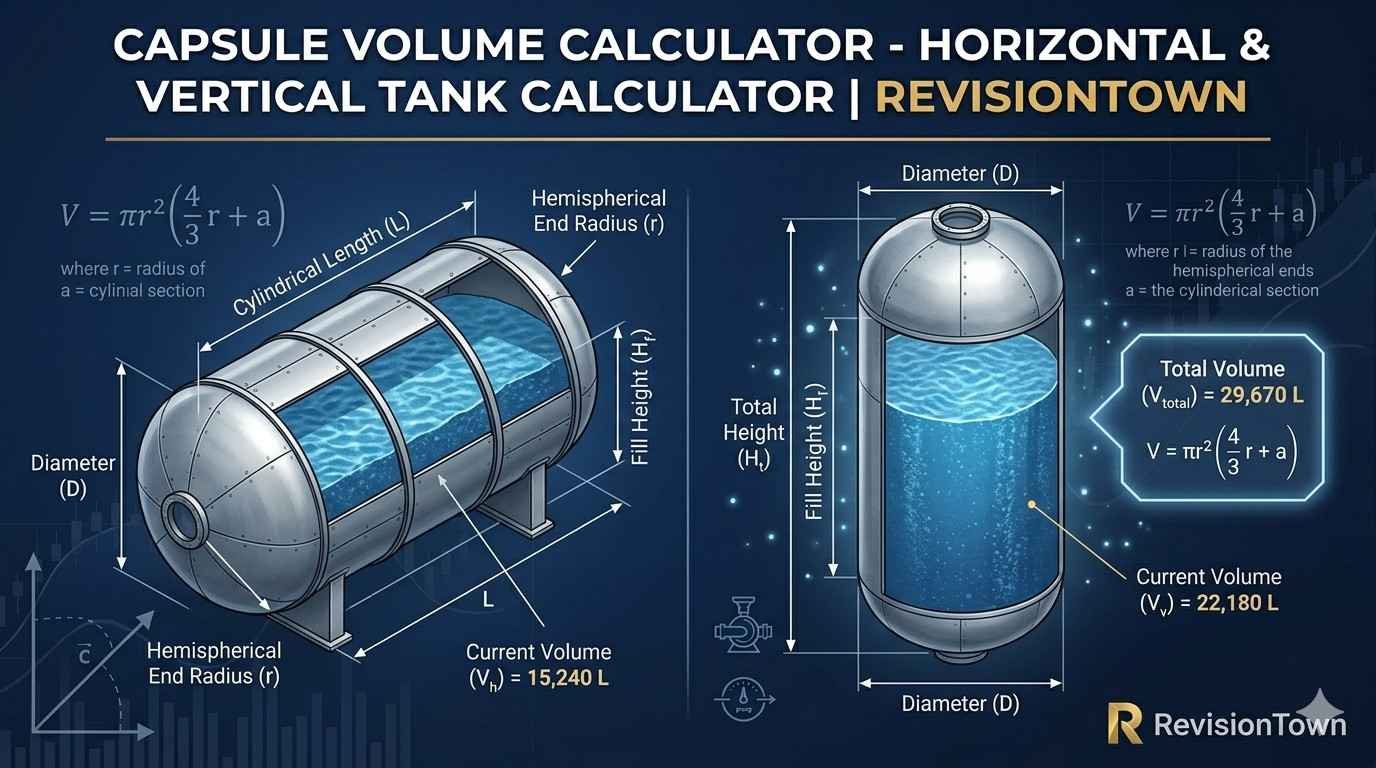
Capsule Volume Calculator
Calculate the volume of capsule-shaped tanks and containers. A capsule consists of a cylinder with hemispherical ends on both sides. Use this calculator for horizontal capsule tanks, vertical capsule tanks, or simple capsule volumes. Supports both full tank capacity and partial fill volume calculations for liquid storage applications.
Calculate Capsule Volume
Tank Orientation
Capsule Diameter/Radius
Radius = Diameter ÷ 2
Cylinder Length
Length does NOT include hemispherical ends. Total length = L + 2r
Fill Height (Partial Volume)
Measured from bottom of tank
Volume Results
Total Volume
--
cubic units
Capacity (Liters)
--
L
Capacity (Gallons)
--
US gal
Volume Breakdown
Capsule Volume Formulas
Total Capsule Volume
1. Complete Capsule Volume Formula:
\( V_{\text{capsule}} = \pi r^2 L + \frac{4}{3}\pi r^3 \)
Where \(r\) is radius, \(L\) is cylinder length (excluding hemispheres). The cylinder contributes \(\pi r^2 L\), and two hemispheres (=one sphere) contribute \(\frac{4}{3}\pi r^3\). Total tank length = \(L + 2r\).
2. Alternative Form (using diameter):
\( V_{\text{capsule}} = \frac{\pi d^2}{4}L + \frac{\pi d^3}{6} \)
Where \(d\) is diameter. Since \(r = d/2\), we can express the formula using diameter. For a capsule with diameter 4m and length 10m: \(V = \frac{\pi(4)^2}{4}(10) + \frac{\pi(4)^3}{6} = 125.66 + 33.51 = 159.17\) m³.
3. Factored Form:
\( V_{\text{capsule}} = \pi r^2\left(L + \frac{4r}{3}\right) \)
Factoring out \(\pi r^2\) shows the effective length is the cylinder length plus \(\frac{4r}{3}\) contribution from hemispheres. Useful for quick mental calculations.
4. Cylinder and Sphere Components:
\( V_{\text{cylinder}} = \pi r^2 L \quad \text{and} \quad V_{\text{sphere}} = \frac{4}{3}\pi r^3 \)
Breaking down: cylinder volume uses base area × height. Two hemispheres equal one complete sphere with volume \(\frac{4}{3}\pi r^3\). Add these components for total capsule volume.
Partial Fill Formulas
5. Horizontal Capsule Partial Volume:
\( V_{\text{fill}} = V_{\text{cylinder segment}} + V_{\text{spherical caps}} \)
Complex calculation: cylindrical segment uses \(\frac{1}{2}r^2(\theta - \sin\theta)L\) where \(\theta = 2\arccos\left(\frac{r-h}{r}\right)\). Add two spherical caps: \(V_{\text{cap}} = \frac{\pi h^2}{3}(3r-h)\) for each end.
6. Vertical Capsule Partial Volume:
\( V_{\text{fill}} = \begin{cases} \frac{\pi h^2}{3}(3r-h) & h \leq r \\ \pi r^2(h-r) + \frac{2\pi r^3}{3} & r < h \leq L+r \\ \pi r^2 L + \frac{4\pi r^3}{3} - \frac{\pi(2r+L-h)^2}{3}(3r-(2r+L-h)) & h > L+r \end{cases} \)
Three cases: (1) bottom hemisphere only, (2) bottom hemisphere + partial cylinder, (3) full tank minus top empty portion. Height measured from bottom.
Practical Applications
🛢️ Storage Tanks
Horizontal capsule tanks for liquid storage (oil, water, chemicals). Hemispherical ends distribute pressure evenly, ideal for pressurized vessels.
🚗 LPG/CNG Tanks
Vehicle fuel tanks with capsule shape for optimal space utilization and structural integrity under high pressure.
💊 Pharmaceutical Capsules
Medicine capsule volume calculation for dosage determination and manufacturing specifications.
🏗️ Construction Materials
Calculate concrete volume for cylindrical columns with rounded ends, or material requirements for capsule-shaped structures.
Frequently Asked Questions
How do you calculate the volume of a capsule?
Calculate capsule volume using the formula: V = πr²L + (4/3)πr³, where r is the radius and L is the length of the cylindrical portion (not including the hemispherical ends). The cylinder contributes πr²L volume, and the two hemispheres (which together form a complete sphere) contribute (4/3)πr³. For example, a capsule with radius 2m and cylinder length 10m has volume: V = π(2)²(10) + (4/3)π(2)³ = 125.66 + 33.51 = 159.17 m³. The total length of the capsule is L + 2r = 14m.
What is the formula for a horizontal capsule tank?
For total volume of a horizontal capsule tank, use V = πr²L + (4/3)πr³. For partial fill volume, the calculation is complex: you need the volume of a cylindrical segment plus two spherical caps. The cylindrical segment volume is (1/2)r²(θ - sinθ)L where θ = 2arccos((r-h)/r) and h is fill height. Each spherical cap at the ends contributes πh²(3r-h)/3. This accounts for the curved shape of both the cylinder and hemispherical ends. For practical applications, online calculators or lookup tables are recommended for partial fill calculations due to complexity.
What is a capsule tank used for?
Capsule tanks are widely used in industrial applications for storing liquids and gases under pressure. Common uses include: horizontal storage tanks for petroleum products, LPG/CNG fuel tanks in vehicles and industrial settings, water storage systems, chemical storage vessels, and compressed air tanks. The hemispherical ends provide superior structural strength compared to flat ends, making capsule tanks ideal for pressurized applications. They distribute stress evenly across the curved surfaces, requiring less material thickness while maintaining structural integrity. The shape also minimizes dead space and allows efficient draining.
How do you measure a capsule tank?
To measure a capsule tank, you need three key dimensions: (1) Diameter or radius - measure the width of the cylindrical section or hemispherical end; they should be equal. (2) Cylinder length (L) - measure only the straight cylindrical portion, excluding the curved hemispherical ends. (3) Total length - measure from one end to the other; this equals L + 2r. For partial fill measurements, measure the liquid depth from the bottom for horizontal tanks, or height from the bottom for vertical tanks. Use the tank's maximum diameter as the reference point. Ensure measurements are in consistent units (all meters or all feet) before calculating volume.
What is the difference between capsule and cylinder volume?
A cylinder has flat ends and volume V = πr²h, while a capsule has hemispherical (rounded) ends and volume V = πr²L + (4/3)πr³. For the same radius and cylinder length, the capsule has additional volume from the two hemispheres equal to (4/3)πr³. For example, comparing a cylinder and capsule both with r=2m and L=10m: cylinder volume = π(2)²(10) = 125.66 m³, capsule volume = 125.66 + 33.51 = 159.17 m³. The capsule has approximately 26.7% more volume due to the hemispherical ends. This extra volume is equivalent to adding 4r/3 (≈2.67m) to the cylinder length.
How to convert capsule volume to liters or gallons?
After calculating volume in cubic units, convert using standard factors: 1 m³ = 1,000 liters = 264.172 US gallons; 1 ft³ = 28.3168 liters = 7.48052 US gallons; 1 cm³ = 0.001 liters = 0.000264 gallons. For example, a capsule with 159.17 m³ volume equals 159,170 liters or 42,058 US gallons. Always ensure your dimensions are in consistent units before calculating - mixing meters and feet will produce incorrect results. For imperial gallons (UK), use 1 m³ = 219.969 imperial gallons. Most industrial tank capacities are specified in liters (metric) or gallons (US/UK) rather than cubic meters or cubic feet.