
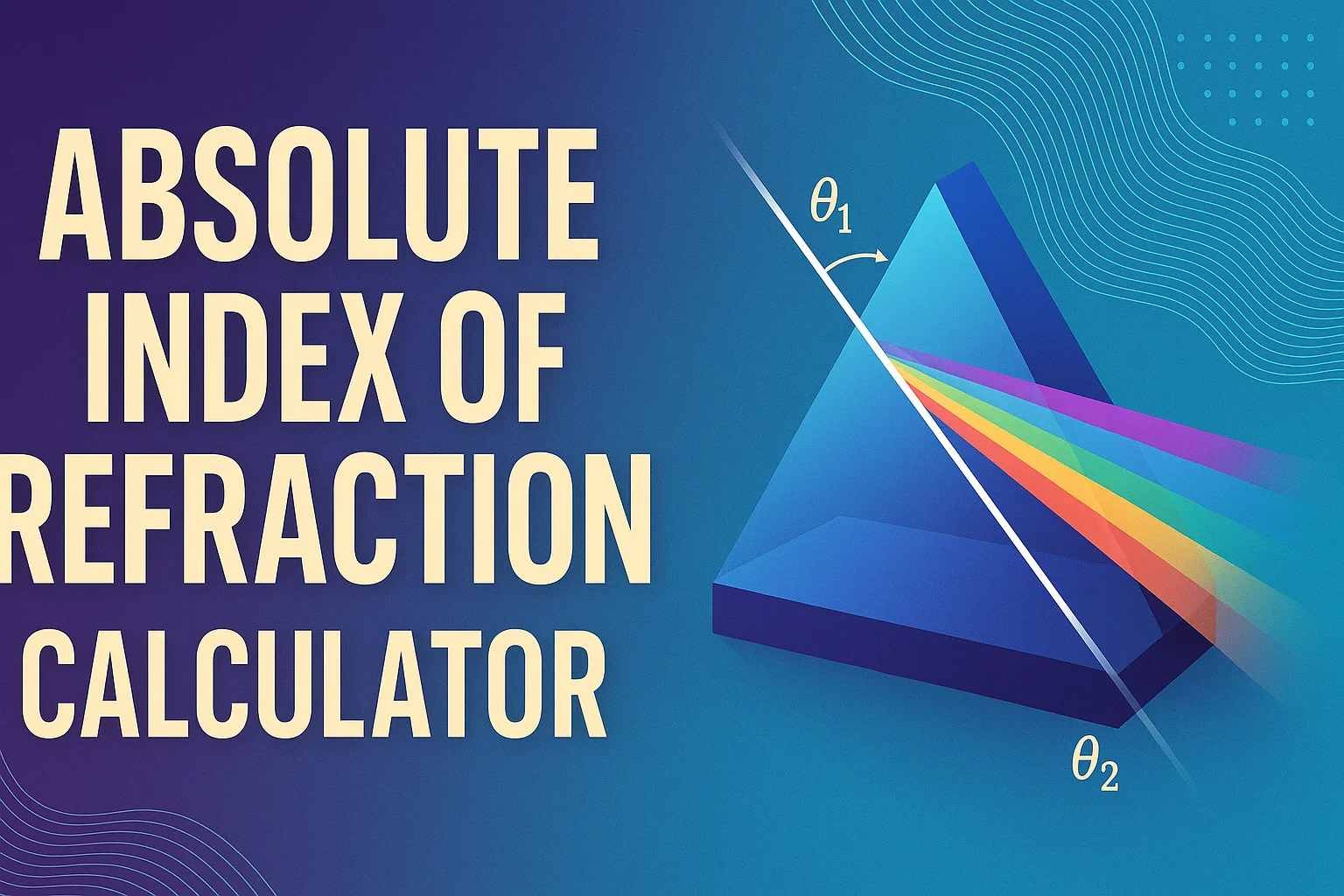
Absolute Index of Refraction Calculator
📚 Understanding Refractive Index
What is the Absolute Index of Refraction?
The absolute index of refraction (n) is a fundamental optical property that describes how much a material slows down light propagation compared to vacuum. Defined as the ratio n = c / v, where c is the speed of light in vacuum (3 × 10⁸ m/s) and v is the light speed in the medium, it's a dimensionless quantity always greater than or equal to 1. This property is essential for understanding light behavior in optics, designing lenses and optical systems, and identifying materials through their optical characteristics.
Fundamental Refractive Index Formulas
| Concept | Formula | Application |
|---|---|---|
| Absolute Refractive Index | n = c / v | Speed-based calculation; fundamental definition |
| Snell's Law | n₁ sin(θ₁) = n₂ sin(θ₂) | Light refraction at interfaces; lens design |
| Critical Angle | sin(θc) = n₂ / n₁ | Total internal reflection; fiber optics |
| Wavelength Change | λ_medium = λ_vacuum / n | Wavelength reduction in dense media |
| Optical Path Length | OPL = n × d | Effective path traveled by light |
Refractive Index of Common Materials
| Material | Refractive Index (n) | Optical Characteristics |
|---|---|---|
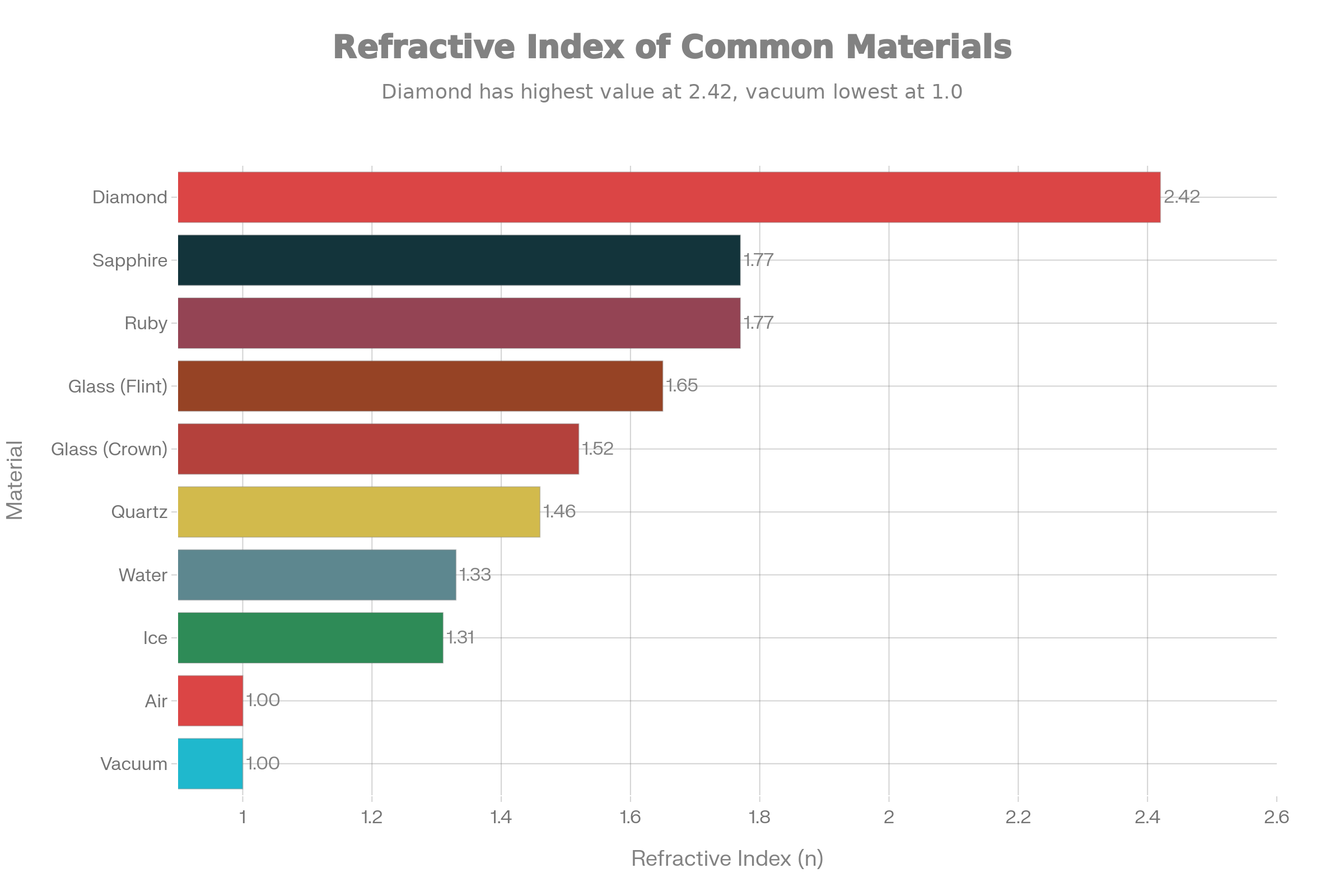
| Vacuum | 1.0 (definition) | Reference standard; no dispersion |
| Air | 1.0003 | Nearly ideal; often treated as 1.0 |
| Water | 1.33 | Common reference; exhibits dispersion |
| Ice | 1.31 | Lower than water; crystalline structure |
| Crown Glass | 1.52 | Standard optical glass; low dispersion |
| Flint Glass | 1.65 | Higher index; greater light bending |
| Quartz | 1.46 | Excellent transparency; UV resistant |
| Diamond | 2.42 | Highest common value; brilliant shine |
| Ruby & Sapphire | 1.77 | Gemstone quality; excellent clarity |
Understanding Snell's Law and Light Refraction
When light travels from one medium to another with different refractive indices, it bends according to Snell's Law: n₁ sin(θ₁) = n₂ sin(θ₂). Here, θ₁ and θ₂ are incident and refraction angles measured from the normal (perpendicular) to the interface. When light enters a denser medium (higher n), it bends toward the normal, slowing down. This bending behavior is the basis for lens function—the primary principle enabling eyeglasses, microscopes, telescopes, and cameras to focus light.
Critical Angle and Total Internal Reflection
When light travels from a denser to a less dense medium (higher n to lower n), there exists a critical angle θc beyond which light undergoes total internal reflection rather than refraction. This occurs when sin(θc) = n₂ / n₁. For water-air interface: sin(θc) = 1/1.33 ≈ 0.75, yielding θc ≈ 48.8°. Beyond this angle, all light reflects back into the water. This principle enables fiber optic cables—light travels through the fiber core via total internal reflection, enabling long-distance, high-capacity data transmission without signal loss.
Dispersion and Wavelength-Dependent Refraction
Refractive index varies slightly with light wavelength—shorter blue wavelengths refract more than longer red wavelengths. This wavelength dependence, called dispersion, causes white light to separate into a spectrum through a prism. When light enters a medium with refractive index n, its wavelength decreases by factor n: λ_medium = λ_vacuum / n. For example, in water (n = 1.33), visible light wavelengths reduce by 25%. This phenomenon causes underwater color changes and is the principle enabling rainbows and spectroscopy applications.
Practical Applications of Refractive Index
- Lens Design: Optical engineers calculate lens power based on material refractive index, enabling precise focus in cameras, microscopes, and telescopes
- Fiber Optic Networks: Using materials with controlled refractive index differences enables total internal reflection for high-speed, long-distance data transmission
- Optical Coatings: Anti-reflection coatings exploit refractive index differences to minimize unwanted reflections in high-precision optical systems
- Gemstone Identification: Refractive index is a key property for identifying and grading precious stones—diamonds (n=2.42) exhibit distinctive optical signatures
- Prism Dispersion: Different refractive indices for different wavelengths enable precise light separation, crucial in spectrometers and scientific instruments
- Medical Optics: Corneal reshaping (LASIK) and intraocular lens design depend on understanding refractive index behavior and light propagation
Why RevisionTown's Refractive Index Calculator?
Calculating refractive index manually requires careful selection among multiple formulas and understanding of optical principles. Our advanced calculator eliminates confusion by supporting four distinct calculation methods—speed ratio, Snell's law, critical angle, and material lookup—automatically applying the correct formula and instantly providing comprehensive optical analysis. Whether you're studying optics, designing optical systems, or analyzing material properties, this calculator ensures accuracy and saves valuable time.
❓ Frequently Asked Questions
The absolute index of refraction (n) is the ratio of light speed in vacuum to light speed in a medium: n = c / v, where c = 3 × 10⁸ m/s and v is light speed in the medium. It's dimensionless and always ≥ 1 since light travels fastest in vacuum. For example, water (n ≈ 1.33) means light travels 1.33 times faster in vacuum than in water. This fundamental property determines how much light bends entering different media and is essential for understanding optical phenomena.
Snell's Law states: n₁ sin(θ₁) = n₂ sin(θ₂), where n₁ and n₂ are refractive indices, θ₁ is incident angle, and θ₂ is refraction angle (measured from normal). This law describes light bending at interfaces. When light enters a denser medium (higher n), it bends toward the normal, slowing down. This principle enables lenses to focus light. From Snell's Law, you can calculate: n = sin(θ₁) / sin(θ₂) for transition from vacuum/air to another medium.
The critical angle (θc) is the incident angle at which refraction angle reaches 90°—light refracts along the interface. Beyond this angle, total internal reflection occurs. Critical angle is found from: sin(θc) = n₂ / n₁ (n₁ > n₂). For water-air interface: sin(θc) = 1/1.33 ≈ 0.75, so θc ≈ 48.8°. This phenomenon enables fiber optic cables, prisms, and creates the diamond's distinctive sparkle through internal light reflection.
Vacuum (n=1.0 by definition); Air (n≈1.0003); Water (n≈1.33); Ice (n≈1.31); Crown Glass (n≈1.52); Flint Glass (n≈1.65); Quartz (n≈1.46); Diamond (n≈2.42); Ruby/Sapphire (n≈1.77); Olive Oil (n≈1.47); Ethanol (n≈1.36). These values determine optical properties crucial for material identification, lens design, and optical system performance. Materials with higher indices bend light more dramatically.
When light enters a medium with refractive index n, its wavelength decreases by factor n: λ_medium = λ_vacuum / n. Frequency remains constant (determined by light source). For example, in water (n=1.33), visible light wavelengths reduce by 25%. This affects color perception—underwater objects appear different colors because blue light (shorter wavelength) penetrates further than red. This relationship is fundamental in spectroscopy and explains rainbow formation through prisms.
Refractive index generally correlates with material density—denser materials typically have higher refractive indices. However, the relationship isn't strictly proportional. Diamond (n=2.42) is denser than glass (n=1.52), but some oils are less dense than water yet have similar refractive indices. The relationship depends on atomic structure and electron distribution. Understanding this correlation helps in material selection for optical applications and enables optical identification of gemstones and other materials.
Refractive index is wavelength-dependent—shorter blue light refracts more than longer red light. This dispersion separates white light into a spectrum through prisms, creating rainbows. For glass: n_blue ≈ 1.53 while n_red ≈ 1.51. Dispersion is crucial in optical design to minimize chromatic aberration (color fringing) in lenses. Understanding wavelength-dependent refraction is essential for spectrometers, color filters, and precision optical systems.
Fiber optic cables exploit total internal reflection using refractive index differences between core and cladding. Light in the high-index core (n≈1.48) undergoes total internal reflection at the core-cladding boundary (n≈1.46), confining light within the fiber. This design enables long-distance, high-capacity data transmission without signal loss. Understanding refractive index and its effect on light propagation is essential for fiber optic system design, optimization, and performance prediction.