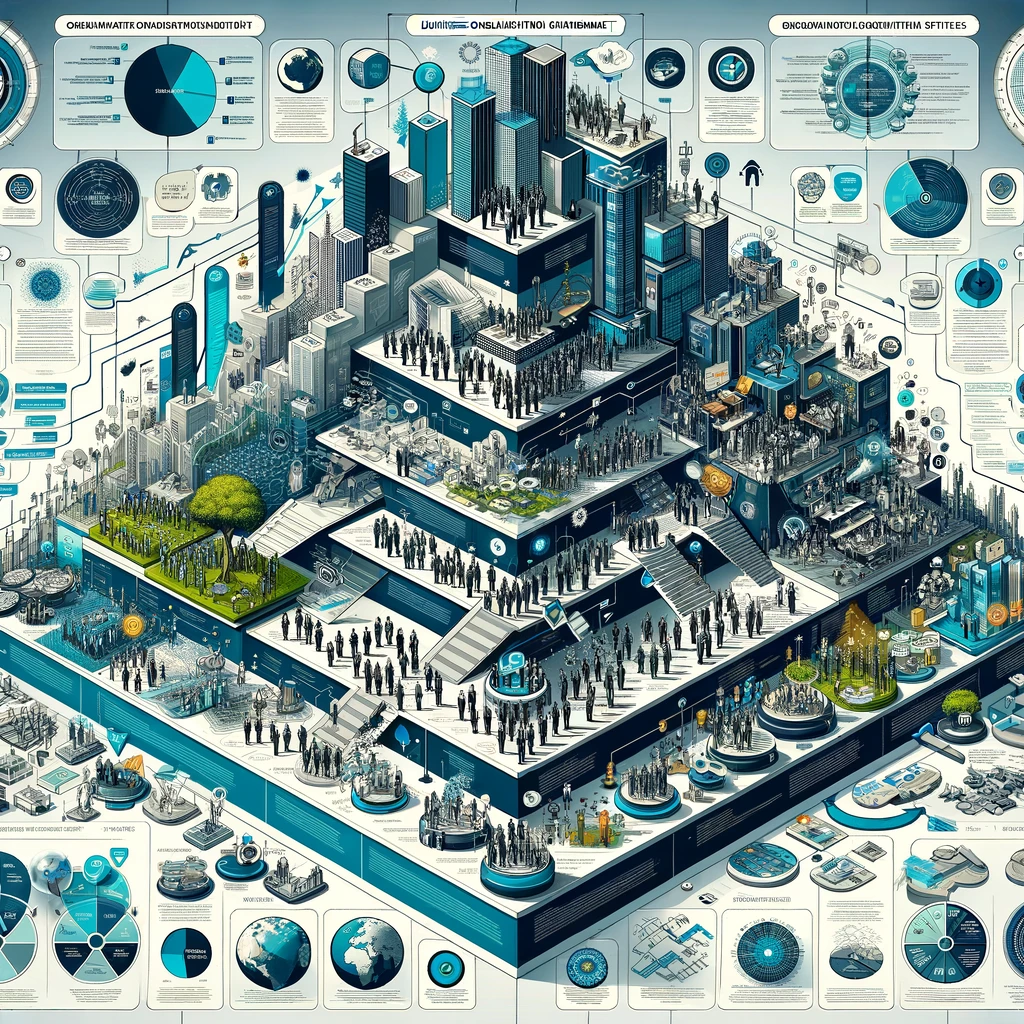
Changes in Organisational Structures: Complete IB Business Management Study Guide
Changes in organisational structures explain how and why businesses redesign authority, hierarchy, communication, responsibility, accountability, teams, departments, and decision-making systems. This guide covers tall and flat structures, delayering, matrix structures, project-based organisations, Charles Handy’s Shamrock Organisation, decentralisation, centralisation, network organisations, exam strategy, score guidance, formulas, diagrams, examples, and current IB Business Management exam information.
This topic sits inside Human Resource Management because structure affects people. It changes who reports to whom, how quickly decisions are made, how employees communicate, how managers delegate, and how flexible the business becomes when external conditions change. In IB Business Management, this topic is especially useful for questions involving growth, innovation, leadership, motivation, resistance to change, corporate culture, mergers, digital transformation, remote teams, outsourcing, and strategic decision-making.
Course placement
Subject: IB Business Management
Unit: Unit 2 — Human Resource Management
Topic: 2.2 Organizational / Organisational Structure
Depth: Changes in organisational structures are normally treated as an HL extension area requiring evaluation.
Key exam command terms
Students may be asked to explain, analyse, discuss, evaluate, compare, or recommend structural changes. Strong answers apply the structure to the case, consider stakeholders, and reach a balanced judgement.
Essential idea
A structure is not only a chart. It is a system for distributing power, communication, workload, coordination, and accountability. Changing it can improve speed and flexibility, but it may also increase stress, uncertainty, conflict, and implementation costs.
Organisational Structure Change Evaluator
Use this tool to compare the current structure with a proposed structure. It calculates span of control, delayering percentage, estimated annual impact, payback period, and an exam-style interpretation. These calculations are study estimates only, not official IB marks or business advice.
What Are Changes in Organisational Structures?
Changes in organisational structures occur when a business modifies the way people, teams, departments, managers, decision-makers, and reporting relationships are arranged. A business may move from a tall hierarchy to a flatter structure, remove middle management through delayering, introduce a matrix structure, create project-based teams, outsource non-core work, centralise authority during a crisis, decentralise authority to improve responsiveness, or redesign itself around products, regions, functions, or customer segments.
In simple terms, the structure answers five practical questions. Who has authority? Who is responsible for each task? Who communicates with whom? Who makes decisions? Who is accountable if performance improves or declines? When the structure changes, the answers to these questions also change. That is why structural change can be powerful but risky. It does not only redraw boxes on an organisation chart; it changes the day-to-day behaviour of employees and managers.
The topic connects strongly to the IB concept of change. Businesses rarely operate in a fixed environment. They face new technology, competition, regulation, globalisation, remote work, sustainability expectations, labour shortages, mergers, acquisitions, cost pressure, and customer demand for faster service. A structure that worked well when the business was small may become slow and bureaucratic when the business grows. A structure that worked well in one country may fail when the business expands internationally. A structure that suited routine production may not support innovation, agile product development, or digital services.
Key Terminology for Organisational Structure
Before evaluating structural change, students must understand the vocabulary used in organisation charts and HRM decisions. These terms often appear in Paper 1 case-study questions, Paper 2 stimulus questions, and HL Paper 3 recommendation tasks.
| Term | Meaning | Why it matters in structural change |
|---|---|---|
| Delegation | Passing authority and responsibility from a manager to a subordinate. | Flatter and decentralised structures require more delegation because fewer managers control wider teams. |
| Span of control | The number of subordinates directly managed by one manager. | A wider span may reduce costs and speed communication, but it can overload managers and reduce supervision. |
| Levels of hierarchy | The layers of authority from top management to operational employees. | Fewer layers usually mean faster communication; more layers may provide clearer control and promotion pathways. |
| Chain of command | The route through which authority and instructions pass. | Matrix and project-based structures can create dual reporting, which may increase flexibility but also confusion. |
| Bureaucracy | A rule-based system with formal procedures, documentation, and hierarchy. | Can improve consistency and accountability but may slow change and discourage creativity. |
| Centralisation | Decision-making authority is concentrated at senior levels. | Useful for consistency, crisis control, and cost discipline; may reduce local responsiveness. |
| Decentralisation | Decision-making authority is passed to lower levels or local units. | Useful for motivation and market responsiveness; may cause inconsistency or duplication. |
| Delayering | Removing one or more layers of management from the hierarchy. | Can reduce costs and speed communication; may damage morale if managers are made redundant. |
| Matrix structure | Employees may report to more than one manager, often by function and project/product. | Improves collaboration and specialist use but can create conflict over priorities. |
Important Formulas for Organisational Structure Analysis
Organisational structure is mainly a qualitative topic, but quantitative evidence can strengthen evaluation. A strong IB Business Management answer often combines concepts with calculations. For example, if a business is delayering, you can calculate the change in span of control, the percentage reduction in hierarchy layers, the estimated cost saving, and the payback period for restructuring.
\[ \text{Span of control} = \frac{\text{Number of employees}}{\text{Number of managers}} \]
\[ \text{Layers removed} = \text{Current hierarchy layers} - \text{Proposed hierarchy layers} \]
\[ \text{Delayering percentage} = \frac{\text{Layers removed}}{\text{Current hierarchy layers}} \times 100 \]
\[ \text{Annual management cost saving} = (\text{Current managers} - \text{Proposed managers}) \times \text{Average manager cost} \]
\[ \text{Net year-one impact} = \text{Annual savings} + \text{Annual benefit} - \text{Transition cost} \]
\[ \text{Payback period} = \frac{\text{Transition cost}}{\text{Annual savings} + \text{Annual benefit}} \]
These formulas do not prove that restructuring is successful. They only provide evidence. A business might save money but lose experienced managers. It might improve communication speed but weaken supervision. It might increase employee empowerment but increase stress. Therefore, quantitative evidence should be used alongside qualitative judgement.
Diagram: Tall Structure, Flat Structure, Matrix Structure, and Project-Based Structure
Why Businesses Change Organisational Structures
Businesses change structures because the old design no longer fits the strategy or environment. The most common reason is growth. A small business may start with a simple entrepreneurial structure where the founder makes most decisions. As the business expands, that structure becomes overloaded. Employees need clearer roles, managers need authority, and the firm may need separate departments for finance, marketing, HR, operations, technology, and customer support.
Another reason is cost pressure. A tall structure can become expensive because it uses several management layers. If middle managers mainly pass information up and down, senior leaders may remove a layer and widen the span of control. This is called delayering. In theory, delayering reduces salary costs and speeds communication. In practice, the outcome depends on whether remaining managers can cope, whether employees are trained, and whether the business provides clear systems for decision-making.
Technological change is also a major driver. Digital platforms, artificial intelligence, cloud collaboration tools, automation, data dashboards, and remote-working systems reduce the need for some traditional supervisory roles. A manager may no longer need to physically inspect every task if performance data is available in real time. However, technology does not remove the human side of structure. Employees still need trust, motivation, clarity, feedback, conflict resolution, and ethical leadership.
Businesses also restructure because of strategy. A firm pursuing innovation may need project teams and flexible communication. A firm pursuing operational efficiency may need standardised processes and centralised control. A multinational company may divide itself by region so local managers can adapt to culture, regulation, and customer preferences. A diversified company may divide itself by product so each business unit can focus on its own market.
Internal drivers
- Business growth or contraction
- New leadership or strategy
- Cost reduction targets
- Poor communication or slow decisions
- Low motivation or high labour turnover
- Mergers, acquisitions, or cultural clashes
External drivers
- New technology and automation
- Competition and market disruption
- Global expansion
- Regulatory change
- Sustainability and ethical expectations
- Remote, hybrid, and gig-economy working patterns
Tall Structures and Flat Structures
A tall structure has many layers of hierarchy and a narrow span of control. This means managers usually supervise a smaller number of employees. Tall structures can provide strong supervision, clear promotion routes, and formal control. They may suit large, regulated, risk-sensitive, or traditional organisations where accuracy, compliance, and accountability are more important than speed.
However, tall structures can become slow. Messages travel through several layers, and information may be distorted or delayed. Employees may feel distant from senior managers. Decision-making can become bureaucratic. In a fast-moving market, this may reduce competitiveness because the business cannot respond quickly to customer needs or competitor actions.
A flat structure has fewer layers of hierarchy and a wider span of control. It can improve communication speed, reduce management costs, and encourage empowerment. Employees may have more responsibility and greater involvement in decisions. Flat structures often suit start-ups, creative industries, technology companies, consultancies, and organisations that rely on collaboration.
The weakness of a flat structure is that managers may supervise too many people. If the span of control is too wide, employees may not receive enough guidance. Decision-making can become unclear if responsibilities are not defined. Promotion opportunities may be reduced because fewer managerial layers exist. Therefore, a flat structure is not automatically better; it works best when employees are skilled, motivated, trained, and supported by strong systems.
Delayering
Delayering means removing one or more levels of hierarchy. It is one of the most important forms of structural change. A business may delayer to reduce costs, remove bureaucracy, empower employees, shorten communication channels, and become more responsive. For example, a company might remove regional middle managers and allow store managers to report directly to divisional managers. This could reduce salary costs and speed local decisions.
The advantages of delayering include lower management costs, quicker communication, more responsibility for remaining employees, and potentially faster responses to market change. It may also reduce duplication when different managers were performing similar coordination tasks.
The disadvantages are serious. Delayering may cause redundancies, lower morale, reduce job security, increase the workload of remaining managers, create resistance to change, and remove experienced employees who held valuable organisational knowledge. If the business removes layers without redesigning processes, it may create confusion rather than efficiency.
Matrix Structure
A matrix structure combines two lines of authority. Employees may report to a functional manager and a project manager at the same time. For example, a marketing specialist may belong to the marketing department but also work on a new product-launch project led by a project manager. This structure is common in multinational companies, engineering, consulting, technology, advertising, product development, and research-based organisations.
The main advantage of a matrix structure is collaboration. Specialists from different departments can work together on complex problems. The business can use expert knowledge more effectively and respond to projects without creating a permanent department for every new task. It can also improve communication across functional silos.
The main disadvantage is conflict. Employees may receive instructions from two managers who have different priorities. A project manager may want speed, while a functional manager may want quality control. Dual reporting can cause stress, confusion, delays, and political behaviour if managers compete for resources. Matrix structures require strong communication, mature leadership, and clear project authority.
Project-Based Organisation
A project-based organisation structures work around temporary projects rather than permanent departments. A team is formed to complete a specific objective, such as launching an app, designing a building, running a marketing campaign, implementing a new IT system, or entering a new market. After the project is completed, the team may be dissolved and employees may move to another project.
Project-based structures are useful when work is complex, time-bound, creative, and cross-functional. They can bring together people from finance, marketing, operations, HR, technology, and external partners. They can improve innovation because employees focus on a clear objective rather than routine departmental tasks.
The risks include uncertainty, duplication, and coordination problems. Employees may feel insecure if projects end frequently. Knowledge may be lost if lessons are not documented. Project managers may compete for the best employees. Costs can rise if several projects require similar resources. For IB evaluation, the key question is whether the business environment requires flexibility strongly enough to justify the complexity.
Charles Handy’s Shamrock Organisation
Charles Handy’s Shamrock Organisation is a model that divides the workforce into three broad groups, like the three leaves of a shamrock. The first group is the core workforce. These are permanent, highly skilled employees who hold the organisation’s central knowledge and strategic capabilities. The second group is the contractual fringe. These are external contractors, consultants, suppliers, or outsourced specialists. The third group is the flexible labour force. These are part-time, temporary, freelance, or gig workers used when demand changes.
The Shamrock Organisation helps explain modern flexible working. Many businesses no longer employ all workers permanently. They may keep a small strategic core while outsourcing logistics, IT support, design, payroll, customer support, or manufacturing. This can reduce fixed costs and increase flexibility. It may also help the business access specialist expertise without hiring full-time employees.
The model also raises ethical and HR issues. Flexible workers may have less job security, fewer benefits, weaker attachment to the business, and less influence over decisions. Outsourcing can reduce control over quality and organisational culture. Core employees may feel overburdened because they carry strategic responsibility while also coordinating external workers. In IB answers, this model is valuable because it links structure to ethics, sustainability, human resource planning, motivation, and stakeholder conflict.
Centralisation and Decentralisation
Centralisation means decision-making power is concentrated at the top of the hierarchy. It can help a business maintain consistent standards, control costs, protect brand identity, and respond firmly during a crisis. For example, a global restaurant chain may centralise menu standards and food safety procedures to protect its reputation.
Decentralisation means decision-making power is delegated to lower levels or local units. It can improve motivation, speed, and local responsiveness. A regional manager may understand customer preferences better than head office. A store manager may know which products sell best in a local community. Decentralisation can also develop future leaders by giving managers real responsibility.
The best answer often recognises that businesses may use both. A multinational company may centralise finance, brand guidelines, cybersecurity, and legal compliance while decentralising marketing campaigns, customer service, and product adaptation. The ideal structure depends on the level of risk, the need for consistency, the skill of local managers, and the diversity of markets served.
Network and Outsourced Structures
A network structure is built around relationships between the core business and external partners. Instead of owning every activity internally, the business coordinates suppliers, contractors, logistics providers, technology vendors, freelancers, and strategic partners. This structure is common in digital businesses, platform businesses, fashion, consumer electronics, e-commerce, and service industries.
The advantage is flexibility. A business can scale quickly, access specialist expertise, reduce fixed costs, and focus on core competencies. The disadvantage is loss of control. If a supplier fails, the whole customer experience may suffer. If outsourced workers are treated poorly, the brand may face reputational damage. Network structures require strong contracts, relationship management, quality control, data security, and ethical supply chain monitoring.
How Structural Change Affects Stakeholders
Structural change affects different stakeholders in different ways. Employees may gain empowerment, better communication, and more interesting work, but they may also face redundancy, role ambiguity, heavier workloads, and stress. Managers may gain strategic responsibility but lose status if layers are removed. Customers may benefit from faster service and innovation, but they may suffer during the transition if employees are confused. Shareholders may benefit from cost savings and efficiency, but they may face short-term restructuring costs. Suppliers may gain new contracts if outsourcing increases, but existing suppliers may be replaced.
A strong IB answer should evaluate stakeholder trade-offs. For example, delayering may improve shareholder returns but reduce employee morale. A project-based structure may improve innovation for customers but increase pressure on employees. A Shamrock structure may reduce fixed costs but raise ethical concerns about job security and fairness. A matrix structure may improve collaboration but create conflict between functional and project managers.
| Stakeholder | Possible benefit | Possible problem | IB evaluation angle |
|---|---|---|---|
| Employees | More empowerment, variety, responsibility, and skill development. | Stress, uncertainty, redundancy risk, unclear reporting lines. | Link to motivation, resistance to change, training, and culture. |
| Managers | Clearer strategic focus, fewer routine approvals, stronger accountability. | Loss of status, heavier span of control, conflict in matrix systems. | Discuss leadership style and communication quality. |
| Customers | Faster service, more innovation, local adaptation. | Temporary disruption or inconsistent service. | Connect to customer satisfaction and brand loyalty. |
| Shareholders | Lower costs, improved agility, stronger competitiveness. | Short-term restructuring costs and execution risk. | Use payback, cost saving, and risk analysis. |
| Suppliers / contractors | More outsourcing opportunities in network or Shamrock structures. | Pressure on prices, quality standards, and delivery deadlines. | Link to ethics, sustainability, and supply chain reliability. |
IB Business Management Course and Assessment Overview
IB Business Management is part of Individuals and Societies. It develops knowledge of business theories, tools, decision-making, and the interaction between internal and external factors. The course includes human resource management, finance and accounts, marketing, operations management, and business organisation. The structural change topic links especially to HRM, leadership, motivation, organisational culture, communication, operations, and strategy.
At Standard Level, students study the core course and complete Paper 1, Paper 2, and the internal assessment. At Higher Level, students study the core plus HL extension material and complete Paper 1, Paper 2, Paper 3, and the internal assessment. The topic “changes in organisational structures” is particularly useful for HL because it requires evaluation of strategic choices and their impact on stakeholders.
| IB Business Management SL component | Time / workload | Weighting | What students should practise |
|---|---|---|---|
| Paper 1 | 1 hour 30 minutes | 35% | Case-study application, definitions, advantages/disadvantages, evaluation. |
| Paper 2 | 1 hour 30 minutes | 35% | Stimulus-based analysis, quantitative skills, and structured evaluation. |
| Internal assessment | 20 hours | 30% | Research project on a real organisation using a conceptual lens. |
| IB Business Management HL component | Time / workload | Weighting | What students should practise |
|---|---|---|---|
| Paper 1 | 1 hour 30 minutes | 25% | Case-study analysis and concise evaluation. |
| Paper 2 | 1 hour 45 minutes | 30% | Stimulus-based decisions, quantitative tools, and extended responses. |
| Paper 3 | 1 hour 15 minutes | 25% | Social enterprise case analysis and recommendation of a plan of action. |
| Internal assessment | 20 hours | 20% | Research project on a real organisation using a conceptual lens. |
Weighted Score Formula for IB Business Management
IB final grade boundaries are not fixed in advance and may vary by examination session. However, students can estimate a weighted course percentage by combining component percentages. The formula below is useful for planning revision, not for predicting an official final grade.
\[ \text{Weighted score} = \sum(\text{Component percentage score} \times \text{Component weighting}) \]
For SL:
\[ \text{SL estimate} = (P1 \times 0.35) + (P2 \times 0.35) + (IA \times 0.30) \]
For HL:
\[ \text{HL estimate} = (P1 \times 0.25) + (P2 \times 0.30) + (P3 \times 0.25) + (IA \times 0.20) \]
Score Guidelines: What Strong Answers Usually Do
The following table is a study guide for Business Management responses. It is not an official grade-boundary table. It helps students understand the difference between descriptive, analytical, and evaluative answers.
| Performance level | Typical response quality | What to improve |
|---|---|---|
| Basic | Defines terms and gives simple advantages or disadvantages, but may not apply to the case. | Add business context, stakeholder impact, and relevant examples. |
| Sound | Explains effects clearly and uses some case evidence. The answer may still be more descriptive than evaluative. | Use both sides of the argument and connect to the organisation’s objective. |
| Strong | Analyses causes and consequences, applies concepts accurately, and considers more than one stakeholder. | Make the judgement sharper and use quantitative evidence where possible. |
| Excellent | Gives balanced evaluation, integrates case evidence, weighs short-term and long-term effects, and reaches a justified conclusion. | Maintain focus on the command term and avoid generic textbook paragraphs. |
2026 IB Business Management Exam Timetable
The timetable below is included for student planning. Schools should always confirm the official schedule, exam zone, and local start time with the IB coordinator.
| Session | Date | Session time block | Business Management paper | Duration |
|---|---|---|---|---|
| May 2026 | Wednesday 29 April 2026 | Afternoon | Business Management HL/SL Paper 1 | 1 hour 30 minutes |
| May 2026 | Wednesday 29 April 2026 | Afternoon | Business Management HL Paper 3 | 1 hour 15 minutes |
| May 2026 | Thursday 30 April 2026 | Morning | Business Management HL Paper 2 | 1 hour 45 minutes |
| May 2026 | Thursday 30 April 2026 | Morning | Business Management SL Paper 2 | 1 hour 30 minutes |
| November 2026 | Wednesday 28 October 2026 | Afternoon | Business Management HL/SL Paper 1 | 1 hour 30 minutes |
| November 2026 | Wednesday 28 October 2026 | Afternoon | Business Management HL Paper 3 | 1 hour 15 minutes |
| November 2026 | Thursday 29 October 2026 | Morning | Business Management HL Paper 2 | 1 hour 45 minutes |
| November 2026 | Thursday 29 October 2026 | Morning | Business Management SL Paper 2 | 1 hour 30 minutes |
How to Answer Exam Questions on Changes in Organisational Structures
For a short question, begin with a precise definition. If asked to explain an advantage and disadvantage, keep the answer balanced. Do not write a long essay. Define the structural change, apply it to the case, explain one benefit, explain one limitation, and make the link to the business objective.
For an evaluation question, use a clear structure. First, identify the structural change and the reason for it. Second, analyse the benefits. Third, analyse the limitations. Fourth, consider stakeholders. Fifth, reach a judgement that depends on the case context. A strong conclusion does not simply say “it depends.” It states what it depends on: training, leadership, communication, culture, cost, employee skills, urgency, and market conditions.
| Command term | Suggested structure | Common mistake |
|---|---|---|
| Explain | Define the structure, apply it to the organisation, and show a clear cause-and-effect link. | Only listing an advantage without explaining why it matters. |
| Analyse | Break down the impact on communication, costs, motivation, decision speed, and stakeholders. | Writing general textbook points with no case evidence. |
| Evaluate | Give arguments for and against, weigh their importance, and make a justified judgement. | Ending with a weak conclusion that repeats both sides. |
| Recommend | Choose the best option, justify it using evidence, and explain implementation steps. | Recommending a structure without considering risks and constraints. |
Example Exam Paragraph
If a fast-growing technology business changes from a functional structure to a project-based structure, one advantage is improved innovation. Employees from marketing, finance, design, and software development can work together on a product launch, reducing departmental barriers and improving the speed of decision-making. This is especially useful if the business competes in a market where customer preferences change quickly. However, the change may create role ambiguity because employees may be uncertain whether their project manager or functional manager has priority. This could reduce motivation and cause conflict if deadlines and responsibilities are not clearly communicated. Overall, a project-based structure may be suitable if the business has skilled employees, strong project leadership, and effective communication systems, but it may fail if the organisation’s culture is highly bureaucratic or if managers resist sharing authority.
Mini Case Study: Delayering at a Growing Online Retailer
Imagine an online retailer called GreenCart. GreenCart started as a small business with twenty employees. The founder made most decisions, and communication was informal. After five years, GreenCart has 220 employees, a warehouse, customer service teams, finance staff, marketing specialists, software developers, and regional delivery partners. The business now has seven hierarchy layers. Customer complaints are increasing because decisions about refunds, delivery changes, and supplier issues take too long.
The CEO proposes delayering by removing two middle-management layers and giving team leaders more decision-making power. The potential benefit is faster response time and lower salary costs. Customer-service employees may solve problems immediately instead of waiting for approval. The company may also become more flexible because decisions are made closer to the customer.
However, GreenCart faces risks. Middle managers may resist the change because their jobs are threatened. Team leaders may lack training. Employees may feel pressure if they receive more responsibility without extra support. If the business cuts management too quickly, service quality may decline. The final recommendation should therefore be conditional: delayer gradually, communicate the purpose clearly, provide training, use performance data, and protect morale through fair redundancy or redeployment policies.
Advantages and Disadvantages of Common Structural Changes
| Structural change | Main advantages | Main disadvantages | Best-fit context |
|---|---|---|---|
| Delayering | Lower costs, faster communication, wider empowerment. | Redundancies, stress, loss of experience, wider span of control. | Businesses with excessive hierarchy and slow decisions. |
| Matrix structure | Cross-functional collaboration, better use of specialists, improved innovation. | Dual authority, conflict, slower consensus-building. | Complex projects requiring multiple departments. |
| Project-based structure | Agility, innovation, clear project focus, flexible teams. | Uncertainty, duplication, resource conflict, knowledge-loss risk. | Technology, consulting, design, construction, product development. |
| Shamrock Organisation | Lower fixed costs, specialist outsourcing, flexible labour use. | Weaker loyalty, ethical concerns, quality-control issues. | Businesses needing flexibility and external expertise. |
| Decentralisation | Faster local decisions, motivation, responsiveness. | Inconsistency, duplication, weaker central control. | Large firms serving diverse regions or customer groups. |
| Centralisation | Consistency, control, standardisation, crisis coordination. | Slow local response, lower empowerment, senior overload. | Regulated industries, crisis periods, brand-sensitive operations. |
How to Evaluate Whether a Structural Change Is Suitable
Suitability depends on strategic fit. A business should not choose a structure because it is fashionable. It should choose a structure because it supports the organisation’s objectives. If the objective is innovation, the structure should support collaboration, creativity, and fast experimentation. If the objective is low cost, the structure should reduce duplication and improve efficiency. If the objective is international growth, the structure should support regional responsiveness and coordination.
Feasibility depends on resources and capability. A matrix structure may look attractive, but it requires skilled managers, clear communication, and employees who can handle multiple priorities. Decentralisation may motivate employees, but it requires trained local managers. Delayering may save money, but it requires systems that allow employees to work with less supervision.
Acceptability depends on stakeholder reaction. If employees strongly resist a restructuring plan, implementation may fail. If customers experience disruption, brand loyalty may decline. If shareholders focus on short-term cost savings, the business may underinvest in training. If suppliers are affected by outsourcing, quality may suffer. Therefore, the best evaluation considers strategic fit, feasibility, and stakeholder acceptance.
Practice Questions
- Define delayering and explain one possible benefit for a business facing high management costs.
- Explain one advantage and one disadvantage of a matrix structure for a multinational company.
- Analyse the effect of a wider span of control on employee motivation and communication.
- Evaluate whether a project-based organisation would be suitable for a fast-growing software business.
- Discuss whether Charles Handy’s Shamrock Organisation is ethical for a business that uses many gig workers.
- Recommend a structural change for a business that has slow decision-making, low innovation, and rising labour costs.
Model Answer Planning Checklist
- Define the structure accurately.
- Apply the point to the specific business or case study.
- Use at least one stakeholder impact.
- Include both benefits and limitations.
- Use quantitative evidence if data is given.
- Link to business objectives such as efficiency, growth, innovation, or customer service.
- Finish with a justified judgement, not a repeated summary.
Frequently Asked Questions
What are changes in organisational structures?
Changes in organisational structures are adjustments to hierarchy, authority, departments, reporting relationships, spans of control, decision-making, and team design. Examples include delayering, matrix structures, project-based organisations, decentralisation, centralisation, and Shamrock-style flexible workforce models.
Is this topic SL or HL in IB Business Management?
General organisational structure is relevant to both SL and HL. The specific evaluation of changes in organisational structures, including examples such as project-based organisations and Charles Handy’s Shamrock Organisation, is normally treated as HL extension content.
What is delayering?
Delayering is the removal of one or more hierarchy levels. It can reduce costs and speed communication, but it may create redundancies, wider spans of control, heavier workloads, and resistance to change.
What is the formula for span of control?
The formula is \( \text{Span of control} = \frac{\text{Number of employees}}{\text{Number of managers}} \). A wider span means each manager supervises more employees.
Why do businesses move to project-based structures?
Businesses move to project-based structures when they need agility, innovation, cross-functional collaboration, and focused delivery of temporary objectives such as product launches, digital transformation, or construction projects.
What is Charles Handy’s Shamrock Organisation?
The Shamrock Organisation is a flexible workforce model with three broad groups: core permanent workers, contractual specialists or outsourced workers, and flexible temporary or part-time workers.
How do I evaluate structural change in an exam?
Evaluate by considering the benefit, limitation, stakeholder impact, short-term and long-term consequences, cost, implementation risk, culture, leadership, and whether the change fits the organisation’s strategy.
Are IB Business Management grade boundaries fixed?
No. Official grade boundaries can vary by examination session. Students should use official markschemes, teacher feedback, and school guidance rather than relying on a fixed percentage-to-grade table.
Conclusion
Changes in organisational structures are central to understanding how businesses adapt. A structure determines how authority flows, how teams communicate, how quickly decisions are made, how employees are motivated, and how well a business responds to external pressure. Delayering, matrix structures, project-based organisations, Shamrock models, centralisation, decentralisation, and network structures all have potential advantages, but none is automatically correct. The best structure depends on strategy, culture, size, technology, employee skill, cost pressure, and the needs of stakeholders.
For IB Business Management, the highest-quality answers are not generic. They apply the structure to the case, use correct terminology, consider stakeholder perspectives, include quantitative evidence when possible, and make a justified judgement. If a question asks whether a business should change its structure, the strongest response will explain not only what the change is, but also why it fits or does not fit the organisation’s objectives, resources, culture, and external environment.