
The American higher education system offers numerous accessible pathways for students who wish to pursue bachelor’s degrees without navigating extremely selective admissions processes. Over 35 accredited universities in the USA maintain 100% acceptance rates, while hundreds more maintain acceptance rates above 90%. This comprehensive guide explores the easiest colleges to get into in the USA for 2026, providing prospective students with detailed information about admission requirements, institutional offerings, costs, and post-graduation outcomes based on the latest government and institutional data.
Understanding the Spectrum of “Easy” College Admissions
What Makes a College “Easy” to Get Into?
The term “easy to get into” encompasses institutions with varying admission philosophies and operational models. Colleges and universities achieve high acceptance rates through several mechanisms: open enrollment policies accepting all applicants meeting basic requirements, larger institutional size accommodating more students, public mission emphasizing educational access, lower application volume, or lower yield rates requiring higher acceptances to fill seats. Critically, high acceptance rates do not indicate low educational quality. Rather, they reflect an institution’s mission to serve different student populations and geographic contexts.
The NCES data demonstrates that while elite institutions maintain extreme selectivity, the broader American higher education landscape prioritizes access. This accessibility allows prospective students to build balanced college lists incorporating appropriate safety schools where admission is predictable and likely.
The Acceptance Rate Spectrum
Understanding acceptance rate categories clarifies the distinctions among institutions:
100% Acceptance Rate (Open Enrollment): Universal admission for qualified applicants
95-99% Acceptance Rate: Near-guaranteed admission with minimal exceptions
90-94% Acceptance Rate: Highly accessible; most applicants admitted
Below 90% Acceptance: Still accessible but with selective elements
This guide focuses on institutions in the first three categories, representing the most accessible pathways to four-year bachelor’s degrees.

Tier 1: Colleges with 100% Acceptance Rates
Open Enrollment Models
The most accessible tier includes institutions operating under open enrollment or universal admission policies. These colleges accept all applicants meeting basic eligibility criteria—typically a high school diploma or GED—without regard to grades, class rank, or standardized test scores.
Utah Valley University (UVU) exemplifies this category. Located in Orem, Utah, UVU maintains a 100% acceptance rate and enrolls over 43,000 students as of 2023, making it the largest public university in Utah. The institution offers 105+ bachelor’s degrees, associate degrees, certificates, and master’s programs spanning disciplines from business and computer science to nursing, visual arts, and psychology. In-state tuition stands at approximately $6,270 annually, with out-of-state tuition at $17,830. Remarkably, 80% of UVU graduates achieve employment within six months of graduation, demonstrating strong post-degree outcomes despite the open enrollment model.
Montana State University–Billings (MSUB), another 100% acceptance rate institution, serves approximately 3,000 undergraduates with strong programs in business, engineering, health sciences, and liberal arts. The Montana Board of Regents eliminated standardized testing requirements for all its campuses, making MSUB test-optional. This approach prioritizes student potential and willingness to engage rather than high school academic performance.
Florida SouthWestern State College (FSW), a public community college with 100% acceptance rate, demonstrates the strength of the two-year college pathway. Located in Fort Myers, Florida, FSW operates with the explicit mission of providing affordable higher education approximately at half the cost of state universities. The college offers numerous associate degree and certificate programs, with transfer pathways to four-year institutions. Tuition for Florida residents costs approximately $8,500 annually.
100% Acceptance Colleges Across America
Additional 100% acceptance rate institutions include:
University of Texas at El Paso (99%): Large public research university serving 24,000+ students with strong engineering and business programs
University of Maine–Fort Kent: Smaller public institution in Maine
Grace Christian University: Private institution
University of Guam: Serves Pacific region students
University of Pikeville: Located in Kentucky
Sul Ross State University: Located in Texas
New England College: Private institution in New Hampshire
Naropa University: Specialized institution in Colorado
These institutions represent diverse geographic locations, missions, and program offerings, ensuring prospective students find accessible options across regions.
Tier 2: Colleges with 95-99% Acceptance Rates
Leading Institutions Near-Universal Acceptance
University of Mississippi (Ole Miss), with a 98% acceptance rate, represents a prominent research university maintaining exceptional accessibility. Founded in 1848 and located in Oxford, Mississippi, Ole Miss enrolls approximately 22,000 students across numerous undergraduate and graduate programs. The institution achieves a remarkable 89% retention rate and 68% graduation rate, demonstrating effective student support despite open-admission policies. Over 90% of graduates achieve employment or continue to graduate studies within one year. In-state tuition costs approximately $9,620 annually, with out-of-state tuition around $27,876.
University of Maine (UMaine), the state’s flagship public research university established in 1865, maintains a 96% acceptance rate while serving over 11,000 students. UMaine achieved rank #40 on US News national university rankings while maintaining extraordinary accessibility. The student-faculty ratio stands at 16:1, providing substantial personalized attention. Approximately 92% of graduates find employment or continue studies within six months of graduation. In-state tuition approximates $14,436 annually, with out-of-state tuition around $33,366.
Marshall University, located in Huntington, West Virginia, accepts approximately 96.9% of applicants while serving 12,000 students. The institution features a 19:1 student-faculty ratio and enrolls admitted students with average GPA of 3.68, indicating both accessibility and academic rigor. Popular majors include health sciences, business, education, and social sciences. The six-year graduation rate reaches 47%, and employment outcomes show 88% of graduates achieving employment or graduate school enrollment within six months.
University of Nevada, Las Vegas (UNLV), with a 96% acceptance rate, serves over 31,000 students in the Las Vegas valley. UNLV offers diverse programs spanning engineering, business, hospitality management, and liberal arts. The institution has strengthened dramatically in recent years through strategic investments in research and student support services.
North Dakota State University (NDSU), maintaining a 96% acceptance rate, serves approximately 14,000 students with particular strength in engineering, agriculture, and business. NDSU benefits from strong regional employer relationships and robust internship networks.
Additional 95-99% Acceptance Institutions
Colleges with 95-99% acceptance rates include:
| College | Acceptance Rate | Location | Type |
|---|---|---|---|
| University of New Mexico | 95% | New Mexico | Public 4-Year |
| Utah State University | 94% | Utah | Public 4-Year |
| University of Memphis | 93% | Tennessee | Public 4-Year |
| University of Kentucky | 92% | Kentucky | Public 4-Year |
| Northern Arizona University | 91% | Arizona | Public 4-Year |
| Barton College | 99% | North Carolina | Private |
| Baker University | 99% | Kansas | Private |
| Benedictine College | 99% | Kansas | Private |
| Belmont Abbey College | 99% | North Carolina | Private |
| Alabama State University | 98% | Alabama | Public 4-Year |
Tier 3: Colleges with 90-94% Acceptance Rates
Major Public Universities with Exceptional Accessibility
Arizona State University (ASU), maintaining a 90% acceptance rate while enrolling approximately 65,000 students, exemplifies how large public universities maintain accessibility within research-intensive contexts. ASU offers over 400 undergraduate degree programs across engineering, business, visual arts, technology, health sciences, and liberal arts. The university provides substantial support through state funding and private scholarships. In-state tuition stands at approximately $11,456 annually. ASU’s honors college, Barrett Honors College, provides selective opportunities within the accessible institution, offering smaller class sizes, enhanced advising, and research opportunities. Recent data demonstrates that honors college students receive exceptional internship support and early career registration benefits.
University of Arizona, with an 87% acceptance rate, serves over 45,000 students in Tucson. The institution maintains strength in sciences, engineering, business, and optical sciences. Arizona guarantees admission to in-state residents meeting a 3.0 GPA threshold or ranking in the top 25% of their high school class.
Indiana University Bloomington, accepting approximately 85% of applicants, enrolls over 42,000 students and maintains particular distinction through the Jacobs School of Music, ranked among world’s best. IU Bloomington offers comprehensive programs across sciences, engineering, business, and liberal arts.
University of Iowa, with an 86% acceptance rate, serves approximately 33,000 students and maintains renowned creative writing and engineering programs. The institution provides strong mentorship and research opportunities for undergraduates.
University of Arizona and other state universities typically offer guaranteed admission for in-state residents meeting specific criteria. Arizona residents achieving a 3.0+ GPA in core courses or scoring 1120+ on the SAT (1180 for non-residents) qualify for assured admission.
Additional 90-94% Acceptance Institutions
Colleges maintaining 90-94% acceptance rates include:
University of Texas at Arlington: 88% acceptance rate, engineering and health sciences strength
University of Utah: 89% acceptance rate, research excellence in engineering and business
Michigan State University: 83% acceptance rate, large public research university
University of Cincinnati: 86% acceptance rate, known for co-op programs
Pace University: 83% acceptance rate, private institution in New York
Colorado State University: 90% acceptance rate, agricultural and engineering programs
Oregon State University: 84% acceptance rate, strong STEM programs
Washington State University: 86% acceptance rate, large Pacific Northwest university
Community Colleges: The Most Accessible Pathway
Open Enrollment Community College System
Community colleges nationwide maintain the most universally accessible admissions policies. Institutions like Pasadena City College (PCC) explicitly state “everyone gets in”. Eligibility requires simply being a high school graduate, having earned a GED, or being 18 years or older if not a high school graduate. Many community colleges waive application fees and feature rolling admissions with no fixed deadlines.
Nashua Community College in New Hampshire exemplifies this model: “We offer a rolling open-admission policy to anyone with a high school diploma or GED. If you want to attend college, you’re welcome at NCC. No application deadlines. Enrolling is easy”.
Benefits of Community Colleges
Community colleges provide significant advantages for students seeking accessible entry points:
Affordability: Tuition typically costs $3,800-$9,000 annually
Open Enrollment: Universal admission for diploma/GED holders
Transfer Pathways: Associate degrees provide pathways to four-year bachelor’s degrees
Flexible Scheduling: Evening, weekend, and online options accommodate working students
Placement Testing: Diagnostic assessments determine appropriate course level without formal prerequisites
Support Services: Tutoring, advising, and developmental education assistance
Career Pathways: Programs target high-demand professions
This community college pathway proves particularly valuable for students from low-income backgrounds, first-generation college students, and non-traditional learners seeking affordable entry to higher education.
Admission Requirements for Easiest Colleges
Minimal Academic Barriers
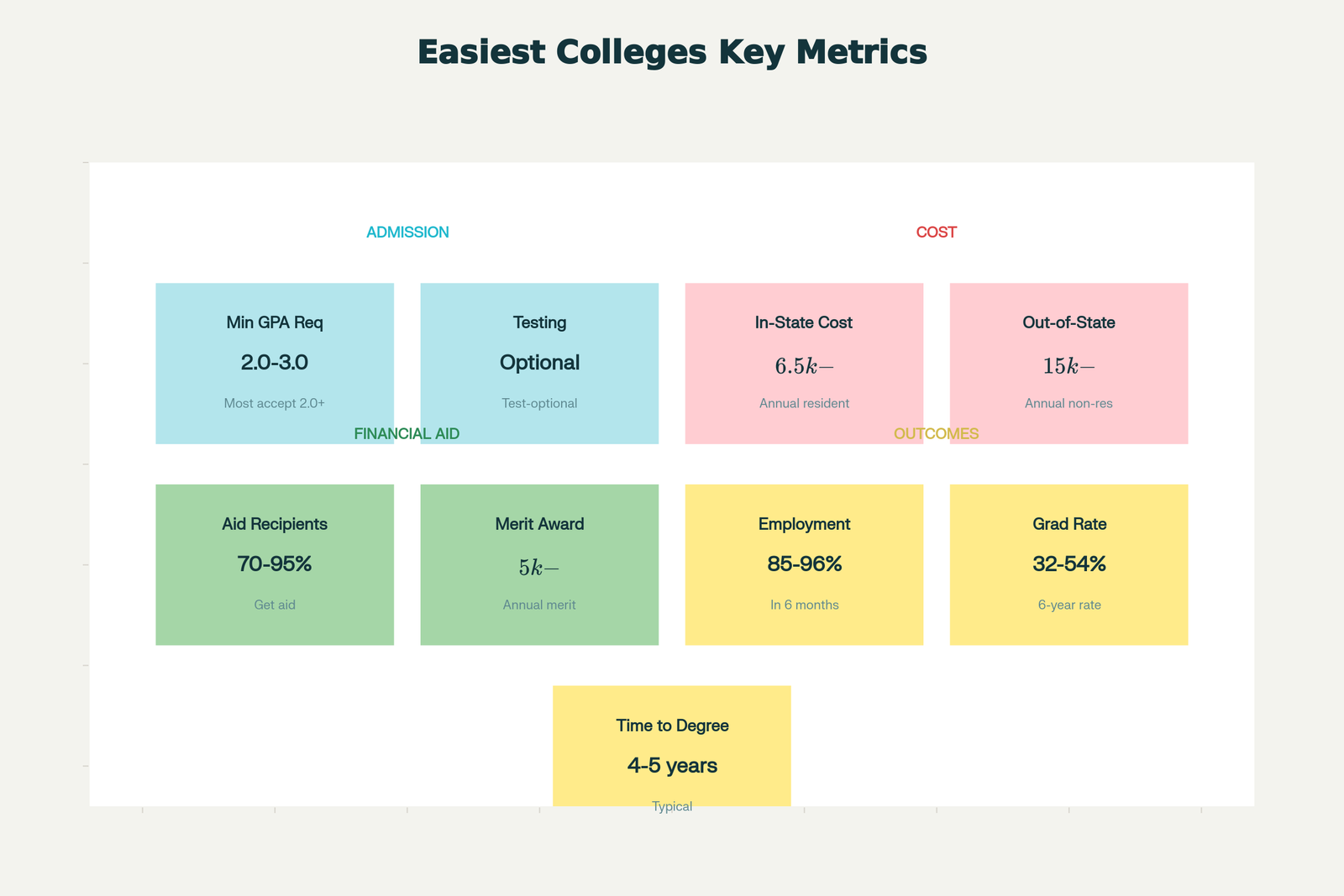
The most accessible colleges maintain remarkably minimal academic requirements. No standardized testing requirement characterizes most open-enrollment institutions; those that do test typically use results for placement rather than admission. Minimum GPA requirements typically range from no requirement to a 2.0 cumulative GPA.
For guaranteed admission at selective state universities, typical requirements include:
Arizona State University Guaranteed Admission:
Minimum 3.0 unweighted GPA in core courses, OR
Top 25% class rank, OR
SAT 1120+ (1180 nonresidents), OR
ACT 22+ (24 nonresidents)
University of Wyoming Assured Admission:
3.0+ cumulative unweighted GPA, AND
Completion of recommended high school curriculum
University of Kansas Assured Admission:
3.25+ GPA, OR
Top 33% class rank with 1060+ SAT
Central Washington University Guaranteed Admission:
3.0 cumulative GPA AND
Completion of recommended curriculum
Application Process Simplicity
Applications to easiest colleges typically require:
Basic Information: Name, contact information, high school/GED completion
High School Transcript: Proof of graduation or GED certification
Application Fee: Often waived for low-income applicants
No Essays Required: Most institutions don’t require personal statements or essays
Minimal Documentation: No letters of recommendation typically required
This streamlined process reduces barriers for students facing economic hardship, limited access to counseling, or first-generation uncertainties about college procedures.
Cost Structure and Financial Aid
Tuition and Fees
Easiest colleges demonstrate significant cost variation:
| Institution Type | In-State Tuition | Out-of-State Tuition | Annual Cost of Attendance |
|---|---|---|---|
| Public 4-Year (Large) | $6,500-$14,000 | $15,000-$30,000 | $20,000-$40,000 |
| Public 4-Year (Regional) | $7,000-$12,000 | $17,000-$28,000 | $22,000-$38,000 |
| Community College | $3,800-$8,500 | $7,500-$12,000 | $10,000-$18,000 |
| Private 4-Year | $20,000-$35,000 | N/A | $30,000-$50,000+ |
Financial Aid Availability
A major advantage of easiest colleges involves extraordinary financial aid accessibility. Approximately 70-95% of students receive some combination of need-based aid, merit scholarships, and work-study. Many institutions meet documented financial need at higher percentages than selective institutions.

Merit Aid Examples:
Arizona State University: Scholarships ranging $5,000-$15,000+ annually for admitted students
University of Mississippi: Merit scholarships available to admitted students
Community Colleges: Many offer small scholarships ($500-$2,000) for admitted students
Federal and State Aid:
Federal Pell Grants (up to $7,395 for 2025-2026) for low-income students
Federal Student Loans (Subsidized/Unsubsidized Stafford Loans)
State grant programs varying by residence
Institutional grant programs based on need
Work-Study and Employment:
Campus employment opportunities at minimum wage or above
Institutional work-study programs reducing student loan needs
Academic Quality and Program Offerings
Rigorous Academic Programs Despite Accessibility
The critical distinction must be emphasized: accessible admission does not mean academic mediocrity. Many easiest colleges maintain rigorous coursework, accomplished faculty, and strong academic outcomes.
University of Mississippi exemplifies this principle. With a 98% acceptance rate, Ole Miss maintains:
Top 20 nationally ranked graduate programs
Active research centers and initiatives
National merit scholar enrollment
Strong professional program placement
Arizona State University, at 90% acceptance, ranks among top research universities:
$600+ million annual research expenditures
Over 400 undergraduate majors representing disciplinary depth
Strong engineering and business school rankings
Substantial alumni networks in technology and industry
Comprehensive Program Offerings
Easy-to-get-into universities typically offer extensive program diversity:
| Institution | Program Count | Notable Strengths |
|---|---|---|
| Arizona State University | 400+ | Engineering, Business, Technology, Arts |
| University of Mississippi | 150+ | Business, Engineering, Health Sciences, Liberal Arts |
| Utah Valley University | 105+ | Business, Computer Science, Nursing, Visual Arts |
| Michigan State University | 200+ | Engineering, Agriculture, Business, Education |
| Indiana University Bloomington | 200+ | Music, Business, Engineering, Sciences |
This program breadth ensures students find specialized offerings and faculty expertise across disciplines.
Developmental Education and Support Services
Placement Testing and Remediation
Unlike selective institutions, easiest colleges invest heavily in developmental education and support services. Students not meeting standard college readiness benchmarks receive placement testing determining appropriate course levels.
Typical Placement Testing:
ACCUPLACER: Assesses English, reading, and mathematics
ALEKS PPL: Adaptive mathematics assessment offering remediation modules
PERT (Florida colleges): Adaptive reading and mathematics assessment
Campus-Specific Assessments: Developed by institutional faculty
Remedial/Developmental Course Tiers:
Students scoring below college readiness benchmarks register for developmental courses
Typical progression: Developmental → College-level courses
Free tutoring and supplemental instruction provided
Comprehensive Student Support Infrastructure
Easiest colleges typically provide robust support systems:
Academic Advising: Dedicated advisors guiding course selection and degree planning
Tutoring Centers: Free peer and professional tutoring across subjects
Writing Centers: Essay review and writing skill development
Mentoring Programs: Faculty and peer mentors supporting academic progress
Study Groups: Organized study sessions and learning communities
Success Coaching: Personal academic success coaches for high-risk populations
Career Services: Resume review, interview preparation, job placement assistance
Disability Services: Accommodations for students with documented disabilities
Mental Health Services: Counseling and wellness programs
Financial Aid Advising: Assistance navigating aid applications and funding options
Post-Graduation Outcomes
Employment Rates and Earnings
A substantial misconception holds that easy-to-get-into colleges produce poor post-graduation outcomes. Data contradicts this assumption. Employment outcomes at accessible institutions demonstrate strong career preparation:
| Institution | Acceptance Rate | Placement Rate | Median Earnings | Note |
|---|---|---|---|---|
| Quinnipiac University | 88% | 96.1% | $55,500 | 6-month placement |
| Marquette University | 86% | 95.55% | $62,600 | 6-month placement |
| University of Iowa | 86% | ~94% | $50,000+ | Discipline-dependent |
| Arizona State University | 90% | ~93% | $55,000+ | Varies by program |
| Saint John’s University | 85% | 95.16% | $48,000 | 6-month placement |
These statistics demonstrate that post-graduation success depends substantially on individual effort, major selection, and engagement rather than admission selectivity.
Strong Programs Generating Employment
Specific program areas at easiest colleges demonstrate particularly strong employment outcomes:
Nursing/Healthcare: 95%+ employment rates due to sector demand
Engineering: 94%+ employment rates; high median salaries ($60,000+)
Business/Accounting: 92%+ employment rates; median salaries $50,000-$70,000
Education: 90%+ employment rates (some regions face constraints)
Information Technology: 93%+ employment rates; median salaries $55,000+
Alumni Network Strength
Many accessible universities maintain surprisingly strong alumni networks due to large enrollment bases:
Arizona State University: Approximately 500,000+ alumni globally; strong recruiting ties with major employers (Google, Microsoft, Amazon, etc.)
University of Mississippi: Active alumni networks in business, law, medicine, and public service
Michigan State University: Strong alumni presence in automotive, agriculture, engineering sectors
These networks provide valuable career opportunities and mentorship relationships for graduates.
Strategic Considerations for Easy-to-Get-Into Colleges
Advantages of Choosing Accessible Institutions
| Advantage | Description | Benefit |
|---|---|---|
| Predictable Admission | Clear admission requirements; minimal uncertainty | Reduces anxiety; enables confident planning |
| Affordability | Lower tuition + substantial aid = manageable costs | Reduces student loan burden |
| Campus Support | Extensive tutoring, advising, mentoring | Increases retention and graduation rates |
| Program Diversity | Hundreds of majors across disciplines | Greater chance of finding ideal major |
| Honors Colleges | Many have selective honors programs within accessible institution | Challenge and prestige without high barriers |
| Transfer Pathways | Many community colleges transfer to 4-year universities | Flexible progression options |
| Flexible Scheduling | Evening/weekend/online options | Accommodates working students |
| Second Chances | Clear pathway to academic redemption | Benefits non-traditional learners |
Potential Considerations
While easiest colleges offer tremendous advantages, prospective students should consider:
Graduation Rates: May be lower than selective institutions; investigate specific school
Peer Support: Larger campus environments may provide less personalized peer interaction
Prestige Perception: Some employers weight institutional selectivity (though outcomes matter more)
Remedial Requirements: May require developmental coursework adding time/cost; offset by affordability
Geographic Constraints: Regional employment networks may be limited in some fields
Building a Balanced College List
Experts recommend balanced college lists incorporating reach, match, and safety schools. Easiest colleges serve critical “safety” role:
Example Balanced List:
Reach Schools (5-10% acceptance rates): Competitive institutions where admission uncertain
Match Schools (30-50% acceptance rates): Moderate selectivity; strong fit probability
Safety Schools (80%+ acceptance rates): Accessible institutions; highly likely admission
Target College: Specific institution or program of greatest interest
This balanced approach reduces anxiety while maintaining aspirational goal engagement.
Special Populations and Enhanced Opportunities
First-Generation College Students
Easiest colleges particularly serve first-generation populations, offering:
Reduced financial barriers
Extensive academic support
First-generation student affinity groups and mentoring
Financial literacy programs
Simplified application processes reducing uncertainty
Non-Traditional and Adult Learners
Many accessible colleges actively recruit working adults through:
Flexible scheduling (evening, weekend, online)
Accelerated program formats
Prior learning assessment (accepting professional experience for college credit)
Military service recognition for GI Bill benefits
Affordable tuition supporting fixed budgets
International Students
Most accessible institutions welcome international students:
Streamlined visa documentation support
English as Second Language (ESL) support
International student scholarships and discounts
Dedicated international student advising
Conclusion: Accessibility as Opportunity, Not Compromise
Colleges with high acceptance rates represent not inferior alternatives to selective institutions, but rather essential components of American higher education’s democratizing mission. These institutions serve diverse student populations—first-generation students, rural students, low-income students, working adults, and international students—who might otherwise face insurmountable barriers to degree completion.
The contemporary higher education landscape demonstrates that post-graduation success depends substantially on institutional fit, program quality, student engagement, and individual effort rather than admissions selectivity alone. Many accessible universities produce graduates with strong employment outcomes, meaningful career trajectories, and high life satisfaction.
For prospective students, the strategic approach involves:
Prioritize institutional fit: Select colleges aligning with academic goals, career aspirations, campus culture, and geographic preferences
Evaluate affordability: Compare total cost of attendance and financial aid packages; lowest tuition may not mean lowest net cost
Assess support services: Investigate tutoring, advising, career services, and mental health resources
Explore program quality: Research faculty credentials, program rankings, alumni outcomes in specific majors
Build balanced lists: Incorporate safety schools ensuring admission certainty while maintaining aspirational goals
Engage authentically: Regardless of acceptance rate, approach applications and college experience with genuine enthusiasm and commitment
The easiest colleges to get into for 2026 offer exceptional opportunities for students committed to pursuing higher education. With acceptance rates reaching 100% and comprehensive support systems designed to facilitate success, these institutions provide accessible pathways to quality degrees, meaningful careers, and personal growth.
Data Sources: Information compiled from U.S. News & World Report college rankings, NCES Integrated Postsecondary Education Data System (IPEDS), College Board’s BigFuture, individual institutional websites, and recent admissions data for the 2025-2026 academic year. All acceptance rates, tuition figures, financial aid statistics, and employment data reflect most recent available institutional reporting as of November 2025.


