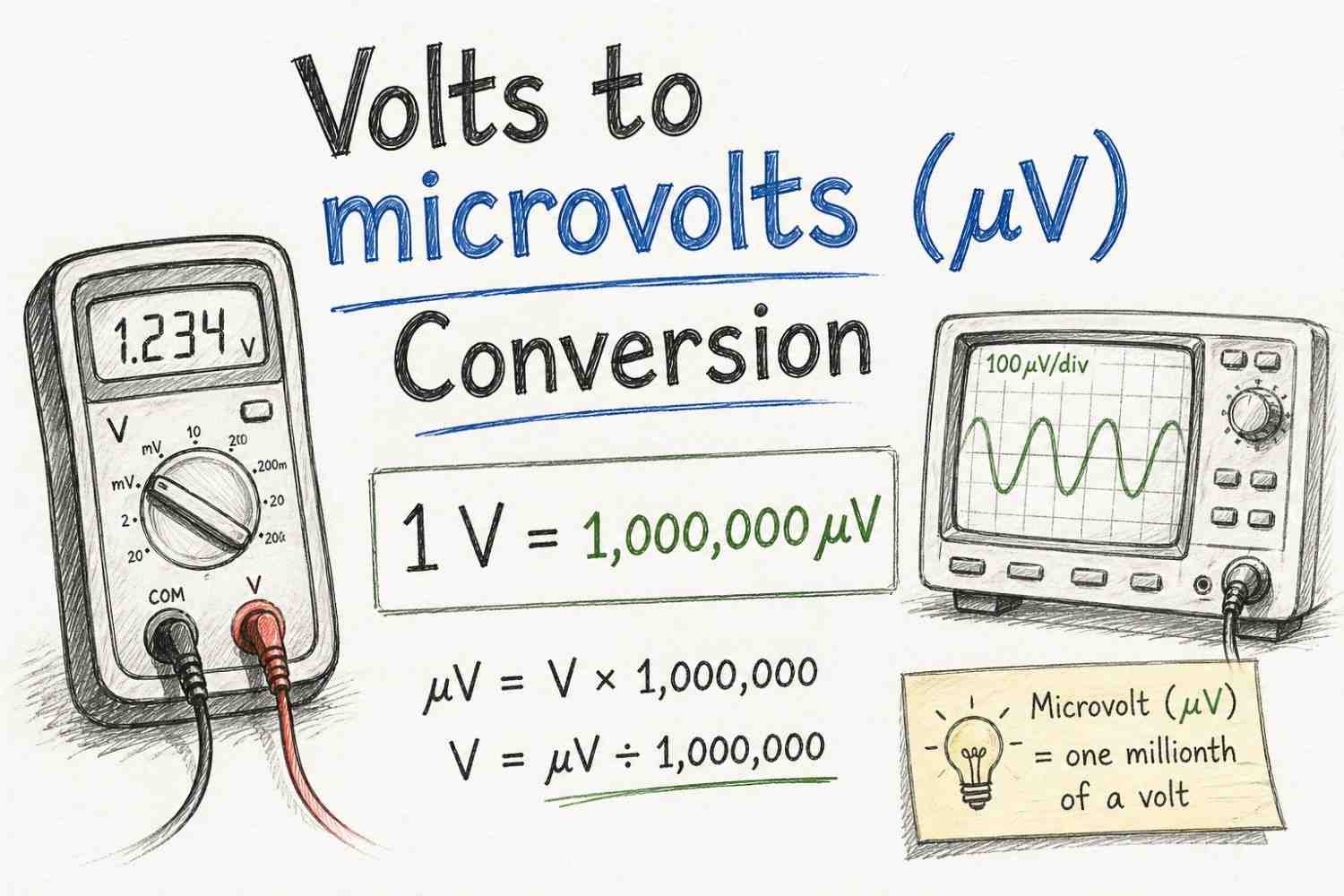
Volts to Microvolts (µV) Converter
Convert volts (V) to microvolts (µV) and microvolts back to volts in one responsive calculator, designed for biosignals, precision sensors, and low‑level analog electronics.
Online Volts to Microvolts Calculator
Understanding Volts and Microvolts
A volt is the standard SI unit of electric potential difference, used for everything from power supplies and logic circuits to mains electricity in your lab or home.
A microvolt (µV) is one millionth of a volt, ideal for describing extremely small signals such as EEG brain waves, ECG heart signals, EMG muscle activity, and precision sensor outputs in instrumentation amplifiers.
Working comfortably with both volts and microvolts is essential when designing low‑noise analog front ends, biomedical acquisition systems, and high‑resolution measurement equipment.
Volts ⇔ Microvolts Conversion Formulas
Volts to Microvolts (V → µV)
One volt equals one million microvolts, so multiply by \(10^6\) to convert.
Example: \( 0.005 \text{ V} \rightarrow V_{(\mu\text{V})} = 0.005 \times 1{,}000{,}000 = 5{,}000 \,\mu\text{V} \).
Microvolts to Volts (µV → V)
One microvolt is \(10^{-6}\) volts, so divide by 1,000,000 to convert to volts.
Example: \( 250{,}000 \,\mu\text{V} \rightarrow V_{(\text{V})} = \frac{250{,}000}{1{,}000{,}000} = 0.25 \text{ V} \).
Metric Prefix Relationship
The prefix “micro” (µ) in SI units always means \(10^{-6}\), while “kilo” (k) means \(10^{3}\) and “milli” (m) means \(10^{-3}\).
Volts to Microvolts Quick Reference
| Volts (V) | Microvolts (µV) | Typical Context |
|---|---|---|
| 0.000001 V | 1 µV | Smallest EEG microvolt fluctuation |
| 0.000005 V | 5 µV | Low‑amplitude EEG/EMG activity |
| 0.000050 V | 50 µV | Typical EEG alpha rhythm |
| 0.000100 V | 100 µV | Moderate biosignal amplitude |
| 0.001 V | 1,000 µV | 1 mV ECG/EMG signals |
| 0.01 V | 10,000 µV | Amplified diagnostic signals |
| 1 V | 1,000,000 µV | Reference or supply voltage |
Step‑by‑Step: Volts to Microvolts
1. Start from your measured volts
Take the measured voltage in volts from your DAQ, oscilloscope, biosignal front end, or simulation output. For microvolt‑level biosignals, this is often a small fraction of a volt after amplification.
2. Multiply by \(10^6\)
Apply the formula \( V_{(\mu\text{V})} = V_{(\text{V})} \times 10^{6} \). If your EEG signal after amplification is \(0.000050 \text{ V}\), then \( V_{(\mu\text{V})} = 0.000050 \times 10^{6} = 50 \,\mu\text{V} \).
3. Use scientific notation for very small or large values
For instrument datasheets or research reports, express results like \( 0.000001 \text{ V} \) as \( 1 \,\mu\text{V} \) or \( 1 \times 10^{-6} \text{ V} \) for clarity, depending on the audience.
4. Verify by converting back
Confirm your calculation by using the inverse formula \( V_{(\text{V})} = V_{(\mu\text{V})} \times 10^{-6} \). This quick check prevents unit mix‑ups in sensitive designs like biomedical amplifiers.
Volts to Microvolts: Frequently Asked Questions
How do I quickly convert V to µV in my head?
Move the decimal point six places to the right. Example: \(0.0002 \text{ V} \rightarrow 200 \,\mu\text{V}\).
Why do EEG and ECG signals use microvolts?
Brain and heart biosignals are extremely small, often from a few µV to a few mV at the skin. Microvolt units match their natural scale and make it easier to compare amplitudes, noise levels, and amplifier gains.
What is the difference between µV, mV, and V?
They are all volts with different prefixes: \(1 \text{ V} = 1000 \text{ mV} = 1{,}000{,}000 \,\mu\text{V}\). Microvolts are ideal for tiny signals, millivolts for moderate analog signals, and volts for supplies and logic levels.
How accurate is this online converter?
The conversion itself is exact because it is based on the SI definition \(1 \text{ V} = 10^{6} \,\mu\text{V}\). Any rounding you see is just for display readability and does not change the underlying ratio.
Explore More Voltage and Physics Tools
Visit RevisionTown for more step‑by‑step calculators, exam‑oriented notes, and engineering‑grade tools built for students, creators, and professionals.
Go to RevisionTown