⚡ dBm to Watts Converter
Professional RF Power Conversion Tool | Telecommunications & Wireless
📊 Common RF Power Levels
📚 Complete Guide to dBm and Watts Conversion
Understanding dBm and Watts
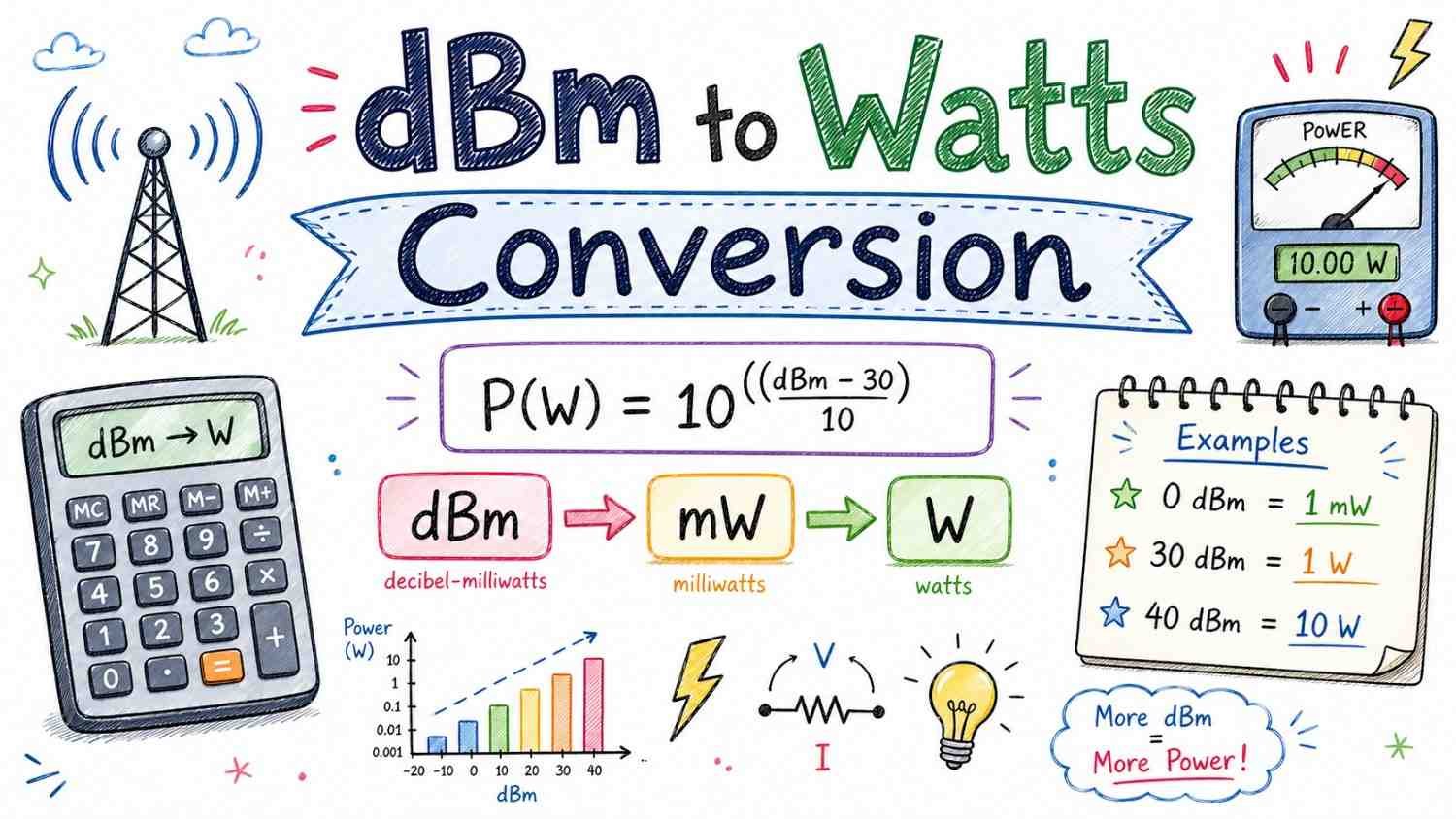
dBm (decibel-milliwatts) is a logarithmic unit expressing absolute RF power relative to 1 milliwatt, universally used in RF engineering, wireless communications, telecommunications, antenna systems, and spectrum analysis. The "dB" indicates decibel (logarithmic measurement), while "m" specifies 1 milliwatt as the reference. Watts (W) are the SI unit for absolute power measurement, representing energy transfer rate used universally in electrical engineering, physics, and power specifications. One watt equals 1 joule per second or 1,000 milliwatts. The fundamental relationship: 0 dBm = 0.001 watts (1 milliwatt) and 30 dBm = 1 watt. Positive dBm values above 30 represent power greater than 1 watt (40 dBm = 10 W, 50 dBm = 100 W); values below 30 represent power less than 1 watt (20 dBm = 0.1 W, 10 dBm = 0.01 W). The logarithmic dBm scale compresses enormous power ranges spanning picowatts to megawatts (15+ orders of magnitude) into manageable numbers typically -100 to +80 dBm, making it intuitive for RF calculations. Watts provide direct linear power measurement essential for electrical specifications, transmitter ratings, power amplifier outputs, electrical load calculations, circuit breaker sizing, cooling requirements, and regulatory compliance documentation. Understanding both units and converting between them is essential for transmitter specifications (cellular base stations 10-100 W = 40-50 dBm), power amplifier selection (ham radio amplifiers 100-1,500 W = 50-62 dBm), antenna system design, link budget analysis, regulatory compliance with FCC/ETSI power limits, electrical safety assessments, and all wireless system engineering from consumer WiFi to broadcast transmitters.
Conversion Formulas
dBm to Watts: \( P_{\text{W}} = \frac{10^{P_{\text{dBm}}/10}}{1000} \) or equivalently \( P_{\text{W}} = 10^{(P_{\text{dBm}}-30)/10} \). Both formulas produce identical results. First method: divide dBm by 10, raise 10 to that power, divide by 1000. Second method (simpler): subtract 30 from dBm, divide by 10, raise 10 to that power. Examples: 0 dBm = 10^((0-30)/10) = 10^-3 = 0.001 W (1 mW); 10 dBm = 10^((10-30)/10) = 10^-2 = 0.01 W (10 mW); 20 dBm = 10^((20-30)/10) = 10^-1 = 0.1 W (100 mW); 30 dBm = 10^((30-30)/10) = 10^0 = 1 W; 40 dBm = 10^((40-30)/10) = 10^1 = 10 W; 50 dBm = 10^((50-30)/10) = 10^2 = 100 W; 60 dBm = 10^((60-30)/10) = 10^3 = 1,000 W (1 kW). Watts to dBm: \( P_{\text{dBm}} = 10 \times \log_{10}(P_{\text{W}} \times 1000) \) or \( P_{\text{dBm}} = 10 \times \log_{10}(P_{\text{W}}) + 30 \). First method: multiply watts by 1000, take base-10 logarithm, multiply by 10. Second method: take logarithm of watts, multiply by 10, add 30. Examples: 1 W = 10 × log₁₀(1) + 30 = 30 dBm; 10 W = 10 × log₁₀(10) + 30 = 40 dBm; 100 W = 10 × log₁₀(100) + 30 = 50 dBm; 0.1 W = 10 × log₁₀(0.1) + 30 = 20 dBm; 0.01 W = 10 × log₁₀(0.01) + 30 = 10 dBm; 0.001 W = 10 × log₁₀(0.001) + 30 = 0 dBm. These formulas are fundamental to RF engineering and enable seamless translation between logarithmic measurements (dBm) used in wireless system calculations and linear power measurements (watts) used in electrical specifications.
Comprehensive Power Conversion Table
| dBm | Watts (W) | Milliwatts (mW) | Typical Application |
|---|---|---|---|
| -30 dBm | 0.000001 W | 0.001 mW | Receiver sensitivity limit |
| -20 dBm | 0.00001 W | 0.01 mW | Weak signal threshold |
| -10 dBm | 0.0001 W | 0.1 mW | Poor WiFi signal |
| 0 dBm | 0.001 W | 1 mW | Reference level (1 mW) |
| 10 dBm | 0.01 W | 10 mW | Bluetooth transmitter |
| 20 dBm | 0.1 W | 100 mW | Low-power WiFi router |
| 23 dBm | 0.2 W | 200 mW | Standard WiFi router |
| 27 dBm | 0.5 W | 500 mW | Cell phone maximum |
| 30 dBm | 1 W | 1,000 mW | Reference level (1 W) |
| 33 dBm | 2 W | 2,000 mW | High-power mobile |
| 37 dBm | 5 W | 5,000 mW | Handheld radio |
| 40 dBm | 10 W | 10,000 mW | Mobile transceiver |
| 43 dBm | 20 W | 20,000 mW | Small base station |
| 47 dBm | 50 W | 50,000 mW | Medium transmitter |
| 50 dBm | 100 W | 100,000 mW | Base station transmitter |
| 60 dBm | 1,000 W | 1,000,000 mW | Broadcast transmitter (1 kW) |
| 70 dBm | 10,000 W | 10,000,000 mW | High-power broadcast (10 kW) |
Transmitter Power Specifications
RF transmitters specify output power in watts for electrical specifications and dBm for RF calculations. WiFi and Consumer Wireless: Home routers transmit 0.1-0.2 W (20-23 dBm) legally. High-power routers reach 1 W (30 dBm) maximum EIRP with antenna gain. Enterprise access points: 0.2-0.5 W (23-27 dBm) per radio chain. Outdoor point-to-point links: 0.5-1 W (27-30 dBm) at antenna connector before gain. Cellular Networks: Mobile phones: 0.2-0.5 W (23-27 dBm) maximum transmit power, dynamically reduced based on signal quality. Femtocells: 0.01-0.1 W (10-20 dBm). Picocells: 0.1-1 W (20-30 dBm). Microcells: 1-10 W (30-40 dBm). Macrocells: 10-100 W (40-50 dBm) per sector. Distributed antenna systems: 1-10 W (30-40 dBm) per antenna. Ham Radio: Handheld transceivers: 1-5 W (30-37 dBm). Mobile radios: 10-50 W (40-47 dBm). Base stations: 100-1,500 W (50-62 dBm). Legal limits vary by band and license class. Commercial Broadcasting: FM radio: 100-100,000 W (50-80 dBm). AM radio: 1,000-50,000 W (60-77 dBm). Television: 1,000-1,000,000 W (60-90 dBm). Understanding these power levels in both watts and dBm enables proper equipment selection, electrical system design, cooling requirements, and regulatory compliance.
Power Amplifier Selection
Power amplifiers boost RF signals, specified in watts output for electrical/thermal design and dBm for RF chain calculations. WiFi Amplifiers: Consumer WiFi boosters: 0.5-1 W (27-30 dBm) output to stay within FCC limits. Commercial wireless bridges: 1-10 W (30-40 dBm) with high-gain antennas for long-range links. Requires 12V DC or 48V PoE electrical supply, active cooling above 1 W. Cellular Amplifiers: Consumer signal boosters: 0.1-1 W (20-30 dBm) uplink to tower, 5-10 W (37-40 dBm) downlink to indoor. Commercial distributed antenna systems: 1-20 W (30-43 dBm) per band. Requires AC power, significant cooling for multi-band high-power units. Ham Radio Amplifiers: QRP (low power): 1-10 W (30-40 dBm) for portable operations. Standard mobile: 50-100 W (47-50 dBm) for vehicle installations. Base station amplifiers: 500-1,500 W (57-62 dBm) requiring 240V AC, substantial cooling, and antenna systems rated for high power. Broadcast Amplifiers: Television/FM broadcast: 1,000-100,000 W (60-80 dBm) requiring three-phase electrical power, industrial cooling systems, and expensive specialized antennas. Understanding amplifier watts-to-dBm conversion enables proper RF system design, electrical infrastructure planning, cooling system sizing, and component selection ensuring amplifier output matches antenna input ratings and regulatory limits.
Electrical Power and Cooling Requirements
Converting RF output watts from dBm enables electrical system and cooling design. Power Consumption: RF amplifiers are 20-60% efficient—10 W (40 dBm) output requires 20-50 W electrical input; 100 W (50 dBm) output requires 200-500 W input; 1,000 W (60 dBm) output requires 2,000-5,000 W input. Inefficiency converts to heat requiring removal. Circuit Breaker Sizing: 50 W RF amplifier at 40% efficiency draws 125 W electrical. At 120V: 1.04 amps (use 5A breaker). 500 W amplifier draws 1,250 W (10.4A at 120V, use 15-20A breaker or 240V circuit). 5,000 W amplifier requires three-phase 240V or 480V industrial power. Cooling Design: Passive cooling (heat sinks) sufficient to ~10 W (40 dBm). Forced air (fans) required 10-500 W (40-57 dBm). Liquid cooling necessary above 500 W. High-power broadcast transmitters use water cooling or vapor-phase refrigerant systems. Battery Backup: UPS sizing requires converting transmitter dBm output to electrical watts input. 40 dBm (10 W) transmitter at 50% efficiency draws 20 W; 100 AH 12V battery provides 1,200 WH, running transmitter 60 hours theoretical (40 hours practical accounting for battery derating and inverter efficiency). Understanding these relationships ensures adequate electrical infrastructure, prevents circuit overloading, maintains safe operating temperatures, and enables reliable backup power for critical communications.
Regulatory Compliance and Safety
Regulatory agencies specify maximum transmit power in both watts and dBm; converting between units ensures compliance. FCC Regulations (United States): WiFi 2.4 GHz: 1 W (30 dBm) EIRP maximum (transmitter power plus antenna gain). 5 GHz varies by sub-band: U-NII-1/2 limited to 1 W (30 dBm), U-NII-3 allows 4 W (36 dBm). Cellular bands: complex limits by frequency, typically 10-100 W (40-50 dBm) base station, 0.2-0.5 W (23-27 dBm) mobile. Amateur radio: varies by band and license class, 10-1,500 W (40-62 dBm). ETSI Regulations (Europe): Generally more restrictive than FCC. WiFi 2.4 GHz: 0.1 W (20 dBm) EIRP typical. 5 GHz: 0.2-1 W (23-30 dBm) depending on band and DFS capability. RF Exposure Safety: FCC/ICNIRP specify safe exposure limits in watts per square meter at specific distances. 10 W (40 dBm) transmitter with 10 dBi antenna (10× gain) produces 100 W EIRP; at 1 meter, power density = 100 W ÷ (4π × 1²) = 7.96 W/m². FCC occupational limit = 10 W/m² (1-6 GHz), so 1 meter separation adequate. 100 W (50 dBm) transmitter requires greater separation. Understanding watts-dBm conversion enables compliance verification, safe installation planning, and proper equipment operation within legal limits avoiding fines and license revocation.
Why Choose RevisionTown's dBm to Watts Converter?
RevisionTown's professional dBm to watts converter provides: (1) Exact Precision—Uses internationally standardized formulas P(W) = 10^((dBm-30)/10) and dBm = 10×log₁₀(P(W)) + 30; (2) Bidirectional Conversion—Seamlessly convert dBm↔watts with dedicated tabs; (3) Bulk Processing—Convert multiple power levels simultaneously for equipment comparison; (4) Quick Reference—Instant access to common transmitter power levels from milliwatts to kilowatts; (5) Formula Transparency—View exact mathematical conversions for verification and education; (6) Mobile Optimized—Use on smartphones during site surveys, installations, and equipment selection; (7) Zero Cost—Completely free with no registration, ads, or limitations; (8) Professional Accuracy—Trusted by RF engineers, wireless technicians, telecommunications professionals, ham radio operators, broadcast engineers, antenna designers, spectrum analysts, network planners, and students for critical power conversions in transmitter specifications, power amplifier selection, antenna system design, link budget calculations, electrical system planning, cooling requirements, regulatory compliance verification, RF safety assessments, and all wireless system engineering applications requiring exact translations between logarithmic dBm and linear watts measurements for professional RF work worldwide from consumer WiFi to broadcast transmitters.
❓ Frequently Asked Questions
To convert dBm to watts: P(W) = 10^(dBm/10) ÷ 1000 or P(W) = 10^((dBm-30)/10). Divide dBm by 10, raise 10 to that power, then divide by 1000. Or subtract 30 from dBm, divide by 10, raise 10 to that power. Examples: 0 dBm = 0.001 W (1 mW); 10 dBm = 0.01 W; 20 dBm = 0.1 W; 30 dBm = 1 W; 40 dBm = 10 W; 50 dBm = 100 W. This reverses the logarithmic dBm definition to recover linear power in watts.
30 dBm equals exactly 1 watt (1 W). Calculation: P(W) = 10^((30-30)/10) = 10^0 = 1 W. This is the key reference point: 30 dBm = 1 W = 1,000 mW. Every 10 dB increase multiplies power by 10: 40 dBm = 10 W, 50 dBm = 100 W, 60 dBm = 1,000 W. Every 10 dB decrease divides by 10: 20 dBm = 0.1 W, 10 dBm = 0.01 W, 0 dBm = 0.001 W.
40 dBm equals 10 watts (10 W). Calculation: P(W) = 10^((40-30)/10) = 10^1 = 10 W. This is a common power level for ham radio mobile transceivers, small cellular base stations, high-power WiFi amplifiers, and two-way radio repeaters. It represents significant RF power requiring proper antenna systems, cooling, and safety precautions.
To convert watts to dBm: dBm = 10 × log₁₀(P(W) × 1000) or dBm = 10 × log₁₀(P(W)) + 30. Multiply watts by 1000, take base-10 logarithm, multiply by 10. Or take logarithm of watts, multiply by 10, add 30. Examples: 1 W = 30 dBm; 10 W = 40 dBm; 100 W = 50 dBm; 0.1 W = 20 dBm; 0.01 W = 10 dBm; 0.001 W = 0 dBm.
50 dBm equals 100 watts (100 W). Calculation: P(W) = 10^((50-30)/10) = 10^2 = 100 W. This is a typical power level for ham radio base station transmitters, cellular base stations, commercial two-way radio repeaters, small broadcast transmitters, and high-power wireless communication systems requiring substantial electrical power (200-500 W input) and active cooling systems.
0 dBm equals 0.001 watts (1 milliwatt or 1 mW). Calculation: P(W) = 10^((0-30)/10) = 10^-3 = 0.001 W. This is the fundamental reference: dBm measures power relative to 1 milliwatt, so 0 dBm = 1 mW = 0.001 W by definition. This is the most important dBm-watts conversion to remember for RF engineering.
RF engineers use dBm because: (1) Logarithmic scale compresses wide power ranges (microwatts to kilowatts, 9+ orders of magnitude) into manageable numbers (-30 to +60 dBm); (2) Simplifies calculations—gains/losses add/subtract in dB instead of multiply/divide in watts; (3) 10 dB rule: every 10 dBm = 10× power (30 dBm = 1 W, 40 dBm = 10 W, 50 dBm = 100 W); (4) 3 dB rule: every 3 dBm ≈ 2× power; (5) Industry standard across wireless/telecommunications; (6) Compatible with antenna gain (dBi) and path loss (dB). Watts provide absolute power for electrical specifications, circuit design, and safety calculations.
60 dBm equals 1,000 watts (1 kilowatt or 1 kW). Calculation: P(W) = 10^((60-30)/10) = 10^3 = 1,000 W. This is high RF power used in commercial broadcast transmitters, high-power ham radio amplifiers, cellular macro base stations, and industrial RF heating equipment requiring three-phase electrical power (2,000-5,000 W input at 20-50% efficiency), substantial cooling infrastructure, and specialized high-power antenna systems rated for kilowatt operation.