⚖️ Pounds to Ounces Converter
📊 Common Cooking Conversions
📚 Complete Guide to Pounds and Ounces Conversion
Understanding Pounds and Ounces in the Imperial System
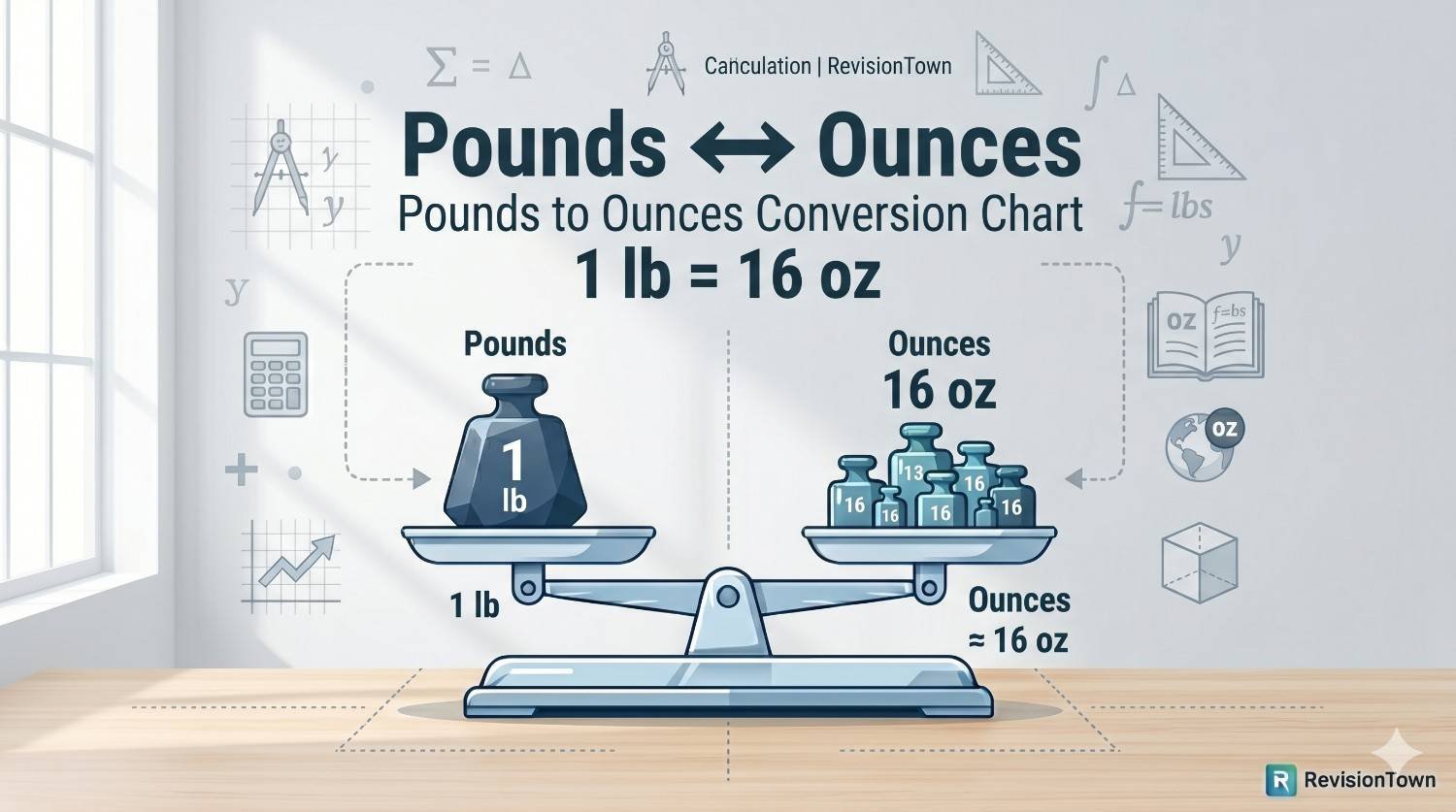
Pounds (lb) and ounces (oz) are both weight units within the Imperial and US customary measurement systems, commonly used in the United States, United Kingdom, and a few other countries. The fundamental relationship between these units is simple and exact: 1 pound equals exactly 16 ounces. This 16:1 ratio has been standardized for centuries and forms the foundation of Imperial weight measurements. Ounces are typically used for smaller, more precise measurements—especially for food ingredients, small packages, and items weighing less than 1 pound. Pounds measure larger quantities like body weight, larger food packages, and commercial goods. Both units are part of the avoirdupois system, which is the standard for everyday commerce, cooking, and general weight measurements. Understanding this relationship is essential for cooking, baking, packaging, shipping, and any context where Imperial weight measurements are used.
The Simple Conversion Formula
The conversion formula between pounds and ounces is remarkably straightforward due to the exact 16:1 relationship. To convert pounds to ounces: oz = lb × 16. This means you simply multiply the pound value by 16 to get the equivalent weight in ounces. For example: 2 pounds = 2 × 16 = 32 ounces; 0.5 pounds = 0.5 × 16 = 8 ounces; 3.25 pounds = 3.25 × 16 = 52 ounces. To convert ounces to pounds: lb = oz ÷ 16. This means you divide the ounce value by 16 to get the equivalent weight in pounds. For example: 48 ounces = 48 ÷ 16 = 3 pounds; 24 ounces = 24 ÷ 16 = 1.5 pounds. These formulas work perfectly because the relationship is exact—no approximations or decimal adjustments needed. The integer factor of 16 makes mental calculations relatively easy, especially for common fractions like half (8 oz), quarter (4 oz), and three-quarters (12 oz) of a pound.
Common Pound to Ounce Conversions for Cooking
| Pounds (lb) | Ounces (oz) | Common Use |
|---|---|---|
| 1/4 lb (0.25) | 4 oz | Quarter pound burger, butter stick |
| 1/2 lb (0.5) | 8 oz | Half pound meat portion, baking recipes |
| 3/4 lb (0.75) | 12 oz | Large meat portions, recipe measurements |
| 1 lb | 16 oz | Standard pound package, butter (4 sticks) |
| 1.5 lb | 24 oz | Family-size portions |
| 2 lb | 32 oz | Large packages, bulk ingredients |
| 3 lb | 48 oz | Party-size portions, bulk cooking |
| 5 lb | 80 oz | Bulk flour, sugar, commercial packaging |
Practical Applications in Cooking and Baking
Pound-to-ounce conversions are essential in cooking and baking, where precision directly affects recipe results. Recipe Scaling: When doubling or halving recipes, understanding the pound-ounce relationship helps maintain accurate ingredient ratios. Many professional baking recipes use weight measurements (ounces or grams) for precision. Butter Measurements: US butter is typically packaged as 1-pound boxes containing 4 sticks of 4 ounces each (1 stick = 1/4 lb = 4 oz). Understanding this helps when recipes call for different butter measurements. Meat Portions: Restaurants and meal planning often use ounces for portion control—a typical serving might be 4-6 oz, while bulk meat packages are sold by the pound. Flour and Sugar: Professional bakers measure flour and sugar by weight (ounces) rather than volume (cups) for accuracy. A 5-pound bag of flour contains 80 ounces. Ingredient Substitutions: When substituting ingredients or scaling recipes between metric and Imperial, knowing both pounds and ounces helps maintain proper ratios and measurements.
Historical Origin of the 16:1 Relationship
The 16-ounce pound originated from medieval English trade and commerce systems. The avoirdupois system (from French "avoir du pois" meaning "goods of weight") was established for general merchandise and became standardized in the 13th-14th centuries. The choice of 16 as the division factor wasn't arbitrary—it's a highly divisible number (16 = 2⁴), allowing easy halving and quartering for market transactions: 1 pound divides cleanly into 1/2 pound (8 oz), 1/4 pound (4 oz), 1/8 pound (2 oz), and 1/16 pound (1 oz). This binary divisibility made mental arithmetic simple for merchants and traders without calculators. The system spread throughout the British Empire and became the standard in countries using Imperial measurements. Despite the global adoption of the metric system in most countries, the pound-ounce system persists in the United States and partially in the United Kingdom, particularly for body weight, cooking, and traditional commerce.
Avoirdupois vs Troy Ounces
It's crucial to understand that different ounce systems exist for different purposes. Avoirdupois ounces (used by this converter) are the standard for everyday weight measurements—food, packages, body weight, and general commerce. One avoirdupois ounce equals 28.3495 grams, with 16 avoirdupois ounces in 1 avoirdupois pound. Troy ounces are used exclusively for precious metals like gold, silver, platinum, and gemstones. One troy ounce equals 31.1035 grams (heavier than avoirdupois), with 12 troy ounces in 1 troy pound. When buying gold or silver, prices are quoted per troy ounce. Unless explicitly stated as "troy ounces," assume recipes, product labels, and general weights use avoirdupois ounces. This distinction matters—using the wrong system in precious metal calculations or pharmaceutical measurements can lead to significant errors.
Weight Ounces vs Fluid Ounces
Another important distinction: ounces measure weight, while fluid ounces measure volume. Weight ounces (oz) measure mass—how heavy something is. Use weight ounces for solid ingredients like flour, sugar, meat, butter, cheese, and any packaged goods sold by weight. Fluid ounces (fl oz) measure liquid volume—how much space liquid occupies. One fluid ounce equals approximately 29.57 milliliters. Use fluid ounces for liquids like water, milk, oil, and juice. The confusion arises because 8 fluid ounces of water weighs approximately 8 ounces by weight, but this equivalence only holds for water. For other substances: 8 fl oz of honey weighs about 12 oz; 8 fl oz of olive oil weighs about 7.6 oz. Always use kitchen scales for weight measurements and measuring cups for volume. Recipes should specify "oz" for weight or "fl oz" for volume to avoid confusion.
Tips for Accurate Conversions and Measurements
Memorize Key Values: Remember that 1 lb = 16 oz, 1/2 lb = 8 oz, 1/4 lb = 4 oz for quick mental calculations. Use Kitchen Scales: For accurate cooking and baking, invest in a digital kitchen scale that measures both pounds and ounces for precise ingredient measurements. Read Labels Carefully: Product labels show net weight—check whether it's listed in pounds, ounces, or both (e.g., "1 lb 8 oz" = 24 oz total). Recipe Interpretation: When recipes list "oz," verify whether it means weight ounces (for solids) or fluid ounces (for liquids) based on ingredient type. Decimal Conversion: When converting fractional pounds, remember: 0.25 lb = 4 oz, 0.5 lb = 8 oz, 0.75 lb = 12 oz. Shipping Weights: USPS and other carriers use pounds and ounces for package weights—knowing both units helps calculate shipping costs. Practice Estimation: Develop intuition for common weights—a deck of cards weighs about 3 oz, a stick of butter is 4 oz, a can of soda is 12 fl oz.
Why Choose RevisionTown's Pounds to Ounces Converter?
Our advanced converter provides comprehensive, accurate conversions by: (1) Using the exact 16:1 conversion factor standardized in Imperial measurements; (2) Offering bidirectional conversion—pounds to ounces and ounces to pounds; (3) Supporting bulk conversions for multiple values simultaneously; (4) Providing quick reference tables for common cooking and baking measurements; (5) Displaying conversion formulas with clear mathematical notation; (6) Including comprehensive educational content about both measurement systems; (7) Offering instant, real-time calculations without page reloads; (8) Mobile-responsive design optimized for kitchen use on phones and tablets; (9) Completely free with no registration or payment required. Whether you're scaling recipes, meal planning, calculating shipping costs, portioning food, or working in food service, RevisionTown provides the accuracy, speed, and reliability you need for confident weight conversions within the Imperial system.
❓ Frequently Asked Questions - Pounds to Ounces
One pound equals exactly 16 ounces. This is the fundamental, universally standardized relationship within the Imperial/US customary weight measurement system. The formula is oz = lb × 16. Examples: 1 lb = 16 oz, 2 lb = 32 oz, 5 lb = 80 oz. This exact integer relationship eliminates decimal confusion and makes mental calculations simple. The 16:1 ratio applies to the avoirdupois pound used for most everyday measurements including food, packages, and body weight. This has been the standard since the British Imperial system was established centuries ago.
To convert pounds to ounces, multiply the pound value by 16. Formula: oz = lb × 16. Examples: 3 pounds = 3 × 16 = 48 ounces; 0.5 pounds = 0.5 × 16 = 8 ounces; 1.25 pounds = 1.25 × 16 = 20 ounces. This simple multiplication works because 1 pound is defined as exactly 16 ounces within the Imperial system. No decimals or approximations needed—the result is always exact. For fractional pounds, the multiplication produces precise ounce values. This conversion is essential for cooking, baking, packaging, and shipping applications where accurate weight measurements matter.
To convert ounces to pounds, divide the ounce value by 16. Formula: lb = oz ÷ 16. Examples: 32 ounces = 32 ÷ 16 = 2 pounds; 48 ounces = 48 ÷ 16 = 3 pounds; 24 ounces = 24 ÷ 16 = 1.5 pounds; 6 ounces = 6 ÷ 16 = 0.375 pounds. For fractional results, keep appropriate decimal places based on required precision. This division works because 16 ounces exactly equal 1 pound. The conversion is always exact within the Imperial system. Understanding this reverse conversion helps interpret product weights and recipe measurements when ingredients are listed in ounces but you need pounds.
Avoirdupois ounces (used for general weights) equal 28.3495 grams, with 16 avoirdupois ounces in 1 pound. This is the standard for everyday use—cooking, food packages, body weight. Troy ounces (used for precious metals) equal 31.1035 grams, with 12 troy ounces in 1 troy pound. Troy ounces are heavier (about 10% more than avoirdupois). This converter uses avoirdupois ounces for cooking, food, packages, and general measurements—the standard for everyday use. Troy ounces are only used for gold, silver, platinum, and other precious metals in jewelry and bullion markets. Always verify which ounce system applies to your specific application to avoid confusion and incorrect conversions.
The 16:1 relationship originated from medieval English measurement systems where the pound divided into 16 ounces for practical trade and commerce. This binary division (16 = 2⁴) allowed easy halving and doubling for market transactions without calculators: 1 pound = 16 oz, half pound = 8 oz, quarter pound = 4 oz, eighth pound = 2 oz. The system standardized over centuries through British Imperial measurements and remains consistent in modern Imperial and US customary units. The exact integer relationship simplifies arithmetic and eliminates fractional confusion in everyday use, which is why it persisted even as other measurement systems evolved toward metric decimal systems.
Common cooking conversions: 1/4 lb = 4 oz (quarter pound, common for butter sticks, burger patties), 1/2 lb = 8 oz (half pound, typical for meat portions), 3/4 lb = 12 oz, 1 lb = 16 oz (standard butter package containing 4 sticks), 2 lb = 32 oz, 3 lb = 48 oz, 4 lb = 64 oz, 5 lb = 80 oz (bulk flour or sugar bags). These exact values are essential for recipe scaling, ingredient measurement, and professional baking where precision affects results. Understanding these relationships helps interpret recipes from different sources and scale servings accurately for family meals or catering.
The converter handles decimal pounds precisely using the formula oz = lb × 16. Examples: 1.5 lb = 24 oz, 2.25 lb = 36 oz, 0.75 lb = 12 oz, 0.375 lb = 6 oz. Results maintain appropriate decimal precision based on input accuracy. This handles recipe fractions perfectly: 1/2 lb = 8 oz, 1/4 lb = 4 oz, 3/4 lb = 12 oz. The calculator works with any decimal pound value and provides precise ounce conversions for food production, packaging, and laboratory applications where fractional pounds are common. The calculator automatically displays results with practical precision—typically whole numbers or one decimal place for cooking applications.
This converter measures weight ounces (avoirdupois), not fluid ounces (volume). Weight ounces apply to solid ingredients like meat, butter, flour, sugar, cheese, and packaged goods. Fluid ounces measure liquid volume (1 fl oz ≈ 29.57 ml). For cooking weights, always use weight ounces. Recipes specify "oz" for weight unless clearly stating "fluid ounces" or "fl oz" for volume measurements. The confusion arises because 8 fl oz of water weighs about 8 oz, but this only holds for water—other liquids and substances have different weight-to-volume ratios. Understanding this distinction is critical for accurate cooking. Use kitchen scales for weight measurements and measuring cups for volume.