Milligrams to Kilograms Converter
Convert between milligrams (mg) and kilograms (kg) instantly
Conversion Result:
1 kg = 1,000,000 mg
Quick Conversion Reference
Understanding Milligrams and Kilograms
Milligrams and kilograms represent opposite ends of the metric mass measurement spectrum commonly used in everyday life. The kilogram is the base unit of mass in the International System of Units (SI), while the milligram is one-millionth of a kilogram. This enormous size difference means that converting between these units involves factors of one million, making them useful for very different applications—kilograms for body weight and large objects, milligrams for medication doses and tiny quantities.
• Kilogram (kg): The SI base unit of mass, defined by the Planck constant since 2019. Used for measuring body weight, food quantities, and moderate to large masses.
• Milligram (mg): One-thousandth of a gram, or one-millionth of a kilogram. Used for measuring very small quantities like medication doses, vitamins, and chemical compounds.
• Relationship: 1 kilogram = 1,000,000 milligrams (or 10⁶ mg)
The conversion between milligrams and kilograms is particularly important in medical contexts, where patient body weight is measured in kilograms but medication doses are prescribed in milligrams. Healthcare professionals routinely calculate dosages based on body weight using formulas like "mg per kg" (milligrams per kilogram), requiring a thorough understanding of this conversion.
Conversion Formula Explained
Converting between milligrams and kilograms involves using a conversion factor of one million (1,000,000 or 10⁶), reflecting the substantial size difference between these units.
Milligrams to Kilograms Formula
Alternatively expressed as:
Or in scientific notation:
To convert milligrams to kilograms, divide the milligram value by 1,000,000 (one million), or multiply by 0.000001. This is equivalent to moving the decimal point six places to the left. The result will be a much smaller number because kilograms are significantly larger units.
Kilograms to Milligrams Formula
Or in scientific notation:
To convert kilograms to milligrams, multiply the kilogram value by 1,000,000. This is equivalent to moving the decimal point six places to the right. The result will be a much larger number because milligrams are significantly smaller units.
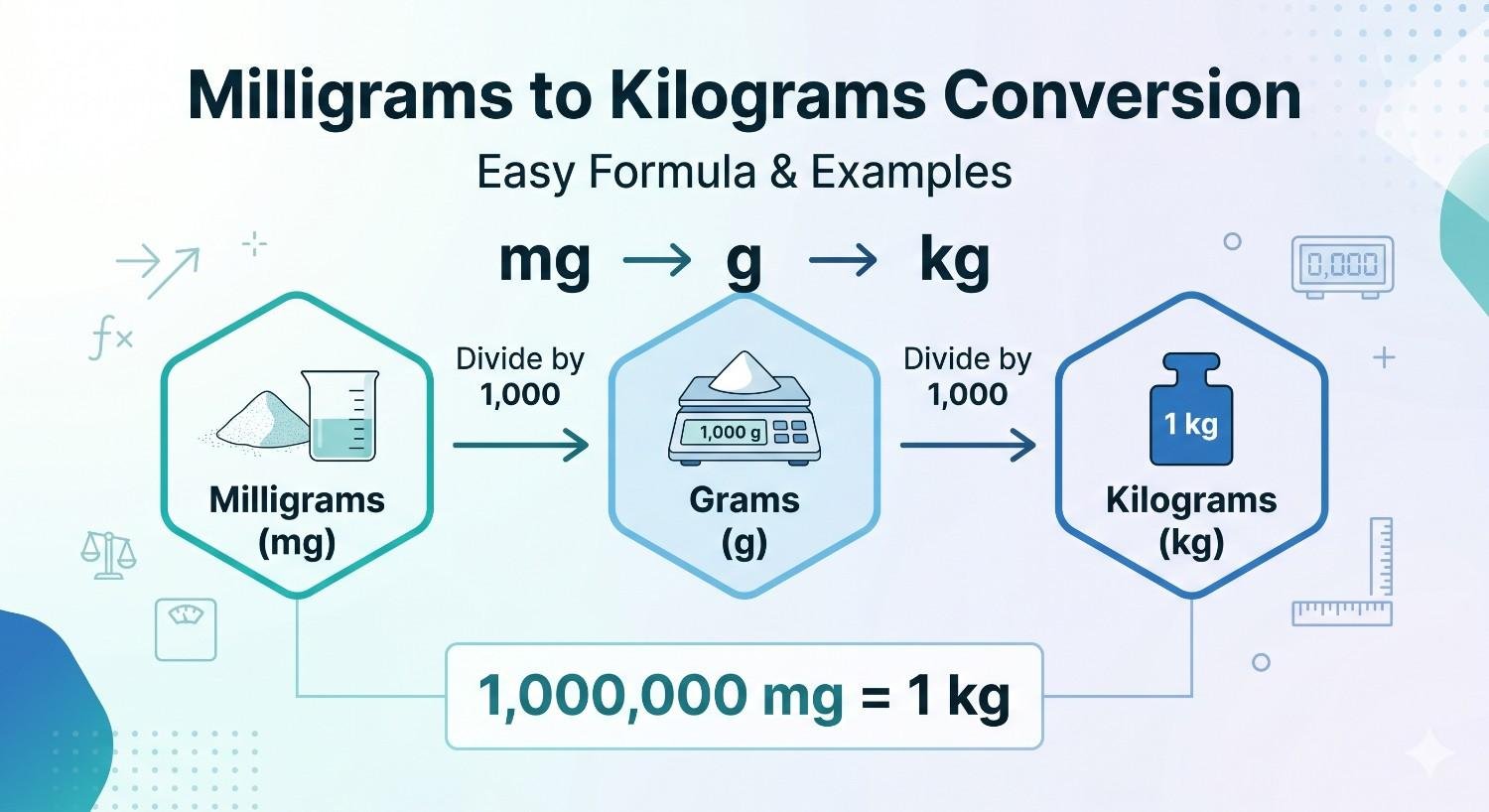
The relationship between kg and mg involves two conversion steps:
1 kilogram (kg) = 1,000 grams (g)
1 gram (g) = 1,000 milligrams (mg)
Therefore: 1 kg = 1,000 × 1,000 = 1,000,000 mg
This demonstrates the metric system's consistent decimal structure based on powers of 10.
Step-by-Step Conversion Guide
How to Convert Milligrams to Kilograms
- Identify the Milligram Value: Determine the mass in milligrams you need to convert.
- Divide by 1,000,000: Take the milligram value and divide it by one million.
- Alternative Method: Move the decimal point six places to the left.
- Result in Kilograms: The quotient is your answer in kilograms.
- Verify Your Answer: The kilogram value should be much smaller than the milligram value (1/1,000,000 of it).
Practical Example 1: Converting 75,000,000 mg to Kilograms
Formula: kg = mg ÷ 1,000,000
Calculation: 75,000,000 ÷ 1,000,000 = 75
Decimal Method: 75,000,000 mg → 75.000000 kg (move 6 places left)
Result: 75,000,000 mg = 75 kilograms
How to Convert Kilograms to Milligrams
- Identify the Kilogram Value: Determine the mass in kilograms you need to convert.
- Multiply by 1,000,000: Take the kilogram value and multiply it by one million.
- Alternative Method: Move the decimal point six places to the right.
- Result in Milligrams: The product is your answer in milligrams.
- Verify Your Answer: The milligram value should be one million times larger than the kilogram value.
Practical Example 2: Converting 0.5 Kilograms to Milligrams
Formula: mg = kg × 1,000,000
Calculation: 0.5 × 1,000,000 = 500,000
Decimal Method: 0.5 kg → 500,000 mg (move 6 places right)
Result: 0.5 kg = 500,000 milligrams
Comprehensive Conversion Table
Use this detailed conversion table for quick reference when converting between milligrams and kilograms:
| Milligrams (mg) | Kilograms (kg) | Common Context |
|---|---|---|
| 1,000 mg | 0.001 kg | Large medication dose (1 gram) |
| 10,000 mg | 0.01 kg | Daily vitamin intake (10 grams) |
| 100,000 mg | 0.1 kg | Small apple weight |
| 500,000 mg | 0.5 kg | Package of pasta |
| 1,000,000 mg | 1 kg | Liter of water, bag of sugar |
| 5,000,000 mg | 5 kg | Newborn baby weight |
| 25,000,000 mg | 25 kg | Young child weight |
| 50,000,000 mg | 50 kg | Small adult weight |
| 75,000,000 mg | 75 kg | Average adult weight |
| 100,000,000 mg | 100 kg | Large adult weight |
Real-World Applications
The conversion between milligrams and kilograms is essential in contexts where precision and scale vary dramatically:
Medical and Healthcare Applications
- Weight-Based Dosing: Medications are prescribed as "mg per kg of body weight." For example, a drug dosed at 10 mg/kg for a 70 kg patient requires 700 mg.
- Pediatric Medicine: Children's medication doses are calculated based on body weight in kg, with precise mg dosages to avoid under- or over-dosing.
- Anesthesiology: Anesthetic agents are dosed per kilogram of patient weight, with amounts measured in milligrams.
- Chemotherapy: Cancer treatment doses are calculated using body surface area and weight, requiring mg to kg conversions.
- Nutrition Support: Intravenous nutrition formulations list ingredients in mg while calculating based on patient weight in kg.
- Dialysis: Fluid removal and medication adjustments use weight-based calculations with mg dosing.
Pharmaceutical Research
- Drug Development: Clinical trials test drugs at various mg/kg doses to determine safe and effective ranges.
- Toxicology Studies: Lethal dose (LD50) and toxic doses are expressed as mg/kg to standardize across different body sizes.
- Pharmacokinetics: Drug absorption, distribution, and elimination are analyzed using mg/kg measurements.
- Quality Control: Active pharmaceutical ingredients (APIs) are measured in milligrams while batch sizes use kilograms.
Veterinary Medicine
- Animal Medications: Pet and livestock medications are dosed per kg of animal weight, from tiny doses for small pets to large amounts for horses and cattle.
- Feed Additives: Nutritional supplements and medications mixed into animal feed use mg/kg ratios.
- Anesthesia: Veterinary anesthesia requires precise mg/kg calculations for animal safety.
Scientific Research and Laboratory Work
- Animal Studies: Research dosing protocols specify mg/kg for experimental compounds administered to laboratory animals.
- Sample Preparation: Biochemical assays may require milligram quantities of reagents while tracking total mass in kilograms.
- Chemical Analysis: Concentration calculations involve converting between mg and kg for different measurements.
- Environmental Science: Pollutant concentrations are measured in mg/kg (parts per million by weight).
Nutrition and Dietary Science
- Micronutrient Requirements: Daily recommended intakes for vitamins and minerals are in mg, compared against body weight in kg.
- Supplement Formulation: Dietary supplements list ingredient amounts in mg per serving.
- Nutritional Research: Studies correlate nutrient intake (mg) with body weight (kg) to establish guidelines.
- Sports Nutrition: Protein, creatine, and other supplements are dosed based on athlete body weight.
Medical Dosage Calculations
Understanding mg to kg conversions is critical for safe medication administration. Here are practical examples:
Example 1: Pediatric Antibiotic Dosing
Calculation: 15 kg × 20 mg/kg = 300 mg per day
Context: The child's weight in kg multiplied by the per-kg dose gives the total mg needed.
Example 2: Adult Pain Medication
Calculation: 70 kg × 10 mg/kg = 700 mg per dose
Context: Body weight determines the safe and effective medication amount.
Example 3: Converting Total Daily Medication
Calculation: 3,000 mg ÷ 60 kg = 50 mg/kg/day
Context: Converting total dose to mg/kg helps compare to recommended guidelines.
Common Conversion Mistakes to Avoid
- Wrong Number of Zeros: 1 kg = 1,000,000 mg (six zeros), not 1,000 or 100,000. Count carefully!
- Decimal Point Errors: Move the decimal exactly six places, not three or nine. This is a common source of 1000-fold errors.
- Direction Confusion: mg to kg = divide by 1,000,000 (smaller number); kg to mg = multiply by 1,000,000 (larger number).
- Medical Calculation Errors: In healthcare, mg/kg dose errors can be fatal. Always double-check and have another person verify.
- Scientific Notation Mistakes: 10⁶ means 1,000,000, not 10×6. Understanding exponents is crucial.
- Unit Label Omission: Always specify mg or kg with your answer to prevent dangerous confusion.
- Rounding Too Early: Complete full calculations before rounding to avoid compounding errors.
- Confusing with Micrograms: Don't mix up mg (milligrams) with mcg or μg (micrograms). 1 mg = 1,000 mcg.
Tips for Accurate Conversions
- Memorize the Factor: 1 kg = 1,000,000 mg (or 10⁶ mg) is the essential relationship to remember.
- Use Scientific Notation: Writing 1×10⁶ or 10⁶ helps avoid counting zeros incorrectly.
- Two-Step Method: Convert kg → g (×1000), then g → mg (×1000) for a total of ×1,000,000.
- Decimal Point Rule: Six places left (mg→kg) or six places right (kg→mg).
- Check Order of Magnitude: Does your answer make sense? 70 kg should equal millions of mg, not thousands.
- Use Reliable Calculators: For medical or scientific work, use verified tools like this calculator.
- Double-Check Medical Conversions: In healthcare settings, always have a second person verify calculations.
- Understand Context: Body weight uses kg; medication doses use mg. Keep them distinct.
- Practice Common Values: Know that 1 kg = 1 million mg, 0.1 kg = 100,000 mg, etc.
Metric Mass Unit Complete Hierarchy
Understanding the full metric mass system helps contextualize the mg-to-kg conversion:
| Unit | Symbol | Relation to Kilogram | Scientific Notation |
|---|---|---|---|
| Microgram | μg or mcg | 0.000000001 kg | 10⁻⁹ kg |
| Milligram | mg | 0.000001 kg | 10⁻⁶ kg |
| Centigram | cg | 0.00001 kg | 10⁻⁵ kg |
| Decigram | dg | 0.0001 kg | 10⁻⁴ kg |
| Gram | g | 0.001 kg | 10⁻³ kg |
| Kilogram | kg | 1 kg (base) | 10⁰ kg |
| Tonne | t | 1,000 kg | 10³ kg |
From milligrams to kilograms, you're moving 6 decimal places:
mg → cg (÷10) → dg (÷10) → g (÷10) → dag (÷10) → hg (÷10) → kg (÷10)
Total: ÷1,000,000 or moving 6 places left
Weight-Based Dosing in Medicine
The most common practical use of mg-to-kg conversion is calculating medication doses based on patient weight:
Standard Dosing Format
Medical prescriptions often specify doses as:
This means X milligrams of medication per kilogram of patient body weight.
Calculating Total Dose
Common Weight-Based Medications
| Medication Type | Typical Dose Range | Example for 70 kg Adult |
|---|---|---|
| Acetaminophen | 10-15 mg/kg | 700-1,050 mg |
| Ibuprofen | 10 mg/kg | 700 mg |
| Amoxicillin | 20-40 mg/kg/day | 1,400-2,800 mg/day |
| Gentamicin | 5-7 mg/kg/day | 350-490 mg/day |
| Propofol | 1-2 mg/kg | 70-140 mg |
Frequently Asked Questions
How many milligrams are in one kilogram?
There are exactly 1,000,000 (one million) milligrams in one kilogram. This relationship is fixed in the metric system: 1 kg = 1,000 g, and 1 g = 1,000 mg, so 1 kg = 1,000 × 1,000 = 1,000,000 mg. You can also express this as 1 kg = 10⁶ mg using scientific notation. This large conversion factor reflects the enormous size difference between these units.
How do I convert 75,000,000 mg to kilograms?
To convert 75,000,000 mg to kilograms, divide 75,000,000 by 1,000,000. The calculation is: 75,000,000 ÷ 1,000,000 = 75 kilograms. Alternatively, move the decimal point six places to the left. This conversion is useful when expressing body weight, as 75 kg is a typical adult weight that equals 75 million milligrams.
Why is the mg to kg conversion factor so large?
The conversion factor is 1,000,000 because milligrams and kilograms are six decimal places apart in the metric system. From mg to kg, you pass through centigrams (×10), decigrams (×10), grams (×10), dekagrams (×10), hectograms (×10), and finally kilograms (×10), giving a total multiplier of 10⁶ = 1,000,000. This large factor allows the metric system to handle both tiny medication doses (mg) and everyday weights (kg) within one coherent system.
How do doctors calculate medication doses using mg and kg?
Doctors use weight-based dosing formulas expressed as "mg/kg" (milligrams per kilogram). They multiply the patient's weight in kilograms by the prescribed mg/kg dose to get the total milligram amount. For example, a 60 kg patient prescribed 10 mg/kg receives 600 mg (60 kg × 10 mg/kg = 600 mg). This ensures appropriate dosing regardless of patient size, which is especially important for children and medications with narrow therapeutic windows.
How do I convert kilograms to milligrams?
To convert kilograms to milligrams, multiply the kilogram value by 1,000,000. For example, 0.5 kg × 1,000,000 = 500,000 mg. You can also move the decimal point six places to the right. The milligram value will be much larger than the kilogram value because milligrams are tiny units. This conversion is less common in practice because expressing everyday weights in milligrams produces unwieldy large numbers.
What's a practical example of mg to kg conversion?
A practical medical example: A patient weighs 70,000,000 milligrams. Converting to kilograms: 70,000,000 mg ÷ 1,000,000 = 70 kg. While we never actually measure body weight in milligrams, this illustrates the relationship. More practically, if a prescription says "take 10 mg per kg of body weight" and you weigh 70 kg, you multiply: 70 kg × 10 mg/kg = 700 mg total dose.
Can I use this conversion for cooking measurements?
While technically possible, it's impractical to convert cooking measurements between mg and kg because the scale difference is too large. Recipes use grams for small quantities and kilograms for large amounts, rarely milligrams (unless specifying tiny amounts of expensive spices or additives). For cooking, stick with g-to-kg conversions (factor of 1,000) which are more practical and less error-prone.
Why do we measure body weight in kg but medication in mg?
Body weight is measured in kilograms because humans and animals weigh tens to hundreds of kilograms, making kg the appropriate scale. Medications are measured in milligrams because therapeutic doses are typically fractions of a gram, making mg more precise and practical. The combination allows doctors to calculate personalized doses using the mg/kg formula, ensuring patients receive appropriate amounts based on their body size.
Is 1,000,000 mg a lot?
1,000,000 mg equals 1 kilogram, which is a moderate everyday weight—about the weight of a liter of water, a bag of sugar, or a pineapple. While one million sounds like a huge number, in the context of milligrams it's actually just 1 kg. This demonstrates why using appropriate units matters: saying "1 kg" is much clearer and more practical than "1,000,000 mg" for everyday measurements.
Historical Context and Medical Standards
The relationship between milligrams and kilograms has important historical and practical significance in medicine and science.
Development of Weight-Based Dosing
Weight-based medication dosing emerged in the early 20th century as physicians recognized that drug effects vary with patient size. The metric system's consistent decimal structure made mg/kg calculations straightforward, leading to its universal adoption in medicine. Before this standardization, dosing was often based on arbitrary "adult" or "child" doses, leading to significant under- or over-dosing.
The Kilogram Standard
The kilogram was originally defined in 1795 as the mass of one liter of water. From 1889 to 2019, it was defined by a physical platinum-iridium cylinder kept in France. In 2019, the kilogram was redefined using the Planck constant, a fundamental physical constant. This redefinition ensures the kilogram (and therefore the milligram) is based on unchanging physics rather than a physical object, providing permanent stability for medical and scientific measurements.
Medical Safety Standards
Organizations like the World Health Organization (WHO), Joint Commission, and Institute for Safe Medication Practices (ISMP) mandate specific practices for mg and kg measurements to prevent errors. Healthcare facilities require independent double-checks of weight-based dose calculations, use of standardized mg/kg conversion tables, and electronic dose calculation systems. These safeguards exist because medication dosing errors, particularly involving decimal point mistakes in mg-to-kg conversions, can be fatal.
International Standardization
The International System of Units (SI), maintained by the International Bureau of Weights and Measures (BIPM), defines all metric units including the kilogram and milligram. This global standardization ensures that a milligram in Tokyo equals a milligram in Toronto, enabling international medical practice, pharmaceutical manufacturing, and scientific collaboration without conversion ambiguity.