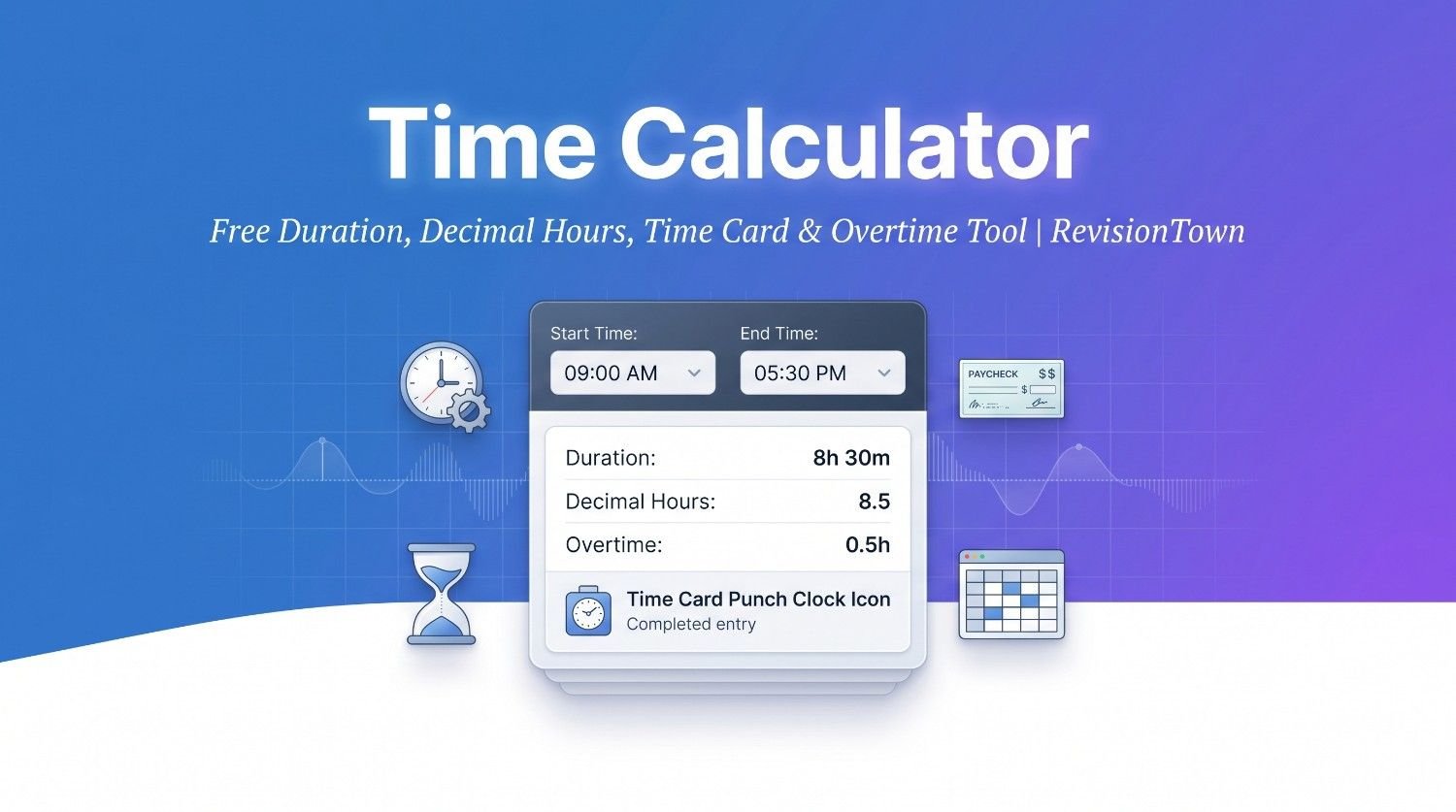
Time & Duration Calculator 2026
Time Calculator — Calculate Time Duration, Decimal Hours, Elapsed Time, and Time Card Hours with Breaks
Use this free time calculator to compute time durations, convert between hours-minutes and decimal hours, calculate elapsed time between two timestamps, and build a complete time card with breaks. This all-in-one time and duration calculator supports payroll time conversion, time and a half overtime calculations, 30-minute lunch break deductions, and two-week time card totals. Whether you are a manager computing labor hours, an employee verifying a timesheet, or a freelancer tracking billable time, this free online time card calculator gives you instant, accurate results. Built by RevisionTown — free, private, no signup required.
Multi-mode calculator: Switch between Duration, Decimal Converter, Time Card, and Time & a Half modes using the tabs below. Each mode is a specialized tool — from a decimal hour calculator to a two-week time card calculator with automatic break deductions.
Calculate Time
Your Time Calculation
Enter your times and click calculate to see duration, decimal hours, payroll conversion, and earnings breakdown.
Detailed Breakdown
This time calculator provides estimates for planning and payroll verification. Actual payroll calculations may differ based on employer rounding rules, state overtime laws, and company policies.
What Is a Time Calculator and Why Workers and Managers Rely on One
A time calculator is a tool that computes durations between timestamps, converts time formats, and totals work hours for payroll processing. While the concept sounds straightforward, time calculations are surprisingly error-prone when done manually — especially when dealing with AM/PM transitions, overnight shifts, break deductions, and the conversion between standard time (hours and minutes) and decimal hours used in payroll systems. This time and duration calculator eliminates those errors by handling every conversion automatically.
Whether you need to calculate time duration between a start and end time, convert minutes to decimal for payroll submission, use an hour duration calculator for project tracking, or build a complete weekly time card with 30-minute lunch break deductions, this tool handles it all. The four specialized modes cover every common time calculation scenario: basic elapsed time, decimal time conversion, full weekly time clock calculator with breaks, and time and a half calculator for overtime pay. This is the free online time card calculator that workers and managers use to verify timesheets, plan schedules, and process accurate payroll.
For payroll professionals, this tool doubles as a payroll time conversion utility. Most payroll systems require time entries in decimal format (8.75 hours instead of 8 hours 45 minutes), and converting dozens of time entries manually is both slow and error-prone. This decimal hour calculator converts instantly in both directions — from HH:MM to decimal and from decimal back to hours and minutes — making it an essential time and calculator for anyone who processes timesheets.
How Each Time Calculator Mode Works — Complete Methodology
Mode 1: Duration Calculator — Calculate Elapsed Time
The duration mode answers the most fundamental time question: how long is the period between two timestamps? Enter a start time and end time, optionally subtract break time, and the calculator tells you the total duration in hours and minutes, decimal hours, total minutes, and total seconds. This is the core calculate elapsed time function. The calculator also handles overnight shifts — if you work from 10:00 PM to 6:00 AM, select "End is next day" and the calculator correctly computes 8 hours rather than returning a negative value.
Mode 2: Decimal Converter — Minutes to Decimal and Back
This mode is a dedicated minutes to decimal calculator and decimal to time calculator. Enter hours and minutes to get the decimal equivalent (e.g., 7 hours 45 minutes = 7.75 decimal hours), or enter a decimal value to convert back to hours and minutes (e.g., 6.33 decimal hours = 6 hours 20 minutes). This converting hours to decimals function is essential for payroll submission, billing, and project management systems that require decimal time entries.
Mode 3: Time Card — Weekly Time Clock with Breaks
The time card mode is a complete online time clock calculator and labor hours calculator. Enter clock-in and clock-out times for each day of the week, specify break durations, and the calculator totals your weekly hours with automatic overtime detection. This time clock calculator with breaks automatically deducts your 30-minute break (or any custom break duration) from each day's total. Enter an hourly rate to see regular pay, overtime pay, and total gross pay — making this a genuine two-week time card calculator when used for consecutive weeks.
Mode 4: Time and a Half Calculator
The overtime mode is a specialized time and a half calculator (also called a time in a half calculator). Enter your hourly rate, regular hours, overtime hours, and select the overtime multiplier (1.5x, 2x, or 2.5x). The calculator shows regular pay, overtime pay, total gross pay, and the effective blended hourly rate. This is the tool for answering the question: "If I work 5 overtime hours this week, how much extra will I earn?"
The Core Time Calculation Formulas — Mathematical Notation
Here are the key formulas this time and duration calculator uses, rendered in proper mathematical notation:
The basic elapsed time formula:
For an 8:00 AM to 5:00 PM shift with a 30-minute lunch break:
The minutes to decimal conversion formula:
For example, 7 hours and 45 minutes:
The reverse decimal to time conversion:
For 6.33 decimal hours:
The time and a half overtime formula:
For $22.00/hour with 40 regular hours and 5 overtime hours:
The work hours in a year formula:
For a standard 40-hour week with 10 holidays and 15 PTO days:
Minutes to Decimal Quick-Reference Table
This minutes to decimal calculator reference shows common minute values and their decimal equivalents. Payroll systems typically require decimal hours — use this table for quick payroll time conversion.
| Minutes | Decimal | Minutes | Decimal | Minutes | Decimal |
|---|---|---|---|---|---|
| 5 | 0.08 | 25 | 0.42 | 45 | 0.75 |
| 10 | 0.17 | 30 | 0.50 | 50 | 0.83 |
| 15 | 0.25 | 35 | 0.58 | 55 | 0.92 |
| 20 | 0.33 | 40 | 0.67 | 60 | 1.00 |
Work Hours in a Year Calculator — How Many Hours Do You Actually Work?
A standard full-time schedule of 40 hours per week across 52 weeks equals 2,080 hours per year. But nobody actually works 2,080 hours because of holidays, vacations, and sick days. The actual number of work hours in a year depends on your employer's PTO policy, the number of paid holidays, and any unpaid leave you take. The standard calculation for the US in 2026 with 10 federal holidays and 15 days of paid time off yields approximately 1,880 actual work hours — about 10% less than the theoretical 2,080. This distinction matters for annualizing hourly wages, comparing job offers, and budgeting.
The 30-Minute Lunch Break Calculator — How Break Deductions Affect Your Pay
The 30-minute lunch break calculator functionality is built into both the duration and time card modes. Under the Fair Labor Standards Act (FLSA), employers are not required to provide breaks, but most do. When breaks are unpaid (as most lunch breaks are), they must be deducted from total hours worked. A 30-minute break calculator shows the impact: an employee who clocks in at 8:00 AM and out at 5:00 PM has 9 hours on the clock, but after a 30-minute unpaid lunch break, the billable time is 8 hours 30 minutes (8.50 decimal hours). Over a 5-day work week, that 30-minute daily break deduction reduces weekly hours from 45 to 42.5 — a difference of $55 per week at $22/hour. Understanding this math is why a time clock calculator with breaks is essential for accurate payroll.
Payroll Rounding Rules
Many employers round time clock entries to the nearest quarter hour (15 minutes) for payroll purposes. Under federal law, this is permissible as long as the rounding averages out over time and does not consistently favor the employer. If your employer rounds, compare the rounded time against actual clock-in/out times using this free online time card calculator to ensure accuracy over a pay period.
Time and a Half Calculator — Understanding Overtime Pay Under FLSA
The time and a half calculator (sometimes searched as time in a half calculator) computes overtime pay at 1.5 times the regular hourly rate. Under the FLSA, non-exempt employees must receive overtime pay for hours worked beyond 40 in a workweek. Some states have additional rules — California requires daily overtime after 8 hours, and double time after 12 hours in a single day. The overtime multiplier selector in this tool supports 1.5x (standard time-and-a-half), 2x (double time), and 2.5x for premium overtime situations.
The overtime calculation has a significant impact on take-home pay. At $22/hour, five overtime hours per week at time-and-a-half adds $165 to weekly gross pay. Over a year, that is an additional $8,580 in gross income. But remember that overtime income is taxed at the same rate as regular income, so the actual take-home increase is approximately $6,000–$6,500 depending on your tax bracket. This time estimate helps you decide whether extra hours are worth the trade-off.
Annual Work Hours Reference Table
This work hours in a year calculator reference shows total annual work hours at different weekly schedules and PTO levels.
| Weekly Hours | No PTO (2026) | 10 Days PTO | 15 Days PTO | 20 Days PTO | 25 Days PTO |
|---|---|---|---|---|---|
| 40 hrs/wk | 2,080 | 2,000 | 1,960 | 1,920 | 1,880 |
| 37.5 hrs/wk | 1,950 | 1,875 | 1,838 | 1,800 | 1,763 |
| 35 hrs/wk | 1,820 | 1,750 | 1,715 | 1,680 | 1,645 |
| 32 hrs/wk | 1,664 | 1,600 | 1,568 | 1,536 | 1,504 |
| 20 hrs/wk (part-time) | 1,040 | 1,000 | 980 | 960 | 940 |
Assumes 10 federal holidays per year. PTO days are additional days off beyond holidays.
Decimal Time for Payroll — Why Payroll Systems Use Decimal Hours
Payroll software and billing systems use decimal hours because standard time (hours:minutes) does not multiply cleanly with dollar amounts. If an employee works 7 hours and 45 minutes, you cannot simply multiply 7:45 by $20/hour without first converting to decimal. The decimal hour calculator converts 7:45 to 7.75, and then 7.75 × $20 = $155.00. This decimal time calculator prevents the most common payroll error: treating minutes as cents (e.g., mistakenly entering 7.45 instead of 7.75 for 7 hours 45 minutes, which underpays the employee by $6.00 per day). Over a year, this single rounding error costs $1,500+ in underpayment, which is why accurate payroll time conversion matters enormously.
Common Time Calculation Mistakes to Avoid
The first and most common mistake is confusing decimal hours with hours-and-minutes. 7.5 decimal hours equals 7 hours and 30 minutes — not 7 hours and 50 minutes. The second mistake is forgetting to deduct unpaid breaks, which inflates reported hours and creates payroll discrepancies. The third mistake is calculating overnight shifts incorrectly — if you work from 10:00 PM to 6:00 AM, the elapsed time is 8 hours, not negative 16 hours. This time time calculator handles all three scenarios correctly.
The fourth mistake involves payroll rounding. Some employers round to the nearest 6 minutes (1/10 of an hour), others to the nearest 15 minutes (1/4 of an hour). If you clocked in at 7:53, a quarter-hour rounding system records 8:00 as your start time, costing you 7 minutes. Over 250 work days, that is approximately 29 hours of unpaid time. Using this time estimate tool to verify your timesheet against actual clock times helps catch systematic rounding errors.
FAQ-Style Guide to Time Calculation
How do I calculate time duration between two times?
Subtract the start time from the end time, then subtract any break time. For 8:00 AM to 5:00 PM with a 30-minute break: 9 hours minus 30 minutes equals 8 hours 30 minutes (8.50 decimal hours). Use the Duration mode of this time and duration calculator for instant results.
How do I convert minutes to decimal hours?
Divide the minutes by 60. For 45 minutes: 45 ÷ 60 = 0.75. So 7 hours 45 minutes = 7.75 decimal hours. This minutes to decimal calculator handles the conversion automatically in the Decimal Converter mode.
How do I convert decimal hours back to hours and minutes?
Take the whole number as hours and multiply the decimal portion by 60 to get minutes. For 6.33: the hours are 6 and the minutes are 0.33 × 60 = 20, giving you 6 hours 20 minutes. This decimal to time calculator does this instantly.
What is time and a half?
Time and a half means your hourly rate multiplied by 1.5. If your regular rate is $20/hour, time and a half is $30/hour. Under the FLSA, non-exempt employees earn time and a half for hours worked beyond 40 per week. This time and a half calculator computes the premium for any rate and hours combination.
How many work hours are in a year?
A standard full-time schedule is 2,080 hours per year (40 hrs/wk × 52 weeks). After subtracting 10 federal holidays (80 hours) and 15 days PTO (120 hours), actual work hours drop to approximately 1,880. This work hours in a year calculator adjusts for your specific schedule and PTO.
How does the 30-minute break calculator work?
Enter your clock-in and clock-out times, then set the break field to 30 minutes. The calculator deducts 30 minutes from the gross time. For an 8:00–5:00 shift: 9 hours gross minus 30 minutes break equals 8.5 hours worked. This 30-minute lunch break calculator ensures accurate payroll calculations.
Can I calculate a two-week time card?
Yes. The Time Card mode calculates a full 7-day week. Run it twice (once for each week) and add the totals for a two-week time card calculator result. The tool automatically detects overtime hours beyond 40 per week and calculates time-and-a-half pay.
How does payroll time conversion work?
Payroll systems require time in decimal format. The conversion divides minutes by 60: 15 min = 0.25, 30 min = 0.50, 45 min = 0.75. This payroll time conversion tool converts any HH:MM time entry to the correct decimal value for payroll submission.
What is a labor hours calculator used for?
A labor hours calculator totals the hours worked by employees across shifts, departments, or projects. It is used by managers, contractors, and HR departments to track labor costs, verify timesheets, and ensure FLSA compliance. This tool serves as a labor hours calculator by summing daily hours across a work week.
How do I calculate elapsed time for an overnight shift?
Select "End is next day" in the Duration mode. If you start at 10:00 PM and end at 6:30 AM with a 30-minute break, the calculator correctly computes 8 hours worked (8.5 gross minus 0.5 break). Without the "next day" flag, the formula would subtract incorrectly.
Related Financial Tools from RevisionTown
Workers and managers using this time calculator often need these complementary tools:
- ADP Hourly Calculator — for computing take-home pay after federal and state taxes on your hourly earnings.
- Income Tax Calculator — for estimating federal income tax on annual earnings from hourly wages and overtime.
- Commission Calculator — for salespeople who earn hourly plus commission and need a total compensation estimate.
- Simple Interest Formula Guide — for understanding how overtime earnings grow in savings and investment accounts.
- CAGR Calculator — for tracking annualized growth of income or investments funded by hourly earnings.