
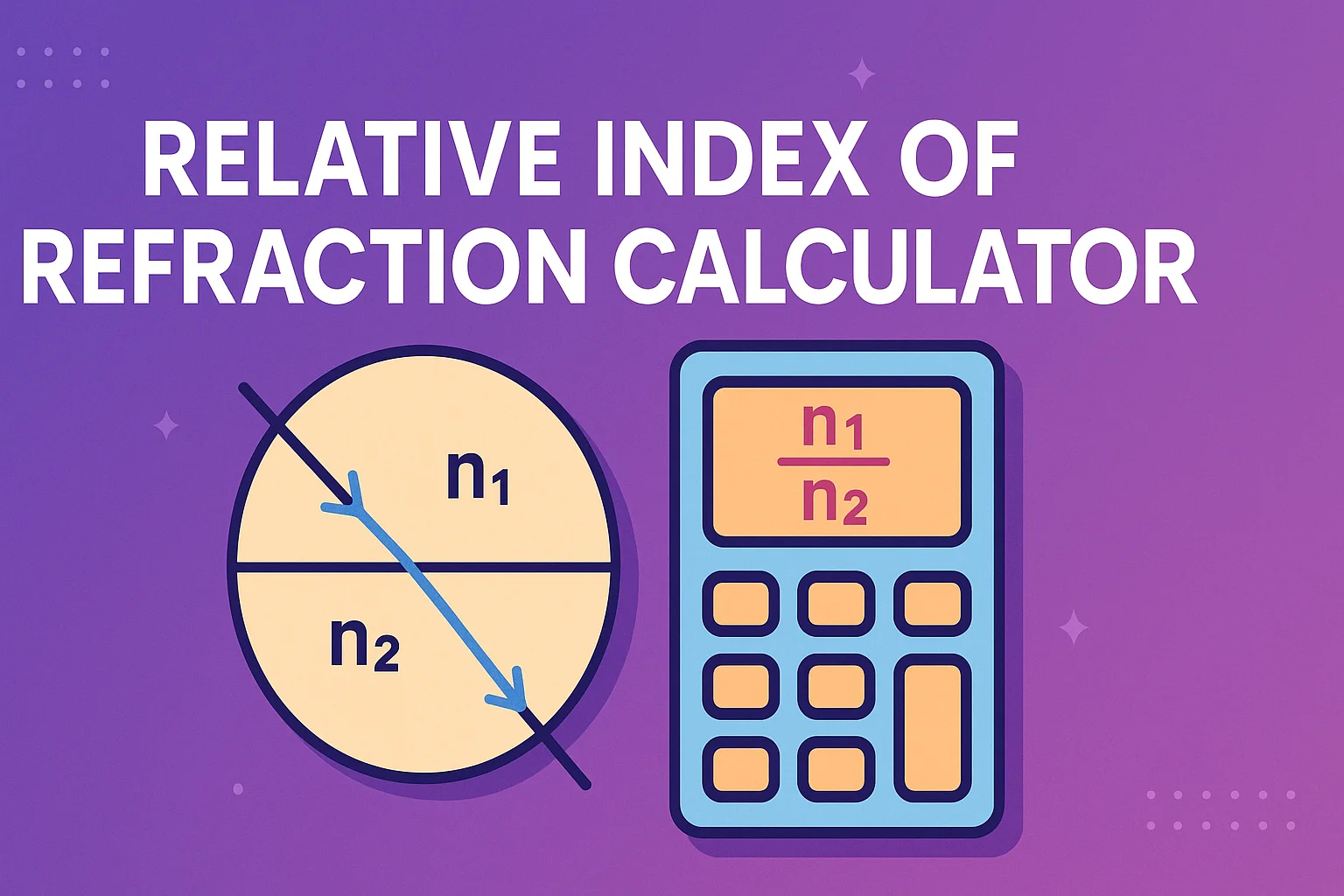
Relative Index of Refraction Calculator
📚 Understanding Relative Index of Refraction
What is Relative Index of Refraction?
The relative index of refraction (n₁₂) compares how light propagates in two different media. Defined as n₁₂ = n₁ / n₂, where n₁ and n₂ are absolute refractive indices, it indicates the ratio of light speeds: n₁₂ = v₂ / v₁. This dimensionless quantity can be greater than, equal to, or less than 1, depending on which medium is optically denser. Relative refractive index is essential for predicting light behavior at interfaces, calculating refraction angles using Snell's law, and understanding total internal reflection phenomena.
Fundamental Relative Refractive Index Formulas
| Concept | Formula | Application |
|---|---|---|
| Relative Refractive Index | n₁₂ = n₁ / n₂ = v₂ / v₁ | Comparison of light speeds in two media |
| Reciprocal Relationship | n₂₁ = 1 / n₁₂ | Reverse direction; opposite effect |
| Snell's Law with Relative Index | n₁₂ × sin(θ₁) = sin(θ₂) | Predicts refraction angles |
| Critical Angle | sin(θc) = 1 / n₁₂ (n₁₂ > 1) | Total internal reflection threshold |
| Optical Density Comparison | If n₁₂ > 1, medium 1 is denser | Determines light bending direction |
Relative Refractive Index of Common Material Pairs
| Material Pair | Relative Index (n₁₂) | Light Behavior |
|---|---|---|
| Air to Water | 1.0 / 1.33 ≈ 0.75 | Light speeds up; bends away from normal |
| Water to Air | 1.33 / 1.0 = 1.33 | Light slows down; bends toward normal |
| Air to Glass | 1.0 / 1.52 ≈ 0.66 | Light speeds up significantly |
| Glass to Air | 1.52 / 1.0 = 1.52 | Light slows down significantly |
| Water to Glass | 1.33 / 1.52 ≈ 0.88 | Light speeds up; minor bending |
| Glass to Diamond | 1.52 / 2.42 ≈ 0.63 | Dramatic speed increase |
| Air to Diamond | 1.0 / 2.42 ≈ 0.41 | Extreme light bending; high brilliance |
Understanding Light Behavior at Interfaces
When light travels from medium 1 to medium 2, the relative refractive index n₁₂ determines whether light speeds up or slows down. If n₁₂ > 1, light is entering a less optically dense medium (higher speed)—light accelerates and bends away from the normal. If n₁₂ < 1, light enters a denser medium (lower speed)—light decelerates and bends toward the normal. This directional relationship is crucial for understanding refraction in lenses, water-air interfaces, and optical fiber design. The magnitude of n₁₂ indicates the strength of this bending effect.
Critical Angle and Total Internal Reflection
When light travels from a denser to less dense medium (n₁₂ > 1), a critical angle exists beyond which total internal reflection occurs. The critical angle is found from: sin(θc) = 1 / n₁₂. For water-air (n₁₂ = 1.33): sin(θc) = 1/1.33 ≈ 0.75, giving θc ≈ 48.8°. When incident angle exceeds this critical value, light cannot refract into the less dense medium—instead, it reflects internally. This principle enables fiber optic cables, diamond brilliance, and precision optical prisms. Understanding critical angle is essential for designing optical systems with controlled light confinement.
Directional Dependence: n₁₂ vs n₂₁
Relative refractive index is directional and reciprocal. If light travels air-to-water, n₁₂ = n_air / n_water = 1.0 / 1.33 ≈ 0.75. For reverse direction (water-to-air), n₂₁ = n_water / n_air = 1.33 / 1.0 = 1.33. Notice n₂₁ = 1 / n₁₂. This reciprocal relationship reflects that light bending reverses direction when reversing propagation direction. Understanding directionality is crucial for analyzing optical systems—light behavior depends entirely on which medium you're coming from and which you're entering.
Practical Applications of Relative Refractive Index
- Lens Design: Relative index between lens material and surrounding medium determines focal length and optical power through the lensmaker's equation
- Optical Fiber Networks: Controlled relative index differences between core and cladding enable total internal reflection for signal propagation
- Anti-Reflection Coatings: Precise relative index matching minimizes unwanted reflections in high-performance optical systems
- Underwater Optics: Water-air relative index creates unique optical challenges requiring specialized lens designs
- Gemstone Identification: Relative refractive index patterns help distinguish diamonds from imitations
- Prism Design: Relative index differences enable light separation in spectrometers and dispersive systems
Why RevisionTown's Relative Index Calculator?
Calculating relative refractive index manually requires understanding multiple formulas and careful attention to directionality. Our advanced calculator eliminates confusion by supporting four calculation methods—absolute indices, Snell's law, critical angle, and material pair selection—automatically handling directional relationships and instantly providing comprehensive analysis. Whether analyzing optical interfaces, designing optical systems, or studying refraction phenomena, this calculator ensures accuracy and saves valuable time.
❓ Frequently Asked Questions
The relative refractive index (n₁₂) is the ratio of absolute refractive indices: n₁₂ = n₁ / n₂, which also equals v₂ / v₁ (ratio of light speeds). It's dimensionless and can be greater than, equal to, or less than 1. For example, water-to-air: n₁₂ = 1.33 / 1.0 = 1.33 (light travels 1.33 times faster in air than water). The reciprocal relationship holds: n₂₁ = 1 / n₁₂. Relative refractive index is directional—reversing light direction reverses the ratio.
Absolute refractive index (n) compares light speed in a medium to light speed in vacuum: n = c / v. It's always ≥ 1 and describes a single medium's optical property. Relative refractive index (n₁₂) compares two absolute indices: n₁₂ = n₁ / n₂, describing light behavior at an interface. Relative index can be <1, =1, or >1 depending on which medium is denser. Absolute index describes inherent material property; relative index describes behavior between two specific media.
The critical angle (θc) is the incident angle where refracted light travels along the interface (refraction angle = 90°). For angles exceeding θc, total internal reflection occurs. Formula: sin(θc) = 1 / n₁₂ (applies when n₁₂ > 1, i.e., light going from denser to less dense medium). For water-air (n₁₂ = 1.33): sin(θc) = 1/1.33 ≈ 0.75, so θc ≈ 48.8°. Beyond this angle, light cannot escape water—it reflects internally. This enables fiber optics and underwater optical phenomena.
When n₁₂ > 1, light travels faster in medium 2 than medium 1, meaning medium 1 is optically denser. Light entering this denser medium (medium 2) slows down and bends toward the normal. For example, water-to-air (n₁₂ = 1.33 / 1.0 = 1.33) shows air is less dense; light speeds up and bends away from normal. Conversely, air-to-water (n₁₂ = 1.0 / 1.33 ≈ 0.75) shows water is denser; light slows and bends toward normal. Understanding density relationship predicts light behavior.
Lens power depends on relative refractive index between lens material and surrounding medium. The lensmaker's equation involves the relative index: 1/f = (n_relative - 1) × (1/R₁ - 1/R₂), where n_relative is the relative index and f is focal length. Higher relative index creates stronger lens effect—underwater lenses require different designs than air lenses due to different relative indices. Contact lens performance depends on relative index with eye fluid. Understanding relative refractive index is crucial for optimizing lens performance across different environments.
Snell's law states: n₁ sin(θ₁) = n₂ sin(θ₂). Dividing by n₂: (n₁/n₂) sin(θ₁) = sin(θ₂), or n₁₂ × sin(θ₁) = sin(θ₂). This shows relative refractive index directly determines refraction angle. Higher relative index produces greater bending. For example, air-to-water (n₁₂ ≈ 0.75): light bends less. Air-to-diamond (n₁₂ ≈ 0.41): light bends dramatically. Snell's law with relative refractive index accurately predicts light bending at interfaces.
Fiber optics exploit relative refractive index differences between core and cladding. A controlled difference (typically n_core / n_cladding ≈ 1.013) creates sufficient relative index to enable total internal reflection. Higher relative index difference increases numerical aperture (light-gathering ability): NA = √(n₁² - n₂²). Understanding and precisely controlling relative refractive index between core and cladding is essential for optimizing fiber performance, bandwidth capacity, and achieving long-distance data transmission without signal loss.
Air-to-water: 0.75; Air-to-glass: 0.66; Air-to-diamond: 0.41; Water-to-glass: 0.88; Water-to-air: 1.33; Glass-to-air: 1.52; Glass-to-diamond: 0.63. Note the reciprocal relationships—reversing direction reverses the index. When relative index < 1, light travels faster in second medium (less dense). When > 1, light travels slower in second medium (more dense). Understanding these relationships helps predict behavior at specific interfaces in optical systems.