⚡ kW to hp Converter
Professional Kilowatts to Horsepower Calculator | Automotive & Industrial
🚗 Common Engine Power Ratings
📚 Complete Guide to kW and Horsepower Conversion
Understanding Kilowatts and Horsepower
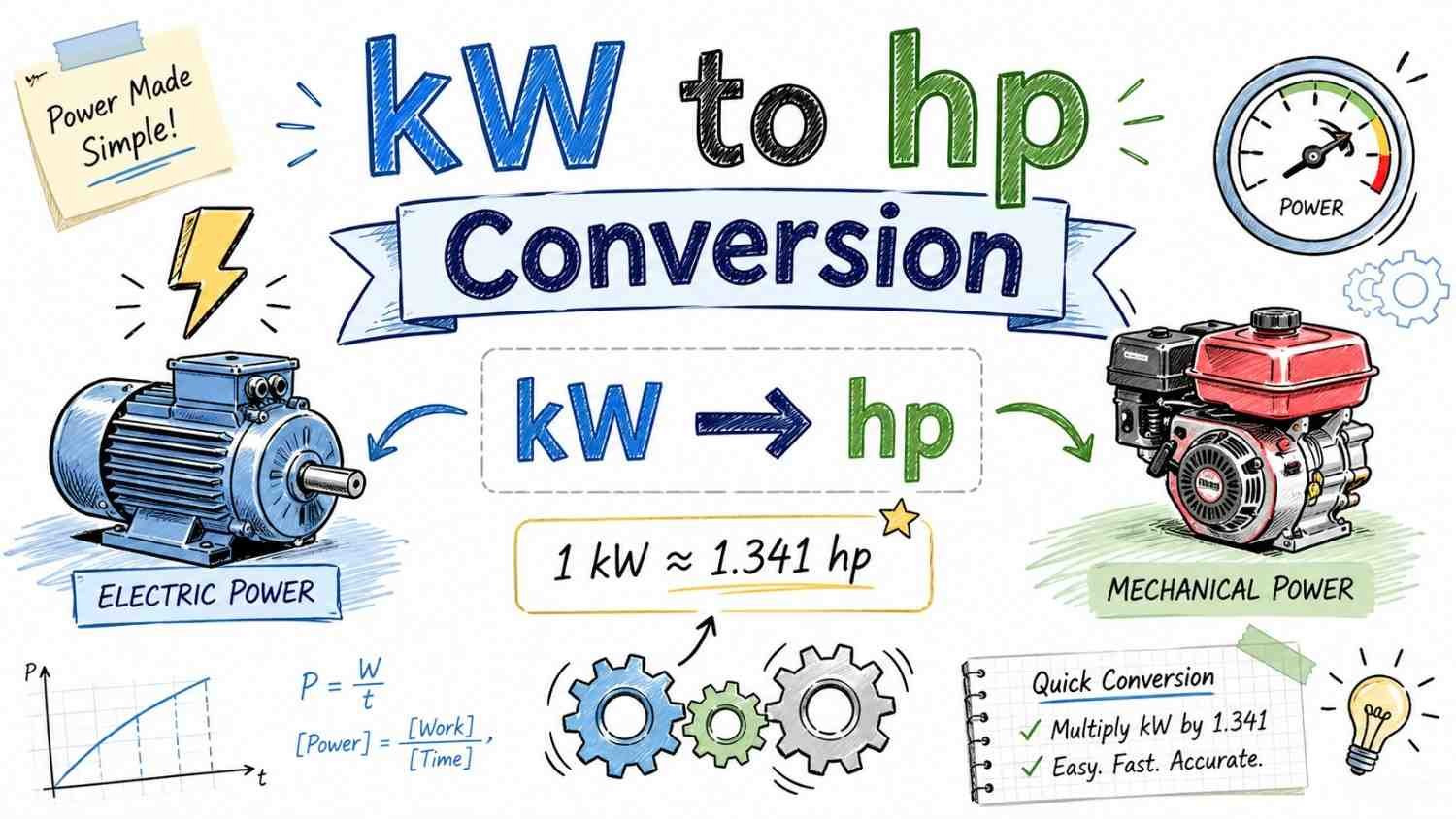
Kilowatts (kW) are the SI (International System of Units) standard measurement of power where 1 kilowatt equals 1,000 watts, universally used in electrical engineering, modern automotive specifications (especially in Europe, Asia, and increasingly in commercial applications worldwide), and energy efficiency calculations. Horsepower (hp) is a unit measuring mechanical power with three distinct standards used globally: Mechanical horsepower (hp, hp(I), or SAE hp) equals 745.7 watts exactly, used primarily in the United States, United Kingdom, and countries following SAE (Society of Automotive Engineers) standards for automotive engines, industrial motors, and power equipment; Metric horsepower (designated PS in Germany from "Pferdestärke", CV in France/Spain from "chevaux-vapeur", ch in Switzerland, pk in Netherlands) equals 735.5 watts, used throughout Europe, Asia, and most other countries for vehicle specifications and industrial machinery; Electrical horsepower (hp(E)) equals exactly 746 watts, defined specifically for electric motor nameplate ratings in North America. The fundamental relationships: 1 kW = 1.341 mechanical hp; 1 kW = 1.360 metric hp (PS); 1 kW = 1.340 electrical hp. Understanding this conversion enables automotive enthusiasts to compare European vehicle specifications (listed in kW) to US/UK specifications (traditionally listed in hp), mechanical engineers to select motors and equipment across international standards, vehicle buyers to ensure accurate power rating comprehension when purchasing imported cars, and professionals to translate between metric electrical power specifications (kW) used in equipment documentation and imperial mechanical power ratings (hp) familiar to US/UK contractors and consumers.
Conversion Formulas
Kilowatts to Mechanical Horsepower: \( \text{hp} = \text{kW} \times 1.341 \) or \( \text{hp} = \frac{\text{kW}}{0.7457} \). Multiply kilowatts by 1.341 to convert to mechanical horsepower. Examples demonstrating common automotive and industrial applications: 30 kW × 1.341 = 40.23 hp (microcar, small motorcycle); 50 kW × 1.341 = 67.05 hp (compact economy car); 75 kW × 1.341 = 100.58 hp (standard sedan, often rounded to 101 hp); 85 kW × 1.341 = 114 hp (mid-size sedan); 100 kW × 1.341 = 134.1 hp (performance hatchback); 110 kW × 1.341 = 147.5 hp (compact SUV); 130 kW × 1.341 = 174.3 hp (family SUV); 150 kW × 1.341 = 201.15 hp (sports sedan); 180 kW × 1.341 = 241.4 hp (performance sedan); 200 kW × 1.341 = 268.2 hp (sports car); 250 kW × 1.341 = 335.25 hp (high-performance sports car); 300 kW × 1.341 = 402.3 hp (supercar); 400 kW × 1.341 = 536.4 hp (exotic supercar). Kilowatts to Metric Horsepower: \( \text{PS} = \text{kW} \times 1.360 \). Examples: 75 kW × 1.360 = 102 PS; 100 kW × 1.360 = 136 PS; 150 kW × 1.360 = 204 PS; 200 kW × 1.360 = 272 PS. Kilowatts to Electrical Horsepower: \( \text{hp(E)} = \text{kW} \times 1.340 \). Examples: 75 kW × 1.340 = 100.5 hp(E); 100 kW × 1.340 = 134 hp(E). Horsepower to Kilowatts: \( \text{kW} = \text{hp} \times 0.7457 \) or \( \text{kW} = \frac{\text{hp}}{1.341} \). Examples for reverse conversion: 100 hp × 0.7457 = 74.57 kW; 150 hp × 0.7457 = 111.86 kW; 200 hp × 0.7457 = 149.14 kW; 250 hp × 0.7457 = 186.43 kW; 300 hp × 0.7457 = 223.71 kW; 400 hp × 0.7457 = 298.28 kW; 500 hp × 0.7457 = 372.85 kW. These conversions enable direct comparison between European and US/UK automotive specifications, selection of motors across international suppliers, understanding of equipment power ratings regardless of regional measurement preferences, and accurate power-to-weight ratio calculations for vehicle performance analysis.
Comprehensive Power Conversion Table
| Kilowatts (kW) | Mechanical HP | Metric HP (PS) | Vehicle Type / Application |
|---|---|---|---|
| 30 kW | 40 hp | 41 PS | Microcar, electric scooter |
| 40 kW | 54 hp | 54 PS | City car, small hatchback |
| 50 kW | 67 hp | 68 PS | Compact economy car |
| 60 kW | 80 hp | 82 PS | Small family car |
| 75 kW | 101 hp | 102 PS | Standard sedan |
| 85 kW | 114 hp | 116 PS | Mid-size sedan |
| 100 kW | 134 hp | 136 PS | Performance hatchback |
| 110 kW | 147 hp | 150 PS | Compact SUV |
| 130 kW | 174 hp | 177 PS | Family SUV |
| 150 kW | 201 hp | 204 PS | Sports sedan |
| 180 kW | 241 hp | 245 PS | Performance sedan |
| 200 kW | 268 hp | 272 PS | Sports car |
| 250 kW | 335 hp | 340 PS | High-performance sports car |
| 300 kW | 402 hp | 408 PS | Supercar |
| 400 kW | 536 hp | 544 PS | Exotic supercar |
| 500 kW | 670 hp | 680 PS | Hypercar |
Automotive Engine Specifications
Understanding kW-hp conversion enables accurate comparison of vehicle performance across international markets. European Specifications: EU-market vehicles list power primarily in kilowatts per regulatory requirements since 2010, with PS (metric horsepower) or hp as supplementary consumer-friendly information. Example: Volkswagen Golf GTI—180 kW (245 PS / 242 hp); BMW M3 Competition—375 kW (510 PS / 503 hp); Mercedes-AMG A45 S—310 kW (421 PS / 416 hp); Audi RS3—294 kW (400 PS / 395 hp); Porsche 911 Carrera—283 kW (385 PS / 380 hp). UK Specifications: British market traditionally uses mechanical horsepower (bhp) but increasingly includes kW for EU compliance and international consistency. Example: Ford Focus ST—206 kW (280 bhp); Aston Martin Vantage—375 kW (503 bhp); McLaren 720S—530 kW (710 bhp); Jaguar F-Type R—423 kW (567 bhp); Land Rover Defender V8—386 kW (518 bhp). US Specifications: American market predominantly uses SAE net horsepower with gradual kW adoption for electric vehicles and international models. Example: Chevrolet Corvette C8 Z06—500 kW (670 hp); Ford Mustang GT—343 kW (460 hp); Dodge Challenger Hellcat Redeye—607 kW (815 hp); Tesla Model S Plaid—761 kW (1,020 hp); Rivian R1T—562 kW (754 hp). Asian Specifications: Japan traditionally uses PS (metric hp) with increasing kW adoption; China mandates kW as primary with PS supplementary. Example: Toyota GR Supra—250 kW (340 PS / 335 hp); Honda Civic Type R—235 kW (320 PS / 316 hp); Nissan GT-R—419 kW (570 PS / 565 hp); Mazda MX-5—135 kW (184 PS / 181 hp). Converting between kW and hp enables consumers to compare vehicles from different markets accurately, automotive journalists to report consistent specifications across regions, enthusiasts to understand true performance regardless of manufacturer's home market labeling conventions, and buyers to make informed decisions when considering imported vehicles.
Electric Vehicle Power Specifications
Electric vehicles naturally use kilowatts for motor ratings but increasingly include horsepower for consumer familiarity and marketing impact. EV Motor Power Ratings: Electric motors specify continuous power and peak power distinctly. Tesla Model 3 Performance rear motor: 158 kW continuous (212 hp), 211 kW peak (283 hp); front motor: 96 kW continuous (129 hp), 147 kW peak (197 hp); combined system: 358 kW peak (480 hp). Multiple Motor Configurations: Dual, tri, and quad-motor setups combine individual motor outputs. Tesla Model S Plaid uses three motors totaling 761 kW (1,020 hp); Rivian R1T quad-motor: 562 kW (754 hp); Lucid Air Dream dual-motor: 819 kW (1,098 hp); Porsche Taycan Turbo S dual-motor: 560 kW (751 hp) with overboost. Power vs Energy Distinction: Motor power (kW/hp) differs from battery capacity (kWh). High-power EV (500 kW motor) with small battery (60 kWh) delivers exceptional acceleration but limited range; lower-power EV (150 kW motor) with large battery (100 kWh) offers moderate performance with extended range. Efficiency Advantages: EVs achieve rated power across broad RPM range unlike ICE engines with narrow power peaks. 200 kW (268 hp) EV accelerates like 300 hp gasoline car due to instant torque delivery from 0 RPM. Charging Power: DC fast charging rated in kW (150 kW, 250 kW, 350 kW) differs from motor power but uses same units—higher charging kW = faster battery replenishment. Power-to-Weight Ratio: EVs carry heavy battery packs affecting performance despite high power. Tesla Model S Plaid: 761 kW (1,020 hp), 2,162 kg = 0.35 kW/kg (472 hp/ton)—exceptional despite weight. Porsche Taycan Turbo S: 560 kW (751 hp), 2,295 kg = 0.24 kW/kg (327 hp/ton). Regenerative Braking: Regen power capacity (60-100 kW typical) converts kinetic energy back to battery, distinct from motor output power. Understanding kW-hp conversion for EVs enables comparison with ICE vehicles, evaluation of motor configurations, comprehension of total system power in familiar horsepower units, and informed EV purchasing decisions based on performance requirements.
Industrial Motor Selection
Industrial electric motors use kW ratings internationally with hp conversions needed for US/UK applications. Standard Motor Sizes: IEC (International Electrotechnical Commission) standard motors: 0.75 kW (1 hp), 1.1 kW (1.5 hp), 1.5 kW (2 hp), 2.2 kW (3 hp), 3 kW (4 hp), 4 kW (5.4 hp), 5.5 kW (7.4 hp), 7.5 kW (10 hp), 11 kW (14.8 hp), 15 kW (20 hp), 18.5 kW (25 hp), 22 kW (30 hp), 30 kW (40 hp), 37 kW (50 hp), 45 kW (60 hp), 55 kW (74 hp), 75 kW (100 hp), 90 kW (121 hp), 110 kW (147 hp), 132 kW (177 hp), 160 kW (215 hp), 200 kW (268 hp), 250 kW (335 hp). Motor Selection Criteria: Match motor power (kW or hp) to mechanical load requirements considering duty cycle, starting torque, and efficiency. Pump application: calculated 18 kW (24 hp) hydraulic load requires 22 kW (30 hp) motor accounting for efficiency losses and safety margin. Service Factor: US motors specify service factor (SF) allowing continuous operation above nameplate rating. 20 hp motor with SF 1.15 can run continuously at 23 hp (17.2 kW). European motors typically sized exactly to load without service factor. Efficiency Classes: IE1 (standard), IE2 (high), IE3 (premium), IE4 (super premium), IE5 (ultra-premium). Higher efficiency motors draw less electrical power (kW input) for same mechanical output (kW or hp output). Example: 30 kW (40 hp) load—IE2 motor draws 33 kW electrical; IE4 motor draws 31 kW electrical. Variable Frequency Drives (VFD): VFDs control motor speed reducing electrical consumption. 75 kW (100 hp) pump motor with VFD operating at 80% speed draws only 38 kW (51 hp) electrical power (cubic power relationship). International Procurement: US facility requires 50 hp motor; European supplier offers 37 kW model. Converting: 37 kW × 1.341 = 49.6 hp—acceptable match. Verify voltage (230/400V vs 460V), frequency (50 Hz vs 60 Hz), and mounting compatibility. Understanding kW-hp conversion enables proper motor sizing across international suppliers, electrical load calculations, efficiency comparisons, and cost-effective equipment procurement regardless of specification units.
Marine Engine Applications
Marine engines specify power in both kW and hp depending on manufacturer origin and market. Outboard Motors: Recreational outboards traditionally rated in hp with kW supplementary. Mercury 150 hp = 112 kW; Yamaha 250 hp = 186 kW; Suzuki 350 hp = 261 kW; Evinrude 300 hp = 224 kW. Matching outboard power to boat hull: 5-meter (16 ft) aluminum boat requires 30-50 hp (22-37 kW); 6.5-meter (21 ft) fiberglass boat needs 115-150 hp (86-112 kW); 8-meter (26 ft) center console requires 225-300 hp (168-224 kW). Inboard Diesels: Commercial and cruising boats use diesel inboards rated primarily in kW internationally. Yanmar 4JH5E: 40 kW (54 hp) for sailboats 10-14 meters; Volvo Penta D3-110: 81 kW (110 hp) for motor yachts 35-45 feet; Caterpillar C18: 522 kW (700 hp) for sportfishing yachts 50-65 feet; MTU 16V 2000: 1,864 kW (2,500 hp) for superyachts 30+ meters. Power-to-Displacement Ratio: Planing hulls require 25-40 hp per ton (19-30 kW per ton) to achieve planing speeds; displacement hulls need 3-5 hp per ton (2.2-3.7 kW per ton) for comfortable cruising. Example: 8-ton sportfisher × 30 hp/ton = 240 hp (179 kW) minimum for planing; twin 150 hp (112 kW each) outboards = 300 hp total adequate. Propeller Sizing: Engine power (kW/hp) determines propeller diameter and pitch. 300 hp (224 kW) outboard on bass boat: 14-inch diameter, 19-23 pitch; same power on heavier offshore boat: 15-inch diameter, 17-21 pitch (larger diameter, lower pitch for heavier load). Electric Propulsion: Electric marine motors rated in kW. Torqeedo Cruise 10.0: 10 kW peak (13.4 hp) replaces 20 hp gasoline outboard (efficiency advantage); Elco EP-20: 20 kW (27 hp) for tenders and sailboat auxiliary; Oceanvolt SD 15.0: 15 kW (20 hp) sailboat drive. Generator Sizing: Onboard generator supplies hotel loads and bow thruster. Calculate total electrical draw: air conditioning 15 kW, watermaker 3 kW, battery charger 5 kW, galley 4 kW = 27 kW minimum; specify 30 kW (40 hp diesel) generator for margin. Converting between kW and hp enables proper marine engine selection, propeller matching, generator sizing, and comparison of outboard options across brands regardless of rating units.
Why Choose RevisionTown's kW to hp Converter?
RevisionTown's professional kilowatts to horsepower converter provides: (1) Multi-Standard Support—Convert kW to mechanical hp, metric hp (PS), and electrical hp with selectable standards avoiding international confusion; (2) Exact Precision—Uses standardized conversion factors (1.341, 1.360, 1.340) for perfect accuracy matching international automotive and engineering standards; (3) Bidirectional Conversion—Seamlessly convert kW↔hp with dedicated tabs for workflow flexibility; (4) Type Selection—Specify horsepower standard (mechanical, metric, electrical) ensuring accurate results for specific applications and regions; (5) Bulk Processing—Convert multiple power ratings simultaneously for comprehensive equipment comparison and multi-vehicle analysis; (6) Quick Reference—Instant access to common automotive, industrial, and marine power ratings from economy cars to supercars; (7) Formula Transparency—View exact mathematical conversions for verification, education, and client documentation; (8) Automotive Focus—Specifically designed for engine specifications with relevant power ranges and vehicle examples; (9) Mobile Optimized—Use on smartphones during vehicle shopping, dealership visits, equipment selection, and specification reviews; (10) Zero Cost—Completely free professional tool with no registration, advertisements, subscriptions, or usage limitations; (11) Professional Accuracy—Trusted by automotive engineers, mechanical engineers, vehicle enthusiasts, automotive journalists, car dealers, marine engineers, industrial equipment buyers, electric motor specialists, and students for critical power conversions in automotive specifications, engine comparisons, vehicle performance analysis, motor selection, marine engine evaluation, industrial equipment procurement, electric vehicle assessment, and all mechanical and automotive engineering applications requiring exact translations between metric kilowatts and imperial/metric horsepower standards for professional automotive work, informed vehicle purchasing, accurate international specification comparison, and seamless integration of European equipment into US/UK applications worldwide.
❓ Frequently Asked Questions
1 kilowatt equals 1.341 mechanical horsepower (hp). Formula: 1 kW = 1.341 hp. This is the standard conversion between SI power units (kW) and mechanical horsepower used in US/UK. For metric horsepower: 1 kW = 1.360 PS (used in Europe). Example: 75 kW = 100.6 hp (often rounded to 101 hp in specifications); 100 kW = 134.1 hp; 150 kW = 201.2 hp.
To convert kilowatts to mechanical horsepower, multiply by 1.341. Formula: hp = kW × 1.341 or hp = kW ÷ 0.7457. Examples: 50 kW × 1.341 = 67.05 hp; 100 kW × 1.341 = 134.1 hp; 150 kW × 1.341 = 201.2 hp; 200 kW × 1.341 = 268.2 hp; 250 kW × 1.341 = 335.3 hp. For metric horsepower (PS): PS = kW × 1.360. This conversion enables direct comparison between European automotive specifications (kW) and US/UK specifications (hp).
100 kilowatts equals 134.1 mechanical horsepower. Calculation: 100 kW × 1.341 = 134.1 hp. This is a common mid-size sedan or performance hatchback engine rating—providing adequate power for highway merging, comfortable acceleration (0-60 mph in 8-10 seconds), and moderate towing capacity (up to 1,500 kg). 100 kW also equals 136 PS (metric horsepower). Examples: Volkswagen Golf 1.5 TSI, Honda Civic 1.5T, Mazda3 2.0.
To convert mechanical horsepower to kilowatts, multiply by 0.7457 or divide by 1.341. Formula: kW = hp × 0.7457 or kW = hp ÷ 1.341. Examples: 100 hp × 0.7457 = 74.57 kW (often rounded to 75 kW); 150 hp × 0.7457 = 111.86 kW (~112 kW); 200 hp × 0.7457 = 149.14 kW (~149 kW); 300 hp × 0.7457 = 223.71 kW (~224 kW); 500 hp × 0.7457 = 372.85 kW (~373 kW).
kW (kilowatts) measures power using SI metric units—standard in Europe, Asia, and modern specifications globally. hp (horsepower) measures power using traditional imperial units—common in US/UK automotive specifications. Both measure identical physical quantity—engine/motor power output. Relationship: 1 kW = 1.341 hp; 1 hp = 0.7457 kW. Regional preference: Europe mandates kW primary (PS/hp optional); US/UK traditionally uses hp (kW increasingly added). Modern trend: specifications list both units (e.g., '150 kW / 201 hp') for international markets and consumer familiarity.
150 kilowatts equals 201.2 mechanical horsepower. Calculation: 150 kW × 1.341 = 201.15 hp (rounded to 201 hp). This is a typical mid-size sedan or small SUV engine rating—providing good acceleration (0-60 mph in 6-8 seconds), adequate highway passing power, comfortable cruising, and moderate towing capacity (2,000-3,000 kg). 150 kW also equals 204 PS (metric horsepower). Examples: BMW 320i, Audi A4 2.0T, Mercedes C200, Toyota Camry V6, Honda Accord 2.0T.
European cars use kilowatts because: (1) SI metric system adoption—Europe standardized on metric system decades ago for all measurements including power; (2) International scientific consistency—kW is the global scientific unit for power used in engineering worldwide; (3) EU regulatory requirements—European Union mandates kW as primary unit since 2010 (PS/hp optional supplementary for consumer information); (4) Electric vehicle transition—EVs naturally specified in kW (electrical power), accelerating kW adoption across entire automotive industry. However, marketing materials often include PS (metric hp) or hp for consumer familiarity and international sales. US/UK markets gradually adopting dual kW/hp specifications as global standardization progresses.
kW and hp both measure power (rate of work) but use different scales. They measure the same physical quantity—rate of energy transfer or work output. Not equal: 1 kW = 1.341 hp (about 34% more). Conversion needed for accurate comparison. kW = SI standard, international, used in science/engineering; hp = traditional, US/UK preference, consumer familiarity. Modern engines specify both units for global markets. Example: 100 kW engine = 134 hp (mechanical) = 136 PS (metric). Use this converter to translate between units for accurate vehicle/equipment comparison.