Kilograms to Milligrams Converter
Convert between kilograms (kg) and milligrams (mg) instantly
Conversion Result:
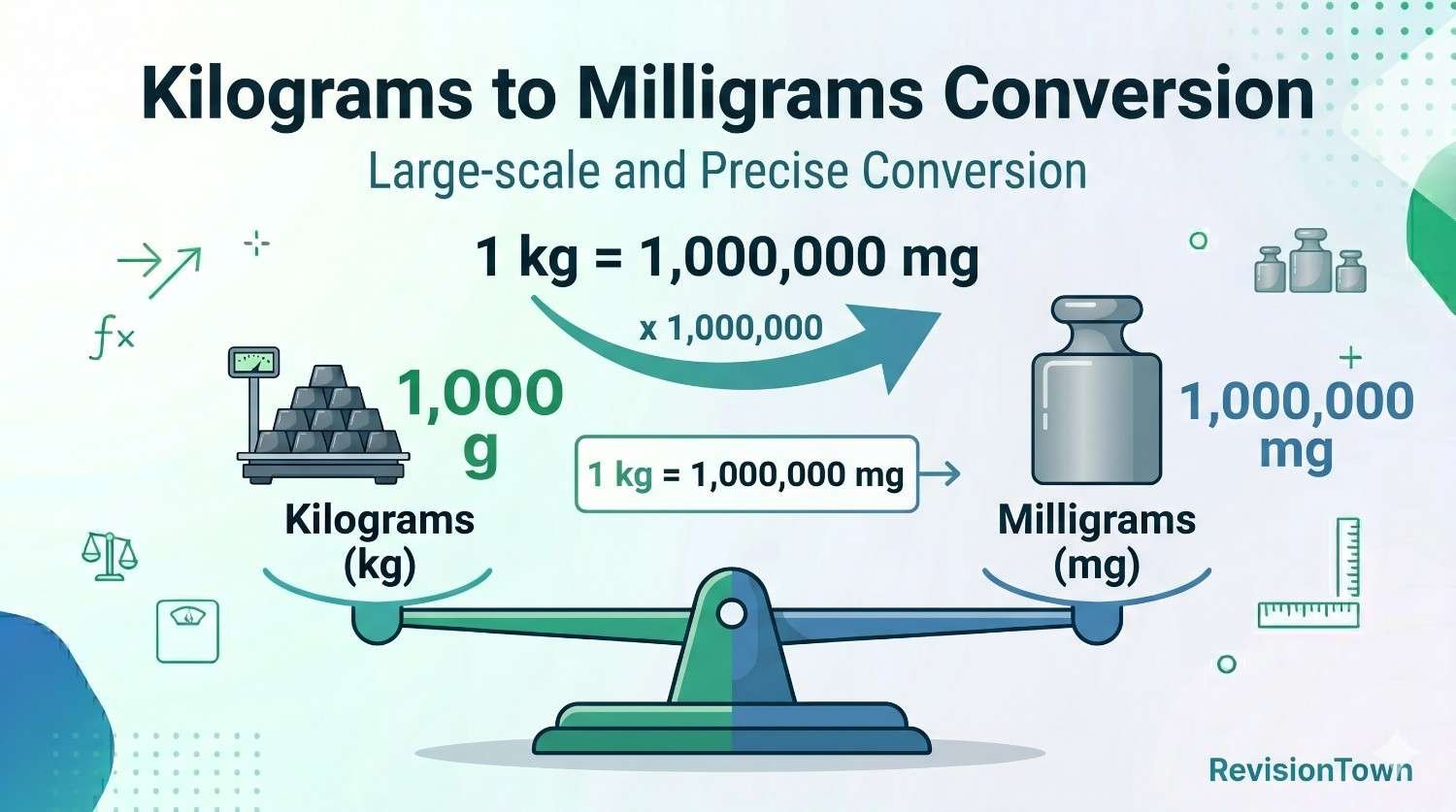
1 kg = 1,000,000 mg
Quick Conversion Reference
Understanding Kilograms and Milligrams
Kilograms and milligrams represent opposite ends of the metric mass spectrum commonly used in everyday measurements. The kilogram is the base unit of mass in the International System of Units (SI), while the milligram is one-millionth of a kilogram, used for measuring extremely small masses with precision. Understanding the relationship between these units is essential in fields ranging from medicine and pharmacology to cooking and scientific research.
• Kilogram (kg): The SI base unit of mass, defined by the Planck constant since 2019. One kilogram equals the mass of approximately one liter of water.
• Milligram (mg): One-thousandth of a gram, or one-millionth of a kilogram. Used for precise measurements of small quantities.
The prefix "milli" comes from the Latin word "mille," meaning one thousand. In the metric system, "milli" indicates one-thousandth (1/1000) of the base unit. Since a gram is already 1/1000 of a kilogram, a milligram is 1/1000 of a gram, making it 1/1,000,000 of a kilogram. This decimal relationship makes conversions straightforward once you understand the pattern.
Conversion Formula Explained
Converting between kilograms and milligrams involves multiplying or dividing by one million (1,000,000 or 10⁶). This large conversion factor reflects the substantial size difference between these two units.
Kilograms to Milligrams Formula
To convert kilograms to milligrams, multiply the kilogram value by 1,000,000 (one million). This is equivalent to moving the decimal point six places to the right. The large multiplier reflects how many tiny milligrams are contained in a single kilogram.
Alternative Expression
Milligrams to Kilograms Formula
To convert milligrams to kilograms, divide the milligram value by 1,000,000. This is the same as moving the decimal point six places to the left. The small result reflects how a large number of milligrams equals relatively few kilograms.
1 kg = 1,000 g (kilograms to grams)
1 g = 1,000 mg (grams to milligrams)
Therefore: 1 kg = 1,000 × 1,000 = 1,000,000 mg
Step-by-Step Conversion Guide
How to Convert Kilograms to Milligrams
- Identify the Kilogram Value: Determine the mass in kilograms you need to convert.
- Multiply by 1,000,000: Take the kilogram value and multiply by one million.
- Result in Milligrams: The product is the equivalent mass in milligrams.
- Verify Your Answer: Check that the milligram value is much larger than the kilogram value.
Practical Example 1: Converting 2.5 kg to Milligrams
Formula: mg = kg × 1,000,000
Calculation: 2.5 × 1,000,000 = 2,500,000
Result: 2.5 kg = 2,500,000 mg
How to Convert Milligrams to Kilograms
- Identify the Milligram Value: Determine the mass in milligrams you need to convert.
- Divide by 1,000,000: Take the milligram value and divide by one million.
- Result in Kilograms: The quotient is the equivalent mass in kilograms.
- Verify Your Answer: Check that the kilogram value is much smaller than the milligram value.
Practical Example 2: Converting 3,500,000 mg to Kilograms
Formula: kg = mg ÷ 1,000,000
Calculation: 3,500,000 ÷ 1,000,000 = 3.5
Result: 3,500,000 mg = 3.5 kg
Comprehensive Conversion Table
Use this detailed conversion table for quick reference when converting between kilograms and milligrams:
| Kilograms (kg) | Milligrams (mg) | Common Applications |
|---|---|---|
| 0.000001 kg | 1 mg | Grain of sand, vitamin tablet |
| 0.00001 kg | 10 mg | Small pharmaceutical dose |
| 0.0001 kg | 100 mg | Common medication dose |
| 0.001 kg | 1,000 mg (1 g) | Small paperclip, coin |
| 0.01 kg | 10,000 mg (10 g) | Two teaspoons of sugar |
| 0.1 kg | 100,000 mg (100 g) | Small apple, smartphone |
| 0.5 kg | 500,000 mg (500 g) | Loaf of bread |
| 1 kg | 1,000,000 mg | Liter of water, bag of flour |
| 2 kg | 2,000,000 mg | Small laptop, pineapple |
| 5 kg | 5,000,000 mg | Bag of potatoes, cat |
| 10 kg | 10,000,000 mg | Bowling ball, toddler |
Real-World Applications
The conversion between kilograms and milligrams is crucial in many specialized fields where precision matters:
Medical and Pharmaceutical Applications
- Drug Dosages: Medications are prescribed in milligrams (e.g., 500 mg antibiotics, 200 mg ibuprofen), but patient body weight is measured in kilograms for dosage calculations
- Intravenous Solutions: IV medications are measured in mg/kg (milligrams per kilogram of body weight) for precise administration
- Pediatric Medicine: Children's medication doses are calculated based on body weight in kilograms, with the medicine measured in milligrams
- Pharmacology Research: Drug studies measure compound quantities in milligrams while tracking subject weights in kilograms
- Vitamin and Supplement Labels: Daily recommended doses are listed in milligrams, while product weights may be in kilograms
Scientific Research and Laboratory Work
- Chemistry Experiments: Reagents and compounds measured in milligrams for precision, while bulk materials use kilograms
- Biology and Microbiology: Cell cultures, DNA samples, and biological specimens measured in milligrams
- Materials Science: Testing material properties requires precise milligram measurements
- Environmental Science: Pollutant concentrations measured in mg/kg (parts per million by mass)
- Quality Control: Manufacturing tolerances specified in milligrams for precision components
Nutrition and Dietetics
- Micronutrient Tracking: Vitamins and minerals measured in milligrams (Vitamin C, calcium, iron)
- Food Additives: Preservatives and fortifications listed in mg per serving
- Dietary Supplements: Recommended daily intakes specified in milligrams
- Nutrition Labels: Sodium, potassium, and other minerals shown in milligrams
- Sports Nutrition: Pre-workout supplements and amino acids measured in milligrams
Industrial and Manufacturing
- Jewelry Making: Precious metal alloys measured to milligram precision
- Electronics Manufacturing: Component weights and material deposits measured in milligrams
- Chemical Production: Catalyst quantities and additives measured in milligrams
- Quality Assurance: Product specifications include milligram-level tolerances
Understanding Metric Mass Units Hierarchy
The metric system organizes mass units in a logical, decimal-based hierarchy. Understanding this structure helps with all metric conversions:
| Unit | Symbol | Relation to Kilogram | Scientific Notation |
|---|---|---|---|
| Milligram | mg | 0.000001 kg | 10⁻⁶ kg |
| Centigram | cg | 0.00001 kg | 10⁻⁵ kg |
| Decigram | dg | 0.0001 kg | 10⁻⁴ kg |
| Gram | g | 0.001 kg | 10⁻³ kg |
| Kilogram | kg | 1 kg (base unit) | 10⁰ kg |
| Tonne | t | 1,000 kg | 10³ kg |
• Milli- = 1/1,000 (one thousandth)
• Centi- = 1/100 (one hundredth)
• Deci- = 1/10 (one tenth)
• Kilo- = 1,000 (one thousand)
Common Conversion Mistakes to Avoid
- Decimal Point Errors: Moving the decimal 3 places instead of 6 places. Remember: kg to mg requires 6 places RIGHT (not 3)
- Confusing with Grams: Don't confuse mg with g. There are 1,000 g in a kg, but 1,000,000 mg in a kg
- Calculator Input Mistakes: When entering 1,000,000, make sure to count all six zeros correctly
- Rounding Too Early: Keep full precision during calculations; round only the final answer
- Unit Label Omission: Always include units (kg or mg) with your answer to prevent confusion
- Scientific Notation Errors: 10⁶ means 1,000,000, not 10,000 or 100,000
- Direction Confusion: Remember: kg to mg = multiply (larger number), mg to kg = divide (smaller number)
Tips for Accurate Conversions
- Remember the Million Rule: Always think "1 kg = 1 million mg" as your anchor reference
- Use Scientific Notation: For large numbers, write 10⁶ or 1×10⁶ to avoid counting zeros
- Break Down the Conversion: kg → g (×1000) → mg (×1000) = total ×1,000,000
- Check Order of Magnitude: Milligrams should be 6 digits longer than kilograms (e.g., 1 kg = 1,000,000 mg has 6 more digits)
- Use Online Calculators: For critical applications like medication dosing, use reliable tools like this calculator
- Practice with Common Values: Memorize key conversions (1 kg = 1M mg, 0.1 kg = 100,000 mg)
- Double-Check Medical Calculations: In healthcare settings, always have a second person verify dosage conversions
- Understand Context: Recognize when milligrams are appropriate (medication) vs. kilograms (body weight)
Milligram Measurements in Medicine
In medical practice, understanding kg to mg conversions is literally life-saving. Healthcare professionals use these conversions daily:
Weight-Based Dosing
Many medications are dosed based on patient weight, using the formula:
Example: A 70 kg patient requires a medication dosed at 5 mg/kg:
Common Medication Dosages
- Acetaminophen (Paracetamol): 325-1000 mg per dose
- Ibuprofen: 200-800 mg per dose
- Amoxicillin: 250-500 mg per dose
- Aspirin: 75-325 mg daily for prevention
- Vitamin C: 500-1000 mg daily supplement
Frequently Asked Questions
How many milligrams are in one kilogram?
There are exactly 1,000,000 (one million) milligrams in one kilogram. This is because 1 kg = 1,000 grams, and 1 gram = 1,000 milligrams. Therefore: 1 kg = 1,000 × 1,000 = 1,000,000 mg. This relationship is constant and forms the basis of all kg to mg conversions.
How do I convert 3 kg to milligrams?
To convert 3 kg to milligrams, multiply 3 by 1,000,000. The calculation is: 3 × 1,000,000 = 3,000,000 milligrams. You can also move the decimal point six places to the right: 3.0 kg becomes 3,000,000 mg.
Is 500,000 mg equal to 0.5 kg?
Yes, 500,000 milligrams equals exactly 0.5 kilograms (half a kilogram). To convert: 500,000 ÷ 1,000,000 = 0.5 kg. This is equivalent to 500 grams.
Why is the conversion factor so large between kg and mg?
The large conversion factor (1 million) reflects the enormous size difference between these units. A kilogram is designed to measure substantial masses (water liters, body weight), while milligrams measure tiny quantities (medication doses, chemical samples). The factor of 1 million allows both units to exist in the same metric system while serving very different practical purposes.
How do I convert milligrams to kilograms?
To convert milligrams to kilograms, divide the number of milligrams by 1,000,000. For example: 2,500,000 mg ÷ 1,000,000 = 2.5 kg. Alternatively, move the decimal point six places to the left.
What is the difference between mg and mcg?
Milligram (mg) and microgram (mcg or μg) are different units. 1 milligram = 1,000 micrograms. A microgram is even smaller than a milligram. The confusion between these units in medical contexts can be dangerous, which is why many healthcare systems avoid abbreviating microgram as "mcg" to prevent errors.
How are kg to mg conversions used in medicine?
In medicine, patient weight is recorded in kilograms while medication doses are measured in milligrams. Doctors calculate weight-based dosing using formulas like "10 mg per kg of body weight," requiring conversion between these units. For example, a 60 kg patient receiving 10 mg/kg would get 600 mg of medication.
Can I use shortcuts to convert kg to mg?
Yes, several shortcuts exist: (1) Add six zeros to whole kilograms (5 kg = 5,000,000 mg). (2) Multiply by 1 million using a calculator. (3) Convert kg→g (×1000) then g→mg (×1000). For decimal kilograms, multiplication is most reliable to avoid errors.
What are practical examples of milligram quantities?
Common milligram quantities include: vitamin tablets (500-1000 mg vitamin C), pain relievers (200-500 mg ibuprofen), antibiotics (250-500 mg amoxicillin), food additives (sodium content on labels), and precious metal measurements in jewelry. These small quantities require the precision that milligrams provide.
Historical Context and Standardization
The milligram, like all metric units, emerged from the need for a universal, rational measurement system. The French Revolution (1789-1799) catalyzed the development of the metric system, with the gram defined as the mass of one cubic centimeter of water at 4°C.
The milligram, as one-thousandth of a gram, naturally followed from this definition. As scientific and medical practices advanced in the 19th and 20th centuries, the need for precise measurements of small quantities became critical. The milligram proved ideal for pharmaceutical applications, where precision could mean the difference between therapeutic effect and toxicity.
Today, the International Bureau of Weights and Measures (BIPM) maintains the standards for all metric units. The 2019 redefinition of the kilogram based on the Planck constant ensures that all derived units, including the milligram, have stable, reproducible definitions grounded in fundamental physics rather than physical artifacts.
In medical practice, international standards bodies like the World Health Organization (WHO) and national agencies like the FDA regulate how medications are measured, labeled, and administered. The universal adoption of milligrams for medication dosing exemplifies the metric system's success in creating global standards that protect public health.