
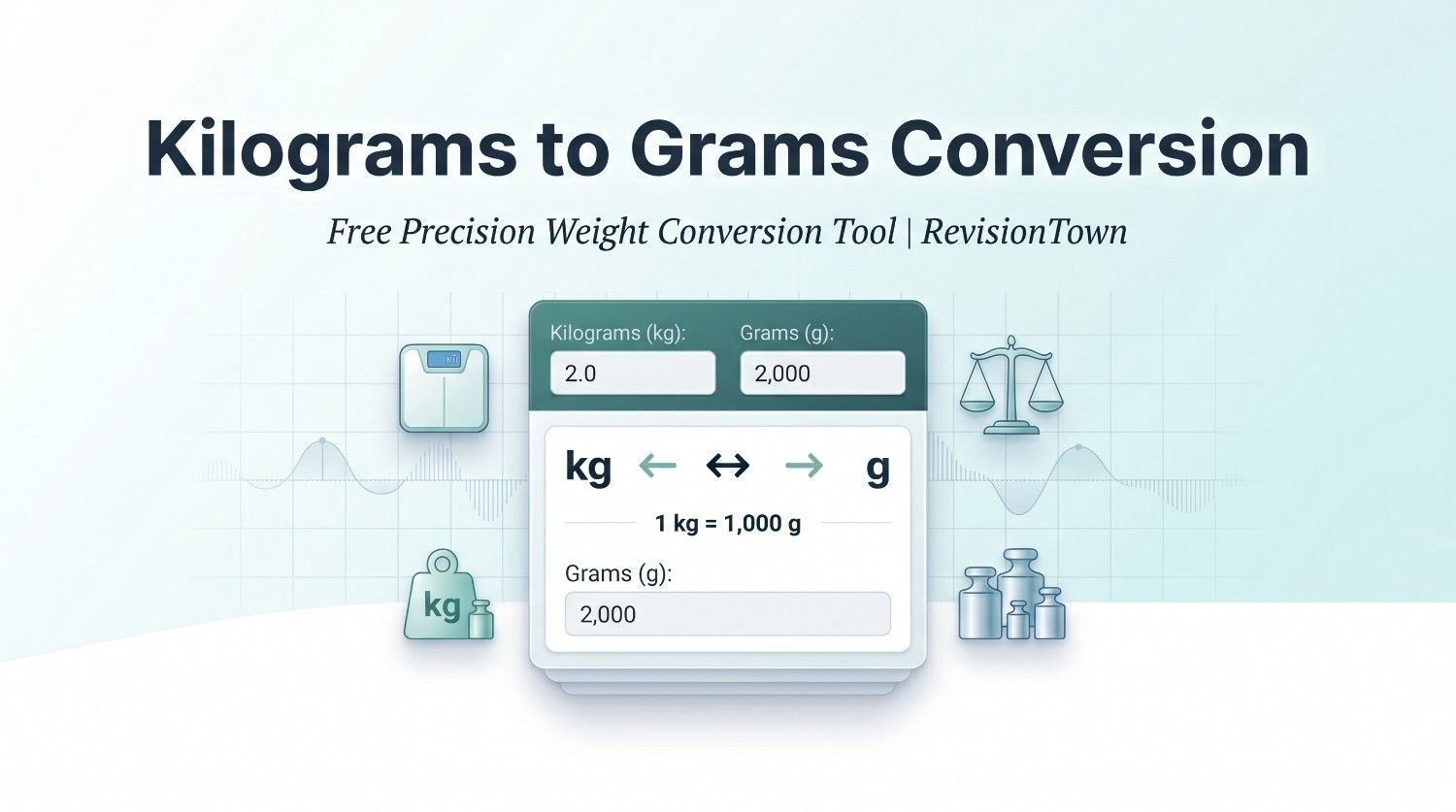
Kilograms to Grams Converter
Convert between kilograms (kg) and grams (g) instantly
Conversion Result:
1 kg = 1000 g
Quick Conversion Reference
Understanding Kilograms and Grams
Kilograms and grams are fundamental units of mass in the metric system, also known as the International System of Units (SI). The gram serves as the base unit of mass, while the kilogram is defined as 1000 grams. Both units are widely used across the globe for measuring weight in everyday life, scientific research, commerce, and industrial applications.
• Kilogram (kg): The base unit of mass in the SI system, originally defined as the mass of one liter of water at 4°C. Since 2019, it is defined by the Planck constant.
• Gram (g): One-thousandth of a kilogram, commonly used for measuring lighter objects and ingredients.
The metric system was developed during the French Revolution in the late 18th century to create a universal, decimal-based measurement system. The kilogram was officially adopted in 1795, making it one of the oldest standardized units still in use today. The beauty of the metric system lies in its simplicity: all conversions are based on powers of 10, making calculations straightforward and intuitive.
Conversion Formula Explained
Converting between kilograms and grams is one of the simplest metric conversions because it follows a straightforward decimal relationship.
Kilograms to Grams Formula
Since 1 kilogram equals 1000 grams, to convert kilograms to grams, you simply multiply the kilogram value by 1000. This is equivalent to moving the decimal point three places to the right.
Grams to Kilograms Formula
Conversely, to convert grams to kilograms, divide the gram value by 1000, which is the same as moving the decimal point three places to the left.
Step-by-Step Conversion Guide
How to Convert Kilograms to Grams
- Identify the Kilogram Value: Determine the weight in kilograms that you want to convert.
- Multiply by 1000: Take the kilogram value and multiply it by 1000.
- Result in Grams: The answer you get is the equivalent weight in grams.
Practical Example 1: Converting 3.5 kg to Grams
Formula: g = kg × 1000
Calculation: 3.5 × 1000 = 3500
Result: 3.5 kg = 3500 g
How to Convert Grams to Kilograms
- Identify the Gram Value: Determine the weight in grams that you want to convert.
- Divide by 1000: Take the gram value and divide it by 1000.
- Result in Kilograms: The answer you get is the equivalent weight in kilograms.
Practical Example 2: Converting 2500 g to Kilograms
Formula: kg = g ÷ 1000
Calculation: 2500 ÷ 1000 = 2.5
Result: 2500 g = 2.5 kg
Comprehensive Conversion Table
Use this detailed conversion table for quick reference when converting between kilograms and grams:
| Kilograms (kg) | Grams (g) | Common Use |
|---|---|---|
| 0.001 kg | 1 g | Single paperclip, small coin |
| 0.01 kg | 10 g | Two teaspoons of sugar |
| 0.05 kg | 50 g | Large egg |
| 0.1 kg | 100 g | Small apple, deck of cards |
| 0.25 kg | 250 g | Cup of flour, stick of butter |
| 0.5 kg | 500 g | Loaf of bread, package of pasta |
| 0.75 kg | 750 g | Standard wine bottle contents |
| 1 kg | 1000 g | Liter of water, bag of sugar |
| 2 kg | 2000 g | Large pineapple, small laptop |
| 5 kg | 5000 g | Bag of rice, newborn baby |
| 10 kg | 10,000 g | Bowling ball, toddler |
| 50 kg | 50,000 g | Average adult weight |
| 100 kg | 100,000 g | Large adult, heavy furniture |
Real-World Applications
Understanding how to convert between kilograms and grams is essential in numerous practical situations:
Cooking and Baking
- Recipe Conversions: Many European and international recipes list ingredients in grams for precision, while some use kilograms for bulk quantities
- Ingredient Measurement: Professional bakers measure flour, sugar, and other ingredients in grams for consistent results
- Portion Control: Nutritionists and dietitians use gram measurements for accurate portion sizes
- Food Packaging: Products may list weights in both kilograms and grams (e.g., 1.5 kg = 1500 g)
Scientific and Medical Applications
- Laboratory Measurements: Chemists measure reagents and compounds in grams for precise experiments
- Pharmaceutical Dosages: Medication doses are often measured in milligrams, requiring conversion from grams
- Medical Records: Patient weights are recorded in kilograms, but some measurements require gram precision
- Research Data: Scientific studies use both units depending on the scale of measurement
Commerce and Trade
- Food Markets: Fresh produce, meat, and cheese are sold by weight in kilograms or grams
- Jewelry and Precious Metals: Gold, silver, and gemstones are measured in grams
- Postal Services: Package weights determine shipping costs, measured in kilograms or grams
- Manufacturing: Industrial processes require precise weight measurements for quality control
Fitness and Sports
- Body Weight Tracking: Athletes monitor weight in kilograms and track changes
- Nutrition Planning: Macronutrient intake (protein, carbs, fats) is measured in grams
- Equipment Specifications: Sports equipment weights are listed in kilograms
- Performance Metrics: Strength training uses kilogram measurements for weights lifted
Understanding the Metric System
The metric system is a decimal-based system of measurement used worldwide. It's built on base units that can be modified using prefixes to represent larger or smaller quantities. For mass, the gram is the base unit.
Common Metric Mass Units
| Unit | Symbol | Relation to Gram | Decimal Value |
|---|---|---|---|
| Milligram | mg | 1/1000 gram | 0.001 g |
| Gram | g | Base unit | 1 g |
| Kilogram | kg | 1000 grams | 1000 g |
| Tonne (Metric Ton) | t | 1,000,000 grams | 1,000,000 g |
Common Conversion Mistakes to Avoid
- Moving Decimal Point Incorrectly: Remember, kg to g means moving the decimal three places RIGHT (multiply by 1000), while g to kg means moving it three places LEFT (divide by 1000)
- Confusing Direction: Always check whether you're converting to a larger unit (divide) or smaller unit (multiply)
- Rounding Too Early: Keep all decimal places during calculations and round only at the end for accuracy
- Unit Confusion: Make sure you're clear about which unit is which before starting the conversion
- Calculator Errors: Double-check your calculator entries, especially when dealing with decimal points
- Mixing Systems: Don't mix metric and imperial units (pounds, ounces) without proper conversion
Tips for Easy Conversions
- Use the "Kilo" Clue: Remember that "kilo" always means 1000, making the conversion straightforward
- Decimal Point Rule: For kg to g, move decimal 3 places right. For g to kg, move 3 places left
- Mental Math Shortcuts: For simple conversions, add three zeros (kg to g) or remove three zeros (g to kg)
- Use Online Calculators: For complex or precise conversions, use reliable online tools like this one
- Practice with Common Values: Memorize frequently used conversions (0.5 kg = 500 g, 1 kg = 1000 g, etc.)
- Check Your Work: Verify that your answer makes sense (grams should be a larger number than kilograms for the same weight)
- Keep Units Clear: Always write the unit symbol (kg or g) with your answer to avoid confusion
Frequently Asked Questions
How many grams are in one kilogram?
There are exactly 1000 grams in one kilogram. This is a fixed conversion factor in the metric system. The prefix "kilo" means 1000, so 1 kilogram = 1000 grams. This relationship is consistent and never changes, making it one of the easiest metric conversions to remember.
How do I convert 2.5 kg to grams?
To convert 2.5 kg to grams, multiply 2.5 by 1000. The calculation is: 2.5 × 1000 = 2500 grams. You can also think of it as moving the decimal point three places to the right: 2.5 kg becomes 2500 g.
Is 500 grams equal to 0.5 kilograms?
Yes, 500 grams is exactly equal to 0.5 kilograms. To convert grams to kilograms, divide by 1000: 500 ÷ 1000 = 0.5 kg. This is also known as half a kilogram and is a commonly used measurement in cooking and shopping.
Why do we use both kilograms and grams?
We use both units because they serve different purposes based on the scale of measurement. Kilograms are convenient for measuring heavier objects like body weight, luggage, or large quantities of food. Grams are better for lighter items or when precision is needed, such as in cooking, jewelry, or scientific experiments. Using the appropriate unit makes numbers easier to read and understand.
What is heavier: 1000 grams or 1 kilogram?
They are exactly the same weight. 1000 grams equals 1 kilogram. There is no difference between these measurements; they are simply two ways of expressing the same mass. This is a fundamental equality in the metric system.
How do I convert grams to kilograms?
To convert grams to kilograms, divide the number of grams by 1000. For example, 3500 grams ÷ 1000 = 3.5 kilograms. Alternatively, move the decimal point three places to the left. So 3500 g becomes 3.5 kg.
What are practical examples of 1 kilogram?
Common objects that weigh approximately 1 kilogram include: a liter (1000 ml) of water, a standard bag of sugar or flour, a large pineapple, two medium-sized apples, or a small laptop computer. These everyday examples help you estimate weights without a scale.
Can I convert kilograms to grams by adding zeros?
Yes, for whole number kilograms, you can simply add three zeros to convert to grams. For example, 5 kg = 5000 g (add three zeros). However, for decimal values like 3.7 kg, you need to multiply by 1000, which gives 3700 g. The "add zeros" method only works as a shortcut for whole numbers.
What is the difference between mass and weight?
Mass is the amount of matter in an object and is measured in kilograms or grams. Weight is the force of gravity acting on that mass and is technically measured in newtons. However, in everyday usage, people use kilograms and grams to express "weight" even though they're technically measuring mass. On Earth's surface, the distinction doesn't matter much for practical purposes.
Historical Background
The metric system, including the kilogram and gram, has a rich history dating back to the late 18th century. During the French Revolution, the need for a standardized, universal measurement system became apparent. The old system of measurements varied from region to region, causing confusion in trade and science.
In 1795, France officially adopted the metric system. The gram was originally defined as the mass of one cubic centimeter of water at 4°C (the temperature at which water has its maximum density). The kilogram was defined as 1000 grams, or the mass of one liter of water.
The International Prototype Kilogram (IPK), a platinum-iridium cylinder kept in France, served as the world's standard kilogram from 1889 to 2019. On May 20, 2019, the definition was updated to be based on the Planck constant, a fundamental constant of nature. This new definition ensures that the kilogram is now defined by an unchanging physical constant rather than a physical object, providing greater long-term stability and precision.
Today, the metric system is used by nearly every country in the world, with the United States being one of the few exceptions that primarily uses the imperial system (though metric units are used in science, medicine, and military applications).