⚡ Gigawatts to Watts Converter
Professional Power Plant & Grid Capacity Calculator
📊 Power Plant Capacity Examples
📚 Complete Guide to Gigawatts and Watts
Understanding Gigawatts and Watts
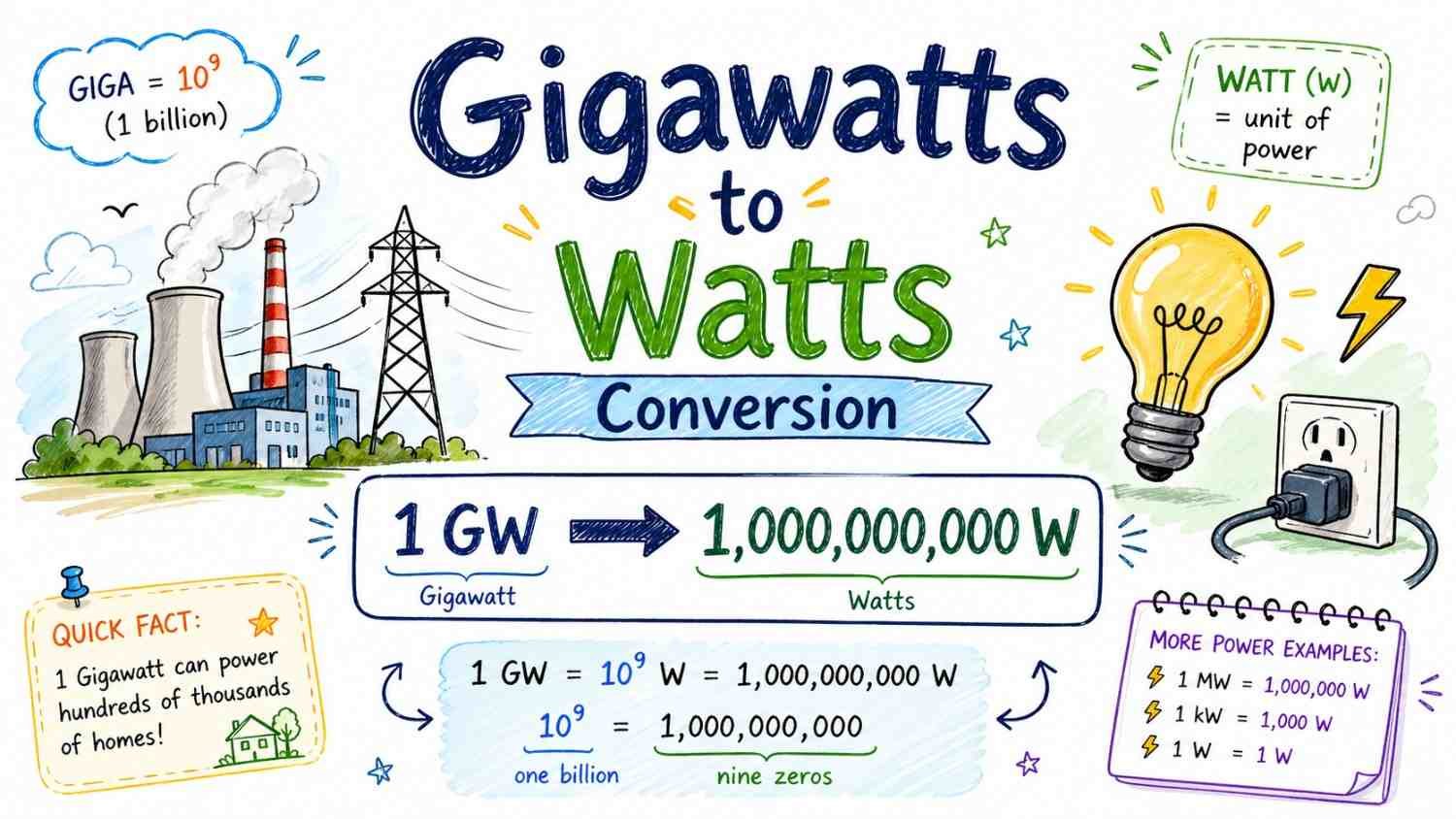
A gigawatt (GW) is a unit of power equal to one billion watts (1,000,000,000 watts or \(1 \times 10^9\) watts), used exclusively to measure large-scale electrical power generation and consumption. The prefix "giga-" in the International System of Units (SI) represents a factor of \(10^9\) or one billion. Gigawatts are the standard measurement for power plant capacity, electrical grid specifications, national energy statistics, and large renewable energy projects where smaller units like megawatts or kilowatts would produce unwieldy numbers. For context, one gigawatt can power approximately 700,000 to 1,000,000 typical homes simultaneously, depending on regional electricity consumption patterns. A watt (W), named after Scottish inventor James Watt, is the SI base unit of power representing one joule per second—the rate of energy transfer or conversion. The exact and universally standardized conversion: 1 gigawatt = 1,000,000,000 watts = 1,000 megawatts = 1,000,000 kilowatts. Understanding this conversion is essential for power plant engineers specifying generation capacity, utility planners forecasting regional electricity demand, energy policy analysts comparing national generation portfolios, renewable energy developers sizing solar and wind farms, electrical grid operators managing transmission capacity, and anyone analyzing large-scale electricity generation, distribution, and consumption across residential, commercial, and industrial sectors worldwide.
Conversion Formulas
Gigawatts to Watts: \( P_{\text{W}} = P_{\text{GW}} \times 1{,}000{,}000{,}000 \) or \( P_{\text{W}} = P_{\text{GW}} \times 10^9 \). Simply multiply the gigawatt value by one billion. This is straightforward multiplication, not logarithmic conversion. Examples: 1 GW × 1,000,000,000 = 1,000,000,000 W; 2 GW × 1,000,000,000 = 2,000,000,000 W; 0.5 GW × 1,000,000,000 = 500,000,000 W; 1.6 GW × 1,000,000,000 = 1,600,000,000 W; 3.5 GW × 1,000,000,000 = 3,500,000,000 W; 10 GW × 1,000,000,000 = 10,000,000,000 W. Watts to Gigawatts: \( P_{\text{GW}} = \frac{P_{\text{W}}}{1{,}000{,}000{,}000} \) or \( P_{\text{GW}} = P_{\text{W}} \times 10^{-9} \). Divide the watt value by one billion. Examples: 1,000,000,000 W ÷ 1,000,000,000 = 1 GW; 2,000,000,000 W ÷ 1,000,000,000 = 2 GW; 500,000,000 W ÷ 1,000,000,000 = 0.5 GW; 100,000,000 W ÷ 1,000,000,000 = 0.1 GW; 5,000,000,000 W ÷ 1,000,000,000 = 5 GW. These conversions enable translation between the massive watt numbers generated by power plants and the more manageable gigawatt figures used in utility planning, energy policy, and international electricity generation comparisons.
Power Plant Capacity Comparison
| Power Plant Type | Gigawatts (GW) | Watts (W) | Typical Capacity Range |
|---|---|---|---|
| Nuclear (Single Reactor) | 1.0 - 1.6 GW | 1,000,000,000 - 1,600,000,000 W | US average ~1 GW per reactor |
| Coal Plant (Large) | 0.5 - 3.0 GW | 500,000,000 - 3,000,000,000 W | Multiple units 500-800 MW each |
| Natural Gas Combined Cycle | 0.5 - 1.5 GW | 500,000,000 - 1,500,000,000 W | Highly efficient baseload |
| Hydroelectric (Large Dam) | 1.0 - 22.5 GW | 1,000,000,000 - 22,500,000,000 W | Three Gorges Dam 22.5 GW largest |
| Solar Farm (Utility-Scale) | 0.05 - 2.0 GW | 50,000,000 - 2,000,000,000 W | Bhadla Solar Park 2.25 GW |
| Wind Farm | 0.05 - 1.5 GW | 50,000,000 - 1,500,000,000 W | Offshore farms up to 1.2 GW |
| Geothermal | 0.01 - 1.5 GW | 10,000,000 - 1,500,000,000 W | Geysers Geothermal 1.5 GW |
| Pumped Storage | 0.3 - 3.0 GW | 300,000,000 - 3,000,000,000 W | Grid-scale energy storage |
Nuclear Power Plant Capacity
Nuclear power plants represent the largest single-unit electricity generators, typically rated in gigawatts. US Nuclear Reactors: Average commercial reactor produces 1.0 GW (1,000,000,000 watts) electrical output. Modern designs like AP1000 generate 1.1 GW; larger units reach 1.6 GW. Multi-unit plants: Palo Verde (Arizona) has 3 reactors totaling 3.9 GW; Browns Ferry (Alabama) has 3 reactors totaling 3.3 GW. International Comparison: France's Cattenom plant: 5.2 GW (4 reactors); Japan's Kashiwazaki-Kariwa: 8.2 GW (7 reactors, world's largest by capacity); Canada's Bruce Nuclear: 6.4 GW (8 reactors). Power Output: 1 GW nuclear plant operating 24/7 at 90% capacity factor produces 7.9 billion kWh annually, powering approximately 750,000 average US homes year-round. Nuclear plants provide baseload power—continuous, reliable output 24/7 regardless of weather, making gigawatt-scale generation economical. Understanding nuclear capacity in both GW and watts enables comparison with other generation sources, grid integration planning, and electricity market analysis where nuclear provides 20% of US electricity from just 93 reactors totaling 95 GW installed capacity.
Renewable Energy Project Scale
Renewable energy projects increasingly reach gigawatt scale as technology advances and costs decline. Solar Farms: Bhadla Solar Park (India): 2.25 GW (2,250,000,000 watts) across 14,000 acres—world's largest operational solar facility. Tengger Desert Solar Park (China): 1.5 GW. Noor Abu Dhabi (UAE): 1.2 GW. These require 5-10 acres per MW, so 1 GW solar farm occupies 5,000-10,000 acres. Capacity factor 15-25% means 1 GW solar generates like 0.15-0.25 GW baseload plant. Wind Farms: Gansu Wind Farm (China): 8 GW planned capacity (largest). Jiuquan Wind Power Base: 6 GW. Alta Wind Energy Center (California): 1.5 GW. Offshore wind: Dogger Bank (UK): 3.6 GW under construction. London Array: 0.63 GW operational. Wind capacity factors 25-45% (offshore higher), so 1 GW wind ≈ 0.3 GW baseload equivalent. Project Economics: 1 GW solar farm costs $800 million-$1.5 billion; 1 GW onshore wind costs $1-2 billion; 1 GW offshore wind costs $3-4 billion. Understanding these gigawatt-scale projects and converting to watts enables comparison with fossil generation, grid integration analysis, and investment planning as renewable energy reaches utility-scale deployment worldwide.
Electrical Grid Capacity and Peak Demand
Electrical grids operate at gigawatt scales, with capacity and demand measured in GW to manage regional electricity supply. US Regional Grids: Texas ERCOT grid: 85 GW installed capacity, 75 GW peak summer demand. California ISO: 60 GW capacity, 50 GW peak demand. PJM Interconnection (Mid-Atlantic): 185 GW capacity, 165 GW peak demand. New York ISO: 42 GW capacity, 35 GW peak demand. National Grids: United States total: 1,200 GW (1.2 TW) installed capacity; China: 2,200 GW; European Union: 1,000 GW; India: 400 GW; Japan: 280 GW. Peak vs. Average: Peak demand occurs during summer afternoons (air conditioning) or winter evenings (heating). US peak demand ~750 GW; average demand ~450 GW. Grids maintain 15-20% reserve margin: if peak demand = 100 GW, installed capacity = 115-120 GW ensures reliability during generator outages or transmission constraints. Grid Planning: Converting between GW and watts enables planners to: size new generation (adding 5 GW solar farm = 5,000,000,000 watts instantaneous capacity); forecast demand growth (3% annual growth on 100 GW grid = 3 GW new capacity needed yearly); analyze intermittent renewables (20 GW wind at 35% capacity factor = 7 GW average contribution). Understanding gigawatt-scale grid operations is essential for utility planning, energy policy, and ensuring reliable electricity supply.
How Many Homes Can Gigawatts Power?
One gigawatt powers hundreds of thousands to millions of homes, depending on regional consumption patterns. US Calculation: Average US home consumes 10,600 kWh/year = 1.21 kW average continuous power (10,600 kWh ÷ 8,760 hours/year). Accounting for losses and reserve margins, 1 GW (1,000,000,000 W) ÷ 1,500 W per home = 667,000 homes. Peak demand is higher: homes draw 3-5 kW during air conditioning, so 1 GW serves fewer homes at peak (250,000-330,000). International Comparison: European homes average 0.5-1 kW continuous, so 1 GW powers 1-2 million European homes. Developing nations with lower consumption: 1 GW serves 2-5 million homes. Practical Examples: Palo Verde Nuclear (3.9 GW) powers ~2.6 million homes year-round. Hoover Dam (2 GW) powers ~1.3 million homes. Typical 1 GW coal plant powers ~700,000 US homes. Capacity Factor Impact: 1 GW nuclear at 90% capacity factor generates 1 GW × 0.9 × 8,760 hours = 7.9 billion kWh/year. 1 GW solar at 20% capacity factor generates 1.75 billion kWh/year (22% as much). Understanding these relationships helps evaluate power plant proposals, energy policy debates, and electricity generation adequacy—translating abstract gigawatts into tangible residential service enables public understanding of energy infrastructure decisions.
Data Center and Industrial Power Consumption
Major industrial facilities and data centers consume megawatt to gigawatt-scale power, approaching small power plant outputs. Hyperscale Data Centers: Large cloud computing facilities consume 50-150 MW (0.05-0.15 GW or 50,000,000-150,000,000 watts) continuously. Microsoft, Google, Amazon, Facebook operate facilities drawing 100+ MW each. Projected future hyperscale data centers may reach 1 GW (1,000,000,000 watts) as AI computing demands escalate. Industrial Manufacturing: Aluminum smelters consume 200-400 MW (0.2-0.4 GW) for electrolysis. Steel mills: 100-300 MW. Chemical plants: 50-200 MW. Semiconductor fabs: 50-100 MW. Cryptocurrency Mining: Large bitcoin mining operations consume 50-100 MW. Global bitcoin network estimated 10-20 GW continuous draw. Electrical Infrastructure: These facilities require dedicated substations, often directly connected to transmission lines. A 100 MW data center at $0.05/kWh pays $4.4 million monthly electricity cost (100,000 kW × 24 hours × 30 days × $0.05). Converting between watts and gigawatts helps utilities plan industrial service, evaluate economic development proposals (1 GW data center = huge electricity demand), and analyze energy consumption trends as computing, manufacturing, and emerging technologies drive industrial electricity demand growth.
Energy Storage at Gigawatt Scale
Grid-scale energy storage systems increasingly reach gigawatt power ratings for renewable integration and grid stability. Pumped Hydroelectric Storage: Bath County (Virginia): 3 GW (3,000,000,000 watts) power rating, 24 GWh storage—largest battery in the US. Operates by pumping water uphill during low demand (charging), releasing through turbines during high demand (discharging). Ludington (Michigan): 1.9 GW. Raccoon Mountain (Tennessee): 1.7 GW. Battery Energy Storage Systems (BESS): Moss Landing (California): 750 MW (0.75 GW) lithium-ion battery—world's largest. Hornsdale (Australia): 150 MW (0.15 GW) made famous by Tesla/Elon Musk. Rapidly growing: 5 GW US battery storage online 2023, 30 GW projected by 2030. Power vs. Energy: Storage systems specify power (GW or MW—discharge rate) and energy (GWh or MWh—total storage). 1 GW battery with 4-hour duration stores 4 GWh energy (1 GW × 4 hours). Grid Applications: Gigawatt-scale storage enables renewable integration (storing excess solar during day for evening peak), grid frequency regulation (responding within milliseconds to maintain 60 Hz), and transmission deferral (avoiding expensive grid upgrades). Converting between watts and gigawatts helps planners size storage systems, evaluate economic viability, and integrate intermittent renewables at scale necessary for decarbonization targets.
Why Choose RevisionTown's GW to Watts Converter?
RevisionTown's professional gigawatts to watts converter provides: (1) Exact Precision—Uses the exact factor \(1 \times 10^9\) for perfect accuracy; (2) Bidirectional Conversion—Seamlessly convert GW↔watts with dedicated tabs; (3) Bulk Processing—Convert multiple power plant capacities simultaneously; (4) Quick Reference—Instant access to common utility-scale generation capacities; (5) Formula Transparency—View exact multiplication/division for educational purposes; (6) Mobile Optimized—Use on smartphones during utility planning, research, and analysis; (7) Zero Cost—Completely free with no registration or limitations; (8) Professional Accuracy—Trusted by power plant engineers, utility planners, energy policy analysts, renewable energy developers, grid operators, electrical engineers, academic researchers, and students for critical power conversions in power plant capacity specifications, electrical grid planning, renewable energy project sizing, national energy statistics, utility demand forecasting, generator specifications, transmission planning, and all large-scale electricity generation and distribution applications requiring exact translations between gigawatts and watts for professional energy sector work worldwide from single power plants to national electrical grids.
❓ Frequently Asked Questions
One gigawatt equals exactly 1,000,000,000 watts (one billion watts). Formula: 1 GW = \(1 \times 10^9\) W = 1,000,000,000 W. This is the standardized SI conversion. One gigawatt can power approximately 700,000-1,000,000 typical homes simultaneously, depending on regional electricity consumption patterns.
To convert gigawatts to watts, multiply by 1,000,000,000 (one billion). Formula: W = GW × 1,000,000,000 or W = GW × \(10^9\). Examples: 1 GW = 1,000,000,000 W; 2 GW = 2,000,000,000 W; 0.5 GW = 500,000,000 W; 3.5 GW = 3,500,000,000 W. This is straightforward multiplication by 1 billion.
One gigawatt (1,000,000,000 watts) can power approximately 700,000 to 1,000,000 homes simultaneously, depending on average home consumption. US homes average 1.2-1.5 kW continuous demand, so 1 GW ÷ 1,500 W = 666,667 homes. European homes averaging 0.5-1 kW allow 1-2 million homes per gigawatt. Actual numbers vary by region, season, and time of day based on air conditioning, heating, and other electrical loads.
To convert watts to gigawatts, divide by 1,000,000,000 (one billion). Formula: GW = W ÷ 1,000,000,000 or GW = W × \(10^{-9}\). Examples: 1,000,000,000 W = 1 GW; 2,000,000,000 W = 2 GW; 500,000,000 W = 0.5 GW; 100,000,000 W = 0.1 GW; 5,000,000,000 W = 5 GW.
Gigawatts (GW) measure power (rate of energy generation/consumption at an instant). Gigawatt-hours (GWh) measure energy (total amount over time). Relationship: Power × Time = Energy. A 1 GW plant running 1 hour generates 1 GWh energy. Running 24 hours generates 24 GWh. GW tells you capacity; GWh tells you total production or consumption. Example: 1 GW nuclear plant at 90% capacity factor produces 7.9 GWh daily (1 GW × 0.9 × 24 hours).
A 1 gigawatt power plant is massive: Nuclear: 1-1.6 GW typical (single reactor), occupies 1-2 square miles. Coal: 0.5-3 GW typical, requires 500-1,000 acres. Natural gas: 0.5-1.5 GW typical, more compact (100-300 acres). Solar farm: 0.1-2 GW, requires 5-10 acres per MW (5,000-10,000 acres for 1 GW). Wind farm: 0.05-1 GW, turbines spread over 50-100 square miles.
Common power plant capacities: Nuclear: 1-1.6 GW per reactor (US average 1 GW). Coal: 0.5-3 GW (large plants 2-3 GW). Natural gas combined cycle: 0.5-1.5 GW. Hydroelectric: 0.1-22 GW (Three Gorges Dam 22.5 GW largest). Solar farms: 0.05-2 GW (Bhadla Solar Park 2.25 GW). Wind farms: 0.05-1.5 GW (Gansu Wind Farm 8 GW planned capacity).
Power plants are measured in gigawatts because they generate enormous power levels where smaller units (megawatts, kilowatts) create unwieldy numbers. A typical nuclear plant at 1,000 MW is more clearly stated as 1 GW. National grids operate at 50-500 GW capacity. Using GW provides manageable numbers for utility-scale generation, grid planning, energy policy, and international comparisons, while watts remain appropriate for household and small commercial applications.