⚡ BTU/hr to Watts Converter
Professional Power Calculator | Thermal to Electrical Conversion Tool
📊 Common Power Conversions
📚 Complete Guide to BTU/hr and Watts Conversion
Understanding BTU per Hour and Watts
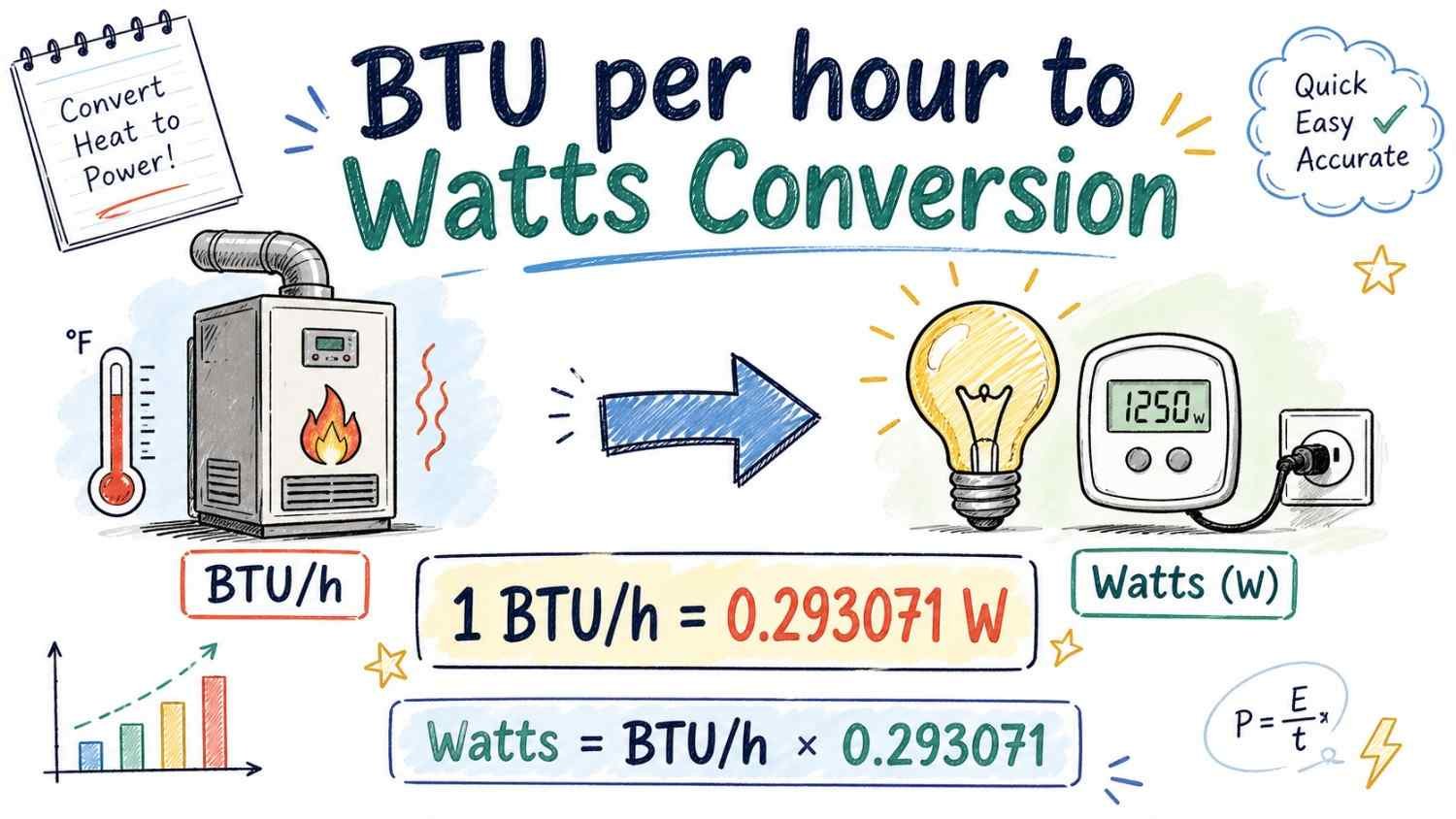
BTU per hour (BTU/hr or Btu/h) measures thermal power or the rate of heat energy transfer, commonly used in HVAC systems, air conditioners, heaters, furnaces, and refrigeration equipment throughout the United States. One British Thermal Unit represents the energy required to raise the temperature of one pound of water by one degree Fahrenheit at sea level. BTU per hour expresses this as a power measurement—how much energy transfers per unit time. Watts (W) are the International System of Units (SI) standard for measuring power, representing the rate of energy transfer used universally in electrical and mechanical systems worldwide. One watt equals one joule per second. The exact and internationally standardized conversion is: 1 BTU/hr = 0.293071 watts, which can also be expressed as: 1 watt = 3.412142 BTU/hr. This conversion is essential for comparing thermal heating/cooling equipment specifications with electrical power requirements, calculating total electrical loads for circuit breaker sizing, designing backup generator systems that must supply both HVAC and electrical loads, converting between US HVAC specifications and international electrical standards, and understanding the relationship between cooling capacity (measured in BTU/hr) and electrical power consumption (measured in watts) for energy efficiency analysis in residential, commercial, and industrial applications.
The Conversion Formula
To convert BTU/hr to watts: W = BTU/hr × 0.293071 or W = BTU/hr ÷ 3.412142. Both formulas produce identical results. Multiply your BTU/hr value by 0.293071 for exact watt conversion. Examples: 1,000 BTU/hr × 0.293071 = 293 W; 5,000 BTU/hr × 0.293071 = 1,465 W; 10,000 BTU/hr × 0.293071 = 2,931 W; 12,000 BTU/hr × 0.293071 = 3,517 W; 24,000 BTU/hr × 0.293071 = 7,032 W; 36,000 BTU/hr × 0.293071 = 10,551 W. To convert watts to BTU/hr: BTU/hr = W × 3.412142 or BTU/hr = W ÷ 0.293071. Multiply watts by 3.412142 for BTU/hr conversion. Examples: 500 W × 3.412142 = 1,706 BTU/hr; 1,000 W × 3.412142 = 3,412 BTU/hr; 1,500 W × 3.412142 = 5,118 BTU/hr; 2,000 W × 3.412142 = 6,824 BTU/hr; 3,000 W × 3.412142 = 10,237 BTU/hr. These conversions are fundamental for electricians sizing circuits and panels, HVAC technicians calculating power requirements, engineers designing building systems, homeowners evaluating appliance specifications, and facilities managers conducting energy audits requiring exact translations between thermal power (BTU/hr) and electrical power (watts) measurements for comprehensive load analysis, equipment comparisons, and energy efficiency calculations.
Common Conversions
| BTU per Hour | Watts (W) | Kilowatts (kW) | Typical Application |
|---|---|---|---|
| 500 BTU/hr | 147 W | 0.15 kW | Small space heater |
| 1,000 BTU/hr | 293 W | 0.29 kW | Portable heater |
| 3,000 BTU/hr | 879 W | 0.88 kW | Small room heater |
| 5,000 BTU/hr | 1,465 W | 1.47 kW | Window AC unit |
| 10,000 BTU/hr | 2,931 W | 2.93 kW | Medium AC unit |
| 12,000 BTU/hr | 3,517 W | 3.52 kW | 1-ton AC (cooling capacity) |
| 18,000 BTU/hr | 5,276 W | 5.28 kW | 1.5-ton AC/Mini-split |
| 24,000 BTU/hr | 7,032 W | 7.03 kW | 2-ton central AC |
| 36,000 BTU/hr | 10,551 W | 10.55 kW | 3-ton central AC |
| 48,000 BTU/hr | 14,068 W | 14.07 kW | 4-ton commercial unit |
Cooling Capacity vs Electrical Consumption
A critical distinction: BTU/hr measures cooling or heating capacity (thermal power output), while actual electrical power consumption in watts is typically much lower due to efficiency. Air Conditioner Example: A 12,000 BTU/hr (1-ton) window air conditioner has 3,517 watts cooling capacity but consumes only 1,000-1,200 watts electrical power (1.0-1.2 kW) depending on energy efficiency ratio (EER) or seasonal energy efficiency ratio (SEER). The difference reflects refrigeration cycle efficiency—heat pumps move heat rather than generate it, achieving 3:1 to 4:1 efficiency ratios. Electric Heater Comparison: Electric resistance heaters have 1:1 efficiency. A 1,500-watt electric heater produces exactly 5,118 BTU/hr heat output (1,500 W × 3.412 = 5,118 BTU/hr). Understanding this distinction prevents confusion when comparing equipment specifications, sizing electrical circuits (use electrical consumption watts, not capacity BTU/hr), and calculating operating costs (electricity bills based on watts consumed, not capacity BTU/hr).
Generator Sizing Applications
Converting BTU/hr to watts is essential for properly sizing backup generators that must power HVAC systems plus electrical loads. Total Load Calculation: Central air conditioning systems are rated in BTU/hr (cooling capacity) but require watts electrical power. A 36,000 BTU/hr (3-ton) central AC with 14 SEER consumes approximately 2,571 watts running power. Add other household loads: refrigerator (700W), lights (300W), electronics (200W), sump pump (800W) = 4,571 watts total running load. Account for startup surge (AC compressor draws 2-3× running current momentarily), requiring 8-10 kW generator capacity. Continuous vs Peak: Generators rated in watts (or kilowatts) must supply continuous running watts plus handle peak surge watts during equipment startup. HVAC equipment BTU/hr ratings don't indicate surge requirements—always check electrical specifications (running watts, locked rotor amps) separately from cooling capacity for accurate generator sizing ensuring backup power reliability during outages.
Circuit Breaker and Electrical Panel Planning
Electricians must convert HVAC BTU/hr capacity to electrical watts for proper circuit breaker sizing and panel load calculations. Dedicated AC Circuits: A 24,000 BTU/hr (2-ton) mini-split air conditioner requires a dedicated electrical circuit. With 12 SEER efficiency, it consumes approximately 2,000 watts running power (24,000 BTU ÷ 12 SEER). At 240 volts, this draws 8.33 amps running current (2,000W ÷ 240V = 8.33A). National Electrical Code requires 125% safety factor: 8.33A × 1.25 = 10.4 amps minimum circuit capacity. Use 15-amp circuit breaker with 14 AWG wire minimum, though 20-amp circuit with 12 AWG wire provides better margin for startup surge. Panel Load Calculation: Main electrical panels rated in amps must accommodate all connected loads. Convert all HVAC BTU/hr ratings to watts, add other electrical loads, then divide total watts by voltage to determine required panel ampacity ensuring adequate capacity prevents overloading and code violations.
Energy Efficiency Analysis
BTU/hr-watt conversions enable accurate energy efficiency comparisons and operating cost calculations. Efficiency Ratings: SEER (Seasonal Energy Efficiency Ratio) measures BTU/hr cooling per watt electrical input. A 12,000 BTU/hr air conditioner with 16 SEER consumes 750 watts (12,000 ÷ 16 = 750W). Higher SEER means less wattage for same cooling capacity. Comparing: 12,000 BTU/hr with 12 SEER uses 1,000W versus 16 SEER using 750W—250W difference saves money continuously. Operating Cost Calculation: Convert BTU/hr to watts, multiply by hours of operation and electricity rate. Example: 18,000 BTU/hr AC with 14 SEER runs 8 hours daily. Power consumption: 18,000 ÷ 14 = 1,286W. Daily energy: 1,286W × 8 hours = 10.3 kWh. At $0.13/kWh: 10.3 × $0.13 = $1.34 daily or $40.20 monthly. Accurate BTU/hr-watt conversion enables precise cost projections for equipment selection and budgeting.
Electric Heater Specifications
Electric resistance heaters provide straightforward BTU/hr-watt relationships due to 100% efficiency. Direct Conversion: Electric heaters convert electrical watts to heat BTU/hr at 1:1 efficiency. A 1,500-watt space heater produces 5,118 BTU/hr (1,500 × 3.412 = 5,118 BTU/hr). A 3,000-watt baseboard heater delivers 10,237 BTU/hr. Unlike heat pumps that achieve 3:1 efficiency, resistance heating directly converts electricity to heat, making watt-to-BTU/hr conversion essential for sizing heaters to room heat loss calculations. Heating Load Matching: Manual J load calculations determine room heat loss in BTU/hr. Convert to watts to select appropriate electric heater capacity. Room requiring 4,000 BTU/hr heating needs minimum 1,173-watt heater (4,000 ÷ 3.412 = 1,173W). Round up to available heater sizes—1,500W electric heater provides 5,118 BTU/hr, adequate margin for thermostat cycling and efficiency.
Quick Mental Conversion Tips
Simple Approximation: Remember that 3,400 BTU/hr ≈ 1,000 watts (exact: 3,412). Divide BTU/hr by 3.4 to estimate kilowatts quickly. Common Benchmarks: 1,000 BTU/hr ≈ 300 W; 5,000 BTU/hr ≈ 1,500 W; 10,000 BTU/hr ≈ 3,000 W; 12,000 BTU/hr ≈ 3,500 W (1 ton AC); 24,000 BTU/hr ≈ 7,000 W (2 tons). Reverse Approximation: Multiply watts by 3.4 to estimate BTU/hr. Example: 2,000W × 3.4 = 6,800 BTU/hr (exact: 6,824). Kilowatt Shortcut: For kilowatts, multiply by 3,412 directly. 5 kW × 3,412 = 17,061 BTU/hr. For precise engineering calculations, electrical specifications, load calculations, equipment selection, and energy cost analysis, always use exact conversion factors (0.293071 or 3.412142) rather than approximations to ensure accuracy in critical applications including circuit breaker sizing, generator selection, HVAC load calculations, and energy audits where even small errors compound in complex system designs.
Why Choose RevisionTown's Converter?
RevisionTown's advanced BTU/hr to Watts converter provides: (1) Exact Precision—Uses internationally standardized conversion factor 0.293071; (2) Bidirectional Conversion—Seamlessly convert BTU/hr↔W with dedicated tabs; (3) Bulk Processing—Convert multiple equipment specifications simultaneously; (4) Quick Reference—Instant access to common HVAC and electrical power ratings; (5) Formula Transparency—View exact mathematical conversions for verification; (6) Mobile Optimized—Use on smartphones at job sites, stores, and homes; (7) Zero Cost—Completely free with no registration; (8) Professional Accuracy—Trusted by electricians, HVAC technicians, engineers, energy auditors, and homeowners for critical power conversions in circuit breaker sizing, generator selection, HVAC specifications, energy efficiency calculations, load planning, equipment comparisons, and electrical system design requiring exact translations between thermal power (BTU/hr) and electrical power (watts) measurements for residential, commercial, and industrial applications worldwide.
❓ Frequently Asked Questions
One BTU per hour equals exactly 0.293071 watts. Formula: 1 BTU/hr = 0.293071 W. This is the internationally standardized conversion factor for power measurement between thermal (BTU/hr) and electrical (watts) systems used globally in engineering and HVAC applications.
Multiply by 0.293071 or divide by 3.412142. Formula: W = BTU/hr × 0.293071. Examples: 5,000 BTU/hr = 1,465 W; 10,000 BTU/hr = 2,931 W; 24,000 BTU/hr = 7,032 W. This conversion is essential for electrical specifications and HVAC power calculations.
12,000 BTU/hr equals 3,517 watts. Calculation: 12,000 × 0.293071 = 3,517 W or approximately 3.5 kW. This is the cooling capacity of a 1-ton air conditioner, though actual electrical power consumption is typically 1,000-1,200 watts depending on efficiency (SEER rating).
1,000 watts equals 3,412.142 BTU per hour. Calculation: 1,000 × 3.412142 = 3,412 BTU/hr. This conversion helps translate electrical power consumption to thermal output for heaters, heat pumps, and other HVAC equipment specifications.
Multiply watts by 3.412142 or divide by 0.293071. Formula: BTU/hr = W × 3.412142. Examples: 500 W = 1,706 BTU/hr; 1,000 W = 3,412 BTU/hr; 1,500 W = 5,118 BTU/hr; 2,000 W = 6,824 BTU/hr; 3,000 W = 10,237 BTU/hr.
BTU/hr measures thermal power (heat transfer rate) used in HVAC and heating systems. Watts measure electrical or mechanical power used universally in SI units. 1 BTU/hr = 0.293071 W. BTU/hr is common in US HVAC specifications; watts are used globally for electrical equipment and international standards. Both measure power (energy per time).
A 24,000 BTU/hr air conditioner has 7,032 watts cooling capacity but typically consumes 2,000-2,500 watts electrical power (2-2.5 kW) depending on efficiency (SEER rating). The BTU/hr rating measures cooling output, not electricity consumption. Higher SEER means lower wattage for the same BTU/hr cooling capacity.
5,000 BTU/hr equals 1,465 watts. Calculation: 5,000 × 0.293071 = 1,465 W. This is a typical cooling capacity for small window air conditioners cooling rooms 150-250 square feet, though actual electrical consumption is around 400-500 watts depending on energy efficiency ratio (EER).