
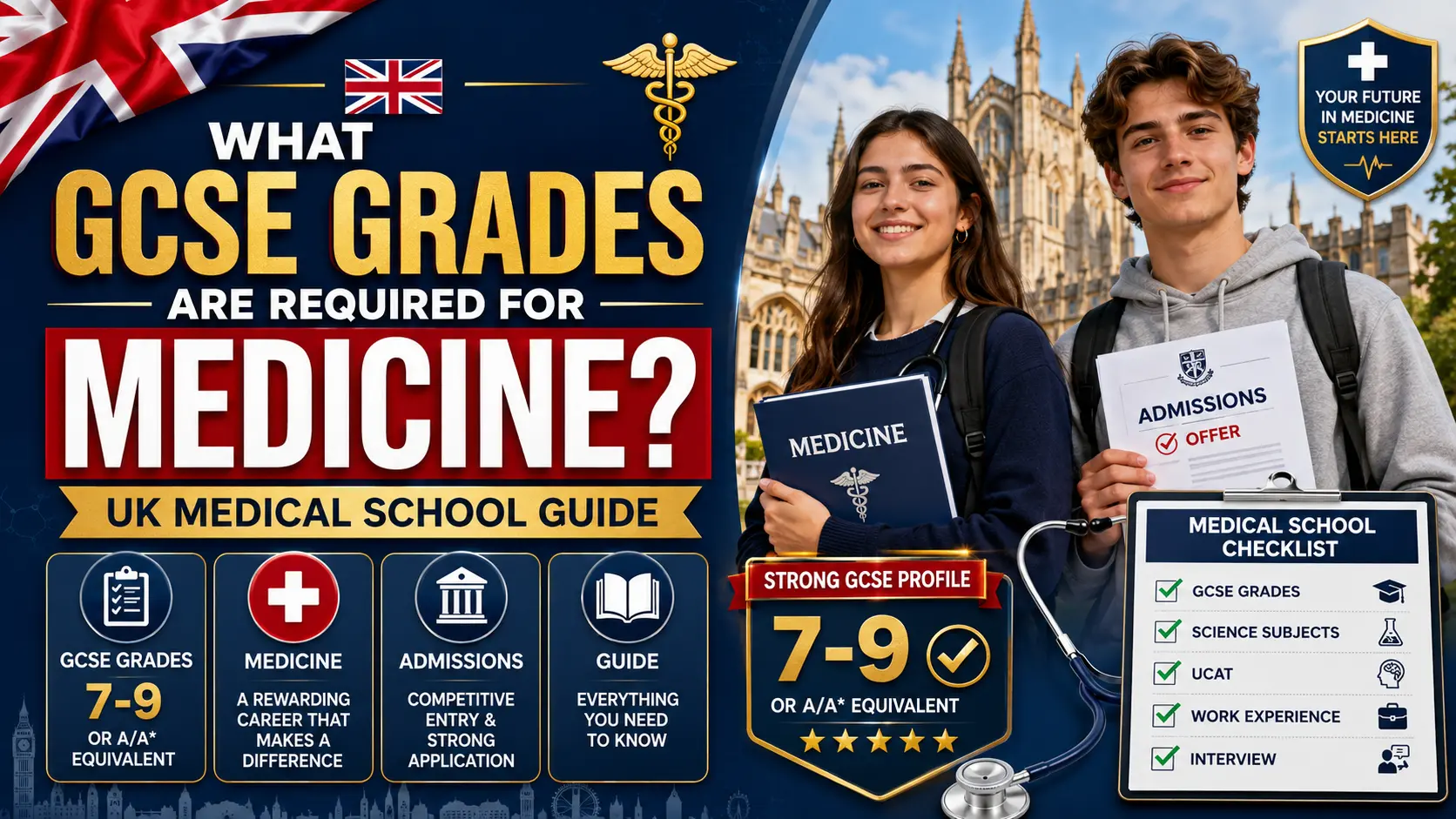
UK medicine GCSE entry guide
What GCSE Grades Are Required for Medicine?
For UK medicine, there is no single GCSE grade profile that guarantees entry. A sensible baseline is GCSE English Language and Mathematics at grade \(6\)/B or above, with many medical schools also requiring Biology, Chemistry or Double Science at grade \(6\)/B or above. Some medical schools accept lower minimums in selected areas, some require stronger profiles such as seven GCSEs at grade \(7\) or above, and some score GCSEs competitively when deciding who gets an interview. The safe answer is: meet every stated minimum, then apply strategically based on how each medical school uses GCSEs, UCAT, A-level predictions, contextual data and interviews.
Current-policy summary as of July 19, 2026: official medical school requirements vary sharply. UCL and King's College London require GCSE English Language and Mathematics at grade \(6\)/B. Birmingham requires English Language, Mathematics, Biology and Chemistry or dual award science at grade \(6\)/B. Manchester requires at least seven GCSEs at grade \(7\)/A or above, while also requiring English Language, Mathematics and at least two sciences at minimum grade \(6\)/B. Oxford states no formal GCSE requirement for Medicine but expects basic education in Biology, Physics and Mathematics, for example grade \(4\)/C or equivalent. Cambridge states no general GCSE requirement, but GCSEs are considered in context.
Guide Roadmap
- Direct answer
- GCSE grade scale
- Core GCSE subjects
- Medical school examples
- Minimum vs competitive GCSEs
- How GCSE scoring works
- English Language vs Literature
- Science GCSEs
- GCSE resits
- GCSEs and UCAT
- International and IGCSE applicants
- Strategic shortlist
- If your GCSEs are below target
- Gateway and foundation routes
- Recording GCSEs on UCAS
- School-by-school review method
- Year 10 and Year 11 plan
- Medicine GCSE checklist
- FAQ
The Direct Answer: What GCSE Grades Do You Need for Medicine?
Most UK medical schools expect strong GCSEs, especially in English Language, Mathematics and sciences. A common minimum is grade \(6\)/B in GCSE English Language and GCSE Mathematics. Many medical schools also require grade \(6\)/B in Biology and Chemistry, or grade \(6,6\)/BB in Double Science or Combined Science. However, this is only a pattern, not a national rule. Medicine entry requirements are set by each university, and they can change by year, applicant category and route.
The simplest way to think about medicine GCSEs is to separate minimum eligibility from competitive selection. Minimum eligibility asks: do your GCSEs meet the published subject thresholds? Competitive selection asks: if the medical school scores GCSEs, are your grades strong enough compared with other applicants? A student with grade \(6\)/B in English, Maths and sciences may meet a threshold at several schools, but may not be competitive at a school where interview selection gives high weight to grades \(8\), \(9\) or A* equivalents.
For many applicants, the realistic target is not merely "pass the required GCSEs." It is to build a profile of mostly grades \(7\), \(8\) and \(9\), while making sure English Language, Mathematics, Biology and Chemistry or Double Science meet every minimum. Medical school competition is high, and GCSEs are one part of a wider selection process that may include UCAT, predicted A-levels, contextual data, references, interviews, work experience reflection and non-academic checks.
\[\text{Medicine GCSE readiness}=\text{English Language}+\text{Maths}+\text{Sciences}+\text{overall GCSE strength}\]
\[\text{Competitive application}\ne\text{minimum GCSE eligibility only}\]
The safest planning answer is: aim for grade \(7\)/A or above in as many GCSEs as possible, protect at least grade \(6\)/B in English Language, Maths and sciences, and then choose medical schools based on how they use GCSEs. If your GCSEs are very strong, you can consider GCSE-scoring schools. If your GCSEs meet minimums but are not mostly \(8\) and \(9\), you may prefer schools that put more weight on UCAT, A-level predictions, interviews or contextual criteria.
Understanding the GCSE 9-1 Grade Scale for Medicine
Medicine requirements may use both the newer GCSE 9-1 scale and the older letter grade scale. The broad comparison used in admissions language is:
| GCSE 9-1 grade | Common letter comparison | Medicine admissions meaning |
|---|---|---|
| \(9\) | High A* | Very strong; often receives maximum GCSE scoring where scoring is used. |
| \(8\) | A* | Very strong; often treated with grade \(9\) for scoring bands. |
| \(7\) | A | Strong; may meet or exceed many competitive thresholds. |
| \(6\) | B | Common minimum for English Language, Maths and sciences at many medical schools. |
| \(5\) | Strong C | Accepted by some routes or foundation routes, but often below standard medicine minimums. |
| \(4\) | Standard C | Accepted by some universities for specific literacy or numeracy requirements, but often too low for standard medicine at many schools. |
This comparison should be used carefully. Universities write their own rules. One course may say grade \(6\)/B in English Language and Maths. Another may say grade \(7\)/A in Maths. Another may say no formal GCSE requirement but will still consider GCSEs in context. Another may award more points for grades \(8\) and \(9\) than for grade \(6\). The words "minimum" and "competitive" are not the same.
If you are converting GCSEs or IGCSEs for international planning, tools such as the GCSE/IGCSE 9 to 1 grade converter, GCSE conversion tools and GCSE to GPA converter can help you understand grade language. Use them for orientation, but always follow the official medical school requirement.
The Core GCSE Subjects Medical Schools Usually Care About
The most important GCSE subjects for medicine are usually English Language, Mathematics and science. English Language matters because doctors need accurate communication, reading and writing skills. Mathematics matters because medicine involves numeracy, data interpretation, dosage calculations, risk, statistics and scientific reasoning. Sciences matter because medical degrees build on biology, chemistry and physical science foundations.
Many medical schools name English Language rather than English Literature. This is not a small detail. King's College London requires GCSE grade \(6\)/B in both English Language and Mathematics. UCL requires grade \(6\)/B in both English Language and Mathematics. Manchester requires English Language, Mathematics and at least two science subjects at minimum grade \(6\)/B and does not accept English Literature in place of English Language. Birmingham requires English Language, Mathematics, Biology and Chemistry or dual award science at grade \(6\)/B or higher.
Science wording can vary. Some medical schools accept separate Biology and Chemistry. Some accept Double Science or Combined Science at specified grades. Some require at least two science subjects. Some focus more on A-level Chemistry and Biology than GCSE sciences, but GCSE science still affects eligibility or scoring. If you are taking separate sciences, protect Biology and Chemistry. If you are taking Combined Science, check whether the medical school requires a double grade such as \(6,6\).
\[\text{Core medicine GCSEs}=\text{English Language}+\text{Mathematics}+\text{Biology/Chemistry or Double Science}\]
For subject revision, useful internal resources include GCSE Biology, Biology study guide, AQA GCSE Biology past papers, Edexcel GCSE Biology past papers, AQA GCSE Chemistry past papers and Edexcel GCSE Chemistry past papers. For Maths, start with GCSE Maths complete guide, GCSE Maths past papers, AQA GCSE Maths past papers and Edexcel GCSE Maths past papers.
Medical School GCSE Requirements: Examples From Current Official Guidance
The table below shows why applicants must check every medical school separately. These examples are current policy examples from official university pages or the Medical Schools Council course directory, but requirements can change, so always verify the entry year before applying.
| Medical school | GCSE requirement pattern | Applicant takeaway |
|---|---|---|
| UCL Medicine | GCSE or equivalent at grade \(6\)/B or above in English Language and Mathematics. | UCL has a clear English Language and Maths threshold; GCSE resits may be used to meet those GCSE requirements. |
| King's College London Medicine | GCSE/IGCSE grade \(6\)/B in English Language and Mathematics. | Functional Skills and numeracy/literacy modules within Access to HE are not accepted for this programme to meet the GCSE requirement. |
| Birmingham Medicine | English Language, Mathematics, Biology and Chemistry or dual award science at grade \(6\)/B or higher. | Birmingham also scores GCSEs for interview selection, so grades above the minimum can matter. |
| Manchester Medicine | At least seven GCSEs at grade \(7\)/A or \(8+\)/A*, plus English Language, Mathematics and at least two sciences at minimum grade \(6\)/B. | Manchester is a strong example of a higher overall GCSE profile requirement. |
| Aston Medicine | Minimum six GCSEs/IGCSEs at grade \(6\), including English Language, Mathematics, Chemistry, Biology or Double Science. | Aston notes that many interview-ranked applicants have grades \(7\), \(8\) and \(9\). |
| Bristol Medicine | Advanced numeracy requirement: GCSE Mathematics grade \(7\)/A or equivalent; standard literacy requirement: GCSE English grade \(4\)/C or equivalent. | Bristol shows how one school may ask for a high Maths GCSE while accepting a lower English literacy threshold. |
| Leicester Medicine | Grade \(6\)/B in English Language, Maths and two sciences including Chemistry and Biology or Double Science for A100; foundation routes can differ. | Leicester also publishes scoring documents, so minimums and scoring strategy both matter. |
| Oxford Medicine | No formal GCSE requirement, but applicants need basic education in Biology, Physics and Mathematics, for example grade \(4\)/C or equivalent. | No formal minimum does not mean GCSEs are irrelevant; Oxford medicine is highly competitive and uses broader academic assessment. |
| Cambridge Medicine | Cambridge states no general GCSE requirement, but GCSE results are considered as an indicator of academic performance in school context. | Cambridge focuses minimum offers on A levels or equivalent Level 3 qualifications, but GCSE performance still forms part of the academic picture. |
These examples show the central rule of medicine admissions: GCSE requirements are not standardized. One applicant might meet UCL and King's GCSE thresholds but fall short of Manchester's seven-grade-\(7\) profile. Another applicant might meet Bristol's English requirement but miss Bristol's advanced numeracy requirement. Another might see Oxford's "no formal GCSE requirement" and misunderstand it as an easy GCSE route, when Oxford's competition and academic scrutiny are extremely high.
The official Medical Schools Council entry requirements directory is useful because it gathers medical school requirements, but it also warns that information may change and should be verified on university websites. Treat it as a shortlist tool, then check each medical school's course page before submitting UCAS.
Minimum GCSE Grades vs Competitive GCSE Grades
A minimum GCSE requirement tells you whether your application can pass the first academic screen. It does not tell you whether you are likely to receive an interview. Medicine is competitive, and many applicants exceed minimum requirements. A medical school that says grade \(6\)/B in English and Maths is required may still interview mostly applicants with several grades \(8\) and \(9\), depending on how it selects candidates.
This is why applicants should avoid asking only "Is grade 6 enough for medicine?" A better question is: "At which medical schools is my GCSE profile competitive when combined with my UCAT, predicted A levels, contextual eligibility and interview preparation?" At one school, GCSEs may be a threshold only. At another, GCSEs may form a large part of the pre-interview score. At a third, GCSEs may be considered in the context of school performance. At a fourth, a specific GCSE subject requirement may be more important than the total number of high grades.
\[\text{Minimum threshold}=\text{can be considered}\]
\[\text{Competitive profile}=\text{strong enough to rank well}\]
A competitive GCSE profile for medicine often includes grades \(7\), \(8\) and \(9\) across the majority of subjects, with no weakness in English Language, Maths or science. But this is not a universal cut-off. Some applicants with less perfect GCSEs can still be competitive if they apply strategically, perform strongly in UCAT, meet A-level requirements, have contextual eligibility, choose schools that do not heavily score GCSEs, and prepare well for interview.
The lesson is practical. If you are in Year 10 or Year 11, aim high across all GCSEs. If you already have GCSE results, do not panic; build a shortlist around how your actual grades are used. Strong GCSEs open more options. Weaker GCSEs do not always end a medicine ambition, but they make medical school selection strategy much more important.
How Medical Schools Score GCSEs
Some medical schools do more than check minimum GCSE grades. They assign points to GCSE grades and combine those points with UCAT or contextual data to decide interview invitations. Birmingham is a clear example. Its selection page states that standard applicants receive an overall score made up of academic, UCAT and contextual components, with the weighting shown as \(45\%\) academic, \(40\%\) UCAT and \(15\%\) contextual. It also states that GCSE achievement is scored across seven subjects including English Language, English Literature, Mathematics, Biology and Chemistry or dual award science, plus two additional GCSEs.
Birmingham's GCSE scoring example awards more points for higher grades. Grades \(8\) or \(9\)/A* receive more points than grade \(7\)/A, and grade \(7\)/A receives more than grade \(6\)/B. That means two applicants can both meet the minimum but have very different academic scores. The difference can affect interview selection.
\[\text{Example selection score}=0.45(\text{academic})+0.40(\text{UCAT})+0.15(\text{contextual})\]
Leicester also publishes scoring documents. For its A100 route, it requires grade \(6\)/B in English Language, Maths and two sciences, and its scoring document explains how GCSEs and UCAT contribute to pre-interview scoring. For its foundation route, Leicester publishes different minimums such as grade \(5\)/C in English Language, Maths and two sciences, with different scoring rules. This shows why applicants must not confuse standard entry medicine with foundation or gateway routes.
Aston also illustrates the minimum-versus-competitive distinction. Its Medical Schools Council page states a minimum of six GCSEs/IGCSEs at grade \(6\), including English Language, Mathematics, Chemistry, Biology or Double Science, but also notes that most applicants ranked high enough for interview have grades \(7\), \(8\) and \(9\) at GCSE level. That is a direct warning that meeting the minimum is not the same as being safely competitive.
When you read a medical school page, look for phrases such as "scored," "ranked," "selection for interview," "academic score," "best eight GCSEs," "minimum threshold," and "contextual score." These words tell you whether GCSEs are used only as a gate or as part of ranking.
GCSE English Language vs English Literature
Many medicine applicants lose eligibility because they assume English Literature can replace English Language. It often cannot. Medical schools usually name English Language because they want evidence of written communication, comprehension and language competence. Manchester explicitly states that English Literature will not be accepted in lieu of GCSE/IGCSE English Language. King's requires English Language and Mathematics at grade \(6\)/B. UCL also names English Language and Mathematics.
English Literature is still valuable. It can improve writing, analysis and communication, and at schools that score multiple GCSEs it may contribute as one of the scored subjects. Birmingham, for example, includes English Literature in the set of subjects it scores. But this does not mean English Literature replaces English Language where English Language is a required subject.
If you are currently taking GCSEs, treat English Language as a non-negotiable medicine subject. If your English Language grade is below the required threshold, check resit rules early. If you are an international applicant with an equivalent qualification or English as a second language route, check whether the medical school accepts your qualification or requires IELTS, TOEFL or another English language test. Do not assume that English-medium schooling automatically satisfies every requirement.
Practical rule: where a medicine page says English Language, read it literally. English Literature may help your profile, but it may not meet the required English Language condition.
Biology, Chemistry and Double Science GCSEs
Medicine is science-heavy, but GCSE science requirements vary. Some medical schools require Biology and Chemistry at GCSE. Some allow Double Science or Combined Science instead of separate sciences. Some specify "at least two science subjects." Some focus more on A-level Chemistry and Biology but still require GCSE science as part of a broad education or academic scoring.
Birmingham requires Biology and Chemistry or dual award science at grade \(6\)/B or higher. Leicester requires English Language, Maths and two sciences including Chemistry and Biology or Double Science. Aston requires Chemistry, Biology or Double Science within its six GCSEs at grade \(6\). Manchester requires English Language, Mathematics and at least two science subjects at grade \(6\)/B and specifies \(6,6\)/BB if Dual Award Science or Core and Additional Science are offered.
Oxford is different. Oxford states no formal GCSE requirement for Medicine, but says applicants need basic education in Biology, Physics and Mathematics, for example at least grade \(4\)/C or equivalent, and that GCSE Dual Award Combined Sciences is appropriate. Cambridge says no general GCSE requirement, but GCSEs are viewed in the context of school performance. These examples show that sciences matter even when the page is not phrased as a simple "grade 6 in science" rule.
Separate sciences can provide a strong foundation for A-level Biology and Chemistry, but many applicants successfully apply with Combined Science where universities accept it. The key is not whether separate sciences look more impressive in the abstract. The key is whether your science GCSE route meets the medical schools on your shortlist and prepares you for A-level science content.
Can You Resit GCSEs for Medicine?
GCSE resit policies vary by medical school. Some schools permit GCSE resits to meet minimum requirements, especially in English Language and Mathematics. UCL says candidates may resit GCSE subjects to meet the GCSE requirements. Manchester permits GCSE resits and says applicants resitting at the point of application must list the resit as a pending qualification on UCAS, while also noting that if the resit result is lower, that result will be used to assess the application. Bristol says applicants who did not achieve the minimum GCSE profile in the first sitting can apply with resits achieved or pending, subject to its policy.
Other schools may allow some resits but not others, or may score only first-sit results. Leicester's foundation-route scoring document says it will consider resits in GCSE English Language and Maths for meeting minimum requirements, but first-sit results must be listed and are used for scoring purposes. For standard routes, policies can differ. The resit rule is therefore not simply "resits are accepted" or "resits are rejected." It depends on the subject, route, reason, timing and scoring method.
If you need a GCSE resit, take these steps:
- Check every medical school's resit policy before adding it to your UCAS shortlist.
- List achieved grades and pending resits accurately on UCAS.
- Ask whether the medical school scores first sitting, best sitting or resit grade.
- Check whether resits are allowed only for English Language and Maths or also for sciences.
- Do not assume A-level excellence cancels out a missing GCSE threshold.
Resitting can be a good decision if it repairs a key eligibility issue. But resitting should be planned early because medicine deadlines are early, and schools may need predicted grades for pending GCSE resits. For timing, use the GCSE exam timetable and, if relevant, the IGCSE exam timetable.
GCSEs, UCAT and the Bigger Medicine Selection Process
GCSEs are important, but they are only one part of medicine admissions. Most UK medical schools require UCAT for current entry cycles. The UCAT Consortium states that applicants must sit UCAT 2026 if applying for entry in 2027 or deferred entry in 2028 to a relevant UCAT Consortium university. Medical schools use UCAT differently. Some apply thresholds, some rank applicants by UCAT, some combine UCAT with GCSEs, and some use UCAT alongside interviews and contextual information.
Birmingham combines GCSE academic scoring with UCAT and contextual data for standard applicants. Manchester screens academic thresholds and requires UCAT; it also states that Band 3 or 4 in UCAT Situational Judgement is not considered. King's requires UCAT and says the overall UCAT score across four subtests is given more consideration than individual subtest scores, with SJT also taken into account when shortlisting. Aston uses UCAT total score in ranking for interview and offers after interview.
This matters because your best medical school choices depend on your whole profile. A student with outstanding GCSEs and a moderate UCAT may prefer schools where GCSEs carry weight. A student with minimum GCSEs but a very high UCAT may prefer schools that rely more heavily on UCAT. A student with contextual eligibility may have different options again. The most common mistake is choosing medical schools based on reputation rather than selection method.
\[\text{Medicine shortlist}=\text{GCSE profile}+\text{UCAT profile}+\text{A-level predictions}+\text{contextual eligibility}\]
UCAS also matters. Medicine, dentistry and veterinary medicine normally use the earlier October deadline. UCAS guidance explains that the 15 October deadline applies to most medicine, dentistry and veterinary medicine/science courses, as well as Oxford and Cambridge. Plan GCSE resits, UCAT registration, work experience reflection and UCAS reference timing around that deadline.
For application planning, RevisionTown's UCAS points system, UCAS tariff points, calculating UCAS points, UCAS score calculator and UCAS clearing system guides can help explain UCAS terminology. Medicine offers are usually not simply tariff offers, but understanding UCAS helps you avoid administrative mistakes.
International, IGCSE and Equivalent Qualifications
Many medicine applicants apply with IGCSEs, O-levels, international school transcripts or other national qualifications. Medical schools usually assess equivalents, but policies vary. UCL says GCSE, IGCSE, O-level, IB or EB equivalents can meet its English Language and Mathematics requirement at grade \(6\)/B or above. King's says international equivalents can be considered and that applicants who studied abroad and did not complete GCSEs/IGCSEs would not necessarily be expected to have met that exact GCSE requirement, but evidence of equivalency is needed. Leicester says international or EU candidates without formal Year 10 or Year 11 examinations may need to submit school transcripts at the time of application.
International applicants should be especially careful with English language evidence. Medicine courses often have high English language requirements because clinical communication is central to patient safety. A medical school may accept GCSE English Language for home applicants but require IELTS, TOEFL or another approved test for international applicants whose education was not in an accepted English-medium context. Check the exact medical school page and do not rely on general university English guidance if the medicine programme has its own requirement.
IGCSE applicants should also check first language versus second language English. Manchester notes that applicants with English as a second language IGCSE may need an acceptable equivalent English qualification or a higher grade. Different universities use different rules. If you are unsure, contact the admissions team before applying and keep written confirmation.
For IGCSE preparation, use Cambridge IGCSE past papers, Edexcel IGCSE past papers, Cambridge IGCSE Biology 0610, Cambridge IGCSE Chemistry 0620, Cambridge IGCSE Mathematics 0580 and IGCSE/O Level resources. These can strengthen exam preparation, but equivalency decisions belong to the medical school.
How to Choose Medical Schools Based on Your GCSE Profile
Medicine applications are strategic because UCAS allows only four medicine choices. The fifth UCAS choice is normally used for a non-medicine backup or left blank. You cannot afford to apply blindly. Start by dividing medical schools into three groups: GCSE-heavy, GCSE-threshold, and GCSE-contextual or less GCSE-focused.
GCSE-heavy schools score GCSEs directly or use them significantly in interview selection. Birmingham and Leicester are examples where GCSE scoring documents are important. Aston highlights that applicants invited to interview often have grades \(7\), \(8\) and \(9\). If your GCSEs are very strong, these schools may reward your profile. If your GCSEs are only at minimum level, these schools may be riskier unless your UCAT and contextual profile compensate under that school's rules.
GCSE-threshold schools require specific grades but may put more selection emphasis elsewhere once the threshold is met. UCL and King's publish clear GCSE requirements in English Language and Mathematics, but applicants must also meet A-level/IB requirements, UCAT and interview criteria. A threshold school is not easy; it simply means GCSEs may not be the main ranking tool after eligibility.
GCSE-contextual schools such as Cambridge state no general GCSE requirement but consider GCSEs within school context. Oxford states no formal GCSE requirements but expects basic science and mathematics education. These universities are still among the most competitive in the country. Applicants should not interpret "no formal GCSE requirement" as "low GCSE grades are fine." It means the evaluation is broader and highly competitive.
\[\text{Best-fit medical school}=\text{your GCSE pattern matched to selection method}\]
Build a shortlist table with these columns: medical school, course code, GCSE minimums, GCSE scoring method, UCAT method, A-level or IB requirements, contextual policy, resit policy, interview style and deadline. Then compare your profile honestly. If your GCSE weakness is English Language, fix it before applying where possible. If your weakness is one non-core subject but your core grades are strong, you may still have many options. If your GCSE profile is strong but UCAT is weaker, choose schools carefully after UCAT results are known.
What If Your GCSE Grades Are Below the Usual Medicine Target?
A lower GCSE profile does not always end a medicine ambition, but it changes the application plan. The first step is to identify exactly what is below target. A grade \(5\) in a non-core subject is a different problem from a grade \(5\) in GCSE English Language, Mathematics, Biology or Chemistry. A lower grade in a core threshold subject can make you ineligible for certain courses, even if your A-level predictions are excellent. A lower grade in a subject that is not named as a requirement may matter only at schools that score many GCSEs.
Use a three-level check. First, ask whether the grade blocks eligibility. If a course requires grade \(6\)/B in English Language and you have grade \(5\), that course is normally unsafe unless a resit or accepted equivalent is possible. Second, ask whether the grade reduces ranking. If a school scores the best seven or eight GCSEs, every grade below \(7\) can reduce the academic score even when the minimums are met. Third, ask whether the grade can be explained through contextual data. Medical schools may consider school performance, widening participation criteria, care experience, extenuating circumstances or disrupted education, but you should never assume contextual consideration unless the policy says so.
The safest response is evidence-based action. If the weak grade is English Language or Maths, check resit rules immediately and decide whether a resit is realistic before the medicine application deadline. If the weak grade is science, check whether the medical school accepts Combined Science, separate science, first-sit grades or resits. If the weak grade is not required, focus on strengthening the rest of the application: A-level predictions, UCAT preparation, interview readiness, work experience reflection and a shortlist that does not over-penalise GCSEs.
\[\text{Risk of rejection}=\text{missing threshold}+\text{low GCSE score}+\text{poor course match}\]
Applicants sometimes ask whether a very high UCAT score can compensate for weaker GCSEs. The answer depends on the medical school. At a UCAT-heavy school, a strong UCAT may help once minimum academic requirements are met. At a GCSE-scoring school, a high UCAT may not fully repair a low GCSE academic score. At a threshold school, UCAT may matter only after the GCSE threshold is met. Therefore, do not think in simple compensation terms. Think in selection-method terms.
If you already have GCSE results, create a realistic profile summary before researching universities. List your grades in English Language, English Literature, Maths, Biology, Chemistry, Physics or Combined Science, then list your next best GCSEs. Mark each grade as \(9\), \(8\), \(7\), \(6\), \(5\) or below. Then compare the profile with each medicine course. This keeps the decision factual and reduces the temptation to apply to courses that are attractive but statistically unsuitable.
Gateway and Foundation Medicine Routes
Some applicants with lower GCSE grades, disrupted education or widening participation eligibility consider medicine with a foundation year, gateway year or widening access route. These routes can be excellent, but they are not simply easier versions of standard medicine. They usually have strict eligibility criteria and may be limited to applicants from specific backgrounds, schools, postcodes or educational circumstances. They may also have different GCSE, A-level and UCAT rules from the standard A100 course at the same university.
Leicester's published foundation-route scoring is a good example of why route type matters. Its foundation route has different minimum GCSE expectations from standard entry, including grade \(5\)/C in English Language, Maths and two sciences in the published document reviewed for this guide. That does not mean every foundation course accepts grade \(5\), and it does not mean a standard medicine course will accept the same profile. Foundation and gateway routes are separate admissions products with separate rules.
Before applying to a gateway or foundation route, check three things. First, check academic eligibility: the exact GCSE grades, A-level subjects, predicted grades and UCAT requirements. Second, check widening participation eligibility: school type, household income indicators, postcode measures, care status, free school meals, first-generation university status or other criteria. Third, check progression rules: whether successful completion of the foundation year automatically leads to the medical degree, whether progression depends on assessments, and whether places are guaranteed or competitive.
Gateway routes can be strategic for the right applicant, but they are highly competitive because the number of places is usually small. Do not apply only because the GCSE minimum looks lower. Apply because you meet the route's purpose and eligibility conditions. If you do not meet widening participation criteria, a standard A100 route with carefully matched GCSE and UCAT selection may be more realistic.
Applicants should also avoid mixing information between routes. If a university offers A100 Medicine and a gateway course, read the correct page for the course code you will enter on UCAS. A grade requirement on one route may not apply to the other. When in doubt, contact admissions with your exact qualifications and intended course code.
How to Record GCSE Grades Correctly on UCAS
Medicine is unforgiving with administration because competition is high and deadlines are early. GCSEs, IGCSEs, O-levels and resits should be recorded accurately on UCAS. Do not omit lower grades because you think they are irrelevant. Do not list a resit as achieved if it is pending. Do not guess equivalencies for international qualifications without checking how the medical school wants them presented.
If you are resitting a GCSE, list the existing qualification and the pending resit according to UCAS instructions and the medical school's guidance. Manchester, for example, tells applicants resitting a GCSE at the point of application to list the resit as pending. This is important because admissions teams need to know whether a required grade has already been achieved or is expected later. If a medical school says it will use the lower resit result if the resit is lower, factor that risk into your plan.
Predicted grades should also be realistic. A pending GCSE English Language resit predicted at grade \(7\) may help demonstrate that the threshold could be met, but the offer or eligibility may still depend on the final result. If the resit is essential for medicine eligibility, the application carries risk until the result is achieved. Applicants should keep copies of certificates, statement of results, transcripts and any admissions emails confirming equivalency.
For international applicants, the safest approach is to prepare a document that maps each qualification to the closest GCSE subject requirement, while still allowing the medical school to make the final equivalency judgement. For example, you might show your English qualification, mathematics qualification and science qualifications clearly, with exam board, year, level and grade. If your school did not run formal GCSE-equivalent exams, ask admissions whether transcripts are required at application stage.
The medicine deadline means this work should be done before October, not during the week of submission. A strong application can be weakened by a missing GCSE certificate, unclear pending qualification or wrong course-code assumption. Treat qualification reporting as part of the selection process, not as a clerical afterthought.
A Practical School-by-School GCSE Review Method
The most reliable way to answer "what GCSE grades are required for medicine?" is to build your own school-by-school evidence table for the current entry year. Start with the Medical Schools Council directory to identify all UK medicine courses, then open the official university page for each course that interests you. Record only information from official sources and keep the date you checked it, because medicine requirements can change between entry cycles.
For each course, write down the exact wording for English Language, Maths and science. Do not shorten "English Language grade 6/B" to "English grade 6" because that can hide the English Literature issue. Do not shorten "Biology and Chemistry or dual award science" to "science" because that may hide whether Combined Science is accepted. Precision prevents mistakes.
Next, classify the course. If the page says GCSEs are scored or gives a GCSE scoring table, mark it GCSE-scoring. If it lists minimum GCSE grades but mainly ranks by UCAT or interview after eligibility, mark it GCSE-threshold. If it says no formal GCSE requirement but GCSEs are considered in context, mark it contextual. If it has a widening participation or foundation route, keep that route separate from standard medicine.
Finally, compare the school against your profile after UCAT. Before UCAT, you can identify academic eligibility. After UCAT, you can judge competitiveness. A school that looked sensible before UCAT may become riskier if your UCAT score is below its recent interview range. A school that looked risky because your GCSEs are not perfect may become more realistic if it is UCAT-heavy and you meet every GCSE threshold. The goal is not to find a universally "best" medical school. The goal is to find courses where your evidence matches the selection method.
Year 10 and Year 11 Plan for Future Medicine Applicants
If you are still in Year 10 or Year 11, the best medicine GCSE strategy is simple but demanding: do not let any core subject become a weakness. English Language, Maths, Biology and Chemistry or Combined Science should be treated as medicine foundation subjects. Aim for grades \(7\), \(8\) and \(9\), but set grade \(6\)/B as the absolute floor in common threshold subjects.
Plan revision by risk, not by comfort. Many students spend too much time revising subjects they already enjoy and too little time repairing weaker core subjects. If English Language is unpredictable, practise timed reading, writing and examiner-focused responses. If Maths is below grade \(7\), identify topic gaps early and use past papers. If Biology or Chemistry marks are inconsistent, build topic summaries, practise command words and correct misconceptions.
A useful revision allocation can be written as:
\[\text{Revision priority}=\text{medicine core subjects}+\text{weakest grade risks}+\text{exam timing}\]
Past papers matter because medicine applicants often need high grades, not only pass marks. Use mark schemes to understand how examiners award precision. For science, practise data handling and extended response questions. For Maths, practise multi-step problems and calculator/non-calculator fluency. For English Language, practise concise analysis and structured writing under time pressure.
Do not neglect non-core GCSEs. At GCSE-scoring medical schools, grades across seven or eight subjects can affect selection. A student with \(9,9,9,9,9,8,8,8\) has a different scoring profile from a student with \(6,6,6,6,6,6,6,6\), even if both meet some minimums. Broader high achievement helps keep options open.
After GCSEs: A Levels, IB and Subject Choices for Medicine
GCSEs are only the foundation. Standard medicine entry usually depends heavily on A-level or equivalent Level 3 subjects. Chemistry is required by most UK medical schools, and Biology is required or strongly expected at many. Oxford requires Chemistry and at least one of Biology, Physics, Mathematics or Further Mathematics. UCL requires Chemistry and Biology at A level. Birmingham requires Chemistry and a second science from Biology, Physics or Maths. Manchester requires Chemistry or Biology plus another science at Higher Level for IB and equivalent science combinations for A-level routes.
That means GCSE science grades should be seen as preparation for A-level sciences. A grade \(6\) may meet a minimum GCSE threshold, but A-level Chemistry and Biology are demanding. If you are only just reaching grade \(6\) at GCSE, you need a serious plan for the jump to A level. Strong GCSE understanding makes the transition easier.
For post-GCSE science preparation, see AS/A Level Biology 9700, A-Level Biology notes and worksheets, AS/A Level Chemistry and A-Level Chemistry notes and worksheets. For exam timing, use the A-levels 2026 exam timetable.
Medicine GCSE Checklist Before You Apply
1. Check English Language
Confirm whether each medical school requires GCSE English Language at grade \(6\)/B, \(5\), \(4\), or another equivalent. Do not assume English Literature is accepted.
2. Check Mathematics
Record each Maths requirement. Some schools require grade \(6\)/B, while Bristol Medicine uses an advanced numeracy requirement of grade \(7\)/A.
3. Check sciences
Write down whether the school requires Biology and Chemistry separately, Double Science, Combined Science or at least two science subjects.
4. Identify GCSE scoring
Find out whether GCSEs are scored for interview selection. If they are, compare your profile with the scoring system, not just the minimum threshold.
5. Check resit policy
If you have resat or plan to resit GCSEs, check whether the school accepts resits and whether first-sit grades are still scored.
6. Match GCSEs to UCAT strategy
After UCAT results, choose medical schools where your GCSE and UCAT combination fits the selection method.
For final GCSE planning, combine your grade tracker with exam dates and subject priorities. RevisionTown's grade calculator, final grade calculator, GCSE resources, GCSE course material and GCSE, IGCSE and A-Level revision worksheets can support study organisation.
Frequently Asked Questions
Is grade 6 enough for medicine GCSEs?
Grade \(6\)/B is a common minimum for English Language, Maths and sciences at many medical schools, but it may not be competitive everywhere. Some schools score GCSEs, and higher grades can improve ranking.
Do I need all 8s and 9s at GCSE for medicine?
No universal rule says you need all \(8\)s and \(9\)s. However, many successful applicants have strong GCSE profiles, and some medical schools reward higher GCSE grades in scoring. Apply strategically based on your actual profile.
Can I study medicine with a grade 5 in Maths?
Some foundation or gateway routes may accept grade \(5\)/C in Maths, but many standard medicine courses require grade \(6\)/B or higher, and some require grade \(7\)/A. Check each course before applying.
Can English Literature replace English Language for medicine?
Often no. Many medical schools specifically require English Language. Some explicitly state that English Literature is not accepted in place of English Language.
Do medicine courses accept Combined Science?
Many do, but the required grades vary. Some medical schools accept Double Science or Combined Science at grades such as \(6,6\)/BB instead of separate Biology and Chemistry.
Can GCSE resits be used for medicine?
Sometimes. Some medical schools allow resits, especially for English Language and Maths, but policies vary and first-sit grades may still be used for scoring. Always check the resit policy.
Do Oxford and Cambridge require specific GCSE grades for medicine?
Oxford states no formal GCSE requirements for Medicine but expects basic education in Biology, Physics and Mathematics. Cambridge states no general GCSE requirement, but GCSEs are considered in context.
What GCSEs matter most for medicine?
English Language, Mathematics, Biology and Chemistry or Double Science matter most for eligibility. Overall GCSE strength can also matter where schools score several GCSEs for interview selection.
Final Takeaway
For UK medicine, aim for at least grade \(6\)/B in GCSE English Language, Mathematics and sciences, and aim higher wherever possible. Many medical schools require those core subjects, while some ask for stronger profiles or score GCSEs directly. A strong applicant does not only meet minimum GCSE thresholds; they choose medical schools where their GCSEs, UCAT, predicted A-levels, contextual eligibility and interview preparation fit the selection method. Always verify the current entry year on the official medical school page before applying.
Official sources checked include the Medical Schools Council entry requirements directory, UCL Medicine 2027 entry requirements, King's College London Medicine requirements, Oxford Medicine, Cambridge accepted qualifications, Manchester Medicine, Birmingham Medicine, Birmingham selection scoring, Aston Medicine, Bristol Medicine, Leicester Medicine, UCAS 15 October deadline guidance and UCAT Consortium university guidance.


