
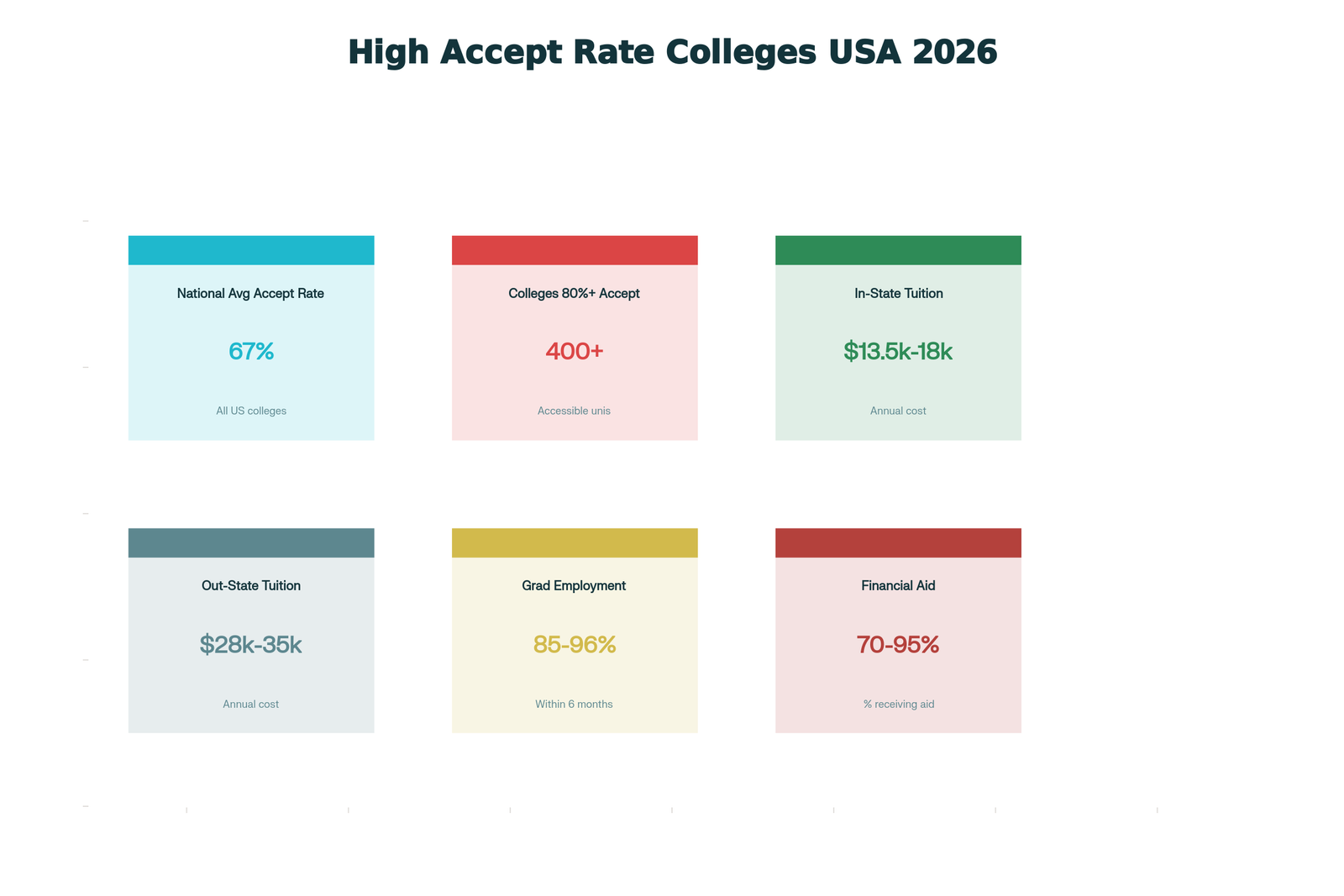
The landscape of American higher education offers far more accessible pathways to degree completion than commonly perceived. While prestigious institutions with acceptance rates below 10% dominate headlines, the national average acceptance rate across US colleges stands at approximately 67%, revealing that thousands of quality institutions welcome the vast majority of their applicants. This comprehensive guide explores colleges with high acceptance rates, providing prospective students with detailed information about accessible yet academically sound institutions that align with the 2025-2026 admissions cycle.
Understanding Acceptance Rates and the Current Higher Education Landscape
The Changing Admissions Environment
The traditional narrative that college admissions has become uniformly “harder” requires significant nuance. While elite institutions continue to maintain extremely selective admission processes, the broader American higher education system has witnessed fundamental shifts driven by pandemic effects, demographic projections, and evolving application patterns. According to the National Center for Education Statistics (NCES), undergraduate enrollment is projected to increase by 9% from 15.4 million to 16.8 million students between 2021 and 2031. This growth creates expanding opportunities at institutions of varying selectivity levels.
A crucial development in the 2025-2026 cycle involves changing application behaviors. Since the pandemic, college applications have surged by 41%, driven by test-optional policies that encouraged students to apply more broadly to 15-20 schools each. However, this statistical increase in applications has not uniformly tightened acceptances across all institutions. While flagship public universities in the South and Southwest have experienced record applications and declining acceptance rates, many regional colleges and comprehensive universities maintain or have increased their acceptance rates. Additionally, demographic changes are significant: the enrollment cliff—projected to reduce the high school graduate pool by 15% by 2030—is prompting many colleges, particularly smaller and mid-sized institutions in the Midwest and Northeast, to maintain more accessible admission policies.
The True Landscape of College Access
The average acceptance rate across American institutions remains robust. According to International College Counselors’ analysis of current admissions data, the average university admit rate is still about 73%, even as elite institutions receive disproportionate media attention. This distinction proves critical for prospective students: colleges with high acceptance rates are not uniformly less academically rigorous. Rather, they serve different functions within the higher education ecosystem, offering quality education, strong support systems, and robust career outcomes to diverse student populations.
Major Categories of Colleges with High Acceptance Rates
Tier 1: 90-100% Acceptance Rate Colleges
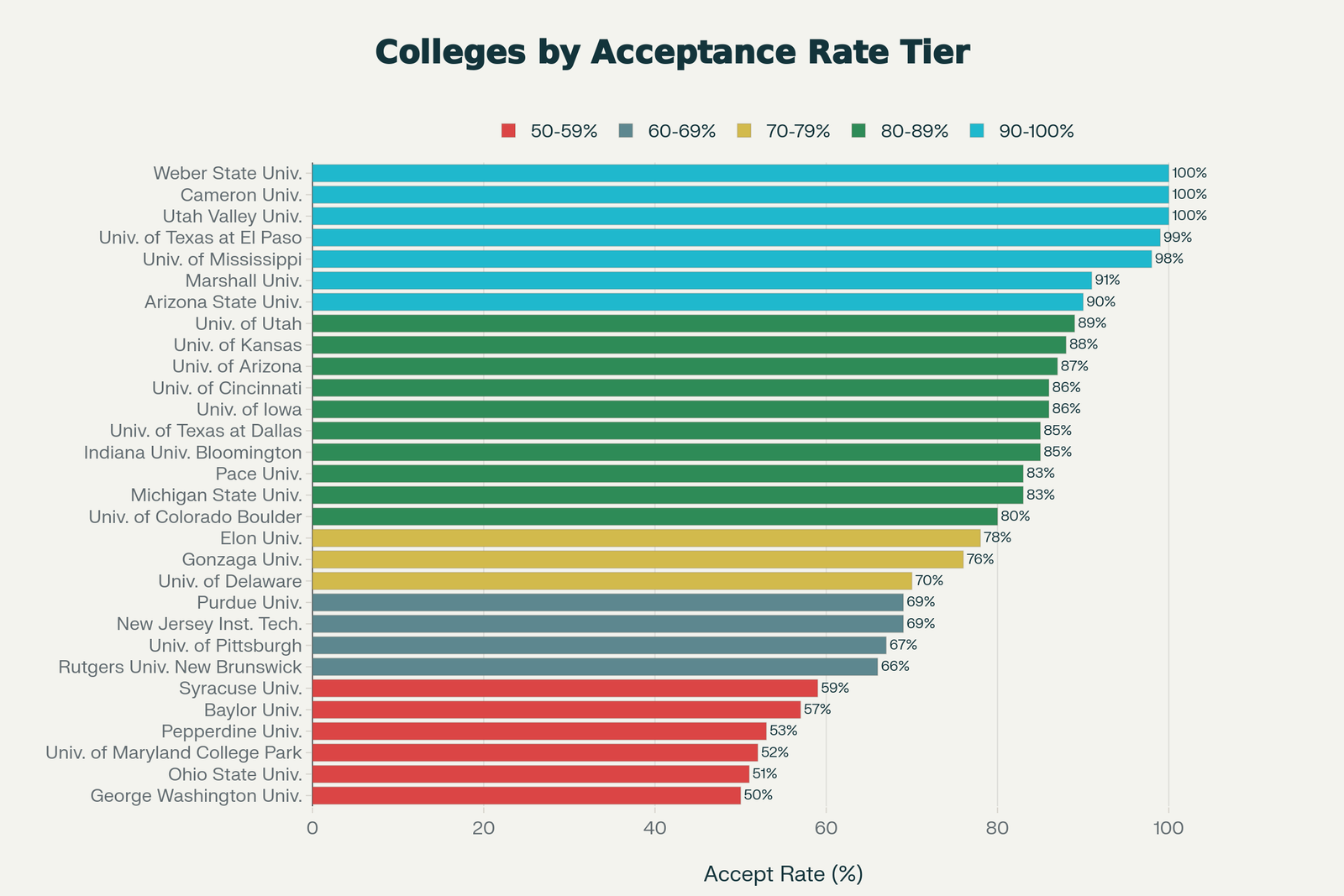
The most accessible tier includes institutions that admit nearly all qualified applicants. Notable examples include the University of Texas at El Paso (99%), University of Mississippi (98%), Utah Valley University (100%), Cameron University (100%), and Weber State University (100%). These universities, primarily public institutions, serve important missions within their regions. Utah Valley University, for instance, is the largest public university in Utah with over 43,000 students as of 2023 and offers 105+ bachelor’s degrees, associate degrees, certificates, and master’s programs. Its in-state tuition stands at $6,270 per year, with an 80% employment rate within six months of graduation.
The University of Mississippi (Ole Miss) represents another exemplar at this tier, with a 98% acceptance rate and a global ranking in the top 200 US National Universities. The institution enrolls 22,000+ students and maintains a 17:1 student-faculty ratio. All 100% of applicants who meet basic requirements—typically a 2.5+ cumulative GPA—receive admission. Marshall University in Huntington, West Virginia, with a 96.9% acceptance rate, provides education to approximately 12,000 students with strong outcomes: 88% employment or graduate school enrollment within six months and popular majors in health sciences, business, education, and social sciences.
Tier 2: 80-89% Acceptance Rate Colleges
The second tier comprises robust regional and state universities attracting strong student bodies. Arizona State University (90%), University of Arizona (87%), Indiana University Bloomington (85%), University of Utah (89%), and University of Iowa (86%) exemplify this category. Arizona State University, one of the largest universities in the nation with approximately 65,000 undergraduates, offers over 400 undergraduate degree programs across disciplines from engineering to business to visual arts. The 90% acceptance rate combines with strong state support, affordable tuition options, and extensive scholarship opportunities.
Indiana University Bloomington, accepting approximately 82-85% of applicants, distinguishes itself through the Jacobs School of Music, ranked among the world’s best music schools. The University of Iowa accepts approximately 86% of applicants and is known for medical, creative writing, and engineering programs while offering generous scholarships and assistantships for international students. University of Utah, accepting nearly 89% of applicants, functions as a research powerhouse in computer science, medicine, and entrepreneurship with a large international student population and top-ranked online programs.
Tier 3: 70-79% Acceptance Rate Colleges
Moderately selective institutions in this range include Michigan State University (83%), University of Kansas (88%), Gonzaga University (76%), Elon University (78%), and University of Cincinnati (86%). These institutions typically attract students with solid academic credentials while maintaining diverse student bodies and comprehensive support systems. Michigan State University, accepting 83% of applicants, provides strong programs across engineering, agriculture, business, and engineering. The University of Cincinnati, with an 86% acceptance rate, is famous for its cooperative education program allowing students to gain paid work experience while studying, with top majors in engineering, business, and health sciences.
Tier 4: 60-69% Acceptance Rate Colleges
Selective universities in this range include University of Colorado Boulder (80%), Rutgers University New Brunswick (66%), University of Pittsburgh (67%), New Jersey Institute of Technology (69%), Purdue University (69%), and University of Delaware (70%). University of Colorado Boulder, accepting 80% of applicants, provides strong academics, outdoor recreation opportunities, and comprehensive student support. Rutgers University New Brunswick at 66% acceptance encompasses #40 on US News’ national ranking and #15 on the Top Public Universities list, with over 70% of undergraduate students receiving financial aid.
Tier 5: 50-59% Acceptance Rate Colleges (Entry to Selective Institutions)
Universities at this threshold include Ohio State University (51%), George Washington University (50%), University of Maryland College Park (52%), and Pepperdine University (53%). Ohio State University, a distinguished public research university with 51% acceptance rate, attracts approximately 70,028 applicants annually. Admitted students typically score between 1290-1440 on the SAT and 27-32 on the ACT, with average GPA around 3.4 or higher. The university maintains a rigorous holistic admissions process and will reinstate standardized testing requirements beginning in 2026.
 Key Statistics for High Acceptance Rate US Colleges (2025-2026)
Geographic Distribution and Regional Insights
Public Universities and State Systems
High acceptance rate universities are concentrated particularly among large public university systems, especially in the South, Southwest, and Midwest. The University of Texas System, including University of Texas at El Paso (99%), University of Texas at Dallas (85%), and UT Arlington (88%), exemplifies accessible yet academically strong institutions. Texas A&M University, with 57% acceptance, represents a middle ground with strong engineering, agriculture, and veterinary programs serving over 70,000 students.
The State University of New York (SUNY) system provides multiple accessible options through institutions like University at Buffalo (70% acceptance) and other regional SUNY campuses. The California State University system, while highly competitive at some campuses like CSU Fresno (97%), provides accessible pathways across 23 campuses to over 450,000 students.
Regional University Leaders
High acceptance rate colleges demonstrate particular strength in underserved regions. The University of Wyoming, with guaranteed admission for applicants with 3.0+ cumulative unweighted GPA who complete recommended coursework, offers accessible pathways while maintaining academic expectations. Similarly, Central Washington University guarantees admission to high school seniors earning 3.0+ GPA and completing recommended curriculum, providing predictability valuable for prospective students.
Financial Accessibility and Aid Opportunities
Tuition and Cost Structure
Colleges with high acceptance rates are not synonymous with affordability, but demonstrate considerable variation. Public universities typically charge:
In-state tuition: $6,270 (University of Wyoming minimum) to $18,000+ annually
Out-of-state tuition: $17,830 (University of Wyoming minimum) to $35,000+ annually
For example, University of Texas at El Paso offers in-state tuition around $8,500-10,000 with comparably low out-of-state rates, reflecting its mission as an accessible institution. Conversely, private colleges with high acceptance rates like Pace University (83% acceptance) in New York City have different cost structures but often provide substantial financial aid packages.
Financial Aid and Scholarship Availability
A significant advantage of high acceptance rate institutions involves financial aid accessibility. Approximately 70-95% of students at these institutions receive financial aid, with average institutional grants and scholarships ranging from $20,000 to $45,000 annually depending on the specific college and student need. Quinnipiac University, maintaining an 88% acceptance rate, provides an exemplary model: approximately 96.1% of graduates achieve employment within six months, and institutional financial aid averages support student affordability.
Public universities frequently offer substantial merit-based scholarships for admitted students. Arizona State University’s scholarship portfolio, coupled with 90% acceptance, creates significant affordability for diverse student cohorts. Private institutions with higher acceptance rates similarly maintain commitment to financial aid accessibility—many smaller liberal arts colleges at 70-80% acceptance provide average grants covering 50-60% of annual attendance costs.
Academic Quality and Student Support
Academic Standards and Rigor
High acceptance rates should not be conflated with academic mediocrity. Many institutions in this category maintain rigorous curricula, demanding faculty, and strong academic support systems. Indiana University Bloomington, for instance, combines 85% acceptance with a top music school and strong business and computer science programs. University of Iowa (86% acceptance) offers demanding creative writing and engineering programs with substantial research opportunities.
The distinction proves crucial: acceptance rate measures admissions selectivity, not educational quality. An 85% acceptance university may maintain rigorous courses, high graduation rates, and strong academic outcomes because it invests in student success through support services, advising, tutoring, and peer mentoring. Research demonstrates that personalized attention, smaller class sizes, and accessible faculty characterize many high-acceptance institutions, particularly regional and public universities.
Student Support Infrastructure
High acceptance rate colleges frequently emphasize holistic student development and robust support systems. These institutions typically offer:
Comprehensive academic advising: Dedicated advisors, course planning support, major-specific mentorship
Tutoring and writing centers: Free peer and professional tutoring services
Mentorship programs: Faculty mentorship, peer mentoring, and professional development
Career services: Resume review, interview preparation, internship coordination, job placement support
Mental health and wellness services: Counseling, health services, wellness programming
Diversity and inclusion initiatives: Cultural centers, affinity groups, first-generation student programs
Employment outcomes validate these support structures. Institutions like Ohio Northern University (69% acceptance, 95.86% job placement rate with $71,200 median earnings), Marquette University (86% acceptance, 95.55% placement rate), and Quinnipiac University (88% acceptance, 96.1% placement rate) demonstrate that accessible admissions correlate with strong post-graduation outcomes.
Application Process and Strategic Admission
Application Timeline for 2025-2026
The standard application calendar for the 2025-2026 academic year follows consistent patterns:
Early Action/Early Decision: November 1-15, 2025, with decisions in mid-December
Regular Decision: January 1-15, 2026, with decisions March-April 2026
Rolling Admissions: No set deadline; continuous processing through spring/summer
High acceptance rate colleges frequently utilize rolling admissions, which provides several strategic advantages: applicants receive decisions within 4-6 weeks of submission, allowing earlier planning and institutional differentiation based on yield management.
Standardized Testing Requirements
The testing landscape continues evolution in 2025-2026. While many institutions maintain test-optional policies, several significant developments emerged:
Reversion to testing requirements: Major institutions including Ohio State University reinstate SAT/ACT requirements beginning Fall 2026
Test-optional persistence: Majority of high acceptance rate institutions remain test-optional, though submission remains advantageous
Score ranges for admitted students: Varies significantly by institution—high acceptance rate institutions typically admit students with SAT scores 1100-1400 and ACT 24-32
For prospective students, strategic test submission becomes relevant: students scoring in the 75th percentile or above for a target institution should submit scores, as doing so statistically increases admission probability even at test-optional schools.
GPA and Academic Requirements
Typical academic profiles for high acceptance rate institutions include:
Minimum GPA: 2.5-3.0 unweighted cumulative GPA for guaranteed admission at some institutions; 3.0-3.5 for competitive merit aid
Curriculum requirements: Most universities require college-preparatory coursework including 4 years English, 3-4 years mathematics, 2-3 years science, 2-3 years social studies
Holistic factors: Extracurricular involvement, personal essays, letters of recommendation increasingly important as academic differentiators
Demographic Diversity and Inclusion
Student Body Composition
High acceptance rate colleges frequently demonstrate exceptional demographic diversity, providing multiple perspectives and enriched learning environments. Public universities in particular attract multicultural student populations:
Ethnicity: Typically 30-50% students of color, with significant representation from Hispanic, Asian, Black, and multiracial populations
First-generation status: 20-50% of students are first-generation college attendees, particularly at public universities in urban areas
International students: 5-20% international student enrollment at major public universities
Gender balance: Approximately 40-60% female enrollment across most institutions
George Mason University (74 diversity index), Rutgers University Newark (74 diversity index), and University of Texas at Arlington provide exemplary models of diverse, accessible higher education. These institutions intentionally create inclusive environments supporting student success regardless of background.
First-Generation and Low-Income Student Support
Many high acceptance rate institutions prioritize access for first-generation and low-income students:
Free application fees: Most public universities waive fees for low-income applicants
Enhanced financial aid: Additional grant funding and reduced loan burden for low-income families
Targeted support programs: First-generation mentorship, cultural affinity programming, financial literacy workshops
Increased representation: 25-50% of admitted classes at many public universities comprise first-generation students
Program Offerings and Specializations
Comprehensive Academic Breadth
A significant advantage of high acceptance rate institutions involves academic diversity. These universities typically offer 100-400+ degree programs across multiple disciplines:
| Program Category | Example Institutions | Notable Strengths |
|---|---|---|
| Engineering | Purdue, Arizona State, Penn State | Strong co-op programs, industry partnerships |
| Business/Management | Indiana University, Texas A&M, Ohio State | AACSB accreditation, job placement |
| Health Professions | University of Pittsburgh, University of Iowa | Pre-med support, clinical opportunities |
| Liberal Arts | Gonzaga University, Elon University | Small class sizes, faculty engagement |
| Education | University of Wyoming, Central Washington | Teacher preparation, education research |
| STEM Fields | Arizona State, University of Utah | Research opportunities, labs |
Co-Op and Experiential Learning
High acceptance rate universities increasingly emphasize experiential learning. The University of Cincinnati operates a renowned cooperative education program allowing students to alternate semesters between classroom and paid industry positions, providing genuine work experience. Similarly, Arizona State University integrates internships, research, and community engagement across curricula.
Career Outcomes and Post-Graduation Success
Employment Rates and Earnings
Comprehensive data from the US Department of Education College Scorecard demonstrates strong post-graduation outcomes at high acceptance rate institutions:
Quinnipiac University (88% acceptance): 96.1% placement rate, $55,500 median earnings
Augustana University (69% acceptance): 96.05% placement rate, $45,900 median earnings
Ohio Northern University (69% acceptance): 95.86% placement rate, $71,200 median earnings
Marquette University (86% acceptance): 95.55% placement rate, $62,600 median earnings
Illinois Wesleyan University (45% acceptance): 95.45% placement rate, $60,500 median earnings
These statistics reveal critical distinctions: employment outcomes depend substantially on field of study, alumni networks, career services quality, and regional economic factors rather than admissions selectivity alone.
Industry Partnerships and Recruitment
High acceptance rate institutions frequently cultivate robust industry partnerships generating employment opportunities. Career services at these institutions typically include:
On-campus recruitment events: Companies visiting campuses for direct hiring
Internship coordination: Structured programs connecting students with employers
Alumni networks: Active alumni engagement in career mentorship and hiring
Job fairs: Regular recruitment events connecting students with multiple employers simultaneously
Admissions Strategy: Leveraging High Acceptance Rate Colleges
Strategic College List Development
Prospective students should develop balanced college lists incorporating target, likely, and safety schools. High acceptance rate institutions (80%+ acceptance) typically serve as “likely” schools—institutions where admission is probable given the student’s academic profile. Strategic application approaches include:
Research fit beyond acceptance rate: Consider location, size, program offerings, support services, cost
Validate academic match: Confirm admitted student profile aligns with your credentials
Assess financial aid generosity: Review average merit scholarships and institutional need-based aid
Evaluate post-graduation outcomes: Examine career placement and earnings data in your field of interest
Consider early action timing: Rolling admissions at many high acceptance rate institutions reward early application
Application Optimization
Successful applications to high acceptance rate institutions include:
Complete essay component: Personal essays demonstrating motivation, goals, and authentic voice remain important
Strong letters of recommendation: Academic recommenders familiar with your coursework and character
Extracurricular engagement: Evidence of sustained involvement and leadership
Authentic personal statement: Why this specific institution aligns with your goals
Test scores if beneficial: Submit if scores strengthen application narrative
Special Populations and Enhanced Opportunities
International Students
High acceptance rate universities welcome international students, often with dedicated support:
International student offices: Visa support, cultural orientation, community building
English as a Second Language (ESL): Many universities offer ESL coursework if needed
International scholarships: Merit aid availability for qualifying international applicants
Diversity value: International students enrich campus communities with global perspectives
Universities like Utah Valley University and University of Wyoming specifically highlight support for international students and international enrollment data.
Non-Traditional and Adult Learners
Many high acceptance rate institutions actively recruit non-traditional students:
Flexible scheduling: Evening, weekend, and online course options
Credit for prior learning: Assessment of professional experience and military service for academic credit
Adult-focused support: Dedicated advisors, peer communities, career transition support
Accelerated programs: Condensed formats for working professionals
Conclusion: The Value Proposition of High Acceptance Rate Institutions
Colleges with high acceptance rates represent not inferior alternatives to selective institutions but rather distinct pathways serving different educational missions and student populations. These universities provide accessible quality education, strong academic support systems, robust career outcomes, and substantial financial aid to diverse student populations.
For prospective students, the strategic consideration should not be “Can I get in?” but rather “What institutional environment best supports my academic and personal success?” High acceptance rate colleges frequently excel in personalized attention, mentorship, support services, and career preparation—outcomes depending less on admissions selectivity than institutional commitment to student development.
The landscape of American higher education offers abundant opportunity. While prestigious, highly selective institutions capture media attention, the 67% national average acceptance rate reflects a system fundamentally designed to provide educational access. Strategic engagement with high acceptance rate institutions—considering fit, financial aid, academic quality, support services, and post-graduation outcomes—enables informed decision-making aligned with individual educational and career aspirations.
Data Sources: Information compiled from National Center for Education Statistics (NCES), Integrated Postsecondary Education Data System (IPEDS), Common Data Set submissions, US News & World Report rankings, College Scorecard data, and individual institutional websites for the 2025-2026 academic year. All acceptance rates, tuition figures, and employment statistics reflect most recent available data as of November 2025.


