What are the costs and benefits of e-commerce to firms and consumers?
E-commerce means buying and selling goods or services through the internet. For firms, it can reduce distribution limits, open wider markets and generate customer data. For consumers, it can increase convenience, choice and price transparency. However, e-commerce also creates real costs: platform investment, digital marketing, delivery, returns, cybersecurity, fraud risk, privacy concerns, misleading reviews, impulse buying and possible exclusion for people without reliable digital access.
Quick answer
E-commerce benefits firms by giving them access to larger markets, lower physical-store costs, more flexible promotion, direct customer relationships, better data and faster scaling. It benefits consumers through 24/7 access, wider choice, easier price comparison, home delivery and access to reviews. The main costs to firms are website or marketplace fees, payment charges, online advertising, delivery systems, cybersecurity, returns, customer service and stronger price competition. The main costs to consumers are delivery fees, delays, privacy risks, fraud, misleading product information, return problems, overbuying and exclusion for people who lack digital skills or secure payment methods.
In exam writing, do not simply list advantages and disadvantages. A high-scoring answer applies each point to the business situation. For example, a small bakery selling online may reach customers outside its local area, but it may also face packaging and delivery costs because cakes are fragile and perishable. A large electronics retailer may benefit from online reviews and comparison tools, but it may also face high return rates because customers cannot test products physically before ordering.
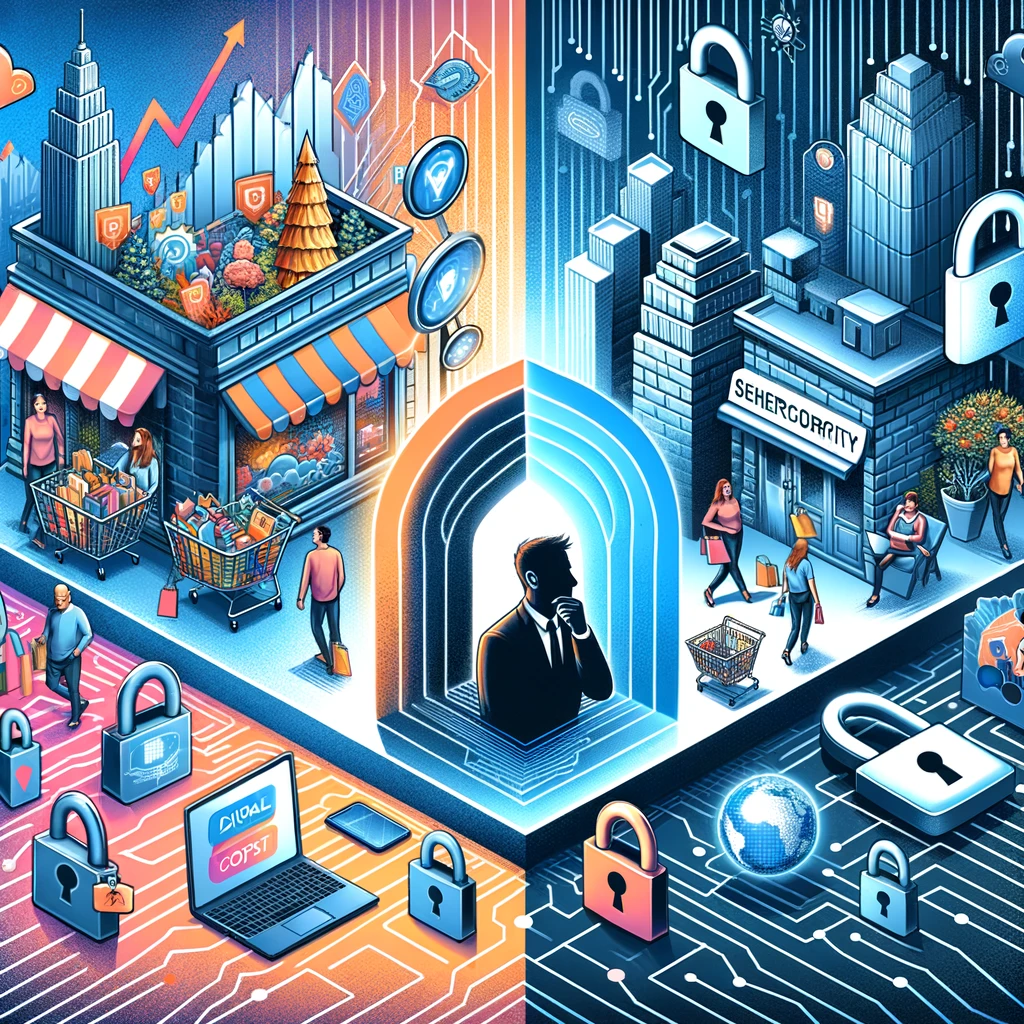
E-commerce ecosystem diagram
Core formulas for analysing e-commerce decisions
1. Total e-commerce cost
A firm should not only count website cost. It should include platform fees, payment fees, delivery, returns, service and security.
\[ \text{Total e-commerce cost} = \text{Platform cost} + \text{Marketing cost} + \text{Payment fees} + \text{Fulfilment cost} + \text{Returns cost} + \text{Security cost} \]
2. Net benefit
The decision is stronger if benefits are compared against costs rather than described separately.
\[ \text{Net benefit} = \text{Total measurable benefits} - \text{Total measurable costs} \]
3. Contribution per online order
This shows whether each order helps cover fixed costs such as website maintenance and digital advertising setup.
\[ \text{Contribution per order} = \text{Selling price} - \text{Variable cost per order} \]
4. Break-even online orders
A business can estimate how many online orders it needs before e-commerce becomes worthwhile.
\[ \text{Break-even orders} = \frac{\text{Fixed e-commerce costs}}{\text{Contribution per order}} \]
5. Conversion rate
Traffic alone is not enough. A website must turn visitors into buyers.
\[ \text{Conversion rate} = \frac{\text{Number of orders}}{\text{Number of website visitors}} \times 100 \]
6. Customer acquisition cost
Online advertising may be expensive if the firm pays for clicks but gains few buyers.
\[ \text{CAC} = \frac{\text{Digital marketing spend}}{\text{Number of new customers acquired}} \]
Interactive e-commerce cost-benefit calculator
Use this simple tool to estimate whether a firm’s e-commerce plan is financially attractive. The result is not an accounting forecast; it is a revision model to help students understand how costs and benefits connect.
Benefits of e-commerce to firms
1. Wider market reach
A physical shop usually depends on people who can travel to that location. An e-commerce store can sell to customers in other towns, regions or countries. This is especially valuable for niche products because the local market may be too small, while the online market may contain enough customers to make the product profitable. A small handmade jewellery business, for example, may not have enough demand in one neighbourhood but may build a loyal customer base through online marketplaces and social media shops.
2. Lower physical-store costs
E-commerce can reduce the need for expensive high-street premises, large display areas and some in-store staff. This does not mean online selling is free. Firms still pay for websites, packaging, warehouse systems, payment processing, customer service and logistics. However, a business that can operate from a smaller warehouse or office may reduce rent and utility costs compared with a traditional store network.
3. 24/7 selling
Online stores can accept orders outside normal opening hours. This can increase convenience for customers and may increase revenue for the firm. A student buying study resources at night or a parent ordering household goods after work can complete the purchase without waiting for a store to open. For firms, this creates the possibility of continuous sales, although customer service and fulfilment still need proper management.
4. Better customer data
E-commerce systems can collect information about search behaviour, abandoned carts, repeat purchases, product preferences and customer reviews. This data helps firms improve stock decisions, promotion, pricing and product recommendations. For example, if a firm sees many customers viewing a product but not buying it, it may test a lower price, clearer photos, better descriptions or free shipping thresholds.
5. More targeted promotion
Online promotion can be targeted by search intent, location, device, interests or previous behaviour. This can make marketing more measurable than traditional mass advertising. A firm can compare ad spend with clicks, conversions and sales. However, targeted promotion is only useful if the firm understands its customers and controls customer acquisition cost.
6. Faster scaling and easier testing
A firm can test new products, prices and promotions quickly online. Instead of printing large catalogues or changing store displays in many locations, it can update a product page, run a small ad campaign or offer a limited online discount. This flexibility helps firms respond to customer feedback and market changes faster.
Costs and problems of e-commerce to firms
| Cost/problem | How it affects the firm | Applied example | Possible control |
|---|---|---|---|
| Website and platform costs | The firm may need to pay for hosting, design, maintenance, marketplace fees, apps and checkout systems. | A clothing start-up may spend heavily on Shopify apps, photography and payment setup before earning enough sales. | Start with a lean store, track conversion and upgrade only when needed. |
| Digital marketing cost | Online competition can make paid ads expensive. A firm may pay for clicks that do not become sales. | A shoe retailer may spend on social ads but lose buyers to cheaper competitors on marketplaces. | Monitor CAC, improve SEO, build email lists and use retargeting carefully. |
| Delivery and fulfilment | Packaging, picking, delivery and tracking add cost and complexity. | A bakery selling cakes online must pay for protective packaging and fast delivery to avoid damage. | Use reliable logistics partners, clear delivery zones and suitable packaging. |
| Returns and refunds | Customers may return goods because they cannot inspect them physically before buying. | Fashion retailers often face high returns due to wrong size, colour or fit expectations. | Use size guides, product videos, accurate photos and clear return policies. |
| Cybersecurity and fraud | Data breaches, fake orders, chargebacks and account attacks can damage trust and increase costs. | A small electronics seller may lose money from fraudulent card transactions or account takeovers. | Use secure payments, two-factor authentication, fraud checks and regular updates. |
| Price transparency | Consumers can compare prices instantly, increasing pressure on margins. | A bookstore may struggle when customers compare prices with global marketplaces. | Differentiate through service, bundles, loyalty, speed or specialist advice. |
| Reputation risk | Negative reviews can spread quickly and reduce trust. | Slow delivery during a sale may trigger public complaints and lower future conversions. | Communicate clearly, resolve complaints quickly and avoid overpromising. |
Strong evaluation: E-commerce is not automatically cheaper. It may reduce store rent but increase logistics, returns, digital advertising and cybersecurity costs. The overall impact depends on product type, customer behaviour, competition, delivery reliability and the firm’s ability to manage data and service quality.
Benefits of e-commerce to consumers
Convenience
Consumers can shop from home, compare products quickly and place orders at any time. This is useful for busy workers, parents, students and people living far from specialist stores.
Wider choice
Online markets often provide access to more brands, sizes, colours, sellers and international products than a local store can stock.
Price comparison
Consumers can compare sellers and read reviews before buying. This can increase competition and may lead to lower prices or better deals.
Reviews and information
Product descriptions, ratings, photos, videos and user reviews can reduce uncertainty when they are accurate and trustworthy.
Home delivery
Delivery saves travel time and can be valuable for bulky goods, remote consumers or people with mobility limitations.
Personalised offers
Consumers may receive recommendations, discounts and reminders based on previous purchases, although this also raises privacy concerns.
Costs and problems of e-commerce to consumers
1. Delivery charges and delays
The advertised product price may look cheap, but delivery fees, taxes or minimum order requirements can increase the final cost. Delivery delays can also reduce consumer satisfaction, especially for urgent purchases such as gifts, medicines, school supplies or replacement parts.
2. Product uncertainty
Consumers cannot always inspect quality, fit, colour, size, texture or durability before buying. Photos can be edited, descriptions may be incomplete, and reviews may not represent every user’s experience. This can lead to disappointment and returns.
3. Privacy and data risks
Online shopping often requires personal details, addresses, payment information and browsing data. Consumers may be concerned about how this information is stored, shared or used for targeted advertising.
4. Fraud and scams
Fake websites, counterfeit goods, phishing messages and fraudulent sellers can harm consumers. The risk is higher when consumers buy from unknown sites without secure payment protection or clear return policies.
5. Return difficulties
Returns may involve printing labels, repackaging items, waiting for courier pickup or paying return postage. Some sellers make refund policies difficult to understand, which creates stress for consumers.
6. Digital exclusion
Not every consumer has reliable internet, digital literacy, a smartphone, online banking or a safe delivery address. If firms move services mainly online, these consumers may face reduced access or higher inconvenience.
Comparison table: firms vs consumers
| Stakeholder | Main benefits | Main costs/risks | Best evaluation point |
|---|---|---|---|
| Firms | Wider reach, lower dependence on physical stores, targeted marketing, customer data, 24/7 ordering, direct selling. | Platform costs, advertising costs, cyber risk, delivery complexity, returns, intense price competition, review pressure. | Benefits are strongest when the product is easy to ship, the website converts visitors well and the firm can control fulfilment costs. |
| Consumers | Convenience, wider choice, easier comparison, access to reviews, home delivery, possible lower prices. | Delivery fees, delays, privacy risk, scams, misleading reviews, difficulty returning goods, inability to inspect items. | Benefits are strongest when the seller is trustworthy, information is accurate and delivery/returns are clear. |
| Society/economy | New business models, digital jobs, easier market entry for small firms, better access in remote areas. | Pressure on high-street stores, packaging waste, delivery emissions, platform dominance and digital divide. | E-commerce growth needs consumer protection, fair competition, data security and sustainable logistics. |
Exam course guide: Cambridge IGCSE Business Studies 0450
Where this topic fits
This topic fits under marketing, especially the impact of technology on the marketing mix. Students should be able to define e-commerce and explain the opportunities and threats of e-commerce to businesses and consumers. It also connects with operations management because online selling changes inventory, delivery, packaging and customer service. It connects with finance because firms must compare additional revenue with additional costs. It connects with external influences because cybersecurity, consumer law, data protection and competition can affect business decisions.
Assessment structure
Cambridge IGCSE Business Studies 0450 uses two externally assessed written papers. Paper 1 is Short Answer and Data Response. Paper 2 is Case Study. Both papers are 1 hour 30 minutes and 80 marks. Each paper assesses the whole syllabus, so e-commerce may appear directly as a marketing question or indirectly inside a case study about growth, promotion, distribution, customer service or international expansion.
Assessment objective weighting
| Objective | Meaning | Qualification weighting |
|---|---|---|
| AO1 | Knowledge and understanding | 40% |
| AO2 | Application to business situations | 20% |
| AO3 | Analysis of information and consequences | 25% |
| AO4 | Evaluation, judgement and recommendation | 15% |
Latest available score threshold reference
| March 2026 combination | Max weighted mark | A* | A | B | C | D | E | F | G |
|---|---|---|---|---|---|---|---|---|---|
| Components 12, 22 | 160 | 100 | 84 | 68 | 53 | 44 | 35 | 26 | 17 |
Thresholds change after each exam series. Use this table as a reference only, not as a fixed prediction for future exams.
Next exam timetable note for Zone 4
For Cambridge IGCSE Business Studies 0450 in Administrative Zone 4, the November 2026 final timetable lists Paper 12 on Tuesday 06 October 2026 in the AM session and Paper 22 on Friday 16 October 2026 in the AM session. The June 2026 Zone 4 timetable listed Paper 12 on Monday 11 May 2026 and Paper 22 on Monday 18 May 2026. Always confirm the final timetable with the school or exam centre because Cambridge may publish updates and exam centres manage local start-time arrangements.
How to answer e-commerce exam questions
Define
A definition answer should be short and precise. Example: “E-commerce is the buying and selling of goods or services online.” This is enough for a simple definition question, but it is not enough for a longer question.
Explain
An explain answer must show why or how. Example: “E-commerce may reduce costs because the firm may not need as many physical stores. This could reduce rent and allow the firm to sell directly to customers through its website.”
Analyse
An analysis answer develops consequences. Example: “If the firm sells online, it may reach customers outside its local area, increasing sales. However, if delivery is expensive or unreliable, customer complaints may rise, damaging repeat purchases and brand image.”
Evaluate
An evaluation answer makes a judgement. Example: “E-commerce is likely to be beneficial for this business if its products are standardised and easy to deliver, because customers will be confident buying without inspection. However, if products are fragile or customised, returns and delivery damage may reduce profitability. Therefore, the firm should start with a limited online range and measure conversion rate, return rate and contribution per order before expanding.”
Model paragraph: 6-mark style answer
One benefit of e-commerce to a firm is that it can reach a wider market because customers can order through a website rather than visiting a physical store. For example, a small clothing business could sell to customers in other cities, increasing potential sales. However, e-commerce may also increase costs because the firm needs to pay for website maintenance, online advertising, delivery and returns. If many customers return clothes because the size is wrong, the firm’s profit margin may fall. Overall, e-commerce is most likely to benefit the firm if it can provide accurate product information, control delivery costs and convert website visitors into repeat customers.
Model paragraph: 8-mark evaluation answer
E-commerce can benefit consumers because it gives them more convenience and choice. They can compare prices, read reviews and buy products at any time without travelling to a shop. This may save time and money, especially if delivery is cheap or free. However, consumers also face costs and risks. They may receive products that look different from the photos, pay unexpected delivery charges or have difficulty returning goods. There is also a risk of fraud or misuse of personal data if the website is not secure. In my judgement, the benefits to consumers are greater when they buy standardised products from trusted sellers with clear reviews and return policies. For expensive, fragile or personalised products, physical stores may still be better because consumers can inspect the item before purchase.
Revision checklist
To secure knowledge marks
- Define e-commerce accurately.
- Know at least four benefits to firms.
- Know at least four costs to firms.
- Know at least four benefits to consumers.
- Know at least four risks to consumers.
To secure analysis and evaluation marks
- Apply each point to the business in the question.
- Explain the consequence for sales, costs, profit, brand image or customer loyalty.
- Use “depends on” factors such as product type, delivery reliability and target market.
- End longer answers with a justified judgement.
- Avoid saying e-commerce is always cheaper or always better.
Practice questions
- Define e-commerce. [2]
- Identify two benefits of e-commerce to consumers. [2]
- Explain one cost of e-commerce to a firm. [3]
- Explain two ways e-commerce could help a small business grow. [6]
- Consider whether a furniture retailer should close some stores and focus more on e-commerce. Justify your answer. [8]
Quick quiz
1. Which is the best definition of e-commerce?
2. Which cost is especially linked with online fashion retail?
3. Which formula measures the percentage of website visitors who buy?
Frequently asked questions
What is e-commerce in simple words?
E-commerce is buying and selling through the internet. It can happen through a website, mobile app, online marketplace, social media shop or digital payment system.
What is the biggest benefit of e-commerce to firms?
The biggest benefit is often wider market reach. Firms can sell beyond their physical location and may attract customers from other regions or countries. However, this benefit only becomes valuable if delivery, payment, customer service and promotion are managed well.
What is the biggest cost of e-commerce to firms?
The biggest cost depends on the business model. Some firms struggle most with digital advertising costs, while others struggle with delivery, returns, cybersecurity or marketplace fees.
How does e-commerce benefit consumers?
Consumers benefit from convenience, wider choice, easier price comparison, online reviews, home delivery and the ability to shop at any time.
What risks do consumers face when shopping online?
Consumers may face fraud, privacy risks, delivery delays, misleading photos or reviews, unexpected delivery costs and difficult return processes.
Is e-commerce always cheaper than physical retail?
No. E-commerce can reduce some costs, such as store rent, but it can increase other costs, such as online advertising, packaging, delivery, returns and cybersecurity.
How should I evaluate e-commerce in an exam answer?
Use a balanced judgement. Explain benefits and costs, apply them to the specific business, and then decide whether e-commerce is suitable based on product type, target market, competition, delivery reliability and expected profitability.