Types of E-commerce: Complete Student Guide, Examples, Formulas, Diagrams & Exam Notes
E-commerce means buying, selling, exchanging, marketing, paying for, or delivering goods and services through digital networks. This page explains every major type of e-commerce in a practical way: B2C, B2B, C2C, C2B, B2G, C2G, D2C, B2B2C, marketplaces, subscriptions, social commerce, mobile commerce, dropshipping, digital products, service platforms, and hybrid models. It is built for students, teachers, founders, and revision users who need clear definitions, real examples, diagrams, formulas, scoring guidance, and exam-ready evaluation.
What Is E-commerce?
E-commerce, or electronic commerce, is the use of digital channels to complete commercial activities. In a simple B2C example, a customer visits a website, chooses a product, pays online, and receives delivery at home. In a B2B example, a retailer uses a supplier portal to order stock in bulk, receive an invoice, and arrange shipment. In a C2C example, one individual sells a used phone to another individual through an online marketplace. The central idea is that the commercial process is partly or fully handled through electronic systems.
E-commerce is not only an online store. It includes online payments, mobile apps, digital marketplaces, social media shops, subscription platforms, cloud software, online booking systems, digital downloads, online courses, food delivery apps, logistics platforms, government procurement portals, creator monetization platforms, and customer support automation. A modern business may combine several types at once. For example, a clothing brand may sell directly to consumers through its own website, list products on a marketplace, sell wholesale to boutiques through a B2B portal, and run live shopping events through social media.
Digital transaction
The transaction can involve physical goods, digital goods, services, subscriptions, data access, advertising, or marketplace matching. The payment may happen online or offline, but the commercial interaction is enabled by digital technology.
Value chain shift
E-commerce changes how firms create demand, manage stock, receive payment, collect data, serve customers, and scale into new markets. It compresses distance, reduces some physical store costs, and increases competition.
Exam evaluation
In exams, strong answers do more than define e-commerce. They compare types, connect them to stakeholders, calculate business performance, and evaluate suitability for a specific business context.
E-commerce Relationship Map
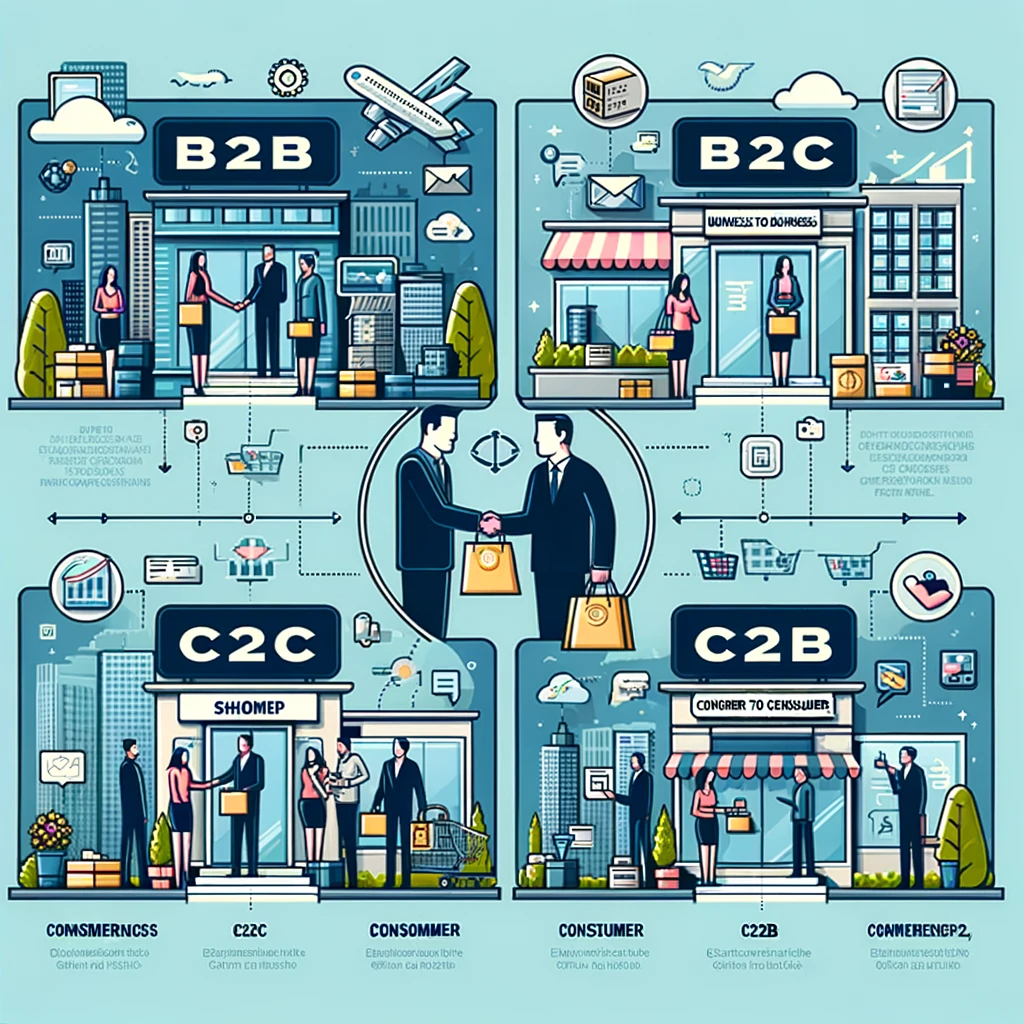
Most e-commerce types are named by identifying who sells and who buys. The common letters are: B for business, C for consumer, and G or A for government or administration. The arrow shows the main direction of value exchange.
The diagram shows the basic transaction directions, but modern e-commerce is usually hybrid. A platform such as a marketplace may enable C2C transactions while operating as a B2C or B2B business. A direct-to-consumer brand may use B2B logistics providers, B2C advertising channels, C2B influencer content, and B2G tax portals in the same operating model. This is why students should learn both the relationship types and the revenue models.
Major Types of E-commerce
Use the filters below to study e-commerce by relationship type, channel type, or operating model. In exam answers, always connect the model to a business objective such as market growth, cost reduction, customer convenience, differentiation, data collection, or improved cash flow.
Business-to-Consumer
B2C e-commerce happens when a business sells directly to individual consumers. Examples include an online fashion store, a grocery delivery app, a streaming subscription, an online course platform, or a restaurant accepting online orders.
B2C is usually driven by branding, user experience, speed, convenience, trust, reviews, payment security, and customer service. The main challenge is high competition because customers can compare prices instantly.
Business-to-Business
B2B e-commerce involves one business selling to another business. Examples include wholesale portals, software as a service, office supply platforms, industrial parts catalogues, cloud hosting, and procurement marketplaces.
B2B orders are often larger, more complex, and more relationship-based than B2C orders. Pricing may be negotiated, credit terms may be offered, and customers may need quotes, purchase orders, invoices, and integration with inventory systems.
Consumer-to-Consumer
C2C e-commerce allows consumers to sell to other consumers. Common examples include used goods marketplaces, auction platforms, resale fashion apps, classified listing sites, and community selling groups.
The platform usually earns from listing fees, commissions, promoted listings, shipping services, buyer protection, or payment processing. Trust, identity verification, dispute resolution, and fraud prevention are crucial.
Consumer-to-Business
C2B e-commerce happens when individuals offer value to businesses. Examples include freelancers selling services, creators licensing content, influencers promoting products, customers selling data insights through research panels, and photographers licensing stock images to companies.
C2B has grown because creators and skilled individuals can now reach business buyers directly. The business benefits from flexible access to talent, while the consumer earns by offering skills, attention, content, or audience access.
Business-to-Government
B2G or B2A e-commerce occurs when businesses sell goods or services to public authorities through digital procurement systems. Examples include construction tenders, IT service contracts, medical supplies, educational technology, consulting services, and office equipment.
B2G requires compliance, documentation, transparent bidding, deadlines, approved vendor registration, and sometimes strict technical standards. Margins may be attractive, but the sales cycle can be slow.
Consumer-to-Government
C2G or C2A includes digital transactions between citizens and government bodies. Examples include online tax filing, traffic fine payments, licence renewals, public service applications, utility payments, and education registration.
It is not always commercial in the normal retail sense, but it is included in e-commerce discussions because payment, records, documents, and service delivery are handled electronically.
Direct-to-Consumer
D2C is a form of B2C where the producer or brand sells directly to customers without relying mainly on wholesalers or traditional retailers. Examples include a skincare brand selling through its own website or a mattress brand shipping directly to households.
D2C gives the brand more control over customer data, pricing, packaging, storytelling, subscriptions, and loyalty. The disadvantage is that the brand must build its own traffic, logistics, customer support, and trust.
Online Marketplace
A marketplace connects multiple sellers with buyers. It may support B2C, B2B, C2C, or mixed transactions. The platform does not always own inventory; it earns through commission, advertising, subscriptions, fulfilment services, or payment fees.
Marketplaces benefit from network effects: more sellers attract more buyers, and more buyers attract more sellers. The challenge is quality control, fake reviews, counterfeit products, seller disputes, and platform dependency.
Subscription Commerce
Subscription commerce charges customers repeatedly for ongoing access or recurring delivery. Examples include streaming services, software, meal kits, learning platforms, beauty boxes, cloud storage, and membership communities.
The key benefit is predictable recurring revenue. The key risk is churn, which means customers cancel. Businesses must keep improving value, content, service, and personalization to maintain retention.
Mobile Commerce
M-commerce means e-commerce through mobile devices. It includes shopping apps, mobile websites, QR code payments, wallet payments, mobile banking, in-app purchases, and location-based offers.
Mobile commerce is important because customers often discover, compare, pay, track, and review products on the same device. A slow or poorly designed mobile experience can reduce conversion rate.
Social Media Commerce
Social commerce uses social platforms to discover, promote, discuss, and sometimes complete purchases. Examples include shoppable posts, livestream selling, creator storefronts, influencer affiliate links, and direct checkout inside social apps.
Social commerce is powerful because it blends entertainment, trust, community, and shopping. However, it can create dependence on algorithms and may require constant content production.
Dropshipping
Dropshipping is an e-commerce model where the seller takes the customer order but a third-party supplier stores and ships the product. The seller focuses on marketing and customer acquisition while the supplier handles fulfilment.
It reduces inventory risk, but it can create weak quality control, long delivery times, low margins, and customer service problems. In exams, do not present dropshipping as automatically easy; evaluate it against brand trust and operational reliability.
Digital Product Commerce
Digital product commerce sells non-physical items such as templates, e-books, online courses, stock photos, software, music, designs, printables, and research reports.
The advantage is low marginal cost after production. Once created, the product can be delivered instantly to many customers. The main risks are piracy, low perceived value, refund abuse, and the need for strong differentiation.
Business-to-Business-to-Consumer
B2B2C occurs when one business reaches final consumers through another business partner while still influencing the customer experience. For example, a payment provider, logistics company, food platform, or embedded insurance service may serve the customer through a partner’s digital interface.
B2B2C can scale quickly through partnerships, but it requires clear control over branding, customer data, service standards, and revenue sharing.
Revenue Models Used in E-commerce
A type of e-commerce explains who trades with whom. A revenue model explains how the business earns money. The same e-commerce type can use different revenue models. For example, a B2C platform may earn from subscriptions, product margins, advertising, delivery fees, or affiliate commissions.
| Revenue Model | How It Works | Best For | Main Risk |
|---|---|---|---|
| Product margin | Buy or produce at one cost and sell at a higher price. | Retail, D2C brands, physical goods. | Inventory risk, price competition, returns. |
| Commission / take rate | Platform takes a percentage of each transaction. | Marketplaces, delivery apps, freelance platforms. | Seller dissatisfaction, disintermediation. |
| Subscription | Customer pays a recurring fee. | SaaS, content, courses, memberships, replenishment products. | Churn and content fatigue. |
| Advertising | Platform sells attention, impressions, clicks, or sponsored placements. | Large traffic sites, social commerce, marketplaces. | Weak user trust if ads dominate experience. |
| Freemium | Basic access is free; advanced features are paid. | Software, learning apps, creator tools. | Too many free users and low conversion to paid plans. |
| Affiliate | Earn commission for referring customers to another seller. | Blogs, influencers, comparison websites. | Dependence on third-party terms and attribution rules. |
| Transaction fee | Charge a small fixed or percentage fee for payment or processing. | Payment platforms, booking platforms, ticketing systems. | Regulation, fraud, and low-margin scale requirements. |
A strong e-commerce strategy often combines models. A marketplace can earn commission, charge sellers for promoted listings, offer fulfilment services, provide premium subscriptions, and sell data analytics to sellers. This improves revenue diversification but also increases complexity.
Important E-commerce Formulas
Quantitative analysis makes an e-commerce answer stronger. Use MathJax-rendered formulas to evaluate performance, not just describe models.
Conversion Rate
Conversion rate measures how effectively traffic becomes customers. A high traffic website with a weak conversion rate may have poor product-market fit, slow checkout, weak trust signals, high prices, unclear delivery policy, or poor mobile design.
Average Order Value
AOV shows how much customers spend per order. Businesses improve AOV through bundles, free-shipping thresholds, cross-selling, upselling, subscriptions, and personalized recommendations.
Gross Merchandise Value
GMV is common for marketplaces because it measures the total value of transactions flowing through the platform. It is not the same as revenue because the platform may only keep a commission.
Marketplace Revenue
If a marketplace handles \( \$1{,}000{,}000 \) in GMV and charges a 10% take rate, its marketplace revenue is \( \$100{,}000 \).
Customer Acquisition Cost
CAC is vital because many e-commerce businesses fail when advertising costs rise faster than profit per customer. A business needs enough margin, repeat purchase, or lifetime value to recover CAC.
Customer Lifetime Value
CLV estimates the value of a customer over time. Subscription, loyalty, and repeat-purchase models focus heavily on increasing CLV.
Break-even Quantity
E-commerce may reduce some fixed costs compared with a physical store, but it can add technology costs, fulfilment costs, payment fees, returns processing, customer support costs, and advertising costs.
Return on Ad Spend
ROAS measures advertising efficiency. A ROAS of 4 means every 1 unit spent on ads generated 4 units of revenue. Profitability still depends on margin, fulfilment cost, refunds, and overheads.
Interactive E-commerce KPI Calculator
Use this mini-tool to estimate basic e-commerce performance. It is useful for classroom examples, case-study analysis, and quick business planning. Enter your own values and the results will update instantly.
How Each E-commerce Type Changes Business Strategy
E-commerce is a strategic choice, not only a technical channel. The type chosen affects operations, marketing, finance, human resources, legal compliance, data management, and brand positioning. A small handmade jewellery business choosing D2C must build a brand story, social proof, packaging, payment systems, fulfilment, and customer service. A manufacturer choosing B2B e-commerce must build catalogues, account pricing, quote management, inventory visibility, and integration with buyers’ procurement processes. A marketplace must build trust on both sides of the platform and balance seller supply with buyer demand.
Marketing impact
E-commerce increases the importance of search visibility, product photography, reviews, user-generated content, email automation, retargeting, social media, influencer partnerships, and conversion-focused design. The marketing mix changes because the place of sale becomes digital and the promotion channel may also become the transaction channel.
Operations impact
Operations must handle inventory accuracy, picking, packing, shipping, returns, fraud checks, delivery tracking, and customer support. Fast delivery can become a competitive advantage, but it can also increase cost and environmental pressure.
Finance impact
Online businesses must manage payment fees, chargebacks, refunds, advertising spend, platform commissions, software subscriptions, logistics costs, and tax compliance. Strong financial analysis uses contribution margin, break-even, cash flow, and customer lifetime value.
Human resources impact
E-commerce requires skills in digital marketing, analytics, product management, UX design, cybersecurity, fulfilment, content creation, customer support, and data protection. Businesses may need to retrain staff or hire specialists.
Advantages of e-commerce
- Wider reach: A business can sell beyond its local area and enter new markets more easily.
- Convenience: Customers can browse, compare, order, pay, and track delivery without visiting a physical store.
- Data collection: Businesses can measure behaviour, personalize offers, and improve decisions with analytics.
- Lower physical store dependency: Some businesses reduce rent, store staff, and location limitations.
- Scalability: Digital systems can process many more orders if operations and infrastructure are designed well.
Disadvantages and risks
- High competition: Customers can compare alternatives quickly, which can reduce pricing power.
- Cybersecurity risk: Data breaches, payment fraud, phishing, and account takeover can damage trust.
- Delivery and return costs: Logistics can become expensive, especially for bulky, fragile, or frequently returned products.
- Platform dependency: Sellers using marketplaces or social platforms may be exposed to algorithm changes, fees, and policy shifts.
- Trust barriers: New online sellers must prove legitimacy through reviews, secure payment, clear policies, and reliable service.
Course Alignment: Business Studies, Commerce & IB Business Management
The topic types of e-commerce connects strongly with business studies because it combines marketing, operations, finance, technology, ethics, sustainability, and strategy. In IB Business Management, the topic can support discussions around marketing planning, the seven Ps, market research, costs and revenues, sources of finance, cash flow, operations methods, management information systems, innovation, and stakeholder impact. It is also relevant for GCSE, IGCSE, AP-style business courses, entrepreneurship units, commerce courses, ICT business applications, and digital marketing courses.
| Course Area | How E-commerce Connects | Possible Exam Focus |
|---|---|---|
| Marketing | Online promotion, social commerce, SEO, email marketing, influencer marketing, pricing transparency, customer journey. | Evaluate whether a business should sell through its own website, marketplace, or social platform. |
| Operations | Inventory, logistics, fulfilment, returns, quality control, delivery speed, automation. | Analyse how e-commerce affects costs, efficiency, customer satisfaction, and capacity. |
| Finance | Revenue models, payment fees, cash flow, break-even, contribution, advertising cost, subscription income. | Calculate conversion rate, AOV, ROAS, break-even, and evaluate profitability. |
| Human Resources | Digital skills, remote customer support, warehouse staffing, training, performance analytics. | Discuss how digital transformation changes workforce planning. |
| Ethics & Sustainability | Data privacy, fair platform policies, packaging waste, delivery emissions, labour conditions, digital inclusion. | Evaluate whether growth through e-commerce is socially responsible. |
Exam Guidelines, Score Table & Next Exam Timetable
IB Business Management May 2026 timetable note
For students using this topic for IB Business Management revision, the official May 2026 IB schedule lists Business Management HL/SL Paper 1 and HL Paper 3 on Wednesday 29 April 2026, and Business Management HL/SL Paper 2 on Thursday 30 April 2026. Schools must still confirm the local exam zone and official start time with their IB coordinator.
| Assessment | Level | Time | Main Skill | How E-commerce May Appear |
|---|---|---|---|---|
| Paper 1 | SL & HL | 1 hour 30 minutes | Case-study analysis and evaluation | Impact of online sales, business growth, stakeholders, strategy, or digital transformation. |
| Paper 2 | SL | 1 hour 30 minutes | Stimulus material and quantitative analysis | Calculating costs, revenue, break-even, cash flow, marketing results, or operational impact. |
| Paper 2 | HL | 1 hour 45 minutes | Stimulus material and extended business analysis | Evaluating whether a business should adopt D2C, marketplace, subscription, or B2B portal strategy. |
| Paper 3 | HL only | 1 hour 15 minutes | Social enterprise, human needs, challenges, and action plan | Digital platforms, access, social impact, stakeholder needs, ethical growth, and implementation risks. |
| Internal Assessment | SL & HL | Coursework | Research project about a real business issue | Investigating whether a real business should launch, improve, or change an e-commerce model. |
Practice score guide for e-commerce answers
Official grade boundaries vary by session and subject component, so the table below is a practical revision guide rather than an official boundary table. Use it to improve answer quality.
| Practice Score Band | Answer Quality | What the Student Does | How to Improve |
|---|---|---|---|
| 1–2 | Basic recall | Defines one type such as B2C but gives little application. | Add examples and connect to the case business. |
| 3–4 | Some understanding | Explains advantages or disadvantages but remains general. | Use business terminology and compare at least two types. |
| 5–6 | Applied analysis | Connects e-commerce to stakeholders, costs, revenue, operations, or marketing. | Add data, formulas, and balanced evaluation. |
| 7–8 | Strong analysis | Uses case evidence, quantitative measures, and considers limitations. | Make the judgement more explicit and prioritize factors. |
| 9–10 | Excellent evaluation | Gives a justified recommendation based on context, stakeholders, risks, and long-term impact. | Maintain concise structure and avoid unsupported claims. |
Exam answer structure
Example 6–10 mark question
Question: Evaluate whether a small handmade candle business should sell through a marketplace or develop its own D2C website.
Strong answer direction: A marketplace gives instant access to customers, built-in trust, payment systems, and search traffic, which may help a small business grow quickly. However, the business may face commission fees, price competition, limited customer data, and dependence on platform rules. A D2C website gives stronger brand control, customer data, and margin potential, but it requires investment in traffic, website maintenance, payment security, delivery systems, and customer support. The best recommendation may be a staged strategy: begin with a marketplace to test demand, then build a D2C website once repeat customers, brand identity, and cash flow improve.
How to Choose the Right E-commerce Type
The best e-commerce model depends on the product, customer, resources, risk tolerance, and growth target. Use the process below for business planning or exam evaluation.
Identify the buyer
Decide whether the buyer is a consumer, business, government, or platform partner. This determines whether the core relationship is B2C, B2B, B2G, C2C, C2B, or a hybrid model.
Match the product
Physical products need fulfilment and returns. Digital products need protection and instant delivery. Services need booking, communication, trust, and proof of expertise.
Choose the channel
Compare website, marketplace, mobile app, social commerce, wholesale portal, or government procurement portal. The channel should match customer behaviour.
Test the numbers
Estimate conversion rate, AOV, CAC, gross margin, ROAS, shipping cost, platform fees, and break-even. A model that looks attractive may fail if customer acquisition is too expensive.
Assess risk
Consider cybersecurity, privacy, fraud, delivery reliability, returns, payment disputes, counterfeit products, platform dependency, and legal compliance.
Build gradually
Start with the simplest viable model, collect evidence, improve operations, then scale. Many businesses use marketplace testing before investing heavily in a custom e-commerce platform.
Decision matrix
| Business Situation | Most Suitable Model | Reason | Warning |
|---|---|---|---|
| New brand with limited traffic | Marketplace + social commerce | Access to existing audiences and faster demand testing. | Commission fees and platform dependency. |
| Established brand with loyal customers | D2C website + subscription | Better margins, data ownership, and repeat revenue. | Requires strong fulfilment and customer support. |
| Manufacturer selling bulk orders | B2B portal | Supports bulk pricing, invoices, repeat orders, and account management. | Long sales cycle and integration complexity. |
| Creators or freelancers selling skills | C2B platform | Connects individual talent with business demand. | Income may be unstable and competition can be global. |
| Used goods or community resale | C2C marketplace | Enables peer-to-peer exchange and circular economy benefits. | Trust, scams, disputes, and quality control. |
Extended Examples for Revision
Example 1: Local bakery moving online
A local bakery may start with B2C e-commerce by allowing customers to pre-order cakes through a website or mobile app. The benefit is improved convenience and better production planning because the bakery knows demand before baking. It can also collect customer data for birthday reminders, loyalty offers, and seasonal campaigns. However, the bakery must manage delivery timing, product freshness, payment security, and customer complaints. If the bakery sells through a delivery marketplace, it may gain visibility but lose margin due to commission fees.
Example 2: Industrial supplier launching a B2B portal
An industrial supplier may use B2B e-commerce to allow factories, contractors, and retailers to place repeat orders online. The system can show stock levels, technical specifications, credit limits, order history, and invoice documents. This can reduce administrative work and errors. However, the supplier must invest in accurate product data, account security, integration with warehouse systems, and customer training. B2B buyers may still expect personal relationship management for large or complex purchases.
Example 3: Student marketplace for used textbooks
A school or community could create a C2C marketplace for students to sell used textbooks. This supports affordability and sustainability because books are reused. The platform may charge a small listing fee or operate free as a community service. The main risks are inaccurate descriptions, payment disputes, fake listings, and safety concerns during exchange. The platform needs moderation, clear rules, and possibly school-approved pickup points.
Example 4: AI software sold through subscription
A software company may use a subscription e-commerce model where users pay monthly for access to AI writing, analytics, or design tools. The strength of this model is predictable revenue and the ability to improve the product continuously. The weakness is churn: customers may cancel if they do not see ongoing value. The company should track activation rate, retention, support tickets, product usage, and customer lifetime value.
Frequently Asked Questions
What are the main types of e-commerce?
The main relationship types are B2C, B2B, C2C, C2B, B2G, and C2G. Modern models also include D2C, B2B2C, marketplaces, subscription commerce, social commerce, mobile commerce, dropshipping, and digital product commerce.
Is D2C the same as B2C?
D2C is a specific form of B2C. In B2C, any business sells to consumers. In D2C, the brand or producer sells directly to consumers rather than relying mainly on wholesalers, distributors, or traditional retailers.
Which e-commerce type is best for a new business?
There is no single best type. A new brand with little traffic may start with a marketplace or social commerce to test demand. A brand with a strong audience may prefer D2C. A supplier selling in bulk may need B2B e-commerce. The best choice depends on product, customer, budget, logistics, and growth goals.
What is the difference between marketplace and dropshipping?
A marketplace connects buyers and sellers, often without owning the products. Dropshipping is a fulfilment model where the seller accepts the order but a third-party supplier stores and ships the product. A marketplace can include dropshipping sellers, but the two ideas are not identical.
What formulas should students know for e-commerce?
Useful formulas include conversion rate, average order value, gross merchandise value, marketplace revenue, customer acquisition cost, customer lifetime value, break-even quantity, gross margin, and return on ad spend.
How can e-commerce appear in a business exam?
E-commerce may appear as a strategy question, case-study recommendation, marketing channel decision, operations challenge, finance calculation, stakeholder analysis, ethics issue, or digital transformation evaluation.
Source Notes & Update Log
Updated for RevisionTown: May 2026. Exam and course references checked against official International Baccalaureate Business Management subject brief and May 2026 examination schedule. Market context checked against public e-commerce statistics from official and trade sources such as U.S. Census Bureau, International Trade Administration, and UN Trade and Development.
Always confirm official exam dates, local exam zone times, and current syllabus requirements with the relevant examination board or school coordinator. This page is an educational revision resource, not an official exam-board publication.