
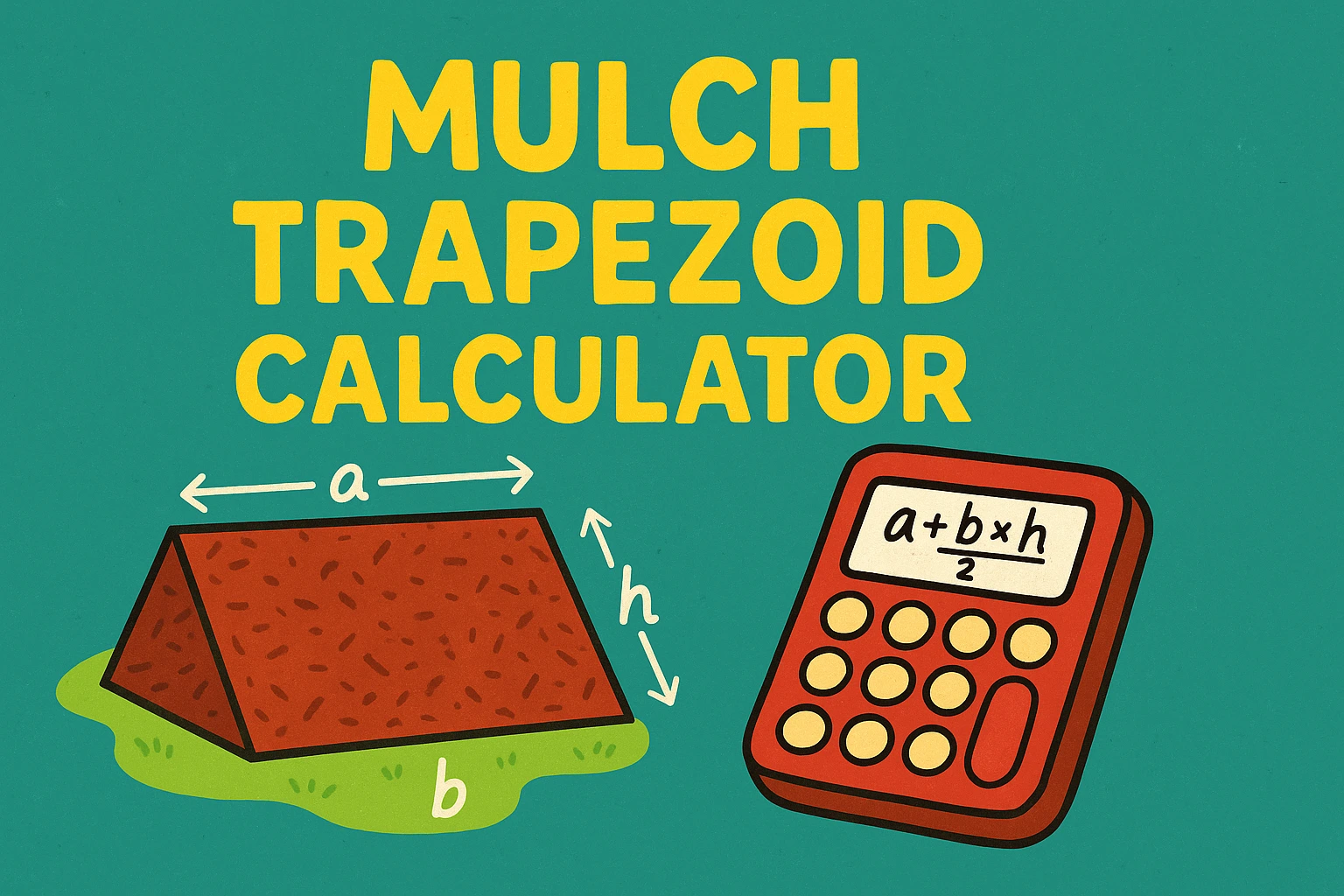
Mulch Trapezoid Calculator: Calculate Mulch for Trapezoidal Garden Beds
A mulch trapezoid calculator is a specialized landscaping tool that accurately computes the volume of mulch, compost, or soil amendments needed to cover trapezoidal garden beds, raised planters, and uniquely shaped landscape features. By inputting the trapezoid's parallel sides, height, and desired mulch depth, this calculator instantly determines cubic yards, cubic feet, bags required, and cost estimates for any four-sided shape with two parallel sides—commonly found in sloped yards, terraced gardens, corner beds, and modern geometric landscape designs—ensuring proper coverage, moisture retention, and aesthetic appeal while optimizing material ordering.
⬛ Interactive Mulch Trapezoid Calculator
Calculate mulch needed for your trapezoidal garden bed
Understanding Trapezoid Measurements
A trapezoid has two parallel sides (bases) and a perpendicular height between them
Step 1: Enter Trapezoid Dimensions
Step 2: Mulch Specifications
Understanding Trapezoid Area Calculations
A trapezoid (or trapezium) is a quadrilateral with exactly one pair of parallel sides. Calculating mulch for trapezoidal beds requires first determining the trapezoid's area using its geometric formula.
Trapezoid Area Formula
The area of a trapezoid is calculated by averaging the lengths of the two parallel sides (bases) and multiplying by the perpendicular height between them.
Trapezoid Area Formula:
\[ A = \frac{(b_1 + b_2)}{2} \times h \]
Where:
\[ A = \text{Area (square feet or square meters)} \]
\[ b_1 = \text{Length of first base (longer parallel side)} \]
\[ b_2 = \text{Length of second base (shorter parallel side)} \]
\[ h = \text{Height (perpendicular distance between bases)} \]
Alternative Formula Representation
Equivalent Form:
\[ A = \frac{1}{2}(b_1 + b_2) \times h \]
This shows the area equals half the sum of bases times height
Basic Trapezoid Area Example:
Given: Trapezoid with bases 12 feet and 8 feet, height 6 feet
Step 1 - Apply formula:
\[ A = \frac{(12 + 8)}{2} \times 6 \]
Step 2 - Calculate:
\[ A = \frac{20}{2} \times 6 = 10 \times 6 = 60 \text{ square feet} \]
Important Measurement Notes
- Parallel sides: The two bases must be parallel to each other
- Height measurement: Height must be perpendicular (90°) to both bases, not diagonal
- Base identification: Doesn't matter which base is called b₁ or b₂—result is the same
- Irregular trapezoids: Formula works for any trapezoid regardless of leg angles
Volume Calculation for Mulch
Once the trapezoidal area is determined, calculate mulch volume by multiplying area by the desired depth of coverage.
Volume Formula
Mulch Volume Calculation:
\[ V = A \times D \]
Where:
\[ V = \text{Volume (cubic feet)} \]
\[ A = \text{Trapezoid area (square feet)} \]
\[ D = \text{Depth in feet (convert inches to feet by dividing by 12)} \]
Unit Conversions
Common Volume Conversions:
\[ \text{Cubic Yards} = \frac{\text{Cubic Feet}}{27} \]
\[ \text{Bags Needed} = \frac{\text{Cubic Feet}}{\text{Bag Size (cu ft)}} \]
Always round up bags to ensure complete coverage
Complete Calculation Example
Real-World Example: Trapezoidal Raised Bed
Project Specifications:
- Base 1 (longer): 15 feet
- Base 2 (shorter): 10 feet
- Height: 8 feet
- Mulch Depth: 3 inches
- Bag Size: 2 cubic feet
- Price: $4.50 per bag
Step 1 - Calculate Trapezoid Area:
\[ A = \frac{(15 + 10)}{2} \times 8 = \frac{25}{2} \times 8 = 12.5 \times 8 = 100 \text{ square feet} \]
Step 2 - Convert Depth to Feet:
\[ D = \frac{3 \text{ inches}}{12} = 0.25 \text{ feet} \]
Step 3 - Calculate Volume:
\[ V = 100 \times 0.25 = 25 \text{ cubic feet} \]
Step 4 - Convert to Cubic Yards:
\[ \text{Cubic Yards} = \frac{25}{27} = 0.93 \text{ yd}^3 \]
Step 5 - Calculate Bags Needed:
\[ \text{Bags} = \frac{25}{2} = 12.5 \rightarrow \text{Round up to 13 bags} \]
Step 6 - Calculate Total Cost:
\[ \text{Cost} = 13 \times \$4.50 = \$58.50 \]
Common Trapezoidal Bed Applications
Where Trapezoids Occur in Landscaping
- Sloped yards: Beds follow natural terrain contours, creating trapezoid shapes
- Corner plantings: Wedge-shaped corner beds often form trapezoids
- Terraced gardens: Individual terrace levels frequently have trapezoidal footprints
- Modern geometric designs: Contemporary landscaping uses angular, non-rectangular shapes
- Property line beds: Following angled fences or property boundaries
- Driveway borders: Beds alongside curved or angled driveways
Recommended Mulch Depths for Trapezoid Beds
| Application | Recommended Depth | Purpose |
|---|---|---|
| Annual Flower Beds | 2-3 inches | Moisture retention, weed control |
| Perennial Gardens | 2-4 inches | Year-round protection, aesthetics |
| Shrub Beds | 3-4 inches | Root insulation, weed suppression |
| Vegetable Gardens | 2-3 inches | Soil temperature regulation |
| Slopes/Erosion Control | 3-5 inches | Prevent soil washout, stabilize |
| Decorative Features | 2-3 inches | Visual appeal, color contrast |
Mulch Types and Selection
Organic Mulch Options
| Mulch Type | Coverage per Bag (2 cu ft) | Longevity | Best For |
|---|---|---|---|
| Shredded Hardwood | 8 sq ft at 3" depth | 2-3 years | General landscaping, perennials |
| Pine Bark | 8 sq ft at 3" depth | 2-3 years | Decorative beds, slopes |
| Cedar Mulch | 8 sq ft at 3" depth | 3-4 years | Insect-resistant areas |
| Pine Straw | 12 sq ft at 3" depth | 1-2 years | Acid-loving plants, slopes |
| Compost | 8 sq ft at 3" depth | 6-12 months | Vegetable gardens, enrichment |
Coverage Formula per Bag
Square Feet Coverage per Bag:
\[ \text{Coverage} = \frac{\text{Bag Size (cu ft)}}{\text{Depth (feet)}} \]
Example: 2 cu ft bag at 3" (0.25 ft) depth
\[ \text{Coverage} = \frac{2}{0.25} = 8 \text{ square feet} \]
Installation Best Practices for Trapezoid Beds
Professional Installation Steps:
- Measure accurately: Mark all four corners with stakes; verify parallel sides
- Clear the area: Remove weeds, grass, old mulch, and debris
- Level if needed: Grade sloped trapezoidal beds for better water distribution
- Install edging: Define trapezoid borders with landscape edging or natural stone
- Apply landscape fabric: Cut to trapezoid shape, overlap seams by 6 inches
- Create plant clearance: Keep mulch 2-3 inches away from stems and trunks
- Distribute mulch evenly: Start at one parallel side, work toward the other
- Rake smooth: Ensure uniform depth across entire trapezoid
- Water lightly: Settle mulch and reduce wind displacement
Special Considerations for Trapezoidal Beds
Sloped Trapezoids
Trapezoidal beds on slopes require special attention to prevent mulch washout and erosion.
- Extra depth: Add 1 inch more mulch on slopes to compensate for settling
- Erosion fabric: Use heavy-duty landscape fabric underneath
- Cross-barriers: Install horizontal boards or rocks across slope to catch mulch
- Heavier mulch: Use larger bark chunks rather than fine shredded mulch
- Terracing: Consider breaking steep trapezoids into stepped levels
Measuring Height Correctly
⚠️ Common Measurement Error
Critical: Height must be perpendicular, not diagonal!
The height of a trapezoid is the shortest distance between the two parallel sides (bases), measured at a right angle (90°) to both. Do not measure along the slanted sides—this gives an incorrect, larger measurement.
Correct Method:
- Place a tape measure perpendicular to one base
- Extend straight across to the opposite parallel base
- This perpendicular distance is the true height
Cost Estimation and Budget Planning
Mulch Pricing Guide
| Purchase Method | Typical Price Range | Best For |
|---|---|---|
| Bagged (2 cu ft) | $3-$6 per bag | Small trapezoidal beds (<150 sq ft) |
| Bagged (3 cu ft) | $4-$8 per bag | Medium projects (150-300 sq ft) |
| Bulk (cubic yard) | $25-$50 per yard | Large beds (>300 sq ft) |
| Delivery Fee | $50-$100 | Bulk orders (3+ cubic yards) |
Bulk vs. Bagged Decision
Break-Even Calculation:
\[ \text{Bags per Yard} = \frac{27 \text{ cu ft}}{2 \text{ cu ft/bag}} = 13.5 \text{ bags} \]
If bagged mulch costs $4.50/bag:
\[ 13.5 \times \$4.50 = \$60.75 \text{ per cubic yard (bagged)} \]
If bulk costs $35/yard + $75 delivery for 3 yards:
\[ \frac{(3 \times \$35) + \$75}{3} = \$58.33 \text{ per yard (bulk)} \]
Maintenance and Replenishment
Annual Mulch Needs
Organic mulch decomposes and settles over time, requiring periodic replenishment.
- Year 1: Full initial depth (2-4 inches as recommended)
- Year 2: Add 1-2 inches to refresh appearance and maintain depth
- Year 3: Add 1-2 inches; some decomposition enriches soil
- Every 3-4 years: Consider removing old mulch and starting fresh
Maintenance Tasks
- Spring refresh: Fluff and redistribute settled mulch
- Edge redefining: Maintain clean trapezoid borders
- Weed removal: Pull weeds promptly before they establish
- Slope check: Redistribute mulch that has washed downhill
- Replenishment: Add new mulch to maintain proper depth
Benefits of Mulching Trapezoid Beds
Functional Advantages
- Water conservation: Reduces evaporation by 25-50%, lowering irrigation needs
- Weed suppression: Blocks sunlight, preventing weed seed germination
- Soil temperature moderation: Keeps roots cooler in summer, warmer in winter
- Erosion prevention: Particularly important for sloped trapezoidal beds
- Soil improvement: Organic mulches decompose, adding nutrients and organic matter
- Disease prevention: Reduces soil splash onto plant leaves
Aesthetic Benefits
- Clean appearance: Uniform mulch creates finished, professional look
- Color contrast: Highlights geometric trapezoid shape in landscape design
- Defines spaces: Clearly separates planting areas from lawn or hardscape
- Modern appeal: Complements contemporary angular garden designs
📝 About the Author
Adam Kumar
Co-Founder at RevisionTown
Adam is a mathematics expert specializing in diverse international curricula including IB (International Baccalaureate), AP (Advanced Placement), GCSE, IGCSE, and various national education systems. With extensive expertise in geometric calculations, particularly area formulas for polygons including trapezoids, Adam develops practical educational tools that help students, homeowners, and landscaping professionals apply mathematical principles to real-world projects including garden bed planning, material estimation, and space optimization in landscape architecture.
Connect with Adam:
🔗 LinkedIn: linkedin.com/in/kumar-k-87346a153
📧 Email: info@revisiontown.com
🌐 RevisionTown: Comprehensive educational resources combining theoretical mathematics with practical calculation tools for IB, AP, GCSE, IGCSE, and everyday applications
"At RevisionTown, we believe mathematical literacy transforms abstract geometric concepts into practical life skills. Our calculators help individuals confidently apply trapezoid area formulas and volumetric calculations to landscaping projects, ensuring accurate material estimation and beautiful, well-planned outdoor spaces."
Frequently Asked Questions
How do I calculate mulch for a trapezoidal bed?
Calculate the trapezoid area using the formula: Area = [(Base 1 + Base 2) ÷ 2] × Height. Then multiply by mulch depth in feet. For example: trapezoid with 12-foot and 8-foot bases, 6-foot height, 3-inch depth: [(12 + 8) ÷ 2] × 6 = 60 sq ft × 0.25 ft = 15 cubic feet ÷ 2 cu ft bags = 8 bags needed. Use the calculator above for instant results.
What's the difference between a trapezoid and a parallelogram?
A trapezoid has exactly one pair of parallel sides (the two bases), while a parallelogram has two pairs of parallel sides. Trapezoids are common in landscaping for corner beds, sloped areas, and geometric designs. The trapezoid formula specifically uses the two parallel sides and perpendicular height between them, different from parallelogram calculations.
How do I measure the height of a trapezoid bed correctly?
The height must be the perpendicular (90-degree) distance between the two parallel sides, not along the slanted edges. Place a tape measure at a right angle to one base and extend straight across to the opposite parallel base. This shortest distance is the true height. Measuring along the angled sides gives an incorrect, larger measurement that will overestimate your mulch needs.
How many bags of mulch do I need for a trapezoid?
First calculate cubic feet needed: trapezoid area (in square feet) × depth (in feet). Then divide by bag size (typically 2 or 3 cubic feet) and round up. For a 50-square-foot trapezoid at 3-inch depth: 50 × 0.25 = 12.5 cubic feet ÷ 2 = 6.25, round up to 7 bags. Always purchase one extra bag for edges and settling.
Can I use the same mulch depth for sloped trapezoidal beds?
Add 1 inch extra mulch on sloped trapezoidal beds to account for settling and potential washout. For standard 3-inch depth, use 4 inches on slopes. Also choose heavier mulch (large bark chunks) rather than fine shredded types, install landscape fabric, and consider cross-barriers to prevent erosion. Sloped beds require more attention to maintain even coverage.
Should I buy bulk or bagged mulch for my trapezoid bed?
Bagged mulch works well for small to medium trapezoidal beds under 300 square feet or projects needing less than 1-2 cubic yards. Bulk mulch becomes more economical for larger areas despite delivery fees. Calculate your needs first: if you need 14+ bags (roughly 1 cubic yard), bulk delivery typically saves money. Bagged offers convenience for smaller geometric beds without requiring wheelbarrow transport.
Key Takeaways
Calculating mulch for trapezoidal garden beds requires understanding trapezoid geometry and applying the area formula that averages the two parallel sides and multiplies by perpendicular height. Accurate measurement ensures proper material ordering and successful landscaping results for these unique geometric beds.
Essential principles to remember:
- Trapezoid area = [(Base 1 + Base 2) ÷ 2] × Height (perpendicular between bases)
- Height must be perpendicular to both bases, not measured along slanted sides
- Multiply area by depth in feet to get volume in cubic feet
- Divide cubic feet by 27 for cubic yards, or by bag size for bags needed
- Recommended depth: 2-3 inches for most beds, 3-5 inches for slopes
- Add 1 inch extra mulch on sloped trapezoidal beds for erosion control
- Always round up bag quantities to ensure complete coverage
- Keep mulch 2-3 inches away from plant stems and tree trunks
Getting Started: Use the interactive mulch trapezoid calculator at the top of this page to determine exactly how much mulch you need for your trapezoidal garden bed. Enter both parallel base measurements, the perpendicular height between them, and your desired mulch depth for instant results in cubic feet, cubic yards, bags needed, and estimated cost. Verify measurements carefully—perpendicular height is crucial for accurate calculations.